



What if you could turn your million-dollar startup idea into a working product without spending hundreds of thousands of dollars? That's exactly why building a Minimum Viable Product (MVP) has become one of the smartest moves for startups in 2027.
Let's say you have a great business idea. You want to turn it into an app, attract users, and slowly transform it into a profitable enterprise.
However, you have a big question before you start: What is the actual cost of developing this app? Is it better to spend $20,000, $50,000, or even $100,000? Most importantly, what happens if you spend all that money creating an app that users are not actually interested in using?
An MVP can help in this situation. You begin with a basic, functional version that solves your customers' main issue rather than creating a full product with many features. You launch it, get user feedback, find out which features people really use, and then make changes based on what your customers actually need.
But a key point that many entrepreneurs miss is that creating an MVP in 2027 requires more than just hiring developers to write code. Market research, product planning, UI/UX design, frontend and backend development, third-party integrations, testing, security, app launch, and post-launch support are just a few of the many extra costs you need to consider.
For example, your app might require features like customer registration, restaurant listings, food ordering, payment options, and simple order tracking if you are launching a food delivery business. Every new feature increases the project's scope and requires more development work. This results in an increase in the total number of development hours, which increases the total cost of developing your MVP.
Building an MVP is getting easier in many ways as 2027 approaches. Founders now have more options to develop and test their ideas because of low-code platforms, reusable components, ready-to-use cloud services, and AI coding tools.
Faster development does not, however, guarantee that your MVP will be less expensive or provide better outcomes. To make the best choices for software design, security, third-party integrations, and overall product quality, you still need skilled and senior specialists.
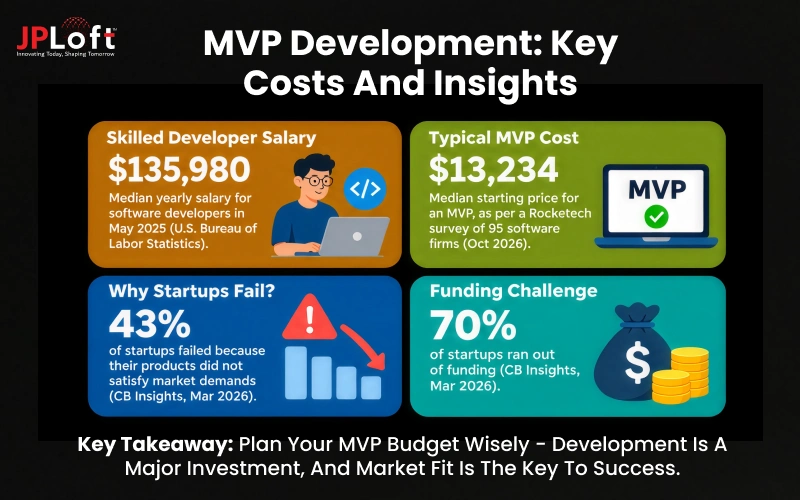
According to the US Bureau of Labor Statistics, the median yearly salary for software developers was $135,980 in May 2025, which helps one appreciate the value of skilled developers. This shows clearly that when planning your MVP development budget, experienced software developers still demand a major investment.
So, what will you actually get for your money? A well-planned MVP should provide you with a functional product with all the features you need, a user-friendly design, the necessary backend system, basic testing, and the capacity to gather feedback from your initial users.
According to a Rocketech survey of 95 software firms in October 2026, 71 firms disclosed their starting prices, with a median of $13,234. This provides you with a useful insight into the prices that software companies charge. Remember, though, that these are only starting costs and do not represent the entire cost of developing an MVP.
Here's another important reason to manage your budget carefully: A March 2026 analysis by CB Insights found that 43% of the 385 startups with known reasons for failure failed because their products did not satisfy market demands, and 70% of the startups ran out of funding.
If you spend all of your money on an overly feature-rich product before evaluating whether or not customers want it, you may have very little money left over for future changes and improvements.
That's why you should not think of an MVP as a cheaper version of your final product. Instead, see it as a way to test your idea, understand what real customers think, and find out what you should invest in next.
The smartest founders don't ask how much they can build with their entire budget; they ask how much they need to spend to learn what customers actually want.
Before deciding how much money to spend, there is one important question we still need to answer: where does all the money spent on MVP development actually go? Let's understand the costs step by step.
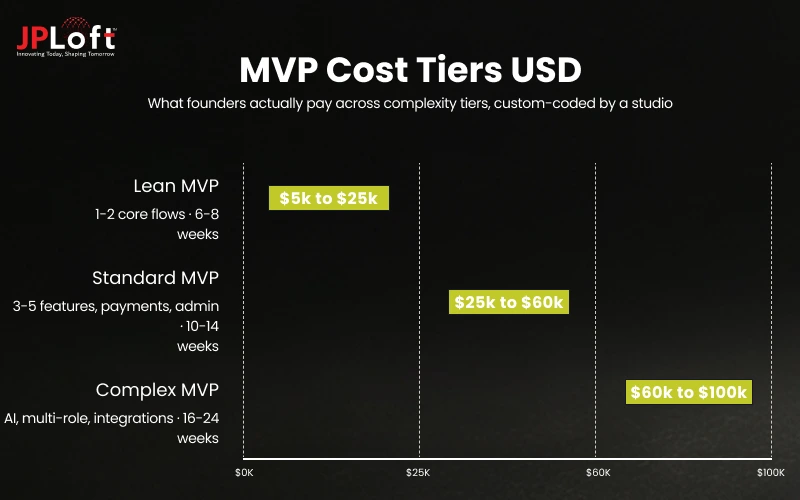
MVP Development Cost in 2027: From a $5,000 Prototype to a $100,000+ Custom Product
Investing in an MVP product, but have you thought about it: “How much should you actually invest in your first product?” MVP development costs vary based on complexity, product type, platform, and development timeline.
Let's explore how these factors affect your budget, from a $5,000 prototype to a $100,000+ custom product.
1. MVP Development Cost by Complexity: Simple vs. Medium vs. Complex MVP
The MVP development pricing in 2027 depends on the product’s complexity, features, and technical requirements.
Complexity is the biggest driver of MVP development cost. A basic or simple app may need less development effort, while applications with multiple user roles increase the budget, and advanced MVP products need larger investment and effort.
The following cost ranges will help you plan the budget based on MVP complexity.
|
MVP Complexity |
Key Features |
Estimated Cost |
|
Simple |
One core workflow and core features. |
$5,000 to $15,000 |
|
Medium |
Sign-in, real data model, few workflows, and 3-4 integrations. |
$15,000 to $40,000 |
|
Complex |
Custom workflow, advanced features, security or compliance needs |
$40,000 to $90,000 |
Also Read:- ERP Software Development Cost in 2026: A Complete Guide
2. MVP Development Cost by Product Type: What Will Your Startup Idea Cost?
The industry can have a major impact on the overall MVP cost. Every industry has different features, workflows, user roles, and security controls. Here are the different cost estimates for product types based on the features required.
|
Product Type |
Features |
Estimated Cost |
|
SaaS |
User roles, plans, data handled |
$5,000 to $10,000 |
|
Limited catalogue, payment, product catalogue, dashboard, order management system |
$6,000 to $15,000 |
|
|
AI-powered Apps |
AI, LLM APIs, RAG, vector databases, data processes, and AI-based workflow |
$15,000 to $40,000 |
|
Email security, finance rules, authentication methods, access control, audit trails, and compliance |
$30,000 to $70,000 |
|
|
Patient data privacy, HIPAA, Infrastructure setup, role-based access control, encryption. |
$25,000 to $60,000 |
|
|
Social Media |
Secure user login, basic profile customization, standard text/image posting, and push notifications |
$20,000 – $50,000 |
|
EdTech |
Simple user management, core learning flow, basic content consumption (PDF/video), simple quizzes. |
$15,000 – $50,000 |
|
Digital menu, digital ordering, fixed delivery radius, basic payment gateway. |
$20,000 – $40,000 |
|
|
Marketplace MVP |
Buyer/seller workflow, payments, dispute handling, and listings |
$40,000 to $90,000 |
a. SaaS MVP
A single subscription plan and one core workflow keep costs lower. Multiple user roles, advanced permissions, billing options, and third-party integrations increase development effort.
b. E-commerce MVP
A limited product catalogue and standard checkout keep initial costs lower. Inventory synchronization, shipping integrations, product variations, and complex order workflows increase the budget.
c. AI-Powered App MVP
Using an existing AI API for a single task keeps costs lower. Custom data processing, RAG implementation, model evaluation, and complex AI workflows increase development expenses.
d. Fintech MVP
A limited financial workflow keeps the initial product scope efficient. Identity verification, transaction security, audit controls, and mandatory compliance requirements increase development costs.
e. Healthcare MVP
A basic appointment or patient management workflow keeps development scope limited. Protected health information, secure access controls, EHR integrations, and HIPAA requirements increase costs.
f. Social Media MVP
A basic platform with standard posting and user profiles requires less development effort. Real-time messaging, content moderation, and media processing increase costs.
g. EdTech MVP
A basic course library with simple learning workflows keeps costs lower. Live classes, advanced assessments, instructor dashboards, and integrations increase development requirements.
h. Food Delivery MVP
A single restaurant or limited delivery area keeps the initial scope manageable. Multi-restaurant operations, delivery coordination, live tracking, and third-party integrations increase costs.
I. Marketplace MVP
A basic marketplace with buyer and seller accounts keeps costs lower. Separate user journeys, payment management, seller verification, reviews, and dispute handling increase development complexity and costs.
3. MVP Development Cost by Platform: Web, iOS, Android, or Cross-Platform
Platform choice affects MVP app development cost because each platform needs its own screens, testing, and upkeep. Businesses should choose a platform based on what their target customers use most, rather than choosing based on popularity or trends.
|
Platform Choice |
Features |
Estimated Cost |
|
Web MVP |
Runs in browsers, easy to update |
$15,000 to $35,000 |
|
iOS |
Apple design rules and App Store review |
$20,000 to $45,000 |
|
Android |
Many devices need more testing |
$8,000 to $25,000 |
|
Cross-platform |
One codebase for both phones |
$40,000 to $70,000 |
|
Web plus Mobile MVP |
Shared backend, multiple front ends |
$40,000 to $80,000 |
1. Web MVP
A web MVP is a cost-effective platform choice, as it is generally cheaper and faster to build. It uses a single codebase and does not require separate mobile app development. This keeps development and maintenance costs lower for businesses.
2. iOS
Another platform is iOS; the MVP development pricing is usually higher than web. For businesses targeting Apple users, an iOS MVP provides access to customers using iPhones and iPads. However, development must follow Apple's design guidelines and App Store requirements. Thus, device testing and platform-specific development increase costs and timeline.
3. Android
Android uses separate codebases and helps businesses reach users across different Android devices. The cost is mainly impacted by screen size, hardware, and OS versions required for MVP testing. This increases development time and cost.
4. Cross-Platform
Cross-platform uses a single codebase for Android and iOS, saving time and investment. Using frameworks like Flutter and React Native allows developers to use one codebase for both platforms. This reduces development time and cost.
5. Web Plus Mobile MVP
Businesses that need browser access alongside mobile apps must develop separate web, iOS, and Android interfaces. Although the backend is shared, each front end needs its own design and testing. This increases the overall budget and time for development and testing.
Also Read:- How Much Does RAG Development Cost in 2026? A Complete Guide
How Much Does It Cost to Build an MVP With Different Budgets?
One of the common questions business founders ask is what they can build within a specific MVP budget. Every startup has a different budget for developing its first product. Some founders ask, what can I build with $5,000, $10,000, $25,000, $50,000, or $100,000?
Let’s remove your confusion by breaking down what each MVP development budget can cover.
A. What can you build with $5,000?
If you have a $5,000 budget, you can develop a basic MVP product. At this investment level, the priority is to build essential functionality rather than a complete application. Let’s break it down for a more specific understanding.
|
MVP Type |
Features |
Monthly Revenue Estimate |
|
Basic Booking Platform |
User registration, service listings, booking forms, and admin access |
$1,500 to $2,000 |
|
Basic Task Management Tool |
User accounts, task creation, status updates, and a simple dashboard |
$100 to $500 |
|
Service-Based MVP |
Core user-facing features, Stripe or PayPal payment integration, and automated notifications |
$15,00 to $3,000 |
B. What can you build with $10,000?
Now, if you have raised your budget to $10,000, you can develop a functional MVP with a more defined user experience and essential business features. It includes a basic e-commerce platform, appointment booking application, or subscription-based product.
|
MVP Type |
Features |
Monthly Revenue Estimate |
|
Basic E-commerce MVP |
Product listings, shopping cart, customer accounts, and payment gateway |
$2,000 to $4,000 |
|
Appointment Booking App |
User profiles, service selection, calendar availability, booking confirmation, and notifications |
$2,000 to $5,000 |
|
Subscription-Based MVP |
User registration, subscription plans, and recurring payments |
$1,000 to $4,000 |
C. What can you build with $15,000?
A $15,000 budget gives you more flexibility to develop an MVP with multiple essential features and connected user workflows. This budget also allows room for custom UI/UX, payment processing, and basic reporting.
|
MVP Type |
Features |
Monthly Revenue Estimate |
|
A Single-Workflow Web App |
User registration, one core workflow, basic dashboard, data management, and admin access |
$1,500 to $4,500 |
|
Basic listing platforms |
Business or product listings, search, basic filters, user profiles, and contact forms |
Commissions of (10% to 20%) Charging for featured listings or ads. |
|
Subscription-Based Platform |
User accounts, one or two subscription plans, recurring payments, and billing history |
$3,000 to $12,000 |
D. What can you build with $25,000?
A $25,000 budget gives you flexibility to add features such as multiple user roles, custom dashboards, third-party integrations, and more detailed backend workflows. Let's understand what these MVPs can offer within this budget.
|
MVP Type |
Features |
Monthly Revenue Estimate |
|
Simple eCommerce Store |
Product listings, product search, shopping cart, checkout, payment gateway, and order management |
$2,000 to $5,000 |
|
Basic SaaS Platform |
User registration, subscription plans, recurring billing, user dashboard, core business functionality, and basic analytics |
$2,000 to $6,000 |
|
AI-Powered Prototype |
Existing AI API integration, basic chatbot, prompt management, user accounts, simple dashboard, and response history |
$8,000 to $20,000 |
E. What can you build with $50,000?
A budget of $50,000 allows startups to develop an MVP with advanced functionality and customised business workflows. From a cross-platform mobile app and Niche marketplace MVP to an AI-powered workflow tool, this investment provides more room for an MVP product.
|
MVP Type |
Features |
Monthly Revenue Estimate |
|
Cross-Platform Mobile App |
Shared iOS and Android app, user registration, profiles, push notifications, payment integration, and a customised dashboard. |
$3,000 to $8,000 |
|
Niche marketplace MVP |
Buyer and seller accounts, product or service listings, advanced search, booking or ordering, payment processing, reviews, and admin controls. |
$4,000 to $12,000 |
|
AI-powered workflow tool |
AI API integration, automated business workflows, document processing, user roles, custom dashboards, and usage tracking. |
$12,000 to $20,000 |
F. What can you build with $100,000?
A $100,000 MVP budget can fund either a complex marketplace platform, a regulated MVP, or a modular AI-powered platform. This budget is suitable for startups who are planning to include advanced backend architecture, multiple user workflows, custom integrations, and detailed security testing.
|
MVP Type |
Features |
Monthly Revenue Estimate |
|
Complex Marketplaces & Multi-Sided Platforms |
Multiple user roles, vendor management, advanced search, booking or ordering, payment splitting, and real-time notifications. |
$8,000 to $20,000 |
|
Regulated MVP {Healthcare/Fintech} |
Secure user accounts, role-based access, appointment or transaction workflows, payment integration, data protection controls, and compliance-focused testing. |
$15,000 to $25,000 |
|
AI-Powered or LLM-Integrated Apps |
LLM API integration, RAG-based search, document processing, custom workflows, user permissions, and usage monitoring. |
$8,000 to $15,000 |
Also Read:- AI Route Optimization for Fuel Delivery: Reduce Delivery Time & Fleet Costs
MVP Development Cost by Development Timeline: 4, 8, 12, and 16 Weeks
The cost and timeline of an MVP move together. A typical MVP may take 4-12 weeks to develop, while custom features or advanced AI integration take a different timeline. The timelines depend on feature complexity, team experience, and testing needs. Here is the breakdown of MVP development budget according to different timelines.
|
Timeline |
App Type |
Estimated Cost |
|
4-8 Weeks |
Prototype or simple MVP |
$5,000 to $30,000 |
|
8-12 weeks |
Simple to lean medium web MVP with payments and admin |
$15,000 to $60,000 |
|
12-16 weeks |
Complex MVP or web plus mobile |
$40,000 to $100,000+ |
- Basic MVPs: A simple MVP with one core workflow and essential features can be developed in 4 to 8 weeks. This suits founders testing a single idea with limited functionality.
-
Standard MVP: Products with multiple user flows, payment integration, and an admin dashboard can take around 8 to 12 weeks.
-
Advanced MVP: Products with advanced AI features, complex workflows, multiple integrations, or cross-platform development may require 12 to 16 weeks or more.
Also Read:- How Much Does Healthcare App Development Cost: A 2026 Guide
MVP Development Cost Breakdown: Every Stage, Every Expense, and Every Dollar Explained
To build a successful MVP and optimize with real users, you need to set the right budget at every stage, for every expense, and for every dollar spent. The overall cost is determined by the critical factors that determine the final cost. Here are the major factors determining the cost to develop an MVP.
|
Factors |
Estimated Cost |
|
Discovery and research |
$3,000 to $8,000 |
|
UI/UX design |
$5,000 to $10,000 |
|
Development [Frontend and Backend] |
$20,000 to $50,000 |
|
QA and testing |
$8,000 to $20,000 |
|
Deployment and launch |
$5,000 to $12,000 |
|
Project management |
$3,000 to $8,000 |
A. How Much Does MVP Discovery and Product Research Cost?
To build an MVP, discovery and product research help validate your idea, with costs near $3,000 to $8,000. However, if you are planning to conduct basic market research and competitor analysis, it requires less investment. Detailed user interviews, market validation, and feasibility studies increase research time and costs.
B. How Much Does MVP Planning and Requirement Analysis Cost?
Another factor contributing to MVP development cost is planning. It involves identifying the core features, user roles, workflows, and technical requirements, and can cost around $1,500 to $4,000.
A simple MVP with fewer features requires less planning and research. However, multiple user journeys, complex workflows, and detailed requirements need more time. This increases the overall planning and requirements analysis cost.
C. How Much Does MVP UI/UX Design Cost?
UI/UX design covers your MVP's screen layouts, user journeys, and clickable prototypes. The cost for UI/UX design for an MVP product ranges between $5,000 and $10,000. Template-based designs with ready-made components cost less.
However, if you prefer, advanced designs with custom illustrations, animations, and complex interactions require more time and increase costs. For most MVPs, a standard custom design offers a good balance between user experience and budget.
D. How Much Does MVP Frontend Development Cost?
Frontend development builds the screens and interactions users see and use. This is the front part of the MVP that users interact with. It costs between $8,000 and $20,000.
This budget is prepared as if you plan for a responsive interface with basic screens; it costs less. Custom animations, complex interactions, multiple screen layouts, and support for different platforms increase development costs.
E. How Much Does MVP Backend Development Cost?
The cost to build an MVP backend ranges between $15,000 and $30,000; it handles logins, business rules, and data processing, while the database stores product information.
Basic user accounts and simple data structures cost less. But if you are planning to add complex workflows, multiple user roles, and advanced data relationships, it increases the overall budget.
F. How Much Does API Development and Third-Party Integration Cost?
APIs connect your MVP with external services such as Stripe, PayPal, and Google Maps. The cost depends on standard integrations with well-documented APIs, which require less development effort.
However, custom integrations with legacy systems, complex data exchanges, and real-time synchronization require additional configuration. Moreover, error handling and testing increase development costs. Therefore, it costs between $5,000 and $15,000.
G. How Much Does MVP Admin Panel Development Cost?
A basic dashboard with standard controls costs between $10,000 and $25,000. Custom reports, advanced permissions, multiple management workflows, and detailed analytics increase development costs.
H. How Much Does MVP Quality Assurance and Testing Cost?
Quality assurance checks whether your MVP works correctly before customers start using it. Basic functional testing costs between $8,000 and $20,000; it checks whether core features work as expected.
However, security checks, performance testing, edge-case testing, and cross-browser compatibility require more time and effort. Products handling sensitive financial or healthcare data also need deeper testing to reduce security risks and prevent critical errors.
The right testing scope depends on your product's complexity, business requirements, and the risks involved.
I. How Much Does MVP Deployment and Launch Cost?
Deployment moves your MVP from development to real-time customers. A basic server setup with standard hosting and configuration costs between $5,000 and $12,000.
Further, several businesses plan to launch an MVP in multiple environments, with advanced infrastructure, security configurations, and complex deployment requirements. This increases development time and cost.
J. How Much Does Project Management Add to MVP Development Cost?
Project management handles development schedules, team coordination, budgets, and communication.
If you hire a small team with a clearly defined scope requires less coordination under the budget of $3,000 to $8,000. However, larger and more experienced teams working on multiple development stages, customized requirements, and complex workflows increase management costs.
How Much Does Each MVP Feature Cost in 2027?
MVP development pricing covers much more than writing code. Another factor affecting cost is the critical features of the MVP. In a typical cost estimate, the budget is split as shown in the table. These feature costs depend on the type, scope, and complexity of your MVP. Here is the complete breakdown of each MVP development cost in 2027.
|
MVP Feature |
Estimated Cost |
|
Registration And Login |
$1,500 to $8,000 |
|
User Profiles |
$1,500 to $6,000 |
|
Payment Gateway |
$5,000 to $15,000 |
|
Search, Filters, Sorting |
$4,000 to $10,000 |
|
Real-Time Chat |
$8,000 to $15,000 |
|
Notifications (Push, Sms, Email) |
$1,500 to $6,000 |
|
Maps and GPS Tracking |
$3,000 to $8,000 |
|
Booking And Scheduling |
$8,000 to $25000 |
|
Subscription Billing |
$7,000 to $20,000 |
|
Dashboards And Analytics |
$4,000 to $10,000 |
|
AI Chatbot Or Basic Recommendations |
$8,000 to $30,000 |
|
Reviews and Ratings |
$2,500 to $5,000 |
|
Roles and Permissions |
$3,000 to $15,000 |
Note: These are indicative estimates for individual feature development, not fixed add-on prices. Actual costs depend on your existing application architecture, integrations, and feature complexity.
1. Registration and Login
Registration and login allow users to create accounts and access your MVP securely. This feature is important for managing user access and personal information. Its development cost can range from $1,500 to $8,000.
But, if you are planning to add social or Google sign-in, OTP verification, multi-factor authentication, and account recovery add higher development.
2. User Profiles
For any user to manage their personal information, preferences, and account details, user profiles help to manage it all. If you want to include this feature, it can cost $1,500 to $6,000.
A basic profile with a name, email, and profile photo needs limited development time and cost to build. But, if you are planning for custom profile preferences, privacy settings, and document uploads require additional screens, data handling, and validation, increasing MVP development budget.
3. Payment Gateway
Adding a payment gateway feature allows users to complete transactions directly through your MVP. It is essential for startups that sell products, offer paid services, or accept online bookings, and can cost around $5,000 to $15,000.
A standard Stripe or PayPal payment integration handles basic checkout and payment confirmation in an MVP. However, split payments, refunds, multiple currencies, and transaction tracking require additional cost and testing.
4. Search, Filters, and Sorting
One of the essential features startups are planning to add in an MVP is using search filters. It helps users find relevant products, services, or information quickly. These features are important for marketplaces, e-commerce platforms, and directory-based applications. Their development cost can range from $4,000 to $10,000.
However, there are several businesses who want to add advanced filters, location-based searches, large datasets, and relevance-based sorting can increase the budget. This helps improve user experience.
5. Real-Time Chat
The real-time chat feature is a manageable starting point for an MVP. It allows users to communicate directly within your MVP to ask for product details or other queries. Developing this feature can cost $8,000 to $15,000. This is especially useful for marketplaces, service platforms, and applications that require customer support.
This was the budget for basic feature, but if you are planning to add group chats, media sharing, read receipts, and instant message delivery can increase development costs.
6. Notifications (Push, SMS, Email)
Users are more likely to prefer MVPs that ensure real-time notifications, keeping users informed about important updates. Adding this functionality can cost $1,500 to $6,000, while improving user engagement and sharing timely information.
Email notifications for account updates or order confirmations are relatively simple to add and require less cost. But push alerts, SMS, and multiple notification rules require separate integrations, delivery management, and additional testing, increasing the overall budget.
7. Maps and GPS Tracking
Adding maps and GPS tracking helps users locate locations, track deliveries, and view nearby services. This feature is important for logistics, travel, and location-based MVPs, with costs ranging from $3,000 to $8,000.
A basic map showing business or user locations requires a standard mapping API, which requires less development time and cost. However, adding live GPS tracking, route planning, location updates, and real-time movement requires more development and ongoing API usage.
8. Booking and Scheduling
Booking and scheduling features are one of the core strengths in healthcare, event, travel, and salon service marketplaces. Adding these features in your MVP can cost around $8,000 to $25,000. A basic booking system lets users select available dates and time slots.
For calendar synchronization, recurring appointments, time-zone handling, cancellations, and automated availability updates add to the budget.
9. Subscription Billing
Subscription billing helps businesses collect recurring payments through monthly or yearly plans. Its development cost can range from $7,000 to $20,000.
A single recurring payment plan is relatively straightforward to implement. Multiple pricing tiers, free trials, plan upgrades, prorated charges, invoices, and failed-payment handling require additional cost and development effort.
10. Dashboards and Analytics
Dashboards and analytics help businesses monitor important activities and measure product performance. They provide useful insights into users, sales, bookings, and other business metrics. If you are planning to add this feature, it can cost $4,000 to $10,000.
But several businesses, when planning for e-commerce or Fintech MVPs, often require custom reports, date filters, interactive charts, and real-time data updates. This increases development cost and timeline.
11. AI Chatbot or Basic Recommendations
AI chatbots and recommendation systems help businesses improve customer support and deliver relevant suggestions. They are useful for MVPs that need automated responses or personalized user experiences. The development cost can range between $8,000 and $30,000.
Custom knowledge sources, data processing, response evaluation, and accuracy controls can increase the overall cost.
12. Reviews and Ratings
A basic review feature allows users to submit ratings and comments on the application. Adding this feature can cost $2,500 to $5,000. Review moderation, reporting, verified purchases, spam detection, and controls for inappropriate content require additional workflows and testing.
13. Roles and Permissions
Implementing roles and permission features allows startups to control and manage access within MVP. Since this is one of the critical features to consider, its cost can range between $3,000 and $15,000.
Further, if you are planning for customized or advanced access rules, role-based dashboards, and detailed permission settings, this can increase the overall budget.
Also Read:- A Complete Guide to Website Development Cost
How Much Does It Cost to Build an AI-Powered MVP in 2027?
Adding AI capabilities to an MVP can increase its development budget. The cost depends on the AI features, model selection, data requirements, and infrastructure.
Here are the complete development costs of different AI capabilities, technical requirements, and the ongoing expenses to consider when planning an MVP budget in 2027.
AI MVP Development Cost by Product Type
The type of AI product you choose plays an important role in your development budget. Each solution has different features, technical requirements, and development needs.
|
AI MVP |
Features |
Estimated Cost |
|
LLM Chatbot |
Answers user questions and holds conversations using large language models. |
$15,000 to $35,000 |
|
AI-Powered Search |
Understands user queries and returns relevant information from available data. |
$20,000 to $40,000 |
|
AI Workflow Automation |
Automates repetitive business tasks using AI and connected applications. |
$25,000 to $60,000 |
|
Predictive Analytics |
Uses historical data to identify patterns and predict future outcomes. |
$20,000 to $60,000 |
|
AI Agent |
Understands tasks, makes decisions, and performs actions using connected tools. |
$25,000 to $50,000 |
|
Computer Vision |
Analyzes images and videos to identify objects, patterns, or activities. |
$30,000 to $80,000 |
|
Voice AI |
Understands spoken commands and generates voice-based responses. |
$20,000 to $50,000 |
|
Generative AI |
Generates content such as text, images, summaries, and other outputs. |
$20,000 to $60,000 |
Note: These estimates represent the overall development cost of an AI-powered MVP, including its core application and AI functionality. The final budget depends on model selection, data requirements, feature complexity, and integrations.
Also Read:- Website Development Guide: Process, Benefits, & Cost
How Much Does It Cost to Hire Someone to Build Your MVP in 2027?
The team you choose to build your MVP directly affects its development cost, delivery timeline, and overall quality. Hiring an in-house team, working with freelancers, or partnering with a development agency involves different expenses. These costs also change based on the team's location, experience, technical expertise, and engagement model.
For example, MVP development cost in USA are generally higher than working with teams in Eastern Europe or Latin America. Here is the complete breakdown of how much it costs to hire a team to build your MVP in 2027.
A. MVP Development Cost: In-House Team vs. Freelancer vs. Development Agency
The cost of building an MVP varies depending on whether you hire an in-house team, work with independent freelancers, or outsource development to an agency. Each hiring model offers a different level of control, technical expertise, project management, and resource availability.
Cost comparison: In-house team vs. freelancer vs. development agency
|
Hiring model |
What the cost includes |
Estimated Cost |
|
In-house Team |
Developer salaries, recruitment, benefits, equipment, and management overhead expenses. |
$10,000 to $50,000 |
|
Freelancers |
Individual developer, UI/UX designer, and QA charges based on project requirements. |
$15,000 to $75,000 |
|
Development Agency |
Design, development, QA, project management, testing, and deployment. |
$20,000 to $90,000 |
Note: These estimates represent potential project-level costs, not monthly salaries or fixed hiring fees. Actual spending depends on team size, engagement duration, and project scope.
B. How Much Does It Cost to Build an MVP With an Offshore Development Company?
An offshore development company builds your MVP from another country. This approach helps startups access experienced developers without hiring a full local team.
The cost depends on the engagement model, project complexity, and team size. Here is an estimated breakdown:
|
Engagement Model |
What it Includes |
Estimated Cost |
|
Fixed-Price Project |
Agreed features, timeline, and deliverables |
$5,000 to $30,000 |
|
Hourly Engagement |
Development based on actual hours |
$25 to $80/hour |
|
Dedicated Development Team |
Developers working on your product |
$8,000 to $15,000/ month |
C. MVP Development Cost by Location: USA vs. Eastern Europe vs. Latin America
The development team's location affects hourly rates and overall project costs. Developers in the USA generally charge more than teams in offshore markets.
|
Location |
Estimated Cost |
|
USA |
$80 to $150/hour |
|
Eastern Europe |
$30 to $70/hour |
|
Latin America |
$35 to $75/hour |
Why the Cheapest Quote Can Become Your Most Expensive Decision
A low development quote does not always mean lower spending. Some companies exclude testing, security, deployment, or post-launch support from their initial estimates. These expenses appear later as additional charges.
For example, one agency may quote $10,000 for development but exclude important integrations and testing. Another may quote $15,000 with these services included. The second quote may offer better overall value.
Before choosing a company, check what the price covers. Review the project scope, deliverables, testing process, ownership rights, and support terms. A clear agreement helps prevent unexpected expenses.
Also Read:- AI Copilot Development Cost: Pricing, Factors & Estimates
The Hidden Costs of Building an MVP: Expenses That Can Blow Your Budget
Your initial development quote may not cover every expense after launch. Some costs appear during development, while others continue as customers start using your product.
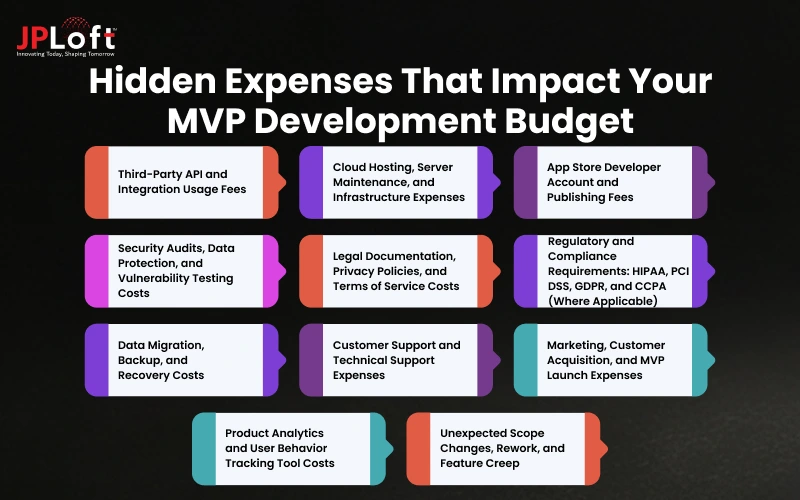
The following estimates show how much these expenses may affect your initial MVP budget of 5,000–100,000+. They are planning allowances, not fixed charges. Not every MVP will require every expense.
1. Third-Party API and Integration Usage Fees
External services such as Google Maps, email platforms, and AI APIs may charge based on usage. These fees can add around 2%–8% to your initial MVP budget, depending on integrations and customer activity.
2. Cloud Hosting, Server Maintenance, and Infrastructure Expenses
Your MVP needs servers, storage, databases, and backups to operate. Hosting and infrastructure may account for 1%–5% of the initial development budget during the early operating period. Higher traffic can increase monthly expenses.
3. App Store Developer Account and Publishing Fees
Publishing mobile apps may require developer accounts and platform fees. Apple's Developer Program currently costs $99 per year, while Google Play Console charges a one-time $25 registration fee.
4. Security Audits, Data Protection, and Vulnerability Testing Costs
Security testing helps identify weak points before they affect customers. Depending on the product's risk, security audits may add 2%–8% to the development budget. Financial and healthcare products may need deeper testing.
5. Legal Documentation, Privacy Policies, and Terms of Service Costs
Your MVP may need privacy policies, terms of service, and user agreements. Legal documentation can account for around 1%–5% of the initial budget. Products handling sensitive information may require additional legal review.
6. Regulatory and Compliance Requirements: HIPAA, PCI DSS, GDPR, and CCPA (Where Applicable)
Regulated products may need compliance reviews, documentation, and additional security controls. These requirements can add 5%–20% or more to the initial MVP budget. The actual expense depends on your industry, location, and data practices.
7. Data Migration, Backup, and Recovery Costs
Moving existing customer or business data into your MVP requires planning and testing. Data migration and recovery may add 1%–5% to the initial budget, depending on data volume and complexity.
8. Customer Support and Technical Support Expenses
Your team needs to handle customer questions, bug reports, and technical issues after launch. Initial support setup and early operations may require 2%–6% of the MVP budget. Costs increase as customer numbers grow.
9. Marketing, Customer Acquisition, and MVP Launch Expenses
Building an MVP does not automatically bring customers. Marketing, launch campaigns, and customer acquisition may require 5%–15% of your initial development budget. Your actual spending depends on the target market and launch strategy.
10. Product Analytics and User Behavior Tracking Tool Costs
Analytics tools help track sign-ups, feature usage, and customer activity. Initial setup and early subscriptions may account for 0.5%–3% of the MVP budget. Paid plans may become necessary as usage increases.
11. Unexpected Scope Changes, Rework, and Feature Creep
New requirements during development can increase costs and delay launch. Scope changes and rework may add 5%–15% to the original estimate. A clear feature list helps prevent unnecessary changes.
How Much Does It Cost to Maintain an MVP After Launch?
Launch is not the finish line. Ongoing maintenance keeps your MVP secure and working. Here is the complete breakdown of post-launch maintenance costs.
|
MVP Complexity |
What It Covers |
Estimated Cost |
|
Basic MVP |
Bug fixes and small updates |
$5,000 to $10,000 |
|
Standard MVP |
Updates, monitoring, security patches |
$8,000 to $20,000 |
|
Complex MVP |
Dedicated support, scaling, compliance upkeep |
$20,000 to $40,000+ |
How to Reduce MVP Development Costs by 30-50% Without Compromising Quality
Reducing MVP costs does not mean removing important features or skipping testing. The goal is to avoid spending money on functionality that does not support your main business idea.
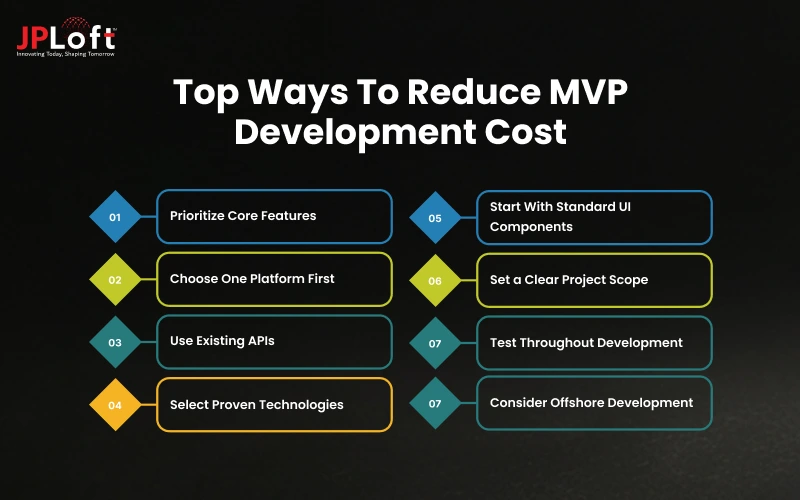
- Prioritize Core Features: Start with the features needed to test your main product idea. Move secondary features to future development stages.
- Choose One Platform First: Build for the platform your target customers use most. Expand to other platforms after validating demand.
- Use Existing APIs: Integrate reliable third-party services instead of developing every feature from scratch.
- Select Proven Technologies: Use familiar frameworks and open-source tools where they meet your requirements.
- Start With Standard UI Components: Avoid expensive animations and complex designs during the first release.
- Set a Clear Project Scope: Document features, timelines, and deliverables before development begins.
- Test Throughout Development: Early testing helps identify problems before they become expensive fixes.
- Consider Offshore Development: Work with an experienced offshore team to access technical skills at competitive rates.
Also Read:- How Much Does It Cost to Develop a Home Services App Like Justlife?
How to Choose an MVP Development Company Within Your Budget
Choosing an MVP development company is not only about comparing quotes. You need a team that understands your business idea, technical requirements, and launch goals. Before making a decision, evaluate these important points:
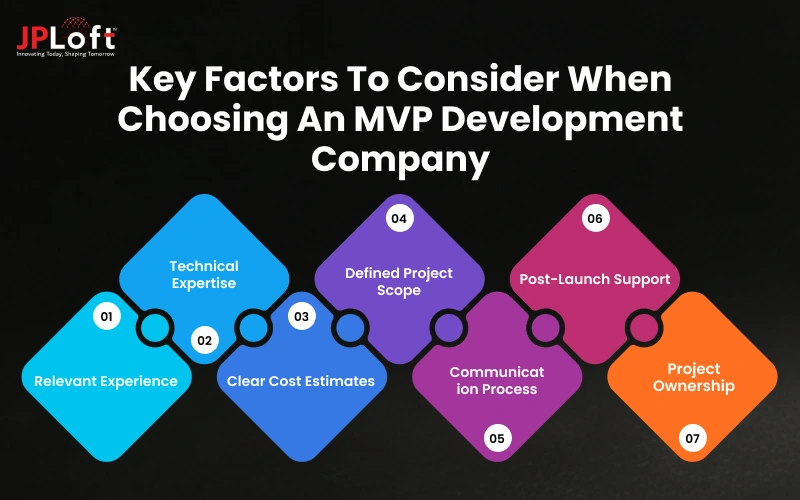
- Relevant Experience: Check whether the company has worked on products similar to yours.
- Technical Expertise: Review its experience with your required platforms, frameworks, integrations, and technologies.
- Clear Cost Estimates: Ask for a cost breakdown covering design, development, testing, deployment, and support.
- Defined Project Scope: Make sure the proposal clearly explains included features and additional charges.
- Communication Process: Understand how the team shares updates, handles feedback, and reports progress.
- Post-Launch Support: Check whether the company provides bug fixes, maintenance, and future improvements.
- Project Ownership: Confirm that you will receive the source code, documentation, and access to relevant accounts.
At JPLoft, we offer custom mobile app development solutions, helping startups and businesses to plan and develop web, mobile, and AI-powered products.
Estimating MVP development costs is not just about calculating developer hours. Founders need to know what their budget will cover. That is why we start by understanding your business idea, target users, product goals, and expected launch timeline.
Our team then breaks the project into clear development requirements. We assess feature complexity, platform selection, UI/UX needs, third-party integrations, technology choices, and testing requirements. This helps us prepare a more realistic cost estimate instead of giving you a broad figure without explaining what it includes.
With 16+ years of app development experience and 1,250+ projects delivered, JPLoft brings practical technical and product knowledge to MVP development.
If you are planning an MVP, JPLoft can help you estimate the investment and choose a practical roadmap for your product. Let's discuss your MVP idea and create a development estimate aligned with your business goals and budget.
Also Read:- GTA 6 Development Cost: Breaking Down the Billion-Dollar Budget
What Does a Real MVP Development Budget Look Like? 3 Practical Cost Scenarios
Real budgets make estimates easier to trust. These three scenarios, at $15,000, $50,000, and $100,000, show where the money goes and what you can trim. Each fits within the ranges used earlier in this guide.
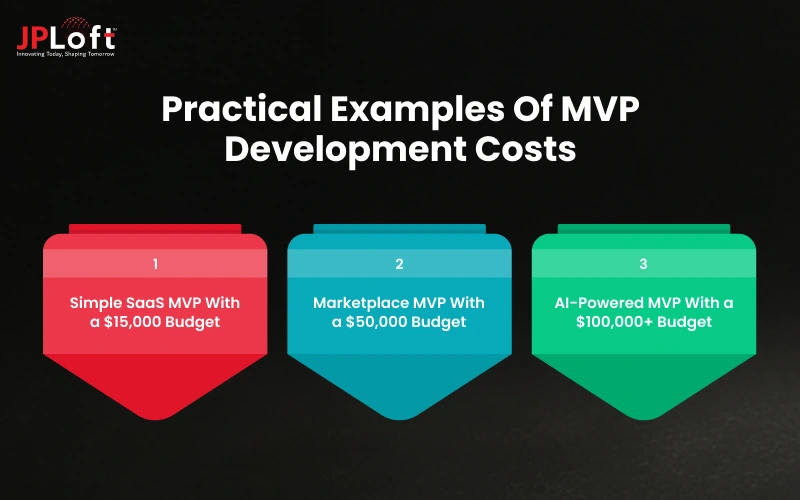
Example 1: Simple SaaS MVP With a $15,000 Budget
A web SaaS with email login, one core workflow, Stripe subscriptions, a basic dashboard, and email alerts. It sits at the low end of the $15,000 to $30,000 simple SaaS range and suits a freelance, nearshore, or offshore team.
Example 2: Marketplace MVP With a $50,000 Budget
A web marketplace with buyer and seller accounts, listings, search, split payments, basic messaging, reviews, and an admin panel. It sits in the lower-middle of the $20,000 to $50,000 marketplace range, so scope stays tight.
Example 3: AI-Powered MVP With a $100,000+ Budget
A web AI assistant that answers questions from a company’s own documents, using an existing LLM and RAG. It includes user roles, a dashboard, and an admin panel, and fits the $30,000 to $100,000+ AI range.

Conclusion
Building an MVP in 2027 can cost anywhere from $5,000 to $100,000+, depending on your product idea, features, technology stack, and development team. However, spending more does not always mean building a better product.
The key is to start with the features your customers actually need. Choose the right platform, set a clear development scope, and keep room for testing and post-launch expenses. You can add advanced features as your product gains users and real market feedback.
Working with an experienced MVP development company can also help you manage costs, avoid unnecessary development, and launch with the right foundation. Focus on building a product that solves a real problem without stretching your budget.
FAQs
The cost to build an MVP in the USA in 2027 is between $5,000 and $100,000+. The cost depends on several factors, including product type, product complexity, and platforms.
Yes, you can build an MVP for under $10,000, but it includes no-code prototypes, a focused web app, and single-feature tools with existing APIs.
The minimum budget required to build an MVP is $5,000 to $15,000 for a prototype or no-code test. A working custom MVP usually costs near $15,000 to $40,000+.
Simple MVPs take 4-8 weeks, medium MVPs take 8-16 weeks, and complex MVPs take 4-6 months. A clear scope and fewer integrations shorten the timeline.
Yes, for most standard web MVPs, such as a marketplace or multi-role SaaS, a $50,000 budget is suitable. It usually falls short for fintech, healthcare, or web-plus-mobile products with strict compliance needs.
Yes, building an MVP with AI is cheaper, faster, and productive with AI in 2027. AI coding tools speed up routine development and require a lower initial budget.
Building an MVP through outsourcing helps to develop faster product launch in market, while in-house team development is better for long-term scaling. Both choices depend on your budget, technical requirements, and MVP product goals.
Building an MVP without coding usually costs $5,000 to $25,000, depending on whether you are hiring a developer team or building it yourself.
Upgrading an MVP into a full-scale product typically costs $30,000 to $200,000+, depending on scale, features, and security needs.
Maintaining an MVP for one year typically costs $5,000 to $10,000 for basic MVPs; for standard MVPs, it costs around $8,000 to $20,000, and $20,000 to $40,000 for complex MVPs.
The biggest expense in building an MVP is software development and feature scope. It takes about 36% of the budget.
Simple SaaS MVPs cost $15,000 to $30,000. A standard SaaS startup with several roles and integrations costs more, while billing, dashboards, and user management drive additional cost.
Cross-platform apps cost $40,000 to $70,000. Single native iOS or Android apps cost $8,000 to $45,000. Web plus mobile costs $40,000 to $80,000. These ranges cover typical MVP app development cost.

Priyanka Sukhwal is the Managing Director and Business Head of JPLoft, with 10+ years of experience in technology, digital product strategy, and business growth. She has worked closely with businesses building mobile applications, custom software, marketplaces, and on-demand platforms across mobility, automotive, consumer services, and startup ecosystems. At JPLoft, she focuses on understanding business models, identifying product opportunities, and helping companies plan digital solutions that can scale with changing market needs.


Share this blog