


Your competitors could be winning customers, cutting costs, and increasing revenue with something already in your customers’ pocket: A mobile app!
Mobile apps are changing how businesses serve customers and run operations as 2027 approaches. Sensor Tower's 2026 AI report projected 36 billion hours spent globally in generative AI apps during the first half of 2026. The opportunity is not simply to launch an app, but to give people a reason to return.
The shift differs by industry. Some apps strengthen direct customer relationships and reduce marketplace dependence; others replace paperwork, manual coordination, or disconnected systems.
Understanding where mobile technology is creating the biggest impact can help you spot market opportunities, improve business performance, and make smarter technology investments.
Let's explore the top 10 industries being transformed by mobile apps in 2027 and how your business can benefit.
How Are Mobile Apps Transforming Industries in 2027?
Mobile apps are changing how businesses operate, serve customers, and generate revenue. In 2027, their role extends beyond providing digital access to products and services. They are becoming an important part of everyday business operations.
Across industries, businesses are using mobile technology to simplify processes, improve customer interactions, and introduce new service models.
Here are six ways mobile apps are transforming business operations across industries:
-
Changing How Customers Access Services: Customers can book appointments, make payments, purchase products, and access support directly from their smartphones, reducing dependence on physical locations.
-
Automating Business Operations: Mobile apps are replacing manual processes with digital workflows for order management, scheduling, inventory tracking, and employee coordination.
-
Introducing New Revenue Models: Businesses are moving beyond traditional sales through subscription services, digital marketplaces, premium features, and app-based transactions.
-
Enabling Data-Driven Decisions: Real-time analytics help businesses track customer behavior, monitor operational performance, and identify opportunities for improvement.
-
Transforming Customer Engagement: Loyalty programs, personalized experiences, and timely notifications are changing how businesses maintain long-term customer relationships.
-
Expanding Business Accessibility: Mobile apps allow businesses to serve customers across different locations without relying entirely on physical stores or traditional service channels.
As mobile technology continues to evolve in 2027, businesses that focus on solving real customer and operational challenges will be better positioned to create measurable value.
Which Industries Offer the Biggest Mobile App Business Opportunities in 2027?
Not every industry offers the same opportunities for mobile app development. Some sectors are seeing growing demand for digital services, while others are using mobile technology to reduce operating costs, automate workflows, and reach new customer segments.
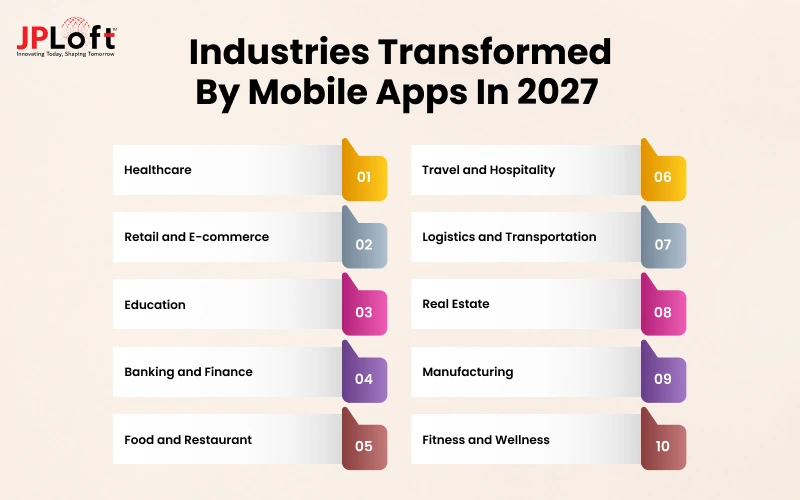
Here are the 10 industries offering promising mobile app business opportunities in 2027:
1. Healthcare
Healthcare businesses are adopting mobile apps to improve patient access and simplify medical services. If you operate a hospital, clinic, pharmacy, or healthcare startup, an app can help you serve patients beyond physical locations.
EMARKETER's February 2026 report estimates that 40.4% of consumers use health apps, while 22.9% have tried and abandoned them.

You can develop solutions for online consultations, appointment scheduling, electronic health records, prescription management, and remote patient monitoring.
Business opportunities include:
-
Telemedicine apps for virtual consultations.
-
Medicine delivery apps for doorstep prescription fulfillment.
-
Hospital apps for appointment and patient management.
-
Remote monitoring apps for tracking patient health.
Revenue potential: Generate revenue through consultation fees, subscriptions, pharmacy commissions, and premium healthcare services. Prioritize data security and regulatory compliance when developing your solution.
2. Retail and E-commerce
If you operate a retail or e-commerce business, a mobile app can help you build a direct sales channel. It allows customers to discover products, make purchases, and track orders conveniently.
EMARKETER forecasts mobile devices will account for more than half of US retail ecommerce sales in 2027.
You can integrate personalized recommendations, digital payments, real-time inventory, and loyalty programs to improve shopping experiences and encourage repeat purchases.
Business opportunities include:
-
Shopping apps for retail brands.
-
Grocery delivery apps with scheduled orders.
-
Multi-vendor marketplaces connecting buyers and sellers.
-
Social commerce apps for product discovery.
Revenue potential: Explore product sales, delivery charges, marketplace commissions, subscriptions, and premium memberships. You can also use personalized offers to increase customer retention.
3. Education
The education sector offers opportunities for businesses delivering digital learning experiences. If you run a coaching institute, training center, or edtech startup, a mobile app can help you reach students beyond your local market.
Features such as recorded lessons, live classes, interactive assessments, and progress tracking can improve learning experiences.
Duolingo reported 64.9 million daily active users and 13.1 million paid subscribers in Q3 2026.
Business opportunities include:
-
E-learning apps offering online courses.
-
Exam preparation apps with mock tests.
-
Language learning apps with interactive lessons.
-
Corporate training apps for employee development.
Revenue potential: Earn through course purchases, monthly subscriptions, certification fees, and institutional partnerships. You can also offer free introductory lessons to attract potential customers.
4. Banking and Finance
Financial businesses are using mobile apps to make payments, transactions, and money management more accessible. If you operate a fintech startup or financial institution, mobile technology can help you deliver convenient financial services.
The ABA's October 2026 survey of 4,402 US adults found that 44% use mobile apps most often to manage bank accounts, compared with 20% using desktop online banking and 10% visiting branches. Mobile led among Gen Z and millennials, at 54% each.
Business opportunities include:
-
Digital banking apps for account management.
-
Mobile wallet apps for payments and transfers.
-
Investment apps for portfolio tracking.
-
Personal finance apps for budgeting and expenses.
Revenue potential: Depending on your business model and regulatory permissions, generate revenue through transaction fees, subscriptions, lending services, and financial partnerships. Security and compliance should remain essential priorities.
5. Food and Restaurant
If you own a restaurant, food chain, cloud kitchen, or delivery business, a mobile app can simplify ordering and customer management.
You can offer digital menus, online ordering, table reservations, payment integration, and delivery tracking. Loyalty programs and personalized offers can also encourage repeat orders.
Chipotle reported that digital sales represented 38.8% of food and beverage revenue in Q3 2026, versus 36.7% a year earlier.
Business opportunities include:
-
Food delivery apps for doorstep ordering.
-
Restaurant apps for direct customer orders.
-
Table reservation apps for booking management.
-
Restaurant management apps for inventory and operations.
Revenue potential: Generate income through food sales, delivery charges, subscriptions, restaurant commissions, and promotional listings. Direct ordering can also reduce dependence on third-party platforms.
6. Travel and Hospitality
Travel and hospitality businesses can use mobile apps to simplify bookings and improve guest experiences. If you operate a hotel, travel agency, resort, or tourism company, an app can help customers access your services conveniently.
Booking Holdings said app bookings accounted for a high-50% share of total room nights in Q3 2026. Its B2C direct-booking share was separately in the mid-60% range.
You can introduce hotel reservations, itinerary planning, digital check-ins, flight bookings, and personalized travel recommendations.
Business opportunities include:
-
Hotel booking apps for reservations.
-
Travel planning apps for personalized itineraries.
-
Vacation rental apps connecting owners and travelers.
-
Tour booking apps for local activities.
Revenue potential: Explore booking commissions, service fees, subscriptions, sponsored listings, and travel add-ons. Partnerships with insurance providers and tourism businesses can create additional income.
7. Logistics and Transportation
For logistics and transportation businesses, mobile apps can improve delivery visibility and operational efficiency. If you manage delivery vehicles, fleets, or transportation services, an app can simplify coordination.
Features such as GPS tracking, route optimization, automated dispatching, and digital proof of delivery can help reduce delays and improve productivity.
Business opportunities include:
-
Fleet management apps for monitoring vehicles.
-
Shipment tracking apps for delivery visibility.
-
On-demand delivery apps for local transportation.
-
Ride-hailing apps connecting drivers and passengers.
Revenue potential: Earn through delivery fees, transportation charges, fleet management subscriptions, and long-term business contracts.
8. Real Estate
Real estate businesses can use mobile apps to simplify property discovery and customer interactions. If you are a property developer, broker, or rental agency, an app can connect you with potential buyers and tenants.
Features such as property listings, virtual tours, mortgage calculators, and appointment scheduling can make property searches more convenient.
Zillow reported 215 million average monthly unique users across apps and websites in Q3 2026, showing the scale of digital property discovery.
Business opportunities include:
-
Property listing apps for buying and selling.
-
Rental management apps for landlords and tenants.
-
Real estate marketplaces connecting buyers and agents.
-
Property management apps for payments and maintenance.
Revenue potential: Generate revenue through listing fees, agent subscriptions, featured advertisements, lead generation, and property management services.
9. Manufacturing
Manufacturing businesses can use mobile apps to improve production visibility and manage daily operations. If you operate a manufacturing company, mobile solutions can connect factory teams, suppliers, warehouse staff, and managers.
You can integrate inventory tracking, production monitoring, equipment maintenance, and quality control features.
Business opportunities include:
-
Inventory management apps for stock monitoring.
-
Production tracking apps for workflow management.
-
Equipment monitoring apps for machine performance.
-
Supply chain apps for supplier coordination.
Revenue potential: Develop internal solutions to reduce operating expenses or offer manufacturing software through SaaS subscriptions, enterprise licensing, and customized integrations.
10. Fitness and Wellness
If you own a gym, fitness studio, wellness center, or coaching business, a mobile app can help you engage customers beyond physical sessions.
You can offer personalized workout plans, nutrition guidance, class bookings, progress tracking, and virtual coaching. Wearable integrations can further improve fitness tracking.
The American College of Sports Medicine ranked wearable technology first and mobile exercise apps fourth in its 2026 fitness trends survey.
Business opportunities include:
-
Workout apps with personalized exercise plans.
-
Gym management apps for memberships and bookings.
-
Nutrition apps for meal planning.
-
Meditation apps offering guided relaxation.
-
Personal training apps connecting coaches and clients.
Revenue potential: Generate income through subscriptions, premium workout plans, coaching fees, and wellness partnerships.
What Mobile App Trends Will Shape These Industries in 2027?
As a business owner, you need to understand which mobile app technologies can improve your operations, attract customers, and increase revenue. In 2027, trends such as AI, automation, IoT, and personalized experiences will influence how businesses compete and serve customers.
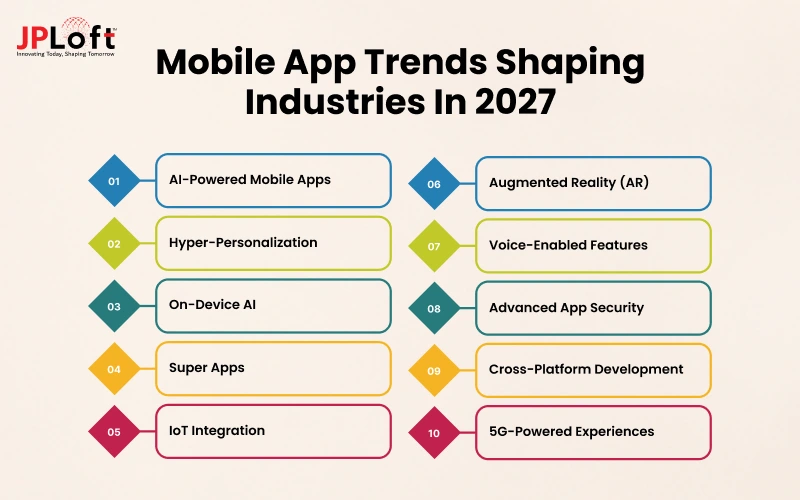
Here are 10 mobile app trends worth considering for your next business investment:
1. AI-Powered Mobile Apps
Sensor Tower's 2026 report points to accelerating use of generative AI apps. In 2027, the opportunity is practical AI: spending insights, administrative support, product discovery, or travel planning. Evaluate reliability, privacy, and human oversight.
2. Hyper-Personalization
Customers expect services that match their preferences. You can use customer data and machine learning to recommend products, customize offers, and improve customer retention.
3. On-Device AI
On-device AI processes information directly on smartphones instead of relying entirely on cloud servers. It can help your business deliver faster app experiences, support offline features, and improve data privacy.
4. Super Apps
Super apps combine multiple services within one platform. You can integrate payments, bookings, shopping, and customer support to increase app usage and create additional revenue opportunities.
5. IoT Integration
IoT-enabled apps connect smartphones with vehicles, equipment, and connected devices. Your business can use them to monitor assets, track deliveries, and manage operations in real time.
6. Augmented Reality (AR)
AR lets customers interact with digital products in real-world environments. You can introduce virtual product trials, furniture previews, and interactive property tours to improve buying decisions.
7. Voice-Enabled Features
Voice technology allows customers to search, place orders, and access services using spoken commands. Adding voice features can simplify app navigation and improve accessibility.
8. Advanced App Security
Biometric authentication, passkeys, encryption, and fraud detection help protect customer information. Investing in these features can strengthen customer trust and reduce security risks.
9. Cross-Platform Development
Frameworks such as Flutter and React Native help you build apps for Android and iOS using shared code. This can reduce development efforts, simplify maintenance, and speed up launches.
10. 5G-Powered Experiences
5G connectivity supports faster data transfers and responsive mobile experiences. Your business can explore real-time tracking, high-quality streaming, and connected device applications.
What Challenges Do Businesses Face When Adopting Mobile Apps?
From development costs and security risks to user adoption and ongoing maintenance, several challenges can affect your app performance. As a business owner, you need to understand these challenges before investing in mobile app development.
Addressing them early can help you control costs, avoid delays, and build an app that supports your business goals.
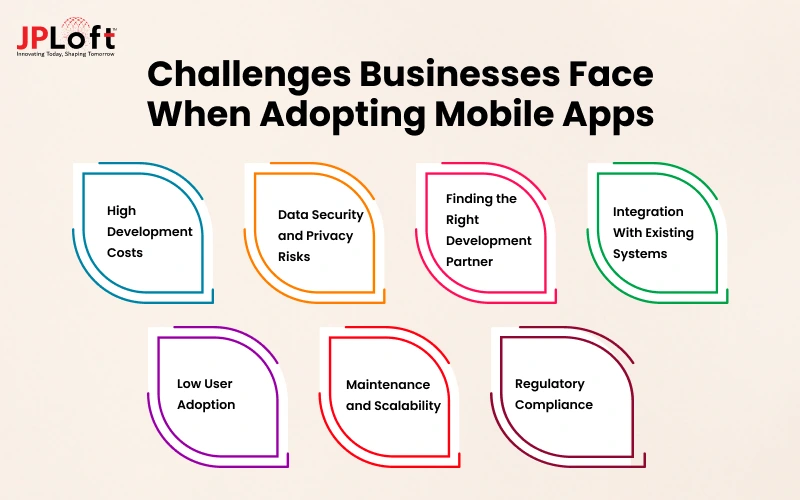
Here are some common challenges businesses face when adopting mobile apps:
1. High Development Costs
Mobile app development involves expenses for planning, design, development, testing, and deployment. Advanced features like AI, payment gateways, and real-time tracking can increase your budget.
How to address it: Start with an MVP and prioritize features that directly support your business goals.
2. Data Security and Privacy Risks
Mobile apps handle sensitive customer information, including personal details, payments, and location data. Weak security can expose your business to data breaches and compliance issues.
How to address it: Use data encryption, secure authentication, access controls, and regular security testing.
3. Finding the Right Development Partner
An inexperienced development team can cause project delays, technical problems, and unexpected expenses. Industry-specific requirements can make choosing the right partner more difficult.
How to address it: Evaluate portfolios, technical expertise, client reviews, and post-launch support before hiring developers.
4. Integration With Existing Systems
Your app may need to connect with existing CRM, ERP, inventory, or payment systems. Poor integration can disrupt workflows and create data inconsistencies.
How to address it: Define integration requirements early and use reliable APIs to connect business systems.
5. Low User Adoption
Customers may avoid using your app if navigation is complicated, performance is slow, or features offer limited value.
How to address it: Focus on user-friendly design, simple onboarding, personalized experiences, and useful features.
6. Maintenance and Scalability
Your app needs regular updates, bug fixes, security patches, and performance improvements. Growing user demand can also increase infrastructure costs.
How to address it: Allocate a maintenance budget and choose scalable technology.
7. Regulatory Compliance
Healthcare, payments, education, and consumer apps can face different requirements depending on who operates the product, what data it handles, and where users live. Examples include HIPAA, PCI DSS, COPPA, FERPA, and state privacy laws.
How to address it: Identify applicable regulations before development and include compliance measures from the beginning.

Why Trust JPLoft for Innovative Mobile App Solutions?
Turning your mobile app idea into a successful business solution requires the right technology partner.
JPLoft is a Denver-based mobile app development company with 16+ years of experience and more than 1,250 projects delivered. Our work includes fuel delivery, healthcare workforce, retail, and enterprise distributor solutions. We help businesses build innovative mobile applications that solve real operational challenges and create better customer experiences.
Here is what that means for you:
-
Industry-specific experience: Dedicated teams and pages for healthcare, fintech, retail, restaurants, logistics, real estate, manufacturing, fitness, and more.
-
Proven delivery: Case studies with named clients and measurable outcomes, not generic claims.
-
Modern stack: Flutter-based cross-platform builds plus AI agent and AI automation capabilities.
-
End-to-end support: Strategy, UI/UX design, development, testing, launch, and post-launch support.
Partner with JPLoft for your custom mobile app development solutions that align with your business goals, market expectations, and scalability.
Conclusion
Mobile apps are reshaping how businesses operate, connect with customers, and generate revenue in 2027. From healthcare and retail to manufacturing and finance, every industry has opportunities to use mobile technology for better efficiency and customer experiences.
As a business owner, your next step is to identify the challenges your customers face and determine how an app can solve them. Focus on essential features, choose the right technologies, and plan for scalability from the beginning.
You do not need to follow every trend or build a feature-heavy application. You need a solution that supports your business goals and delivers measurable value.
With the right development strategy and technology partner, you can turn your mobile app idea into a competitive business advantage and unlock new growth opportunities.
FAQs
Healthcare, retail, education, banking, logistics, and travel benefit significantly from mobile apps. They improve customer experiences, automate operations, and create new revenue opportunities.
Healthcare, e-commerce, banking, food delivery, education, and logistics have strong demand. Businesses use mobile apps to improve service accessibility, customer engagement, and operational efficiency.
Mobile apps help traditional businesses automate processes, accept digital payments, reach more customers, and personalize services. They also create new revenue channels and improve customer retention.
Healthcare, AI-powered education, fintech, logistics, fitness, and e-commerce offer promising opportunities. Startups can address specific customer problems through scalable apps and recurring revenue models.
AI enables personalized recommendations, predictive analytics, automated support, and intelligent workflows. Businesses can use these capabilities to improve decisions, reduce manual work, and deliver better customer experiences.

Priyanka Sukhwal is the Managing Director and Business Head of JPLoft, with 10+ years of experience in technology, digital product strategy, and business growth. She has worked closely with businesses building mobile applications, custom software, marketplaces, and on-demand platforms across mobility, automotive, consumer services, and startup ecosystems. At JPLoft, she focuses on understanding business models, identifying product opportunities, and helping companies plan digital solutions that can scale with changing market needs.




Share this blog