


Running a fuel delivery business feels like solving a puzzle every morning, and the pieces never sit still.
Orders pile up, drivers hit traffic, and dispatchers are stuck figuring out who goes where using little more than memory and gut instinct.
That worked fine when fleets were small, but the moment volume grows, or an emergency order shows up, the whole plan can fall apart fast.
This is where AI route optimization comes in.
It keeps track of traffic, tank levels, and driver locations, and adjusts routes the moment something changes, instead of waiting for a dispatcher to catch the problem.
And it's no longer just for big fleets either; it's become genuinely affordable for smaller businesses too.
Explore this guide to AI route optimization in fuel delivery to understand the whole process, from how AI plans delivery routes to the key benefits, challenges, and costs of using it in your business.
What Is AI Route Optimization in Fuel Delivery?
Fuel delivery route optimization uses algorithms and real-time data to find the most efficient route for each delivery.
It considers multiple factors that a human dispatcher cannot track manually across dozens of trucks at once.
Many businesses that decide to create a fuel delivery app build this capability in from the start, rather than bolting it on later.
Unlike a route planned once and followed rigidly for the rest of the day, this process happens continuously, updating as conditions on the ground change.
A road closure, a sudden spike in orders, or a driver running ahead of schedule can all trigger a recalculation within seconds, something that would take a human dispatcher far longer to notice and react to.
1. How It Differs From Standard GPS Navigation?
Standard GPS navigation tells a single driver how to get from point A to point B based on current traffic conditions.
It doesn't account for a dozen other trucks in the fleet, upcoming tank-level alerts, or which delivery should take priority if traffic suddenly backs up on the highway.
AI-powered route optimization works at the fleet level, not the single-vehicle level, coordinating multiple trucks, drivers, and delivery windows simultaneously to get the most out of every route across the entire operation.
It's the difference between one driver finding their own best path and an entire fleet moving in a coordinated, efficient pattern.
2. Where It Fits Into the Broader Dispatch Workflow
Route optimization doesn't operate in isolation.
It sits inside the larger dispatch process, pulling data from order management systems, GPS tracking, and often tank monitoring sensors to make routing decisions that reflect what's actually happening in the field.
Businesses that have already invested in fuel management system development tend to see the fastest, smoothest results here, since the routing engine has more accurate data to work with from day one.
Without clean order data and reliable vehicle tracking feeding into it, even the most advanced routing algorithm will struggle to make genuinely smart decisions.
Why Traditional Route Planning Falls Short?
Manual and semi-automated route planning served the fuel delivery industry for decades, but it was never built to handle the complexity that today's fleets deal with on a daily basis.
As order volume grows and customer expectations shift toward faster, more predictable delivery windows, the cracks in traditional methods become harder to ignore.
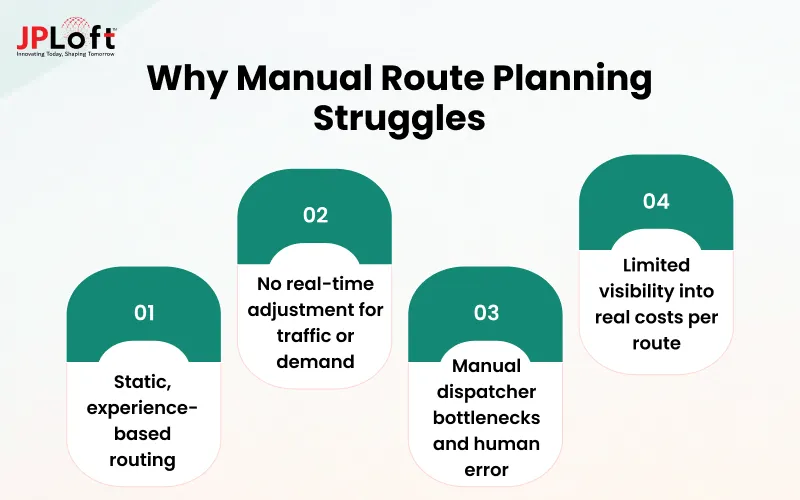
Here are some ways traditional route planning is getting replaced by AI route optimization in fuel delivery apps:
-
Static, experience-based routing – Routes are often planned the night before or first thing in the morning, based on a dispatcher's memory of what worked last time, rather than what's actually happening on the roads that day.
This approach depends heavily on one or two experienced staff members, which becomes a real liability if that person is out sick or leaves the company. -
No real-time adjustment for traffic or demand – Once a route is set, it typically stays fixed, even if traffic builds up, a customer moves their delivery window, or a new urgent order comes in mid-shift.
Dispatchers are left manually reshuffling the schedule, often over the phone while a driver waits. -
Manual dispatcher bottlenecks and human error – Every route decision routed through a single dispatcher creates a bottleneck, and the more orders a business handles, the more likely small mistakes, like double-booked drivers or missed delivery windows, start piling up.
These aren't rare exceptions either; they tend to become a predictable part of daily operations once a fleet crosses a certain size. -
Limited visibility into real costs per route – Without route-level data, it's difficult for a fuel business to know exactly which routes are burning excess fuel.
Or which drivers are consistently running behind. Or where inefficiencies are quietly draining profit month after month.
These limitations are exactly why more fuel businesses are shifting toward fuel delivery route optimization software that removes the guesswork and reacts to real conditions instead of yesterday's plan.
How AI Route Optimization Reduces Delivery Time?
Speed is one of the most immediate benefits fuel businesses notice after adopting AI in fuel delivery apps.
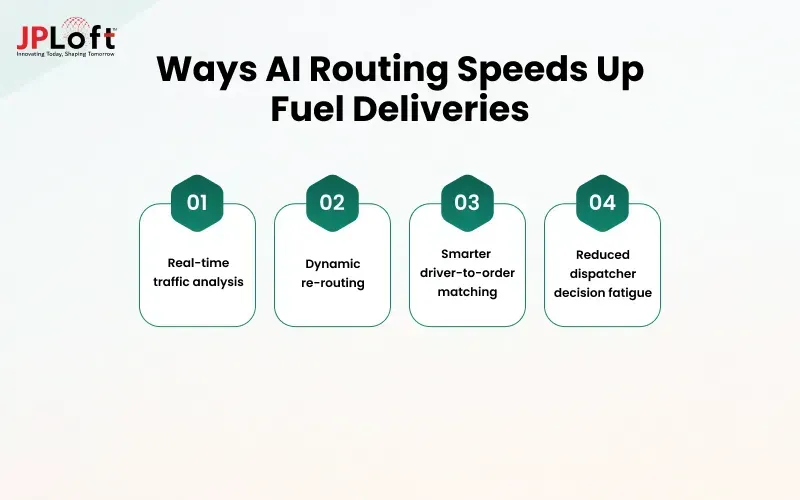
This can benefit businesses by reducing delivery time:
-
Real-time traffic analysis – The system continuously monitors live traffic data and adjusts routes on the fly, keeping drivers out of unnecessary delays before they even happen. Instead of a driver discovering a traffic jam after they're already stuck in it, the system reroutes proactively based on live conditions.
-
Dynamic re-routing – When a new urgent order comes in or a delivery window shifts, the AI recalculates the route instantly instead of forcing a dispatcher to manually rework the entire schedule. This matters enormously in fuel delivery, where emergency orders, especially during cold snaps or supply shortages, can happen at any point in the day.
-
Smarter driver-to-order matching – Orders get assigned to the closest available driver with the right vehicle capacity, cutting down on unnecessary backtracking across the service area. A driver finishing a delivery on one side of town won't be sent across the city when another driver is already nearby.
-
Reduced dispatcher decision fatigue – When routing decisions are automated, dispatchers spend less mental energy on repetitive scheduling tasks and more time handling exceptions, customer communication, and the parts of the job that genuinely need human judgment.
Together, these features mean drivers spend less time stuck in traffic or driving inefficient loops, and customers get their fuel delivered closer to the time they were promised, which directly improves customer satisfaction and repeat business.
How AI Route Optimization Cuts Fleet Costs?
Reducing delivery time is only half the story. The other major benefit of AI-powered route optimization shows up directly on the balance sheet, since every mile saved translates into real operational savings that compound over time.
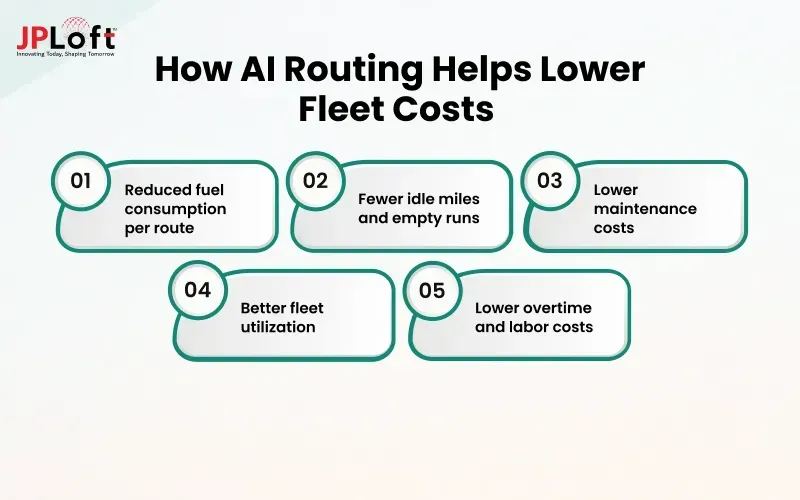
- Reduced fuel consumption per route – Shorter, smarter routes mean trucks burn less fuel completing the same number of deliveries, which matters even more for a business that's literally in the fuel business. Even a modest reduction in miles driven per route adds up significantly across a fleet running dozens of deliveries daily.
- Fewer idle miles and empty runs – Optimized routing minimizes the distance drivers travel without an active delivery in progress, cutting down on wasted trips back and forth between the depot and delivery zones.
- Lower maintenance costs – Vehicles that log fewer unnecessary miles experience less wear and tear, which extends maintenance cycles, reduces the frequency of tire and brake replacements, and lowers long-term repair costs.
- Better fleet utilization – With smarter routing, the same number of trucks and drivers can complete more deliveries per shift, reducing the need for additional vehicles or hires as order volume grows. This is often the single biggest cost advantage, since scaling deliveries without scaling headcount and fleet size proportionally has a direct impact on profitability.
- Lower overtime and labor costs – When routes are planned efficiently from the start, drivers are less likely to run into unexpected delays that push shifts into overtime, which helps control labor costs on top of fuel and maintenance savings.
Businesses evaluating whether to invest in this technology often start by comparing it against their current cost to develop a fuel delivery app, since route optimization is frequently built as one core module within a broader dispatch platform rather than a standalone tool.
Traditional Route Planning vs AI Route Optimization
Traditional Routing vs AI-Powered Planning
Seeing the two approaches side by side makes the practical differences easier to grasp, especially if you're looking to start a fuel delivery business and want to get routing right from day one.
|
Aspect |
Traditional Route Planning |
AI Route Optimization |
|
Route creation |
Manual, based on dispatcher experience |
Automated, based on real-time data |
|
Adaptability |
Fixed once set for the day |
Continuously recalculated as conditions change |
|
Traffic response |
Reactive, driver discovers delays live |
Proactive, reroutes before delays occur |
|
Driver assignment |
Based on memory or availability guesswork |
Based on real-time location and capacity matching |
|
Scalability |
Becomes harder to manage as fleet grows |
Scales naturally with order volume |
|
Fuel efficiency |
Inconsistent, dependent on route quality |
Consistently optimized for shortest, smartest paths |
|
Emergency orders |
Requires manual rescheduling |
Slotted in automatically without disrupting existing routes |
|
Data and reporting |
Limited historical insight |
Detailed route-level performance data |
Key Technologies Behind AI-Powered Routing
AI route optimization for fuel delivery doesn't run on a single piece of technology.
It's the combination of several systems working together in real time, and understanding each piece helps clarify why this capability has become so much more accessible in recent years.
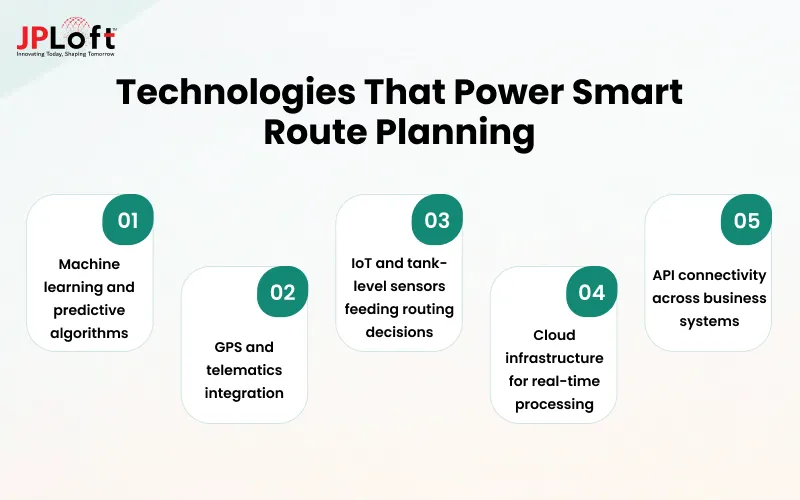
Here are some technologies for AI-powered routing:
-
Machine learning and predictive algorithms – These models learn from historical delivery data, traffic patterns, and seasonal demand to make increasingly accurate routing decisions over time. The longer a system runs, the better it gets at anticipating patterns specific to a business's own service area and customer base.
-
GPS and telematics integration – Live vehicle location data feeds directly into the routing engine, giving the system an accurate, real-time picture of where every truck actually is at any given moment, rather than relying on estimated positions.
-
IoT and tank-level sensors feeding routing decisions – For businesses handling propane, heating oil, or bulk fuel, wireless tank sensors can trigger automatic reorder routing. This can happen before a customer even realizes their tank is running low. We cover this capability in more depth in our guide on IoT in fuel delivery app development.
-
Cloud infrastructure for real-time processing – Route recalculations need to happen instantly across hundreds of active deliveries. This requires a scalable, cloud-based architecture that can handle real-time computational demands. On-premises systems may struggle with this level of workload.
-
API connectivity across business systems – Route optimization works best when it's not siloed. Connecting it to accounting, inventory, and customer communication tools ensures that routing decisions reflect the full picture of the business, not just what's happening on the road.
Real-World Use Cases & Results of Leveraging AI Route Optimization
AI route optimization is already helping fuel businesses improve daily delivery operations.
From better route planning to fewer delays, its impact can be seen across different parts of fuel delivery.
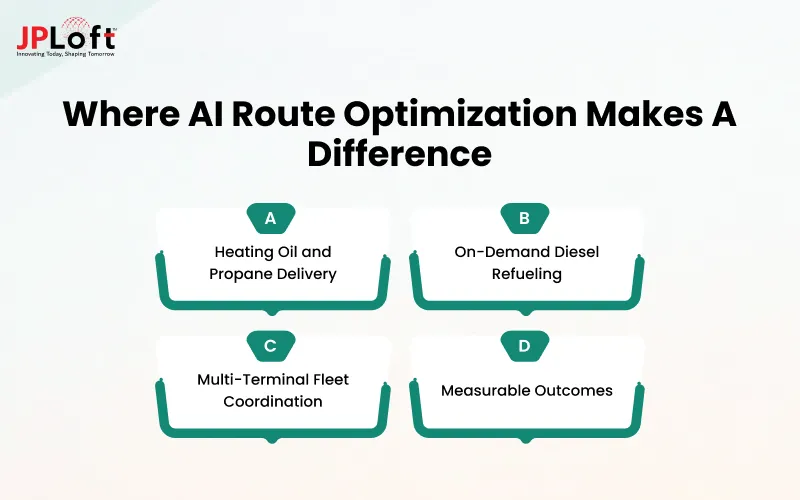
The following use cases show how businesses can apply AI route optimization and the results it can deliver:
1. Heating Oil and Propane Delivery
Heating oil and propane providers deal with unpredictable demand swings, especially during cold snaps when multiple customers need emergency deliveries at once.
AI route optimization factors in degree-day forecasting alongside live tank data, allowing dispatchers to proactively route trucks to customers likely to run low before they even call in, rather than reacting after the fact.
This shift from reactive to predictive delivery has become one of the more meaningful advantages for businesses operating in colder climates with seasonal demand spikes.
2. On-Demand Diesel Refueling
For businesses offering on-demand diesel delivery to construction sites, fleets, or commercial customers, timing is everything.
AI-driven routing allows dispatchers to slot last-minute orders into existing routes without disrupting already-scheduled deliveries.
This keeps response times fast even during high-demand periods.
Construction and commercial clients tend to have little tolerance for delays. Equipment sitting idle without fuel translates directly into lost productivity on their end.
3. Multi-Terminal Fleet Coordination
Larger fuel distributors operating across multiple depots or terminals face an added layer of complexity, since routing decisions need to account for which terminal is closest to a given delivery and which has adequate inventory on hand.
AI route optimization can coordinate across multiple terminals simultaneously, assigning deliveries not just to the nearest available driver, but to the terminal best positioned to fulfill the order efficiently.
4. Measurable Outcomes
Fuel businesses that adopt route optimization typically report fewer missed delivery windows, meaningful reductions in fuel spent per route, and the ability to handle a growing order volume without proportionally growing their fleet size.
Over time, these efficiency gains compound, since even small per-route savings add up significantly across hundreds of deliveries a month.
Reporting and analytics built into most modern platforms also give business owners visibility they simply didn't have before, making it easier to spot underperforming routes or drivers and address issues before they become larger problems.
Signs Your Fuel Business Is Ready for AI Route Optimization
Not every business needs to make this shift immediately, but certain signs tend to indicate that manual or semi-automated dispatching has hit its limits.
-
Dispatchers are spending most of their day manually adjusting routes rather than handling exceptions or customer issues
-
Missed delivery windows or customer complaints about delivery timing are becoming more frequent
-
Fuel costs per delivery have been creeping up without a clear explanation
-
The business is adding trucks or drivers faster than order volume actually justifies
-
There's no reliable way to track which routes or drivers are consistently underperforming
-
Emergency or last-minute orders regularly disrupt the entire day's schedule
If several of these sound familiar, it's usually a strong indication that the current dispatch process has outgrown manual methods and that fuel delivery route optimization software could deliver a meaningful, near-term return.
How to Implement AI Route Optimization in Your Fuel Business?
Bringing this technology into an existing operation involves more than simply buying software and flipping a switch. A thoughtful rollout tends to produce far better long-term results than rushing the process.
-
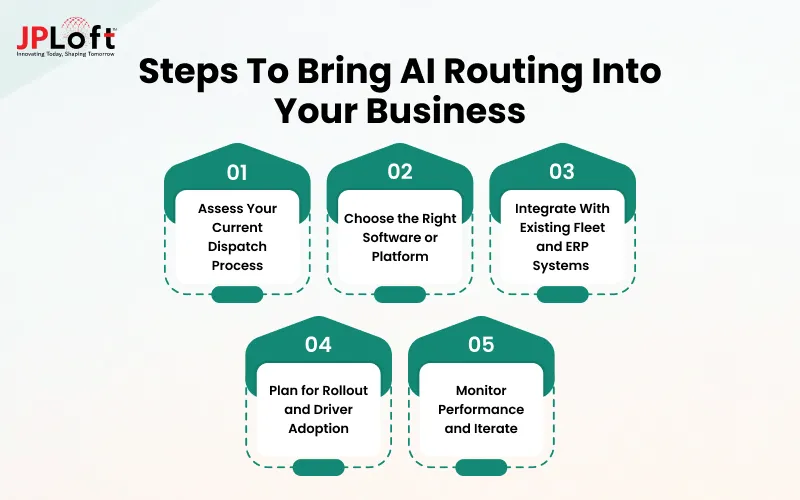
Assess Your Current Dispatch Process – Start by identifying where your existing routing breaks down, whether that's frequent late deliveries, high fuel costs, or dispatchers spending too much time manually coordinating drivers.
This baseline also makes it much easier to measure the actual impact once the new system is in place. -
Choose the Right Software or Platform – Look for fuel delivery route optimization software that fits your fleet size and integrates with the systems you already use, rather than forcing you to rebuild your entire tech stack from scratch.
Vendors vary significantly in how well they handle fuel-specific needs like tank monitoring and degree-day forecasting.
So, it's worth confirming this experience directly rather than assuming general logistics software will translate well. -
Integrate With Existing Fleet and ERP Systems- Route optimization delivers the most value when it's connected to your broader operations, including accounting, inventory, and telematics, an area covered further in our piece on API integration for fuel delivery apps.
Disconnected systems tend to recreate the same manual bottlenecks the new software was meant to eliminate. -
Plan for Rollout and Driver Adoption- Even the smartest routing system only works if drivers actually trust and follow it, so plan for a gradual rollout with a small group of drivers first, gather feedback, and adjust before a full fleet-wide launch.
Drivers who feel like the system genuinely makes their job easier, rather than adding another layer of complexity, tend to adopt it far more willingly. -
Monitor Performance and Iterate- Once live, keep tracking key metrics like fuel savings, delivery time improvements, and driver feedback.
AI systems typically improve with more data over time, so ongoing monitoring helps a business get more value out of the platform the longer it's in use.
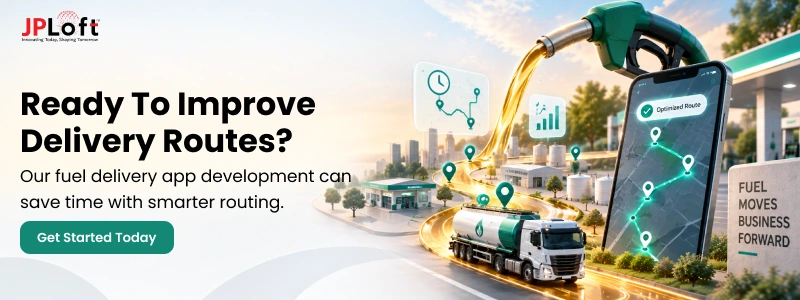
How Can JPLoft Help You Implement AI Route Optimization?
Every delivery has a clock ticking in the background. A wrong turn, traffic delay, or poorly planned stop can quickly affect the entire schedule.
JPLoft helps businesses use AI route optimization to make daily deliveries more organized and efficient. We first understand your fleet, delivery volume, service areas, and business needs.
Then, our team builds routing solutions that use real-time traffic, delivery priorities, vehicle capacity, and driver data.
Our fuel delivery app development services can connect route optimization with dispatch, order management, driver tracking, and customer updates.
With 1,250+ projects delivered across 70+ countries, JPLoft brings broad experience to fuel delivery solutions.
We combine AI-driven routing with practical workflows to help businesses manage deliveries more efficiently and give teams better control over daily operations.
Conclusion
AI route optimization for fuel delivery has moved from a nice-to-have feature to a genuine competitive advantage for businesses trying to deliver faster while keeping fleet costs under control.
The technology works by replacing static, experience-based planning with real-time decisions that adapt as conditions change throughout the day, and the payoff shows up in shorter delivery times, lower fuel consumption, and a fleet that can handle more orders without adding more trucks.
If your business is still relying on manual dispatching or route planning, the gap between where you are and where AI-powered fleets already operate is only going to widen.
Partnering with a team that understands both the technology and the fuel delivery business itself makes the difference between adopting a tool that looks good on paper and building a system that actually moves your fleet forward.
FAQs
Pricing varies based on fleet size, the depth of automation, and whether tank monitoring or telematics hardware is included. Basic route optimization tools can start in the low hundreds of dollars per month, while advanced platforms with full AI-driven optimization and ERP integration can run into the thousands per month for larger fleets.
A straightforward implementation connecting to existing GPS and order systems can take a few weeks to a couple of months. More complex rollouts involving new hardware, tank sensor integration, or custom development typically take three to six months, depending on fleet size and system complexity.
It works for both. Small fleets benefit from reduced fuel costs and fewer scheduling errors even with just a handful of trucks, while large fleets gain the added advantage of multi-terminal coordination and the ability to scale order volume without proportionally scaling headcount.
Most businesses see measurable fuel savings, fewer missed delivery windows, and improved fleet utilization within the first few months. Exact ROI depends on fleet size and how inefficient the previous routing process was, but many businesses recover their software investment within a year through combined fuel, labor, and maintenance savings.
In many cases, it can integrate with GPS and telematics hardware a business already has in place. However, adding features like real-time tank monitoring or advanced telematics may require additional sensors or devices, depending on how deep the automation needs to go.

Savannah is a passionate tech enthusiast with a sharp understanding of client needs across diverse digital domains. With expertise spanning financial platforms, on-demand solutions, and emerging technologies, she brings a unique blend of analytical insight and interpersonal skills, helping businesses decode complexities and make informed decisions in today's rapidly evolving digital world.



Share this blog