


Key Takeaways:
Most RAG projects cost $15,000 to $200,000+, from basic builds to enterprise platforms, based on data, features, and security.
Expect about $300 to $15,000+ per month, covering hosting, AI usage, and RAG maintenance costs.
Data prep takes 15% to 25% of the budget. Clean, organized files cut the cost, while messy data raises it.
Ready-made tools suit pilots and simple needs. Custom RAG costs more upfront but fits secure, complex, high-volume projects.
Enterprise builds start near $100,000 and can pass $200,000 due to security, compliance, many data sources, and large user volumes.
Everyone wants an AI that knows their business. Few people know what it costs to get one.
Retrieval-Augmented Generation, or RAG, lets an AI answer questions using your data. That means more accurate answers and more trust from your users. But before you approve the budget, you need real numbers.
Here is the catch. Most quotes look simple on paper. Then data cleaning, hosting, and upkeep show up, and the bill grows fast. Founders get surprised. CTOs get questioned. Investors ask for a clear plan.
This guide gives you that plan. It explains the RAG development cost in 2026 in simple words, from a small pilot to a large enterprise setup. You will also find what drives the price, where money is often wasted, and how to spend smarter.
Let's break down every cost, one clear piece at a time.
RAG Development Cost by Project Complexity
Not every RAG project needs the same budget. The cost to build a RAG system ranges from $15,000 to $200,000+ across three levels, and each level adds more data, features, and safety.
|
Level |
One-Time Build Cost |
Timeline |
|
Basic RAG |
$15,000 to $40,000 |
1 to 2 months |
|
Mid-level/Production RAG |
$40,000 to $100,000 |
2 to 4 months |
|
Enterprise RAG |
$100,000 to $200,000+ |
4 to 6+ months |
1. Basic RAG
A basic RAG system connects one clean data source, like a help center or product guide, to one AI model. It works well for FAQ bots and small internal tools.
To build a RAG system like that, the cost usually sits between $15,000 and $40,000, with a build time of 4 to 8 weeks. Monthly running costs stay low, around $300 to $1,500.
|
Cost Component |
Estimated Cost |
|
Data preparation and cleaning |
$3,000 to $8,000 |
|
Vector database setup |
$2,000 to $5,000 |
|
Search and retrieval setup |
$3,000 to $8,000 |
|
AI model integration |
$3,000 to $8,000 |
|
Basic chat interface |
$3,000 to $8,000 |
|
Testing and launch |
$1,000 to $3,000 |
Data work and the chat interface take the largest shares. Clean files keep you near the lower end, while messy files push the cost higher.
2. Mid-level/Production RAG
A production RAG system serves real users every day. It pulls data from three to five sources, such as your CRM, database, and files, and gives fast, correct answers.
The RAG application development cost here ranges from $40,000 to $100,000, and the build takes 2 to 4 months. Monthly running cost ranges from about $1,500 to $5,000.
|
Cost Component |
Estimated Cost |
|
Multi-source data pipeline |
$8,000 to $20,000 |
|
Vector database and hybrid search |
$6,000 to $15,000 |
|
Re-ranking and source citations |
$5,000 to $12,000 |
|
AI model integration and guardrails |
$6,000 to $15,000 |
|
User interface and access control |
$8,000 to $18,000 |
|
Testing and deployment |
$7,000 to $20,000 |
Data pipelines and the user interface take the biggest share. Guardrails and testing matter too, because wrong answers hurt trust once real users depend on the system.
3. Enterprise RAG
Enterprise RAG is built for large companies with strict rules. It connects 10 or more data sources, serves thousands of users, and keeps full audit records.
The enterprise RAG development cost starts near $100,000 and can exceed $200,000 in regulated fields like banking and healthcare. The build takes 4 to 6+ months, with monthly running costs of $5,000 to $15,000+.
|
Cost Component |
Estimated Cost |
|
Data pipeline for 10+ sources |
$20,000 to $40,000 |
|
Advanced retrieval and tuning |
$15,000 to $30,000 |
|
AI model routing and guardrails |
$12,000 to $25,000 |
|
Security and compliance |
$20,000 to $40,000 |
|
Multi-tenant app and admin dashboard |
$18,000 to $35,000 |
|
Testing and deployment |
$15,000 to $30,000 |
App security and compliance take one of the largest shares. Costs can pass $200,000 when you add fine-tuned models, live data feeds, or support for many languages.
To pick your level, check three things: how much data you have, how many people will use it, and how strict your accuracy and privacy needs are.
One more point matters. The cost of implementing RAG systems goes beyond the build price, since hosting, updates, and fixes continue every month. Plan for them from day one.
What Makes Up the Total RAG Development Cost?
Every RAG system is built from several connected layers, and each layer adds to the final bill. Understanding these parts shows exactly where your money goes and where to save. Here is what goes into it.
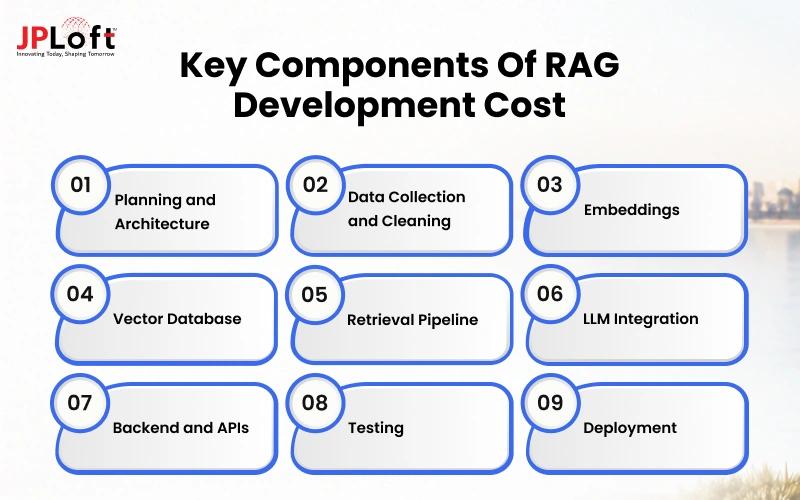
1. Planning and Architecture
This step sets the base for everything else. A professional AI development company defines the goal, the users, and the tools before coding starts.
Good planning costs less than fixing mistakes later. This stage usually takes about 5 to 10 percent of the budget.
2. Data Collection and Cleaning
RAG answers are only as good as your data. This step gathers files and removes duplicates, errors, and old content.
Messy data is the biggest surprise in RAG Development Cost, often taking up 15 to 25 percent of the budget.
3. Embeddings
Embeddings turn your text into numbers that AI can compare. This lets the system find meaning, not just matching words.
Cost depends on how much text you have. This part is small, usually 3 to 5 percent of the budget.
4. Vector Database
A vector database stores your embeddings and finds the closest matches fast. Popular options include Pinecone, Qdrant, Weaviate, and pgvector.
Setup takes 5 to 8 percent of the budget. Hosting adds a monthly fee, which grows as your data grows.
5. Retrieval Pipeline
Retrieval decides which pieces of data reach the AI, so it shapes the cost to develop a RAG system the most.
This includes search, ranking, and source links. It takes 10 to 15 percent of the budget and needs careful testing.
6. LLM Integration
Here, retrieved data goes to an AI model, like GPT or Claude, which writes the final answer in clear language.
Prompt writing and safety checks are part of this work. Budget 8 to 12 percent, plus monthly AI usage fees.
7. Backend and APIs
The backend is the engine that connects everything. It handles requests, user logins, and links to your CRM or databases.
Each new integration adds time and cost. This is a major slice, around 15 to 20 percent of the total.
8. Testing
Testing checks that answers are correct, safe, and fast. Teams test for wrong answers, leaks, and heavy traffic before launch.
Skipping this step seems like a saving but causes costly fixes later. Plan 8 to 10 percent of the budget.
9. Deployment
Deployment puts your RAG system live on cloud servers. It includes setup, security settings, monitoring, and a smooth first launch.
This stage takes 5 to 8 percent of the budget. After launch, cloud hosting and support become regular monthly costs.
Key Factors That Affect RAG Development Cost
The cost to make a RAG system changes from project to project. A few key factors decide whether your budget stays small or grows fast. See what each one adds.
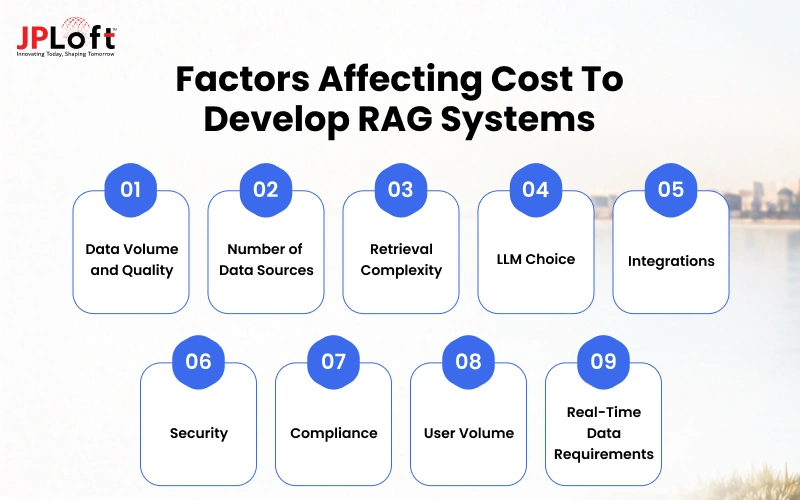
Factor 1. Data Volume and Quality
More files mean more storage, embedding, and cleaning work. Poor quality data costs even more because teams must fix errors by hand and re-check every answer. Data volume and quality can easily affect the overall cost by 15% to 25%.
Factor 2. Number of Data Sources
Each new source needs its own connection, format checks, and update schedule. Pulling from a CRM, a website, and cloud files takes far more work than reading one folder. This factor adds roughly 10% to 15% to the overall cost.
Factor 3. Retrieval Complexity
Retrieval complexity adds 10% to 15% to the overall RAG application development cost. Simple search is quick to build. Smarter retrieval, such as hybrid search, re-ranking, and source links, takes more design and testing. Better retrieval means fewer wrong answers.
Factor 4. LLM Choice
Premium models give better answers but charge more for every single question. Smaller models cost less but may need extra prompt tuning. Your LLM choice can affect the overall cost by 8% to 12%, mostly through monthly API usage fees.
Factor 5. Integrations
Connecting RAG to tools like your CRM, ERP, Slack, or helpdesk needs extra backend work and testing. Each tool has its own rules and limits. Integrations add 10% to 15% to the overall cost, and more tools mean more time.
Factor 6. Security
Security work such as encryption, role-based access, private hosting, and audit logs pushes the enterprise RAG development cost higher. It protects sensitive customer data from leaks and misuse. Security typically adds about 8% to 12% to the overall project cost.
Factor 7. Compliance
Rules like HIPAA, GDPR, and SOC 2 require reviews, documentation, and additional controls. Healthcare, finance, and government projects usually feel this most. Compliance can add 10% to 20% to the overall cost, and audits can also extend the timeline.
Factor 8. User Volume
More users mean more questions, more traffic, and more servers. A tool for 50 staff is far cheaper than one for 50,000 customers. User volume typically affects the overall cost by 5% to 10%, mostly through scaling and load testing.
Factor 9. Real-Time Data Requirements
Real-time data increases RAG infrastructure costs because systems must sync, index, and refresh content throughout the day. Live feeds from tickets, prices, or stock levels need special streaming tools. This factor adds about 8% to 12% to the overall cost.
Custom RAG vs Off-the-Shelf RAG
Before setting a budget, decide whether to build a custom RAG system or use a ready-made tool. A trusted software development company offers different paths, each having a different price, timeline, and level of control.
The table below compares both options side by side so you can choose.
|
Factor |
Custom RAG |
Off-the-Shelf RAG |
|
Upfront cost |
$15,000 to $200,000+ |
$0 to $10,000 for setup |
|
Monthly cost |
$300 to $15,000+ |
$100 to $2,000 |
|
RAG maintenance cost |
Paid by you or your tech partner |
Mostly included in the plan fee |
|
Build time |
4 weeks to 6+ months |
Days to 2 weeks |
|
Data control |
Full control |
Limited, vendor-hosted |
|
Customization |
Fully tailored |
Fixed features |
|
Security and compliance |
Built to your rules |
Depends on the vendor |
|
Scalability |
Grows with your needs |
Costs rise with usage |
|
Best for |
Complex, regulated, or high-volume projects |
Pilots and simple use cases |
How to Reduce the Cost to Develop RAG Systems?
Smart planning can lower the cost of implementing RAG systems without hurting answer quality. These six steps help you spend less, avoid waste, and grow at a steady, safe pace.
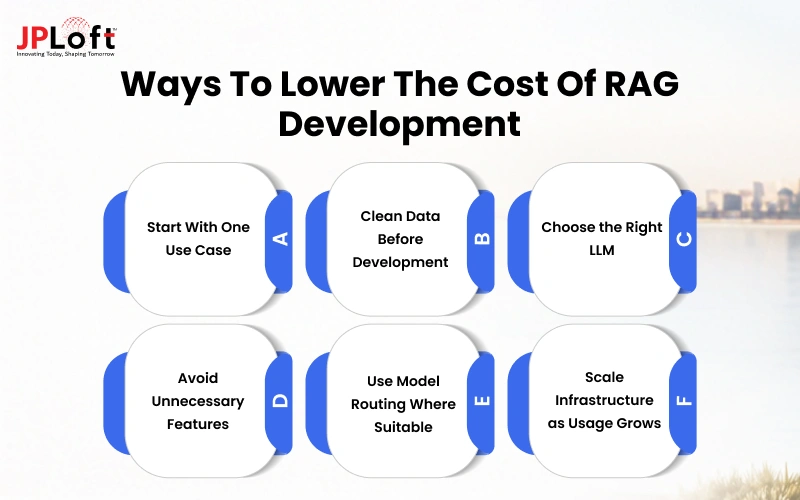
1. Start With One Use Case
Building everything at once raises your budget fast, so pick one clear problem first, such as:
-
Support answers
-
Policy search
-
Sales document lookup
Prove the value, then expand. Hire AI developers for a focused launch to cut first build cost by 20% to 30%.
2. Clean Data Before Development
Complex data forces extra rework later. Before coding starts:
-
Remove duplicate and outdated files
-
Fix broken formats and missing text
-
Tag documents by topic and owner
Cleaning data early can save 15% to 25% of the budget and improve answers.
3. Choose the Right LLM
A bigger model is not always better. Match the model to the task, because LLM fees drive the RAG system cost every month:
-
Small models for simple FAQs
-
Premium models for complex reasoning
Right-sizing models can save 10% to 20%.
4. Avoid Unnecessary Features
Every extra feature adds design, coding, and testing time. Start with must-haves and delay these:
-
Voice input
-
Multi-language support
-
Advanced analytics dashboards
Staying lean can easily reduce the overall budget by 10% to 20% and speed up your launch date.
5. Use Model Routing Where Suitable
Model routing sends easy questions to cheap models and sends hard ones to strong models.
-
Easy FAQs: small model
-
Hard queries: premium model
-
Repeat questions: cached answers
Routing and caching together can cut monthly AI fees by 30% to 50%.
6. Scale Infrastructure as Usage Grows
Paying for big servers on day one wastes money. Keep the RAG infrastructure cost low by:
-
Starting with small cloud plans
-
Using auto-scaling for traffic spikes
-
Tracking usage monthly
Pay-as-you-grow setups can lower early hosting bills by 20% to 30%.
Why Choose JPLoft for Cost-Effective RAG Development?
Choosing a development partner shapes how much you spend, both now and later. JPLoft's RAG development services are built to keep that spending sensible, starting with a clear plan around your goals, data, and budget.
From there, the work moves in phases. Projects begin with one proven use case, so you see results early, and data cleaning support helps avoid costly rework down the road. Right-sized LLMs and model routing then keep monthly AI fees in check.
Trust matters as much as price. Clear pricing means no hidden charges, and a secure, compliance-ready setup supports industries with strict rules. This approach keeps the cost to build a RAG system predictable without lowering quality.
Support continues after launch, with monitoring, updates, and fixes, so ongoing expenses stay low as your data and users grow. To get started, share your idea and receive a clear, realistic estimate.
Conclusion
RAG can turn your company data into fast, accurate answers, but the budget needs careful planning. As this guide showed, projects can cost anywhere from $15,000 to $200,000+, depending on size, data, security, and integrations.
Basic projects stay near the lower end, while enterprise builds with strict security and compliance needs sit at the top. Costs do not end at launch, because hosting, AI usage, and updates continue every month.
The good news is that a planned approach keeps the RAG development cost under control and your results strong. Start small, clean your data, pick the right model, and scale only when real usage grows.
With the right plan, RAG becomes a smart investment instead of a surprise expense. If you are ready to move forward, JPLoft can help you build a system that fits your goals, timeline, and budget.
FAQs
Most projects range from $15,000 to $200,000+. Basic builds cost $15,000 to $40,000, production systems $40,000 to $100,000, and enterprise platforms $100,000 to $200,000+, depending on data, features, and security.
Expect $300 to $15,000+ per month, covering hosting, AI usage, and the RAG maintenance cost of updates, fixes, and monitoring. Larger systems with more users and live data cost more.
Data prep often takes 15% to 25% of the budget. Clean, well-organized files lower the cost, while messy, duplicate, or scattered data needs extra cleaning and pushes the price up.
Ready-made tools suit pilots and simple needs, with low setup cost but limited control. Custom RAG costs more upfront and fits secure, complex, or high-volume projects that need full control.
Security, compliance, many data sources, and large user volumes drive the enterprise RAG development cost, which starts near $100,000 and can pass $200,000. Monthly fees add another $5,000 to $15,000+.

Yashwant Sharma is the CTO of JPLoft, with 18+ years of experience in software engineering, solution architecture, and digital innovation. His expertise spans scalable application development, AI-powered systems, RAG solutions, cross-platform development, software maintenance, and emerging mobility technologies such as EV and EV-charging platforms. He works across complex technical environments to help businesses build secure, maintainable, and high-performing digital products for industries including education, fitness, aviation, and healthcare.


Share this blog