


Key Takeaways:
Mobile app maintenance is a continuous process that supports long-term app stability, scalability, security, and operational performance after launch.
Modern apps require ongoing maintenance because of evolving operating systems, APIs, cloud infrastructure, integrations, and changing user expectations.
Businesses should understand different maintenance types, including corrective, adaptive, predictive, and perfective maintenance.
AI and automation are transforming modern app maintenance through predictive monitoring, automated testing, risk detection, and user experience optimization.
The average mobile app maintenance cost in 2026 ranges between 15% to 20% of the initial app development cost annually, depending on several aspects.
Choosing the right app maintenance partner helps businesses maintain cross-platform compatibility, performance stability, and long-term operational continuity.
If your business has a mobile app and you have never heard of “post-launch app maintenance”, then you seriously need to reconsider your digital strategy.
Simply developing and launching the app is not the only job to be worried about. A mobile app can perform flawlessly at launch and still begin losing users within months.
There can be several reasons for it, but slow app performance, unstable integrations, failed updates, or growing infrastructure issues are the core issues resulting in app failure.
This is why mobile app maintenance has become a critical part of long-term digital product success in 2026.
Without ongoing monitoring, optimization, and infrastructure support, maintaining app stability becomes increasingly difficult.
In this blog, we will discuss in detail how to maintain an app after launch, what modern-day app maintenance includes, and who can help maintain your app.
What Is App Maintenance?
Mobile app maintenance is the ongoing process of monitoring, optimizing, and supporting an application after launch to ensure long-term stability and performance.
The need for such maintenance is increasing because modern-day app development processes rely heavily on operating systems, APIs, cloud infrastructure, and third-party integrations. Such a backend shift is important to fulfill evolving user expectations.
Without regular maintenance, apps can experience crashes, compatibility issues, security risks, and declining user retention.
Today, the maintenance approach goes beyond fixing bugs. It includes performance monitoring, backend support, compatibility management, infrastructure reliability, and continuous app improvement.
Mobile App Maintenance vs Mobile App Updates
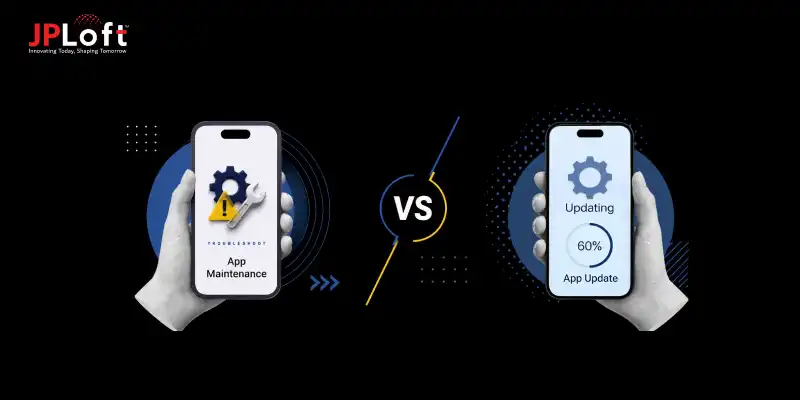
Many businesses find no difference between app maintenance vs app updates, but both serve different operational purposes.
While updates focus on visible features or interface changes, maintenance supports the ongoing stability, performance, and reliability required to keep apps functioning smoothly.
|
Aspect |
Mobile App Maintenance |
Mobile App Updates |
|
Purpose |
Maintains long-term app stability, performance, security, and operational reliability |
Introduces visible changes such as new features, UI improvements, or version releases |
|
Focus Area |
Backend systems, APIs, infrastructure, compatibility, monitoring, and optimization |
User-facing enhancements and feature modifications |
|
Frequency |
Continuous and ongoing throughout the app lifecycle |
Released periodically based on the product roadmap or business goals |
|
Visibility to Users |
Often happens in the background without direct user visibility |
Usually noticeable through new functionality or interface changes |
|
Business Impact |
Supports scalability, operational continuity, retention, and infrastructure stability |
Helps improve engagement, feature adoption, and user experience |
|
Common Examples |
Fixing API disruptions, optimizing server performance, and managing OS compatibility |
Launching a new dashboard, adding payment methods, and redesigning app screens |
Why Mobile App Maintenance Matters More Than Ever in 2026?
The need for post-launch app maintenance and support is increasing in 2026. Modern-day businesses can no longer treat maintenance as occasional technical support.
Modern businesses need to understand what happens if you don't maintain an app, which can help them better plan their maintenance practices.
A] Rising Operating System Updates
Android and iOS updates now roll out faster and introduce stricter policies around permissions, background processing, security access, and UI behavior.
Apps that fail to adapt to such updates often experience feature failures, device incompatibility, battery performance issues, or app store policy violations.
Hence, understanding why maintain a mobile app helps businesses ensure platform compatibility without disrupting the user experience.
B] Increasing Dependency on APIs and Integrations
The advanced apps with diverse functionalities heavily depend on external integrations. These include payment gateways, cloud databases, authentication services, maps, messaging systems, and analytics platforms.
Even minor API version changes can interrupt critical app functionality, impact app performance, and affect user experience.
Hence, partnering with app maintenance teams is important to continuously monitor these dependencies to prevent service disruptions, failed transactions, or broken workflows.
C] Higher User Expectations for Performance
If you are wondering why app maintenance is important, then you must be aware of the comparisons modern users make when selecting mobile apps.
Users now compare app experiences against the fastest and most responsive platforms in the market. Slow loading screens, delayed actions, freezing interfaces, or unstable sessions can quickly reduce engagement and increase uninstall rates.
The guide to mobile app maintenance helps businesses identify bottlenecks, optimize backend responses, and sustain smooth user experiences as traffic and feature complexity increase.
D] Growing Security and Compliance Pressure
Mobile apps handle sensitive customer information, payment data, location tracking, and real-time transactions at scale. Such data handling is becoming a key reason the mobile apps are prone to cyber threats.
As cybersecurity threats continue increasing, businesses must continuously strengthen mobile app security measures, authentication systems, patch vulnerabilities, secure APIs, and monitor infrastructure risks.
Regular maintenance also helps apps stay aligned with evolving compliance standards and platform-level security requirements.
E] Scalability and Operational Stability
Every business operates with a scalability goal, and as businesses expand into new regions, user bases, and service offerings, the app complexity increases.
Hence, with scalability, the application infrastructure must handle increased traffic loads and operational complexity.
Without proactive monitoring and backend optimization, scaling often leads to server instability, downtime, or a question mark on how to keep an app updated after launch.
What Modern Mobile App Maintenance Includes: A Complete Checklist
The above section covers the need for app support and maintenance in 2026, but as an entrepreneur, what should you expect when hiring dedicated developers for your app maintenance?
Modern app maintenance solutions are no longer limited to fixing bugs; depending on the platform requirements, the approach regarding how to maintain an app after launch is decided.
Here’s what the app maintenance checklist includes when you partner with expert developers:
1. Performance Monitoring and Stability Management
The core aspect of any mobile application maintenance guide is monitoring the performance of a platform and ensuring stability.
As apps scale, even small performance inefficiencies can affect user retention and operational reliability.
The maintenance process involves continuously monitoring crash reports, response times, memory usage, and server performance to identify issues before they impact the system at large.
2. API and Integration Reliability
A well-performing app needs to have reliable integration and stable APIs that can support real-time functioning and sudden traffic shifts.
Changes in external systems can disrupt transactions, login flows, notifications, or real-time synchronization.
Maintenance teams regularly validate these integrations, manage version compatibility, and resolve dependency conflicts to prevent operational disruptions and failed user actions.
3. Infrastructure and Scalability Support
As businesses grow, applications must support increasing traffic volumes, larger databases, and expanding feature ecosystems without compromising speed or reliability.
Maintenance practices include cloud-based app maintenance, server architecture optimization, and evaluating traffic distribution systems to reduce downtime risks and maintain operational continuity.
This becomes especially critical for industries like fintech, eCommerce, travel, and on-demand services, where performance directly affects revenue generation.
4. Compatibility Across Devices and Platforms
A regular app maintenance process ensures the app compatibility across devices and platforms, including Android and iOS.
Such is important because Android and iOS frequently introduce changes that affect permissions, UI behavior, background activity, and hardware compatibility.
Planning for maintenance ensures constant adaptation of evolving platform requirements while ensuring consistent functionality across operating systems, screen sizes, and device configurations.
5. Security Monitoring and Risk Reduction
The checklist is not just limited to the pre-development phase, but also involves post-launch app maintenance. Modern applications process sensitive customer data, financial transactions, location tracking, and real-time communications at scale.
Maintenance teams leverage relevant app maintenance tools to continuously monitor vulnerabilities, strengthen authentication systems, and adopt approaches to reduce security risks.
Regular security maintenance also helps businesses align with changing compliance requirements and platform-level security standards.
6. User Experience Refinement and Continuous Improvement
User expectations continue to change as digital experiences become more competitive across industries.
Maintenance teams analyze behavioral data, session patterns, customer feedback, and friction points to improve usability and engagement over time.
Small refinements in navigation, loading behavior, onboarding flows, or feature responsiveness often play a major role in improving retention and long-term customer satisfaction.
What are Different Types of Mobile App Maintenance?
Along with understanding why app maintenance is important, it is also essential to be aware of the types of mobile app maintenance.
Depending on operational challenges, platform changes, infrastructure demands, and evolving user expectations, different mobile applications have different maintenance needs.
Here are some of the common mobile app maintenance types that can be considered:
A. Corrective Maintenance
Corrective maintenance focuses on resolving issues that directly affect app functionality or user experience.
This includes fixing crashes, broken features, failed API responses, payment errors, or performance disruptions identified after deployment.
In production environments, even minor issues can quickly impact app ratings, customer trust, and transaction flow, making rapid issue resolution critical for operational continuity.
B. Adaptive Maintenance
Adaptive maintenance helps apps remain compatible with changing technologies and external environments.
As Android, iOS, cloud platforms, APIs, and third-party services continue evolving, applications must regularly adjust to new technical requirements.
This type of maintenance ensures apps continue functioning smoothly across updated devices, operating systems, security standards, and integration ecosystems without disrupting user experiences.
C. Predictive Maintenance
Predictive maintenance focuses on identifying operational risks before they affect app performance, stability, or user experience.
Modern maintenance teams increasingly use AI-driven monitoring tools, predictive analytics, and automated alerts to detect infrastructure abnormalities, server instability, API failures, and dependency conflicts early.
This proactive approach helps businesses reduce downtime risks, improve operational continuity, and prevent larger technical failures that become more expensive and complex to resolve later.
D. Perfective Maintenance
Perfective maintenance improves app performance, usability, and scalability based on user behavior and business growth.
Teams refine navigation flows, optimize backend efficiency, improve feature responsiveness, and enhance user interactions using analytics and customer feedback.
This process supports continuous app improvement while helping businesses maintain engagement, retention, and competitive user experiences over time.
Mobile App Maintenance Lifecycle
Mobile app maintenance operates as an ongoing lifecycle rather than a one-time technical process. As applications scale, maintenance priorities continuously shift based on user behavior, infrastructure demands, platform updates, and evolving business requirements.
Each stage across the mobile app maintenance lifecycle plays a critical role in maintaining long-term app stability, scalability, and operational performance.
Stage 1: Post-Launch Stabilization
Once the app goes live, maintenance teams focus on monitoring crashes and resolving early-stage bugs. Such is further led by app-responsive optimizations and identifying real-world performance issues across devices and operating systems.
Stage 2: Growth and Scalability Management
If wondering how to keep an app updated, then at this stage, the maintenance experts focus on ensuring app scalability. As user traffic increases, apps often require backend optimization, database tuning, and server monitoring to maintain stable performance.
Stage 3: Continuous Optimization and Feature Support
Over time, continuous app maintenance approaches improve app experiences through UX refinements, workflow optimization, and feature enhancements. Such improvements are based on analytics, customer feedback, and changing user expectations.
Stage 4: Platform and Compatibility Management
Android, iOS, APIs, SDKs, and third-party services continuously introduce updates that can affect app functionality. Maintenance teams regularly manage compatibility, integration, stability, and platform-level adjustments to prevent operational disruptions.
Stage 5: Long-Term Operational Support
As applications mature, maintenance approaches focus more on how to monitor app performance after launch. Hence, it becomes focused on infrastructure reliability, security audits in maintenance, operational continuity, and ongoing optimization.
Mobile App Maintenance Cost and Timeline
The average cost to maintain a mobile app in 2026 ranges anywhere from 15% to 20% of the initial development cost annually. Such a cost varies depending on the app’s complexity, infrastructure, feature ecosystem, and active user base.
Throughout the app lifecycle, businesses often ask, “How long does app maintenance take?”
In reality, mobile app maintenance is a continuous process that extends throughout the entire application lifecycle.
Some maintenance activities may take weeks or months, while ongoing monitoring, optimization, and support continue regularly based on the app’s complexity and business requirements.
Role of AI and Automation in Mobile App Maintenance
The modern mobile app maintenance process is increasingly driven by AI and automation technologies that help businesses manage growing operational complexity more efficiently.
As applications scale across devices, cloud systems, APIs, and large user bases, relying entirely on manual processes often becomes slower, reactive, and resource-intensive.
So let’s discuss the role of automation and AI in the app maintenance process.
1] AI-Based Performance Monitoring
AI-powered monitoring systems help maintenance teams analyze app performance, traffic behavior, crash patterns, and server activity in real time.
This allows businesses to identify operational issues early and reduce the risk of large-scale performance disruptions.
2] Automated Testing and Bug Detection
Automation in app maintenance simplifies repetitive activities such as compatibility testing, regression testing, and bug identification across devices and operating systems.
This helps businesses improve testing accuracy while accelerating maintenance and release cycles.
3] Predictive Maintenance and Risk Detection
Modern maintenance practices increasingly use predictive analytics to detect infrastructure abnormalities, API instability, dependency conflicts, and server risks before they affect app functionality.
This proactive approach helps reduce downtime, maintain operational continuity, and also such regular maintenance approach helps save money.
4] AI-Driven User Experience Optimization
Businesses now leverage AI-based analytics to understand user behavior, engagement patterns, and usability challenges more effectively.
These insights help maintenance teams optimize navigation flows, feature responsiveness, and overall app experiences based on real user interactions.
Mobile App Maintenance Best Practices for Long-Term App Success
Effective mobile app maintenance requires a structured approach focused on stability, scalability, performance, and long-term operational continuity.
Here are some of the best practices to be followed for an effective app maintenance in 2026.
► Continuously Monitor App Performance
Businesses should regularly monitor crash reports, response times, server behavior, API activity, and app usage patterns to identify operational issues before they affect large user groups or disrupt platform stability.
► Maintain Cross-Platform Compatibility
Android, iOS, APIs, SDKs, and connected technologies frequently introduce updates that can affect app functionality. Continuous compatibility testing helps businesses maintain stable app experiences across devices, operating systems, and platform environments.
► Prioritize Security and Infrastructure Stability
Modern apps process sensitive customer data, financial transactions, and real-time communications at scale. Businesses should continuously monitor vulnerabilities, secure APIs, strengthen authentication systems, and maintain infrastructure reliability to reduce operational risks.
► Leverage AI and Automation for Maintenance
AI-powered monitoring tools, predictive analytics, and automated testing systems help businesses identify performance abnormalities, reduce manual monitoring efforts, accelerate issue detection, and improve maintenance efficiency across complex app ecosystems.
► Focus on Continuous Optimization
User expectations continuously evolve as digital experiences become more competitive. Businesses should regularly analyze user behavior, optimize feature responsiveness, improve navigation flows, and refine app experiences to maintain engagement and long-term retention.
Why Businesses Choose JPLoft for Mobile App Maintenance?
Businesses today need more than basic post-launch support. They need a partner that can maintain app stability, manage evolving infrastructure, and support long-term scalability without disrupting user experience.
JPLoft is a leading mobile app maintenance service provider helping businesses manage these operational demands through a proactive approach focused on reliability, performance, and continuous optimization.
-
Proactive Monitoring: JPLoft continuously monitors app performance, crashes, API behavior, and infrastructure health to identify issues early and reduce operational disruptions before they affect users.
-
Cross-Platform Stability: From Android and iOS updates to third-party integrations and cloud environments, JPLoft helps businesses maintain consistent functionality across evolving platforms and technologies.
-
Scalability and Performance Support: As apps grow, JPLoft supports backend optimization, infrastructure reliability, and performance stability to help businesses manage increasing traffic and operational complexity.
-
Continuous Improvement: JPLoft follows agile maintenance workflows focused on UX refinements, performance optimization, and ongoing app improvements that support long-term user engagement and business growth.
Conclusion
Launching a mobile app is only the beginning of its operational journey. As technologies, user expectations, and digital ecosystems continue changing, mobile apps need to be continuously maintained and optimized to ensure long-term stability, scalability, and performance.
From infrastructure reliability and API management to user experience refinement and platform compatibility, mobile app maintenance directly influences retention, customer trust, and business continuity.
A well-planned mobile application maintenance guide helps businesses reduce operational risks, improve app reliability, and adapt more effectively to growth and evolving market demands.
For companies looking for how to maintain an app after launch, partnering with experienced teams like JPLoft can support continuous optimization and operational stability across the entire app lifecycle.
FAQs
Without regular maintenance, mobile apps can experience performance issues, security vulnerabilities, compatibility problems, API failures, and declining user retention. Over time, this can negatively impact app ratings, customer trust, and overall business operations.
Mobile app maintenance is an ongoing process that continues throughout the app lifecycle. As operating systems, user expectations, third-party integrations, and security standards evolve, apps require continuous monitoring, optimization, and operational support to remain stable and competitive.
Modern mobile app maintenance usually includes performance monitoring, bug fixing, backend support, API management, security updates, infrastructure optimization, compatibility testing, and continuous UX improvements to maintain long-term app reliability and scalability.
Proactive maintenance helps businesses identify operational risks before they impact users. Continuous monitoring and optimization reduce downtime, improve app stability, maintain user satisfaction, and support long-term scalability in rapidly changing digital environments.
Businesses should look for partners with strong technical expertise, proactive monitoring capabilities, cross-platform experience, scalable infrastructure support, and long-term lifecycle management strategies. A reliable maintenance partner should focus on operational stability, performance optimization, and continuous app improvement.

Rahul Sukhwal is the CEO and Founder of JPLoft, a visionary technologist with 18+ years at the forefront of emerging tech innovation and software engineering. He channels deep software engineering and AI expertise into building smarter, scalable solutions that shape how forward-thinking businesses worldwide harness the true power of AI.


Share this blog