


Key Takeaways:
The maintenance cost of a mobile app commonly accounts for 15%–20% of the original development cost annually.
First-year maintenance costs can reach up to 50% of the original development cost due to post-launch fixes, optimization, and stabilization.
Maintenance spending can occur monthly, annually, or in phases, with additional costs arising from major OS updates, security issues, releases, and unexpected technical problems.
Cloud infrastructure, platform compatibility, third-party services, user growth, security, and release frequency are among the key factors affecting maintenance costs.
Hidden expenses such as emergency fixes, infrastructure scaling, API pricing changes, store policy updates, and data migration can increase the overall budget.
Preventive maintenance, automation, monitoring, and planned updates can help reduce unnecessary costs while maintaining app performance and reliability.
In 2026, more than 4 million mobile apps are available across iOS and Android. But how many of them will make it to 2027?
Changing app store policies, rising user expectations, security requirements, and technology updates create ongoing demands for app owners.
Yet, many app owners hesitate to invest in maintenance because of the cost involved. Without regular maintenance, apps can face compatibility issues, security vulnerabilities, performance problems, and a declining user experience.
The annual cost of maintaining a mobile app can range from around $3,000 for basic apps to $75,000+ for complex products. However, there is no fixed price. Costs vary based on app complexity, technology stack, infrastructure, integrations, and support requirements.
This guide covers mobile app maintenance costs, key cost factors, hidden expenses, and practical ways to reduce spending without affecting app performance.
What Does It Cost to Maintain a Mobile App?
The maintenance cost of a mobile app typically ranges from 15%–20% of the initial development cost per year. However, this is a planning benchmark rather than a fixed price.
During the first year after launch, maintenance costs can reach up to 50% of the initial development cost due to post-launch stabilization, bug fixes, infrastructure optimization, security updates, and other adjustments.
For example, if an app costs $100,000 to develop, its annual maintenance cost may fall around $15,000–$20,000, equivalent to approximately $1,250 – $1,667 per month.
|
App Complexity |
Estimated Annual Maintenance Cost |
Typical Maintenance Scope |
|
Basic |
$3,000–$8,000 |
Bug fixes, hosting, OS updates |
|
Medium |
$8,000–$25,000 |
Performance optimization, API management, analytics |
|
Complex |
$25,000–$75,000+ |
Security, scalability, cloud optimization, continuous enhancements |
These cost ranges provide a starting point for maintenance budgeting, but the actual cost varies significantly based on the app's tech stack, user base, third-party services, and ongoing product requirements.
How to Calculate Mobile App Maintenance Costs?
The 15%–20% annual benchmark provides a starting point, but an average annual maintenance cost for a custom mobile app should account for the specific cost of running an app.
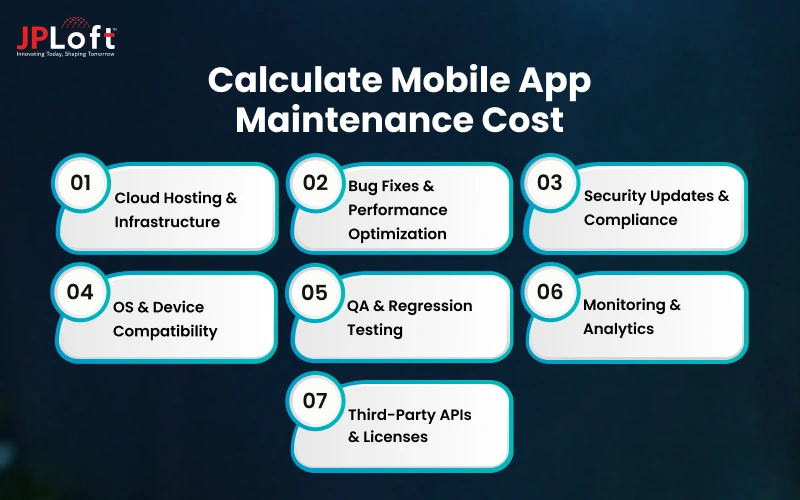
Some expenses recur monthly, while others arise during scheduled updates, security reviews, or specific maintenance phases. Here are the key cost areas to consider when calculating your maintenance cost:
► Cloud Hosting & Infrastructure
Plan for this as a monthly recurring expense, typically accounting for around 10%–20% of the annual maintenance budget.
Costs cover servers, databases, storage, bandwidth, backups, and infrastructure scaling. Actual spending can increase as traffic, transactions, and data volumes grow.
► Bug Fixes & Performance Optimization
Allocate approximately 15%–25% of the annual budget for ongoing issue resolution.
Minor bugs may require attention throughout the year, while larger performance optimization efforts can be scheduled quarterly or during specific maintenance phases.
► Security Updates & Compliance
Reserve around 10%–15% of your annual budget for compliance security audits in maintenance.
Critical patches should be addressed as soon as vulnerabilities emerge, while security checks, penetration testing, and compliance reviews can typically be scheduled quarterly, biannually, or annually, depending on the app and regulatory requirements.
► OS & Device Compatibility
Set aside approximately 10%–15% of your maintenance cost annually, but expect spending to occur in phases around major Android and iOS releases.
Teams may need additional testing and updates when new OS versions, devices, or platform requirements are introduced.
► QA & Regression Testing
Reserve about 5%–10% annually, with spending occurring whenever significant updates, bug fixes, integrations, or new releases are introduced.
Testing intensity should increase during major release cycles rather than being treated as an equal monthly expense.
► Monitoring & Analytics
Plan for this as a monthly recurring cost, allocating approximately 5%–10% of the annual maintenance budget.
Expenses may include cost of app maintenance tools, crash reporting, uptime monitoring, performance tracking, analytics, and alerting tools.
► Third-Party APIs & Licenses
Account for recurring costs associated with payment gateways, maps, analytics, communication tools, authentication services, APIs, and SDKs.
These expenses may be billed monthly, annually, or based on usage, with costs potentially increasing as application activity grows.
Mobile App Maintenance Cost by Platform and App Type
The cost to maintain mobile apps also varies based on the app type because different products require different levels of infrastructure, integrations, security, scalability, and ongoing updates.
Here is an estimate of the general annual maintenance range for common mobile app categories.
|
Platform / App Type |
Estimated Annual Maintenance Cost |
Key Maintenance Cost Drivers |
|
iOS Apps |
$5,000–$40,000+ |
iOS store updates, device compatibility, iOS App maintenance requirements, third-party integrations, security, and performance |
|
Android Apps |
$5,000–$45,000+ |
Android OS and device fragmentation, compatibility testing, Google Play requirements, integrations, security, and performance |
|
Cross-Platform Apps |
$7,000–$50,000+ |
Framework updates, OS compatibility, shared codebase, native integrations, testing, and performance |
|
eCommerce Apps |
$7,000–$25,000+ |
Payments, product management, APIs, security, performance, and seasonal traffic |
|
Food & Restaurant Apps |
$5,000–$30,000+ |
Ordering, payments, delivery workflows, real-time communication, and integrations |
|
Social Media Apps |
$5,000–$60,000+ |
User-generated content, messaging, media processing, security, and scalability |
|
Video Streaming Apps |
$10,000–$75,000+ |
Content delivery, bandwidth, media processing, infrastructure, and traffic spikes |
|
AI-Powered Apps |
$10,000–$65,000+ |
Model usage, inference costs, cloud infrastructure, APIs, retraining, and scalability |
Key Factors That Affect Cost of App Maintenance
The annual maintenance cost for custom mobile apps varies because each app has different technical requirements, infrastructure needs, and update cycles.
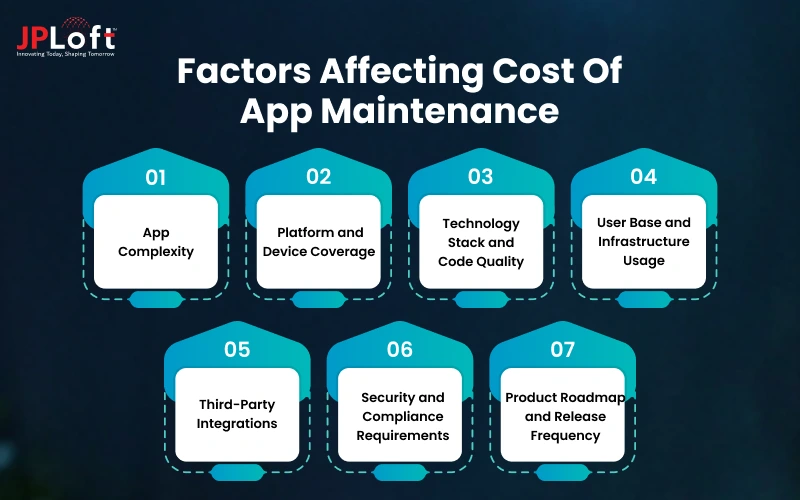
The following factors have the biggest influence on the cost of running an app that every app owner should be aware of.
1. App Complexity
Apps with multiple features, complex workflows, real-time functionality, or custom backend systems generally require more maintenance. Complex architectures also need more app testing and troubleshooting when new features or platform updates are introduced.
2. Platform and Device Coverage
Supporting Android, iOS, tablets, and a wide range of devices increases testing and compatibility requirements. Each platform also introduces its own OS updates, SDK changes, and technical considerations that may require ongoing adjustments.
3. Technology Stack and Code Quality
The frameworks, programming languages, libraries, and architecture used during development affect long-term maintenance effort. Well-structured and documented code is generally easier to update, while outdated dependencies or poorly maintained code can increase troubleshooting and modernization work.
4. User Base and Infrastructure Usage
As an app gains users, its infrastructure may need to handle more traffic, transactions, storage, and data processing. Higher usage can increase cloud, database, monitoring, and performance optimization requirements.
5. Third-Party Integrations
Payment gateways, maps, analytics platforms, communication APIs, authentication services, and other integrations can introduce additional maintenance work. Changes made by external providers may require updates or compatibility fixes within the app.
6. Security and Compliance Requirements
Apps handling sensitive or regulated data may require more frequent mobile app security updates, vulnerability assessments, access-control reviews, and compliance-related changes. These requirements can increase ongoing maintenance efforts.
7. Product Roadmap and Release Frequency
Apps that receive frequent feature updates require continuous development, testing, deployment, and monitoring. A clear release schedule can help manage these activities, while frequent unplanned changes may increase maintenance effort and costs.
Hidden Expenses to Consider in Your Cost of App Maintenance
The visible maintenance expenses are usually easier to anticipate, but several less obvious costs can also affect the overall budget.
These expenses often emerge as the app scales, third-party services change, or unexpected technical issues require immediate attention.
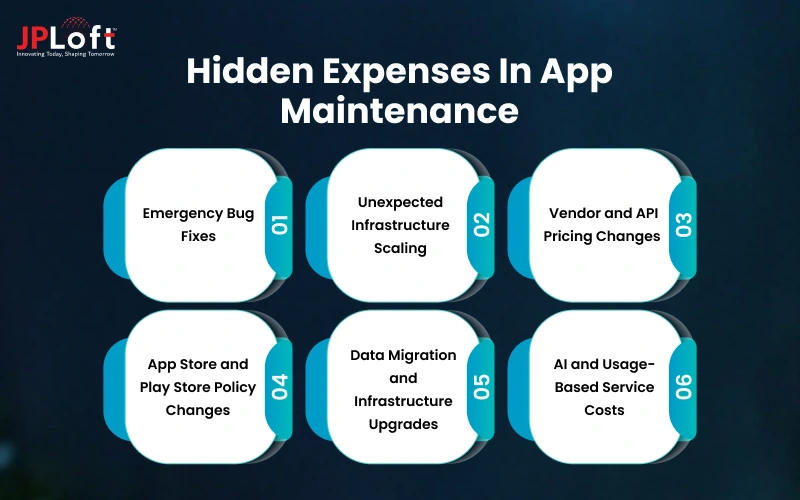
Here are the key hidden factors to consider that can help businesses avoid unplanned spending and build more realistic long-term maintenance expenses.
[A] Emergency Bug Fixes
Critical bugs can require immediate developer intervention, especially when they affect payments, authentication, core workflows, or app availability. Urgent troubleshooting and production fixes may require additional development and testing resources outside the planned maintenance cycle.
[B] Unexpected Infrastructure Scaling
A sudden increase in users, transactions, storage, or API requests can raise cloud maintenance and database costs. Businesses may also need additional infrastructure resources to maintain performance during traffic spikes, campaigns, or rapid growth.
[C] Vendor and API Pricing Changes
Third-party services can change their pricing, usage limits, features, or subscription terms. Payment gateways, maps, analytics platforms, communication services, and other APIs may create additional maintenance expenses when usage increases or pricing models change.
[D] App Store and Play Store Policy Changes
Changes to Apple App Store or Google Play requirements can require updates to app functionality, permissions, security practices, or submission processes. Meeting new platform requirements may involve development, testing, and release work that was not part of the original maintenance plan.
[E] Data Migration and Infrastructure Upgrades
Changes to databases, cloud services, backend architecture, or third-party platforms can require data migration and infrastructure upgrades. These projects may involve additional development, testing, backups, and validation to prevent disruption to existing users and services.
[F] AI and Usage-Based Service Costs
AI-powered apps can incur variable costs based on model usage, API calls, token consumption, inference, GPU resources, or vector database usage. As user activity grows, these expenses can increase alongside regular maintenance and infrastructure costs.
App Maintenance Cost vs. App Development Cost vs. App Update Cost
Building a mobile app, maintaining it, and updating it all serve different purposes and involve different cost structures. Understanding these differences helps businesses plan the right budget for each stage of the app lifecycle.
|
Cost Factor |
App Development Cost |
App Maintenance Cost |
App Update Cost |
|
Primary Purpose |
Build the app and establish its core functionality |
Keep the existing app secure, stable, compatible, and operational |
Improve or expand the existing app |
|
Key Activities |
UI/UX design, coding, database setup, API integration, testing, and deployment |
Bug fixes, security patches, performance optimization, monitoring, infrastructure, and compatibility fixes |
New features, UI/UX improvements, workflow changes, integrations, and functionality enhancements |
|
When It Occurs |
Mainly during the initial development phase |
Continuously after launch |
Periodically based on business and user requirements |
|
Cost Frequency |
Primarily upfront |
Monthly, quarterly, and annual depending on the maintenance activity |
Project-based or milestone-based |
|
Major Cost Factors |
App complexity, features, platforms, technology stack, integrations, and development team |
Infrastructure, app complexity, integrations, security, user base, technology stack, and support requirements |
Feature complexity, design changes, integrations, technology requirements, and development effort |
|
Typical Budget Approach |
Based on overall project scope and development requirements |
Commonly 15%–20% of original development cost annually |
Based on the scope and complexity of the update |
|
Typical Examples |
Building a new ecommerce or fintech app from scratch |
Fixing crashes, updating dependencies, patching vulnerabilities, or supporting a new OS version |
Adding a new payment method, redesigning checkout, or introducing a new user feature |
|
Main Objective |
Launch a functional product |
Maintain existing functionality and reliability |
Add or improve functionality |
How Can You Reduce App Maintenance Costs Without Affecting Performance?
Reducing maintenance costs does not mean cutting back on essential technical work. The right approach is to optimize resources, prevent recurring issues, and prioritize maintenance activities that protect app performance and long-term stability.
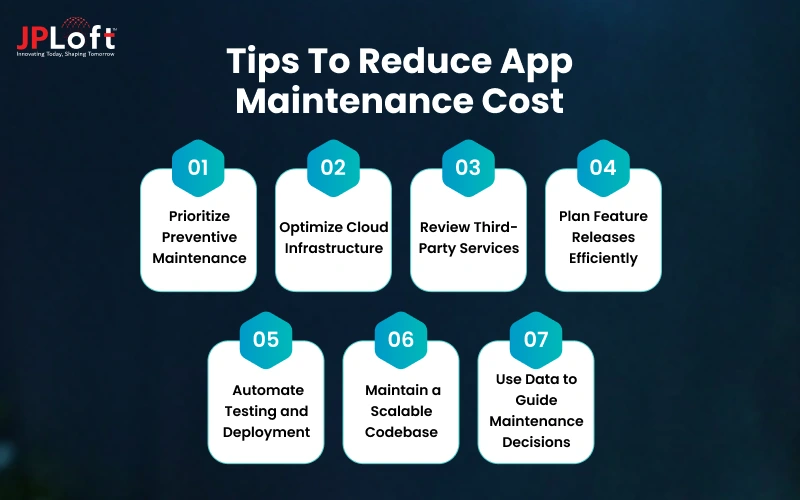
1. Prioritize Preventive Maintenance
Regular monitoring, security updates, dependency checks, and performance reviews can help identify issues before they become expensive production problems. Addressing smaller issues during preventive and predictive maintenance cycles can reduce the need for emergency fixes.
2. Optimize Cloud Infrastructure
Review cloud resources regularly to identify unused capacity, inefficient configurations, and unnecessary infrastructure costs. Scaling resources according to actual demand can help control spending while maintaining the performance required during periods of higher usage.
3. Review Third-Party Services
Regularly evaluate APIs, plugins, SDKs, and other external services used by the app. Removing unnecessary integrations, optimizing usage, and reviewing service plans can help reduce recurring expenses without affecting essential functionality.
4. Plan Feature Releases Efficiently
Frequent unplanned changes can increase development, testing, and deployment effort. Grouping related enhancements into planned releases can help teams use maintenance resources more efficiently while maintaining a consistent product roadmap.
5. Automate Testing and Deployment
Using automation in maintenance can reduce repetitive work across regression testing, deployment, and release validation. Automated workflows help teams identify issues earlier, streamline updates, and reduce the time and effort required for recurring maintenance tasks.
6. Maintain a Scalable Codebase
Clean architecture, reusable components, proper documentation, and manageable dependencies can make future changes easier to implement. A maintainable codebase reduces the effort required to troubleshoot issues and introduce new functionality as the app grows.
7. Use Data to Guide Maintenance Decisions
Analytics and monitoring data can help identify recurring bugs, performance issues, underused features, and areas that require additional infrastructure. Using this information to prioritize maintenance work helps businesses invest resources where it have the greatest operational impact.
JPLoft: Your Partner For Cost-Effective Mobile App Maintenance
App maintenance is an ongoing investment, but increasing costs should not come at the expense of application performance, security, or reliability.
As an experienced mobile app maintenance services provider, JPLoft brings 16+ years of engineering experience, 130+ experts, and expertise across mobile frameworks, cloud, AI, and modern technologies to help businesses keep maintenance spending under control.
Our portfolio includes global brands such as Nike, Whirlpool, and Red Bull, reflecting our experience with complex applications and enterprise-level requirements.
Our maintenance expertise spans bug fixes, performance optimization, security updates, OS and device compatibility, third-party integrations, testing, and monitoring.
We begin each engagement by assessing the existing codebase, infrastructure, dependencies, and integrations to identify recurring issues and avoidable maintenance expenses. Through proactive optimization and structured maintenance, we have helped clients achieve nearly 30% reductions in maintenance costs and effort across relevant engagements.
The result is a more stable application, fewer recurring issues, and greater control over long-term maintenance spending.
FAQs
Mobile app maintenance can cost around $3,000 to $75,000+ annually, depending on the app’s complexity, infrastructure, integrations, security requirements, and user base.
Businesses generally allocate 15%–20% of the original development cost annually for mobile app maintenance. The actual amount varies based on the app’s technical and operational requirements.
App complexity, technology stack, platforms, cloud infrastructure, third-party integrations, user base, security requirements, and codebase quality are among the biggest cost factors.
Regular monitoring, proactive bug fixing, automated testing, optimized infrastructure, timely updates, and clean code can help reduce recurring maintenance work and unexpected costs.
Yes. Maintenance can include security patches, dependency updates, vulnerability fixes, audits, and compliance-related updates based on the app’s requirements.

Yashwant Sharma is the CTO of JPLoft, with 18+ years of experience in software engineering, solution architecture, and digital innovation. His expertise spans scalable application development, AI-powered systems, RAG solutions, cross-platform development, software maintenance, and emerging mobility technologies such as EV and EV-charging platforms. He works across complex technical environments to help businesses build secure, maintainable, and high-performing digital products for industries including education, fitness, aviation, and healthcare.



Share this blog