


Key Takeaways:
Consistent app maintenance is the continuous process of updating, optimizing, and securing your app to ensure smooth performance, higher stability, and long-term relevance across all devices and OS versions.
Regular app maintenance saves money by preventing costly breakdowns, reducing emergency fixes, improving performance, minimizing downtime, and eliminating the need for expensive large-scale redevelopment later.
App maintenance is essential because it strengthens security, enhances user experience, boosts retention, ensures compatibility with new technologies, and protects your app from performance issues and vulnerabilities.
A cost-effective maintenance plan starts with a clear checklist, performance monitoring, timely security updates, automation, cloud optimization, analytics-driven decisions, and preventive care instead of reactive fixes.
JPLoft provides expert, end-to-end app maintenance services, ensuring constant updates, strong security, faster performance, cloud optimization, and long-term stability, making them the trusted partner for keeping your app future-ready.
Did you know the global mobile app market is expected to reach $626 billion by 2030, making app performance and stability more crucial than ever? In such a competitive landscape, regular app maintenance saves money far more than most businesses realize.
Instead of spending heavily on fixing breakdowns, poor performance, or security issues later, routine maintenance helps you prevent them early, saving time, budget, and reputation.
Proper app upkeep ensures faster speed, better security, higher user satisfaction, and smoother scalability. And with a well-planned app maintenance checklist, businesses can avoid unexpected downtime, costly bugs, or feature failures.
In this blog, we’ll explore ways to avoid expensive app fixes, highlight essential steps in an app maintenance checklist, and share strategies to keep your app secure, efficient, and future-ready.
What Is Regular App Maintenance?
Regular mobile app maintenance is the ongoing process of keeping your mobile application updated, stable, and performing at its best. In the app world, regular maintenance includes fixing bugs, updating features, improving security, optimizing performance, and ensuring compatibility with the latest OS updates and devices.
It also helps your app stay aligned with user expectations, industry trends, and new technologies. Whether your app is brand-new or has been running for years, consistent maintenance ensures it remains fast, safe, and relevant, so users keep coming back without frustration.
It also prevents unexpected breakdowns that could disrupt the user experience or cause revenue loss. Over time, regular maintenance helps your app operate smoothly, reduces long-term repair costs, and ensures your product evolves as your business grows.
Why Regular App Maintenance Matters More Than You Think?
Regular app maintenance is often underestimated, but it’s one of the most powerful ways to keep your digital product stable, secure, and cost-efficient. Whether you run a startup or a large enterprise, maintaining your app consistently can dramatically improve performance, reduce risks, and save money in the long run.
Here’s why it matters far more than most businesses realize:
-
Prevents Major Failures Before They Happen: With ongoing application maintenance and support, you fix bugs, crashes, and performance issues early, long before they turn into expensive system failures or downtime emergencies.
-
Reduces Long-Term App Expenses: Routine optimizations help reduce long-term app expenses by minimizing the need for rework, emergency fixes, and full feature rewrites. Investing small amounts regularly prevents massive bills later.
-
Boosts App Speed, Stability & User Satisfaction: A well-maintained app loads faster, crashes less, and performs smoothly across all devices. This results in better ratings, increased engagement, and stronger user loyalty.
-
Strengthens App Security & Compliance: Frequent updates ensure your mobile app security and keep it protected against vulnerabilities, malware, and new cyber threats. This also keeps you compliant with evolving data protection laws.
-
Supports App Downtime Prevention: Continuous monitoring and cloud-based maintenance help with app downtime prevention, ensuring users always experience reliable uptime, even during heavy traffic.
-
Ensures Cost-Effective Scalability: As your user base grows, regular updates ensure your app can scale without performance drops. This makes it easier to achieve cost-effective app management and long-term sustainability.
In short, regular maintenance keeps your app healthy, cost-efficient, and consistently high-performing. It’s not an expense, it’s an investment that protects your long-term growth.
How Regular App Maintenance Saves Money in the Long Run?
Most businesses think app maintenance is an “extra cost,” but in reality, regular app maintenance saves money and a lot more than you might imagine.
When you maintain your app consistently, you prevent expensive failures, unexpected downtime, and large-scale rebuilds that drain your budget. Maintenance is not about spending, it’s about protecting your investment while ensuring your app stays fast, secure, and future-ready.
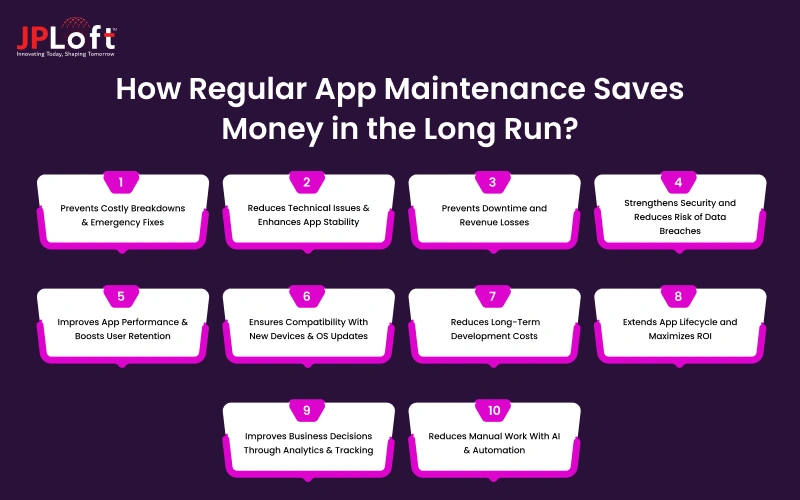
Here’s a deeper look at how app maintenance saves money and why it’s one of the smartest decisions for any business building or running a mobile product.
1. Prevents Costly Breakdowns & Emergency Fixes
A well-planned app maintenance checklist ensures your team identifies bugs early, eliminates minor glitches, and resolves backend errors before they turn into full-blown breakdowns.
Instead of spending thousands on emergency fixes, you simply pay a small, predictable fee for app maintenance, resulting in massive software maintenance cost savings. Businesses with a structured app maintenance strategy significantly cut long-term expenses since small fixes cost far less than major emergency repairs.
Using top app maintenance tools also helps automate detection, monitor performance, and alert teams before issues escalate, making your maintenance workflow even more efficient and cost-effective.
2. Reduces Technical Issues & Enhances App Stability
A laggy or slow-performing app drives users away. Regular updates help you reduce technical issues in apps, fix crash points, update APIs, and modernize your backend architecture.
This directly leads to better app stability and functionality, smoother navigation, and overall improved user experience, which saves money by reducing churn and retaining more loyal users.
When users face fewer glitches, they interact more, spend more, and trust your product longer. That means every small maintenance update adds long-term financial value.
3. Prevents Downtime and Revenue Losses
App downtime is extremely expensive. Even a few hours of interruption can ruin conversions, sales, and brand reputation. With proper maintenance, you invest in app downtime prevention, real-time monitoring, server optimization, and error detection.
Cloud-powered approaches such as cloud maintenance for mobile apps and modern cloud development also help you minimize downtime through automated scaling, performance alerts, and faster recovery responses.
And when you hire mobile app developers with strong backend and cloud expertise, your system can detect performance drops earlier and recover faster, saving both revenue and reputation. Continuous uptime boosts customer confidence, strengthens brand reliability, and keeps your business competitive.
4. Strengthens Security and Reduces Risk of Data Breaches
Regular security audits in app maintenance ensure that your app stays protected against cyber threats. Maintenance updates include security patches, encrypted storage upgrades, and firewall enhancements.
Without ongoing application maintenance and support, cyberattacks, data leaks, and compliance failures become extremely costly risks. Proactive security saves thousands in potential damages and legal issues.
Consistent security upgrades don’t just protect the system; they protect customer trust. And in today’s digital world, trust is one of the most expensive assets to lose.
5. Improves App Performance & Boosts User Retention
A high-performance app attracts loyal users and reduces churn. Regular maintenance helps enhance mobile app performance, improve loading speed, optimize backend logic, and update outdated libraries and frameworks.
When your app runs smoothly, it contributes to improving app user retention, reducing acquisition costs, and increasing long-term revenue. Consistent performance improvements make users feel the app is evolving with their needs.
This not only increases engagement but also strengthens brand trust and credibility over time.
6. Ensures Compatibility With New Devices & OS Updates
Every year, iOS and Android release major updates, and apps that don’t adapt quickly often break or become slow. Regular maintenance helps you maintain your iOS app and Android counterpart by keeping them updated with the latest OS changes, screen resolutions, device models, and API updates.
By staying compatible, you avoid sudden breakdowns, major redevelopment costs, and negative user reviews. Routine updates ensure cost-effective app management and make your app future-ready in a fast-changing tech environment.
This helps your app stay competitive among users who constantly upgrade to the latest devices.
7. Reduces Long-Term Development Costs
Apps that skip routine maintenance eventually require expensive, large-scale rebuilds. These rebuilds often include code refactoring, UI redesign, library upgrades, and API replacements, costing far more than small, regular updates.
Consistent maintenance ensures affordable app maintenance solutions and long-term software maintenance cost savings. It prevents technical debt from piling up and eliminates the risk of major system failures.
Keeping your app updated gradually is always cheaper and more manageable than fixing everything at once later.
8. Extends App Lifecycle and Maximizes ROI
Apps that are regularly updated dominate the market longer. Maintenance helps increase longevity, improve user engagement, and strengthen brand credibility. With continuous improvements, your product stays relevant and competitive, creating long-term ROI.
This is exactly why businesses partner with the best mobile app development company. Regular enhancements also help your app adapt to new trends, technologies, and user expectations, preventing it from becoming outdated.
A well-maintained app consistently delivers value, which not only boosts customer satisfaction but also lowers future redevelopment costs.
9. Improves Business Decisions Through Analytics & Tracking
Maintenance includes continuous app analytics and tracking, helping you understand user behaviors, feature performance, drop-off points, and existing bugs or bottlenecks.
With the support of automation in app maintenance, these insights are gathered in real time, making it easier to detect issues early and measure user engagement accurately.
By studying these insights, businesses can make smarter decisions, avoid unnecessary investments, and prioritize features that genuinely improve user experience. This data-driven approach ensures your product roadmap stays aligned with real user needs while helping you allocate budgets more efficiently for long-term growth.
10. Reduces Manual Work With AI & Automation
Modern maintenance uses AI in app maintenance to detect issues early, automate testing, track crashes, and monitor performance. This lowers operational costs and reduces human workload, making maintenance more efficient and cost-effective.
AI-driven monitoring also ensures problems are identified before users even notice them, protecting your app’s reputation. Automation speeds up release cycles, minimizes errors caused by manual processes, and ensures consistent quality across every update.
Over time, this intelligent approach helps businesses scale faster, maintain stronger app stability, and significantly reduce long-term management efforts.
Ultimately, regular app maintenance saves money by preventing downtime, reducing technical failures, improving security, enhancing performance, and lowering future development expenses. It ensures your app stays stable, secure, relevant, and profitable for years.
How to Create a Cost-Effective Regular App Maintenance Plan?
Creating a smart and cost-effective maintenance plan is the key to keeping your app stable, fast, secure, and budget-friendly in the long run. The good news? You don’t need a massive budget, just a structured strategy that focuses on the right priorities.
Below is a simple but powerful approach to help you plan maintenance efficiently and avoid unnecessary mobile app maintenance cost escalations.
-
Start with a Clear App Maintenance Checklist: Before anything else, outline all essential maintenance tasks, security upgrades, bug fixes, performance tuning, UI updates, and server checks. A well-defined checklist ensures nothing gets missed and helps your team follow a systematic, predictable workflow.
-
Schedule Performance Monitoring & Cloud Maintenance: Real-time monitoring, automated alerts, and cloud optimization prevent slowdowns and reduce long-term app expenses. Cloud maintenance offers flexibility, faster scalability, and lower infrastructure costs, all of which are essential for cost-effective app management.
-
Prioritize Security First: Regular security audits, vulnerability checks, and updated encryption protect your app from cyber risks. Proactive security is always cheaper than handling breaches, penalties, or data-loss issues later.
-
Use Automation & AI for Faster Issue Detection: Automation in app maintenance and AI-driven monitoring tools help detect crashes, bottlenecks, and unusual user behavior instantly. This reduces manual workload, improves efficiency, and lowers recurring maintenance hours, saving thousands over time.
-
Update APIs, Frameworks, and OS Compatibility Regularly: Avoid major redevelopment expenses by updating libraries, frameworks, and third-party tools on a consistent schedule. This ensures compatibility with the latest devices and OS versions while improving app stability and functionality.
-
Plan Preventive Maintenance Instead of Reactive Fixes: Preventive care, timely updates, regular testing, and checking integration keep your app healthy and avoid emergency fixes. This approach ensures sustainable app maintenance cost savings and a longer app lifecycle.
-
Leverage Analytics to Guide Maintenance Decisions: App analytics and tracking help you understand which features users love, where they drop off, and what needs immediate attention. Data-driven decisions reduce wasted spending and allow you to allocate a budget where it gives maximum ROI.
-
Work With a Skilled Maintenance Partner: You can hire dedicated developers to ensure continuous updates, top-notch security, optimized performance, and strategic support. A professional partner creates a long-term maintenance roadmap tailored to your app’s needs.
A cost-effective maintenance plan isn’t just about lowering expenses; it’s about increasing value, boosting stability, and helping your product grow with future trends. With a well-executed strategy, your app becomes stronger, faster, and far more profitable over time.
Maintenance Case Studies: Key Lessons for Long-Term App Stability
Real-world examples are the strongest proof of how regular app maintenance influences performance, user retention, and long-term costs.
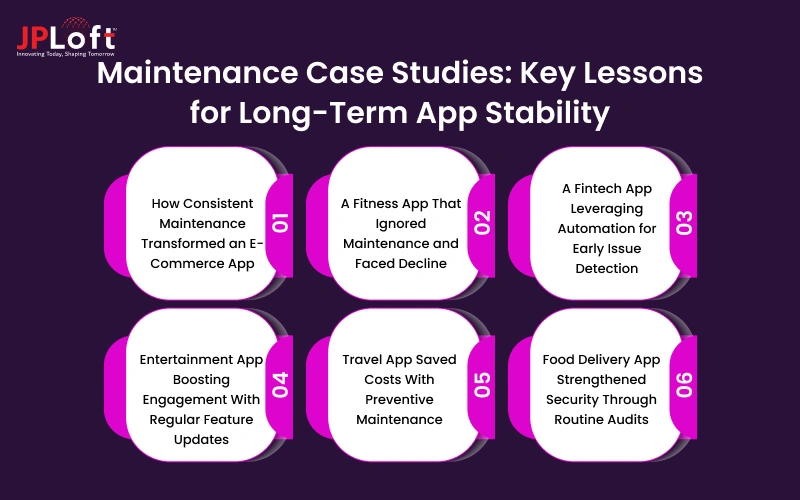
These case studies reveal exactly why consistent updates, timely bug fixes, and preventive care matter more than most businesses realize.
1. Case Study: How Consistent Maintenance Transformed an E-Commerce App
A mid-scale e-commerce brand was struggling with slow loading times, frequent cart crashes, and rising customer complaints.
After partnering with an E-commerce development company and implementing a structured maintenance strategy, covering cloud optimization, security patching, and timely API updates, the results were dramatic.
Outcome:
-
32% improvement in app speed
-
48% drop in crash rate
-
Higher conversions due to smoother performance
This case proves that regular maintenance doesn’t just fix issues; it directly impacts revenue and growth.
2. Case Study: A Fitness App That Ignored Maintenance and Faced Decline
A popular fitness app with millions of downloads failed to update its frameworks and didn’t fix long-standing performance issues.
Even though the brand had previously invested in fitness app development services, they overlooked routine maintenance, which eventually made the app incompatible with the latest OS updates, causing login failures, UI glitches, and inconsistent performance.
Outcome:
-
Low ratings drop in the Play Store rating
-
Massive user churn
-
Expensive redevelopment is needed later.
This example shows how skipping maintenance can turn small issues into costly disasters.
3. Case Study: A Fintech App Leveraging Automation for Early Issue Detection
A growing fintech startup partnered with expert FinTech app development services and adopted AI-powered monitoring along with automated performance tracking to maintain a highly secure and stable app environment.
With smart automation in place, the system could detect vulnerabilities within seconds and trigger instant alerts, allowing the team to apply quick fixes before issues turned critical.
Outcome:
-
Zero major outages
-
Strong security compliance
-
Higher user trust and retention
This case highlights how proactive monitoring is essential for apps that handle sensitive user data.
4. Case Study: Entertainment App Boosting Engagement With Regular Feature Updates
An entertainment streaming platform collaborated with experts in enterprise product development services to introduce a structured monthly update cycle.
These updates focused on improving UI/UX, optimizing media loading speed, and rolling out fresh, engaging features to keep users hooked and enhance content accessibility.
Outcome:
-
25% increase in daily active users
-
Better user reviews
-
Stronger brand recall
This shows that maintenance is also about engagement, not just fixing bugs.
5. Case Study: Travel App Saved Costs With Preventive Maintenance
A growing travel-booking platform partnered with a travel app development company to tackle frequent server overloads during peak holiday seasons.
Instead of reacting to breakdowns, the team implemented preventive maintenance practices such as regular load testing, server optimization, API cleanup, and performance monitoring.
Outcome:
-
40% reduction in server crashes
-
Faster page loading during peak traffic
-
Significant savings on emergency fixes
This case proves that preventive maintenance reduces panic situations, safeguards user experience, and cuts long-term repair costs.
6. Case Study: Food Delivery App Strengthened Security Through Routine Audits
A food delivery platform handling thousands of daily transactions partnered with a food delivery app development company to implement routine security audits, encryption updates, and continuous vulnerability scanning.
This proactive approach ensured full compliance, protected sensitive data, and strengthened user safety across all payment touchpoints.
Outcome:
-
Zero security breaches reported
-
Highr user trust and transaction success
-
Improved brand credibility in a competitive market
This example highlights how security-focused maintenance protects both the business and the end-user from risks and reputational damage.
Apps that invest in ongoing maintenance experience better stability, higher ROI, fewer breakdowns, and stronger user loyalty, while apps that ignore maintenance eventually face performance drops, security issues, and huge rebuilding costs.
Why Should You Prefer JPLoft as Your App Maintenance Partner?
Keeping an app stable, secure, and high-performing needs ongoing expertise, something many businesses can’t manage alone. That’s why having a reliable maintenance partner becomes essential.
Choosing the right partner for mobile app maintenance service makes all the difference in your app’s long-term success, and that’s exactly where JPLoft stands out.
With years of experience, a skilled in-house development team, and 24/7 support, JPLoft ensures your app stays secure, fast, and future-ready at all times.
Whether you need performance optimization, security updates, API upgrades, crash fixes, automation support, or cloud optimization, JPLoft provides end-to-end maintenance tailored to your business goals.
With transparent pricing, expert consulting, and a strategic maintenance roadmap, JPLoft becomes your long-term growth partner, not just a vendor. If you want reliability, affordability, and consistent quality, JPLoft is the trusted choice for seamless mobile app maintenance.
Final Wrap-Up
Today’s digital landscape is more competitive and fast-moving than ever, and this is exactly why regular app maintenance saves money and protects your product from unexpected challenges. By staying proactive with updates, performance optimizations, and security enhancements, you prevent breakdowns long before they become costly emergencies.
A well-maintained app not only performs better, but it also delivers smoother user experiences, reduces operational overhead, and continuously adapts to new devices, OS updates, and market trends.
Over time, this consistent care improves user retention, boosts brand trust, and increases long-term profitability. Instead of spending heavily on sudden repairs or full-scale redevelopment, businesses that maintain their apps regularly enjoy predictable budgets and higher ROI.
FAQs
Regular app maintenance prevents expensive breakdowns, emergency fixes, security breaches, and major redevelopment work. By fixing small issues early, updating frameworks, optimizing performance, and improving stability, businesses significantly reduce long-term expenses.
The global mobile app industry is expected to surpass $626 billion by 2030, meaning competition is higher than ever. Apps that receive regular updates see 30–50% higher retention rates and lower operational costs, proving maintenance is a long-term ROI booster.
Start by building a clear app maintenance checklist, scheduling performance monitoring, and prioritizing security. Use cloud optimization, automate issue detection, update frameworks regularly, and rely on analytics to guide your improvement decisions.
Regular app maintenance is the ongoing process of updating, optimizing, and fixing your app to keep it secure, functional, and user-friendly. It includes bug fixes, security patches, performance tuning, API updates, compatibility improvements, and UI enhancements.
Maintenance matters because it helps prevent downtime, reduce user churn, enhance performance, strengthen security, and keep your app compatible with new OS versions. It also lowers long-term expenses by avoiding costly emergency fixes.

Meet Yashwant, the CTO of JPLoft. With 18+ years of industry experience, he brings deep technical expertise and visionary leadership to complex digital challenges. From scalable software architectures to emerging technology implementations, Yashwant drives innovation that empowers businesses across diverse industries to build future-ready, secure, and high-performing digital solutions.


Share this blog