



Key Takeaways
Implement mobile app predictive maintenance by collecting real-time data, using AI/ML models to forecast issues, automating alerts, integrating with app architecture, and continuously refining the system for reliable performance.
Predictive maintenance turns mobile apps from reactive to proactive, preventing issues before they affect users.
Traditional app maintenance struggles with unexpected crashes, slow fixes, higher costs, and limited visibility. Predictive maintenance solves all of these with early detection.
Following best practices like clear goals, scalable architecture, regular model retraining, and automation improves accuracy and results.
Businesses see measurable ROI through reduced unplanned downtime, lower maintenance costs, better performance, higher retention, and improved release quality.
With expertise in AI-driven development and a dedicated app maintenance service, JPLoft helps businesses build future-ready, stable, and high-performing apps.
Imagine if your mobile app could sense a problem before it even happened, almost like having a built-in sixth sense. That’s exactly the promise of mobile app predictive maintenance, a smart technology that’s quietly reshaping how modern apps stay fast, stable, and user-friendly.
Today’s users are impatient; one crash, one lag, one slow screen, and they instantly switch apps. Brands and developers feel constant pressure to keep performance flawless.
But with AI, machine learning, and real-time analytics, predictive maintenance is becoming the secret weapon behind high-performing apps. It prevents downtime, boosts user retention, reduces costs, and keeps your app one step ahead.
In this blog, we’ll explore how predictive maintenance works in mobile apps, why it’s essential today, and how it helps you build smarter, more reliable apps that users love returning to.=
The Business Case for Predictive Maintenance
Such of mobile app maintenance has become more than a tech upgrade; it’s a strategic advantage for any business that relies on mobile apps.
Here’s why companies are investing heavily in predictive maintenance mobile solutions:
1. Reduced Downtime & Faster Issue Prevention- Predictive maintenance helps detect issues early through advanced app failure prediction, minimizing unexpected crashes that can harm user trust. This ensures the app remains stable even during peak traffic hours, keeping users satisfied and engaged.
2. Improved User Experience & Higher Retention- By ensuring consistent speed, reliability, and smooth performance, predictive maintenance builds user confidence. Apps that run seamlessly reduce uninstalls caused by technical frustrations, resulting in higher retention and loyal users.
3. Optimized App Performance with AI Insights- Using real-time data for performance optimization for mobile apps, predictive maintenance can spot bottlenecks before they impact the user journey. This leads to enhanced load times, responsiveness, and overall app efficiency, providing a superior user experience.
4. Cost Savings on Maintenance & Development- Predictive maintenance cuts the costs of fixing major breakdowns by reducing the need for emergency patches or frequent manual checks. It also frees up developer time to focus on building new features and innovations rather than constantly troubleshooting.
5. Better Decision-Making With Predictive Data- Predictive maintenance provides actionable insights into user behavior and app health. These insights support smarter product planning, efficient release cycles, and allow businesses to forecast future performance risks, enabling proactive improvements.
Implementing predictive maintenance transforms app management from reactive to proactive, ensuring smoother performance, happier users, and a clear competitive edge.
It also helps businesses bring some of the best mobile app ideas to life with better stability, fewer failures, and long-term reliability, making the entire app ecosystem stronger and more future-ready.
Challenges Businesses Face with Traditional App Maintenance
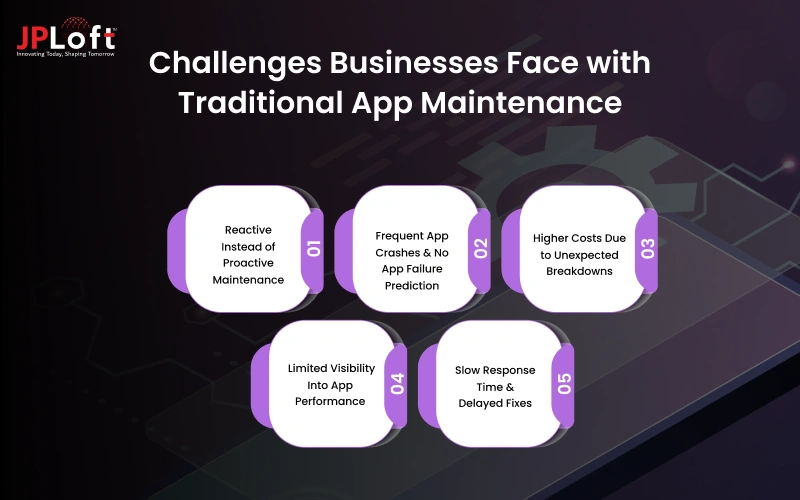
Traditional app maintenance is often slow, reactive, and unable to prevent issues before they impact users. This approach leads to frequent downtime, higher costs, and several app maintenance mistakes to avoid, like fixing problems only after failures happen.
Because these methods lack real-time insights, businesses struggle with performance drops, security risks, and unexpected breakdowns.
That’s why predictive maintenance is becoming essential, offering faster detection, automation, and smarter performance management.
A] Reactive Instead of Proactive Maintenance
Traditional app maintenance focuses on fixing issues only after they occur, causing delays and disruptions. With predictive maintenance, teams are shifting their focus to app maintenance, identifying potential issues early, and preventing downtime.
B] Frequent App Crashes & No App Failure Prediction
Since old maintenance methods can’t foresee crashes, failures often appear unexpectedly. Thanks to modern app failure prediction, businesses can detect risk signals in advance and avoid sudden user-impacting failures.
C] Higher Costs Due to Unexpected Breakdowns
Emergency fixes and surprise crashes lead to high operational costs under traditional systems. With the help of predictive maintenance, companies save significantly by predicting system breakdowns and planning repairs ahead of time.
D] Limited Visibility Into App Performance
Periodic monitoring leaves hidden issues unnoticed until they become severe. Predictive analytics now offers continuous monitoring, real-time alerts, and early anomaly detection.
E] Slow Response Time & Delayed Fixes
Teams relying on manual checks or user complaints often respond late . Predictive maintenance automates alerts and enables faster, smarter fixes.
Overall, shifting from traditional methods to predictive maintenance helps businesses stay ahead of failures, reduce downtime, and deliver a smoother user experience.
It not only strengthens app performance but also ensures long-term reliability and cost efficiency, making it an essential upgrade for modern app-driven businesses.

Key Performance Indicators You Should Track
To make the most of mobile app predictive maintenance, monitoring the right KPIs is essential. These indicators help you spot issues early, strengthen app failure prediction, and support better performance for mobile apps.
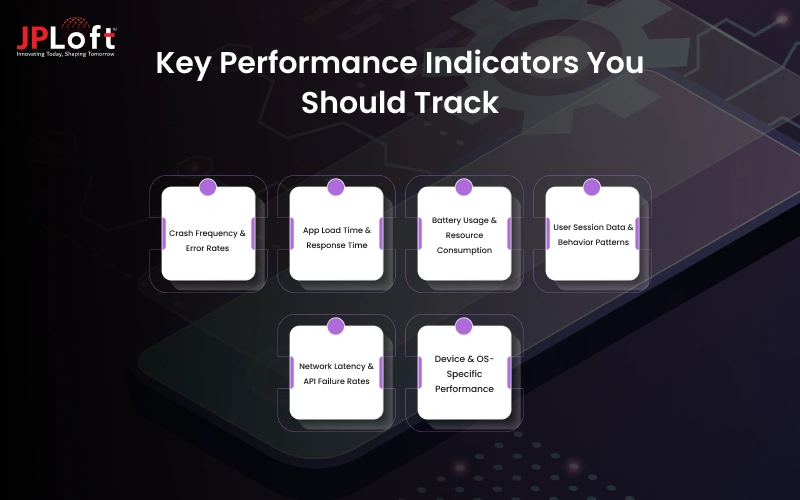
Whether you plan to create an app or optimize an existing one, tracking these KPIs ensures your app stays reliable, fast, and user-friendly.
► Crash Frequency & Error Rates
It can track how often your app crashes or throws errors, helps identify patterns that predictive models can analyze for early warnings. This is crucial for improving stability and user trust.
► App Load Time & Response Time
App load time & response time measures how quickly the app opens and responds which is a key metric for performance optimization for mobile apps. It slowdowns often signal deeper issues that predictive maintenance can detect early.
► Battery Usage & Resource Consumption
It shows how much memory, CPU, and battery the app consumes. Abnormal spikes often indicate performance bottlenecks or upcoming system breakdowns. This supports proactive tuning before users complain.
► User Session Data & Behavior Patterns
This helps to analyse session duration, drop-off points, and feature usage and helps predictive models understand stress points and forecast potential failures. Also, it is valuable for both maintenance and feature planning.
► Network Latency & API Failure Rates
It monitors server response times and failed API calls. High latency often signals backend issues that can lead to user frustration. Predictive maintenance uses this data for early app failure prediction.
► Device & OS-Specific Performance
Through it, you can track how the app behaves across different devices and operating systems. It helps detect compatibility issues before they impact a large user base, which is essential for maintaining consistent performance across platforms.
By continuously monitoring these KPIs, businesses gain the insights needed to prevent failures, optimize performance, and keep their apps running smoothly with the power of predictive maintenance mobile solutions.
Technologies Used in Mobile App Predictive Maintenance
Predictive maintenance relies on a powerful mobile app tech stack that analyzes user behavior, system performance, and real-time app data to predict issues before they happen.
These technologies work together to support proactive monitoring, smarter diagnostics, and accurate app failure prediction.
Here are the key technologies that enable seamless mobile app predictive maintenance:
|
Technology |
Role in Predictive Maintenance |
How It Helps Apps |
|
AI & Machine Learning (ML) |
Identifies patterns, anomalies, and failure signals |
Enables accurate app failure prediction and automated insights |
|
Real-Time Data Analytics |
Continuously tracks performance metrics |
Supports faster issue detection and performance tuning |
|
Cloud Computing |
Stores and processes large volumes of app data |
Makes predictive infrastructure scalable and cost-efficient |
|
IoT & Device Telemetry |
Monitors device-specific behavior and performance |
Helps detect hardware-related app issues early |
|
Automation Tools & DevOps |
Automates testing, monitoring, and deployments |
Ensures faster updates and reduces human error |
|
APM (Application Performance Monitoring) Tools |
Tracks KPIs such as crashes, latency, and response time |
Improves performance optimization for mobile apps |
These technologies form the backbone of modern predictive maintenance, helping apps stay fast, stable, and reliable.
By combining AI, analytics, and cloud-powered scalability, businesses can prevent downtime, optimize performance, and deliver an experience that users can trust, every time they open the app.
Steps to Implement Predictive Maintenance in Mobile Apps
Implementing mobile app predictive maintenance is no longer just an advanced strategy used by top tech companies; it has become an essential approach for every business that wants high stability, better performance, and seamless user experience.
Predictive maintenance works by using AI, ML, and data intelligence to identify problems before they occur, helping teams prevent downtimes, reduce mobile app maintenance costs, and ensure sustained reliability.
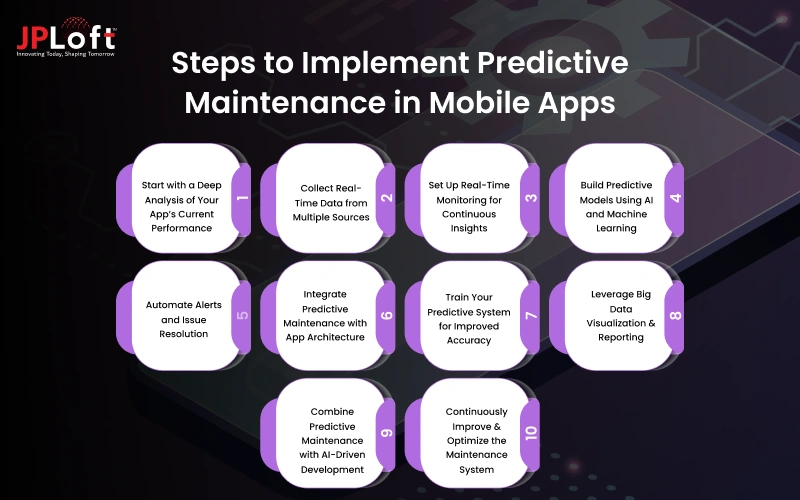
Below is a complete breakdown of the step-by-step process to integrate predictive maintenance into your app smoothly and efficiently.
Step 1: Start with a Deep Analysis of Your App’s Current Performance
Before adding any smart system, businesses must analyze what’s already happening inside their app. Understanding existing bottlenecks helps in designing a strong foundation for predictive maintenance mobile solutions.
You should focus on:
-
Slow screens and app crashes
-
API response delays
-
Device-specific performance issues
-
Patterns observed during high traffic
This initial evaluation helps teams understand how predictive maintenance works in mobile apps and where it can create the biggest impact. It also highlights the importance of mobile app testing, which plays a key role in ensuring you collect accurate and complete data.
Step 2: Collect Real-Time Data from Multiple Sources
Data is the heart of every predictive system. To build a strong predictive maintenance app, businesses must gather real-time information from different touchpoints across the app. This includes:
-
User behavior metrics
-
Device logs
-
Network signals
-
Crash reports
-
API performance logs
-
Third-party service data
The more high-quality data you collect, the more accurate your app failure prediction becomes. This stage also sets the base for big data predictive maintenance, which uses large-scale data to identify hidden patterns and prevent future system breakdowns.
Step 3: Set Up Real-Time Monitoring for Continuous Insights
Successful predictive maintenance depends heavily on real-time monitoring. This process allows your system to instantly track performance fluctuations, usage spikes, errors, and background issues.
With real-time monitoring, you can detect:
-
Sudden CPU or memory usage spikes
-
Abnormal load times
-
Downtime indicators
-
Error frequency patterns
The insights captured here significantly enhance your predictive analytics for mobile apps, helping you take immediate corrective action before users ever notice a problem.
Step 4: Build Predictive Models Using AI and Machine Learning
This is the core of predictive maintenance. Businesses must now use advanced AI and ML algorithms to predict potential issues before they occur.
Different technologies that come into play include:
-
AI-powered predictive maintenance to automate decision-making
-
Machine learning predictive maintenance to identify repeat patterns
-
Deep learning maintenance for high-accuracy predictions using layered data structures
-
Artificial intelligence maintenance systems for automated risk detection
-
Predictive maintenance mobile solutions for end-to-end monitoring and predictions
Many organizations collaborate with an experienced ML development company to design and train these predictive models, as building them requires strong expertise in data engineering, automation, and real-time analytics.
Step 5: Automate Alerts and Issue Resolution
Once the predictive model starts generating insights, the next step is automating the response process. The automation in app maintenance can fix problems before they affect users, ensuring better uptime and enhanced stability.
Automated systems can:
-
Notify your technical team instantly
-
Trigger automatic restart of affected modules
-
Rebalance server load
-
Block harmful activities
-
Activate fallback modes
This creates a strong framework for automated maintenance for mobile apps, reducing the need for manual intervention and increasing operational efficiency.
Step 6: Integrate Predictive Maintenance with App Architecture
To maximize efficiency, top app maintenance tools should be deeply integrated into your app’s core infrastructure. This includes:
-
Backend systems
-
Databases
-
APIs and microservices
-
Frontend frameworks
A well-integrated system helps developers understand the benefits of predictive maintenance for mobile apps, such as improved speed, fewer crashes, and better user satisfaction. It also enhances long-term scalability and strengthens your ability to handle peak loads.
Step 7: Train Your Predictive System for Improved Accuracy
Predictive systems get smarter over time, especially when new data is continuously fed into them. This ongoing training not only improves prediction accuracy but also helps businesses detect rare or complex issues, including potential threats to mobile app security.
The training process involves:
-
Feeding new user data
-
Updating ML models
-
Adding new datasets
-
Regularly validating predictions
This continuous cycle ensures your system becomes more accurate, reducing breakdown risks and optimizing user experience.
Step 8: Leverage Big Data Visualization & Reporting
Once your predictive maintenance app is running smoothly, the next step is visualizing the insights. Clear reports help teams make better decisions, forecast risks, and plan future improvements.
Reporting systems offer:
-
Weekly performance summaries
-
Crash prediction trends
-
Risk-level indicators
-
Infrastructure usage reports
-
Real-time anomaly alerts
This level of detail supports performance optimization for mobile apps, making your entire development process smarter and more data-driven.
Step 9: Combine Predictive Maintenance with AI-Driven Development
Predictive maintenance becomes even more powerful when combined with the role of AI in mobile app development. AI enhances automation, improves user behavior prediction, and streamlines problem resolution, making apps smarter and more reliable.
Key ways AI-driven development strengthens predictive maintenance include:
-
Automated Issue Detection – AI monitors app performance and identifies anomalies before they escalate.
-
User Behavior Prediction – Machine learning predicts user actions and potential stress points within the app.
-
Streamlined Problem Resolution – Intelligent automation resolves common issues faster, reducing downtime.
-
Optimized Future Updates – AI insights guide feature enhancements and maintenance priorities.
This synergy helps reduce maintenance costs, improve app performance, and make future updates easier and more efficient. If your business doesn’t have an in-house technical team, you can also hire mobile app developers in the USA who specialize in predictive maintenance technologies to ensure smoother implementation and long-term support.
Step 10: Continuously Improve & Optimize the Maintenance System
Predictive maintenance is an ongoing process. As your app grows and user behavior changes, your predictive models must be regularly updated to maintain accuracy and ensure a smooth, reliable experience.
Continuous improvement includes:
-
Updating AI models
-
Scaling infrastructure
-
Adding new prediction parameters
-
Enhancing automation workflows
-
Improving data quality
This helps maintain high reliability, ensures sustainable growth, and delivers a consistently smooth experience to users.
Implementing predictive maintenance is one of the smartest decisions for modern app development. It helps businesses move from reactive fixes to intelligent, proactive solutions.
By using AI and ML in predictive maintenance apps, brands can reduce crashes, improve speed, prevent downtimes, and make their app future-ready.
When done right, predictive maintenance transforms the overall performance, keeps users satisfied, and ensures long-term business success.
Best Practices for Implementing Predictive Maintenance Successfully
Implementing predictive maintenance isn’t just about adding AI into your app; it’s about creating a smart, future-ready ecosystem that can detect, prevent, and solve issues before they occur. To get the best results, businesses must follow proven methods that ensure accuracy, scalability, and long-term reliability.
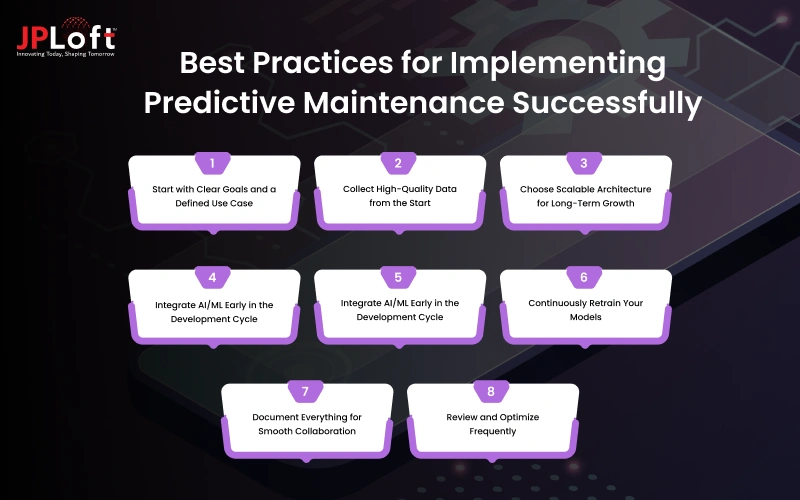
Below are the best practices you should always keep in mind:
1] Start with Clear Goals and a Defined Use Case
Before implementing predictive maintenance, define what you want to achieve: reduced crashes, better performance, lower maintenance costs, or higher user satisfaction. Clear goals help streamline planning and avoid unnecessary complexity.
2] Collect High-Quality Data from the Start
Predictive models depend on accurate and consistent data. Track real-time events, logs, user behavior, device performance, and app health metrics to feed your AI system with reliable inputs.
3] Choose Scalable Architecture for Long-Term Growth
Predictive maintenance requires handling large volumes of data. Use cloud-based, scalable solutions so your system can grow without compromising speed or performance.
4] Integrate AI/ML Early in the Development Cycle
Instead of adding AI at the final stage, include predictive algorithms from the beginning. This makes the entire system more efficient and reduces rework later.
5] Conduct Regular Security Audits
Incorporating security audits in app maintenance helps detect vulnerabilities early, strengthens system integrity, and prevents unexpected failures that could affect predictive analytics.
6] Continuously Retrain Your Models
AI and ML models must evolve with new user behavior, updated features, and shifting patterns. Regular retraining ensures better predictions and high accuracy.
7] Document Everything for Smooth Collaboration
Keep proper documentation of algorithms, workflows, updates, and maintenance procedures to help teams collaborate effectively and scale the system in the future.
8] Review and Optimize Frequently
Predictive maintenance requires ongoing refinement. Analyze results, identify gaps, and regularly optimize your strategies to ensure long-term app stability and performance.
Implementing these best practices ensures your predictive maintenance system stays accurate, proactive, and capable of evolving with your users and technology trends. Following them not only improves reliability but also future-proofs your app for long-term success.
ROI & Success Metrics That Prove Predictive Maintenance Works
Before investing time and resources into predictive maintenance, businesses often ask one critical question, “How do we measure success?”
The good news is predictive maintenance provides clear, trackable, and high-impact performance indicators that make ROI measurement straightforward.
By examining the right metrics, you can accurately understand how well your system is reducing failures, improving performance, and increasing overall app reliability.
-
Reduction in Unplanned Downtime: Track how predictive alerts help you prevent sudden outages. The fewer unexpected breakdowns, the stronger your ROI.
-
Decrease in Maintenance Costs: Track how much you save on repairs, manual monitoring, and emergency fixes. Predictive maintenance also helps reduce long-term mobile app development cost by preventing unexpected failures and minimizing frequent updates.
-
Improved App Performance & Stability: Analyze performance benchmarks such as response time, crash frequency, latency, and error events. A stable app equals higher user satisfaction.
-
Accuracy of App Failure Prediction: Evaluate how accurately your system predicts system breakdowns. The higher the prediction accuracy, the more efficient the maintenance strategy.
-
Extended Asset & Infrastructure Life: Predictive maintenance avoids overloading servers and infrastructure, directly improving their lifespan and reducing hardware replacement costs.
-
Increase in Release Quality: Track how predictive analytics reduce bugs during updates and deployments, less rework means faster releases.
-
User Retention & Satisfaction Growth: Stable, fast, and error-free apps lead to better ratings, more engagement, and stronger loyalty.
When implemented correctly, predictive maintenance becomes one of the most powerful tools for long-term cost reduction and app reliability. These success metrics not only help you justify your investment but also guide continuous improvement across your entire development lifecycle.
By tracking the right KPIs, businesses can confidently scale, optimize, and future-proof their applications with data-driven precision.
Why Choose JPLoft for Predictive Maintenance App Development?
Selecting the right development partner is crucial when you're building a predictive maintenance ecosystem that relies on AI, ML, automation, and real-time monitoring. JPLoft stands out as one of the most trusted names in the industry, offering a perfect blend of technical expertise, innovation, and long-term support.
From data integration and model development to full-scale deployment, we handle every step with precision. You also get access to a dedicated mobile app maintenance service, ensuring your predictive solution remains updated, monitored, and continuously optimized.
With JPLoft, you don’t just get an app, you get a strategic advantage. We prioritize scalability, automation, user experience, and reliability, delivering solutions that help businesses reduce costs, prevent breakdowns, and stay ahead in a competitive digital landscape.
Whether you're upgrading an existing app or building something new, JPLoft ensures your predictive maintenance journey is smooth, efficient, and future-ready.

The Bottom Line
Predictive maintenance is no longer just an optional upgrade, it’s becoming a core requirement for businesses that want to deliver high performance and uninterrupted digital experiences.
By integrating predictive intelligence into your mobile app, you reduce operational hassles, prevent costly breakdowns, and enhance user satisfaction. Adopting predictive maintenance transforms the traditional maintenance approach into a smarter, data-driven, and proactive system.
It ensures long-term reliability, boosts operational efficiency, and strengthens your app’s overall value. As technology evolves, businesses that embrace predictive maintenance will stay competitive, scalable, and prepared for the future.
FAQs
It’s a proactive approach that uses AI, ML, and data analytics to predict app issues before they happen, helping prevent crashes and improve performance.
Common technologies include AI/ML models, deep learning, big data analytics, real-time monitoring tools, and predictive algorithms to automate alerts and analysis.
Traditional maintenance is reactive, slow, and costly, leading to unexpected failures, poor user experience, and limited visibility into app performance.
Key steps include collecting app data, setting monitoring parameters, building AI/ML models, automating alerts, testing predictions, and continuously improving the system.
It’s especially beneficial for apps with large user bases, high data volume, or complex workflows, such as e-commerce, fintech, healthcare, logistics, and SaaS apps.

Meet Yashwant, the CTO of JPLoft. With 18+ years of industry experience, he brings deep technical expertise and visionary leadership to complex digital challenges. From scalable software architectures to emerging technology implementations, Yashwant drives innovation that empowers businesses across diverse industries to build future-ready, secure, and high-performing digital solutions.



Share this blog