


Key Takeaways:
Aircraft maintenance software centralizes MRO workflows, improving safety, compliance, and operational efficiency across aviation operations.
Key benefits include reduced downtime, predictive maintenance, better cost control, and scalable fleet management capabilities.
Effective platforms require deep aviation expertise, secure architecture, and compliance-first system design.
Successful development depends on clear planning, role-based interfaces, seamless integrations, and thorough testing.
Working with an experienced aviation software partner like JPLoft ensures reliable, future-ready maintenance solutions.
The aviation sector is moving rapidly toward digital transformation. Airlines and MRO providers invest heavily in technology to reduce downtime and improve safety standards.
The demand for smart maintenance platforms is rising as fleets grow larger and regulations become stricter. Modern aviation operations depend on accurate data and automated tracking systems.
How to create an aircraft maintenance software?
A strong platform begins with clear requirements and practical design. Aircraft maintenance software can manage schedules, work orders, spare parts, and compliance records in one system.
In the following sections, you will learn the core steps, benefits, and costs required to build an aircraft maintenance software effectively.
An Overview of Aircraft Maintenance Software
Aircraft maintenance software (also called MRO software) is a specialized digital system that helps airlines and maintenance providers to manage, track, and optimize all aspects of aircraft upkeep.
This software helps airlines and MRO software teams manage the daily maintenance tasks.
Apart from this, the aircraft maintenance software organizes inspection schedules, repair logs, spare parts tracking, and compliance records in one place. The system reduces manual paperwork and enhances accuracy.
Here, the technicians can monitor aircraft status, plan work, and much more. The aircraft maintenance software is also designed to improve communication between departments. In simple terms, the software keeps aircraft maintenance organized, transparent, and efficient from start to finish.
If you’re planning to build aviation software or aircraft maintenance software, it’s important to first understand the aviation market landscape.
-
The global aviation software market size was estimated to be USD 11.18 billion in 2024, and is projected to reach USD 16.93 billion by 2030, that is growing at a CAGR of 7.5% from 2025 to 2030.
-
As per the precedence research, the global aviation market size was calculated at USD 11.50 billion in 2024, and is predicted to reach around USD 23.10 billion by 2034, expanding at a CAGR of 7.22% from 2025 to 2034.
-
Additionally, as per Fortune Business Insights, the MRO software market size was valued at USD 7.70 billion in 2024. This market is predicted to grow from USD 8.13 billion in 2025 to USD 11.68 billion by 2032, at a CAGR of 5.3%.
Now, one of the major questions that arises here is “ who uses the aircraft maintenance software” or by whom can the aircraft maintenance software be used”.
Hence, let's check it all out in the following section.
Who uses Aircraft Maintenance Software?
Aircraft maintenance software is used by a wide range of aviation professionals, including airlines, military aviation, MRO facilities, and corporate flight departments, as well as general aviation operators.
Let’s study them all, in detail, below.
1. Airlines and Commercial Aviation Operators
After building an airline's reservation system, commercial airlines, cargo carriers, and charter flight operators use aircraft maintenance software.
It helps them to manage fleet-wide maintenance schedules, ensure regulatory compliance, and maximize aircraft availability across their operations.
2. MRO Facilities and Maintenance Providers
Maintenance, Repair, and Overhaul (MRO) service providers utilize this software to coordinate work orders, track technician assignments, manage parts inventory, and document all maintenance activities for multiple client aircraft efficiently.
3. Private Aircraft Owners and Corporate Flight Departments
Business aviation departments and private jet owners rely on maintenance software to schedule inspections, track service history, manage compliance requirements, and coordinate with maintenance providers for their aircraft fleets.
4. Military and Government Aviation
Military branches and government agencies operating aircraft fleets use specialized maintenance software to ensure mission readiness, track maintenance hours, manage complex logistics, and maintain detailed records for audit and accountability purposes.
Now, if you are one of the above, let’s discover what the core benefits you will receive after developing an aircraft maintenance software in the following section.

Benefits of Building an Aircraft Maintenance Software
The core benefits of building an aircraft maintenance software are that it enhances safety and compliance, increases operational efficiency, and provides significant cost savings.
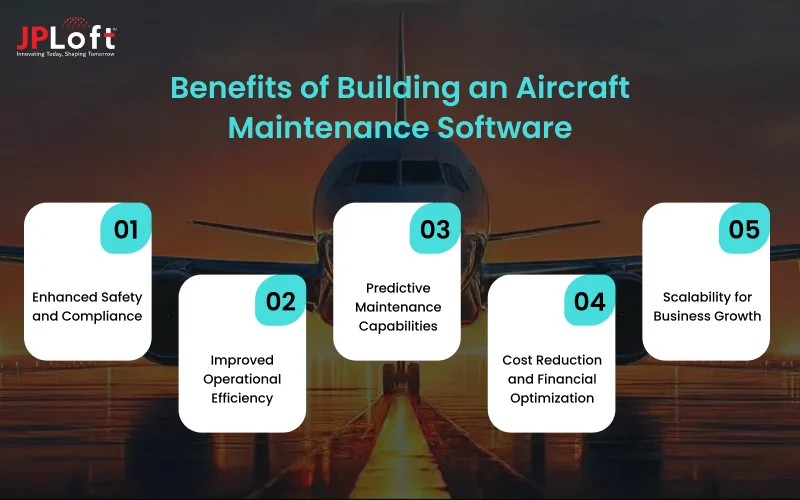
Now, let’s check out the complete list of benefits of creating an aircraft maintenance software in this section.
1. Enhanced Safety and Compliance
Custom aircraft maintenance software ensures strict adherence to aviation safety regulations and compliance requirements set by authorities such as the FAA, EASA, and ICAO.
The system automates compliance tracking, generates mandatory reports, and alerts teams about upcoming inspections or certification renewals, preventing regulatory violations. Hence, building an aircraft maintenance software is a crucial phenomenon here.
2. Improved Operational Efficiency
Building dedicated maintenance software streamlines workflows by automating routine tasks such as work order generation, parts requisition, technician scheduling, and documentation processes that traditionally consume significant time.
Digital systems eliminate paperwork bottlenecks, reduce data entry errors, and enable real-time information sharing across maintenance teams, operations, and management.
3. Predictive Maintenance Capabilities
Modern aircraft maintenance software incorporates data analytics and machine learning algorithms that analyze historical maintenance data, flight hours, and sensor readings to predict component failures before they occur.
This predictive approach shifts maintenance from reactive repairs to proactive interventions, preventing costly in-flight failures, unscheduled groundings, and emergency maintenance situations.
4. Cost Reduction and Financial Optimization
Custom maintenance software provides detailed tracking of all maintenance-related expenses, including labor hours, parts costs, contractor fees, and downtime impacts, enabling accurate cost analysis and budget forecasting.
Hence, it reduces the overall cost of building aviation software. The system identifies cost-saving opportunities such as bulk parts purchasing, warranty claim tracking, optimized maintenance intervals, and efficient technician utilization.
5. Scalability for Business Growth
Custom-built aircraft maintenance software is designed to scale seamlessly as your fleet grows, supporting additional aircraft, users, locations, and complexity without performance degradation or architectural limitations.
The system accommodates evolving business needs through configurable workflows, modular features, and integration capabilities that adapt to new requirements, technologies, and regulatory changes.
Now, proceeding with the benefits, let's learn about the factors to consider before building an aircraft maintenance software.
Things to Consider Before Building an Aircraft Maintenance Software
Different factors that can be considered before building an aircraft maintenance software are the budget of the app, user needs, regulatory compliance, integration ability, scalability, and more.
Let’s discover the complete list of creating an aircraft maintenance software, below.
-
User Needs: Identify the exact roles that will work inside the system. Map daily technician tasks and manager expectations, so features stay useful and simple.
-
Regulatory Compliance: Aviation software must align with authority guidelines. The platform should generate audit trails, digital signatures, and maintenance history that inspectors accept.
-
Integration Ability: Plan connections with ERP systems, inventory tools, and flight operations databases. Smooth integration prevents double entry and keeps data accurate across departments.
-
Scalability: The system should grow with your fleet and business operations. Architecture must support new modules and higher workloads without major redesign.
-
Security Standards: Maintenance data is highly sensitive. Strong authentication, encrypted storage, and role-based permissions are essential from the first design stage.
-
Workflow Fit: Software must reflect real maintenance processes. Work orders, inspections, and approvals should follow the same logical sequence teams already trust.
-
Budget And Timeline: Clear cost planning avoids surprise expenses later. Define realistic milestones so development stays controlled and delivers ROI quickly.

How to Create an Aircraft Maintenance Software?
You can create an aircraft maintenance software by conducting a specified planning, selecting the right features, designing the software, evaluating the right tech stack, and then building it effectively.
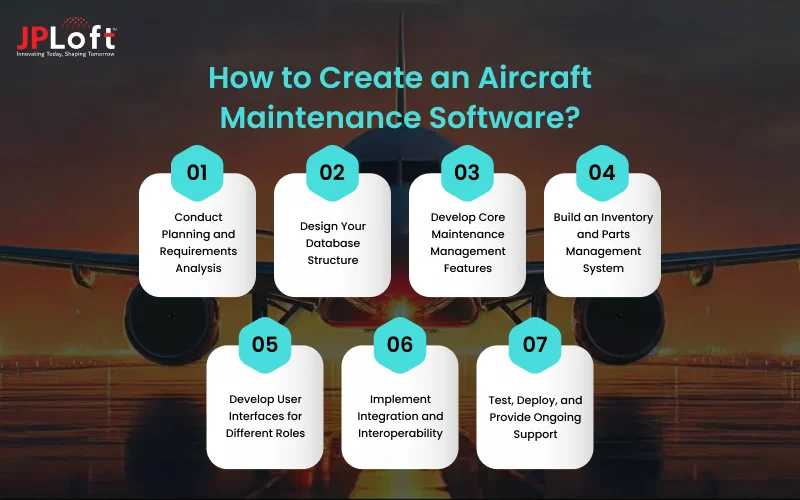
Let’s learn the steps to build an aircraft maintenance software, below.
Step 1: Conduct Planning and Requirements Analysis
Before you begin to develop an aircraft maintenance software, it's crucial to understand the specific needs, regulatory requirements, and operational workflows of your target users. This foundational step determines the project scope, technical requirements, and success criteria.
A] Identify Stakeholder Requirements
Engage with all stakeholders, including maintenance technicians, engineers, compliance officers, operations managers, and executives, to understand their specific needs and pain points.
Conduct interviews, workshops, and observation sessions at maintenance facilities to document current workflows, inefficiencies, and desired improvements. Before you proceed with the aircraft maintenance process, it's essential to know why you need it.
Hence, it's important to gather requirements around maintenance tracking, parts management, compliance reporting, work order processing, and integration needs with existing systems.
B] Define Regulatory and Compliance Framework
Research and document all applicable aviation regulations from authorities like FAA, EASA, ICAO, and regional aviation bodies that govern maintenance record-keeping, inspection schedules, and reporting requirements.
Understanding these regulatory frameworks from the beginning prevents costly redesigns later and ensures the aircraft maintenance software development process incorporates compliance as a core architectural principle rather than an afterthought.
Step 2: Design Your Database Structure
Designing a robust technical architecture is essential when you create an aircraft maintenance software that can handle complex data relationships, ensure data integrity, and scale with growing needs.
This step establishes the technical foundation supporting all system functionality.
A] Choose Appropriate Technology Stack
Select programming languages, frameworks, databases, and infrastructure that align with your project requirements, team expertise, and long-term maintenance considerations.
Consider cloud-based architectures using AWS, Azure, or Google Cloud for scalability, disaster recovery, and global accessibility, or on-premises solutions if data sovereignty or security policies require it.
Choose database technologies (SQL for structured data, NoSQL for flexible schemas) appropriate for aviation data's relational complexity, and select frameworks that support rapid development while maintaining code quality.
B] Design Data Models and Relationships
Create comprehensive data models representing aircraft, components, maintenance tasks, work orders, technicians, parts inventory, compliance records, and their complex interrelationships.
Design database schemas that efficiently handle queries for maintenance schedules, parts availability, technician assignments, and historical reporting while maintaining referential integrity.
You can connect with the UI/UX design services if you plan to design the software as per the
Step 3: Develop Core Maintenance Management Features
The core functionality of your aircraft maintenance software forms the foundation that users interact with daily to manage maintenance operations, track work, and ensure compliance.
A] Implement Work Order Management System
Build comprehensive work order functionality that allows users to create, assign, track, and close maintenance tasks with complete documentation of labor hours, parts used, procedures followed, and inspection results.
You should include effective aviation software features to provide prompt benefits to the crew members and to the aviation business.
B] Create Maintenance Scheduling and Planning Module
Develop intelligent scheduling capabilities that track maintenance intervals based on flight hours, calendar time, cycles, or regulatory requirements, and automatically generate upcoming maintenance tasks.
Implement calendaring systems that visualize aircraft availability, maintenance windows, technician assignments, and facility capacity to optimize resource utilization.
Build forecasting features that predict future maintenance requirements based on usage patterns, helping operations plan for aircraft downtime and budget for upcoming expenses.
Step 4: Build an Inventory and Parts Management System
Effective parts and inventory management is critical for aircraft maintenance operations, ensuring required components are available when needed while minimizing carrying costs and preventing obsolescence.
A] Develop Parts Tracking and Procurement
Create inventory management functionality tracking parts across multiple locations, warehouses, and aircraft, with real-time visibility into quantities, locations, costs, and reorder thresholds.
Include serialized component tracking for critical parts requiring individual history records, batch/lot tracking for consumables, and shelf-life monitoring for time-sensitive materials.
B] Implement Component Lifecycle Management
Design systems tracking individual aircraft components from installation through their entire operational life, including maintenance performed, inspections completed, overhauls conducted, and eventual removal or retirement.
Maintain complete traceability linking components to specific aircraft, locations installed, time-in-service calculations, and compliance with manufacturer service bulletins or airworthiness directives.
Build alerts for components approaching time-between-overhaul limits, calendar expiration dates, or cycle limits requiring action.
Step 5: Develop User Interfaces for Different Roles
Aircraft maintenance involves diverse users with different needs, requiring role-specific interfaces that optimize their workflows and provide appropriate access to information.
A] Create Technician-Focused Mobile Interface
Design mobile applications optimized for technicians working on aircraft, providing easy access to work orders, technical documentation, parts requests, and task completion without requiring desktop computers.
Mobile-optimized technician interfaces are critical when you create aircraft maintenance software because they directly impact maintenance efficiency and data accuracy at the point where work actually occurs.
You need to follow the aviation software trends when it comes to designing and integrating the advanced tech stack into the software.
B] Build Management Dashboards and Analytics
Develop executive and management dashboards providing high-level visibility into key performance indicators, including aircraft availability, maintenance costs, technician productivity, parts inventory value, and compliance status.
Create customizable analytics showing trends over time, comparative metrics across aircraft or fleets, and predictive insights forecasting future maintenance requirements and costs.
These analytical capabilities transform maintenance data into strategic business intelligence, justifying the investment to develop an aircraft maintenance software by demonstrating clear ROI through improved decision-making and operational optimization.
Step 6: Implement Integration and Interoperability
Modern aircraft maintenance software must integrate with various systems across the aviation ecosystem to provide seamless data flow and eliminate duplicate data entry.
A] Build API and System Integrations
Develop robust APIs (Application Programming Interfaces) enabling your maintenance software to exchange data with flight operations systems, inventory management platforms, financial/accounting software, and manufacturer systems.
Implement integration with OEM (Original Equipment Manufacturer) portals for accessing service bulletins, parts catalogs, and technical documentation directly within your maintenance system. You can implement AI in the aviation sector to enhance the overall performance of the system.
These integrations are essential in the aircraft maintenance software development process because isolated systems create data silos, duplicate work, and increase error risks when information must be manually transferred between platforms.
B] Ensure Data Exchange Standards Compliance
Implement support for aviation industry data exchange standards such as Spec2000, ATA Chapters, and OASIS specifications, ensuring interoperability with other aviation systems and partners.
Build import/export capabilities supporting standard formats for maintenance records, parts catalogs, and technical documentation used across the aviation industry. Develop data transformation and mapping tools handling differences between your internal data structures and external system formats.
Include validation and error handling, ensuring data exchanged with external systems maintains integrity and meets quality standards.
Step 7: Test, Deploy, and Provide Ongoing Support
Thorough aviation software testing and proper deployment are critical for aviation software, where errors can have serious safety and operational consequences.
A] Conduct Comprehensive Testing and Validation
Perform extensive functional testing, verifying every feature works correctly across different scenarios, user roles, and data conditions.
Conduct performance testing, ensuring the system handles expected user loads, large datasets, and complex queries without degradation.
Implement user acceptance testing (UAT) with actual maintenance personnel, planners, and managers, validating that the software meets their needs and workflows.
B] Deploy and Train Users Effectively
Plan phased deployment strategies that minimize operational disruption, potentially starting with pilot programs on limited aircraft or maintenance facilities before full rollout.
Develop comprehensive training programs, including role-based training for technicians, planners, managers, and administrators covering their specific system functions and workflows.
Establish support systems, including help desks, ticketing systems, and escalation procedures, ensuring users receive timely assistance when issues arise.
Provide ongoing support, regular updates, and continuous improvement based on user feedback, ensuring the aircraft maintenance software development process doesn't end at initial deployment but continues evolving to meet changing needs, regulations, and technologies throughout the software's operational life.
Following these steps in depth, you can proceed with the cost to make an aircraft maintenance software in the next section.
Because when you think about custom software development, one of the crucial parts is “cost”, and you cannot neglect it.
Cost to Build an Aircraft Maintenance Software
The cost to make an aircraft maintenance software can range between $10,000 to $50,000+. This cost will depend on different factors, such as the infrastructure of the app, the features of the app, and much more.
Let's break down the cost to make an aircraft maintenance software, in the table mentioned below.
|
Cost Range |
What You Get |
|
Under $10,000 |
Basic maintenance tracking with simple logs and schedules |
|
$10,000 – $25,000 |
Standard system with work orders and parts management |
|
$25,000 – $50,000 |
Advanced platform with integrations and compliance modules |
|
$50,000+ |
Enterprise-grade software with custom workflows and real-time analytics |
Well, whether it's about deciding on the aircraft maintenance software development process or related to its cost, you might face certain challenges that might impact the overall curriculum.
Hence, switch to the following section to evaluate the list of challenges to make an Aircraft maintenance software.
Challenges to Make an Aircraft Maintenance Software
The challenges to making an aircraft maintenance software can include stringent regulatory compliance (FAA, EASA), data security, and legacy system integration etc.
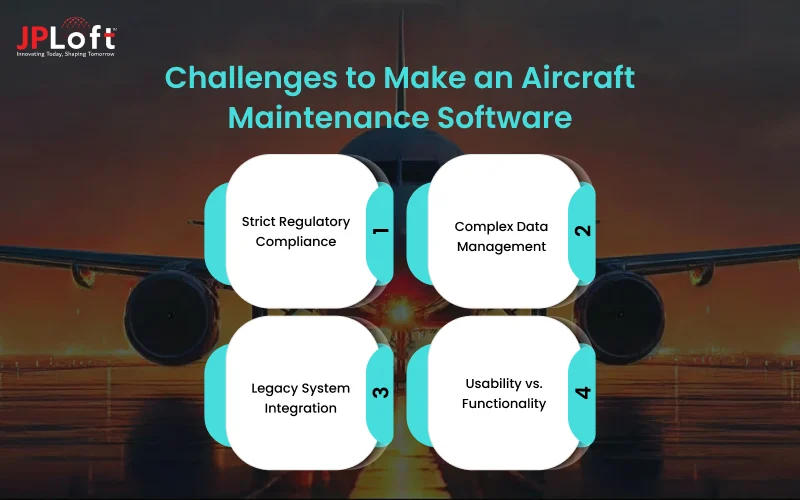
Let’s check out the complete list of challenges to make an aircraft maintenance software, below.
1. Strict Regulatory Compliance
Aviation maintenance is governed by stringent, constantly evolving regulations from multiple authorities (FAA, EASA, ICAO) that vary by region and aircraft type.
Software must accommodate diverse compliance frameworks while adapting to new airworthiness directives, creating ongoing development challenges that require deep aviation industry expertise.
2. Complex Data Management
Aircraft maintenance involves complex data relationships between configurations, serialized components, and maintenance intervals across thousands of parts.
Tracking time-based, cycle-based, and condition-based schedules simultaneously while maintaining complete traceability creates significant technical challenges critical for safety and compliance.
3. Legacy System Integration
Most aviation organizations operate legacy or paper-based systems, making accurate data migration challenging. This can be considered as one of the crucial challenges in making aviation software.
Software must integrate seamlessly with diverse platforms, including flight operations, inventory management, and manufacturer portals, using different data formats, requiring extensive development to achieve real-time interoperability.
4. Usability vs. Functionality
The software must provide extensive features covering work orders, scheduling, inventory, and compliance while remaining intuitive for users with varying technical skills.
Creating role-specific interfaces that serve both technicians needing simple mobile access and compliance officers requiring sophisticated analytics presents significant user experience design challenges.
 Platform.webp)
Ready to Partner with JPLoft and Build Your Aircraft Maintenance Software?
Here’s the thing: building aircraft maintenance software is not a simple plug-and-play task. It demands domain understanding, strict compliance, and technology that works flawlessly in real operations.
If you are planning to launch a maintenance platform or modernize existing workflows, the smartest move is to collaborate with an experienced aviation software development company as JPLoft, that knows the industry inside out.
JPLoft brings years of expertise in custom aviation solutions, from MRO modules to inventory tracking and real-time maintenance scheduling. The team focuses on creating software that reduces downtime, improves efficiency, and keeps safety at the center of every feature.
With JPLoft as your development partner, your vision can turn into a reliable system built for long-term performance and growth.
Conclusion
Aircraft maintenance software transforms how aviation teams plan, track, and execute critical upkeep tasks. A well-designed system reduces paperwork, prevents errors, and keeps every aircraft compliant and ready to fly.
From airlines to private owners and military operators, digital platforms bring clarity into complex MRO processes. Smart scheduling, secure databases, and real-time integrations make maintenance predictable and efficient. The right technology stack ensures scalability and strong security.
Careful planning and user-focused design deliver long-term ROI. With expert guidance, any aviation organization can build software tailored to its fleet, technicians, managers, and regulatory demands effectively. JPLoft supports custom development needs perfectly.
FAQs
Aircraft maintenance software is a digital platform used to manage all maintenance tasks for aircraft. It stores inspection schedules, repair logs, spare parts data, and compliance records. The system replaces manual paperwork with organized workflows. Technicians and managers use it daily to keep aircraft safe and operational.
Any organization that operates or maintains aircraft can benefit from maintenance software. Airlines, private jet owners, corporate flight departments, and military aviation units all need it. MRO facilities also rely on this software to manage client aircraft. If you handle aircraft upkeep in any capacity, you are an ideal user.
Yes, small aviation companies can absolutely build aircraft maintenance software. The key is to start with essential features and a clear scope. Even a basic system can deliver strong value to smaller fleets. Working with an expert team like JPLoft makes the process easier and cost-effective.
The timeline depends on project scope and complexity. A simple maintenance tracking system can be built in a few weeks. Advanced enterprise platforms with integrations take longer. Phased development usually works best. Proper planning helps control both time and cost.
Every maintenance software should include work order management, scheduling, and parts tracking. Compliance reporting and component lifecycle management are also essential. Mobile access for technicians adds practical value. These features form the heart of any efficient MRO platform.
To develop aircraft maintenance software, start with clear planning and requirements analysis. Define user roles, then you need to proceed with planning, compliance, design, testing, scheduling, and inventory management.

Meet Yashwant, the CTO of JPLoft. With 18+ years of industry experience, he brings deep technical expertise and visionary leadership to complex digital challenges. From scalable software architectures to emerging technology implementations, Yashwant drives innovation that empowers businesses across diverse industries to build future-ready, secure, and high-performing digital solutions.





Share this blog