



Key Takeaways
Aviation software improves operational efficiency, safety, and compliance by integrating AI, IoT, and predictive analytics for real-time decision-making and coordination.
The cost to develop aviation software ranges from $15,000 to $80,000+, depending on complexity, design, compliance, and technology choices.
Understanding factors like software type, tech stack, and maintenance helps businesses allocate budgets and avoid unexpected costs.
Compliance with aviation standards like DO-178C, FAA, and EASA ensures security, safety, and regulatory approval for aviation systems.
Choosing the right development team impacts both cost and quality, making location and expertise crucial for efficient project delivery.
Monetization opportunities such as subscriptions, licensing, and analytics services enable long-term profitability for aviation software owners.
Partnering with JPLoft ensures a scalable, compliant, and high-performance aviation solution tailored to your business goals.
The aviation industry is stepping toward digital transformation, with aviation software projected to reach nearly $23 billion by 2034.
From flight management systems to maintenance tracking and crew scheduling tools, advanced software solutions are redefining how airlines and airports operate.
However, one of the most common questions businesses ask is, How much does it cost to develop aviation software?
The cost typically ranges from $15,000 to $80,000+, depending on several factors like app complexity, feature set, compliance requirements, and technology stack.
Whether you’re building a basic flight-tracking app or an enterprise-level aviation operations system, understanding these cost parameters helps you plan your investment wisely and build a high-performing, regulation-compliant solution.
Let’s learn the complete breakdown in this guide.
All About Aviation Software Development
Aviation software development refers to the creation of digital systems that power airlines, airports, and aviation service providers. It includes flight management systems, crew scheduling tools, air traffic control platforms, booking and passenger apps, and maintenance tracking solutions.
These applications ensure safety, efficiency, and real-time coordination across multiple aviation operations. They have to be developed in conformance with strict standards related to aviation, such as DO-178C, FAA, and EASA regulations for reliability and security.
Modern aviation software integrates advanced technologies like AI, IoT, and predictive analytics in this respect for making better decisions, reducing operational costs, and ensuring seamlessness for pilots, engineers, and passengers.
Let’s check out the following market statistics related to the software, below.
-
The global aviation software market size was estimated at USD 10.68 billion in 2023 and is projected to reach USD 16.93 billion by 2030, growing at a CAGR of 7.2% from 2024 to 2030.
-
Additionally, the aviation software market size was calculated at USD 11.50 billion in 2024 and is predicted to reach around USD 23.10 billion by 2034, which is expanding at a CAGR of 7.22% from 2025 to 2034.
-
The global aviation software market size was valued at USD 9.6 billion in 2023, and is expected to grow from USD 10.26 billion in 2024 to USD 17.5 billion by 2032.
-
However, the aviation compliance monitoring software market is estimated to be valued at USD 9.9 billion in 2025, and is projected to reach USD 19.9 billion by 2035.
These stats define why you should invest in this software. Now, as you are ready to build an aviation software, let’s check out the cost in the following section.
What is the Cost to Create an Aviation Software?
The cost to create aviation software varies from $15,000 to $80,000+. Here, this cost varies depending on different parameters such as the complexity of the app, the design of the app, required features, technology stack, compliance requirements, and the developer’s location.
A basic aviation management system, as well as a booking application, might fall at the lower end, while enterprise-level flight operations, MRO, and air traffic management solutions can go well over $80,000.
Via AI integration, predictive analytics, and IoT-based monitoring, costs go up. Along with this, the total investment required for aviation software development is further influenced by cloud hosting, customization, and post-launch maintenance.
Let’s discuss the cost in the following table.
|
Type of Aviation Software |
Description |
Estimated Cost (USD) |
|
Basic Aviation App |
Simple booking, flight info, or schedule tracking features. |
$15,000 – $25,000 |
|
Mid-Level Aviation Software |
Includes crew management, maintenance logs, and analytics. |
$25,000 – $50,000 |
|
Advanced Aviation Platform |
Full-scale system with AI, IoT, and compliance integration. |
$50,000 – $80,000+ |
Continuing with the cost, let's check out the complete list of factors impacting the overall cost to build aviation software, below.
Factors Influencing the Complete Cost to Build an Aviation Software
When building custom software, it's essential to cover the cost parameter. Learning about the factors affecting the cost can help you evaluate the complete aviation software.
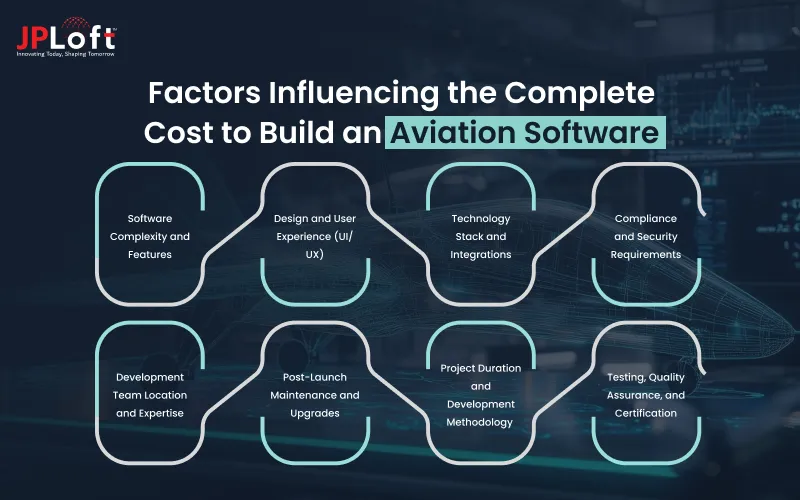
Let’s check out the complete list of factors influencing the complete cost, below.
1. Software Complexity and Features
The more complex your aviation software is, the more expensive it will be. Basic solutions, like flight tracking or booking apps, require minimal functionality and integrations.
The aviation software development cost is impacted by the large enterprise-grade systems with modules for maintenance, crew management, and analytics take more time and expertise.
Advanced functionality such as AI-driven route optimization, predictive maintenance, or IoT-based monitoring can drive prices even higher. Complexity also increases requirements for the backend architecture and testing routines, further influencing the overall budget.
Now, let’s check out the given table stating how the complexity impacts the total cost to build an aviation software.
|
Complexity Level |
Description |
Estimated Cost (USD) |
|
Basic Software |
Includes limited modules like flight schedule display or booking interface; minimal backend logic and no integrations. |
$5,000 – $8,000 |
|
Moderate Software |
Adds real-time updates, admin dashboard, limited API integrations, and better UI/UX design. |
$8,000 – $14,000 |
|
High-Complexity Software |
Covers multiple modules such as crew management, MRO tracking, analytics, and third-party API integration. |
$14,000 – $20,000 |
2. Design and User Experience (UI/UX)
Design is crucial to aviation software, because users span from pilots to passengers to administrators. A well-structured, intuitive UI means seamless navigation and error-free operations.
The cost to make aviation software is impacted via complex dashboards, real-time visualizations, and responsive layouts increase design hours and, therefore, costs. You can connect with the professional UI/UX design company to get your design lead competitive market.
Investing in a professional UI/UX design phase improves efficiency and safety but may add up to 10–20% to the total development cost. Adding more unique design elements, such as 3D maps or flight visualization tools, easily pushes expenses even higher.
Let’s check out the given table for evaluating how design impacts the cost in the given table.
|
Design Complexity Level |
Description |
Estimated Cost (USD) |
|
Basic Design |
Simple layouts with standard UI components, minimal customization, and limited user flows. |
$3,000 – $6,000 |
|
Intermediate Design |
Custom dashboards, responsive layouts, improved navigation, and better user engagement elements. |
$6,000 – $10,000 |
|
Advanced Design |
High-end UI/UX with interactive visuals, 3D flight maps, animations, and data-driven dashboards. |
$10,000 – $15,000 |
3. Technology Stack and Integrations
When you develop aviation software, the tech stack is the core of every system. Selection of technologies-programming languages, frameworks, databases, and cloud platforms also a significant factor in cost estimation.
The need for integrations with third-party APIs, such as weather data systems, GPS, or aviation databases like FAA or IATA, adds to the cost and intricacy.
For enterprise solutions, integrations with ERP, CRM, and IoT frameworks also call for advanced technical competencies. Employing scalable technologies, like AWS or Azure, might increase the upfront cost but decrease long-term maintenance expenses.
The given table describes the complete cost, stating how the tech stack impacts it.
|
Technology Stack Type |
Description |
Key Components |
Estimated Cost (USD) |
|
Basic Tech Stack |
Ideal for simple aviation apps with limited features and minimal integrations. Uses standard frameworks and single-platform support. |
PHP, MySQL, HTML/CSS, basic APIs |
$8,000 – $12,000 |
|
Mid-Level Tech Stack |
Supports scalable backend, better security, and moderate integrations like flight tracking or booking APIs. |
Node.js, React, PostgreSQL, REST APIs, AWS |
$12,000 – $18,000 |
|
Advanced Tech Stack |
Designed for enterprise aviation systems with AI, IoT, and real-time data synchronization. Ensures high performance and compliance. |
Python, Angular, MongoDB, AI/ML models, IoT frameworks, Cloud (Azure/AWS) |
$18,000 – $22,000+ |
4. Compliance and Security Requirements
The aviation software should be developed following severe DO-178C, FAA, EASA, and cybersecurity standards.
Such certification provides many benefits because it ensures reliability, safety, and data protection, but requires intensive documentation, testing, and audits; each step costs money.
Encryption, API security, and user authentication increase both development time and budget. Failure to comply can lead to delays or rejection by aviation authorities, thus making investments in compliance non-negotiable.
Let's discuss the cost in the given table.
|
Compliance Level |
Description |
Estimated Cost (USD) |
|
Basic Compliance |
Covers standard data encryption, user authentication, and basic security checks for non-critical aviation apps. |
$5,000 – $8,000 |
|
Moderate Compliance |
Includes adherence to basic aviation standards, secure APIs, GDPR policies, and system audits. |
$8,000 – $12,000 |
|
High-Level Compliance |
Meets strict aviation and safety regulations like DO-178C, FAA, and EASA with end-to-end encryption and certification processes. |
$12,000 – $15,000 |
5. Development Team Location and Expertise
Where your development team is located greatly affects the overall cost. While developers in North America or Europe charge $80 to $150/hour, their teams in Asia or Eastern Europe may provide similar expertise for $25 to $60/hour.
But let's not forget that higher rates are often justified by experience in aviation-specific systems or certified development: DO-178C specialists, among others.
Working with a seasoned custom software development company will ensure delivery faster, of better code quality, and with fewer issues after launch.
Now, let's discuss the factor of how the development team's location impacts the total cost below.
|
Team Type / Location |
Description |
Estimated Cost (USD) |
|
Offshore Team (Asia / Eastern Europe) |
Offers affordable rates with skilled developers. Suitable for startups or MVP builds, but may require strong project coordination. |
$6,000 – $12,000 |
|
Nearshore Team (Middle East / South America) |
Balanced pricing with easier collaboration, overlapping time zones, and moderate aviation experience. |
$12,000 – $20,000 |
|
Onshore Team (USA / UK / Western Europe) |
Highly experienced in aviation standards, compliance, and large-scale projects; ensures top-tier quality and faster delivery. |
$20,000 – $30,000 |
6. Post-Launch Maintenance and Upgrades
The cost to build aviation software is impacted by post-launch maintenance parameters. Aviation systems must be updated regularly to meet continuously changing regulations, new aircraft types, and emerging technologies.
Maintenance itself includes server monitoring, bug fixing, and version upgrades with performance optimization. Normally, annual maintenance ranges in cost from 15 to 25% of the initial development budget.
Neglecting maintenance may lead to either performance degradation or compliance issues. Long-term support covers stability, scalability, and seamless integration with future aviation systems. A leading software maintenance services provider with an experienced team knows well the frequency of updates.
Let's discuss the factor and the cost below.
|
Maintenance Level |
Description |
Estimated Cost (USD) |
|
Basic Maintenance |
Covers bug fixes, minor updates, and routine performance checks. |
$5,000 – $8,000 |
|
Standard Maintenance |
Includes security patches, API updates, feature refinements, and system monitoring. |
$8,000 – $12,000 |
|
Advanced Maintenance |
Ongoing optimization, scalability upgrades, compliance updates, and integration of new technologies. |
$12,000 – $15,000 |
7. Project Duration and Development Methodology
The total timeline of the project directly affects the cost: a short, well-defined MVP with limited features may take 2–3 months, while full-scale aviation platforms often span 8–12 months.
Another factor is the development approach: Agile allows iterative releases and better budget control, while Waterfall requires more upfront investment but ensures structured delivery.
Delays in approval cycles, testing, or documentation obviously extend both time and cost. Efficient project management and continuous communication help keep expenses under control.
Here, let's discuss the complete factor and its impact on cost, below.
|
Project Scale / Methodology |
Description |
Timeline |
Estimated Cost (USD) |
|
Short-Term (Agile MVP) |
Focused on essential features with quick iterations and faster deployment. Ideal for startups or pilot projects. |
2 – 3 months |
$15,000 – $30,000 |
|
Mid-Term (Hybrid Approach) |
Balanced scope with modular development, regular sprints, and structured documentation. Suited for moderate complexity. |
4 – 6 months |
$30,000 – $55,000 |
|
Long-Term (Full-Scale / Waterfall) |
Enterprise-grade aviation platform with complete modules, compliance audits, and certification processes. |
7 – 12 months |
$55,000 – $80,000+ |
8. Testing, Quality Assurance, and Certification
Aviation software requires very high accuracy because even small bugs can affect safety and operations. Testing includes functional, performance, security, and compliance testing, which may take up to 25–30% of the total hours spent on the project.
Certification processes such as DO-178C and ISO 27001 further introduce additional layers of review, documentation, and validation.
Simulation of real-time flight scenarios, stress-testing systems under loads, and manual or automated QA increase both cost and credibility. This stage will ensure that the software meets global aviation standards for safety and reliability.
|
Testing & Certification Level |
Description |
Estimated Cost (USD) |
|
Basic QA Testing |
Covers functional and usability testing to ensure the software runs smoothly and error-free. |
$5,000 – $8,000 |
|
Standard QA & Security Testing |
Includes performance, security, and integration testing along with initial compliance checks. |
$8,000 – $14,000 |
|
Advanced Certification & Compliance Testing |
Involves end-to-end testing, load simulation, and certifications like DO-178C, FAA, or EASA. |
$14,000 – $20,000 |
Continuing with the factors impacting the complete cost to make an aviation software, there can be certain hidden costs to be considered in the following section.
Hidden Cost Impacting the Complete Aviation Software Development Cost
Learning about the hidden cost can help in examining the other factors that you might have missed.
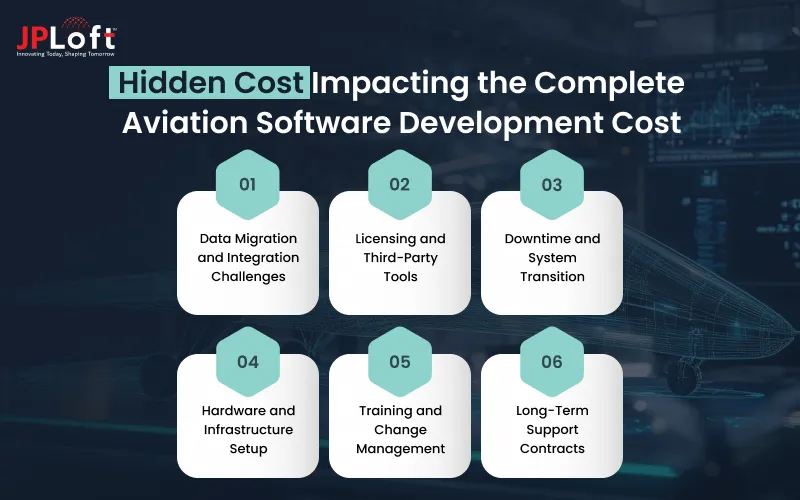
Let's discuss them all here.
1] Data Migration and Integration Challenges
Migrating existing flight, maintenance, or passenger data to a new system can add unexpected expenses.
Legacy systems often use outdated formats that require custom scripts or middleware to integrate. Ensuring the accuracy, consistency, and security of the data during migration increases both time and cost.
2] Licensing and Third-Party Tools
Some aviation functionalities depend on premium APIs, such as weather data, GPS tracking, or flight analytics.
These will have recurring subscription charges or per-usage charges. Furthermore, using licensed libraries or frameworks can raise the cost even more over time.
3] Downtime and System Transition
Obviously, temporary downtime or reduced productivity is realized when there is a change from the old systems to a new aviation platform.
These usually require backup systems, training of personnel, and phasing-in, thus increasing the overall costs of the businesses concerned.
4] Hardware and Infrastructure Setup
For software that controls ground operations or aircraft systems, there needs to be compatible hardware like IoT sensors, beacons, or edge devices.
Setting these up, along with the servers or cloud infrastructure, adds to the final budget.
5] Training and Change Management
Most aviation systems are pretty complex, and staff and administrators usually need additional training.
Moreover, the cost of organizing workshops, preparing user manuals, and onboarding new users is often belittled but very important. Proper training will ensure smooth adoption and reduce post-launch issues.
6] Long-Term Support Contracts
Many aviation businesses sign annual or multi-year support agreements with development partners for such systems, which include system monitoring, performance tuning, and security audits.
While valuable contributions to reliability, these add considerably to the long-term financial commitment.
Now, as we have discussed the cost, complete factors, and hidden factors, let's move on to the monetization strategies in the following section.
How To Earn Money From Aviation Software?
You can earn money by creating aviation software through effectively examining the potential attributes and optimizing the app.
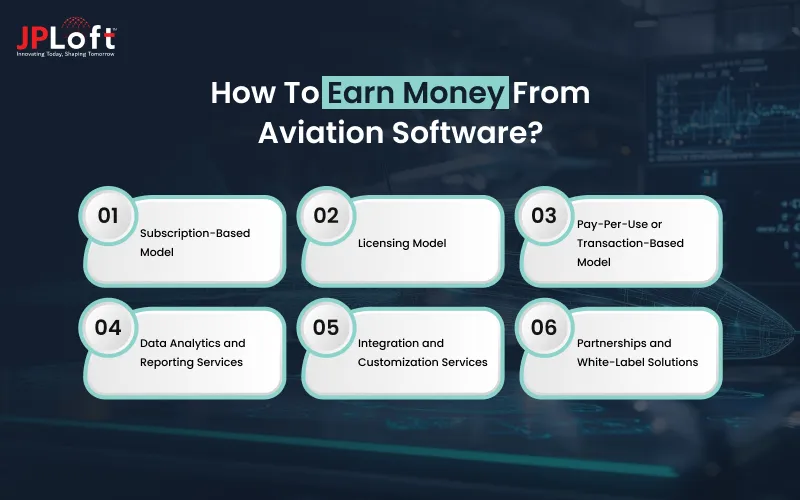
There are effective monetization strategies you can adopt for your aviation software. Let’s learn them all below.
► Subscription-Based Model
Charge a recurring monthly or yearly fee to the users for using your aviation software. This model will suit the business requirements of airlines, MRO companies, and charter services, which require continuous updates and support.
You can provide tiered plans with added features, such as analytics, predictive maintenance, or API access, to attract more clients and ensure steady income.
► Licensing Model
License and sell to those aviation companies that want to completely own the product once and for all, rather than pay periodically.
You may separately charge for setup, customization, and annual renewals for updates. It works for enterprise-level software, like crew scheduling or air traffic management systems, which would require on-premise deployment.
► Pay-Per-Use or Transaction-Based Model
Charge per actual usage, such as the number of flights tracked, passengers booked, or maintenance tasks logged.
With this model, the cost scales with company growth and is more attractive to small operators or startups. It encourages greater adoption while keeping the entry cost for new customers low.
► Data Analytics and Reporting Services
Aviation software gathers huge amounts of operational data. To monetize this, you may offer advanced analytics dashboards, real-time insights, or predictive reports as premium add-ons.
Airlines and MRO providers are often willing to pay for advanced insights and decision-making tools that unlock efficiency gains in operations and help cut either fuel or maintenance costs.
► Integration and Customization Services
Charge for the integration of the software with the clients' systems, such as ERP, CRM, or IoT devices, or for custom-built modules.
Most aviation businesses require a tailored solution to their workflow, and offering these services brings in more project-based revenue in addition to your main product.
► Partnerships and White-Label Solutions
Offer your aviation software on a white-label basis to other businesses and resellers.
That means allowing partners to rebrand and sell the software under their name, as you generate income through licensing or revenue-sharing agreements. It's an effective way to scale globally without extra marketing costs.
Partner with JPLoft and Build an Aviation Software
When it's all about selecting the right development company, you might face an issue with the same.
However, with JPLoft, you can sit back and enjoy app app-building process as we lay trust in our foundation.
Connect with JPLoft, a trusted aviation software development company, to turn your aviation vision into a high-performing digital solution. Our team specializes in building intelligent, secure, and scalable software tailored for airlines, airports, and aviation service providers.
From flight scheduling and crew management to MRO tracking and passenger experience platforms, we create end-to-end solutions that optimize operations and enhance efficiency. We follow strict compliance standards such as DO-178C, FAA, and EASA to ensure complete safety and reliability.
With advanced technologies like AI, IoT, and predictive analytics, we help aviation businesses streamline workflows and cut operational costs.
Partnering with us means getting a dedicated team that understands the complexities of aviation technology and delivers robust, future-ready systems. Whether you’re a startup or an established enterprise, JPLoft ensures your aviation software takes flight with performance, precision, and innovation.

Conclusion
Building aviation software is a long-term investment that blends innovation, compliance, and advanced technology to enhance aviation operations.
With development costs ranging from $15,000 to $80,000, several factors, such as software complexity, design, compliance, and team expertise, influence the total cost.
Leveraging technologies like AI, IoT, and predictive analytics helps improve efficiency, safety, and real-time coordination.
The key lies in partnering with a trusted aviation software development company that understands industry standards and ensures high performance, scalability, and regulatory compliance. With the right approach, your aviation software can redefine operational excellence and profitability.
FAQs
Aviation software manages flight operations, crew scheduling, maintenance, booking, and air traffic control, improving safety, efficiency, and communication across aviation systems.
It generally costs between $15,000 and $80,000, depending on software type, features, compliance standards, and integration complexity.
The development process typically takes 3 to 12 months, depending on the project’s scale, methodology, and certification requirements.
Start with market research and requirement analysis, choose a reliable aviation software development company, define features, ensure compliance, develop using Agile, and test thoroughly before deployment.
AI, IoT, cloud computing, and predictive analytics are commonly used, along with frameworks like Node.js, React, Python, and AWS.
Yes, through models like subscriptions, licensing, data analytics, customization, and white-label partnerships, ensuring consistent and scalable revenue streams.

Yashwant Sharma is the CTO of JPLoft, with 18+ years of experience in software engineering, solution architecture, and digital innovation. His expertise spans scalable application development, AI-powered systems, RAG solutions, cross-platform development, software maintenance, and emerging mobility technologies such as EV and EV-charging platforms. He works across complex technical environments to help businesses build secure, maintainable, and high-performing digital products for industries including education, fitness, aviation, and healthcare.



Share this blog