


Key Takeaways
Aviation software testing safeguards human lives by validating safety-critical systems before real-world deployment.
Continuous testing cuts certification delays, grounding risks, and expensive post-release fixes.
Compliance with standards like DO-178C enables faster regulatory approval and audit readiness.
Structured testing improves system reliability, performance, and cybersecurity resilience.
Early testing investments support long-term scalability as aviation systems grow more complex.
JPLoft provides certification-focused aviation software testing with full traceability, reducing compliance risk and launch uncertainty.
The global aviation software market is expanding fast, with billions being invested into avionics, air traffic systems, maintenance platforms, and safety monitoring tools.
With that growth comes a more relevant question: how do you prove aviation software is safe, compliant, and reliable before it ever touches real-world operations? The answer starts with Aviation software testing.
For investors and entrepreneurs, this matters because aviation software is not like typical apps. A small defect can delay certification, trigger grounding risks, or create major financial and reputational damage. Testing is the layer that protects both human safety and business outcomes.
From MVP planning to deployment and long-term updates, testing stays active throughout the lifecycle. It validates requirements, checks system behavior under extreme conditions, and produces the evidence regulators expect.
This guide breaks down the testing process, key standards, tools, and best practices so you can make smarter product and investment decisions.
Let’s check out the complete guide below for more.
All About Aviation Software
Aviation software refers to specialized digital systems designed to support, control, and optimize operations across the aviation industry.
It powers critical functions such as flight control, navigation, air traffic management, aircraft maintenance, safety monitoring, and ground operations.
Aviation software must operate with extreme accuracy and reliability because even minor failures can impact flight safety.
These systems are designed to build an aviation software foundation that meets strict regulatory standards and is tested under real-world and simulated conditions before deployment.
From avionics and flight management systems to airline scheduling and maintenance platforms, this aviation software testing guide explains how aviation software ensures aircraft operate safely, efficiently, and in full compliance with global aviation regulations.
Let’s look forward to the Aviation market stats below.
-
The global market size is estimated at USD 11.18 billion in 2024, and is projected to reach USD 16.93 billion by 2030. This is growing at a CAGR of 7.5% from 2025 to 2030.
-
Additionally, the aviation software market in the Asia Pacific region is expected to grow at a CAGR of over 10.8% from 2025 to 2030.
-
Based on the Predence research, the global aviation software market size is estimated to be USD 11.50 billion in 2024, and is predicted to reach around USD 23.10 billion by 2034, that is expanding at a CAGR of 7.22% from 2025 to 2034.
-
The global aviation software is further estimated at USD 7.70 billion in 2024. This is predicted to grow from USD 8.13 billion in 2025 to USD 11.68 billion by 2032, exhibiting a CAGR of 5.3% during the forecasted period.
Considering a brief on the market stats, are you ready to build an aviation software?
Well, if yes, then one of the core parts we are discussing here is about testing. You cannot ignore the testing process from the beginning.
From day one of MVP development for aviation software to the launch and even after launch, the testing process is never-ending.
If you are still wondering why you need to proceed with the aviation software testing, then the given section can be helpful.
Why is Aviation Software Testing Important?
Aviation software testing is crucial because even minor glitches in complex systems can lead to serious failures. It ensures safety, reliability, and regulatory compliance while preventing accidents and supporting seamless, efficient flight operations.
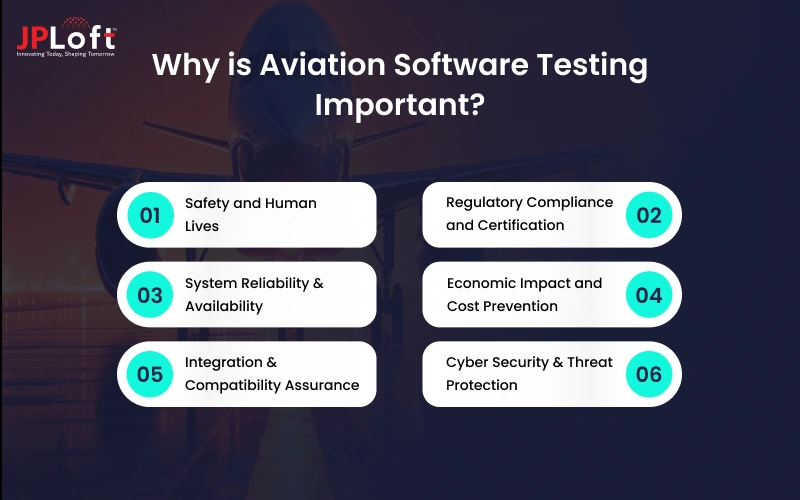
Let’s learn the details on why aviation software testing is crucial.
1. Safety and Human Lives
Aviation software is used to control various critical flight systems such as navigation systems, engine controls, and communication systems.
The failure of software at any stage may result in disastrous crashes, which can cause fatalities.
It is of utmost importance that these systems are thoroughly tested for proper functionality even in extreme conditions, such as normal conditions, as well as crash scenarios.
2. Regulatory Compliance and Certification
Aviation software ought to satisfy rigorous international standards such as DO-178C (Software Considerations in Airborne Systems), which are pronounced by regulatory agencies such as the FAA, EASA, and others.
This provides particular guidelines on how the testing ought to be carried out. Aviation software that is not tested on a regulatory basis cannot be used on a commercial aviation platform.
Aviation software compliance saves the manufacturer from violating the Aviation Software Law.
3. System Reliability & Availability
Planes are subjected to intensely harsh conditions with respect to temperatures, pressures, and electromagnetic interference. Software testing is performed to ensure that systems support stable operations throughout the aircraft’s operating conditions.
It helps protect against system failure during flight, which may result in forced landing, diversion, or reduced aircraft availability for maintenance.
Software that works correctly is essentially a component contributing to increased airline efficiency.
4. Economic Impact and Cost Prevention
The cost of repairing software bugs that are identified after installation is exponentially more expensive than identifying them during the phases of software testing.
Software flaws have the potential to cause entire aircraft fleets to be grounded, resulting in significant loss of revenues, compensation, and damage to the airline’s reputation.
Software bugs within an aircraft's software systems can be removed through software testing, thereby eliminating potential catastrophic costs.
5. Integration & Compatibility Assurance
Modern airplanes have dozens of interacting software systems sourced from various suppliers, which need to interact flawlessly with each other.
The testing ensures that the systems interact with each other properly, exchange data in the correct manner, and do not produce conflicts or malfunctions.
Integration testing is a highly essential process, as systems might be functioning flawlessly separately but may malfunction when interacting with other systems.
6. Cyber Security & Threat Protection
Aviation systems are becoming interlinked with earth-based networks, satellite communications, as well as passenger Wi-Fi networks, thus presenting potential vulnerabilities.
Security testing helps discover vulnerabilities that might be used maliciously with the intention of hacking aircraft systems.
The increasing threat of cyber-terrorism, as well as cyber-attacks on vital infrastructure, is a serious concern; thus, ensuring aircraft systems are protected from hacking, breaches, as well as potential bombings.
Proceeding with the software testing is crucial because it not only helps in sustaining the competition, but crucial to provide seamless services to the users.
Well, as you know, testing is important. Now, this guide to aviation software testing walks you through the different types of aviation software testing you can undertake in the section below.
Core Testing Types Used in Aviation Software
Aviation software is tested under extreme conditions because safety, reliability, and compliance are non-negotiable. Hire software developers who are well aware of the different testing types that can be used for checking the quality of aviation software.
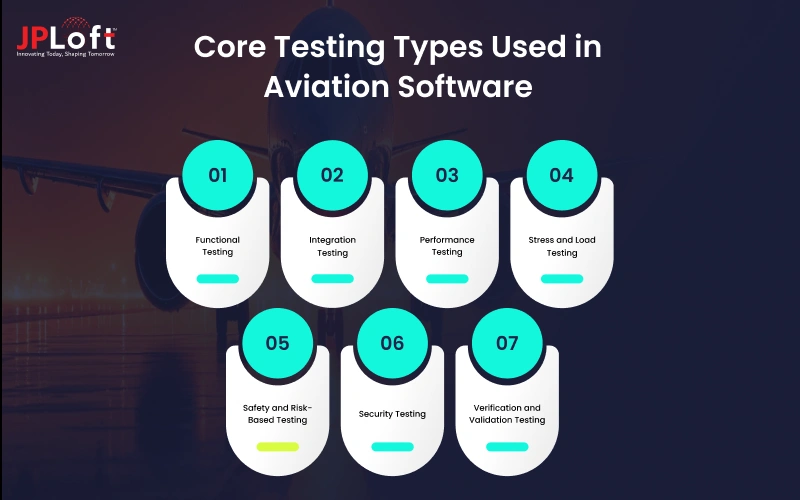
Below are the key testing types used in aviation software projects, explained clearly and practically.
Type 1: Functional Testing
Functional testing verifies that every feature works exactly as defined in the system requirements.
It checks flight logic, navigation calculations, alerts, and user interactions to ensure correct outputs under normal and edge conditions. Any deviation is treated as a critical defect.
Type 2: Integration Testing
Integration testing validates how different aviation systems communicate with each other. This includes interactions between avionics modules, sensors, flight management systems, and ground control software.
The goal is to detect data flow issues, timing mismatches, and interface failures early.
Type 3: Performance Testing
Performance testing evaluates how aviation software behaves under high load and time-critical scenarios.
It measures response time, system stability, and throughput during peak operations such as takeoff, landing, or high air-traffic density situations.
Type 4: Stress and Load Testing
Stress testing pushes aviation software beyond expected operational limits.
It helps identify failure points, system degradation, and recovery behavior during extreme conditions like hardware overload, sensor failure, or unexpected data spikes.
Type 5: Safety and Risk-Based Testing
Safety testing focuses on identifying potential hazards that could impact flight operations.
Test cases are designed based on risk severity, ensuring that safety-critical functions are tested more rigorously than non-critical components.
Type 6: Security Testing
Security testing ensures aviation software is protected against unauthorized access and cyber threats.
It evaluates data encryption, access control, communication channels, and vulnerability exposure to prevent system compromise.
Type 7: Regression Testing
Regression testing confirms that new updates or fixes do not break existing functionality.
Given the long lifecycle of aviation systems, regression tests are essential after software upgrades, patches, or regulatory updates.
Type 8: Verification and Validation Testing
Verification ensures the software is built according to specifications, while validation confirms it meets real-world operational needs.
This testing proves that the system is not only technically correct but also fit for actual aviation use.
After considering different types of aviation software testing, let's get ahead with how you need to test aviation software and what kind of steps you should follow, in the given section.
Step-by-Step Process for Aviation Software Testing
When you test your aviation software, it's essential to evaluate the complete procedure. The process will begin with planning, then move to deployment, focusing heavily on safety and compliance, and landscape.
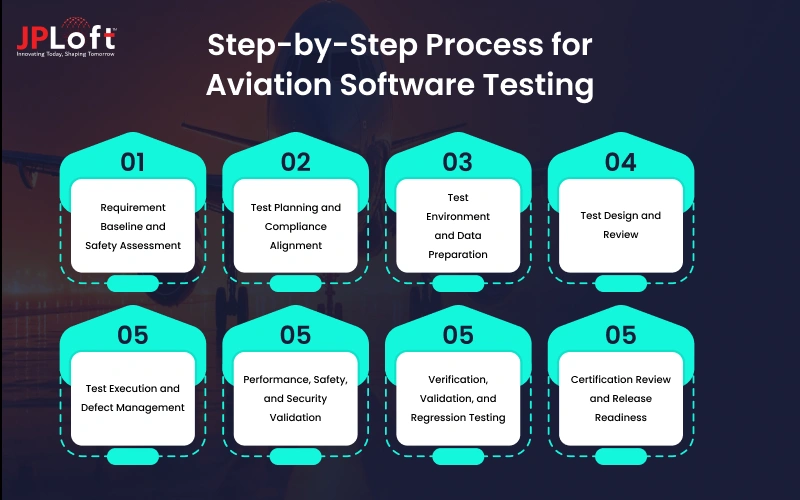
Let’s learn the step-by-step process below.
Step 1: Requirement Baseline and Safety Assessment
Testing begins by finalizing system requirements and identifying safety-critical functions. Software criticality levels are defined, since they control test depth and documentation needs.
A requirement-to-test traceability matrix is created to ensure complete coverage. Entry and exit criteria are locked before execution starts.
Step 2: Test Planning and Compliance Alignment
A detailed test plan is prepared covering scope, timelines, responsibilities, and risk priorities. Each testing activity is mapped to applicable aviation standards and certification expectations.
This step also defines defect classification, review checkpoints, and evidence requirements for audits. No testing proceeds without formal approval.
Step 3: Test Environment and Data Preparation
Realistic test environments are built using simulators, emulators, and hardware-in-the-loop setups. Test data is prepared to represent normal operations, edge cases, and abnormal flight conditions.
Configuration control is enforced to ensure results remain repeatable. This step prevents false confidence from unrealistic testing.
Step 4: Test Design and Review
Test cases are designed from requirements, safety hazards, and operational scenarios. They cover nominal flows, boundary conditions, error handling, and system transitions.
Each test includes measurable expected results and traceability references. Peer reviews are conducted to remove gaps before execution.
Step 5: Test Execution and Defect Management
Tests are executed in controlled phases across unit, integration, and system levels. Defects are logged, prioritized by safety impact, and tracked through resolution.
Safety-critical issues trigger immediate investigation and re-testing. All results are documented for certification review.
Step 6: Performance, Safety, and Security Validation
The software is tested under high load, time-critical scenarios, and degraded conditions. Fault injection is used to validate safety mechanisms and fail-safe behavior.
Security testing verifies protection against unauthorized access and data manipulation. This step confirms resilience under real-world stress.
Step 7: Verification, Validation, and Regression Testing
Verification confirms the software meets its specifications, while validation proves it works in real operational scenarios.
Regression testing ensures updates do not impact existing certified functionality. Automated suites are often used here to improve coverage and consistency. Evidence is collected systematically.
Step 8: Certification Review and Release Readiness
All test artifacts, reports, and traceability records are compiled for compliance review. Internal audits or independent verification validate readiness for certification.
Once approved, the software is cleared for release and monitored post-deployment. This step closes the testing lifecycle responsibly.
Proceeding with the steps in the guide to aviation software testing, let's get ahead with the list of challenges in the following section.
Key Challenges in Aviation Software Testing
One of the common challenges that you might face is the complications of aviation software features.
Yes, the complexity can have a large impact on the testing process. The more complex the features, the heavier the tools or experienced the quality checker you will need.
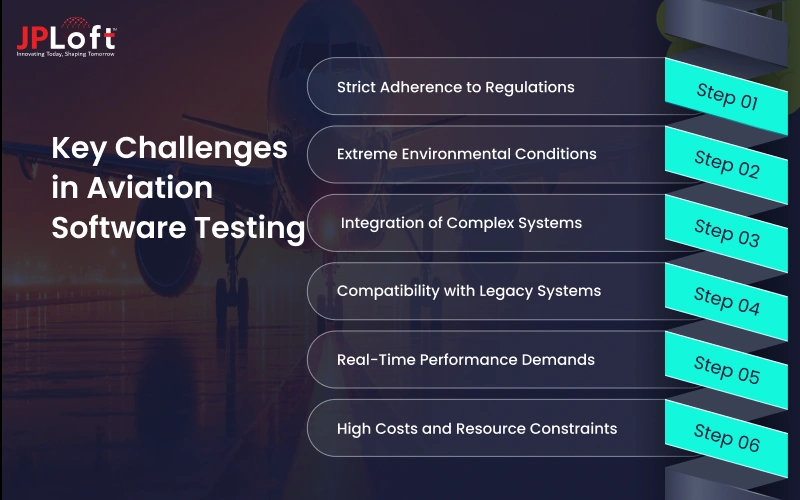
Let’s discover some more challenges that your software might face during the testing process.
1] Strict Adherence to Regulations
The development of aviation software needs rigorous attention to strict certification rules, such as DO-178C.
It includes heavy documentation and traceability features, which demand much time and require certain specialized expertise. Even the tiniest documentation gap may result in delays of up to several months in the certification process.
2] Extreme Environmental Conditions
Avionics software has to operate within extreme temperature ranges from -55°C to +70°C, at differing pressures, and in high electromagnetic interference.
Replicating these sorts of conditions requires very expensive, specialized equipment. Flight testing under real conditions is rare and expensive.
3] Integration of Complex Systems
Modern aircraft have hundreds of interdependent software components that need to be integrated into a seamless interaction; this makes changes in one system produce unforeseen and sometimes alarming effects in others.
Due to the high number of component failure combinations, exhaustive testing is in practice impossible.
4] Compatibility with Legacy Systems
New software should be integrated with decades-old legacy systems, devoid of modern documentation in most cases.
The need to maintain backward compatibility often introduces many modern features, adding much complexity. Long operational life spans of aircraft mean supporting systems that could be 20-30 years old.
5] Real-Time Performance Demands
Aviation software has to run under very strict real-time settings, where one millisecond of extra time might be very costly.
Testing is required to ensure that operations are completed within an allocated time window under all system loads. Specialized tools will be needed to detect race conditions and timing issues.
6] High Costs and Resource Constraints
Specialized engineers are required for aviation software testing. Thus, talents are rare and very expensive. Testing is extremely time-consuming; certification testing alone consumes 50-60% of the development costs.
The use of expensive, specialized equipment together with extended timelines contributes to a lower return on investment.
Address the challenges in aviation software testing by connecting with the leading software development services.
Along with this, you should be well aware of the effective tools and frameworks helpful to enhance the quality of aviation software. Let’s check them all out below.
Common Tools and Frameworks Used in Aviation Software Testing
The common tools and frameworks that can be used in aviation software testing are the LDRA tool suite, VectorCAST, IBM DOORS, Cantata, and many more.
Let’s evaluate the tools in the given table.
|
Tool / Framework |
Purpose |
How It Helps in Aviation Software Testing |
|
LDRA Tool Suite |
Verification and validation |
Supports requirement traceability, structural coverage, and compliance reporting needed for safety-critical aviation software. |
|
VectorCAST |
Unit and integration testing |
Automates unit testing and coverage analysis for embedded avionics software, helping detect logic and boundary issues early. |
|
IBM DOORS |
Requirement management |
Maintains strict traceability between requirements, test cases, and results, which is essential for certification audits. |
|
MATLAB / Simulink |
Model-based testing |
Enables simulation and testing of flight control algorithms before real hardware testing begins. |
|
NI LabVIEW |
Hardware-in-the-Loop testing |
Simulates real aircraft hardware behavior to validate software responses under real-time conditions. |
|
Cantata |
Embedded software testing |
Provides automated unit testing and code coverage for safety-critical embedded systems used in aviation. |
|
Jenkins |
Test automation orchestration |
Automates build, test execution, and regression cycles for continuous verification of aviation software updates. |
|
Wireshark |
Communication analysis |
Analyzes data packets between avionics systems to verify protocol integrity and timing accuracy. |
|
QAC / MISRA Checkers |
Static code analysis |
Detects coding rule violations, unsafe constructs, and potential defects before runtime testing begins. |
Proceeding with the tools, this aviation software testing guide moves to examining the best practices for reliable aviation software testing in the following section.
Best Practices for Reliable Aviation Software Testing
The best practices for a reliable aviation software testing include following crucial standards, ensuring traceability, including automated testing as an important part, and more.
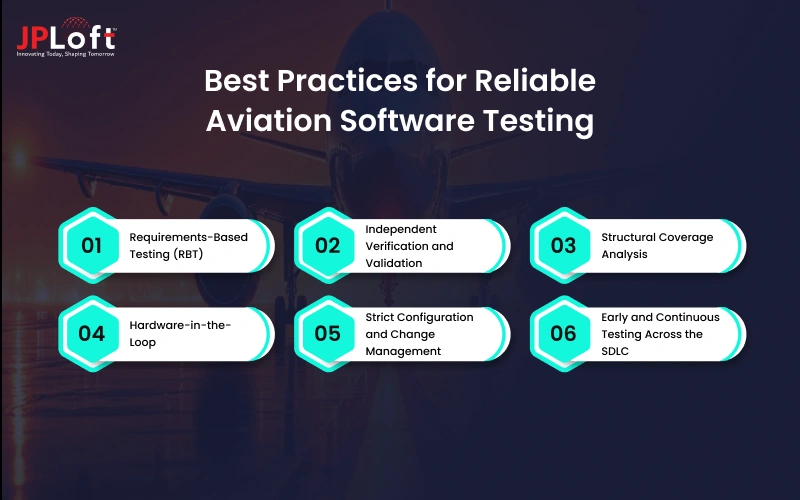
Here is a detail of the practices that you need to learn:
► Requirements-Based Testing (RBT)
Each test case shall directly map to a documented requirement. This means that there shall be full traceability, at least, and it ensures that flight systems do not include unverified behavior. In the testing of aviation software, anything that cannot be traced back to a requirement is considered a potential risk.
► Independent Verification and Validation
The testing should be done or reviewed by teams that are independent of the development of the software. This removes bias and uncovers logic gaps that are often missed by developers. IV&V strengthens confidence that the software behaves correctly under real operational conditions.
► Structural Coverage Analysis
Output validation is not sufficient in safety-critical software. Structural coverage will prove that all internal code paths, decisions, and conditions are meaningfully exercised; therefore, nothing has been left hidden or unused in field-operating systems.
► Hardware-in-the-Loop
Testing Software should be tested along with real or representative hardware components. HIL testing reveals timing issues, sensor inconsistencies, and other interface failures at an early stage. It helps validate the behavior of software in near-real flight conditions.
► Strict Configuration and Change Management
Every modification of the code should be tracked, reviewed, and approved. This is ensured by configuration control, where consistency across requirements, code, tests, and documentation is maintained. It's an essential discipline for audit readiness and long-term system reliability.
► Early and Continuous Testing Across the SDLC
Test activities should begin during the definition of the requirements themselves and progress through the maintenance periods. Testing early reduces expensive late-stage defects and rework. Continuous testing ensures that the safety of systems remains intact during updates and enhancements being introduced over time.
How to Choose the Right Aviation Software Testing Partner?
Choosing the right aviation software testing partner starts with one core question: can they prove safety, not just promise quality?
Aviation systems demand deep domain knowledge, strict compliance handling, and teams that understand certification pressure, traceability, and zero-failure tolerance. The right partner brings experience with safety-critical workflows, disciplined documentation, independent verification practices, and a testing mindset aligned with regulators, not shortcuts.
This is where JPLoft stands out. As an experienced Aviation software development company, JPLoft approaches testing as a certification-driven process, not a final checkpoint.
Their teams work closely with development and compliance from day one, ensuring requirements traceability, structural coverage, and audit-ready documentation throughout the lifecycle.
What this really means is fewer surprises during certification and more confidence in system behavior under real flight conditions. With JPLoft, aviation organizations gain a testing partner that understands safety, timelines, and accountability, all at the same time.
Conclusion
Aviation software testing is not a phase you add later. It is a discipline that runs through the entire lifecycle of the system. From defining safety-critical requirements to certification readiness, every testing activity exists to protect reliability, compliance, and human lives.
As aviation systems grow more complex and interconnected, testing must stay structured, traceable, and regulation-driven. Organizations that invest early in rigorous testing avoid costly delays, certification risks, and operational failures.
Working with an experienced partner like JPLoft helps ensure aviation software meets global standards, performs reliably in real conditions, and remains audit-ready long after deployment.
FAQs
Aviation software testing is the process of validating and verifying software used in aircraft and aviation systems. It ensures safety, reliability, performance, and compliance with aviation regulations before deployment.
This testing covers both normal operations and extreme scenarios to confirm predictable system behavior.
Aviation software controls safety-critical functions like navigation and flight control. Even a small defect can cause system failure, safety risks, or regulatory rejection, making thorough testing essential.
Proper testing directly protects human lives and operational continuity.
Key standards include DO-178C for airborne software, DO-278A for ground systems, DO-326A for cybersecurity, and FAA, EASA, and ICAO regulations for global compliance.
These standards define how testing, documentation, and traceability must be handled for certification.
Common testing types include functional testing, integration testing, performance testing, safety testing, security testing, regression testing, and verification and validation testing.
Each testing type focuses on a different risk area within safety-critical aviation systems.
Testing can span several months to years, depending on system complexity and certification level. In many projects, testing and certification consume more than half of the total development effort.
Timelines also depend heavily on regulatory review cycles and audit readiness.
Look for proven experience in safety-critical systems, strong regulatory knowledge, clear traceability practices, and certification-ready documentation.
A reliable partner treats testing as a continuous compliance-driven process rather than a final-stage activity.

Yashwant Sharma is the CTO of JPLoft, with 18+ years of experience in software engineering, solution architecture, and digital innovation. His expertise spans scalable application development, AI-powered systems, RAG solutions, cross-platform development, software maintenance, and emerging mobility technologies such as EV and EV-charging platforms. He works across complex technical environments to help businesses build secure, maintainable, and high-performing digital products for industries including education, fitness, aviation, and healthcare.




Share this blog