



Key Takeaways
AI in Aviation improves safety and reliability using predictive maintenance, real-time monitoring, and smarter air traffic systems that reduce human errors.
The role of AI in airline industry focuses on improving efficiency, optimizing flight operations, fuel usage, security, and overall passenger experience at scale.
Airlines and airports reduce costs by minimizing delays, improving fuel efficiency, and automating support, operations, and maintenance workflows effectively.
Successful AI adoption requires high-quality data, strong compliance, and proper testing to ensure safety, accuracy, and alignment with aviation regulations.
Partnering with JPLoft helps build scalable AI solutions aligned with business goals and future growth.
Artificial Intelligence is changing how airlines work by helping them make smarter decisions. Airlines are now faster, safer, and more efficient because of it.
In 2026, AI in Aviation is reshaping the entire airline industry. Airlines face rising costs and tough competition worldwide, and AI helps them handle these challenges better than before.
It is not just about automation. AI learns from data and improves over time, making airline operations smoother and more reliable for everyone.
Airlines using AI are seeing real results. Flights are delayed less often. Fuel costs are going down. Passengers are having better travel experiences.
AI also helps with aircraft maintenance by detecting problems before they become serious. Hence, this keeps planes in the air and schedules on time.
Now, let’s understand the role of AI, and more properly, in this blog.
Why is AI Important in the Aviation Industry?
Airlines today face many challenges that affect daily operations and long-term growth. These issues increase costs, create delays, and make it harder to deliver smooth passenger experiences.
This is where AI in the aviation industry plays a key role by helping businesses manage problems faster and make better decisions. The global AI in aviation market size is projected to reach USD 36.68 billion by 2034.
-
AI supports Airline operations by helping track flights, predict delays, and improve coordination across teams.
-
AI in aviation safety helps reduce risks, while AI in aviation maintenance finds issues early and avoids costly repairs.
-
Artificial Intelligence enables faster responses by analyzing data and automating routine tasks efficiently.
How is AI used in Aviation Industry?
AI in airline industry helps airlines handle complex tasks, improve safety, and deliver better services using real-time data and smart systems. It supports faster decisions, reduces manual work, and helps businesses manage operations more efficiently every single day.
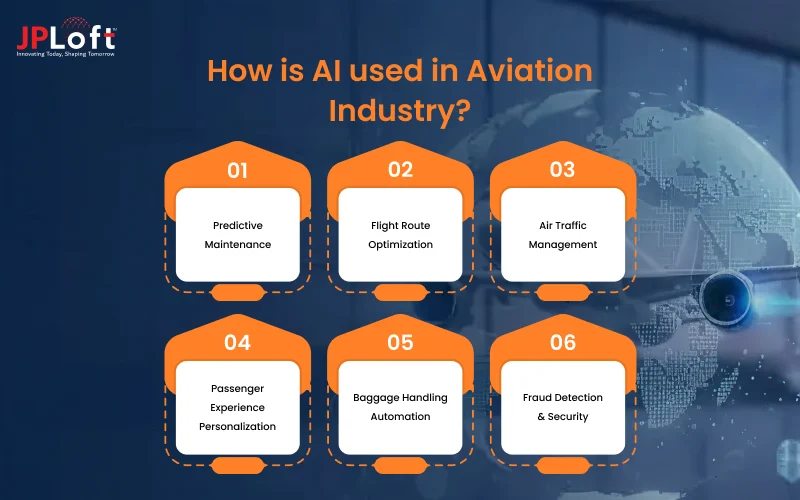
Below are points that explain how AI helps the airline industry perform better:
1. Predictive Maintenance
AI in aviation maintenance studies aircraft data, using aircraft maintenance software, to find problems early and avoid sudden failures.
Airlines like Delta use AI to reduce delays and improve aircraft reliability. By this, systems may fix issues automatically before they even occur.
2. Flight Route Optimization
AI helps airlines choose better routes by studying weather, traffic, and fuel use. However, airlines today save fuel and reduce delays using this method.
Furthermore, AI will plan routes instantly with even higher accuracy and lower costs.
3. Air Traffic Management
Using AI improves traffic flow by managing aircraft movement and reducing congestion in busy airspaces.
Future systems may fully automate air traffic control, shaping the future of AI in aviation with minimal human support.
4. Passenger Experience Personalization
Airline systems use AI to send updates, suggest services, and improve customer support quickly by depending on smart aviation software features.
Companies like Emirates use AI chatbots for better service. Future systems will offer fully personalized travel experiences based on passenger preferences and behavior.
5. Baggage Handling Automation
AI in aviation ground operations tracks baggage and reduces errors during transfers at airports.
Many airports use smart systems for faster baggage handling today. In the future, AI will ensure near-zero baggage loss with fully automated tracking systems.
6. Fraud Detection & Security
Artificial Intelligence helps detect unusual behavior and improve airport security systems.
Airlines use AI to prevent fraud and protect passenger data. Future systems will provide faster threat detection with stronger and more advanced security measures.
Benefits of Considering AI in Aviation Businesses
AI in the aviation industry helps airlines improve performance, reduce costs, and deliver better services by using smart data systems. It supports faster decisions, improves safety, and helps businesses handle daily operations in a more efficient and reliable way.
Let’s understand the table with the help of a table:
|
Benefits |
How AI Helps |
Business Impact |
|
Cost Reduction |
AI reduces fuel use, predicts maintenance, and avoids unexpected repairs by using real-time data. |
Airlines save money, reduce losses, and improve overall profit margins over time. |
|
Improved Safety |
AI in aviation market detects risks early and supports better decision-making during flight operations. |
Fewer accidents, better compliance, and stronger trust from passengers and regulators. |
|
Faster Operations |
AI automates tasks like scheduling, routing, and ground handling to reduce delays and manual work. |
Faster services, improved efficiency, and better use of resources across operations. |
|
Better Customer Experience |
AI in Airline systems offers quick support, personalized services, and real-time travel updates. |
Higher customer satisfaction, improved loyalty, and better brand reputation through strong aviation software UI/UX design. |
|
Data-Driven Decision Making |
Artificial Intelligence in Aviation industry studies large data sets to provide useful insights quickly. |
Smarter business decisions, better planning, and improved long-term growth strategies. |
How to Implement AI in Aviation Software: Step-by-Step Process
AI in Aviation industry helps businesses improve safety, reduce costs, and manage complex operations using smart and reliable systems. To get the best results, companies must follow a clear and structured process maintained by a trusted software development company with proper planning.
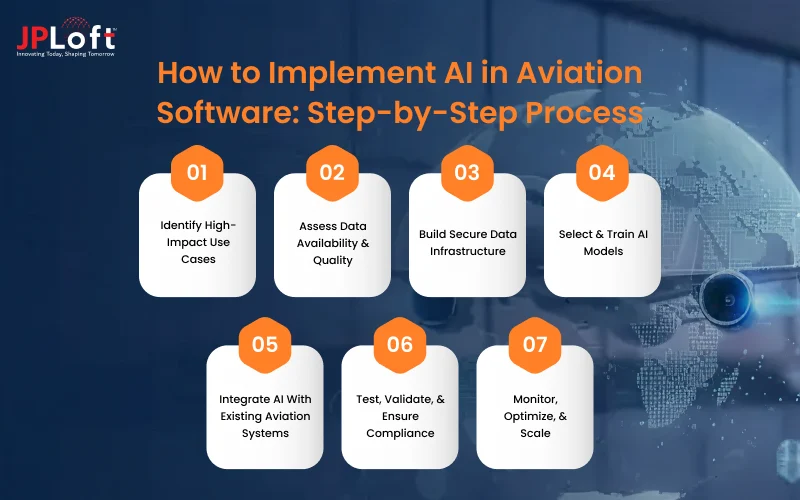
Let’s understand the step-by-step process to integrate Artificial Intelligence in Aviation industry simply and practically.
Step 1: Identify High-Impact Use Cases
The first step is to decide where AI can create real business value in aviation operations. Focus on areas that involve high costs, safety risks, or complex daily tasks.
Common use cases include:
-
AI in aviation maintenance to predict aircraft issues early
-
Flight route optimization to save fuel and reduce delays
-
Passenger handling systems to improve customer experience
Choosing the right use case helps avoid wasting time and money on low-impact solutions. It also ensures your AI investment delivers clear and measurable results from the beginning.
Step 2: Assess Data Availability & Quality
AI systems depend on good data to deliver accurate and useful results in real-world aviation scenarios. You need to review the data collected from aircraft systems, flight operations, and customer interactions.
Here’s what to check:
-
Is the data complete and up to date?
-
Is it consistent across different systems?
-
Can it be accessed easily when needed?
Poor data quality can lead to wrong predictions and serious safety risks in aviation operations. This step ensures your AI models learn from reliable information and perform well in real situations.
Step 3: Build Secure Data Infrastructure
Before using AI, you need a system that can store, process, and protect large amounts of aviation data. This includes setting up cloud platforms, data pipelines, and strong security systems to handle sensitive information.
Key elements include:
-
Real-time data collection from aircraft and airport systems
-
Secure storage solutions for large data sets
-
Strong cybersecurity measures to protect data
A secure infrastructure helps meet aviation rules and keeps both operational and passenger data safe. It also ensures smooth performance when AI tools handle large and complex data in real time.
Step 4: Select & Train AI Models
Once your data is ready, the next step is selecting AI models based on your specific use case. Different problems, like an airline reservation system, need different approaches, so choosing the right model is very important.
For example:
-
Machine learning for predicting maintenance issues
-
Computer vision for security checks
-
Chatbots for customer support
These models are trained using past aviation data to learn patterns and improve performance over time. Testing models with real-world scenarios ensures they provide accurate and reliable results before full deployment.
Step 5: Integrate AI With Existing Aviation Systems
AI solutions must work smoothly with systems like aviation crew management software to avoid disruptions in daily operations. This includes systems like flight management, maintenance platforms, and airport operations software.
Important considerations:
-
Ensure smooth data flow between systems
-
Avoid breaking existing workflows
-
Focus on practical and usable AI insights
Proper integration allows teams to use AI insights directly in their daily tasks without confusion. It also improves efficiency by making sure all systems work together in a connected and smart way.
Step 6: Test, Validate, & Ensure Compliance
AI in aviation market must follow proper aviation software testing before full use. You need to check how AI systems perform under different conditions and real-life scenarios.
Key steps include:
-
Testing system accuracy and reliability
-
Checking safety impact on operations
-
Ensuring compliance with aviation regulations
Explainable AI is important so teams understand how decisions are made by the system. This builds trust and helps meet strict approval standards set by aviation authorities.
Step 7: Monitor, Optimize, & Scale
AI systems need regular monitoring after deployment to ensure they continue to perform well over time. Changes in data or operations can affect performance, so updates and improvements are necessary.
What to focus on:
-
Track system performance and accuracy
-
Update models with new data
-
Fix issues quickly to avoid disruptions
Once the system proves successful, businesses can scale AI further and align with the future of AI in aviation. Working with experienced development teams can also help maintain and improve AI systems effectively.
Cost of Implementing AI Solutions in Airline Industry
The cost of AI in the aviation industry usually ranges from $15,000 to $300,000+, based on features, complexity, and system requirements.
Each airline has different needs, so the final cost to create an aviation software depends on the use case, data quality, and level of AI integration.
For startups and growing businesses, understanding these cost factors, like the cost to hire AI developers, helps plan budgets and avoid unexpected expenses during development.
|
Development Level |
Features Included |
Estimated Cost Range |
|
Basic AI Integration |
Chatbots, basic automation, simple analytics tools |
$15,000 – $50,000 |
|
Mid-Level AI Integration |
Predictive analytics, route optimization, customer personalization |
$50,000 – $150,000 |
|
Advanced AI Integration |
Predictive maintenance, real-time decision systems, AI in aviation safety |
$150,000 – $300,000+ |
Key Factors That Affect the Cost of Integration
-
Project scope and use cases - Simple tools like chatbots cost less, while advanced systems like aviation maintenance require higher investment.
-
Data readiness and quality - Clean and structured data reduces cost, while poor data increases development time and overall expenses significantly.
-
AI models and technology used - Advanced AI systems with real-time processing require more resources, which increases development and maintenance costs.
-
Integration with existing systems - Connecting AI with airline software, flight systems, and airport tools can increase complexity and overall cost.
-
Security and compliance needs - AI in aviation safety requires strict testing and compliance, which adds to the overall development cost.
Challenges of Implementing AI in Aviation & Its Solutions
AI in Aviation industry offers many benefits, but it also comes with challenges that businesses must handle carefully.
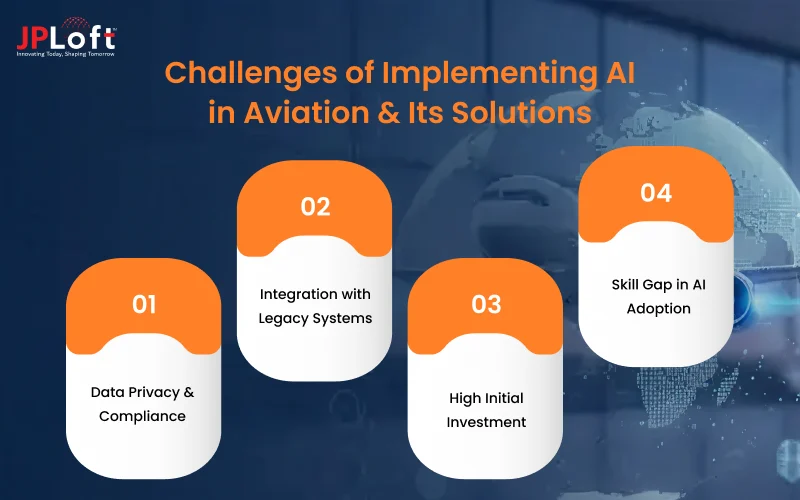
Understanding these challenges in aviation software development helps airlines plan better and avoid delays, risks, and unexpected costs during implementation.
Challenge 1: Data Privacy & Compliance
Airlines handle large amounts of sensitive passenger and operational data, which must follow strict global aviation and data protection rules. Managing this data securely while using AI systems can become complex and risky without proper controls in place.
Solution: Use strong data security systems and follow global compliance standards to protect data and avoid legal issues.
Challenge 2: Integration with Legacy Systems
Many airlines still use old systems that are not designed to work with modern AI technologies and tools. This makes integration difficult and can slow down operations if not handled properly during implementation.
Solution: Use flexible APIs and phased integration to connect AI with existing systems without disrupting daily operations.
Challenge 3: High Initial Investment
The cost of implementing AI in the airline industry can be high due to development, infrastructure, and testing requirements. This can be a major concern for startups or small airlines with limited budgets and resources.
Solution: Hire AI developers to start with small AI projects and scale gradually to manage costs and achieve better return on investment.
Challenge 4: Skill Gap in AI Adoption
Many aviation teams lack the experience and skills required to manage and operate AI systems effectively in real-world scenarios. This can slow down adoption and reduce the overall impact of AI solutions in aviation operations.
Solution: Partner with an experienced AI development company or train internal teams to build the required skills over time.

Why Businesses Choose JPLoft for AI Aviation Solutions?
Businesses choose JPLoft as a trusted aviation software development company because it delivers smart, scalable, and secure AI solutions for modern aviation needs. The team understands how is AI used in Aviation and applies this knowledge to build systems that improve safety, efficiency, and customer experience.
With strong industry experience, JPLoft helps airlines and startups turn ideas into reliable digital products with real business value. The company focuses on custom solutions, whether it is predictive maintenance, route optimization, or passenger service platforms.
JPLoft also ensures smooth integration with existing systems, so businesses do not face operational disruptions during implementation. Their development approach is simple, transparent, and focused on long-term growth.
By combining technical expertise with a deep understanding of aviation challenges, JPLoft helps businesses reduce costs and improve performance. This makes it a reliable partner for companies looking to adopt AI and stay competitive.
Conclusion
AI is no longer an emerging concept in aviation. It has become a foundational technology driving safety, efficiency, and scalability across airlines, airports, and air traffic systems.
From predictive maintenance and optimized flight operations to personalized passenger experiences and advanced security, AI is reshaping how the aviation industry operates at every level. With global passenger volumes and revenues continuing to rise, adopting AI is no longer optional for aviation stakeholders.
Organizations that invest in structured, compliant, and scalable AI integration today will be better positioned to handle future demand, regulatory complexity, and sustainability goals while delivering safer and smarter aviation experiences.
FAQs
AI improves aviation safety by enabling predictive maintenance, real-time anomaly detection, smarter air traffic management, and pilot assistance systems that reduce human error and proactively prevent operational risks.
Key AI use cases include predictive maintenance, flight route optimization, air traffic management, passenger experience personalization, airport security, revenue management, and fuel efficiency optimization across airline operations.
Yes, AI systems in aviation are designed to meet strict regulatory requirements set by aviation authorities, focusing on explainability, validation, traceability, and human-in-the-loop decision-making models.
AI reduces costs by minimizing unscheduled maintenance, optimizing fuel usage, reducing delays, improving aircraft utilization, and automating customer support and operational workflows across aviation systems.
No. AI is designed to support, not replace, pilots and controllers by enhancing situational awareness, decision-making, and workload management while keeping humans in full operational control.
Successful AI integration requires high-quality data, secure infrastructure, regulatory compliance, system integration, extensive testing, and continuous monitoring to ensure safety, accuracy, and long-term performance.

Yashwant Sharma is the CTO of JPLoft, with 18+ years of experience in software engineering, solution architecture, and digital innovation. His expertise spans scalable application development, AI-powered systems, RAG solutions, cross-platform development, software maintenance, and emerging mobility technologies such as EV and EV-charging platforms. He works across complex technical environments to help businesses build secure, maintainable, and high-performing digital products for industries including education, fitness, aviation, and healthcare.





Share this blog