



The aviation market is shifting faster than ever, with reports showing the global aviation software industry on track to surpass $45 billion by 2030 as airlines and airports push for smarter, safer, and more efficient systems.
That raises a big question: how do aviation technology trends change the industry?
They reshape everything, from predictive maintenance and real-time decision tools to automated airports and AI-powered passenger journeys.
But here’s the thing many people overlook: how is aviation technology essential for entrepreneurs and investors? Because every new trend opens fresh opportunities for cost reduction, automation, sustainability, and long-term scalability.
Anyone stepping into aviation, startups, tech founders, OEMs, or investors needs to understand these shifts to stay relevant and future-ready.
This blog gives you a clear, practical look at the technologies transforming aviation right now, why they matter, and how they will reshape growth and competition in the coming years.
Why Technology Matters More Than Ever in Aviation?
When you create aviation software, proceeding with the recent aviation technology trends becomes a compulsion.
When you integrate the recent technologies such as AI, IoT, etc, it is essential to identify the reasons behind their integration.
Let’s check them all below.
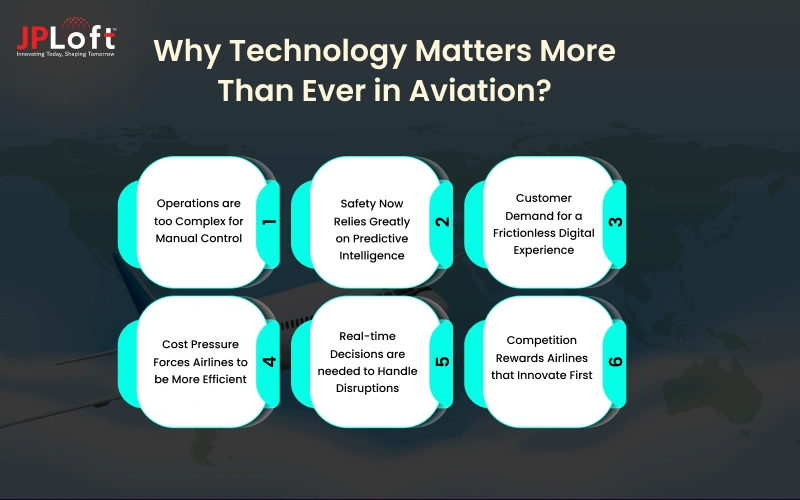
A] Operations are too Complex for Manual Control
Airlines handle thousands of flights, crew shifts, and ground activities concurrently. Manual coordination slows everything down and increases the chance of errors.
Technology helps teams automate routine tasks, streamline workflows, and maintain control during peak hours. It keeps the entire operation running smoothly, even on the busiest days.
B] Safety Now Relies Greatly on Predictive Intelligence
Modern aircraft generate massive amounts of data that reveal early warning signs of technical issues. Predictive maintenance tools analyze the data and help engineers act before a small fault becomes a risk.
These systems help pilots and technicians by enhancing visibility throughout the aircraft. The result is fewer delays, safer flights, and faster problem detection.
C] Customer Demand for a Frictionless Digital Experience
People want speedy check-in, timely updates, and useful information at all touchpoints along the way. That is what the legacy systems cannot deliver.
Technology enables airlines to deliver personalized notifications, enhance the flow of airports, and keep travelers up-to-date. A seamless digital experience leads directly to improvements in satisfaction and loyalty.
D] Cost Pressure Forces Airlines to be More Efficient
Prices for fuels, maintenance, and labor grow every year. Technology in the aviation industry supports airlines in optimizing the usage of fuel, planning smarter routes, and reducing manual labor.
Therefore, automated systems cut off unnecessary expenses without hurting service quality, enabling airlines to stay profitable and provide even better experiences to passengers.
E] Real-time Decisions are needed to Handle Disruptions
Weather, congestion, crew shortage, and unexpected incidents can all cause schedule disruptions within minutes. Technology allows tracking of live data and the facility for instant response.
Airlines can re-assign resources, adjust routes, or notify passengers much faster.
Quick decision-making reduces delays, keeping operations predictable. This is an important aviation software feature to include in the app, helpful to get the essential information in real-time.
F] Competition Rewards Airlines that Innovate First
Travelers pit airlines against one another not just on cost but now on digital convenience. Companies that have invested heavily in tech are offering quicker services, fewer disruptions, and smoother journeys.
That begets trust and solidifies brand loyalty. Innovation is no longer optional; it's a requirement to stay ahead.
After analyzing these reasons, let's proceed with the best aviation technology trends in the following section.

Top Aviation Technology Trends to Explore
As the current era of technologies is booming and changing the global industries, aviation is not an exception.
When it comes to the question“ What are the top aviation technology trends?, the answer includes AI, machine learning, big data, IoT, and much more.
Let’s check out the list of the best aviation technologies trends that you can include and sustain in the competitive environment.
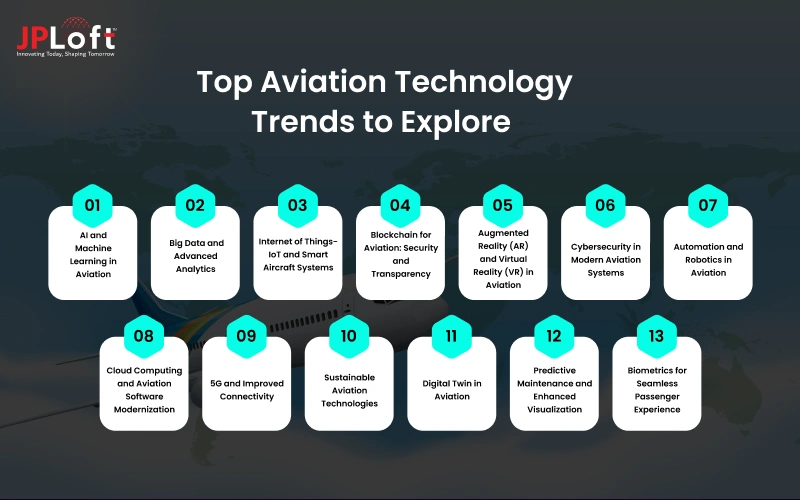
1] AI and Machine Learning in Aviation
AI is at the core of the top technology trends in the aviation industry, with smart airports increasingly embracing real-time automation.
Airlines use ML models to estimate delays more accurately, for route optimization and crew allocation. AI-driven systems also contribute to smooth baggage flows, optimal boarding, and self-service systems at airports.
Since Aviation technology trends in 2026 depend a lot upon autonomous decision-making, AI remains one of the strongest innovation pillars for the industry.
2] Big Data and Advanced Analytics
The airlines generate massive volumes of flight, passenger, and operational data every second. Big Data tools extract insights that improve pricing strategy, fuel planning, and demand forecasting.
This shift is in support of the leading trends in aviation software since analytics reduces guesswork, enabling smarter, data-first operations.
As carriers prepare for Aviation software trends for 2026, advanced analytics will play a bigger role in uncovering patterns that improve punctuality and reduce operational costs.
3] Internet of Things-IoT and Smart Aircraft Systems
IoT enables connected engines, sensor-based maintenance, real-time cabin monitoring, and cargo tracking. Live data from smart aircraft systems supports early fault detection and accurate maintenance planning.
Because airlines want deeper visibility into the performance of aircraft, these capabilities make IoT a prime part of new trends in aviation technology.
IoT will manage fully automated operations inside the aircraft and throughout the airport ecosystem when the market heads toward the 2026 aviation software trends era.
4] Blockchain for Aviation: Security and Transparency
Blockchain enhances trust in ticketing, identity verification, and supply chain processes by cementing their security. Hence, connecting with the best blockchain development company can be effective here.
It produces clear, tamper-proof logs that aviation teams can use for compliance and audits. This technology goes in tandem with emerging trends in aviation technology since the industry has to be better protected from fraud and manipulative actions with data.
As the digital workflows continue to grow, blockchain will remain one of the best technology trends in aviation industry in assuring transparent and traceable operations.
5] Augmented Reality (AR) and Virtual Reality (VR) in Aviation
AR helps engineers conduct visual overlays during inspections, while VR assists in immersive pilot and crew training. These tools reduce the time needed and enhance the level of accuracy, hence becoming part of future trends in aviation technology.
Indoor airport wayfinding by AR enhances passenger flow, reduces congestion, and minimizes confusion in big hubs.
Since interactive simulations are increasingly being demanded, AR/VR will remain one of the top highlights among the latest trends in aviation technology.
6] Cybersecurity in Modern Aviation Systems
With growing digital dependence, system protection against cyber threats becomes more critical than ever. Airlines are recognized for storing sensitive information relating to passengers and operate complex networks that need to be kept secure and stable.
In line with the trends in the aviation industry in 2026, cybersecurity controls include threat detection, encryption, and multi-layer defense frameworks, as hackers have become increasingly sophisticated.
As software is modernized, cybersecurity turns out to be the base layer of technology trends, and editorial discussions across geographies on Aviation.
7] Automation and Robotics in Aviation
Airports embrace automated tugs, self-driving vehicles, and drones for runway inspections and cargo checks. Robotics also supports customer service through humanoid assistants, guiding travelers and responding to queries.
These new technologies reshape the top trends within the aviation software industry: reduced delay possibilities, great accuracy, and a reduction in human workload.
The automation of processes due to increasing Technology trends transforming aviation maintenance by 2026 would lead to innovation both at the airside and terminal levels.
8] Cloud Computing and Aviation Software Modernization
Cloud platforms help airlines replace legacy systems with faster, scalable, and more collaborative solutions. You might connect with the Google Cloud development services for the aviation software modernization.
Crew management, flight ops, passenger services, and analytics tools now run efficiently on cloud-native setups. This modernization is in line with the Aviation technology trends viewpoint since digital transformation cannot take place without cloud adoption.
As airlines prepare for aviation software trends in 2026, cloud solutions will unlock better uptime, flexibility, and cost efficiency.
9] 5G and Improved Connectivity
5G introduces faster communication between aircraft, crew, and ground systems. Passengers enjoy smoother on-board Wi-Fi, while operations utilize 5G for real-time tracking and quicker decision-making.
This fits perfectly into the latest trends in aviation technology because connectivity underpins every modern digital system.
As airports evolve into smart hubs, 5G will play a major role in supporting automation, IoT devices, and predictive analytics.
10] Sustainable Aviation Technologies
Airlines are using electric engines, alternative fuels, and AI-based route planning to reduce emissions.
Sustainability is increasing rapidly among trends in the Aviation industry in 2026, especially due to the demands of regulators for clean operations.
Digital tools will also help monitor carbon output and optimize energy consumption across the airport. As global expectations change, green innovation will be a significant driver of future trends within aviation technology across fleets and ground operations.
11] Digital Twin in Aviation
Digital twin technology virtually replicates aircraft, engines, or airport assets. These models support engineers in testing scenarios, predicting failures, and optimizing decisions about long-term maintenance.
Their adoption is tied to the best aviation software trends since digital twins make the management of complex operations easier.
As carriers move toward aviation technology trends in 2026, digital twins will unlock deeper accuracy in simulation and lifecycle planning.
12] Predictive Maintenance and Enhanced Visualization
Predictive maintenance tools evaluate engine health, vibration levels, and patterns of operation to predict breakdowns.
Enhanced visualization systems make it easier for technicians to interpret data, allowing more rapid turnaround. These capabilities directly support Technology trends transforming aviation maintenance 2026 because they cut downtime and increase fleet availability.
Airlines rely on these systems to lower costs while improving safety and reliability. Connecting with the top software development company will help you stay updated related to visualization and predictive maintenance.
13] Biometrics for Seamless Passenger Experience
Biometric gates provide for check-in, security checks, and boarding using face or fingerprint recognition. It reduces queues and offers frictionless travel in the airport.
Biometric technology will play a significant role in aviation technology trend editorials, as most airports are now aiming for zero-touch processes.
As soon as more terminals begin using the digital identity system, biometrics will influence many new aviation technology trends centered around passenger comfort.
Continuing with the best aviation software trends, the crucial question that arises is ‘What is the future of tech-driven aviation?”
Hence, let's proceed with the following section.
The Future of Tech-Driven Aviation: What’s Coming Next
In this rising technical vulnerabilities, following the current technology trends is important. Learning about the future of aviation will encourage you to invest in the app. Hence, this section talks about the future of aviation apps.
Let’s discuss them all below.
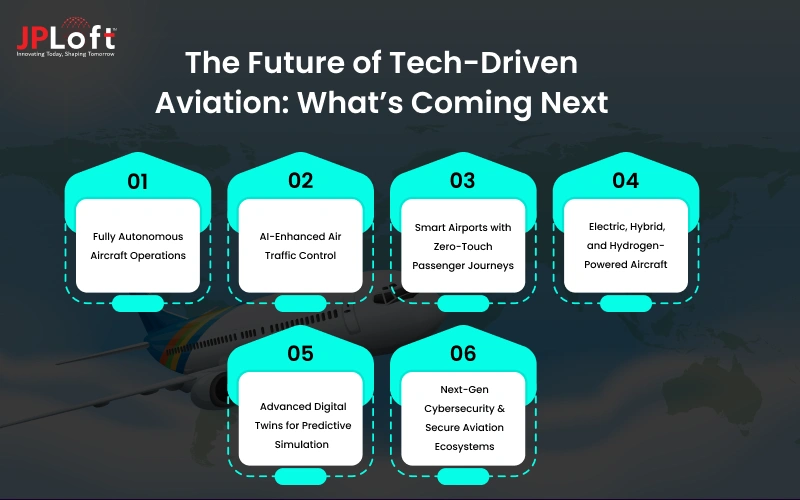
A] Fully Autonomous Aircraft Operations
Autonomy is moving beyond basic autopilot into advanced AI-led decision systems.
Future aircraft will depend on intelligent sensors, onboard analytics, and real-time data to manage large portions of the flight safely. An AI development company helps in identifying the core demands of the users and then integrating the bots' algorithms as per their needs.
Human pilots will move into supervisory roles as smarter automation supports them in their work. The result will be lower operational costs and improved safety across long-haul operations.
B] AI-Enhanced Air Traffic Control
For growing air traffic, ATC centers will look up to AI for forecasting congestion, route optimization, and the reduction of communications-related errors.
Machine-driven coordination will assist controllers in handling more flights with improved accuracy. The transition will ensure better punctuality and efficiency of airspace utilization. AI-driven ATC is one of the strongest upgrades expected soon within global aviation.
C] Smart Airports with Zero-Touch Passenger Journeys
Fully automated processes such as biometric boarding, robotic assistance, smart check-in, and AI-guided navigation are the airports' future. Such systems would reduce bottlenecks and deliver faster passenger flow.
Smart sensors would monitor crowds, queues, and movement patterns in real time. The entire airport experience would feel far smoother, safer, and more predictable.
D] Electric, Hybrid, and Hydrogen-Powered Aircraft
Sustainability targets are driving airlines to transition to cleaner propulsion systems. Electric and hybrid aircraft will handle short-haul flights, while hydrogen-based engines try to make long-haul flying different.
Both technologies will sharply lower emissions and diminish dependence on traditional fuels. The shift is one of the biggest energy transitions aviation has seen since the jet engine.
E] Advanced Digital Twins for Predictive Simulation
Digital twins will become dynamic, real-time replicas of aircraft, engines, terminals, and various airport assets. The systems will be able to simulate performance, stress levels, maintenance cycles, and environmental impact with a high degree of accuracy.
Airlines can test scenarios without grounding aircraft or disrupting operations. In short, digital twins will be very important in terms of planning, safety, and cost management. You can hire dedicated developers to include the advanced digital twins in your project.
F] Next-Gen Cybersecurity & Secure Aviation Ecosystems
As aviation becomes increasingly connected, so will the scale and complexity of cyber threats. The security systems of the future will be dependent on AI pattern detection, secure blockchain verification, and multi-layer encryption.
Airlines and airports will be moving away from reactive protection to proactive defense frameworks. Cyber resilience will be as important as physical aviation safety itself.
Partner with JPLoft and Build Your Aviation Software
Aviation is shifting toward smarter, faster, and more automated systems, and companies need technology partners who understand how complex this industry really is.
Modern airlines and airports rely on software that improves safety, reduces delays, and gives passengers a smoother journey from check-in to landing. This is where the right expertise makes all the difference.
When you partner with JPLoft, you work with an Aviation software development company that builds solutions designed for real operational challenges.
The team focuses on predictive maintenance, crew and fleet management, real-time data intelligence, and seamless integrations that keep every part of your operation connected.
JPLoft also ensures your software stays scalable, secure, and future-ready as aviation technology continues to evolve.

Conclusion
The aviation industry is entering a new era where technology defines efficiency, safety, and long-term growth. AI, automation, IoT, cloud modernization, and digital twins are no longer optional upgrades; they’re strategic essentials that help airlines operate smarter and respond faster.
With rising competition and higher passenger expectations, companies that invest in modern aviation software now will lead the industry in the coming years.
These trends show a clear shift toward predictive systems, autonomous workflows, and greener operations. Adopting the right technology today ensures your aviation business stays future-ready, resilient, and aligned with the next wave of global innovation.
FAQs
AI, automation, IoT, cloud platforms, and predictive maintenance are driving major improvements in safety, efficiency, and passenger experience across modern aviation operations. These innovations help airlines act faster and reduce operational risks.
AI improves decision-making, predicts disruptions, optimizes routes, and enhances maintenance. It helps airlines operate with more accuracy, less downtime, and better passenger support. From crew planning to baggage management, AI automates complex workflows that once required manual oversight, leading to smoother operations overall.
IoT sensors track aircraft health, baggage movement, cabin conditions, and ground equipment in real time, reducing delays and improving visibility for engineering and airport teams. These connected systems help detect issues earlier and streamline routine workflows. With expanding IoT adoption, both aircraft and airports become smarter and more efficient each year.
Cloud platforms replace outdated systems with faster, scalable, and more reliable software. They improve collaboration, reduce IT costs, and support data-driven operations across flights and ground teams. Cloud-based aviation systems also enable quicker updates, better security, and seamless integration with modern analytics tools.
Digital twins simulate aircraft, engines, and terminals, helping teams predict failures, test scenarios, and plan maintenance without interrupting operations. This reduces downtime and increases fleet availability. As airlines invest in more advanced models, digital twins become a key tool for long-term planning and cost optimization.
Biometrics speed up check-ins, security checks, and boarding by reducing manual verification. This creates a smoother, quicker, and more secure passenger experience across terminals. These systems also help airports manage crowds better and support zero-touch travel, which passengers increasingly expect.

Yashwant Sharma is the CTO of JPLoft, with 18+ years of experience in software engineering, solution architecture, and digital innovation. His expertise spans scalable application development, AI-powered systems, RAG solutions, cross-platform development, software maintenance, and emerging mobility technologies such as EV and EV-charging platforms. He works across complex technical environments to help businesses build secure, maintainable, and high-performing digital products for industries including education, fitness, aviation, and healthcare.




Share this blog