


Key takeaways:
Building a trading app like Fidelity includes market research, compliance (KYC/AML), real-time data integration, and a high-performance trading engine.
Core features drive success, such as real-time market data, advanced charting, smart order execution, portfolio tracking, and AI-powered insights.
The Fidelity clone app development costs range from $25,000 to $300,000+, depending on complexity, features, scalability, and security requirements.
Key challenges include latency, security, scalability, and compliance, which require advanced architecture and continuous optimization.
Fidelity-like apps can make money through subscriptions, margin trading, advisory fees, and data monetization opportunities.
Emerging trends like AI, social trading, and personalization are shaping the future of stock trading apps and creating opportunities for differentiation.
The investment habits among the general audience are shifting at large, and people are willing to take risks against higer returns.
Such a habit shift has been beneficial for the existing stock trading apps, such as Fidelity, and has generated an opportunity for businesses to build a stock trading app like Fidelity.
The success of the Fidelity app has brought financial success for the founders and a case study for entrepreneurs worldwide on how to build a successful stock trading app and scale it.
The process to develop apps like Fidelity includes conducting market research, planning app features, designing, testing, and deploying the app, followed by continuous monitoring.
In this blog, we will discuss more about how to develop an app like Fidelity, key features, cost, and challenges associated with the development process.
Let’s proceed:
What is Fidelity and How Does It Work?
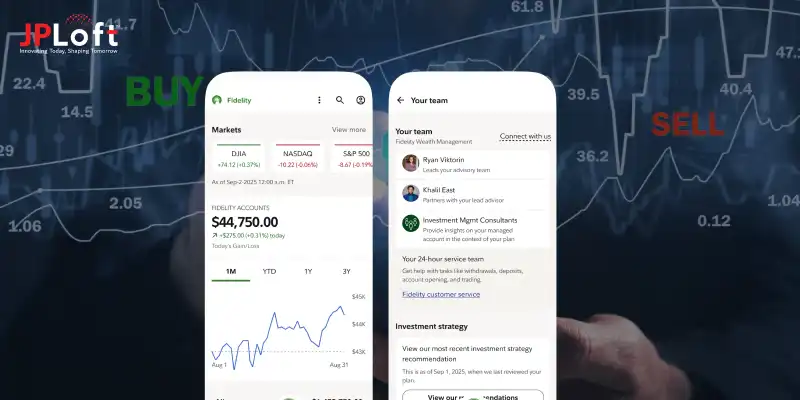
The Fidelity Investments app is among the leading stock trading apps that has become a benchmark in the digital brokerage space. Built for active market participation, it offers real-time stock data, advanced charting, and seamless trade execution within a highly intuitive interface.
Fidelity manages over $17.5 trillion in assets under administration and handles an average of $4.4 trillion trades every day, highlighting its massive scale and trust in global markets.
Such numbers reinforce its position in high-volume stock trading environments. It also played a major role in driving zero-commission stock trading, a shift that transformed the brokerage industry.
With AI-driven insights, in-depth equity research, and personalized dashboards, Fidelity focuses strongly on stock market engagement, making it a powerful reference for building scalable, trading-centric applications.
How does the Fidelity App work?
If you are planning to create apps like Fidelity, then you should be aware of how these apps work so that you can plan your app functionality.
Here is how Fidelity works:
-
User Onboarding & Account Setup: Users create an account, complete identity verification (KYC), and link bank accounts for fund transfers.
-
Fund Management: Investors can deposit funds, view balances, and manage cash positions seamlessly within the app.
-
Market Exploration: The app provides real-time stock data, charts, analyst ratings, and news to help users evaluate investment opportunities.
-
Trade Execution: Using the data, the users can place different types of orders (market, limit, stop-loss) across stocks, ETFs, mutual funds, and more.
-
Portfolio Tracking: A centralized dashboard allows users to monitor holdings, performance, gains/losses, and asset allocation.
-
Research & Insights: Fidelity offers in-depth research reports, screeners, and AI-backed recommendations to support decision-making.
-
Automation & Advisory: Features like robo-advisors and recurring investments help users automate their investment strategies.
Benefits Of Investing In A Trading App Like Fidelity
The entrepreneurs planning to invest in a Fidelity clone app development should be aware of the potential benefits associated with it.
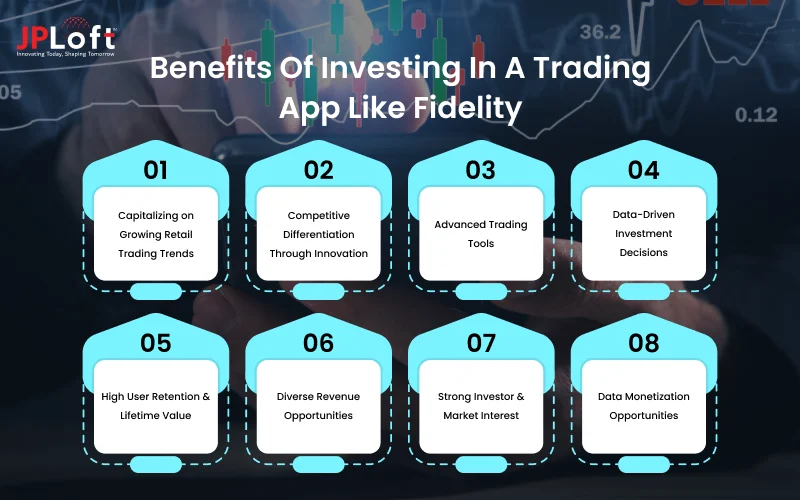
1. Capitalizing on Growing Retail Trading Trends
The rise of self-directed investing and mobile-first trading has significantly increased demand for stock trading apps, making it a future-ready investment. Further planning for apps like Fidelity can help plan for a successful and scalable trading app.
2. Competitive Differentiation Through Innovation
Planning for a fidelity-like app development helps entrepreneurs leverage advanced tech features like AI-driven analytics, social trading, or automated investing, to stand out in a crowded market and attract niche audiences.
3. Advanced Trading Tools
The Fidelity app offers advanced trading tools to users, from technical indicators to customizable charts. These apps provide tools that were once limited to professional traders, helping users analyze stock trends with precision.
4. Data-Driven Investment Decisions
Investing in leading trading apps like Fidelity ensures that you can have features like integrated research reports, analyst ratings, and AI-powered insights. Such features help users make smarter, evidence-based investment choices rather than relying on guesswork.
5. High User Retention & Lifetime Value
The best stock trading apps naturally encourage frequent engagement as users monitor markets, execute trades, and manage portfolios, leading to higher retention and long-term customer value. Hence, providing the investors with the opportunity to ensure long-term user retention and earning potential.
6. Diverse Revenue Opportunities
The Fidelity-like app development offers diverse revenue opportunities to entrepreneurs. They can monetize through brokerage fees (premium trades), margin trading, subscription plans, advisory services, and payment for order flow, creating diversified income channels.
7. Strong Investor & Market Interest
Fintech and trading platforms continue to attract significant venture capital and institutional investment, increasing growth and exit opportunities. Hence, the entrepreneurs don’t have to worry about the investment required to scale the project when the user base increases.
8. Data Monetization Opportunities
User behavior, trading patterns, and market interactions generate valuable data that can be leveraged for insights, personalization, and strategic partnerships. Such opportunities can also offer entrepreneurs a way to earn revenue from this business model.
How to Build an App Like Fidelity?
Let’s proceed by discussing how to develop an app like Fidelity that can offer the desired competitiveness and scalability for your stock trading app.
In short, it can be stated that developing such an app is a multi-layered process that requires deep technical expertise, regulatory understanding, and a strong focus on real-time performance.
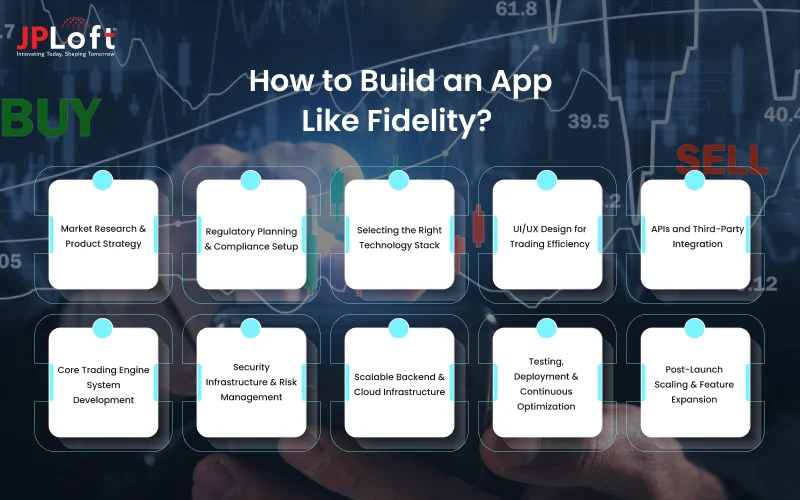
Here’s a detailed, step-by-step breakdown to help businesses build a stock trading app that is scalable and competitive.
Step 1: Market Research & Product Strategy
Before development begins, it’s crucial to define your app’s positioning in the stock trading ecosystem.
-
Before planning to build apps like Fidelity, it is important to identify whether your platform will target beginners, active traders, or institutional users.
-
Also, it is important to analyze your competitors, identify user expectations, and gaps in existing trading apps to shape your value proposition.
-
A clear roadmap helps shape a strong product strategy, which includes revenue models, supported asset classes (stocks, ETFs, options), and core differentiators such as AI insights or social trading.
Step 2: Regulatory Planning & Compliance Setup
The next step is to plan for the regulatory and compliance requirements of the stock trading app.
As stock trading apps operate in a highly regulated environment, planning for compliance is a foundational step.
-
Collaborate with legal experts and regulatory bodies to understand the compliance and regulatory requirements within the region.
-
Businesses must integrate KYC (Know Your Customer), AML (Anti-Money Laundering), and data privacy regulations into the system.
-
Planning compliance early ensures smoother approvals, reduces legal risks, and builds long-term user trust.
Step 3: Selecting the Right Technology Stack
Once the operational fundamentals have been planned, the next step is to move ahead and select the right tech stack. A suitable tech stack directly impacts your app’s performance and scalability.
-
Look for the top app development frameworks, competitors’ tech stack, and evaluate your tech requirements as per the features you are integrating in your app.
-
Frontend technologies like React Native or Flutter enable cross-platform development, while backend technologies like Node.js or Python handle real-time processing.
-
Databases, cloud infrastructure, and APIs must be selected to support high-frequency data flow. A well-planned tech stack ensures stability during peak trading hours.
Step 4: UI/UX Design for Trading Efficiency
Design plays a critical role in simplifying complex trading workflows. When planning for the stock trading app design, ensure that the interface provides easy navigation between market data, charts, and order execution.
-
Planning for intuitive dashboards, customizable watchlists, and visually clear charts that can improve user experience.
-
Start with designing app wireframes, test them, make necessary changes, and proceed with the final development accordingly.
-
A well-designed UI reduces user friction and improves engagement across both beginner and advanced traders.
Step 5: APIs and Third-Party Integration
Fidelity clone app development is not just about the frontend and backend. But also, it requires planning for relevant APIs and third-party integrations.
-
Stock trading apps rely heavily on real-time data feeds for prices, charts, and news. Integrating reliable market data APIs is essential for accuracy and speed.
-
Along with the data management, integrations are required to handle the in-app payments, real-time conversations, and data safety.
-
The system must handle continuous data streams without delays. This ensures users can make timely decisions and execute trades efficiently.
Step 6: Core Trading Engine System Development
Once integrations are in place, the next step is to build the core trading engine that powers the entire stock trading app. This is the most critical component, responsible for executing buy and sell orders in real time.
-
The trading engine must support multiple order types, such as market, limit, and stop-loss orders, to meet diverse trading needs.
-
It should be designed to handle high-frequency transactions with minimal latency and zero errors.
-
A well-optimized trading engine ensures speed, accuracy, and reliability, which directly impacts user trust and platform performance.
Step 7: Security Infrastructure & Risk Management
Mobile app security is critical in stock trading apps due to the sensitive nature of financial data. Implement encryption, multi-factor authentication, and biometric login.
-
Developers must integrate features like end-to-end encryption, multi-factor authentication, and biometric login.
-
Additionally, risk management systems such as fraud detection and unusual activity monitoring should be included.
-
A strong security infrastructure not only protects users but also ensures compliance with financial regulations.
Step 8: Scalable Backend & Cloud Infrastructure
Trading apps must handle high volumes of concurrent users and transactions, especially during market volatility. A scalable backend ensures consistent performance under load.
-
Adopt cloud-native infrastructure and microservices architecture to ensure flexibility and scalability.
-
Implement auto-scaling capabilities to manage sudden increases in user activity without affecting performance.
-
A scalable backend ensures consistent app performance and supports long-term growth.
Step 9. Testing, Deployment & Continuous Optimization
Before launching the app, it is essential to conduct thorough mobile app testing to ensure performance, security, and usability. Trading apps must function flawlessly under real-time conditions.
-
Perform load testing, security testing, and API testing to identify and resolve potential issues.
-
Once the app passes the testing phase, the next approach is to deploy it on the relevant platforms.
-
Post-deployment, it is important to look for app maintenance service provider and plan for continuous optimization for the stock trading app.
Step 10: Post-Launch Scaling & Feature Expansion
After deployment, the focus shifts to continuous improvement and scaling the platform. Launch is just the beginning of the app lifecycle in the trading ecosystem.
-
Monitor user behavior, gather feedback, and analyze performance metrics to identify improvement areas.
-
Gradually introduce advanced features like AI-driven insights, build a robo-advisory, or social trading to enhance user engagement.
-
Continuous updates and innovation help maintain competitiveness and turn the app into a complete stock trading ecosystem.
Essential Features to Have in the Fidelity-like App
Along with being aware of the development process and how to create an app like Fidelity, it is also important to be aware of the key competitive features to include in your app.
The essential features of a stock trading app that your Fidelity clone should include are:
1. Secure User Onboarding & KYC
A frictionless onboarding process with built-in KYC ensures users can quickly create accounts while meeting regulatory compliance.
Features like document verification and identity checks build trust from the start. A smooth onboarding experience also reduces drop-offs and improves user acquisition.
2. Real-Time Market Data Integration
Access to live stock prices, market depth, and price movements is critical for active trading.
This feature ensures users make decisions based on accurate, up-to-the-second data. It directly impacts trading speed, execution accuracy, and overall user confidence.
3. Advanced Charting & Technical Indicators
Interactive charts with indicators like RSI, MACD, and moving averages help users analyze stock performance.
These tools empower traders to identify patterns, trends, and entry-exit points. It transforms the app from a basic platform into a professional trading environment.
4. Smart Order Execution System
Supporting multiple order types, such as market, limit, and stop-loss, allows users to execute trades strategically.
A fast and reliable execution engine minimizes slippage and delays. This is essential for maintaining performance in high-volume trading scenarios.
5. Portfolio Management Dashboard
A centralized dashboard gives users a clear view of holdings, profits/losses, and asset allocation.
It helps investors track performance and adjust strategies in real time. This feature plays a key role in improving long-term engagement and retention.
6. AI-Powered Insights & Recommendations
AI-driven analytics provide personalized stock suggestions, risk assessments, and trend predictions.
This helps users make informed decisions without deep market expertise. It also enhances user engagement by delivering relevant, data-backed insights.
7. Watchlist & Real-Time Alerts
Users can track selected stocks and receive instant alerts for price changes or market events.
This keeps them connected to the market without constant monitoring. Alerts improve responsiveness and encourage more frequent app interaction.
8. High-End Security Features
Robust security measures like multi-factor authentication, biometric login, and data encryption protect user assets and data.
Strong security is essential for compliance and user trust. It also reduces the risk of fraud and unauthorized access.
How Much Does It Cost to Develop Trading Apps Like Fidelity?
The cost to develop a stock trading app like Fidelity Investments typically ranges between $25,000 to $300,000+. The development cost of a stock trading app varies, depending on the app’s complexity, feature set, and scalability requirements.
Since trading apps operate in a high-performance, real-time environment, costs are also influenced by the technical complexity and the regulatory considerations.
-
Basic Trading App: ($25,000 – $60,000): Includes essential features like user onboarding, basic stock trading, limited charts, and simple UI.
-
Mid-Level Trading App: ($60,000 – $150,000): Adds real-time data, advanced charts, multiple order types, portfolio tracking, and improved security.
-
Advanced Trading App: ($150,000 – $300,000+): Includes AI-driven insights, high-speed trade execution, scalable infrastructure, robo-advisory, and institutional-grade features.
Let’s have a look at the key factors and their potential impact on the Fidelity-like clone app development cost.
|
Cost Factor |
What It Includes |
Estimated Cost Impact |
|
App Complexity |
Basic trading features vs advanced tools like AI insights, analytics, and automation |
$25,000 – $60,000 |
|
Real-Time Market Data Integration |
APIs for live stock prices, market depth, and financial data feeds |
$10,000 – $20,000 |
|
UI/UX Design |
Interactive dashboards, charting interfaces, and user-friendly trading flows |
$5,000 – $25,000 |
|
Backend Development |
Trade execution engine, user management, portfolio tracking, and scalability |
$20,000 – $80,000+ |
|
Security & Compliance |
KYC, encryption, multi-factor authentication, and regulatory adherence |
$10,000 – $30,000 |
|
Third-Party Integrations |
Payment gateways, analytics tools, brokerage APIs, and cloud services |
$5,000 – $20,000 |
|
Platform (iOS/Android/Web) |
Single platform vs cross-platform or multi-platform development |
$10,000 – $50,000 |
|
Maintenance & Updates |
Ongoing support, feature upgrades, and performance optimization |
15–25% of the total cost annually |
These costs are just estimates and can vary largely depending on your project requirements and the real-time cost factors. Hence, before you hire mobile app developers, get a detailed cost estimate
Challenges in Developing Fidelity-Like App Development
For modern entrepreneurs, understanding how to build a stock trading app like Fidelity can have several benefits, from better revenue opportunities to better scalability in the competitive space.
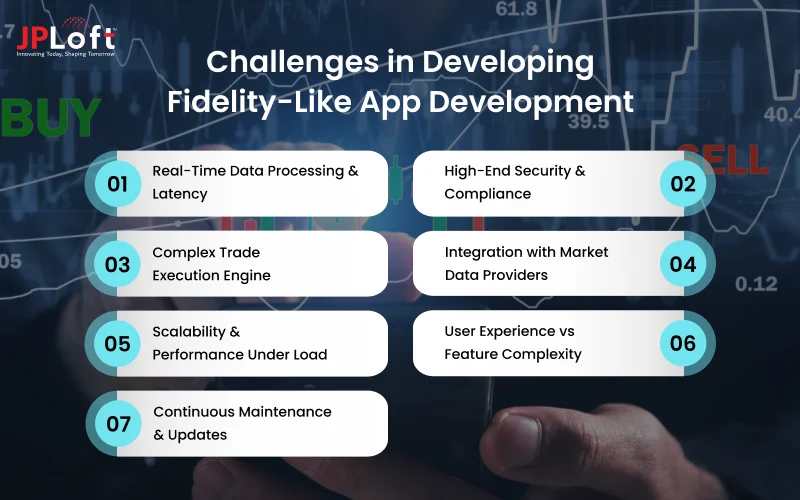
But along with these, several challenges in Fidelity like app development, exist that you need to be aware of. These include:
Challenge 1: Real-Time Data Processing & Latency
Stock trading depends on real-time data, where even milliseconds can impact trade outcomes.
Delays in price updates or order execution can lead to missed opportunities and user dissatisfaction. Handling continuous, high-frequency data streams adds further complexity and acts as a key challenge in developing a stock trading app.
Solution: Implement low-latency systems using WebSockets, in-memory caching, and edge computing. Optimize backend performance with event-driven architecture to ensure faster data delivery.
Challenge 2: High-End Security & Compliance
The stock trading apps deal with sensitive financial data, making them a favorable target for cyberattacks and fraud.
Also, meeting the strict compliance requirements like KYC and AML becomes challenging when operating globally. Failing in either can lead to legal risks and loss of user trust.
Solution: Use end-to-end encryption, multi-factor authentication, biometric login, and conduct regular security audits when deciding how to make an app like Fidelity. Integrate compliance frameworks from the start to ensure regulatory readiness.
Challenge 3: Complex Trade Execution Engine
Another aspect to be focused on complicated trade execution setup. The trading apps are required to execute large volumes of buy and sell orders accurately and instantly.
Any delay, mismatch, or failure in execution can result in financial losses. Also, the system must handle peak loads without compromising speed.
Solution: Build a high-performance, event-driven trade engine with optimized matching algorithms and failover systems by partnering with an expert mobile app development company to maintain speed and accuracy in Fidelity-like apps.
Challenge 4: Integration with Market Data Providers
When planning to develop apps like Fidelity, a key aspect to be focused on is integrating them with market data providers.
Such is important because trading apps rely heavily on third-party APIs for stock prices, charts, and financial news. Inconsistent data, API downtime, or latency issues can disrupt the user experience.
Solution: The entrepreneurs should hire dedicated developers to build a system that uses multiple data providers with fallback mechanisms and caching layers. This ensures consistent, accurate, and uninterrupted data flow.
Challenge 5: Scalability & Performance Under Load
Market volatility often leads to sudden spikes in user activity and transactions. If the system cannot handle the load, it may crash or slow down significantly. This directly impacts the reliability of the trading platform and the user's trust.
Solution: When investing in Fidelity-like app development, the developer should adopt cloud-native infrastructure, microservices architecture, and auto-scaling capabilities to handle traffic spikes efficiently.
Challenge 6: User Experience vs Feature Complexity
Understanding stock markets and the trading activities is not everyone’s cup of tea. Hence, it is important that the trading app caters to both beginners and advanced traders. But adding too many features can overwhelm users, while too few can limit functionality. Striking the right balance is difficult but critical.
Solution: Partner with an expert UI/UX design services provider and design a modular and customizable UI where users can personalize dashboards and features based on their experience level.
Challenge 7: Continuous Maintenance & Updates
Stock trading apps require constant updates like any other apps to adapt to market changes, security threats, and evolving user expectations. Neglecting these maintenance requirements can quickly make the platform outdated or vulnerable to external threats and impact its performance.
Solution: Follow DevOps practices with continuous integration and deployment, automated testing, and real-time monitoring for ongoing optimization.
Trends to Leverage to Stand Out
If you are planning to develop a stock trading app like Fidelity, then you should focus on the key merits of the app that bring the audience, as well as the potential challenges.
Along with these, you should also consider key stock trading app trends that you can leverage to add competitiveness to your app.
► AI-Powered Trading & Predictive Analytics
AI in stock trading is transforming the sector by enabling predictive insights, risk analysis, and personalized recommendations.
If building trading apps like Fidelity, use machine learning to analyze market patterns and user behavior. This helps traders make faster, data-backed decisions and improves engagement
► Social & Community-Based Trading
Another trend to focus on is social and community-based trading. The modern-day user is increasingly looking for collaborative investing experiences where they can follow, learn from, and replicate expert traders.
Social trading features like leaderboards, shared strategies, and discussion forums boost user retention. It also builds trust among new investors.
► Gamification of Trading Experience
Gamified elements like rewards, badges, streaks, and challenges are the key approaches that keep users engaged and make trading more engaging.
This approach not only encourages frequent app usage, but also improves new user onboarding. It is especially effective when attracting younger, mobile-first investors.
► Fractional Share Investing
A key investing trend that you can consider is providing the option of fractional share investing, which provides users with diverse investment opportunities and keeps them engaged.
Such a feature allows users to invest in high-value stocks with small amounts, lowering entry barriers. It increases user acquisition and broadens market participation.
► API-First & Modular Architecture
The stock trading apps should be built with a scalability focus from day one. Hence, following such, businesses are adopting API-first approaches to build scalable and flexible trading platforms.
This enables faster integrations with third-party services like market data providers and payment gateways. It also supports quicker feature rollouts.
► Blockchain for Transparency & Security
Security among the stock trading apps is becoming a non-negotiable aspect. The entrepreneurs are planning to hire blockchain developers and exploring blockchain-based solutions to enhance transaction transparency and security in trading platforms.
Such tech upgrades can reduce fraud risks and improve trust in trade settlements. While still evolving, it presents strong future potential.
► Hyper-Personalization
Modern users expect tailored experiences based on their trading behavior and preferences. Hence, along with the plan to make apps like Fidelity, the modern apps are shifting towards hyper-personalization.
AI-driven dashboards, alerts, and recommendations improve engagement and satisfaction. Personalization also increases retention and lifetime value.
► Voice & Conversational Trading Interfaces
The modern-day entrepreneurs are focusing on voice-enabled trading and chatbot integration as convenience-driven features.
These upgrades can allow users to check stock prices, place trades, or get insights using natural language. This enhances accessibility and user experience.
How Fidelity-like Apps Make Money?
The discussion has helped you understand how to build an app like Fidelity, but along with building the app, you must also be aware of the ways to monetize your stock trading app.
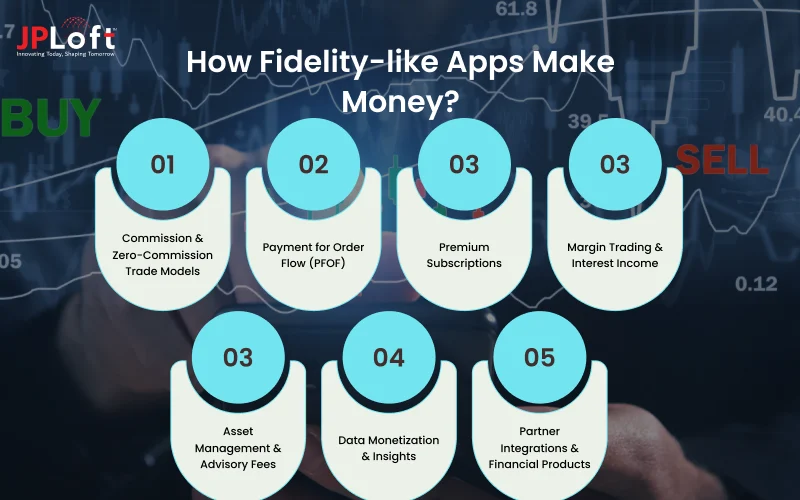
Here are some of the key stock trading app monetization strategies that can be considered for your trading apps, like Fidelity.
1. Commission & Zero-Commission Trade Models
While many apps offer zero-commission trading to attract users, they may still charge for specific transactions like options or international trades.
This hybrid model balances user acquisition with revenue generation and also encourages higher trading volumes.
2. Payment for Order Flow (PFOF)
The popular trading apps route user trades to market makers in exchange for compensation. Such routing allows platforms to offer commission-free trading while still earning revenue.
However, it is important to ensure transparency and regulatory compliance when following such a monetization route.
3. Premium Subscriptions
The entrepreneurs can plan for advanced features like in-depth analytics, real-time advanced charts, and expert research available to the users through paid plans.
This creates a steady, recurring revenue stream and also helps the platform segment casual users from professional traders.
4. Margin Trading & Interest Income
Another app monetization strategy to consider is the margin trading and interest income.
Trading platforms allow users to borrow money to trade stocks, and can charge interest on the borrowed amount. This is a significant revenue source for many trading apps. It also increases trading activity on the platform.
5. Asset Management & Advisory Fees
The trading apps can offer robo-advisory and portfolio management services for a percentage-based fee.
This provides the trading app a long-term, scalable income source, and as user portfolios grow, such revenue becomes a larger chunk of the entire earnings.
6. Data Monetization & Insights
The stock trading apps have the relevant insights on trading activities as well as real-time user data.
Such user trading data can be monetized and used as a revenue source for the trading app. These insights can be sold to institutions or used internally for better personalization.
7. Partner Integrations & Financial Products
Trading apps can partner with financial institutions to offer insurance, loans, or other investment products. Such offerings and sales help the platform earn commissions or referral fees.
These offerings help the platform expand its product and service portfolio, as well as increase the changes of revenue generation from multiple sources, reducing dependency.
How JPLoft Can Help You Develop an App Like Fidelity?
If you are planning to develop a stock trading platform like Fidelity Investments, then you need to focus on more than just development; it demands deep fintech expertise and a strategic approach.
JPLoft, as a trusted stock trading app development company, helps businesses transform complex trading ideas into scalable, high-performance applications.
From initial planning to post-launch support, JPLoft delivers end-to-end development tailored to your business model. The team specializes in building real-time trading systems with low latency, ensuring seamless order execution and accurate market data processing.
JPLoft also focuses on custom feature development, including advanced charting tools, AI-driven insights, and intuitive dashboards that enhance user engagement. With a strong emphasis on security and compliance, the platform integrates KYC, encryption, and fraud detection mechanisms to ensure safe trading environments.
By combining technical excellence with market understanding, JPLoft enables businesses to launch reliable, scalable, and future-ready stock trading apps that compete with industry leaders.
Conclusion
Investing to create a stock trading app like Fidelity Investments is a significant opportunity for businesses to enter a rapidly growing trading market. Success depends on combining real-time data processing, advanced trading features, strong security, and a seamless user experience.
From planning and development to scaling and monetization, every stage plays a crucial role in creating a competitive platform. Businesses that focus on performance, innovation, and user-centric design can build apps that drive engagement and long-term revenue.
With the right strategy and development approach, a Fidelity-like app can evolve into a scalable, future-ready stock trading ecosystem.
FAQs
The development timeline typically ranges from 3 to 9 months, depending on app complexity, features, and compliance requirements. Basic apps take less time, while advanced platforms with real-time trading, AI insights, and security layers require longer development cycles.
To build an app like Fidelity Investments, businesses need to follow a structured process that includes market research, compliance planning, tech stack selection, UI/UX design, API integrations, and trading engine development.
The cost to build a Fidelity-like stock trading app typically ranges from $25,000 to $300,000+, which varies on features, complexity, and scalability requirements. Basic apps with essential trading features cost less, while advanced platforms with AI insights, real-time analytics, and robust security systems require higher investment.
Apps like Fidelity Investments generate revenue through multiple streams such as premium subscriptions, margin trading interest, payment for order flow, and advisory services. This diversified model ensures consistent profitability.
Key challenges include real-time data processing, security and compliance, trade execution speed, and scalability. Overcoming these requires strong backend architecture, reliable integrations, and continuous performance optimization.

Savannah is a passionate tech enthusiast with a sharp understanding of client needs across diverse digital domains. With expertise spanning financial platforms, on-demand solutions, and emerging technologies, she brings a unique blend of analytical insight and interpersonal skills, helping businesses decode complexities and make informed decisions in today's rapidly evolving digital world.



Share this blog