


Key Takeaways:
A stock trading app helps users trade anytime with real-time data, which increases engagement and builds long-term platform value.
Trading app earning models include PFOF, transaction fees, subscriptions, margin interest, and other reliable revenue streams.
Knowing monetization models helps founders choose revenue paths that match their goals and improve user experience.
Real-world examples like Robinhood, Webull, eToro, and more show how different monetization strategies generate steady earnings.
Future monetization trends include the use of AI tools, paid learning, auto-investing, and smarter personalization features.
Experienced developers at JPLoft help build secure, scalable trading apps that support strong monetization and long-term growth.
Millions of people trade stocks from their phones, but few ask how the app behind the trade turns a profit.
Zero-commission trading looks free on the surface, yet these platforms still generate real revenue, often through channels users never notice.
For entrepreneurs planning a stock trading app, understanding these revenue streams matters as much as the features themselves.
The monetization model shapes pricing, the audience you attract, and how you compete with established players already dominating the market.
In this blog, we walk through the most effective ways stock trading apps make money today, from transaction fees to subscriptions and beyond, so you can choose a model that fits your business and keeps users engaged.
How Do Stock Trading Apps Make Money?
Stock trading apps aren't popular just because they make trading simple. They're also built to generate consistent revenue for the entrepreneurs behind them.
Revenue in these apps comes from more than one source, supporting both daily operations and long-term growth.
Even when trading appears free to the user, several systems work behind the scenes to keep the business profitable, and an experienced stock trading app development company can help build them from the start rather than bolting them on later.
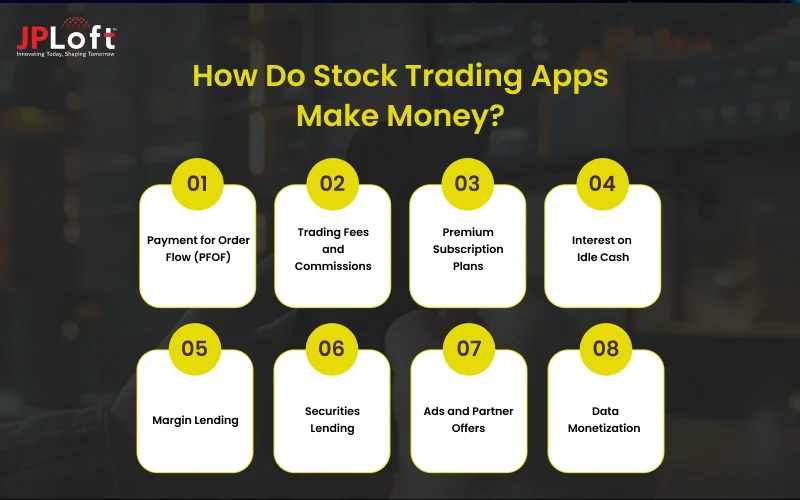
Here are some of the ways to monetize a stock trading app.
1. Payment for Order Flow (PFOF)
PFOF is one of the most common routes to make money for stock trading apps. When users place buy or sell orders, the app routes those orders to market makers instead of sending them directly to an exchange.
The market maker pays the app a small fee for each order. While the fee is tiny, the large trading volume makes it a steady income source. This allows apps to offer free trading while still earning money in the background.
You can plan to integrate the PFOF model into your stock trading app by hiring mobile app developers having relevant expertise.
2. Trading Fees and Commissions
Many trading apps promote free stock trading, yet they still charge fees for certain actions. These fees appear on advanced trades, options, extended-hours trading, faster withdrawals, or currency conversions.
Each fee is small, but when thousands of users perform these actions daily, the revenue becomes significant. These charges help cover operational costs without affecting the core free-trading model, and hence act as trusted stock trading app monetization models.
3. Premium Subscription Plans
The stock trading app makes money also makes money through premium subscription plans. Users pay monthly or yearly fees to access advanced trading app features like smart alerts, detailed market insights, faster deposits, advanced charting tools, or priority customer support.
These plans attract serious traders who want extra control and faster data. Subscription income is predictable, which helps the platform plan long-term improvements. This model is growing quickly because users prefer paying for value-added tools rather than paying per trade.
4. Interest on Idle Cash
Before users invest money, it often sits in their trading account for hours or days. The apps can earn interest on this idle cash, hence acting as one of the hidden monetization strategies for Stock Trading apps.
Even small deposits across millions of users create a strong and dependable revenue stream. This method does not affect the user’s balance, but helps the platform earn extra revenue without adding new fees.
5. Margin Lending
Another monetization strategy for investment apps is “Margin lending”. It allows users to borrow money to increase their buying power. The app charges interest on the borrowed amount, creating a high-value revenue source.
Margin interest rates are usually higher because margin trading carries more risk. Many active traders use margin to boost returns, which makes this income stream consistent.
For trading apps, margin lending is powerful because it grows as users trade more often and take bigger positions, leading to steady earnings for the platform.
6. Securities Lending
Some trading apps lend stocks that users hold in their accounts to institutions that need shares for short-selling or settlement purposes. In against to such lending, the app earns a lending fee from the institutions. Hence, it is among the key money lending app monetization models.
The platform also shares a percentage of the earnings with users, which keeps the process transparent. Securities lending is a quiet yet meaningful revenue channel because it uses existing assets while creating extra income without adding fees or affecting the user’s trading activity.
7. Ads and Partner Offers
Along with all, a considerable way through which a stock trading app makes money is through ads and other partner promotions. These include promoting credit cards, loan products, insurance, robo-advisors, or other financial services on the stock trading app.
The app earns money when users click, view, or sign up for these offers. Also, helps the app diversify earnings and reduce reliance on trading activity alone. Partner deals also allow apps to promote services that users may find helpful.
8. Data Monetization
Another common way to monetize the stock trading app is through data monetization. The stock trading app has its user data, which can be shared with fintech organizations, research firms, and more.
But such an exchange should be done ethically and as per the national or global data protection norms or standards. This is important to ensure that the user’s confidential data has no unauthorized access.
Why You Need To Be Aware of Stock Trading App Monetization Models?
If you plan to build a stock trading app, having an understanding of monetization strategies for Stock Trading apps.
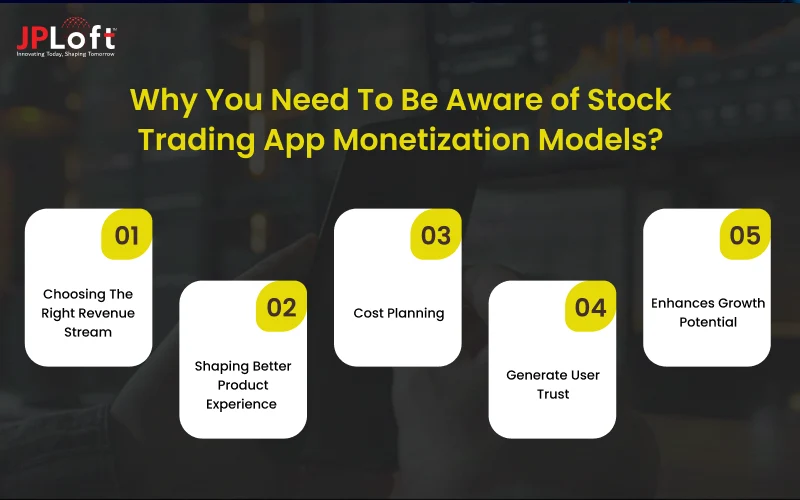
When you know how you can earn through stock trading apps, you can build an app that feels trustworthy and stays strong as more users join.
1. Choosing The Right Revenue Stream
There are diverse monetization strategies for investment apps, including order routing, premium or paid plans, or margin accounts. Also, each strategy works for a different type of user and platform.
Hence, when you understand these choices, you can pick the perfect mix that matches your app goals and contributes to its scalability.
2. Shaping Better Product Experience
Selecting the stock trading app monetization strategy also impacts your users’ experience when they are on your app. Your revenue model affects how your product works.
Free trading needs a smooth order flow. Paid plans need useful features that make the fee worth it. Margin accounts need strong risk checks. When your revenue plan fits your features, users feel more confident and enjoy using your app.
Also, planning for money lending app monetization strategies in advance can help plan for mobile app security and balance app monetization and usability.
3. Cost Planning
Another reason why you need to be aware of how a stock trading app makes money is cost planning.
You need to plan for the cost to develop a stock trading app as well as the associated operational costs. Also, you will need systems for safety checks, market data, support, and cloud hosting.
4. Generate User Trust
Stock trading apps need to ensure fairness and transparency at every level.
A clear understanding of the app revenue model helps build an app that feels safe, and even the users get a clear understanding of the stock trading app monetization model.
This makes the platform safe, gets the user’s trust, and hence supports the app's scalability and growth in every possible way.
Ensuring such trust generation is also one of the key stock trading app development challenges that needs to be focused on.
5. Enhances Growth Potential
Adopting well-planned money lending app monetization strategies supports the steady growth of the trading app you are planning to build. This is because the monetization models not only generate revenue, but also provide a source of finance that can be further used to ensure app scalability.
As more users join your app, each revenue source grows a little more. This creates a stable flow of income that helps your app expand without putting pressure on the user experience.
Real-Life Examples of Revenue Models in Action
The popular stock trading apps around the world use different stock trading app monetization strategies to generate revenue based on their user base, trading volume, and business goals.

Focusing on these examples makes it easier to understand how monetization models work in day-to-day operations and how your app can stay ahead of the stock trading app trends. Here are real examples of how popular trading apps use these revenue streams.
1. Robinhood
Revenue Model: Payment For Order Flow (PFOF)
Robinhood is one of the clearest examples of a platform that earns heavily from Payment for Order Flow. Most of its commission-free trading model runs on this revenue source.
When users place trades, Robinhood routes the orders to market makers, who pay small fees for the flow. With millions of trades happening each day, these tiny payments add up, contributing to a strong mobile app monetization strategy.
This trading app revenue model helped Robinhood offer free trading long before it became a standard across the industry.
2. Webull
Revenue Model: Trading Fee
Another popular stock trading platform to consider is “Webull”. The platform offers free stock and ETF trading, but it still earns through several fee-based services. It charges small fees for option contracts, short-selling, wire transfers, and certain advanced features.
These charges are minimal for individual users and not even worth taking care of, but they create steady revenue due to Webull’s active trading audience.
Webull also earns from regulatory and clearing fees passed to the user. Together, these fee-based incomes ensure that building an app like Webull offers a balanced and functional monetization strategy that supports a low-cost trading model while covering operational costs.
3. eToro
Revenue Model: Premium Subscription Model and Other Fees.
eToro uses a subscription-like approach to monetize a Stock Trading app. Its Club membership program justifies how investment apps earn money. It allows users to unlock perks like priority support, access to expert market insights, reduced fees, and exclusive tools.
But these facilities are only for users who hold certain balance levels. This monetization model creates recurring revenue, especially from serious investors who are looking for advanced features.
The platform also earns from spread fees, but the tiered membership gives it a second stable income source. This blend supports long-term growth without relying fully on trading fees.
4. Fidelity
Revenue Model: Interest on Idle Cash
Fidelity earns interest from uninvested cash that users keep in their accounts. These idle funds are placed in interest-bearing accounts, which generate income for the platform.
Since many users keep some cash ready for future trades, this trading app's revenue model remains stable year-round.
Businesses planning to build a platform like Fidelity can also offer options for users to move idle cash into higher-yield products. This model works well because it does not add direct fees or change the user’s trading experience.
5. Interactive Brokers
Revenue Model: Margin Lending
Interactive Brokers is known for extensive margin trading services. The platform charges interest rates on borrowed funds, and this creates one of its strongest income sources.
The majority of its users are active traders who use margin to take larger positions, which increases borrowing activity.
Because the platform handles high trading volumes across global markets, margin lending becomes a dependable and large part of its total revenue. This example shows how strong margin lending can be as part of money lending app monetization strategies.
Future Trends in Stock Trading App Monetization
The way “how investment apps earn money” is changing. New technology and new user habits are opening fresh earning opportunities.
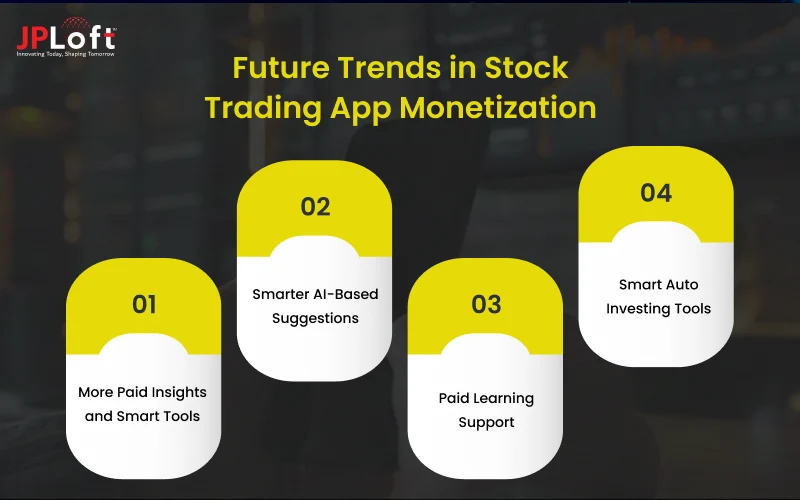
If you plan to build a mobile app, it helps to understand where monetization is heading so you can prepare for the future.
1. More Paid Insights and Smart Tools
Users want simple and helpful guidance. Hence, this will contribute to improved introduction of paid tools that provide users with clear market insights, help them understand trends in plain language, show risks clearly, and help users make better decisions.
These smaller, easy-to-use insights will become popular and create a steady trading app revenue model in the future.
2. Smarter AI-Based Suggestions
The increased focus on the use of AI in stock trading apps will also take over the market. Stock trading apps will use AI to study what users like and need. The app will then suggest useful paid tools or upgrades at the right moment.
Such an approach will make the platform more personalized for the users and will also allow the trading app to plan for custom revenue generation strategies as per the users.
3. Paid Learning Support
The stock trading app users are growing, but the majority of them face challenges with complex terminology and hence want guidance. The stock trading apps will offer short paid lessons, simple guides, and easy learning tools.
Also, the platform can offer real-time insights to users when they are making trades, hence allowing users to improve their skills and giving the app another steady revenue path.
4. Smart Auto Investing Tools
The stock trading apps can hire dedicated developers to develop auto-investing tools that will offer automated investment features that build small portfolios for users.
However, these tools may come with a small fee and will help beginners invest without stress while giving the app a stable earning stream.
How Can JPLoft Help Build Scalable and Profitable Stock Trading Apps?
A stock trading app isn't just built for users; it's built for the entrepreneurs staking their business on it. Strong development gets the app running, but a solid monetization strategy is what keeps it profitable.
Every revenue stream, whether PFOF, subscriptions, or margin interest, depends on trust, uptime, and rock-solid execution. Miss any one, and the model falls apart. This is where JPLoft delivers.
JPLoft builds trading apps with security baked in from day one, backing every revenue stream with strong encryption, compliance-ready workflows, and airtight data handling. The team integrates monetization directly into the app's architecture, from PFOF and margin interest to subscriptions and securities lending.
Scalability gets equal attention, with infrastructure built to handle high trading volumes and fast order execution without buckling. With JPLoft, your idea becomes an app engineered for scale and profit.
Conclusion
Stock trading apps succeed when they balance smart monetization with a seamless, trustworthy user experience. From commissions and PFOF to subscriptions and premium tools, each revenue stream works best when the app is secure, fast, and built with long-term growth in mind.
As the stock trading market space continues to evolve, users will naturally gravitate toward platforms that feel transparent, reliable, and genuinely helpful.
If you're planning to build a stock trading app, get clear on your revenue model early and pair it with a development partner who can turn that model into a secure, scalable product.
With the right approach, your app can generate steady income while giving users an experience they trust and keep coming back to.
FAQs
Stock trading apps earn through diversified sources, including payment for order flow, margin interest, subscriptions, premium tools, and service-based fees. The apps can rely on any one of the models, or can opt for a mix of these models to ensure sustainable revenue generation.
There's no single best model. The right mix depends on your target audience, trading volume, and app goals. Many successful apps combine two or three streams, such as PFOF, subscriptions, and interest on idle cash, rather than relying on one.
Yes, stock trading apps often reinvest idle balances or earn interest spreads, creating a steady revenue source without directly charging users. But these should be done while following ethical norms and data protection standards.
The PFOF stock trading app's monetization strategies help the stock trading app to keep the platform free for users while earning from order processing and transactions. Apart from these, several other approaches exist, including security lending and ads, to keep the platform profitable.
Free trading apps earn through indirect channels like Payment for Order Flow (PFOF), interest on idle cash, margin lending, and premium subscriptions. The trading itself may be free, but several revenue systems run in the background.

Savannah is a passionate tech enthusiast with a sharp understanding of client needs across diverse digital domains. With expertise spanning financial platforms, on-demand solutions, and emerging technologies, she brings a unique blend of analytical insight and interpersonal skills, helping businesses decode complexities and make informed decisions in today's rapidly evolving digital world.



Share this blog