


Key Takeaways:
AI is transforming stock trading by analyzing market data, identifying patterns, monitoring risks, and supporting trading decisions. Its value lies in speed, scale, and automation, but it does not guarantee profitable trades.
Artificial intelligence can support predictive analytics, sentiment analysis, portfolio optimization, risk management, and automated execution.
AI use in trading depends on reliable data, validated models, secure infrastructure, and continuous monitoring.
Leading financial firms and trading platforms are using AI for investment research, portfolio insights, market analysis, risk management, and trading workflows.
Regulatory compliance, model governance, security, and human oversight remain essential for responsible AI trading.
Emerging AI capabilities are enabling trading copilots, agentic workflows, personalized investing, and real-time risk intelligence.
Stock markets can change within seconds. A company announcement, economic update, or sudden shift in investor sentiment can influence thousands of trading decisions almost immediately.
For traders and financial businesses, the challenge is no longer simply accessing market information but making sense of it quickly enough to act with confidence.
This is where AI is becoming increasingly important in stock trading.
Financial institutions and trading platforms are now applying AI across research, market intelligence, portfolio analysis, risk monitoring, and trading workflows.
The growing adoption of AI in financial services reflects a broader shift toward technology that can support faster analysis and more informed decision-making at scale.
For businesses building next-generation trading platforms, this has also increased demand for AI stock trading app development services that combine intelligent capabilities with secure infrastructure, reliable data, and appropriate governance.
However, AI for stock trading is not a shortcut to guaranteed profits or a replacement for sound trading strategies. Its effectiveness depends on how responsibly it is designed and applied.
This guide explores how AI works in stock trading, its applications, benefits, technologies, risks, regulations, real-world adoption, and future trends.

How Does AI Work in Stock Trading?
AI in stock trading app works through a structured process that converts large volumes of market information into insights, signals, and controlled trading actions.
Depending on the platform and trading strategy, the workflow can support research, decision-making, risk management, and automated execution.
Here’s how a typical AI-powered stock trading workflow operates:
-
Market Data Collection: AI systems gather price, volume, news, financial, and sentiment data from multiple sources.
-
Data Preprocessing: Raw data is cleaned, standardized, and prepared for analysis.
-
Feature Engineering: Relevant indicators and patterns are extracted to help models understand market conditions.
-
Model Training: Machine learning models learn from historical data to recognize patterns and relationships.
-
Signal Generation: The trained models generate potential buy, sell, or hold signals based on current conditions.
-
Risk Checks: Risk parameters are evaluated before a trade is approved or executed.
-
Order Execution: Approved trades can be sent automatically through connected brokerage or exchange systems.
-
Monitoring and Retraining: Model performance is continuously monitored, with models updated when market conditions or data patterns change.
Traditional Stock Trading vs AI Stock Trading: Which is Better?
As markets become more data-intensive and fast-moving, manual analysis alone can make it difficult to process information at the required scale and speed.
The use of latest stock trading app trends including AI helps address this gap by continuously analyzing market data, identifying patterns, and supporting faster, data-driven decisions.
The comparison below highlights how traditional and AI-powered approaches differ across key aspects of modern stock trading.
|
Factor |
Traditional/Manual Stock Trading |
AI Stock Trading |
|
Data Analysis |
Relies on manual research and analysis |
Processes large datasets automatically |
|
Decision-Making |
Based on human judgment and experience |
Supported by AI models and algorithms |
|
Speed |
Limited by human processing |
Can analyze data and generate signals rapidly |
|
Emotional Bias |
More vulnerable to emotional decisions |
Can reduce emotion-driven decisions |
|
Scalability |
Limited by human capacity |
Can monitor multiple assets simultaneously |
|
Risk Management |
Often requires manual monitoring |
Supports automated risk checks and alerts |
|
Adaptability |
Can apply contextual human judgment |
Depends on model training and data |
|
Automation |
Requires greater manual involvement |
Enables automated analysis and execution |
|
Human Oversight |
Central to the trading process |
Still required for strategy and supervision |
So, which is better?
Integrating AI features when building a stock trading app offers clear advantages for processing data, automation, and scalability, while traditional trading remains valuable for contextual judgment and strategic decision-making.
In practice, combining AI capabilities with human oversight can provide a more balanced approach, particularly when managing complex or high-risk trading decisions.
What are the Key Benefits of AI in Stock Trading?
AI applications in stock trading offer practical advantages for analyzing market data, monitoring portfolios, managing risks, and automating repetitive trading tasks.
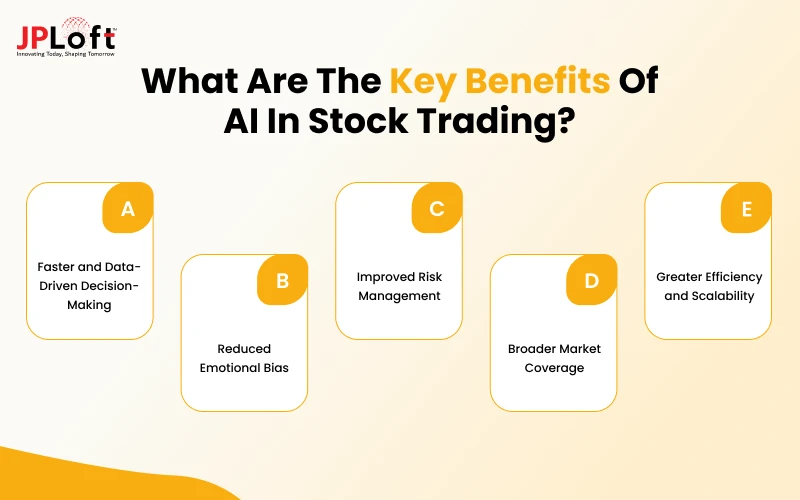
Here are some of the key benefits of AI in stock trading, for both app owners and end users.
1. Faster and Data-Driven Decision-Making
AI can process large volumes of market data, including prices, trading volumes, financial reports, and news, far faster than manual analysis. This helps identify relevant patterns and potential signals more efficiently.
2. Reduced Emotional Bias
Trading decisions can be influenced by fear, greed, overconfidence, and other emotional factors. AI follows predefined models, parameters, and rules, helping reduce emotion-driven decisions and maintain greater consistency across trading workflows.
3. Improved Risk Management
AI can continuously evaluate portfolio exposure, volatility, liquidity, position sizes, and market conditions. Combined with predefined thresholds, it can trigger alerts or risk controls when conditions change.
4. Broader Market Coverage
AI systems can monitor multiple stocks, sectors, markets, and indicators simultaneously, hence contributes to more effective stock trading app features. This allows traders and financial platforms to evaluate a wider range of market information without increasing the manual workload.
5. Greater Efficiency and Scalability
Integrating AI in trading apps can automate repetitive activities such as market monitoring, data analysis, signal generation, alerts, and selected execution workflows. This allows trading platforms to handle larger volumes of information and activity without relying entirely on manual processes.
How is AI Used in Stock Trading?
Artificial intelligence has much diversified use cases in the stock trading market. From analyzing market data, to identify patterns, assess risks, and automating trading workflows, AI can support more efficient and data-driven trading workflows.
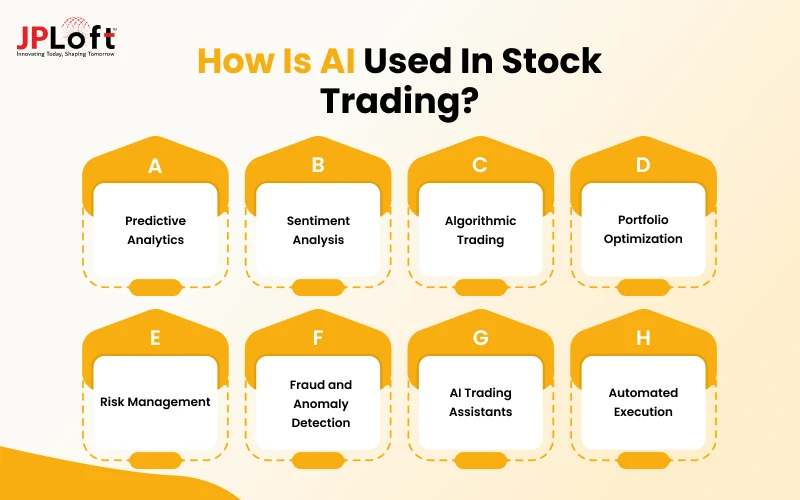
Here are the most common and effective use cases of AI in trading apps:
A] Predictive Analytics
AI trading apps use machine learning models to analyze historical prices, trading volume, technical indicators, and real-time market data to identify patterns and generate potential price or trading signals.
Models such as regression, random forests, and neural networks can support building AI stock prediction platforms, but they cannot guarantee market outcomes.
B] Sentiment Analysis
Using NLP models, AI can analyze financial news, earnings reports, SEC filings, analyst commentary, and social media to determine market sentiment.
Sentiment scores can then be combined with price and volume data to provide additional trading signals.
C] Algorithmic Trading
Using AI in trading apps supports algorithmic trading by identifying predefined market conditions and optimizing trading strategies.
Machine learning and reinforcement learning models can analyze historical behavior and improve strategy parameters, while rule-based systems control execution and risk limits.
D] Portfolio Optimization
The investors can use AI to evaluate of asset returns, volatility, correlation, and risk tolerance to recommend portfolio allocations.
Optimization algorithms and machine learning models can support diversification, asset weighting, and automated rebalancing as market conditions change.
E] Risk Management
AI applications in stock trading can also continuously analyze volatility, portfolio exposure, drawdown, liquidity, and position sizes to identify potential risks.
Trading platforms can combine these insights with predefined risk thresholds, stop-loss rules, and position limits to strengthen risk controls.
F] Fraud and Anomaly Detection
Artificial Intelligence can help detect unusual trading or account behavior by analyzing transaction patterns, order activity, and historical behavior.
Anomaly detection and classification models can flag potentially suspicious activity for further investigation.
G] AI Trading Assistants
LLMs and generative AI can power trading assistants that summarize financial reports, explain market movements, answer portfolio-related questions, and retrieve relevant financial information.
RAG systems can ground responses in approved financial documents and data sources.
H] Automated Execution
AI-generated signals can be connected to broker APIs and order-management systems for automated execution.
Execution engines can evaluate price, liquidity, order size, and predefined risk parameters before placing eligible orders, while real-time monitoring helps track execution and system performance.
AI Technologies and Architectures Used in Stock Trading
Integrating AI in stock trading app is not just about a single technology or API integrated into an app.
The AI powered stock trading platforms combine multiple technologies to analyze market information, generate insights, manage risk, and support automation.
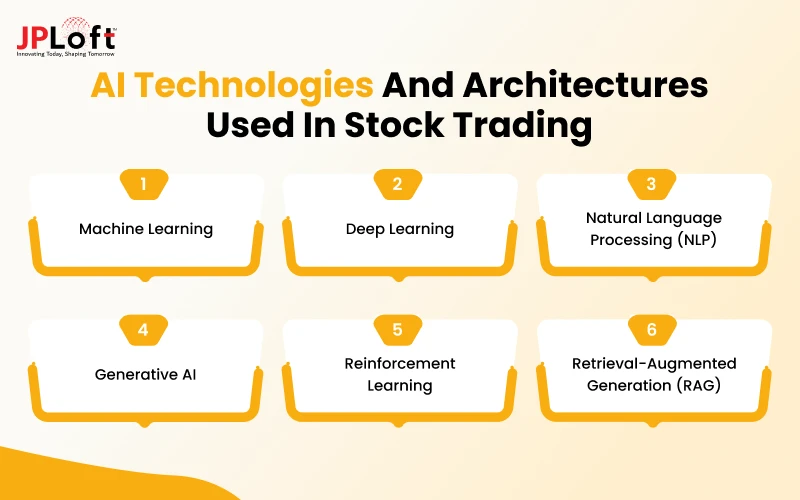
Here is the AI stock trading app tech stack used to make a trading app intelligent.
[1] Machine Learning
Machine learning models identify patterns and relationships in historical and real-time market data.
Techniques such as regression, random forests, gradient boosting, and classification models can support price forecasting, volatility analysis, signal generation, and risk assessment.
[2] Deep Learning
Deep learning uses multi-layer neural networks to model complex patterns in large datasets.
Architectures such as LSTMs and transformers can process time-series market data and other high-dimensional inputs to support forecasting, pattern recognition, and market-state analysis.
[3] Natural Language Processing (NLP)
NLP enables AI systems to process unstructured financial information such as news, earnings reports, regulatory filings, analyst commentary, and social media.
It can support sentiment analysis, event detection, document classification, and extraction of market-relevant information.
[4] Generative AI
Generative AI in stock trading can transform complex financial information into natural-language outputs such as market summaries, research briefs, earnings analysis, and portfolio explanations.
LLMs are a key technology within this category and can also power conversational trading assistants and financial copilots.
[5] Reinforcement Learning
Reinforcement learning trains models to make sequential decisions by evaluating actions against defined rewards and penalties.
In trading, it can be explored for strategy optimization, portfolio allocation, and execution decisions, particularly through controlled simulations and backtesting.
[6] Retrieval-Augmented Generation (RAG)
Retrieval-augmented generation (RAG) connects language models with external sources such as financial filings, research reports, market documents, and internal databases.
By retrieving relevant information before generating a response, RAG can provide more context-aware outputs for financial research and trading assistants.
Real-World Examples: Companies Using AI in Stock Trading
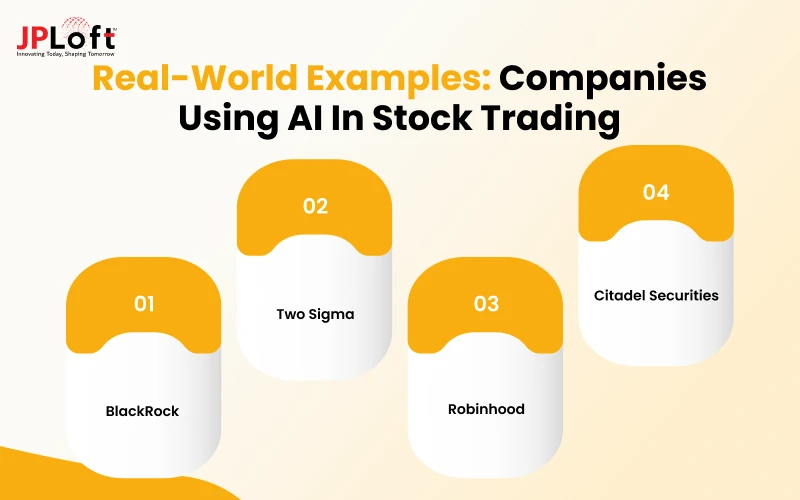
Leading financial firms are applying AI and machine learning across investment research, portfolio analysis, risk management, and trading workflows. The following examples of the best stock trading apps show how these technologies are being used in practice.
► BlackRock
BlackRock is integrating generative AI into its Aladdin investment platform. Its Aladdin Copilot uses GenAI to surface information and support investment decisions, while Aladdin Wealth's AI-powered Auto Commentary helps advisors turn portfolio data into client-ready insights.
Impact: AI is helping extend Aladdin from portfolio and risk analytics into intelligent research and decision-support workflows.
► Two Sigma
Two Sigma combines data science, machine learning, algorithms, and large-scale computing across its investment process. In its 2026 outlook, the firm highlights AI's growing role in quantitative investing and research.
Impact: AI and machine learning enable faster experimentation, large-scale data analysis, and systematic investment research.
► Robinhood
Robinhood is bringing generative AI directly to retail investors through Robinhood Cortex. Its Cortex Digests were used by nearly 1 million customers by April 2026, while Cortex Assistant is being rolled out to provide real-time AI-powered market insights.
Impact: AI is making market research, portfolio analysis, and financial insights more accessible within a consumer trading platform.
► Citadel Securities
Citadel Securities uses machine learning to support quantitative research and financial-market modeling. Its machine-learning teams work with researchers to develop deep-learning capabilities for analyzing and predicting financial markets.
Impact: AI helps researchers test models faster and explore complex market patterns at scale.
Regulatory Landscape and Legal Considerations for AI in Stock Trading
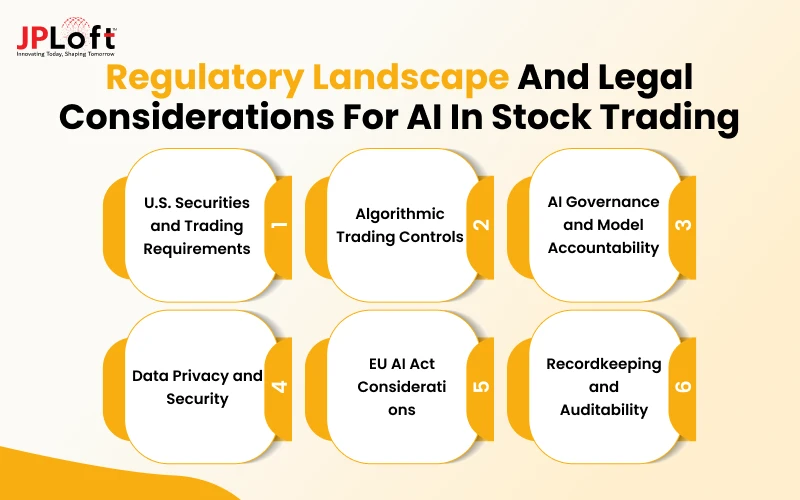
AI-powered trading must operate within financial, algorithmic trading, data protection, and market conduct requirements. The exact obligations vary by jurisdiction, trading activity, and the role of the platform.
1. U.S. Securities and Trading Requirements
In the U.S. market, AI-powered trading remains subject to applicable SEC and FINRA requirements. Such requirements applies to the stock trading app designs, its operational approaches, and future upgrades.
Businesses must maintain appropriate supervision, testing, monitoring, documentation, and recordkeeping to ensure AI-supported activities operate within existing securities regulations.
2. Algorithmic Trading Controls
AI systems involved in automated order decisions may be subject to algorithmic-trading requirements.
Under frameworks such as MiFID II, firms may need effective risk controls, trading limits, resilient infrastructure, testing, monitoring, and appropriate records for algorithmic trading activities.
3. AI Governance and Model Accountability
Businesses should establish governance throughout the AI model lifecycle, including validation, performance monitoring, version control, and defined responsibilities.
Audit trails can help investigate unexpected outputs, assess model performance, and establish accountability when AI contributes to trading decisions.
4. Data Privacy and Security
Trading platforms process sensitive financial and transaction data, making security and privacy essential.
Encryption, access controls, secure APIs, data governance, and appropriate retention policies should be implemented alongside applicable mobile app security and cybersecurity requirements.
5. EU AI Act Considerations
The EU AI Act follows a risk-based approach, so financial AI systems are not automatically classified as high-risk.
Businesses must assess each system's purpose and use case to determine applicable obligations, which may include risk management, documentation, logging, human oversight, and monitoring.
6. Recordkeeping and Auditability
AI-supported trading should maintain reliable records of relevant inputs, outputs, decisions, orders, and system events where required.
Strong audit trails support compliance reviews, model investigations, performance assessment, and accountability.
Risks and Limitations of AI Trading
Using AI can improve the speed and scale of trading analysis, but it cannot eliminate market uncertainty or guarantee profitable outcomes.
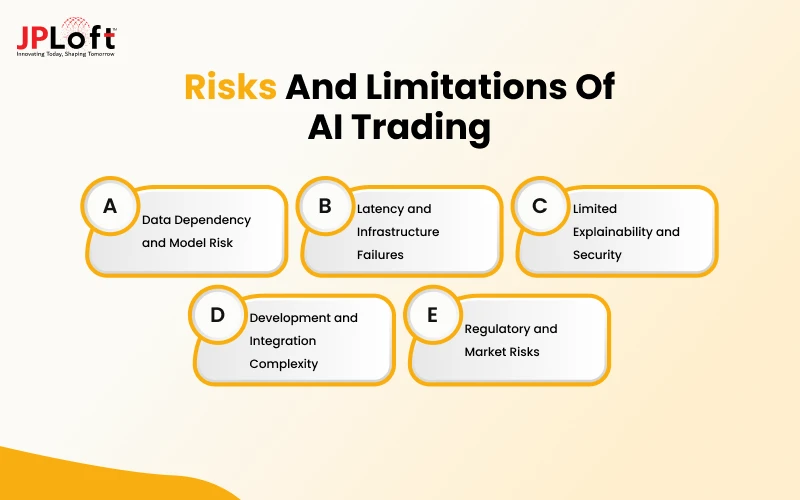
Its effectiveness depends on data quality, model reliability, infrastructure, security, and changing market conditions. Here are some of the key risks of AI in stock trading that every entrepreneur needs to consider before integrating AI and automation in their trading platform.
► Data Dependency and Model Risk
AI systems depend on accurate, timely, and representative data. Missing or biased data can affect outputs, while models trained on historical patterns may perform poorly when market conditions change.
Overfitting can also make strategies appear successful during backtesting but produce weaker results in live markets.
Solution: Hire AI developers who can ensure high-quality data pipelines, out-of-sample testing, stress testing, and continuous model-performance monitoring.
► Latency and Infrastructure Failures
Trading systems can be sensitive to delays in market-data feeds, model processing, API communication, and order execution.
Network failures, system outages, or integration errors can disrupt trading workflows and affect execution quality.
Solution: Use resilient infrastructure, redundant systems, real-time monitoring, and predefined fallback mechanisms to minimize service disruptions.
► Limited Explainability and Security
Some AI models can generate trading signals without providing easily interpretable reasoning, making unexpected decisions harder to investigate.
AI systems can also face cybersecurity threats, data manipulation, and unauthorized access.
Solution: Partner with AI development company to implement explainability measures alongside strong authentication, encryption, access controls, security testing, and audit logging.
► Development and Integration Complexity
Building AI-powered trading capabilities requires reliable market-data feeds, brokerage APIs, trading infrastructure, risk controls, and secure integrations to work together. Poor architecture or integration issues can affect system reliability and performance.
Businesses should also account for these stock trading app development challenges when planning AI-based trading solutions.
Solution: Design a scalable architecture and validate APIs, data pipelines, security controls, and AI components through rigorous testing before deployment.
► Regulatory and Market Risks
AI-driven trading must comply with applicable financial, market-conduct, and data regulations.
Poorly controlled automated strategies may also amplify unusual market activity or create unintended outcomes.
Solution: Establish AI governance, regulatory monitoring, model controls, documented compliance processes, and human oversight for consequential decisions.
What Does the Future of AI in Stock Trading Look Like?
Role of AI in stock trading is moving beyond basic automation toward systems that can support research, portfolio decisions, risk monitoring, and more autonomous workflows.
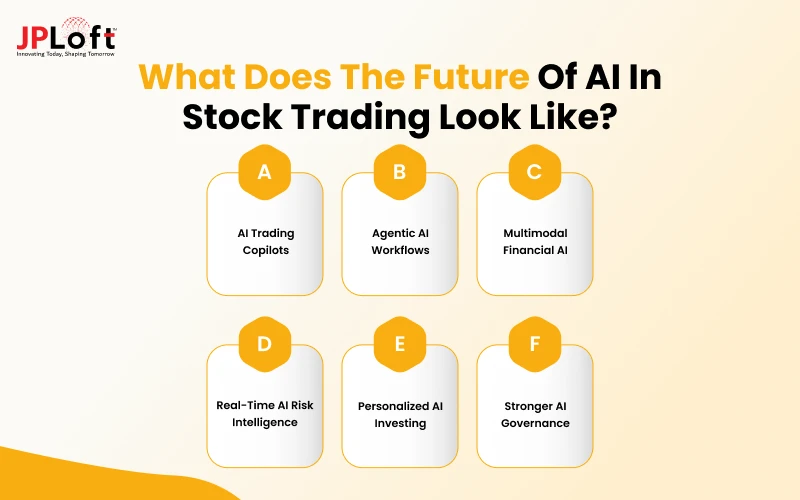
Current industry research shows that adoption is already expanding across investment management, while regulators are increasingly examining the risks of more autonomous AI systems.
[A] AI Trading Copilots
AI-powered copilots can help traders research securities, summarize earnings calls and filings, analyze portfolios, and interpret market information through natural-language interfaces.
These tools can reduce the time spent on repetitive research while keeping final trading decisions under human control.
[B] Agentic AI Workflows
AI agents for stock trading can perform multi-step tasks such as gathering market information, comparing securities, analyzing financial documents, and preparing research summaries.
As these systems become more capable, controlled agentic workflows could support trading operations, although permissions, validation, monitoring, and human oversight remain essential.
[C] Multimodal Financial AI
Future AI systems in fintech space will increasingly combine structured and unstructured information, including price data, charts, financial filings, earnings calls, news, and economic indicators.
Processing these different inputs together can provide broader context for market analysis and support more comprehensive investment research.
[D] Real-Time AI Risk Intelligence
AI will increasingly monitor portfolio exposure, volatility, liquidity, correlations, and unusual market activity in real time.
These systems can identify emerging risk conditions and generate alerts or trigger predefined controls, helping trading teams respond more quickly to changing market conditions.
[E] Personalized AI Investing
Trading platforms are likely to provide more personalized research, portfolio insights, alerts, and educational guidance based on individual preferences and investment objectives.
AI can adapt the presentation and relevance of financial information without necessarily making autonomous investment decisions.
[F] Stronger AI Governance
As AI takes on more consequential financial tasks, model validation, explainability, auditability, cybersecurity, and human oversight will become increasingly important.
Regulators and financial institutions are already paying greater attention to the risks associated with autonomous and interconnected AI systems.
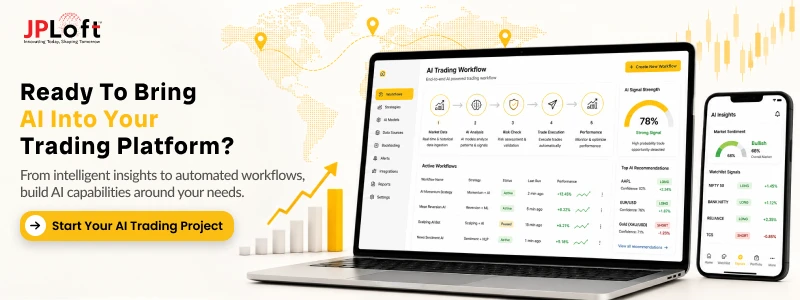
How JPLoft Can Help Build AI-Powered Trading Solutions?
Building an AI-powered trading solution requires more than integrating an AI model. It involves connecting market data, intelligent analysis, risk controls, trading workflows, and secure financial infrastructure into a reliable system.
JPLoft helps businesses integrate AI capabilities for market analysis, portfolio insights, risk monitoring, personalized experiences, and intelligent trading assistants.
Our team can connect AI with real-time market data, brokerage APIs, portfolio management systems, and other financial services while supporting authentication, data security, audit trails, and compliance workflows.
Whether you are adding AI capabilities to an existing trading platform or building a new solution, JPLoft can help you design and integrate AI capabilities around your business goals, technical requirements, and compliance needs.
Conclusion
AI is reshaping stock trading by helping financial platforms analyze large volumes of data, identify market patterns, monitor risks, and deliver more personalized trading insights.
From predictive analytics and sentiment analysis to AI assistants and automated workflows, its applications continue to expand across the financial industry. However, AI is not a substitute for sound trading strategies or human oversight.
Reliable data, robust risk controls, model monitoring, security, and regulatory compliance remain essential for responsible adoption.
As AI capabilities advance, businesses can use these technologies to build smarter and more efficient trading experiences while maintaining appropriate controls. The focus should be on applying AI where it adds measurable value rather than pursuing automation for its own sake.
FAQs
If focuses on using artificial intelligence to analyze market data, identify patterns, assess risks, generate insights, and support trading decisions. It can also automate selected analysis and trading workflows based on predefined rules and controls.
AI can be used to analyze market data, identify patterns, generate trading signals, monitor risks, and support portfolio decisions. Traders can integrate AI into their workflows while using predefined risk controls and human oversight for critical decisions.
AI plays an important role in predictive analytics, sentiment analysis, algorithmic trading, portfolio optimization, risk management, anomaly detection, financial research, trading assistants, and selected automated execution workflows.
Key benefits include faster data analysis, reduced emotional bias, continuous risk monitoring, broader market coverage, and greater operational efficiency. However, these benefits do not guarantee higher returns or profitable trades.
Key risks include poor data quality, model overfitting, changing market conditions, infrastructure failures, latency, limited explainability, cybersecurity threats, and regulatory challenges. Strong testing, monitoring, security, and human oversight can help manage these risks.

Savannah is a passionate tech enthusiast with a sharp understanding of client needs across diverse digital domains. With expertise spanning financial platforms, on-demand solutions, and emerging technologies, she brings a unique blend of analytical insight and interpersonal skills, helping businesses decode complexities and make informed decisions in today's rapidly evolving digital world.


Share this blog