



Key Takeaways:
Robo-advisors automate stock investing using algorithms, real-time data, and predefined strategies to manage portfolios efficiently with minimal manual intervention.
Building a robo-advisor requires defining investment logic, data infrastructure, compliance, and scalable system architecture.
Core functionality includes profiling, risk assessment, portfolio allocation, rebalancing, and trade execution, all powered by integrated APIs and analytics engines.
Features like dynamic portfolio engines, real-time data integration, and automated rebalancing are critical for performance, accuracy, and user trust.
The cost to build a robo advisor for stock trading typically ranges from $20,000 to $300,000+, depending on complexity, AI capabilities, and scalability requirements.
Stock trading has long been one of the most effective ways to build wealth, but navigating market volatility, analyzing data, and making timely decisions remains a challenge for many investors.
This growing complexity has accelerated the demand for intelligent tools that can simplify investing, creating a strong opportunity for businesses to innovate in this space.
One of the impactful innovations is “Robo-advisors in stock trading”. But building a robo advisor is far more complex than developing a standard application.
The robo advisor development process involves designing investment logic, integrating real-time market data, ensuring regulatory compliance, and delivering a seamless user experience backed by robust technology.
In this guide to build a robo advisor for stock trading, we will discuss more about what robo advisors are, their working, their types, development steps, associated costs, and more.
What are Robo Advisors?
Robo-advisors are automated platforms that execute trades and optimize investment portfolios backed by algorithms and data analytics capabilities.
Instead of relying on human intervention or financial advisors, these platforms assess user inputs such as financial goals, risk tolerance, and investment horizon to make decisions.
They continuously monitor market conditions and automatically execute actions like asset allocation, portfolio rebalancing, and tax optimization.
Hence, planning to create a robo advisor for stock trading can help businesses deliver a convenient and low-risk decision-making platform to the users.
How Do Robo-Advisors Work?
Before proceeding to develop a robo advisor for stock trading, it is important to understand how these tools work at the operational level.
Robo advisors automate portfolio management through a structured workflow to deliver data-driven, scalable investment decisions.
-
User Profiling: Collect financial goals, risk tolerance, and investment horizon through structured inputs.
-
Risk Assessment: Classify users into risk categories using scoring models and financial parameters.
-
Portfolio Construction: Allocate assets using quantitative models to balance risk and expected returns.
-
Strategy Execution: Apply goal-based or algorithm-driven investment strategies.
-
Market Data Integration: Use real-time data feeds for continuous portfolio evaluation.
-
Automated Rebalancing: Adjust allocations based on market changes or predefined thresholds.
-
Trade Execution: Execute orders via brokerage APIs with minimal latency.
- Performance Tracking: Provide analytics dashboards for monitoring portfolio performance.
Key Benefits of Robo Advisors for Stock Investing
The visible benefit of robo-advisors for stock trading is that they can automate stock trading.
But along with this, several other benefits exist that you should be aware of before you build a robo-advisor for stock trading.
Such an understanding can help you plan the direction your robo-advisor should focus on when building a stock trading app.

Here are the key robo-advisor benefits for stock trading to be aware of:
1. Scalable Investment Management
Robo advisors are powered by algorithms and machine learning models that can handle thousands of portfolios simultaneously without increasing operational complexity.
2. Better Cost Efficiency
For both businesses and investors, AI robo advisor development is affordable, as they reduce reliance on human advisors, significantly lowering operational and service costs.
3. Personalized Portfolio Allocation
Robo advisors in stock trading help plan for custom investment strategies based on user goals, risk profiles, and behavior.
4. Automated Rebalancing & Optimization
These advanced tools are programmed to continuously adjust portfolios using real-time market data and maintain performance as per the set investment goals.
5. Data-Driven Decision Making
Along with all, a key benefit of creating a robo advisor for stock trading is that they rely on algorithms and data sets, hence are able to eliminate emotional bias and improve investment accuracy.

Types of Robo Advisors For Stock Trading
Robo-advisors differ in how they handle decision-making, personalization, and scalability.
Hence, choosing the right type shapes your platform’s capabilities, complexity, market positioning, and robo advisor development cost.
|
Type |
How It Works |
Potential Use Case |
|
Rule-Based |
Follows predefined allocation rules and fixed logic |
Used to auto-assign portfolios based on risk scores and rebalance at set intervals in basic trading apps |
|
Hybrid |
Blends algorithmic investing with human oversight |
Users receive automated portfolios but can consult advisors for adjustments during volatile market conditions |
|
AI-Driven |
Uses machine learning to adapt portfolios dynamically |
Continuously analyzes market patterns, user behavior, and risk signals to optimize investments in real time |
|
Goal-Based |
Maps investments to specific financial outcomes |
Allocates and adjusts portfolios based on goals like retirement, wealth growth, or short-term savings targets |
|
ESG-Focused |
Filters assets using ESG scoring models |
Builds portfolios aligned with sustainability metrics, excluding non-compliant stocks or industries |
You can connect with an expert software development company to better understand the types and plan for a robo-advisor for your stock trading app.
Must-Have Features of a Stock Trading Robo Advisor
The successful execution of a robo advisor depends on how well the robo advisor's features for the stock trading platform have been planned.
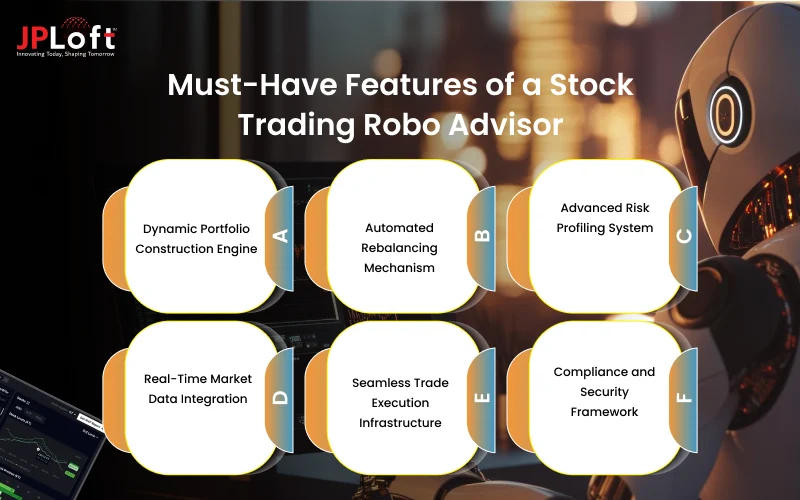
Here are the must-have features to include when planning to build a robo advisor.
[A] Dynamic Portfolio Construction Engine
Automatically builds diversified portfolios using quantitative models, aligning asset allocation with user risk profiles, investment goals, and evolving market conditions.
[B] Automated Rebalancing Mechanism
Continuously monitors portfolio drift and reallocates assets based on predefined thresholds or market signals to maintain optimal risk-return balance over time.
[C] Advanced Risk Profiling System
Evaluates user risk tolerance through behavioral inputs, financial data, and adaptive scoring models to personalize investment strategies and portfolio configurations effectively.
[D] Real-Time Market Data Integration
Processes live market feeds and historical data to enable timely portfolio adjustments, accurate analytics, and informed algorithmic investment decision-making.
[E] Seamless Trade Execution Infrastructure
Integrates with brokerage APIs and stock trading app features to execute buy and sell orders efficiently, ensuring low latency, high accuracy, and secure transaction processing.
[F] Compliance and Security Framework
Implements KYC, AML protocols, data encryption, and fraud detection systems to ensure regulatory compliance and protect sensitive user and financial information.
Step-by-Step Process to Build a Robo Advisor
Building a robo advisor brings together financial logic, technology, and compliance into one working system. Partnering with a stock trading app development company can help build a functional and scalable robo-advisor for your platform.
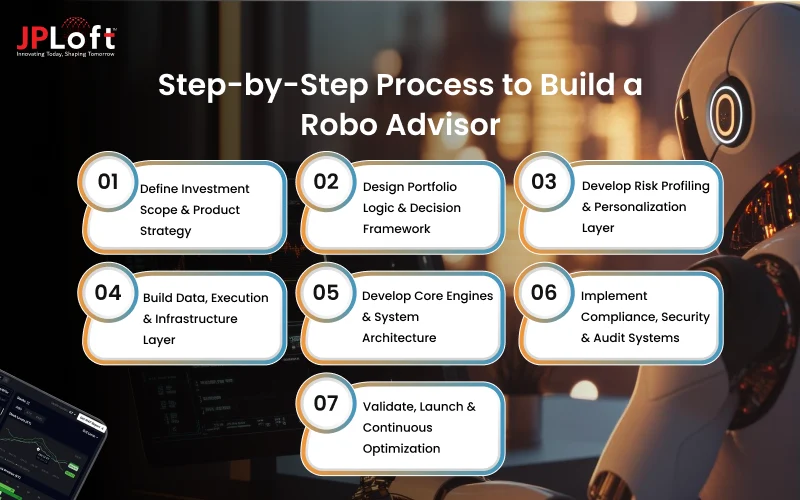
Here is a step-by-step process on how to develop a robo-advisor for stock trading that actually works.
Step 1: Define Investment Scope & Product Strategy
This stage determines what your robo-advisor will offer and how it will differentiate in the market. It sets the direction for features, complexity, and long-term scalability, making it one of the most critical decisions before robo-advisor platform development begins.
-
Plan for the asset type your robo advisor will provide assistance for, such as stocks, ETFs, or multi-asset portfolios.
-
Choose an investment approach like passive, goal-based, or AI-driven strategies.
-
Define user journeys, including one-time investments, recurring contributions, or hybrid flows.
-
Plan for the monetization model and align it with your product capabilities and the targeted audience.
Step 2: Design Portfolio Logic & Decision Framework
This is the core intelligence layer where the robo-advisor is designed to make investment decisions. The efficiency of this decision layer directly impacts portfolio performance, user trust, and the overall effectiveness of your platform in real-world market conditions.
-
Build allocation models based on diversification, risk levels, and expected returns.
-
Define constraints like sector exposure, asset limits, and liquidity thresholds.
-
Set rules that the robo advisor will follow for rebalancing, portfolio adjustments, and exit strategies.
-
Partner with an expert AI development company and incorporate logic for handling market volatility and sudden price movements.
Step 3: Develop Risk Profiling & Personalization Layer
A strong robo-advisor ensures that user inputs meaningfully influence portfolio behavior. This step focuses on translating financial and behavioral data into actionable investment decisions for better personalization and user alignment.
-
Map questionnaire responses to specific asset allocation changes.
-
Include behavioral indicators such as reaction to losses and investment patterns.
-
Create dynamic profiles that evolve with user activity and portfolio performance.
-
Allow flexibility for preferences like sector bias or ethical investing choices.
Step 4: Build Data, Execution & Infrastructure Layer
This layer ensures your platform can process real-time information and execute trades reliably. Without a strong robo advisor tech stack, even well-designed strategies fail due to latency, inaccuracies, or execution gaps.
-
Integrate real-time market data, historical datasets, and analytics feeds.
-
Develop order management systems to handle trade execution and confirmations.
-
Optimize infrastructure for low latency, high availability, and scalability.
-
Implement fallback mechanisms for data failures or execution errors.
Step 5: Develop Core Engines & System Architecture
At this stage, the platform is structured into independent systems that handle different responsibilities. A modular architecture ensures flexibility, easier updates, and the ability to scale without rebuilding the entire product.
-
Build a portfolio engine to manage allocation, tracking, and performance updates.
-
Develop a rebalancing engine based on thresholds, timing, or market signals.
-
Create an execution engine for order routing and trade confirmations.
-
Ensure seamless communication between modules using APIs or microservices.
Step 6: Implement Compliance, Security & Audit Systems
Stock trading is a highly regulated space, making compliance and security non-negotiable. This step ensures your robo-advisor platform development process is legally sound and capable of handling sensitive financial data securely.
-
Implement KYC and AML verification workflows for user onboarding.
-
Apply data encryption, secure authentication, and fraud detection systems.
-
Maintain detailed audit logs for all portfolio decisions and transactions.
-
Ensure alignment with financial regulations and data protection standards.
Step 7: Validate, Launch & Continuous Optimization
This is the last step to consider when looking for how to create a robo-advisor for stock trading. But before going live, the system must be tested against real-world conditions to ensure accuracy and reliability.
-
Post-launch, continuous optimization is essential to ensure performance optimization over time.
-
Backtest strategies across multiple market cycles and volatility scenarios.
-
Simulate edge cases like sudden drawdowns or liquidity constraints.
-
Monitor system performance, execution accuracy, and user behavior.
-
Continuously refine algorithms and features based on real-time data insights.
How Much Does It Cost to Build a Robo Advisor?
The cost to build a robo-advisor for stock trading ranges anywhere from $20,000 to $300,000, with costs increasing as you move from basic automation to AI-driven investment systems.
|
Level |
Estimated Cost |
What You Get? |
|
Basic (MVP) |
$20,000 – $80,000 |
Rule-based portfolios, basic risk profiling, and limited integrations |
|
Mid-Level Platform |
$80,000 – $180,000 |
Portfolio management, rebalancing, API integrations, improved UX |
|
Advanced Platform |
$180,000 – $300,000+ |
AI-driven strategies, real-time analytics, scalable infrastructure |
Key Factors That Influence the Cost to Develop a Robo Advisor For Stock Trading
Several technical and operational factors directly impact the overall investment made to develop a robo-advisor for stock trading. These factors include:
-
Algorithm Complexity: Basic rule-based logic costs less, while AI-driven models increase development time and effort.
-
Data & API Integrations: Real-time market data, brokerage APIs, and analytics tools add to both cost and system complexity.
-
Compliance & Security Requirements: Implementing KYC, AML, encryption, and regulatory frameworks significantly increases development scope.
-
Platform Coverage: Building for web, iOS, and Android simultaneously raises both cost and timelines.
-
UI/UX & Dashboard Complexity: Advanced financial dashboards and analytics interfaces require additional design and frontend effort.
Challenges In Building Stock Trading Robo Advisors
Along with understanding how to build AI Robo Advisors for stock trading, it is also important to look for potential challenges that can impact the platform's success.
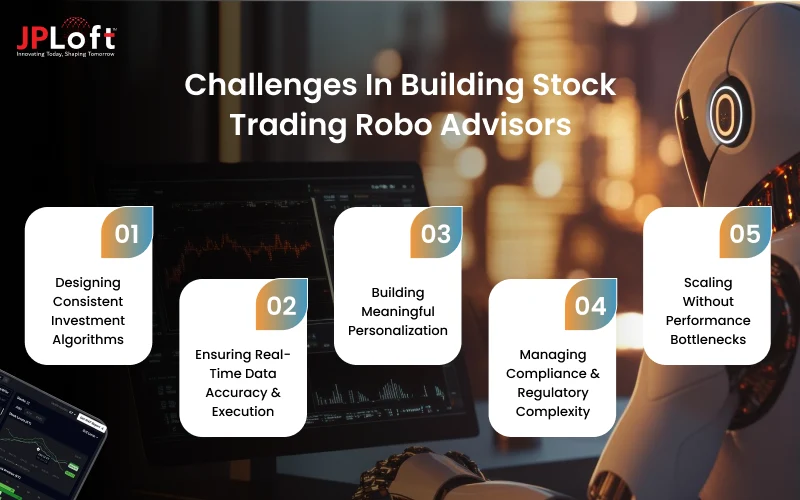
Challenge 1: Designing Consistent Investment Algorithms
Building algorithms or AI systems that perform reliably across different market conditions is a key challenge. Models that work in stable markets may fail during volatility, impacting returns and user confidence.
Solution: Use diversified strategies, backtest the AI models across multiple market cycles, and continuously refine models using real-time performance data.
Challenge 2: Ensuring Real-Time Data Accuracy & Execution
Robo-advisors depend on accurate, real-time data and seamless trade execution. Any delay or inconsistency in fetching data or analyzing it can lead to incorrect decisions or failed transactions.
Solution: Hire AI developers and integrate reliable APIs for data collection, test the validation layers, and optimize execution systems for low latency and accuracy.
Challenge 3: Building Meaningful Personalization
Collecting user data is easy, but translating it into actionable investment decisions for robo-advisory is challenging. Poor personalization leads to generic portfolios and low user engagement.
Solution: Develop dynamic risk profiling systems when planning for robo-advisor platform development, where user inputs directly influence portfolio allocation and strategy adjustments.
Challenge 4: Managing Compliance & Regulatory Complexity
Another challenge in developing and operating robo-advisors is that tools in the fintech space must adhere to strict regulations, which can vary significantly across markets. Non-compliance can result in legal and operational risks.
Solution: Integrate KYC, AML, and audit mechanisms early in the steps to develop a robo advisor app for stock trading to ensure continuous regulatory alignment.
Challenge 5: Scaling Without Performance Bottlenecks
As user volume and transaction loads increase, maintaining the performance of robo advisors becomes challenging without a scalable architecture. Also, in most scenarios, it fails to keep up with the emerging or transforming industry trends.
Solution: Partner with dedicated developers who can use cloud-based infrastructure, modular system design, and optimized APIs to ensure stability and scalability under growth.
Conclusion
This blog summarises how to build a robo-advisor for stock trading that aligns with the needs of modern investors.
Robo-advisors are redefining how investment platforms operate by combining automation, data intelligence, and scalability.
For businesses, integrating robo advisor features for stock trading is not just about launching a feature but creating a system that can deliver consistent, personalized investment experiences at scale.
The opportunity is clear, but execution is what sets platforms apart. Businesses that invest in the right foundation today are the ones that will lead the next wave of digital investing.
FAQs
The approach to develop a robo advisor follows a set process from defining investment goals to designing portfolio logics, developing risk profiles, providing data access, implementing compliance, and more.
The expected timeline to develop a robo advisor typically ranges from 3 to 9+ months, depending on platform complexity, features, integrations, and compliance requirements.
Robo-advisors are automated platforms that operate on set algorithms and predefined logics. Further, AI features can be integrated in the robo advisor to ensure it can make smart decisions beyond the algorithms, by analysing real market scenarios, and deliver effective results.
Robo advisors rely on algorithms to allocate assets, diversify portfolios, rebalance investments, and optimize strategies based on market data and user risk profiles. Hence, they don’t guarantee returns, but help minimize the risk based on their data evaluation abilities.
Key challenges in developing a robo advisor include building reliable algorithms, ensuring real-time data accuracy, maintaining compliance, enabling personalization, and scaling the platform efficiently.

Savannah is a passionate tech enthusiast with a sharp understanding of client needs across diverse digital domains. With expertise spanning financial platforms, on-demand solutions, and emerging technologies, she brings a unique blend of analytical insight and interpersonal skills, helping businesses decode complexities and make informed decisions in today's rapidly evolving digital world.



Share this blog