


Key Takeaways
Blockchain-based social media apps in 2026 empower users with data ownership, transparency, and censorship-resistant interactions.
Building these platforms in 2026 requires strong planning around decentralization, token ecosystems, and community-driven governance.
The cost to develop a blockchain-based social media app in 2026 ranges from $20,000 to $90,000, depending on features, security layers, and blockchain choices.
Success depends on choosing the right blockchain protocol, ensuring scalability, and integrating secure smart contract logic.
Partnering with JPLoft ensures expert guidance, structured development, and a future-ready product built with precision and innovation.
Blockchain is reshaping how digital platforms operate, and social networking is one of the biggest areas set for transformation in the coming years.
As data privacy concerns grow and users demand more transparency, security, and control, decentralized platforms are gaining strong momentum.
That shift naturally leads to an important question for founders and investors planning their next product: what’s the cost to develop a blockchain-based social media app in 2026?
On average, the cost ranges between $20,000 and $90,000, depending on features, blockchain complexity, security layers, and platform scalability.
Unlike conventional networks, blockchain-powered platforms eliminate centralized control, giving users ownership of their content and digital identity. With decentralization becoming mainstream, blockchain-based social media apps in 2026 are emerging as a powerful innovation wave for startups and enterprises alike.
What is a Blockchain-Based Social Media App?
A blockchain-based social media app is a decentralized platform where users fully control their content, data, and digital identity.
Unlike traditional platforms, it removes central authority, storing information on a secure, transparent blockchain ledger that prevents unauthorized edits or censorship.
Users can also participate in community governance through tokenized voting systems.
As interest in Discord alternatives grows, blockchain social networks are emerging as fairer, more transparent options, offering innovative ways to engage, share, and monetize content without centralized control.
Why Blockchain Matters for the Next-Gen Social Media Platforms?
Blockchain is not just a buzzword; it’s a game-changer for social media. Platforms built on blockchain technology offer unique advantages that traditional networks can’t match.
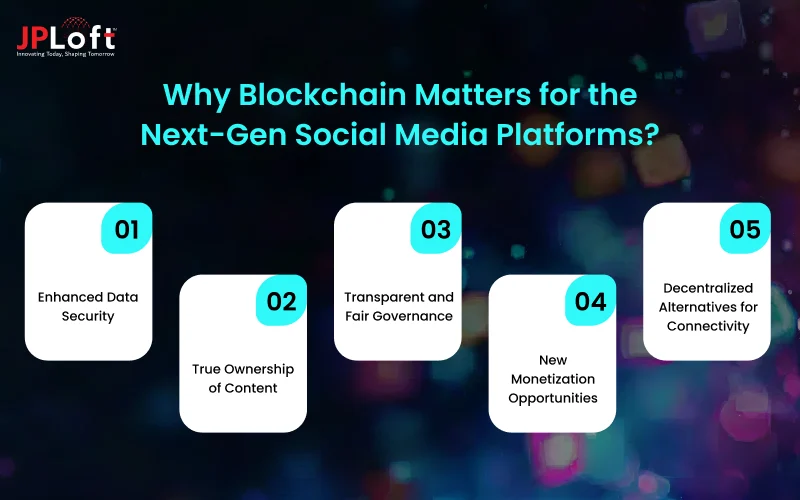
Here are some of the main reasons why businesses and users are gravitating toward decentralized social networks:
1. Enhanced Data Security
Blockchain in social media apps ensures that user data is encrypted and distributed across a decentralized network.
Unlike centralized servers, this structure reduces the risk of hacks and data breaches, giving users confidence that their personal information is safe.
2. True Ownership of Content
Decentralized platforms allow users to own their content completely. From posts and images to digital assets, every piece of content is stored immutably on the blockchain.
This is one of the core benefits of blockchain in social media apps, empowering creators to monetize and control their work without relying on intermediaries.
3. Transparent and Fair Governance
Tokens and voting mechanisms let communities make decisions collectively. Users can influence platform policies, moderation rules, and feature prioritization.
This model shows how blockchain can transform social media platforms, creating fairer and more community-driven experiences.
4. New Monetization Opportunities
Blockchain enables innovative ways to earn on social platforms. Users can receive crypto rewards, trade NFTs, or participate in tokenized economies.
For startups exploring how to create a social media app, these features can help attract early adopters while differentiating from traditional networks.
5. Decentralized Alternatives for Connectivity
As privacy-focused networks gain popularity, platforms that function as Skype alternatives or support niche communities are increasingly relevant.
Decentralized systems ensure that no single entity controls user interactions, making networks more resilient and trustworthy.
Blockchain Social Media Pros and Cons
Blockchain-based platforms bring innovation, transparency, and security, but they also come with a few limitations.
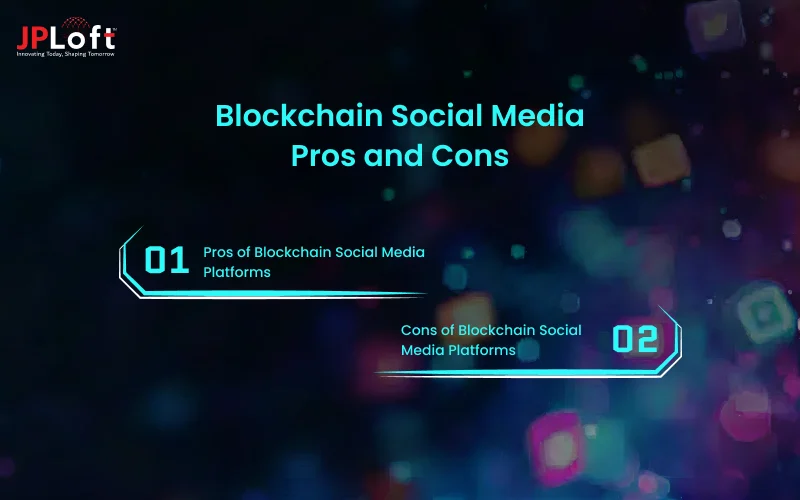
Understanding both sides helps businesses make informed development decisions.
► Pros of Blockchain Social Media Platforms
Blockchain-powered social platforms offer several standout advantages that enhance security, transparency, and user control.
1. True Data Ownership
One of the biggest benefits of blockchain in social media apps is that users fully own and control their data.
Content is stored on a decentralized ledger, preventing unauthorized modifications and giving users more freedom over what they share.
2. High Transparency and Security
Blockchain-based systems record every activity immutably, reducing the chances of data tampering and security breaches.
This level of transparency is why businesses compare these platforms with modern alternatives, similar to evolving choices like the cost to develop an app like Instagram for custom solutions.
3. Fair Monetization for Users and Creators
Creators can earn through token-based rewards, crypto tipping, and NFTs.
This model gives them more direct income control, aligning with the growing interest in how social media apps make money without relying purely on ads.
4. Resistant to Centralized Censorship
With decentralized governance, users participate in voting and policymaking.
This ensures fair moderation and reduces the risk of biased control from a single authority.
► Cons of Blockchain Social Media Platforms
Despite their benefits, blockchain-based social platforms also come with certain limitations that businesses and users should be aware of.
1. Scalability Challenges
Handling millions of posts, images, and interactions per second requires high network efficiency.
Blockchain networks sometimes face slow transaction speeds, similar to concerns highlighted in social media app development trends, especially for high-performance apps.
2. Complex User Onboarding
Users unfamiliar with wallets, tokens, or private keys may find decentralized platforms confusing at first.
This learning curve can affect mainstream adoption.
3. Limited Mass Adoption (Currently)
Blockchain-based social platforms are still emerging.
They compete with established centralized networks, and many users stick to familiar options like Snapchat alternatives until decentralized tools become more widely adopted.
4. Higher Initial Development Costs
Building a blockchain-based platform often requires specialized expertise, smart contract development, and node infrastructure, all of which add to the total development cost.
However, these investments create long-term operational advantages.

Key Features That Differentiate Blockchain-Based Social Platforms
Blockchain-powered social platforms stand out because they’re built on transparent, user-first foundations rather than centralized control.
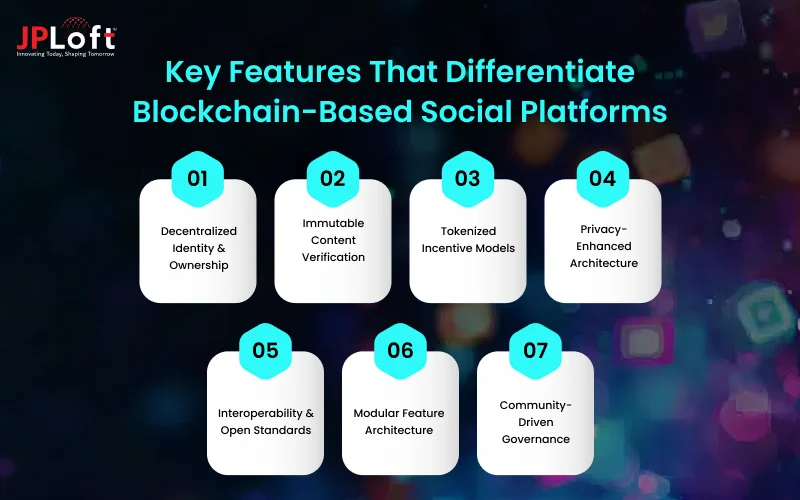
Below are the core social media app features that define how decentralized apps function, giving founders, developers, and decision-makers a clear understanding of what sets them apart.
1. Decentralized Identity & Ownership
Blockchain-based identity gives users full ownership of their accounts, data, and interactions.
This eliminates central control, enabling founders to build platforms with user-first transparency and autonomy.
2. Immutable Content Verification
Every post or edit can be timestamped immutably, locking authenticity into the chain.
This is crucial when businesses aim to make a blockchain-based social media app that prioritizes trust, verifiable history, and transparent moderation, core expectations in today’s digital environment.
3. Tokenized Incentive Models
Token rewards, micro-transactions, and NFT-based monetization open new earning paths for creators.
This directly supports the evolving role of blockchain in social media apps, where communities reward meaningful contributions without relying solely on ads.
4. Privacy-Enhanced Architecture
Hybrid on-chain and off-chain data handling enables end-to-end encryption, selective disclosure, and user-permissioned access.
This gives teams clarity on how to design a social media app that safeguards sensitive information while maintaining transparency where needed.
5. Interoperability & Open Standards
Cross-chain communication, universal APIs, and wallet-based identity allow users to move reputation, assets, and data across platforms.
This flexibility is valuable for entrepreneurs exploring how to start a social media business without building every component from scratch, leveraging existing Web3 infrastructure.
6. Modular Feature Architecture
Developers can integrate blockchain in layers, identity, incentives, and governance, without overhauling the entire product.
Starting with core functionalities and expanding progressively allows faster launch, smoother testing cycles, and better scalability.
7. Community-Driven Governance
DAO-powered voting lets users influence platform policies, content rules, and feature roadmaps.
This distributed control increases trust and makes communities feel genuinely represented, something traditional platforms often struggle to deliver.
What’s the Cost to Create a Blockchain-Based Social Media App?
Creating a blockchain-based social media app can vary widely in cost depending on features, platform, and blockchain complexity.
So, what’s the cost to develop a blockchain-based social media app? On average, the cost to develop a blockchain-based social media app ranges between $20,000 and $90,000.
Factors such as smart contract integration, decentralized storage, and token-based monetization increase complexity and influence pricing.
Smaller MVPs with essential functionalities, like profiles, posting, and basic token rewards, cost less, while fully-featured platforms with advanced governance, NFT support, and cross-platform compatibility are at the higher end.
Security is crucial; robust social media app security measures help protect user data and maintain platform reliability over time.
Estimated Cost Breakdown
|
Feature/Module |
Estimated Cost ($) |
|
User Profiles & Core Functions |
5,000–15,000 |
|
Blockchain Integration & Tokens |
10,000–30,000 |
|
Governance & Voting Mechanisms |
5,000–15,000 |
|
Security & Maintenance |
5,000–15,000 |
|
NFT / Reward Systems |
5,000–15,000 |
A clear roadmap and lean MVP can help manage costs efficiently.
Factors Impacting the Cost to Make a Blockchain-Based Social Media App
Understanding the cost drivers helps businesses plan budgets efficiently.
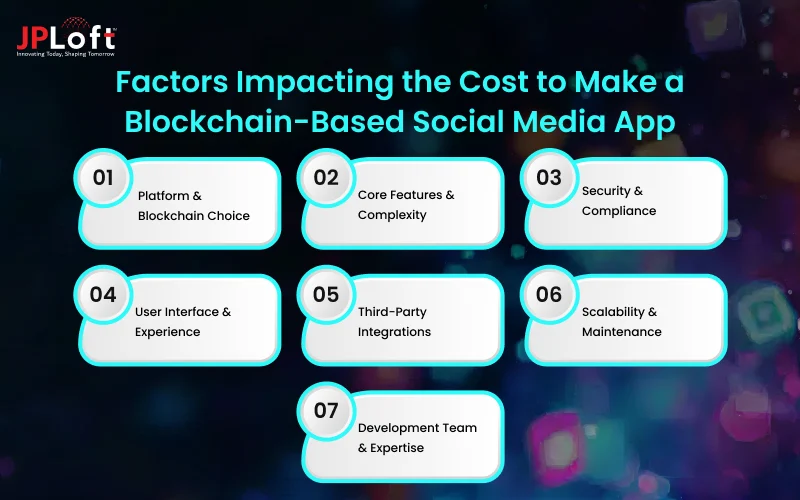
Here are the key factors affecting the cost to make a blockchain-based social media app:
1. Platform & Blockchain Choice
The blockchain protocol (Ethereum, Solana, Polygon, etc.) affects speed, scalability, and fees.
Selecting the right platform impacts the cost to create a blockchain-based social media app and overall maintenance.
2. Core Features & Complexity
Essential functionalities like profiles, posting, token rewards, governance, and NFT integration determine development effort.
More advanced features increase both time and budget.
3. Security & Compliance
Robust encryption, smart contract audits, and data privacy compliance are critical.
Platforms that prioritize social media app testing and secure coding practices reduce risks but add to costs.
4. User Interface & Experience
Custom UI/UX, intuitive navigation, and cross-platform compatibility require specialized design resources.
High-quality interfaces improve adoption but slightly increase the cost to build a blockchain-based social media app.
5. Third-Party Integrations
Integrating messaging, analytics, wallet services, or APIs, like a messenger app like Botim or social sharing modules, affects cost depending on complexity.
Careful selection and optimization of these integrations also influence the cost to develop a blockchain-based social media app and the platform’s overall performance and reliability.
6. Scalability & Maintenance
Decentralized apps need ongoing network optimization, especially when you're exploring how to develop an app like Threads with scalable performance.
Node infrastructure and maintenance influence the cost to develop a blockchain-based social media app in the long term.
7. Development Team & Expertise
Experienced blockchain developers, smart contract engineers, and designers command higher rates.
Team location and skill set significantly affect the total cost to make a blockchain-based social media app.
Estimated Cost Breakdown
|
Feature/Module |
Estimated Cost ($) |
|
Core Features & UI/UX |
10,000–25,000 |
|
Blockchain Integration & Tokens |
15,000–30,000 |
|
Smart Contract Development & Audits |
5,000–15,000 |
|
Security & Testing |
5,000–10,000 |
|
Third-Party Integrations |
3,000–8,000 |
|
Maintenance & Scalability |
5,000–10,000 |
Practices to Reduce the Cost to Create a Blockchain-Based Social Media App
Startups and enterprises aiming to optimize budgets often ask, “How to Create a Blockchain-Based Social Media App?” efficiently.
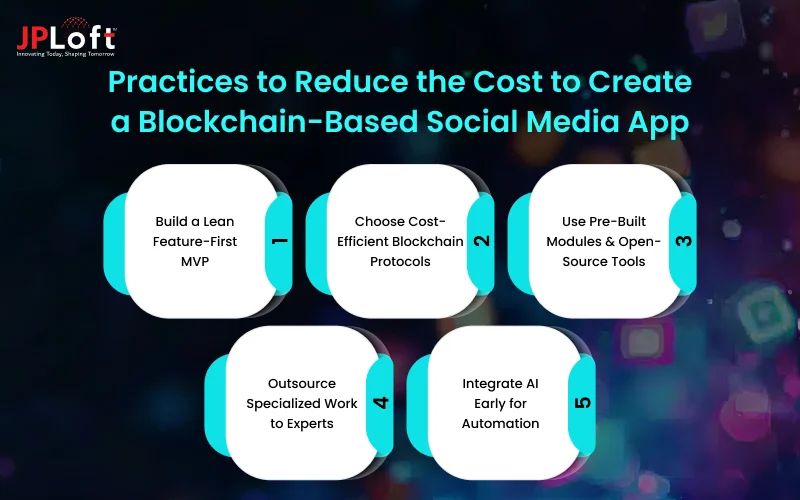
Here are practical ways to reduce cost without compromising quality.
► Build a Lean Feature-First MVP
Start with core features such as profiles, posting, and wallet-based login.
A focused MVP lowers the initial cost to develop a blockchain-based social media app while allowing real user feedback before scaling.
This is especially helpful when founders also plan to develop a messaging app later in the roadmap.
► Choose Cost-Efficient Blockchain Protocols
Opt for chains with low gas fees and strong developer ecosystems.
Platforms like Polygon and Solana reduce ongoing operational expenses while maintaining performance.
This helps control long-term scaling costs.
► Use Pre-Built Modules & Open-Source Tools
Wallets, analytics, moderation tools, and chat modules can be integrated without reinventing the wheel.
It also accelerates development, keeping budgets in check and enabling faster iterations for iOS compliance and getting your social media app approved on the iOS store easily.
► Outsource Specialized Work to Experts
Hiring specialized blockchain teams reduces rework, eliminates technical debt, and shortens development cycles.
This approach is effective when planning advanced capabilities like token rewards or exploring future add-ons similar to the cost to build an app like BeReal.
► Integrate AI Early for Automation
Using AI in social media helps automate moderation, personalization, and fraud detection, reducing manual workload and operational costs.
AI-led efficiency helps teams keep feature updates lean and scalable.
How to Monetize a Blockchain-Based Social Media App?
Monetization in decentralized platforms is evolving quickly, and the right approach can significantly offset the cost to build a blockchain-based social media app while improving long-term sustainability.
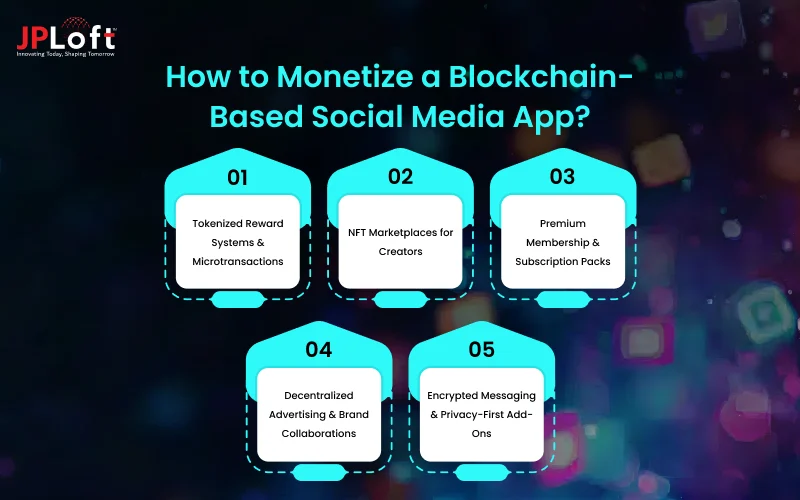
Here are the most effective social media app monetization models founders can apply.
1] Tokenized Reward Systems & Microtransactions
Platforms can introduce tokens that users earn for contributions, engagement, or moderation. These tokens can be used for premium features, tipping creators, or unlocking tools.
Strong token utility helps reduce the overall cost to develop a blockchain-based social media app over time by generating recurring revenue.
2] NFT Marketplaces for Creators
Creators can mint, sell, or auction NFTs representing posts, art, collectibles, or exclusive content.
This model attracts artists and influencers exploring Pinterest alternatives, giving them new monetization pathways within a decentralized ecosystem.
3] Premium Membership & Subscription Packs
Ad-free experiences, advanced analytics, or exclusive communities can be offered as paid tiers.
These models work especially well when paired with a scalable social media app tech stack that supports secure user flows, premium content delivery, and recurring billing.
4] Decentralized Advertising & Brand Collaborations
Blockchain allows transparent, user-driven ad participation.
Users can earn tokens for choosing to view ads, while brands benefit from better targeting.
This model is ideal for businesses studying the cost to develop an app like Quora and aiming to replicate community-driven engagement.
5] Encrypted Messaging & Privacy-First Add-Ons
Privacy-oriented users can pay for secure messaging upgrades or exclusive encryption features.
This approach is valuable for platforms looking to build trust and improve user retention, similar to what teams follow when exploring how to create an app like Signal for privacy-centric communication.
Top Blockchain-Based Social Media Networks
Below are some of the most popular blockchain-based social media networks shaping the future of decentralized content, creator ownership, and user governance.
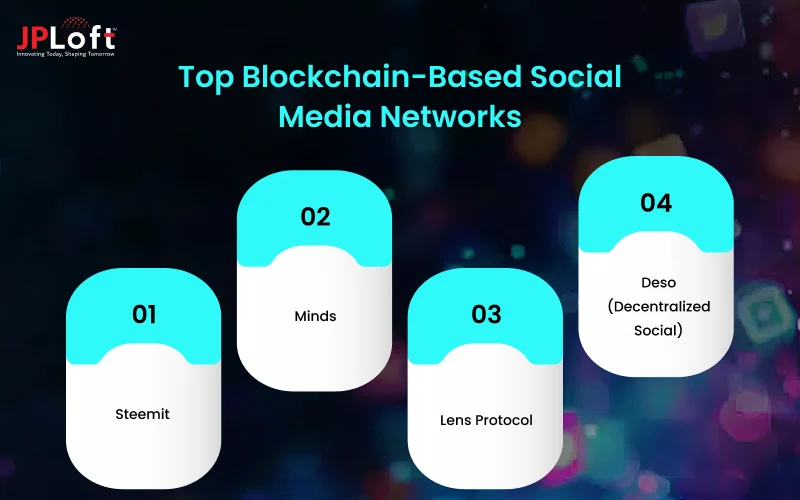
1. Steemit
A pioneering blockchain social platform where users earn rewards for publishing and curating content.
Its token-based model offers insights for creators and brands exploring how to make an app like Facebook with decentralized incentives.
2. Minds
A privacy-focused social network powered by Ethereum.
Users can boost posts, support creators, and earn tokens through engagement.
It’s an ideal reference for founders comparing community-driven models and exploring transparency-focused social platforms.
3. Lens Protocol
A Web3-native social graph enabling modular and portable profiles.
Developers can build apps on top of Lens, similar to how they may research the cost to develop an app like TikTok but with decentralized customization.
4. Deso (Decentralized Social)
A blockchain dedicated entirely to social media apps.
It allows tokenized creator economies, NFT posts, and scalable interactions, making it useful for teams planning high-engagement platforms with Web3 foundations.
Challenges in Building a Blockchain-Based Social Media App
Building decentralized platforms comes with unique technical and operational hurdles.
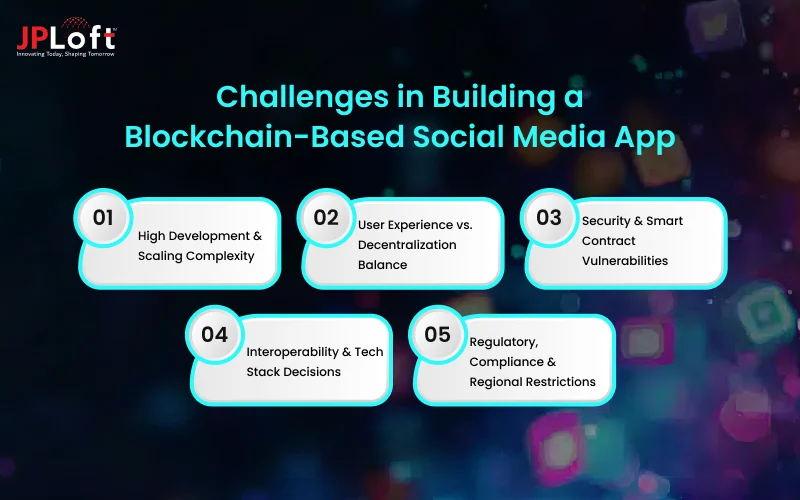
Anyone aiming to build a blockchain-based social media app in 2026 must be aware of common social media app development challenges to plan effectively and ensure a smooth launch.
Challenge 1: High Development & Scaling Complexity
Implementing blockchain in social media apps requires handling smart contracts, tokenomics, wallets, and consensus mechanisms.
These layers make scaling harder than traditional architectures and directly influence the cost to develop a blockchain-based social media app for mid- to large-scale platforms.
Challenge 2: User Experience vs. Decentralization Balance
Features like wallet onboarding, private key handling, and transaction confirmations can overwhelm non-technical users.
Founders must simplify UX flows, similar to how teams plan to create a mobile app with an intuitive learning curve.
Challenge 3: Security & Smart Contract Vulnerabilities
Blockchain reduces centralized risks but introduces smart contract exposure.
Audits, bug prevention, and data protection require strong engineering expertise, just as teams focus on how to design a mobile app with multi-layered security.
Challenge 4: Interoperability & Tech Stack Decisions
Choosing the right chain, nodes, APIs, storage, and identity frameworks demands careful planning.
Mixing on-chain and off-chain components to build a reliable mobile app tech stack adds complexity for Web3-first products.
Challenge 5: Regulatory, Compliance & Regional Restrictions
Data policies, token regulations, and jurisdiction-based compliance can slow down deployment.
Businesses expanding internationally often collaborate with experts, such as a mobile app development company in the UK, to navigate evolving global standards.
Partner with JPLoft and Create Your Blockchain-Based Social Media App
Building a secure, scalable, and future-ready blockchain social platform becomes far easier when you partner with JPLoft, a trusted social media app development company known for delivering high-performance digital products.
Our team brings deep expertise in blockchain, smart contracts, decentralized storage, tokenization, AI-driven personalization, and community-first UX design, ensuring your platform stands out in a competitive landscape.
From product strategy and feature planning to full-stack development and launch support, we help you move from idea to market seamlessly.
If you're ready to build a next-gen social network that prioritizes privacy, ownership, and transparency, JPLoft is your ideal development partner.
Conclusion
Blockchain-based social media is reshaping how users interact, share content, and protect their digital identity.
As more innovators explore blockchain social media platforms, the demand for transparency, security, and user ownership continues to rise.
These blockchain-based social media networks are not just trending, they’re becoming the foundation of a new, decentralized digital ecosystem.
Whether your goal is enhanced privacy, tokenized rewards, or censorship-resistant communities, blockchain offers the ideal backbone for next-gen experiences.
By understanding the technologies, challenges, and opportunities involved, businesses can confidently build platforms that stand out.
Now is the perfect time to turn your vision into a powerful, future-ready blockchain social network.
FAQs
A blockchain-based social media app uses decentralized ledger technology to store data securely, ensuring transparency, user ownership, and protection from centralized control or censorship.
They encrypt user data, distribute it across nodes, and eliminate centralized servers, making it extremely difficult for unauthorized parties to modify or misuse information.
Key features include decentralized identity management, token-based rewards, end-to-end encryption, content immutability, smart contracts, and transparent community governance.
Yes. Messaging, feeds, profiles, groups, and creator tools can all be built on blockchain, often with enhanced transparency, rewards, and security.
Popular options include Ethereum, Solana, Polygon, Flow, and Avalanche. The best choice depends on transaction speed, cost, security, and ecosystem compatibility.
Yes, especially when built using Layer-2 solutions or high-throughput chains. Scalability depends on architecture choices like sidechains, sharding, and off-chain storage.

Conor has more than 10 years of experience in software development, app creation, solution engineering, and UX/UI design. With an impressive track record of high retention and growth working with Fortune 500 companies, he brings the technical depth and strategic perspective needed to help businesses build impactful, user-focused digital solutions.




Share this blog