



Key Takeaways:
Different types of apps include social networking, media sharing, messaging, live streaming, short-form video, and social commerce.
The right tech stacks to develop a social media app are Flutter, React Native, Node.js, Django, MySQL, PostgreSQL, and Docker.
Building a social media app costs between USD 30,000 and USD 150,000+, varying based on complexity, features, and scalability.
How to develop a social media app step by step starts by defining the idea, market research, designing, developing, testing, and launching.
Monetization strategies are ads, subscriptions, and social commerce, help generate consistent revenue while maintaining user engagement.
Future of social media apps will focus on personalization, community engagement, emerging technologies, and privacy.
JPLoft delivers custom social media app solutions with scalable architecture, advanced features, and user-focused design for growth.
In 2026, startups and businesses of all sizes are entering the social media space to connect users, build communities, and drive engagement. Having a social media app now is not just limited to big tech companies.
The hype of social media apps among youth easily captures the market with a strategic design. It can create real-time interactions, support user-generated content, and open new revenue streams.
However, to build a social media app, you require more than a great idea. You need the right features, a scalable architecture, and a clear understanding of user behavior. From choosing the right tech stack to ensuring data security and smooth performance, every step plays a key role.
In this social media app development guide, we will walk you through the complete process. It will help you understand the essential features, development stages, costs, and strategies for launching a competitive, user-friendly platform.
What Is a Social Media App and How Does It Work?
A social media app is a digital platform that allows users to create, share, and interact with content in real time. These apps help users connect through content and interactions while using technology to deliver a seamless and personalized experience.
Popular platforms like Facebook, Instagram, and X are common examples that show how users engage through posts, messages, and media sharing.
How Does a Social Media App Work?
A social media app works through a combination of frontend and backend technologies that manage user interactions:
-
User Registration and Profiles: Users sign up and create profiles with personal details, profile pictures, and preferences.
-
Content Creation and Sharing: Users can post text, images, or videos. The app stores and displays this content for others to view.
-
News Feed Algorithm: The app uses algorithms to show relevant content based on user behavior, interests, and engagement patterns.
-
Interaction Features: Users can like, comment, share, or message each other, creating continuous engagement.
-
Notifications System: Real-time alerts inform users about new likes, comments, messages, or updates.
-
Backend Infrastructure: Servers handle data storage, security, and processing, ensuring smooth performance and scalability.
Recent Social Media App Market Statistics
Below, we have listed the recent market statistics of social media apps:
-
According to Blog2Social, the social media world has reached 5.66 billion social media users in 2026, that's 69% of the global population.
-
Blog2Social has found in research that eight new users join every second, and the average user spends 2 hours and 23 minutes on a social platform daily.
-
Demandsage estimated that in the United States, 93% of people (around 310 million) are active on social media.
-
Facebook remains the largest platform, with over 3 billion monthly active users, as estimated by NewMedia.
Why Invest in Developing a Social Media App in 2026?
Investing in building a social media app is a strategic business move driven by massive user adoption, evolving digital behavior, and strong monetization potential.
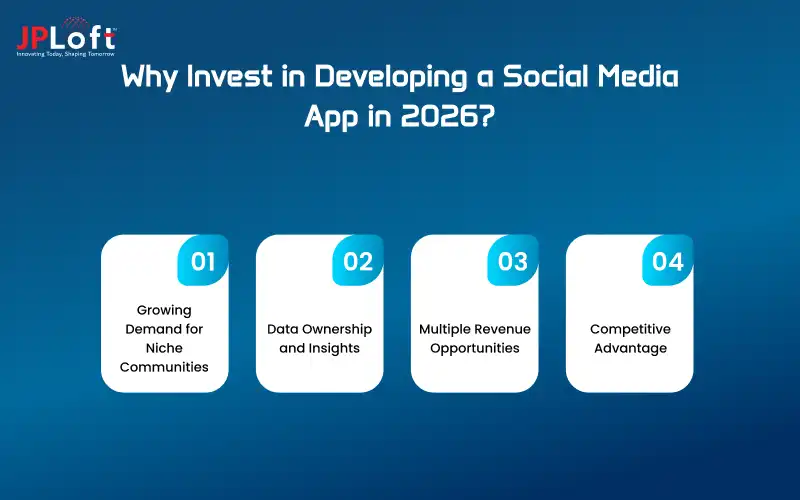
Here are the reasons to invest in how to make a social media app in 2026:
1. Growing Demand for Niche Communities
Users prefer platforms built around specific interests and communities. Investing in a niche social media app helps businesses attract targeted audiences, increase engagement, and build stronger connections with users over time.
2. Data Ownership and Insights
With your own app, you control user data and behavior insights. This helps in making better business decisions and improving marketing strategies. It helps build stronger relationships, gather feedback, and improve customer experience without relying on third-party platforms.
3. Multiple Revenue Opportunities
Another benefit to develop a social media app is that it supports diverse monetization models. Such as in-app purchases, subscriptions, and advertising. This flexibility allows businesses to generate consistent revenue while scaling their platform based on user growth.
4. Competitive Advantage
Launching a unique social media app helps businesses stand out. It creates new market opportunities and reduces dependency on existing platforms. A dedicated platform keeps users within a branded environment and increases retention through personalized experiences.
Types of Social Media Apps You Can Build
Before you explore how to create a social media app, you should know the different types of options you have. Each is designed to serve a specific purpose and audience.
Here is a table of different types of social media apps you can choose to build depending on your business requirements:
|
App Type |
Description |
Examples |
|
Social Networking Apps |
Connect users with friends, family, or professionals through profiles and interactions like posts, likes, and comments. |
Facebook, LinkedIn |
|
Media Sharing Apps |
Focus on sharing photos, videos, and visual content to drive engagement and creativity. |
|
|
Messaging Apps |
Enable real-time communication through text, voice, and video with individuals or groups. |
WhatsApp, Telegram |
|
Microblogging Platforms |
Allow users to share short updates, opinions, and trending content quickly. |
X (initially Twitter) |
|
Community & Forum Apps |
Built around discussions, questions, and shared interests within groups or communities. |
|
|
Live Streaming Apps |
Allow users to broadcast real-time video content for entertainment or engagement. |
Twitch, YouTube Live |
|
Short Video Apps |
Focus on quick, engaging, and trend-driven short-form video content. |
|
|
Social Commerce Apps |
Combine social interaction with online shopping and product discovery. |
Pinterest, Instagram |
|
Audio-Based Social Apps |
Focus on voice chats, live audio rooms, and discussions for interactive experiences. |
This will help you make an easier comparison of different social media app types and choose the one that best fits your business idea and target audience.

Must-Have Features of a Social Media App
While we know how to build a social media app, we need a robust set of features to keep users engaged, connected, and active. The right social media app features improve user experience and support scalability and monetization.
Below, we have provided a table for the important features you must consider when you begin with how to create a social media app:
|
Component |
Feature |
Description |
|
User Management |
User Registration & Login |
Allows users to sign up using email, phone, or social accounts for easy access. |
|
User Profiles |
Enables users to create and manage personal profiles with bio, image, and info. |
|
|
Content Management |
Create & Share Content |
Users can post text, images, videos, and other media formats. |
|
Content Feed |
Displays personalized content based on user interests and activity. |
|
|
Media Upload |
Supports uploading photos, videos, and other multimedia content. |
|
|
Interaction Features |
Likes & Reactions |
Allows users to engage with content through likes or other reactions. |
|
Comments |
Users can comment on posts to start conversations. |
|
|
Share/Retweet |
Enables users to share content with their network easily. |
|
|
Communication |
Real-Time Messaging |
Supports one-on-one and group chats with instant delivery. |
|
Voice & Video Calls |
Allows users to connect through audio and video communication. |
|
|
Notifications |
Push Notifications |
Sends real-time alerts for likes, comments, messages, and updates. |
|
In-App Notifications |
Displays activity updates within the app interface. |
|
|
Discovery |
Search Functionality |
Helps users find people, content, hashtags, and groups. |
|
Hashtags & Trends |
Organizes content and highlights trending topics. |
|
|
Security & Privacy |
Data Privacy Controls |
Gives users control over who can view their content and profile. |
|
Authentication & Security |
Ensures secure logins with features such as OTP and two-factor authentication. |
|
|
Performance |
Scalable Backend |
Supports growing users and data without affecting app performance. |
|
Fast Load Time |
Ensures smooth browsing and quick content loading. |
|
|
Monetization |
Ads Integration |
Allows businesses to run targeted advertisements within the app. |
|
Subscription Plans |
Offers premium features through paid memberships. |
These features help how to develop a social media app with the best user experience and seamless business scalability.
Step-by-Step Social Media App Development Process
Steps for how to make a social media app require a strategic approach to ensure long-term success. By following a structured process, businesses can create a scalable, user-friendly, and competitive platform.
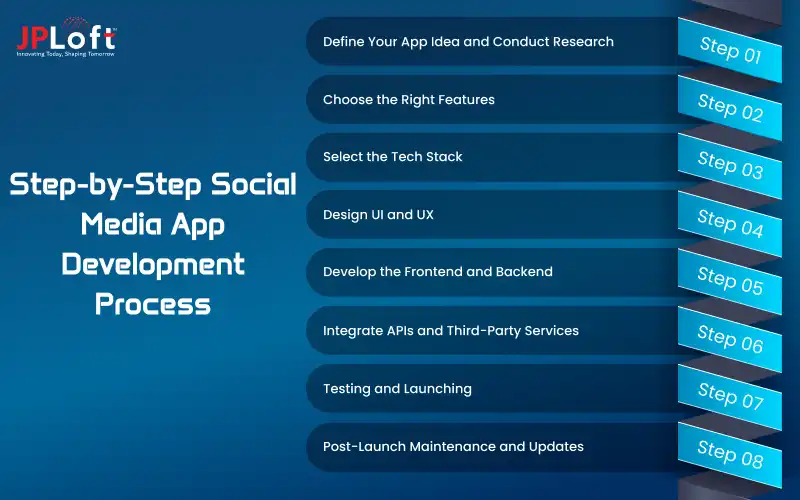
Let's now look at how to develop a social media app step by step:
Step 1: Define Your App Idea and Conduct Research
Start by identifying the purpose and target audience of your social media app idea. Set clear goals to help you shape features, user flow, and monetization strategy. Define your unique value proposition and long-term vision to guide future growth.
Analyze the best social media apps like Instagram and TikTok to understand what works. It helps you make informed business decisions.
Step 2: Choose the Right Features
List the core and advanced features that your app will offer. Start with essential features like user profiles, content sharing, messaging, and notifications. Avoid adding too many features in the beginning.
Focus on a Minimum Viable Product to test your idea quickly. Prioritize features based on user needs and business goals to ensure efficient development and faster time to market.
Step 3: Select the Tech Stack
Choose technologies that support performance and scalability. Decide on frontend frameworks, backend systems, databases, and cloud services. The best tech stack for social media app ensures smooth functionality and prepares your app for future growth.
Make sure the selected technologies align with your teams’ expertise and support long-term maintenance, upgrades, and integrations without major challenges.
Step 4: Design UI and UX
Create wireframes and prototypes to visualize your app layout. Focus on simple navigation, clean design, and engaging user experience. A strategic social media app design interface improves user retention and makes your app easy to use.
Conduct user testing on designs when working on how to create a social networking app from scratch early. This identifies usability issues and refines the interface before moving into the development phase.
Step 5: Develop the Frontend and Backend
Start the development process by building the frontend and backend simultaneously while keeping track of the latest social media app trends. The frontend handles user interactions, while the backend manages data, authentication, and server logic.
Ensure a seamless performance by integrating both parts effectively. Use agile development practices to improve collaboration, track progress, and adapt quickly to changes and improvements throughout development.
Step 6: Integrate APIs and Third-Party Services
Add APIs for features like payment gateways, social login, analytics, and notifications. As when build custom social media app, it relies heavily on real-time interactions. Use technologies like WebSockets or cloud-based services to enable instant messaging, live updates, and notifications.
Optimize these features to handle high traffic efficiently without delays. This ensures a smooth user experience even during peak usage and high engagement scenarios.
Step 7: Testing and Launching
Test your app thoroughly to identify bugs and performance issues. Conduct functional testing, usability testing, and social media app security checks. Regular testing also helps maintain code quality and ensures your app delivers a reliable and consistent user experience at all times.
Get your social media app approved on the iOS Store and Google Play Store before the launch. Make sure your app meets all guidelines and is optimized for performance.
Step 8: Post-Launch Maintenance and Updates
Post-launch, continuously monitor app performance and user feedback. Fix bugs, improve features, and release updates regularly. Ongoing social media app maintenance ensures you stay aligned with changing user expectations and trends.
Plan your scaling strategy carefully to manage infrastructure, trends, optimize costs, and maintain a high-quality user experience as your platform grows.
Tech Stack Required to Build a Social Media App
The best tech stack for social media app ensures it can handle high traffic, deliver real-time experiences, and scale as your user base grows. The right tech stack will help with development speed, user experience, and long-term growth.
Here is a breakdown of the key technologies required for how to build a social media app:
|
Component |
Technology/Tools |
Description |
|
Frontend |
Flutter, React Native |
Helps develop cross-platform mobile apps with a native-like experience. |
|
Backend |
Node.js, Django, Ruby on Rails |
Handles server logic, APIs, authentication, and data processing. |
|
API Layer |
REST APIs, GraphQL |
Enables smooth communication between frontend and backend systems. |
|
Database |
PostgreSQL, MySQL, MongoDB |
Stores structured data like user profiles and transactions. |
|
Cloud & Hosting |
Amazon Web Services, Google Cloud Platform, Microsoft Azure |
Provides scalable infrastructure, storage, and computing power. |
|
Real-Time Technologies |
WebSocket, Firebase |
Enables live messaging, notifications, and instant updates. |
|
Media Storage & CDN |
Amazon S3, Cloudflare |
Stores and delivers images and videos with high speed and reliability. |
|
Security & Authentication |
OAuth, JWT |
Ensures secure login, access control, and data protection. |
|
Analytics & Monitoring |
Google Analytics, Mixpanel |
Tracks user behavior, engagement, and app performance. |
|
DevOps & CI/CD |
Docker, Kubernetes |
Automates deployment, scaling, and application management. |
These social media app tech stack can help you build a robust, scalable, and feature-rich social media app effectively.
Cost to Develop a Social Media App
The development cost in 2026 for a social media app ranges between USD 30,000 to USD 150,000+. The development cost of social media depends on the features, complexity, and scalability requirements. A simple MVP costs much less than a full-featured platform with real-time interactions, AI, and media processing.
Cost Breakdown by Development Stage
Below is a detailed total cost breakdown with the timeline that will help you plan efficiently:
|
Development Stage |
Estimated Cost Range (in USD) |
Estimated Duration |
|
Planning & Research |
$5,000 – $15,000 |
2 – 4 weeks |
|
UI/UX Design |
$8,000 – $20,000 |
3 – 6 weeks |
|
Frontend Development |
$10,000 – $50,000 |
6 – 16 weeks |
|
Backend Development |
$15,000 – $100,000 |
8 – 20 weeks |
|
Testing & QA |
$5,000 – $30,000 |
3 – 6 weeks |
|
Deployment & Launch |
$3,000 – $10,000 |
1 – 2 weeks |
These estimates for cost and time align with industry benchmarks but can exceed them depending on complexity.
Social Media App Development Cost Based on Complexity
The cost varies widely depending on the complexity of features implemented in your social media app.
1. Basic MVP:
-
Features: User profiles, basic feed, simple posting, limited interactions
-
Development Time: 3 to 5 months
-
Estimated Cost in USD: $30,000 – $50,000
2. Mid-Level App:
-
Features: Media sharing, push notifications, basic chat, improved UI/UX
-
Development Time: 5 to 9 months
-
Estimated Cost in USD: $60,000 – $100,000
3. Advanced App:
-
Features: Real-time messaging, live streaming, scalable backend, advanced features
-
Development Time: 8 to 12+ months
-
Estimated Cost in USD: $100,000 – $150,000+

Social Media App Monetization Strategies
Monetizing comes next after we know how to build a social media app. It requires a clear strategy that aligns with your user experience and business goals. A well-balanced social media app monetization strategy ensures steady revenue while maintaining a seamless and engaging user experience.
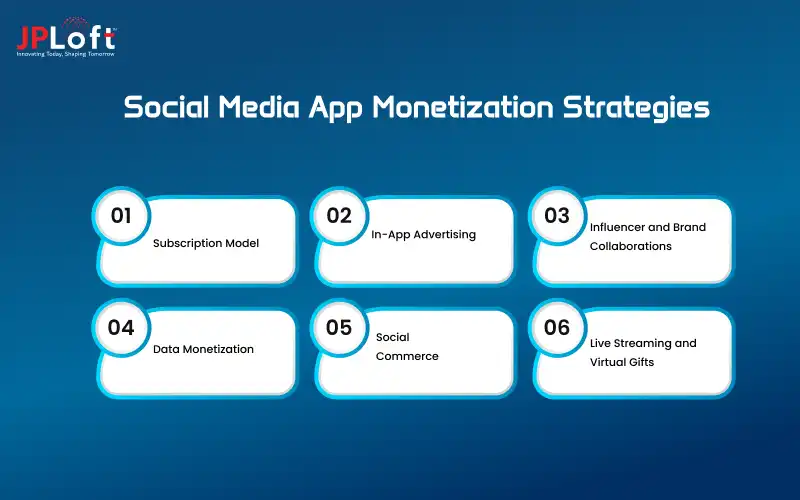
Let's look at successful monetization strategies for social media apps:
1. Subscription Model
Offer premium features through paid plans. Users pay monthly or yearly to access exclusive content, an ad-free experience, or advanced tools.
Revenue Source: Recurring subscription fees.
2. In-App Advertising
Build a social media platform that displays ads to monetize user traffic. Businesses pay to show ads in feeds, stories, or videos.
Revenue Source: Cost per click (CPC), cost per impression (CPM), and sponsored posts.
3. Influencer and Brand Collaborations
Partner with influencers and brands for promotions. Brands pay to promote their products through creators on your platform.
Revenue Source: Sponsored content and collaboration fees.
4. Data Monetization
Use user insights to create business value. Provide anonymized data insights to businesses for targeted marketing.
Revenue Source: Data analytics services and partnerships.
5. Social Commerce
Integrate shopping features when you build custom social media app. Users can discover and purchase products without leaving the platform.
Revenue Source: Commission on sales and listing fees.
6. Live Streaming and Virtual Gifts
Monetize real-time content through audience engagement. Users send paid virtual gifts during live streams to creators.
Revenue Source: Commission on virtual gifts and live event access.
Challenges in Building a Social Media App
The process to create a social media app comes with several technical and business challenges. From handling user data to ensuring smooth performance, each social media app development challenge requires smart planning and the right solutions.
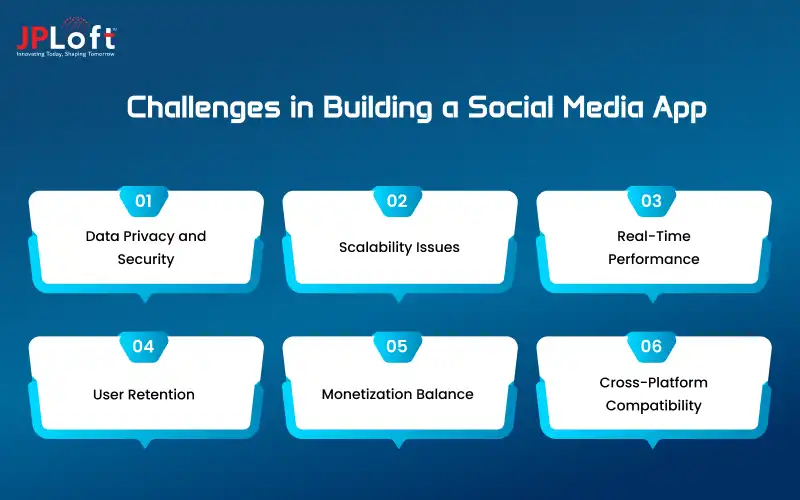
Here are the key challenges you might face while working on how to develop a social media app:
Challenge 1: Data Privacy and Security
Protecting user data is difficult due to increasing cyber threats, data breaches, and strict privacy regulations that require constant monitoring and advanced security implementation.
Solution: Implement strong encryption, secure authentication, regular audits, and compliance with global data protection standards to ensure user data safety and trust.
Challenge 2: Scalability Issues
Handling rapid user growth and high traffic loads after you develop a social media app can impact app performance. This causes slow response times, crashes, and a poor user experience during peak usage.
Solution: Use cloud infrastructure, scalable architecture, load balancing, and efficient database management to handle increasing traffic smoothly without affecting performance.
Challenge 3: Real-Time Performance
Delivering real-time messaging, notifications, and content updates without delays is complex, especially when millions of users interact simultaneously across different regions and devices.
Solution: Use WebSockets, optimized backend systems, and content delivery networks to ensure instant communication and seamless real-time user interactions.
Challenge 4: User Retention
Keeping users engaged over time is challenging due to high competition and changing preferences. Lack of unique features that encourage consistent interaction and loyalty, resulting in the failure of social media app.
Solution: Focus on personalized content, engaging features, regular updates, and gamification techniques to improve user retention and long-term platform engagement.
Challenge 5: Monetization Balance
Generating revenue without affecting user experience is challenging after you build custom social media app. Excessive ads or paid features can reduce engagement and drive users away from the platform.
Solution: Use balanced monetization strategies like native ads, freemium models, and user-friendly subscriptions that do not disrupt the overall experience.
Challenge 6: Cross-Platform Compatibility
Ensuring consistent performance across different devices, operating systems, and screen sizes is complex, requiring extensive testing and optimization for a seamless user experience.
Solution: Use cross-platform frameworks, responsive design, and thorough testing to deliver a consistent and smooth experience across all devices and platforms.
Future of Social Media Apps: What to Expect Next
The future of how to create a social media app is evolving rapidly, driven by changing user behavior, advanced technologies, and stricter regulations. Businesses that adapt to personalization, community, commerce, and trust will be better positioned to scale in the upcoming years.
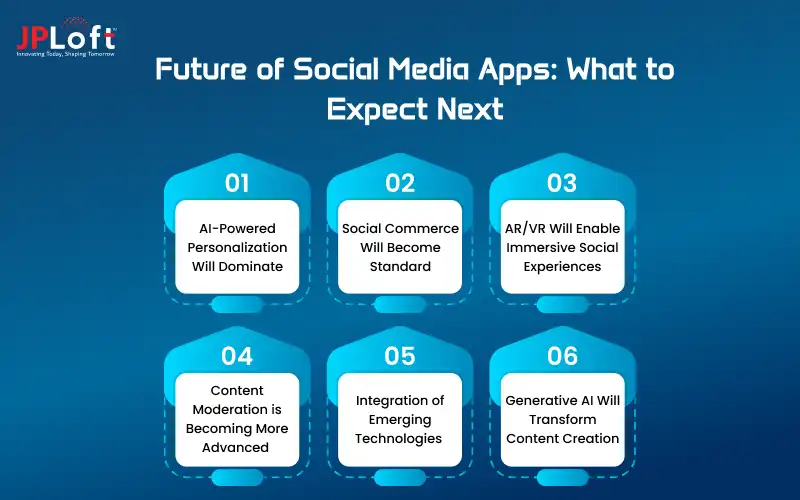
1. AI-Powered Personalization Will Dominate
AI in social media will play a central role in content creation, recommendations, and user engagement. Platforms will deliver highly personalized feeds and even generate content automatically, making experiences more tailored and efficient.
2. Social Commerce Will Become Standard
Build a social media app that will integrate shopping features directly into platforms. Users can discover, review, and purchase products without leaving the app, creating seamless buying experiences and new revenue opportunities.
3. AR/VR Will Enable Immersive Social Experiences
AR/VR in social media apps will take interaction beyond screens. Users will engage in immersive environments, attend virtual events, and interact through digital avatars. AR/VR will also enhance storytelling, product experiences, and real-time engagement, creating more interactive and engaging social platforms.
4. Content Moderation is Becoming More Advanced
Content moderation in social media apps will evolve to handle complex challenges like misinformation, deepfakes, and harmful content across formats. Real-time moderation will detect context, tone, and intent more accurately, while human moderation will still play a key role in sensitive decisions.
5. Integration of Emerging Technologies
Technologies like augmented reality, virtual reality, and AI assistants will enhance user experiences. If you build a social media platform with such technologies, it will become more interactive, immersive, and engaging, offering users innovative ways to connect.
6. Generative AI Will Transform Content Creation
Generative AI in social media apps will reshape how content is created and consumed on social media. Users will rely on AI to generate text, images, and videos instantly, improving speed and creativity. This type of content is already dominating feeds, raising both efficiency and concerns around authenticity and trust.
Get Custom Solutions for Social Media Platform with JPLoft
Building a successful social media platform requires more than just coding. It demands the right strategy, scalable architecture, and a user-focused approach. That’s where JPLoft, an experienced social media app development company, can help you turn your idea into a powerful digital product.
JPLoft offers end-to-end app development solutions tailored to your business needs. Our team handles every stage, from initial idea validation to final deployment, with precision and clarity. We focus on constructing apps that are fast, secure, and capable of scaling as your user base expands.
Our experts specialize to create a social media app with advanced functionalities like real-time chat, content feeds, media sharing, and monetization tools. We also integrate the latest technologies to enhance user experience and keep your platform competitive in a dynamic market.
With a strong focus on UI and UX, JPLoft delivers engaging and intuitive designs that drive user retention. Whether you are launching a niche community app or a large-scale social platform, we provide custom solutions that align with your goals and budget.
Partner with JPLoft to build a reliable, future-ready social media platform that stands out and delivers long-term value.
Conclusion
A social media app development guide comes with a clear strategy, the right technology, and a strong understanding of user expectations. From choosing the right app type to selecting a scalable tech stack, every decision plays a key role in long-term success.
Focusing on essential features, smooth performance, and data security helps create a reliable and engaging platform. At the same time, planning the budget for building a social media app and selecting the right monetization strategies ensures sustainable growth.
With the right approach and tools, we can manage challenges like scalability, user retention, and content moderation. As the future of social media continues to shift towards personalization, community-driven experiences, and advanced technologies, businesses have a strong opportunity to innovate.
By following the right development process and trends, you can build a social media app that is competitive, delivers real value to users, and drives consistent business growth.
FAQs
To build a social media app, define your idea, research the market, choose essential features, select a scalable tech stack, and design an intuitive UI. Develop frontend and backend, integrate APIs, test thoroughly, launch on app stores, and continuously improve based on user feedback.
You can build networking apps, media sharing platforms, messaging apps, community forums, live streaming apps, and social commerce platforms. Each type targets different audiences and offers unique features to support specific engagement and business goals.
Businesses should invest to gain direct user access, build brand loyalty, and create new revenue streams. Social media apps also provide control over data, improve engagement, and reduce reliance on third-party platforms for customer interaction.
A typical tech stack includes frontend frameworks like React, backend technologies like Node.js, databases like MongoDB, and cloud platforms like AWS. It also includes tools for real-time communication, security, analytics, and performance optimization.
The future includes AI-driven personalization, niche communities, video content growth, social commerce, and stronger privacy measures. Emerging technologies like AR and VR will also enhance user experience and make platforms more interactive and immersive.

Conor has 10+ years of experience in software development, application engineering, solution design, and UX/UI. He has worked across digital products in restaurant technology, food and grocery delivery, healthcare, media, streaming, and social platforms, bringing both technical and user-experience perspectives to product development. His experience working with large organizations and growth-focused digital products helps businesses translate complex requirements into practical, user-focused solutions.





Share this blog