


Key Takeaways
The UK is a regulation-focused and digitally mature market, making it important to align social media apps with local user behaviour, privacy laws, and compliance requirements.
Following a structured development process helps manage costs, reduce risks, and build a scalable platform suited for long-term growth.
Prioritising usability, security, and meaningful engagement is more effective than simply replicating existing social platforms.
Building a social media app in the UK needs a structured, regulation-first approach across validation, UX, tech, development, testing, and maintenance for lasting growth.
The cost to create a social media app in the UK ranges from $20,000 to $120,000+ (£16,000 to £95,000+), depending on features, platform, and compliance requirements.
Social media apps in the UK must adopt AI, immersive features, creator monetisation, and privacy-first design to stay competitive and compliant.
Working with an experienced partner like JPLoft provides the strategic insight and technical support needed to build a reliable, future-ready social media platform for the UK.
Social media continues to shape how people in the United Kingdom connect, share content, and build online communities. With a digitally mature audience and high smartphone penetration, many startups and businesses are looking to build a social media app in the UK that reflects local user behaviour and compliance standards.
However, launching a successful platform in the UK is not just about copying existing networks. It requires a clear understanding of regulations like GDPR, user privacy expectations, and the competitive digital ecosystem. If you plan to create a social media app UK users will trust and actively use, your approach to planning, development, and scalability matters.
This guide explains how to build a social media app in the UK, covering everything from market opportunities and development steps to features, costs, and emerging technologies, helping you make informed decisions at every stage.
Why Build a Social Media App in the UK?
The UK offers a highly digital-first audience, strong startup infrastructure, and a mature app ecosystem. With users actively engaging across multiple platforms, businesses focusing on custom social media app development UK can tap into a market that values innovation, privacy, and meaningful online interactions.
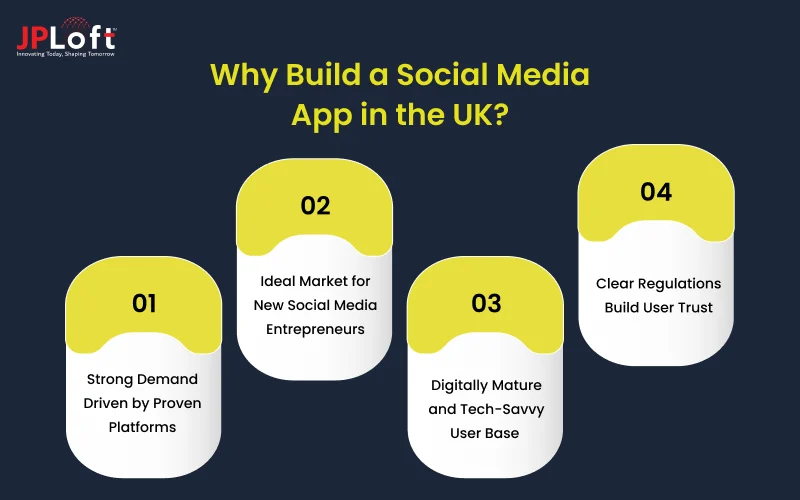
Here are four key reasons why the UK is an ideal market.
1. Strong Demand Driven by Proven Platforms
The success of the best social media apps in the UK shows a consistent demand for platforms that support community building, content sharing, and creator engagement. British users are quick to adopt new digital experiences, especially apps that solve niche problems or offer better privacy and moderation. This creates room for new platforms to grow alongside established networks.
2. Ideal Market for New Social Media Entrepreneurs
The UK is a favourable environment for founders exploring how to start a social media business. Access to accelerators, tech talent, and early-stage funding allows startups to validate ideas faster. Combined with a strong digital economy, this makes it easier to test concepts, attract early adopters, and scale a platform that resonates with UK users.
3. Digitally Mature and Tech-Savvy User Base
UK consumers are comfortable with mobile-first experiences, real-time interactions, and personalised content. This behaviour encourages businesses to create a social media app UK users find intuitive and engaging. High smartphone usage, widespread 5G adoption, and familiarity with subscription-based apps further support long-term user retention and monetisation opportunities.
4. Clear Regulations Build User Trust
Strict data protection laws, including GDPR and the UK Data Protection Act, create a transparent framework for social media app development UK. While compliance requires effort, it also builds trust among users who are increasingly concerned about privacy and data misuse. Apps that prioritise security and ethical data handling are more likely to succeed in the UK market.
With these advantages in mind, you can now explore how to create a social media app in the UK, as explained in the next section through clear and easy-to-follow steps.

Step-by-Step Process To Build a Social Media App in the UK
Building a successful platform requires a structured, regulation-first approach tailored to British users. This step-by-step framework explains how to develop a social media app in the UK from validation to launch while addressing compliance, scalability, and user experience.
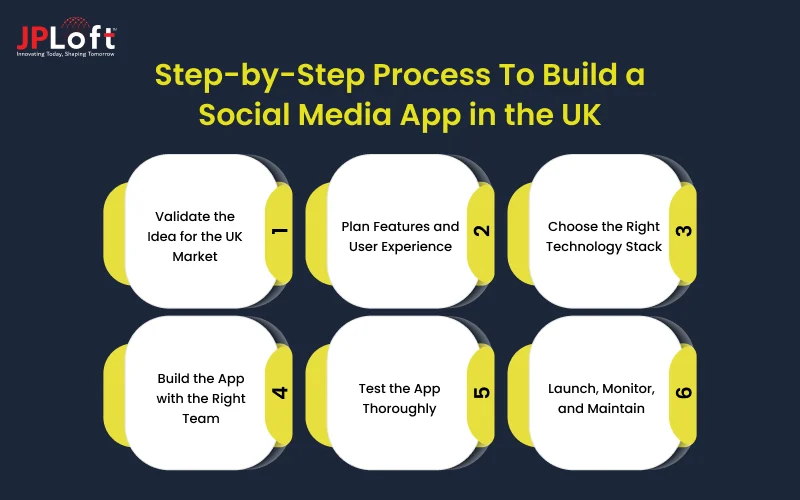
Each step reflects real-world practices followed in social media app development UK projects.
Step 1: Validate the Idea for the UK Market
Before development begins, ensure the concept solves a real problem for UK users and fits local behaviour. Following this validation process is the first critical step in how to create a social media app in the UK successfully.
► Understand UK User Behaviour
Analyse how British users interact with content, communities, and privacy controls. UK audiences prefer transparency, meaningful interactions, and platforms that avoid excessive data misuse. This insight shapes features, onboarding, and content formats.
► Define the App’s Core Value Proposition
Clarify what makes your platform different: niche communities, local networking, or creator-led engagement. This step lays the foundation for anyone researching how to create a social media app with long-term relevance.
► Assess Regulatory Feasibility
Validate compliance with GDPR and UK data protection laws early. Legal feasibility at this stage reduces rework and builds trust from day one.
Step 2: Plan Features and User Experience
A clear plan for features and UX ensures smooth user journeys, intuitive interfaces, and a focused MVP, helping teams deliver quality quickly while retaining users effectively.
► Map User Journeys
Define how users register, interact, post content, and engage with communities. Smooth journeys are essential if you want to create a social media app in the UK that retains users beyond the first week.
► Design Intuitive Interfaces
Strong UX is critical when deciding how to design a social media app for a diverse UK audience. Accessibility, simple navigation, and inclusive design principles should guide every screen.
► Prioritise MVP Features
Start with essential functionality only. A focused MVP helps you test assumptions, gather feedback, and refine the product before scaling.
Step 3: Choose the Right Technology Stack
The right technology stack ensures optimal performance, scalability, and secure, cost-effective development for long-term app growth.
► Select Frontend and Backend Technologies
Frameworks like React Native or Flutter support cross-platform efficiency, while Node.js or Django work well for scalable backends. Choosing the right social media app tech stack ensures faster development and smoother updates.
► Plan for Scalability
UK platforms often experience rapid adoption. Cloud-native architectures and modular services help manage traffic spikes and feature expansion.
► Ensure Data Security
Encryption, secure APIs, and role-based access control are essential for protecting user data and meeting UK compliance standards.
Step 4: Build the App with the Right Team
Execution quality depends on the expertise behind the build. Partnering with experienced social media developers UK ensures compliance, scalability, and a reliable user experience.
► Assemble a Skilled Development Team
You may need dedicated social media app developers UK for frontend, backend, DevOps, and compliance. Many UK-focused startups choose to hire iOS developers due to the strong iPhone user base.
► Collaborate with Local Experts
Working with a mobile app development company in UK helps navigate regulations, timelines, and local user expectations more effectively.
► Follow Agile Development
Iterative development allows faster feedback loops and better alignment with evolving business goals.
Step 5: Test the App Thoroughly
Thorough mobile app testing ensures your app is reliable, secure, and delivers a seamless user experience, identifying issues early to prevent problems before the public launch.
► Functional and Performance Testing
Validate every feature under real-world conditions. Referring to a structured social media app testing process helps teams identify bugs, crashes, and usability gaps early, ensuring a smoother user experience before launch.
► Security and Compliance Testing
Penetration testing and compliance audits ensure the app meets UK data protection and privacy standards.
► User Acceptance Testing
Real users provide insights into navigation issues, feature clarity, and overall experience, critical before scaling.
Step 6: Launch, Monitor, and Maintain
Post-launch activities ensure your app runs smoothly, meets user expectations, and stays secure, scalable, and engaging over time.
► Plan a Phased UK Launch
Start with a controlled release to monitor performance and user feedback. This approach reduces risk and improves stability.
► Monitor Analytics and Engagement
Track retention, session length, and feature usage to refine the product continuously.
► Maintain and Update Regularly
Ongoing updates, timely security patches, and continuous feature enhancements are part of effective social media app maintenance, helping the platform remain secure, scalable, and relevant over the long term.
With these development steps, you not only understand how to develop a social media app in the UK but can also optimise post-launch growth and maintain long-term engagement.
Features to Include in a UK Social Media App
To succeed in the UK’s competitive digital landscape, your app must balance usability, compliance, and innovation. When you develop a social media app for the UK, social media app features should reflect British user behaviour, privacy expectations, and accessibility standards, while still feeling fresh and engaging. Below are the essential feature categories to prioritise.
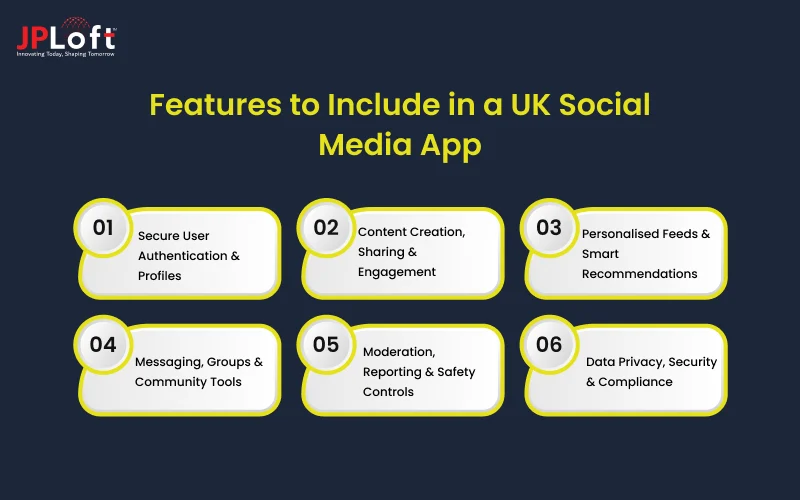
1. Secure User Authentication & Profiles
A smooth yet secure onboarding experience is critical. Offer email, phone, and social sign-ups with multi-factor authentication to meet UK security expectations. Customisable profiles, privacy controls, and visibility settings help users feel in control, an important trust factor in social networking app development UK projects.
2. Content Creation, Sharing & Engagement
Posts, stories, reels, and live streams remain central to user engagement. Adding likes, comments, shares, and saves encourages interaction, while ensuring these elements load quickly and perform smoothly across devices, especially important given the UK’s high mobile usage.
3. Personalised Feeds & Smart Recommendations
UK users expect relevant content without feeling over-tracked. Intelligent feeds based on interests, location, and behaviour help you develop a social media app in the UK that feels personal while remaining GDPR-compliant. Transparency around how content is recommended is equally important.
4. Messaging, Groups & Community Tools
Private messaging, group chats, and community spaces encourage deeper connections. For niche platforms, these features support local groups, professional circles, or interest-based communities, often inspired by unique social media app ideas that target specific UK audiences.
5. Moderation, Reporting & Safety Controls
Content moderation tools protect users and the platform’s reputation. Reporting systems, block/mute options, and AI-assisted moderation help manage abuse, misinformation, and spam, key considerations when planning custom social media app development UK solutions.
6. Data Privacy, Security & Compliance
Security is non-negotiable in the UK. End-to-end encryption, secure data storage, and consent management ensure compliance with GDPR and the UK Data Protection Act. Strong social media app security practices also build long-term trust and reduce legal risk.
Cost to Build a Social Media App in the UK
Building a social media platform in the UK involves more than just development; it requires investment in design, engineering, compliance, testing, and long-term scalability. When businesses plan to create a social media app in the UK, understanding realistic cost ranges helps avoid budget overruns and ensures better decision-making from day one.
On average, the cost to build a social media app in UK ranges between $20,000 to $120,000+ (approximately £16,000 to £95,000+), depending on feature complexity, platform choice, and compliance requirements. Startups focusing on an MVP can stay closer to the lower range, while scalable, feature-rich platforms require higher investment.
For early-stage products, costs remain manageable by limiting features to user profiles, content posting, messaging, and basic moderation. However, platforms targeting rapid growth, advanced engagement, and enterprise-level stability should expect budgets closer to the upper range of social media app development costs in the UK.
Cost Breakdown Table
|
Component |
Estimated Cost (USD) |
Estimated Cost (GBP) |
|
UI/UX Design |
$4,000 – $10,000 |
£3,200 – £8,000 |
|
Frontend & Backend Development |
$10,000 – $45,000 |
£8,000 – £36,000 |
|
Core Social Features (feeds, chat, profiles) |
$5,000 – $15,000 |
£4,000 – £12,000 |
|
Testing, QA & Deployment |
$3,000 – $10,000 |
£2,400 – £8,000 |
|
Security & Compliance (GDPR, audits) |
$3,000 – $10,000 |
£2,400 – £8,000 |
|
Total Estimated Cost |
$20,000 – $120,000+ |
£16,000 – £95,000+ |
Note: Development and compliance costs form a major part of the budget, especially when the goal is to develop a social media app for the UK market with strong privacy and data protection standards.
Factors Influencing the Cost
The final budget for social networking app development UK projects depends on multiple technical and business factors.
1. Feature Complexity
Apps with advanced feeds, real-time messaging, community tools, and moderation systems require more development hours. The broader the feature set, the higher the cost to build a social media app in the United Kingdom with stability and performance.
2. Platform Selection
Developing for iOS, Android, or both directly impacts cost. Native apps generally cost more, while cross-platform development can reduce initial expenses without compromising reach in the UK market.
3. Third-Party Integration
Payment gateways, cloud storage, analytics tools, and notification services enhance functionality but add to development effort. These integrations significantly affect the overall social media app development cost.
4. UI/UX Design Depth
Clean navigation, accessibility compliance, custom animations, and responsive layouts increase design effort. High-quality UX is essential when businesses create a social media app UK users will engage with consistently.
5. Security & Compliance
UK apps must comply with GDPR and the UK Data Protection Act. Secure authentication, encryption, and audits increase backend complexity but are non-negotiable for trust and legal safety.
6. Scope Expansion
If you later plan decentralised or Web3 features, the cost to develop a blockchain-based social media app is significantly higher and should be budgeted separately from a standard platform build.
Overall, the cost to build a social media app in UK typically ranges from £16,000–£30,000 for MVP-level products to £65,000–£95,000+ for scalable, production-ready platforms. Careful planning, phased development, and clear priorities help control costs while ensuring long-term success.
Challenges in Building a Social Media App in the UK
While the UK offers a strong market for innovation, building and scaling a social platform comes with its own set of hurdles. Businesses planning to build a social media app in the United Kingdom must anticipate social media app development challenges early and address them with the right technical and strategic solutions.
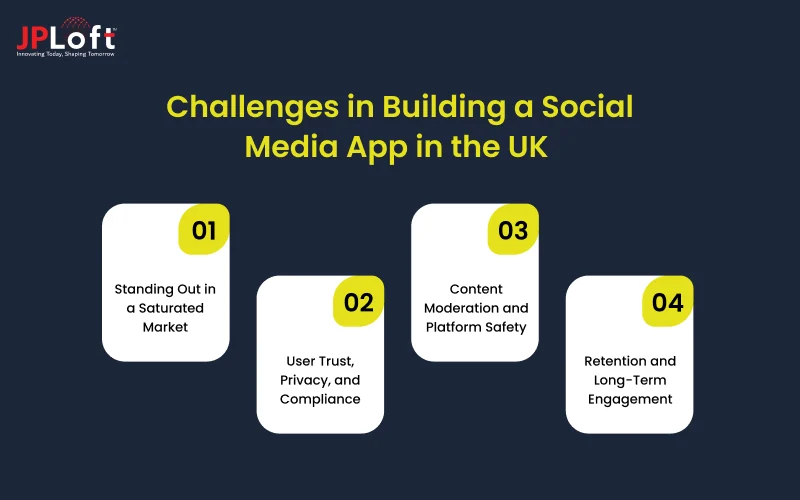
Challenge 1: Standing Out in a Saturated Market
The UK social media space is crowded with global and niche platforms competing for user attention. One of the biggest hurdles is differentiation; many apps fail because they don’t offer a clear and compelling value proposition.
Solution: Focus on niche communities, local relevance, or underserved user needs. Clear positioning, strong onboarding, and unique engagement features help avoid the common pitfalls highlighted when analysing why social media apps fail in competitive markets like the UK.
Challenge 2: User Trust, Privacy, and Compliance
UK users are highly privacy-conscious, and regulations such as GDPR leave little room for error. Poor data handling, unclear consent flows, or weak security can quickly damage credibility and adoption.
Solution: Build privacy-first architecture from the start. Transparent data policies, secure authentication, and regular compliance audits help you develop a social media app for the UK that users trust and regulators approve.
Challenge 3: Content Moderation and Platform Safety
Managing harmful content, misinformation, and abuse is a major operational challenge, especially in markets with strong regulatory oversight.
Solution: Combine automated moderation tools with human review processes. Clear community guidelines, reporting mechanisms, and escalation workflows ensure safer interactions while keeping moderation scalable.
Challenge 4: Retention and Long-Term Engagement
Attracting users is easier than retaining them. Many platforms struggle with declining engagement after initial downloads, which directly impacts growth and monetisation.
Solution: Invest in meaningful interactions rather than vanity metrics. Personalised feeds, community-driven features, and regular updates improve retention and strengthen the overall social networking app development UK strategy.
Social Media Trends To Leverage in the UK
The UK social media landscape is evolving rapidly, driven by changing user behaviour, regulatory awareness, and technological innovation. Businesses that build a social media app in the United Kingdom need to align their product strategy with key social media app development trends to stay competitive and future-ready. Below are the most relevant trends shaping social media app development in the UK today.
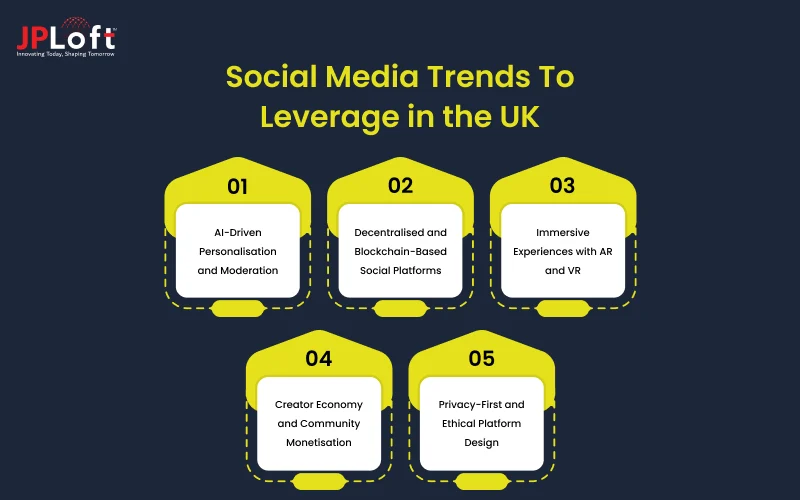
1. AI-Driven Personalisation and Moderation
Artificial intelligence is transforming how platforms deliver content and manage communities. From smart feeds to automated moderation, AI in social media helps platforms personalise user experiences while identifying harmful content at scale. In the UK, where privacy and safety are critical, AI-driven moderation also supports compliance and user trust.
2. Decentralised and Blockchain-Based Social Platforms
Blockchain technology is gaining attention for enabling decentralised identity, content ownership, and transparent moderation. UK startups exploring community-driven networks can use blockchain to reduce platform control and improve user trust. However, these platforms require careful planning due to higher development complexity and governance challenges.
3. Immersive Experiences with AR and VR
Augmented and virtual reality are reshaping how users interact online. From virtual events to AR filters and social shopping, immersive features encourage deeper engagement. As 5G adoption increases across the UK, AR/VR experiences are becoming more practical for mainstream social platforms.
4. Creator Economy and Community Monetisation
UK users increasingly support platforms that empower creators through subscriptions, tipping, and exclusive content. Social apps that integrate monetisation tools can attract creators while building loyal communities, an important growth lever when you develop a social media app for the UK market.
5. Privacy-First and Ethical Platform Design
Transparency, consent-driven data usage, and ethical algorithms are becoming key differentiators. Platforms that prioritise user control over personal data build stronger trust, align with UK regulations, and reduce compliance risks. A privacy-first design approach also encourages long-term engagement, responsible innovation, and sustainable platform growth across diverse user communities nationwide.
Why Partner with JPLoft to Create a Social Media App in the UK?
Selecting the right technology partner is a decisive factor when launching a scalable and compliant social platform for British users. JPLoft brings hands-on experience in delivering secure, high-performance social platforms while aligning every stage of development with UK regulations and user expectations.
As a trusted social media app development company, JPLoft focuses on building products that prioritise privacy, performance, and long-term growth. Our team works closely with businesses to design intuitive user experiences, implement robust backend systems, and ensure smooth deployment without compromising quality.
If you’re planning to create a social media app UK users can rely on, or aiming to expand your digital presence through a platform built for scale, JPLoft provides end-to-end support, from strategy and design to testing and ongoing optimisation, helping your product succeed in the competitive UK market.
Conclusion
Building a successful social platform requires more than just a good idea; it demands careful planning, the right technology choices, and a deep understanding of local users. For businesses looking to create a social media app in the UK, aligning your product with British user behaviour, privacy expectations, and regulatory requirements is essential for long-term success.
From validating your idea and defining features to managing costs and overcoming development challenges, every stage plays a crucial role in shaping a scalable and engaging platform. Keeping up with emerging trends and focusing on user trust can further strengthen your position in a competitive market.
Whether you’re a startup exploring new opportunities or an enterprise expanding your digital ecosystem, a structured approach and the right development expertise can help you develop a social media app for the UK that delivers real value, drives engagement, and supports sustainable growth.
FAQs
How long does it take to create a social media app in the UK?
The development timeline typically ranges from 3 to 6 months for an MVP, depending on feature complexity and platform choice. A more advanced or scalable platform with extensive testing and compliance checks can take 6–9 months or longer.
Yes. If your platform targets UK users or processes data within the UK, GDPR and the UK Data Protection Act apply, regardless of where other users are located. Compliance must be built into data handling, consent, and security practices from the start.
Starting with an MVP is highly recommended. It allows you to validate your idea, gather user feedback, and reduce initial costs. Once traction is proven, features can be added incrementally based on real user behaviour.
Absolutely. Many UK users prefer platforms built around specific interests, professions, or local communities. Niche positioning often leads to higher engagement and loyalty compared to broad, general-purpose networks.
The most common mistake is ignoring user trust and compliance early on. Poor privacy practices, unclear moderation policies, or weak security can quickly damage credibility and limit growth in the UK’s regulation-focused environment.

Conor has more than 10 years of experience in software development, app creation, solution engineering, and UX/UI design. With an impressive track record of high retention and growth working with Fortune 500 companies, he brings the technical depth and strategic perspective needed to help businesses build impactful, user-focused digital solutions.



Share this blog