


Key Takeaways
Facebook’s success proves that scalable features, strong engagement loops, and smart monetization define the future of social platforms.
Building modern social apps requires a strategic blend of UI/UX, real-time architecture, security, and continuous optimization.
Understanding how to create an app like Facebook helps founders plan better around features, workflows, tech stack, and long-term scalability.
Facebook like app development cost ranges from $25,000 to $150,000, depending on complexity, team expertise, and the advanced capabilities you want to integrate.
Partnering with an experienced team like JPLoft ensures your platform is built with the right strategy, technology, and execution for long-term growth.
Creating a platform that mirrors Facebook’s scale, engagement, and influence may seem challenging, but today’s technology makes it more achievable than ever.
One of the biggest questions entrepreneurs ask is: How to make an app like Facebook?
You can make an app like Facebook by defining your core features, planning the architecture, choosing the right tech stack, designing an intuitive UI, and building a secure, scalable backend supported by real-time communication tools.
With billions of users interacting daily, Facebook has set the benchmark for social networking excellence.
This guide breaks everything down clearly: how Facebook works, the features you need, the technology behind it, development steps, monetization, and the total cost to build an app like Facebook, so you can build a platform that scales, engages, and grows confidently in 2025.
An Overview of Facebook App
Facebook began as a university networking platform and evolved into one of the best social media apps globally, shaping how people connect, communicate, and consume digital content.
Today, it functions as a massive multi-layered ecosystem offering social networking, messaging, community building, groups, marketplaces, live streaming, business pages, and advertising, everything within a single integrated experience.
Its real strength lies in combining social interaction with discovery-driven features that keep users engaged year after year.
Key Facebook Statistics (2025)
-
3.07 billion monthly active users, making it the world’s largest social platform.
-
According to a 2025 report, over 500 million users use Facebook Stories daily, showcasing the shift toward visual-first engagement.
-
Facebook generates 97%+ of its revenue from advertising, proving the strength of its targeted ad ecosystem.
-
The average user spends 33 minutes per day on Facebook, reflecting strong retention and engagement.
As of 2025, Facebook continues to dominate the social media landscape, generating billions in revenue from ads, marketplace interactions, and business services.
Because of this success, many startups and enterprises study Facebook’s model to understand how to create a social media app that can scale globally, support real-time communication, and deliver consistent engagement.
These insights make one thing clear: Facebook isn’t just a social network; it’s a blueprint for building future-ready, community-driven digital platforms.
Working Process of the Facebook App
Facebook operates through a smooth, interconnected system that makes browsing, posting, and connecting feel effortless.
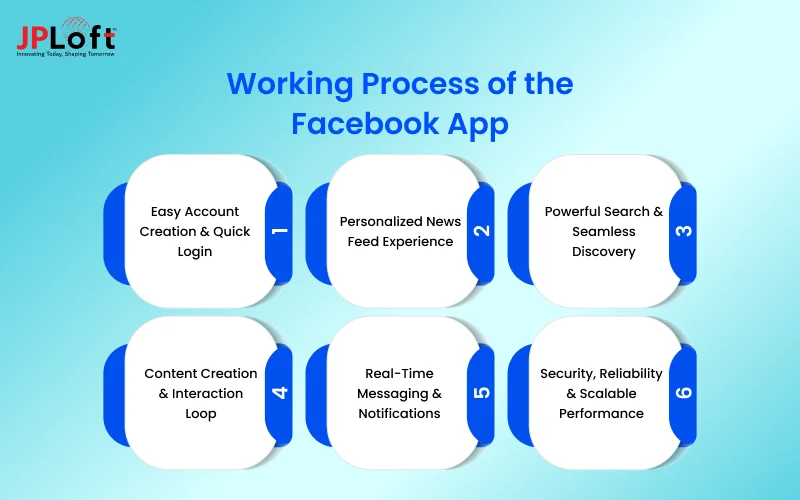
Its workflow is built to deliver fast, personalized content while maintaining a secure and high-performance environment, qualities developers often study when planning to create a mobile app experience inspired by Facebook’s success.
1. Easy Account Creation & Quick Login
Users begin by signing up with their name, phone/email, and password. Basic details help personalize their initial experience.
After this, logging in becomes instant, allowing users to jump back into the app without any delays. This simple onboarding system helps build consistency and smooth repeat usage.
2. Personalized News Feed Experience
After login, users land on the News Feed, where Facebook’s algorithms sort posts based on interests, viewing patterns, and interactions.
The feed updates constantly, making every scroll feel fresh and relevant. This personalized display system is a major reason the platform maintains high engagement levels.
3. Powerful Search & Seamless Discovery
The search bar lets users find friends, pages, groups, topics, and events effortlessly. Auto-suggestions based on recent activity and interests make discovery quicker.
Users can follow creators, send friend requests, or join communities with a single tap, forming new connections naturally.
4. Content Creation & Interaction Loop
Users can upload photos, videos, reels, text posts, or even go live. Every post includes options like reactions, comments, and shares, encouraging fast and emotional interaction.
This loop of creating and engaging content is one of the core mechanisms that keeps users active daily.
5. Real-Time Messaging & Notifications
Messenger supports instant chats, voice calls, and video calls, while notifications alert users about likes, comments, tags, friend requests, and group updates.
This continuous flow of real-time interactions keeps the platform lively and encourages users to return multiple times a day.
6. Security, Reliability & Scalable Performance
Behind the scenes, social media app security plays a crucial role in keeping the platform safe through encrypted sessions, secure logins, privacy controls, and fraud prevention systems.
Alongside these protections, Facebook’s scalable infrastructure ensures smooth performance even during heavy traffic, allowing the app to handle millions of interactions without slowing down.
For entrepreneurs, understanding this workflow is a blueprint for building next-generation, community-driven social platforms.
Reasons to Invest in an App like Facebook
Social media continues to dominate the digital landscape, and Facebook’s success proves there’s a huge appetite for community-driven platforms.
Building your own Facebook-style app isn’t just about social networking; it’s an opportunity to create a business that scales, engages, and generates revenue.
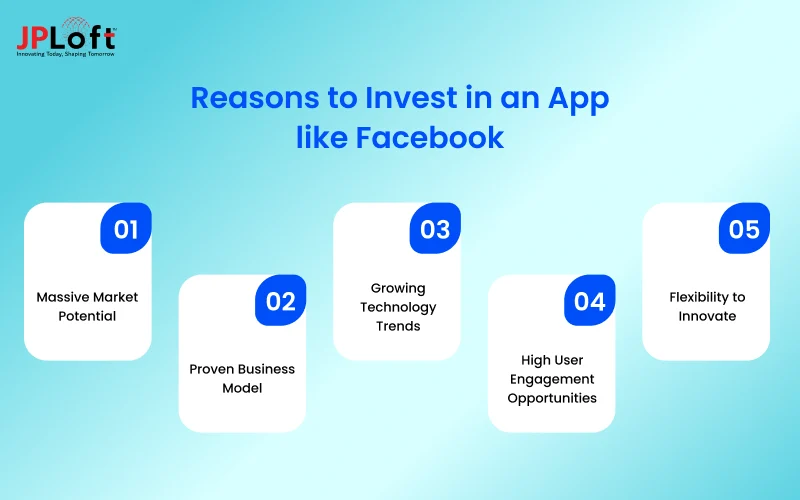
Understanding the reasons to invest helps you focus your strategy and resources effectively.
1] Massive Market Potential
With billions of people using social media daily, there’s a vast user base to tap into.
Entrepreneurs who want to start a social media business can leverage this audience to offer niche communities, targeted content, or innovative features that differentiate their platform.
2] Proven Business Model
Facebook’s ad-driven revenue model demonstrates the profitability of social networking apps.
A well-built platform can monetize through ads, subscriptions, premium features, and in-app commerce.
This is why Facebook-like app development remains a lucrative investment for tech startups and enterprises.
3] Growing Technology Trends
AI, AR, live streaming, and real-time communication continue to shape social media experiences.
Keeping up with social media app development trends ensures your app stays relevant and competitive, offering modern features that users expect.
4] High User Engagement Opportunities
Social networking apps are sticky by nature; users spend significant time browsing, interacting, and sharing content.
Learning how to make a social media app like Facebook allows you to replicate engagement-driven features such as feeds, groups, and messaging systems.
5] Flexibility to Innovate
Unlike established platforms, your app can introduce new monetization methods, unique user experiences, or niche-focused communities.
This creative freedom gives investors and developers an edge in capturing untapped markets.
Investing in a Facebook-style app isn’t just about copying an existing model; it’s about understanding the ecosystem, identifying opportunities, and applying lessons from one of the world’s most successful social media platforms.
Features to Include in an App like Facebook
To make a Facebook-style app successful, you need to focus on core features that drive engagement, retention, and monetization.
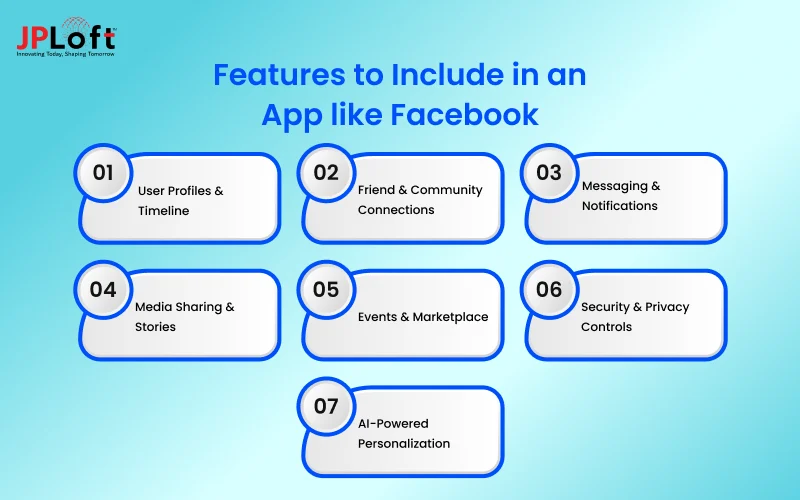
Incorporating the right functionality from the start ensures your platform is competitive and appealing to users.
► User Profiles & Timeline
Profiles let users showcase personal information, photos, and activity. The timeline/feed organizes content in chronological or relevance-based order, keeping users engaged.
Implementing this feature is essential if you want to build a clone app like Facebook that feels familiar yet intuitive.
► Friend & Community Connections
The ability to send friend requests, join groups, or participate in communities encourages interaction.
These features help users form meaningful connections and boost engagement metrics.
Carefully designing these social interactions is part of how to design a social media app effectively.
► Messaging & Notifications
Real-time chat, push notifications, and alerts keep users returning to the app.
Integrated messaging functionality is a critical element if you aim to create a clone app like Facebook that replicates a seamless communication experience.
► Media Sharing & Stories
Allow users to share images, videos, and ephemeral content like stories.
Media sharing encourages creativity and engagement, making your app dynamic and interactive.
This aligns with social media app features that users have come to expect from top platforms.
► Events & Marketplace
Adding event management and marketplace features creates additional touchpoints for users.
It enables communities to organize meetups and facilitates commerce, making your platform more versatile and sticky.
► Security & Privacy Controls
Robust security measures, such as strong privacy settings, encrypted data handling, and effective content moderation, play a critical role in protecting users and maintaining compliance.
Prioritizing mobile app security not only safeguards sensitive information but also strengthens user trust, which is essential for any modern social platform.
► AI-Powered Personalization
Recommending friends, groups, content, and ads based on user behavior increases engagement and retention.
This is a modern enhancement that differentiates your platform from standard clones.
Building a Facebook-style app isn’t just about copying features, it’s about implementing them thoughtfully, combining engagement-driven elements with intuitive design.
By prioritizing these functionalities, you lay the foundation for a scalable, user-friendly social media platform.
How to Make an App like Facebook?
Building an app like Facebook requires careful planning, robust technology, and a user-centric design approach.
From ideation to launch, each stage plays a crucial role in creating a platform that can scale, engage users, and remain secure.
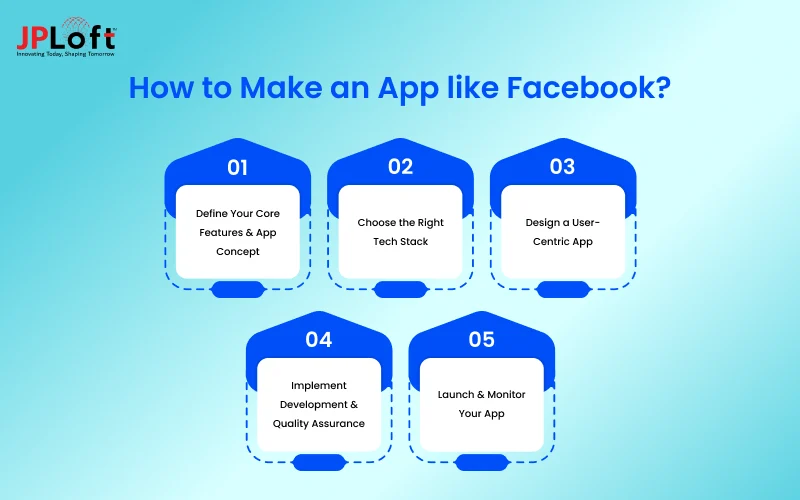
Understanding the step-by-step development process ensures you can make a social media app like Facebook successfully.
Step 1: Define Your Core Features & App Concept
Before writing a single line of code, clearly define what your app will offer. Decide which features are essential and how your app will differentiate itself. This clarity forms the backbone of your development process.
► User Profiles & Feeds
Allow users to create personalized profiles and timelines to share updates, photos, and media.
Profiles form the foundation of a social network, enabling users to connect and engage.
This is critical if you want to create a social media app like Facebook that keeps users active.
► Messaging & Notifications
Implement real-time chat, push notifications, and alerts to maintain engagement.
Messaging ensures users remain connected and return frequently to the app.
► Groups & Communities
Enable users to create or join groups based on interests, locations, or activities.
Community building drives engagement and fosters loyalty.
► Events & Marketplace
Integrate event management and marketplace features to offer more utility.
These features increase retention and open monetization opportunities, which is essential for anyone looking to build a social media clone like Facebook.
Step 2: Choose the Right Tech Stack
Selecting the correct technologies determines your app’s scalability, security, and performance.
A strong social media app tech stack also simplifies future upgrades and maintenance.
► Frontend Frameworks
Use robust frontend technologies to deliver a smooth, responsive, and engaging user interface.
Popular choices include React Native or Flutter for cross-platform applications.
These frameworks help ensure consistent performance, native-like interactions, and an overall modern experience for users.
► Backend Infrastructure
A reliable backend is essential for managing user data, handling authentication, and powering real-time features.
Frameworks such as Node.js, Django, and Ruby on Rails are widely preferred because they offer scalability, strong community support, and efficient API handling, making them suitable for apps that need to grow seamlessly.
► Database Solutions
Choose a database that scales with your user base. NoSQL databases like MongoDB or Firebase are ideal for dynamic social platforms.
► Cloud & Hosting Services
Use cloud platforms to support storage, real-time communication, and dependable app hosting.
Solutions like AWS, Azure, or Google Cloud Services provide the flexibility, uptime, and global reach needed to keep applications running smoothly at scale.
These platforms also simplify deployment and enable secure, efficient performance management.
Step 3: Design a User-Centric App
Design is critical in social apps because it directly affects usability and engagement.
Focus on a clean, intuitive interface that encourages interaction and content sharing.
► UI/UX Best Practices
Ensure your app is visually appealing, easy to navigate, and consistent across devices.
A well-thought-out interface keeps users engaged longer.
► Mobile Optimization
Optimize for various screen sizes and devices to maintain performance. This enhances user experience and reduces bounce rates.
► Prototyping & Wireframes
Develop wireframes and interactive prototypes to visualize workflows. This step helps identify design gaps before actual development begins.
► Design Tools & Guidelines
Use professional tools like Figma or Adobe XD to maintain design consistency.
Follow platform-specific design rules and understand how to get your social media app approved on the iOS store to ensure smooth submissions.
Step 4: Implement Development & Quality Assurance
With your design and tech stack ready, begin development while continuously testing for bugs, performance, and usability.
► Development Practices
Follow Agile methodologies to iteratively build features. Collaborate closely with designers, developers, and testers for efficient workflows.
► App Testing & QA
Conduct thorough testing to ensure stability, usability, and bug-free performance across devices.
► Maintenance Planning
Plan for social media app maintenance post-launch to handle updates, security patches, and feature enhancements. Regular maintenance ensures longevity and user trust.
► iOS & Android Approval
Follow proper platform guidelines, perform pre-launch checks, and ensure policy compliance to avoid review delays and speed up your app’s approval on both stores.
Step 5: Launch & Monitor Your App
Launching is just the beginning. Monitor app performance, user engagement, and analytics to refine features and improve user satisfaction continuously.
► Analytics & Insights
Use tools to track user behavior, engagement, and retention. Analytics informs feature improvements and monetization strategies.
► Feedback Loops
Collect user feedback to fix issues and add requested features. A responsive approach builds trust and keeps your community active.
► Scaling & Optimization
Gradually scale infrastructure as your user base grows. Optimize servers, databases, and content delivery for performance and speed.
► Continuous Improvement
Iteratively release updates to enhance features, improve security, and incorporate new trends. Continuous improvement ensures your app remains competitive.
How Modern Technologies Shape the Development of Facebook-Style Apps
Modern social media apps rely heavily on advanced technologies to provide seamless, scalable, and engaging experiences.
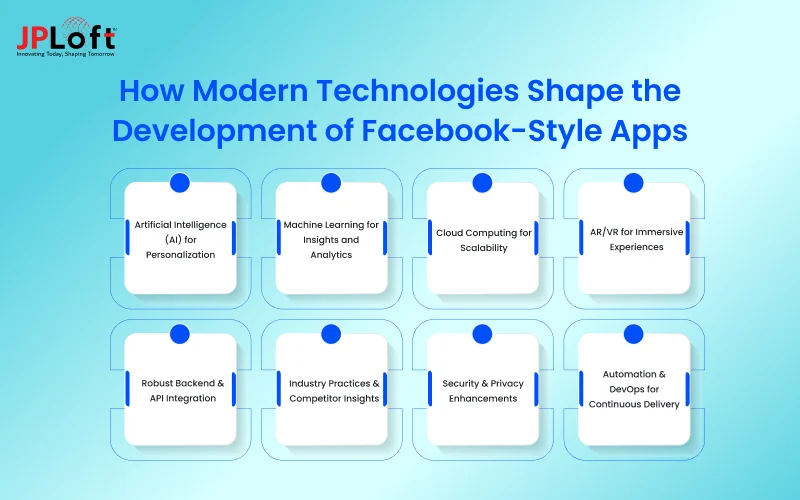
From AI-driven personalization to robust backend frameworks, these technologies determine both the performance and appeal of a Facebook-style app.
1] Artificial Intelligence (AI) for Personalization
AI powers content recommendations, friend suggestions, and targeted ads, ensuring users see relevant information in their feed.
Leveraging AI in social media allows apps to deliver hyper-personalized experiences that increase engagement and retention.
2] Machine Learning for Insights and Analytics
Machine learning models analyze user behavior, engagement patterns, and preferences. These insights enable better feature planning, predictive analytics, and smarter ad targeting.
Entrepreneurs learning how to develop a social media app like Facebook? can use ML to make data-driven decisions that scale efficiently.
3] Cloud Computing for Scalability
Cloud-based infrastructure allows apps to handle millions of users without performance issues. By integrating scalable servers, developers can ensure smooth operations as traffic grows.
This also helps address social media app development challenges, such as real-time data synchronization and load management.
4] AR/VR for Immersive Experiences
Augmented and virtual reality enhance engagement with interactive content, such as live video filters, immersive events, and virtual meetups.
These technologies are increasingly expected in modern apps, contributing to Facebook-like app development that feels futuristic and user-centric.
5] Robust Backend & API Integration
Modern apps rely on APIs to connect various services, from payment gateways to messaging systems.
Choosing the right backend architecture is essential to build a social media clone like Facebook that is fast, reliable, and scalable.
6] Industry Practices & Competitor Insights
Top developers, including mobile app development company in the USA, use cutting-edge tech stacks, rigorous testing, and performance monitoring to create competitive social media platforms.
Studying their practices helps startups replicate successful patterns while avoiding common pitfalls.
7] Security & Privacy Enhancements
Advanced encryption, secure authentication, and compliance measures protect user data.
AI also assists in detecting suspicious behavior, reducing risks associated with social media apps. These enhancements are critical for long-term success and trust.
8] Automation & DevOps for Continuous Delivery
Automation tools help deploy updates, monitor server health, and maintain app stability.
Using DevOps pipelines ensures that new features reach users faster without compromising performance or quality.
This section demonstrates how AI, cloud, and modern frameworks enable developers to create scalable, secure, and user-friendly Facebook-style apps while overcoming technical challenges.
Leveraging these technologies is crucial for anyone planning how to develop a social media app like Facebook?.
How Much Does It Cost to Build a Facebook-Like App in 2025?
Facebook like app development cost in 2025 typically ranges between $25,000 and $150,000+, depending on feature depth, scalability needs, AI integration, and overall social media app development cost factors.
Many founders are exploring how to build an app like Facebook? or planning to create a social media app like Facebook aim to understand how features directly influence budgets across regions and team structures.
Core elements like chat systems, feed algorithms, and real-time updates can increase engineering hours.
For instance, when evaluating how to develop a messaging app, chat encryption, delivery receipts, media transfer, and scalability can significantly affect total pricing.
Advanced backend architecture, user authentication layers, and cloud infrastructure also impact the cost to develop an app like Facebook with modern standards.
Different regions price development differently, but complexity remains the strongest driver, whether you're building an MVP or a high-performance, large-scale social network.
Cost Breakdown Table
|
Component |
Estimated Cost (USD) |
|
UI/UX Design |
$3,000 – $15,000 |
|
Backend Development |
$8,000 – $45,000 |
|
Mobile App Development |
$10,000 – $55,000 |
|
AI/ML + Personalization |
$4,000 – $25,000 |
|
QA, Testing & Deployment |
$3,000 – $20,000 |
|
Total Estimated Range |
$25,000 – $150,000+ |
How to Monetize an App Like Facebook?
Below are the most effective monetization strategies founders study when learning how social media apps make money and planning sustainable revenue models.
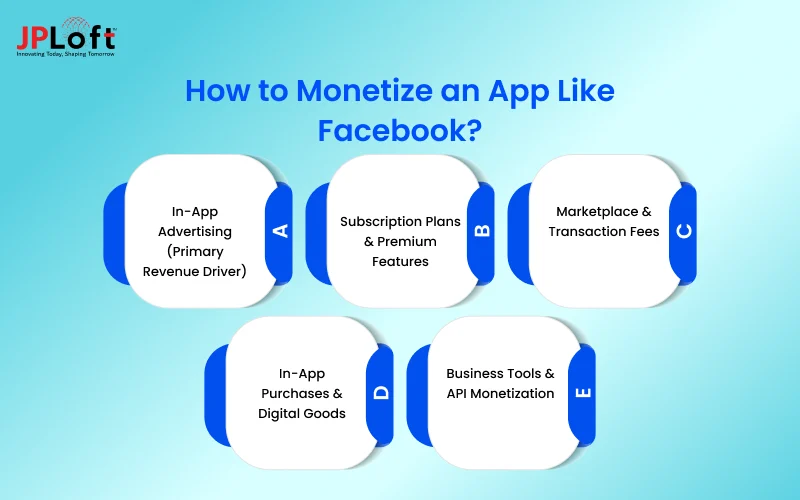
A] In-App Advertising (Primary Revenue Driver)
Ads remain the biggest source of income for platforms trying to build an app like Facebook.
You can monetize through display ads, video ads, boosted posts, and branded content. The more user data your platform collects ethically, the more accurately you can target ads and increase revenue potential.
B] Subscription Plans & Premium Features
Founders exploring how to build an app like Facebook? Often add premium tiers to offer ad-free experiences, advanced analytics, creator tools, or exclusive features.
Subscriptions improve revenue consistency while giving power users upgraded functionality, boosting long-term retention and lifetime value.
C] Marketplace & Transaction Fees
If you're planning to make a social media app like Facebook, integrating a marketplace can unlock huge revenue growth.
Charge fees on product listings, service bookings, or peer-to-peer transactions. This model turns your social platform into a commerce ecosystem, generating passive income while increasing user activity.
D] In-App Purchases & Digital Goods
Creators and communities often purchase badges, gifts, stickers, and virtual items as part of engagement features.
This strategy is highly scalable for businesses learning how to develop an app like Facebook? Because it works across gaming, short-form content, creator communities, and live streaming.
E] Business Tools & API Monetization
Companies planning to create a social media app like Facebook often monetize by offering business dashboards, analytics tools, or paid API usage.
Brands pay for deeper insights, audience targeting data, and engagement metrics, creating a powerful B2B revenue stream.
Partner with JPLoft and Create an App Like Facebook
Launching a successful social platform requires the right expertise, tools, and long-term vision.
JPLoft, a leading social media app development company, helps founders transform ideas into fully scalable products with modern architecture, intuitive UI/UX, and enterprise-grade performance.
If you’re exploring how to build an app like Facebook, our team ensures the entire journey, feature planning, development, integrations, testing, and deployment are streamlined and transparent.
With deep experience in social platforms, real-time features, and AI-enabled experiences, JPLoft delivers solutions built for growth. Partner with us to build a platform users trust and businesses can scale confidently.

Conclusion
Building a successful social platform requires the right balance of strategy, modern features, and a deep understanding of how global platforms scale.
If you’re exploring how to create an app like Facebook, the journey involves thoughtful planning, strong architecture, and a user-centric vision.
You must focus on seamless communication, performance, security, and continuous innovation to stay competitive in today’s dynamic digital space.
With the right roadmap and team, you can confidently develop a social media app like Facebook that attracts users, drives engagement, and grows sustainably.
The opportunity is massive, now it’s your turn to build something remarkable.
FAQs
To develop an app like Facebook, start by defining your core features, profiles, posts, messaging, notifications, and communities. Next, choose a scalable tech stack, build real-time capabilities, integrate security layers, and design an intuitive UI/UX. Finally, test thoroughly and launch with a clear monetization and growth strategy.
A basic social platform takes 4–6 months, while a full-featured Facebook-style app may take 9–14 months, depending on features and complexity.
User profiles, newsfeed, messaging, notifications, friend system, media sharing, groups, privacy settings, and admin controls.
Typically: Node.js or Python (backend), React/Flutter (frontend), cloud hosting, real-time sockets, and robust databases like MongoDB or PostgreSQL.
Costs vary based on features, team, and technology, but generally range from $25,000 to $150,000+.

Conor has 10+ years of experience in software development, application engineering, solution design, and UX/UI. He has worked across digital products in restaurant technology, food and grocery delivery, healthcare, media, streaming, and social platforms, bringing both technical and user-experience perspectives to product development. His experience working with large organizations and growth-focused digital products helps businesses translate complex requirements into practical, user-focused solutions.




Share this blog