



Key Takeaways :
A structured development process with the right technology partner is the most effective way to build a private jet booking app.
Development costs range from $20,000 to $170,000+, depending on features, platform, and team location.
Real-time availability, secure payments, and operator management are non-negotiable features for any serious private aviation platform.
AI transforms the booking experience by delivering personalization, dynamic pricing, and demand prediction at scale.
Combining commission models, memberships, and empty seat listings creates the most sustainable revenue structure for private jet platforms.
The era of calling a broker to book a flight is over. Today's high-net-worth travelers expect to book a private jet the same way they hail a premium cab — instantly, on a screen, with full transparency on pricing and aircraft details.
Global private jet charter services are projected to reach $45.43 billion by 2030, and a significant share of that growth is driven by one thing: mobile-first booking experiences.
Luxury travelers are no longer tolerating friction. They want real-time availability, seamless payments, document management, and personalized concierge services in a single app.
So, if you are an aviation startup, a charter operator, or an enterprise looking to digitize a fleet, private jet booking app development is no longer a niche investment. It is a competitive necessity.
This guide covers everything you need to build one that actually scales.
What is a Private Jet Booking App?
A private jet booking app is a platform that lets users search, compare, and book private aircraft, while eliminating brokers, phone calls, and paperwork.
Here is how such an application works:
-
User creates a profile, uploads travel documents, and adds payment details once.
-
Enter departure city, destination, date, and passenger count.
-
View available jets with cabin photos, capacity, range, and pricing.
-
Filter by aircraft type, price, departure time, or operator rating.
-
Add catering preferences, ground transport, or special requests.
-
Book immediately or request a custom quote from the operator.
-
Pay via card, wallet, or wire transfer through an encrypted gateway.
-
Get booking details, crew information, and FBO instructions instantly.
-
Monitor flight status and any schedule updates live.
-
Rate the aircraft, operator, and overall experience.
Types of Private Jet Booking Apps
Not every private flight booking app is built the same way. The type you build defines your business model, target user, and development scope. So, before you build an airline reservation system, have a look at the different types of apps mentioned below.
|
Type |
What It Does |
Best For |
|
Charter Marketplace Apps |
Connects travelers with multiple operators for real-time browsing and booking |
Startups entering private aviation |
|
Membership-Based Jet Apps |
Subscription access with priority booking and exclusive fleet rates |
Frequent flyers, corporate executives |
|
Empty Seat Booking Apps |
Lists discounted repositioning flights that would otherwise fly empty |
Budget-conscious luxury travelers |
|
Corporate Aviation Apps |
Manages recurring business travel with approval workflows and cost reporting |
Enterprises managing team travel |
Why Should Businesses Invest in Private Jet Booking Apps?
The private aviation market is an open space, and businesses that move early will own the highest-value customer base in travel. Let’s discuss why businesses must choose to develop a private jet booking app.
→ Growing Demand for Luxury Travel Solutions
High-net-worth travelers now prioritize privacy, flexibility, and time efficiency above everything else. Demand for on-demand luxury aviation is growing faster than traditional travel.
Luxury booking app development is sitting at the center of this shift. Businesses that deliver seamless digital experiences are capturing the most loyal segment of travelers.
→ Rise of On-Demand Aviation Services
Travelers today expect instant availability, transparent pricing, and one-tap booking without speaking to a single agent. The on-demand model has permanently changed aviation expectations.
Platforms that offer a fast and frictionless private jet booking experience consistently outperform traditional broker-led booking models across all markets.
→ Revenue Opportunities in Private Aviation
Private aviation offers multiple high-margin revenue streams, including commissions, memberships, empty seat listings, and premium upgrades. All are running simultaneously on one platform.
When you develop an app to book private jet with these streams built in from day one, the platform becomes a long-term revenue engine, not just a booking tool.
→ Benefits for Aviation Companies and Startups
Aviation companies reduce broker dependence, cut commission costs, and build direct relationships with travelers by investing in private aviation app development that pays long-term dividends.
For startups, a marketplace model offers a low-barrier-to-entry entry point with a scalable architecture that scales with your fleet, user base, and market reach.

Must-Have Features of a Private Jet Booking App
The jet charter app features you build into your platform define the user experience, operational efficiency, and revenue potential.
Here is a complete breakdown of top aviation software features across all three panels.
|
Panel |
Feature |
What It Does |
Why It Matters |
|
User Panel |
User Registration & Profile Management |
Secure sign-up with saved documents and payment details |
Reduces friction on repeat bookings |
|
Advanced Jet Search Filters |
Filter by aircraft type, price, range, and rating |
Helps users find the right fit faster |
|
|
Real-Time Jet Availability |
Live fleet sync across routes and dates |
Eliminates double bookings and outdated listings |
|
|
Instant Booking & Scheduling |
One-tap confirmation or future scheduling |
Delivers the on-demand experience users expect |
|
|
Secure Payment Integration |
Multi-gateway support with end-to-end encryption |
Builds trust with high-value transactions |
|
|
AI-Based Jet Recommendations |
Personalized suggestions based on travel history |
Increases booking conversion and repeat usage |
|
|
Flight Tracking & Notifications |
Live status updates and delay alerts |
Keeps travelers informed at every stage |
|
|
Loyalty Programs & Memberships |
Points, subscription tiers, and member benefits |
Drives retention and recurring revenue |
|
|
In-App Chat & Concierge Support |
Direct operator and concierge communication |
Handles special requests without leaving the app |
|
|
Multi-Language & Multi-Currency Support |
Localized experience for global travelers |
Expands platform reach across markets |
|
|
Operator Panel |
Fleet Management Dashboard |
Centralized view of all aircraft and booking history |
Simplifies fleet operations in real time |
|
Aircraft Availability Management |
Update availability, blackout dates, and pricing |
Keeps listings accurate and bookable |
|
|
Crew Scheduling System |
Assigns crew to bookings with conflict detection |
Ensures compliance and smooth departures |
|
|
Route & Fuel Management |
Optimal route planning with fuel cost calculations |
Reduces operational costs per flight |
|
|
Maintenance Tracking |
Logs maintenance with airworthiness status |
Keeps aircraft safe and audit-ready |
|
|
Admin Panel |
User & Operator Management |
Controls accounts, onboarding, and permissions |
Maintains platform integrity and trust |
|
Dynamic Pricing Control |
Adjusts pricing by demand, season, and route |
Maximizes revenue across peak and off-peak periods |
|
|
Analytics & Reporting Dashboard |
Tracks bookings, revenue, and user behavior |
Powers data-driven platform decisions |
|
|
Revenue Monitoring |
Real-time view of all income streams |
Keeps financial performance visible and actionable |
|
|
Security & Fraud Detection |
Monitors transactions for suspicious activity |
Protects platform and high-value users |
Advanced Technologies Used in a Private Jet Booking App
Building a future-ready platform means going beyond basic booking.
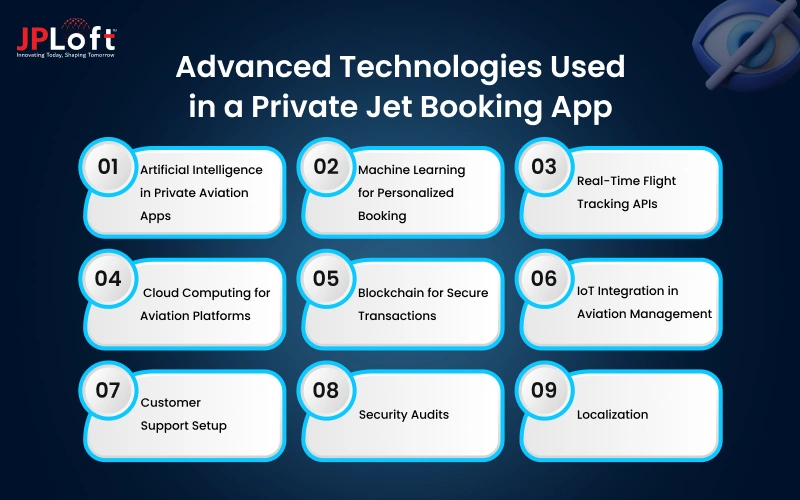
These are the core aviation technology trends that define a scalable luxury booking app development investment.
1. Artificial Intelligence in Private Aviation Apps
AI in aviation powers smart search, automated support, and dynamic pricing across the platform. It reduces manual intervention at every stage of the booking journey.
For operators, AI flags scheduling conflicts and predicts demand, making fleet utilization leaner and more profitable.
2. Machine Learning for Personalized Booking
Machine learning analyzes individual travel behavior and surfaces relevant aircraft options whenever a user opens the app.
The platform gets smarter with every booking, improving conversion rates and reducing the likelihood of users switching to a competitor.
3. Real-Time Flight Tracking APIs
Tracking APIs connect the platform to live aviation data, including position, altitude, speed, and ETA, updated continuously throughout the flight.
This feeds both the user-facing tracking screen and the operator dashboard with actionable real-time intelligence.
4. Cloud Computing for Aviation Platforms
Cloud infrastructure allows a private aviation app development platform to scale instantly, handling booking surges and multi-region traffic without downtime.
It also cuts infrastructure costs significantly, replacing physical servers with elastic resources that grow with the platform.
5. Blockchain for Secure Transactions
Using Blockchain in aviation creates an immutable record for every high-value transaction, critical when bookings routinely run into tens of thousands of dollars.
Smart contracts automate payment releases and refunds, removing manual reconciliation and reducing financial dispute risk entirely.
6. IoT Integration in Aviation Management
IoT sensors feed live data on engine health, fuel levels, and cabin conditions directly into the operator dashboard.
IoT in aviation allows operators to flag airworthiness issues early, keeping the fleet compliant and bookings uninterrupted.
Step-by-Step Private Jet Booking App Development Process
Knowing how to build a private jet booking app the right way requires a structured approach.
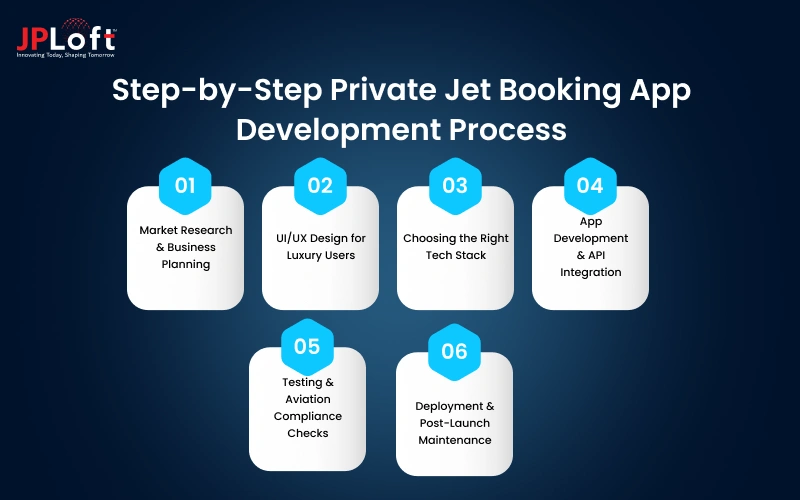
Here is the exact process to build an aviation software for jet booking from idea to launch.
Step 1: Market Research & Business Planning
Before building anything, you need clarity on who you are building for and why your platform will be different from what already exists.
► Target Audience & Competitor Analysis
Start by understanding who your users are, what they currently dislike about existing platforms, and what gap your app can fill better than anyone else in the market.
► Revenue Model & Feature Prioritization
Choose your business model early, whether it is a marketplace, membership, or hybrid. This one decision will guide every feature you build and every dollar you spend.
Step 2: UI/UX Design for Luxury Users
In a luxury product, UI/UX design services are everything. Users will judge your platform in seconds, so every screen needs to feel premium, clean, and effortless to use.
► Premium Visual Language & Brand Identity
Your app needs to look and feel expensive. The colors, typography, and animations should instantly communicate that this is a high-end platform built for discerning travelers.
► Seamless Booking Flow & User Journey Mapping
Keep the path from search to booking as short as possible. Every extra step you remove makes it easier for users to complete a booking without second-guessing themselves.
Step 3: Choosing the Right Tech Stack
The app tech stack you choose will determine how well your platform performs, how easily it scales, and how much it costs to maintain as your user base grows.
► Frontend, Backend & Database Selection
Use proven technologies like React Native or Flutter for the app, Node.js for the backend, and PostgreSQL for your database. These work well together and are easy to scale.
► Cloud, Scalability & Security Planning
Build on AWS or Google Cloud from day one. You get automatic scaling, strong security, and global performance without having to manage any physical infrastructure yourself.
Step 4: App Development & API Integration
This is where your product comes to life. Build a mobile app in modules so each feature can be developed, tested, and improved without breaking the rest of the platform.
► Core Booking Engine & User Account Build
The booking engine is the heart of your app. It needs to handle search, availability checks, pricing, and confirmations smoothly so users never hit a dead end while booking.
► Third-Party APIs & Payment Gateway Integration
Connect aviation data APIs for live flight information and integrate trusted payment solutions to handle secure transactions across different currencies and regions worldwide.
Step 5: Testing & Aviation Compliance Checks
Never skip app testing in aviation. A single broken booking flow or failed payment can damage user trust in a market where reputation is everything.
► Functional, Performance & Security Testing
Test every possible user scenario before launch. This includes edge cases, high traffic situations, and payment failures, so your platform handles everything smoothly from day one.
► Regulatory Review & Compliance Validation
Make sure your platform meets the aviation and data privacy regulations of every market you are entering. Non-compliance can result in serious legal and operational consequences down the line.
Step 6: Deployment & Post-Launch Maintenance
Getting your app live is just the beginning. The real work is keeping it fast, bug-free, and relevant with app maintenance services as your users grow.
► App Store Release & Production Monitoring
Publish your app to the Play Store and submit it to the App Store with all required documentation ready. Once live, monitor performance and booking success rates every single day without exception.
► Bug Fixes, Updates & Feature Enhancements
Set a regular schedule for updates. Fix issues quickly, improve features based on user feedback, and keep adding value so your platform stays ahead of the competition consistently.
How Much Does Private Jet Booking App Development Cost?
The cost to develop a private jet booking app usually ranges from $20,000 to $170,000+. However, the final airline software development cost depends entirely on the complexity of features, the technology stack chosen, and the development team you work with.
The cost usually differs as:
|
App Complexity |
Features Included |
Estimated Cost |
Timeline (in months) |
|
Basic MVP |
Core booking, user profiles, search, and payments |
$20,000 to $40,000 |
3 - 4 |
|
Mid-Level Platform |
Advanced filters, operator panel, tracking, notifications |
$40,000 to $90,000 |
4 - 7 |
|
Full-Scale Platform |
AI recommendations, multi-panel, blockchain, IoT integration |
$90,000 to $170,000+ |
7 - 10+ |
Factors Affecting the Cost to Develop a Private Jet Booking App
Several key factors influence what you will ultimately spend when you learn how to develop a private jet booking app.
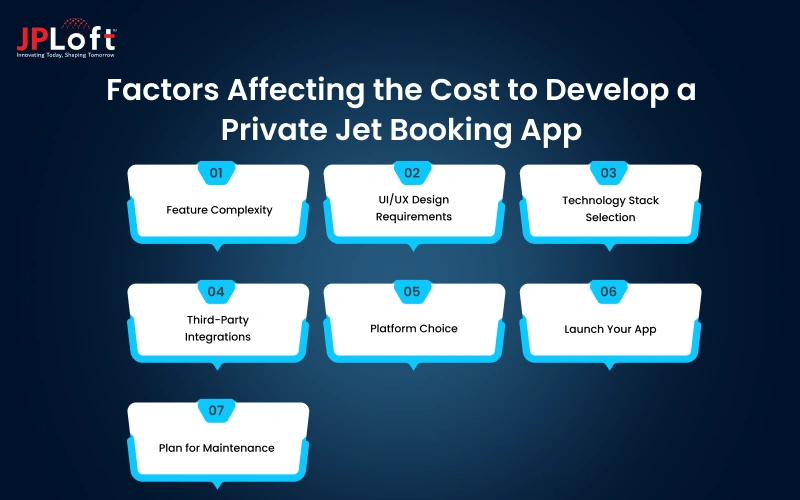
The actual mobile app development cost is dependent on multiple factors mentioned below.
(i) Feature Complexity
The more app features you include, the higher the cost. Advanced capabilities like AI recommendations, real-time tracking, and blockchain integration add significant development time and expense to any private flight booking app project.
(ii) UI/UX Design Requirements
Luxury platforms demand premium app design. Custom animations, high-end visual language, and a refined user experience require considerably more design hours compared to building a standard travel booking app.
(iii) Technology Stack Selection
The frameworks, databases, cloud services, and third-party APIs you choose directly impact both the cost to create a private jet booking app and the long-term maintenance expenses for the platform.
(iv) Third-Party Integrations
Every API you connect to, whether it is a flight data provider, payment gateway, or mapping service, adds licensing costs, integration time, and ongoing maintenance expenses to the total project budget.
(v) Platform Choice
Building for both iOS and Android simultaneously increases the overall cost to make a private jet booking app compared to launching on a single platform first.
Monetization Models for Private Jet Booking Apps
There are multiple ways to generate revenue from a jet booking app.
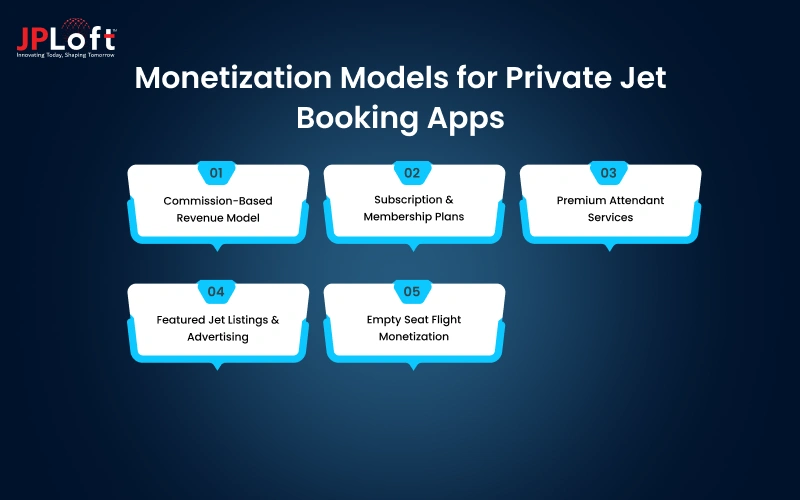
Here are the most practical and proven ways how airline solutions make money today.
[A] Commission-Based Revenue Model
Charge a fixed percentage on every booking made through the platform. This is the simplest model to start with and works well for marketplace-style apps.
[B] Subscription & Membership Plans
Offer monthly or annual plans that give users priority access, better rates, and exclusive benefits. This creates a reliable stream of recurring revenue for the platform.
[C] Premium Attendant Services
Charge additionally for high-end services like catering arrangements, ground transport, hotel bookings, and personal travel assistance that go beyond standard flight booking.
[D] Featured Jet Listings & Advertising
Allow operators to pay for better visibility on the platform. Featured listings, homepage placements, and sponsored spots are a straightforward way to monetize operator relationships.
[E] Empty Seat Flight Monetization
List available empty leg flights at discounted rates and take a commission on each sale. This turns otherwise lost inventory into a genuine revenue opportunity.
Challenges in Private Jet Booking App Development
Every serious decision on how to create a private jet booking app comes with real app development challenges.
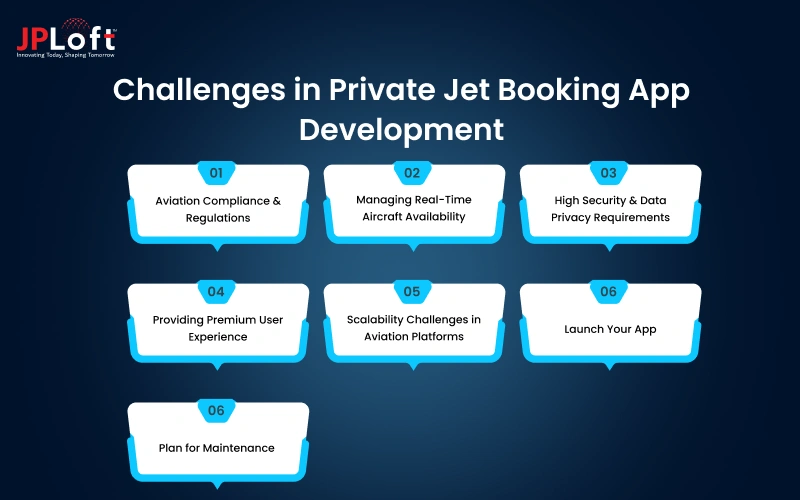
Here is what to expect and how to address each one.
Challenge 1: Aviation Compliance & Regulations
Different countries have different aviation authority requirements and passenger data regulations. Building across multiple markets means staying compliant with all of them at once. Non-compliance can get the platform shut down.
Solution: Work with aviation legal experts and build compliance checks directly into the operator onboarding flow.
Challenge 2: Managing Real-Time Aircraft Availability
Aircraft availability changes constantly based on bookings, maintenance, and crew schedules. However, displaying outdated availability leads to failed bookings and frustrated users.
Solution: Integrate reliable aviation APIs with live sync and build automated conflict detection into the booking engine.
Challenge 3: High Security & Data Privacy Requirements
Private jet users share sensitive personal and financial data on the platform. Any security breach carries serious legal and reputational consequences for the business.
Solution: Hire dedicated developers to implement end-to-end encryption, two-factor authentication, and regular third-party security audits across the platform.
Challenge 4: Providing Premium User Experience
Luxury travelers have very high expectations. A slow screen or confusing booking flow will push users away instantly. Every interaction needs to feel effortless and premium.
Solution: Invest in UI/UX designers who understand luxury product design and conduct regular usability testing with real users.
Challenge 5: Scalability Challenges in Aviation Platforms
As the user base grows, the platform needs to handle increasing bookings and data without slowing down. Poor infrastructure planning leads to performance issues that damage user trust.
Solution: Build on cloud infrastructure from day one and design the architecture to scale as demand increases.
Why Choose JPLoft to Build a Private Jet Booking App?
Private jet booking platforms demand precision, security, and a seamless user experience that leaves no room for error. Not every development team understands the technical complexity that aviation software requires.
JPLoft does.
From real-time flight availability and dynamic pricing engines to secure payment processing and operator management systems, our team builds every layer of your platform with aviation-specific expertise.
Our custom aviation software development approach ensures your app is designed around your specific business operations, fleet structure, and target clientele. Never a generic solution.
We have delivered high-performance platforms for startups and enterprises across travel, logistics, and aviation verticals globally.
Transparent timelines, clear pricing, and dedicated post-launch support make JPLoft the partner serious aviation businesses trust.
Ready to build your private jet booking platform? Let JPLoft turn your vision into a market-ready product.
Conclusion
Private jet booking app development sits at the intersection of luxury travel expectations and complex technical execution.
This guide has covered every layer of that complexity. From understanding the market opportunity and choosing the right app type, to building the correct feature set across all three panels.
The technology choices you make, whether cloud infrastructure, blockchain transactions, or AI-powered recommendations, directly determine how well your platform performs at scale.
Compliance, security, and real-time availability management are not optional considerations. In aviation, they are non-negotiable from day one.
The cost, the development process, and the monetization models all point to one conclusion. This is a high-investment, high-return opportunity for businesses that execute it correctly.
Building a platform that serious travelers trust requires more than good design. It requires aviation-specific technical expertise at every development stage.
JPLoft delivers exactly that.
FAQs
Start with thorough market research and a defined business model. Then move through UI/UX design, tech stack selection, core development, API integrations, compliance testing, and deployment.
The cost to make a private jet booking app typically ranges from $20,000 to $170,000+. The final figure depends on feature complexity, platform choice, technology stack, and the development team you work with.
Real-time jet availability, advanced search filters, secure payment integration, flight tracking, crew scheduling, operator management, and AI-based recommendations are the most critical features for a competitive private aviation platform.
AI personalizes aircraft recommendations based on travel history, automates dynamic pricing, predicts demand patterns, and flags scheduling conflicts for operators. It reduces manual intervention across the entire booking journey while improving conversion rates.
Commission-based revenue, membership plans, empty leg flight listings, premium concierge services, and featured operator placements are the most effective and proven monetization models for private jet booking platforms.

Rahul Sukhwal is the CEO and Founder of JPLoft, with 18+ years of experience in software engineering, emerging technologies, and digital product development. His expertise spans artificial intelligence, including AI agents, generative AI, LLMs, chatbots, computer vision, and machine learning, as well as blockchain, IoT, AR/VR, mobile, web, and enterprise software. He focuses on applying these technologies to real business challenges across industries such as healthcare, education, mobility, finance, real estate, and on-demand services.





Share this blog