


Key Takeaways
Real-time audio apps succeed by focusing on live conversations, interest-based communities, and seamless user engagement.
Core features include live rooms, clubs, moderation, notifications, AI recommendations, and monetization for scalable engagement.
Planning from ideation, tech stack selection, UX/UI design, development, testing, and launch ensures a reliable app.
AI, cloud infrastructure, and real-time communication boost personalization, moderation, and scalability for next-gen audio platforms.
Developing a Clubhouse-like app costs $35K–$200K+, with revenue from subscriptions, creator tools, and sponsorships.
Partnering with JPLoft accelerates delivery, ensures quality, and creates a high-impact, scalable social audio platform.
The explosive rise of audio-based social platforms has transformed how people connect, learn, and build communities online. Apps like Clubhouse proved that real-time voice conversations can create deeper engagement than traditional social feeds.
For startups and businesses exploring this space, understanding how to build an app like Clubhouse is no longer just a tech question; it’s a strategic growth opportunity.
From community-driven networking to creator economies and niche audience ecosystems, audio social platforms unlock powerful monetization and scalability potential.
If you're planning to enter this market, knowing how to develop an app like Clubhouse the right way, technically, strategically, and commercially, can define whether your platform becomes a trend or a long-term digital brand.
In this blog, we will discuss the step-by-step development process, features, costs, technologies, and monetization strategies to help you efficiently develop your Clubhouse-like app.
An Overview of the Clubhouse App
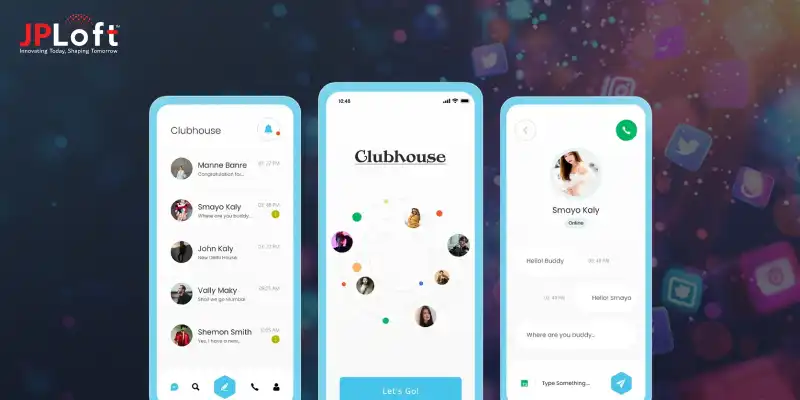
Clubhouse is an innovative audio-based social networking platform where users enter virtual rooms to participate in real-time voice conversations. Unlike text or image-first platforms, Clubhouse stands out by focusing purely on live audio discussions, giving creators and listeners a more intimate way to connect.
Understanding this unique format is essential for anyone exploring clubhouse-like app development, as it highlights the value of live audio interactions and community-driven engagement in modern social networking platforms..
Key Data Stats & Insights
Here are the latest data statistics that show where Clubhouse stands today:
-
~15 million weekly active users engaging across diverse communities, up drastically from early growth years.
-
Over 20 million total global downloads, reflecting sustained interest.
-
More than 10 million weekly active users as of 2025, reflecting sustained engagement.
-
Users create 700,000+ rooms daily, showcasing vibrant user-generated interaction.
These figures show that Clubhouse continues to maintain relevance as a voice-based community platform even years after its launch.
How Clubhouse Like Apps Work?
Here’s a simple breakdown of how real-time audio platforms function, from discovery to live interaction and moderation.
-
User onboarding: Sign up, select interests, follow creators, and get room recommendations when you create a clubhouse-like app.
-
Room discovery: AI-driven suggestions help users find relevant rooms for live discussions.
-
Live audio sessions: Users join rooms, listen, request to speak, or host conversations in real time.
-
Moderation & control: Hosts manage speakers, mute users, and maintain discussion quality.
-
Scalability flow: Real-time infrastructure, event handling, and streaming logic are built through structured clubhouse clone app development, while addressing core social media app development challenges like latency, moderation, and concurrency.
Reasons to Invest in an App Like Clubhouse
The audio-social economy is reshaping how people connect, learn, and build communities online.
Voice-first platforms are unlocking new business models, creator ecosystems, and scalable digital opportunities that go far beyond traditional social networking.
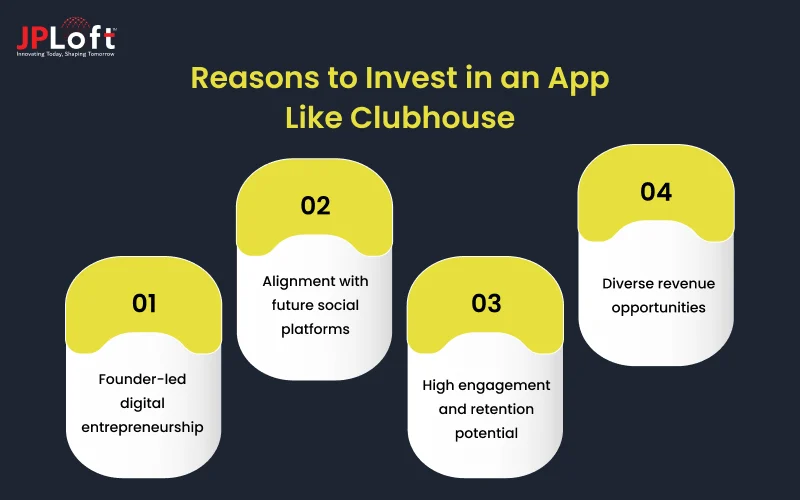
1. Founder-led digital entrepreneurship
Building an audio platform opens doors for creators, startups, and innovators exploring how to start a social media business model.
When you develop a social media app like Clubhouse, you create a scalable digital ecosystem where communities, creators, and brands grow together through conversation-driven engagement.
2. Alignment with future social platforms
Audio-first communities are strongly aligned with emerging social media app development trends, including creator economies, decentralized communities, and immersive engagement.
Brands that make a social media app like Clubhouse position themselves at the intersection of innovation, human connection, and long-term platform sustainability.
3. High engagement and retention potential
Live voice interactions create emotional connections that outperform traditional content formats.
Users stay longer, participate more actively, and form trust-based communities, increasing loyalty, session time, and long-term retention compared to conventional feed-driven social networks.
4. Diverse revenue opportunities
From creator monetization and premium rooms to subscriptions, brand sponsorships, enterprise communities, and exclusive access models, audio platforms enable multiple scalable revenue streams.
This reduces over-reliance on advertising and supports balanced, resilient, and sustainable long-term digital business growth.
Features to Include in an App Like Clubhouse
When designing an audio-based platform, understanding social media app features is critical.
Core functionalities such as live conversations, user engagement tools, and moderation capabilities ensure your platform is interactive, safe, and scalable for a global audience.
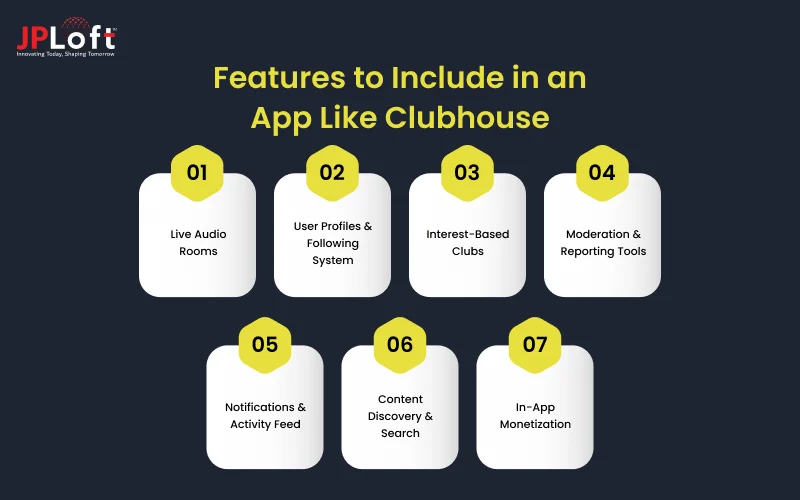
Here are the key features that you should include in your app like Clubhouse
1. Live Audio Rooms
Enable real-time voice conversations where users can join, listen, or speak freely. This core feature significantly boosts engagement, encourages authentic interactions, and forms the interactive community foundation when you create a social media app like Clubhouse.
2. User Profiles & Following System
Profiles with interest tags, followers, and detailed activity tracking promote personalized content discovery. This system strengthens social connections, builds trust, encourages recurring engagement, and is a key element in any clubhouse-like app development strategy.
3. Interest-Based Clubs
Communities centered around shared interests allow users to join specific groups and discussions. This increases engagement, encourages regular participation, and supports niche content ecosystems, helping your app build loyal and active user communities.
4. Moderation & Reporting Tools
Hosts and administrators can manage speakers, mute participants, or remove inappropriate content. Strong moderation ensures compliance with regulations, enhances social media app security, and builds user trust, privacy, and a safer community environment.
5. Notifications & Activity Feed
Timely updates about rooms, clubs, or user activity keep the platform dynamic and engaging. Notifications encourage real-time participation, prompt recurring interactions, and drive higher session frequency, improving overall growth and user retention metrics.
6. Content Discovery & Search
AI-powered recommendations and search tools help users easily find relevant rooms, topics, or creators. This ensures content stays personalized, dynamic, and highly engaging, improving user satisfaction and long-term platform retention.
7. In-App Monetization
Enable subscriptions, tipping, or premium room access for creators to earn revenue. These monetization features incentivize content creation, increase platform revenue, and contribute to a sustainable, long-term business model for your app.
Step-by-Step Guide to Make an App Like Clubhouse
Developing a social media app requires a structured approach, from ideation and market research to design, development, and post-launch optimization.
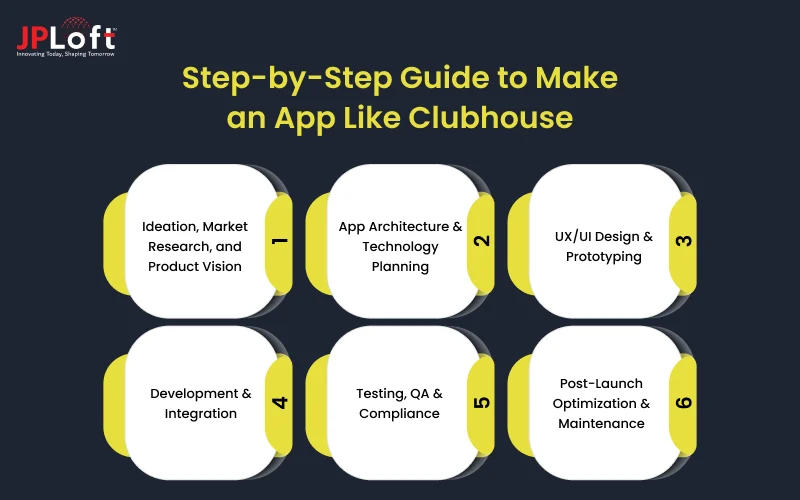
Following a clear roadmap guide your way on how to build an app like clubhouse successfully with scalability, engagement, and monetization in mind.
Step 1: Ideation, Market Research, and Product Vision
This foundational stage defines your platform’s purpose, target audience, and differentiation. It reduces costly pivots and ensures your app solves real social networking needs while guiding how to develop an app like Clubhouse effectively.
► Understand User Preferences & Audio Trends
Analyze the target audience’s behavior, interests, and engagement patterns. Assess popular audio topics, room sizes, and live interaction expectations to ensure your platform delivers meaningful experiences that retain and grow users organically.
► Validate the Business Model
Explore revenue models like subscriptions, sponsorships, or creator monetization. Market research helps identify opportunities and challenges, shaping a strategy that ensures sustainability, ROI, and competitive differentiation in the social audio space.
► Define Core Value Proposition
Clarify what differentiates your platform from competitors. Whether it’s moderation tools, AI recommendations, or exclusive communities, a strong value proposition guides all design, technical, and marketing decisions moving forward.
Step 2: App Architecture & Technology Planning
Designing a robust, scalable infrastructure is crucial for real-time audio interactions. The technical foundation ensures seamless functionality, enabling you to build a clubhouse-like app that supports millions of concurrent users with minimal latency and high reliability.
► Define System Architecture
Decide between cloud-native or hybrid architecture to support live audio, chat, and community features. Proper planning ensures smooth streaming, low latency, and easy scalability as the user base grows.
► Select the Social Media App Tech Stack
Choose frameworks, servers, and databases that support real-time communication. Using the right social media app tech stack ensures the platform can handle voice rooms, notifications, and analytics efficiently.
► Plan Data Flow & Security
User profiles, conversations, and community data must be stored securely. Implement end-to-end encryption and scalable APIs to maintain social media app trust and security, ensuring privacy and compliance.
Step 3: UX/UI Design & Prototyping
A smooth, intuitive interface significantly drives user engagement and long-term retention. Thoughtful design ensures effortless navigation through rooms, clubs, and live interactions while delivering a rich, immersive, and highly interactive social experience.
► Wireframing & User Flows
Map key user journeys such as joining rooms, raising hands to speak, or creating clubs. Detailed wireframes clarify interaction patterns, ensuring the platform remains intuitive, seamless, and highly engaging for all users.
► Interface Design & User Experience Planning
Develop UI/UX around accessibility, responsiveness, and clarity. A well-structured approach to designing a social media app ensures users can interact with live audio features smoothly, intuitively, and enjoyably across all devices.
► High-Fidelity Prototypes
Create interactive prototypes for testing and early feedback. This process refines interfaces, reduces user friction, validates design decisions, and ensures smoother development, higher adoption rates, and stronger long-term user satisfaction.
Step 4: Development & Integration
This stage transforms approved designs and system architecture into a fully functional, real-time social platform that supports live audio, clubs, communities, secure interactions, and scalable performance across all user experiences.
► Frontend & Create a Mobile App Phase
Develop user interfaces, live audio rooms, and interactive components. While creating a mobile app, focus on smooth performance, responsive layouts, accessibility, and engaging interactions across both Android and iOS platforms.
► Backend & Mobile App Tech Stack
Implement servers, databases, and APIs to manage live audio, notifications, and user data. Selecting the right mobile app tech stack ensures scalability, reliability, secure processing, and seamless real-time communication across the platform.
► Design a Mobile App Layer
Integrate UX/UI designs into functional, production-ready code. Designing a mobile app layer ensures intuitive navigation, seamless room interactions, consistent performance, and personalized user experiences across all supported devices and platforms.
Step 5: Testing, QA & Compliance
Ensuring quality, reliability, and regulatory compliance before launch is critical for building user trust and platform stability. It also supports smooth performance, security readiness, and long-term adoption across diverse user environments and device ecosystems.
► Functional & Performance Testing
Test all app features for stability, speed, and responsiveness across devices. Effective social media testing ensures live audio, notifications, clubs, and interactions function seamlessly even under heavy traffic and real-time user load.
► App Store Compliance
Prepare thoroughly for iOS and Android review processes. Following the guidelines to get your social media app approved on the iOS store helps prevent rejections, reduce approval delays, and accelerate launch timelines efficiently.
► Security & Privacy Audits
Verify encryption standards, data access controls, and moderation systems. Maintaining security ensures regulatory compliance, protects sensitive user data, and builds long-term trust, credibility, and platform integrity.
Step 6: Post-Launch Optimization & Maintenance
Continuous updates, performance optimization, and proactive support are essential for retention, scalability, and platform stability. They also address evolving user needs, support feature enhancement, and enable sustainable long-term growth after launch.
► Monitoring & Analytics
Track usage patterns, room popularity, engagement behavior, and conversion metrics. These insights guide feature improvements, optimize performance, enhance user experience, and support data-driven product growth strategies over time.
► Maintenance & Updates
Regularly update features, fix bugs, and optimize infrastructure. Strong social media app maintenance practices ensure smooth operations, system reliability, consistent performance, security upgrades, and long-term platform sustainability.
► Global Development Partnerships
Collaborate with experienced teams to scale infrastructure and deliver innovation faster. Partnering with a mobile app development company in the USA provides technical expertise, global scalability, quality assurance, and enterprise-grade delivery standards.
How Modern Technologies Shape the Development of Clubhouse-Style Apps
Emerging technologies are redefining how real-time audio platforms are built, scaled, and experienced.
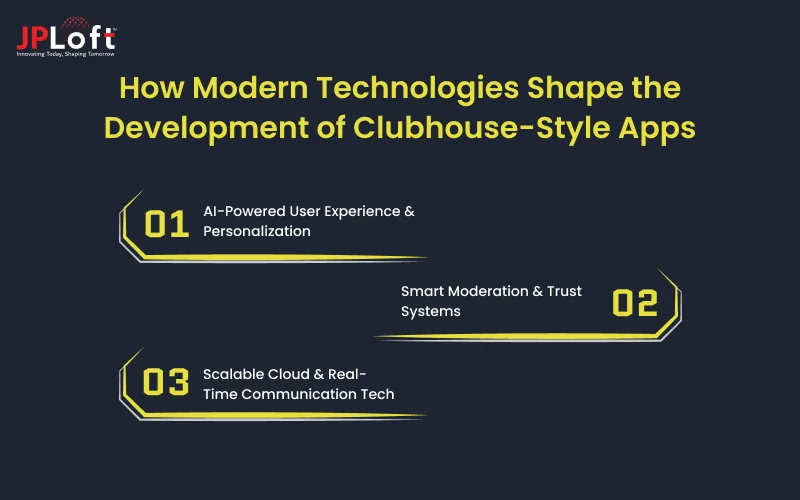
From intelligent moderation to adaptive personalization, innovation is now central to successful Clubhouse-like app development, making platforms smarter, safer, and more engaging for global audiences.
[1] AI-Powered User Experience & Personalization
Artificial intelligence analyzes user behavior, interests, and engagement patterns to personalize room recommendations, club suggestions, and content discovery.
The integration of AI in social media allows platforms to deliver highly relevant experiences, improving retention and long-term user engagement organically.
[2] Smart Moderation & Trust Systems
Modern AI models enable real-time content moderation, speech analysis, and abuse detection across live audio environments.
This helps platforms create safe, compliant communities, reduce manual intervention, and maintain trust, essential when you develop a social media clone like Clubhouse at scale.
[3] Scalable Cloud & Real-Time Communication Tech
Cloud infrastructure, low-latency streaming protocols, and microservices architecture ensure seamless audio delivery and global scalability.
These technologies support high concurrency, live interactions, rapid feature expansion, and continuous performance optimization without system bottlenecks or degradation.
What's the Cost to Build an App Like Clubhouse?
The cost to build an app like Clubhouse typically ranges from $35,000 to $200,000+, depending on feature depth, real-time audio infrastructure, scalability requirements, and product complexity.
A basic MVP with live audio rooms, user profiles, and moderation tools sits at the lower end, while enterprise-grade platforms with AI moderation, analytics, and advanced scalability push budgets higher.
Cost Based on Complexity
|
App Type |
Feature Scope |
Estimated Budget |
|
MVP Version |
Audio rooms, profiles, basic moderation |
$35K – $60K |
|
Mid-Level Platform |
Scheduling, analytics, creator tools, monetization |
$60K – $120K |
|
Enterprise Platform |
AI moderation, personalization, scalability, automation |
$120K – $200K+ |
Understanding the social media app development cost structure helps founders plan smarter investments, avoid scope creep, and build scalable products instead of short-lived prototypes.
When estimating the cost to build an app like Clubhouse, businesses must factor in technology architecture, development team composition, and long-term growth planning.
It’s not just about coding; infrastructure, security, performance, and future scalability all play a critical role. Ultimately, the final cost reflects how ambitious, intelligent, and market-ready your platform will be.
Cost Breakdown by Development Stage
|
Development Phase |
Estimated Cost Range |
|
Product Strategy & Research |
$3,000 – $8,000 |
|
UI/UX Design |
$4,000 – $12,000 |
|
Frontend Development |
$10,000 – $30,000 |
|
Backend Development |
$12,000 – $40,000 |
|
Real-Time Audio Infrastructure |
$8,000 – $25,000 |
|
Testing & QA |
$4,000 – $12,000 |
|
Deployment & Launch |
$2,000 – $6,000 |
|
Total Estimated Range |
$35,000 – $200,000+ |
Key Factors That Influence Cost
The following are the key factors which play a vital role in affecting the Clubhouse like app development cost.
1. Feature Complexity
Advanced moderation, creator monetization tools, AI-based recommendations, and real-time analytics significantly increase development scope and budget.
2. Real-Time Audio Infrastructure
Live audio streaming, low-latency communication, and room scalability require robust cloud architecture and specialized engineering.
3. Scalability & Performance Engineering
Apps built for thousands of concurrent users need stronger backend systems, increasing infrastructure and optimization costs.
4. Security & Compliance
User privacy, data protection, moderation systems, and regulatory compliance directly impact engineering time and investment.
5. Post-Launch Growth Readiness
Platforms built for long-term expansion require modular architecture, API readiness, and automation pipelines, raising initial costs but lowering long-term risk.
Founders who focus only on development pricing often underestimate real business costs. A scalable audio-first platform isn’t just an app; it’s a real-time social ecosystem. Smart investment upfront reduces technical debt, improves retention, and creates monetization-ready infrastructure.
How to Monetize an App Like Clubhouse?
A sustainable audio-social platform depends on diversified revenue streams that balance creator value, user experience, and platform scalability.
Strategic monetization mirrors how social media apps make money by combining creator economy models, platform services, and brand-driven revenue without disrupting community engagement.
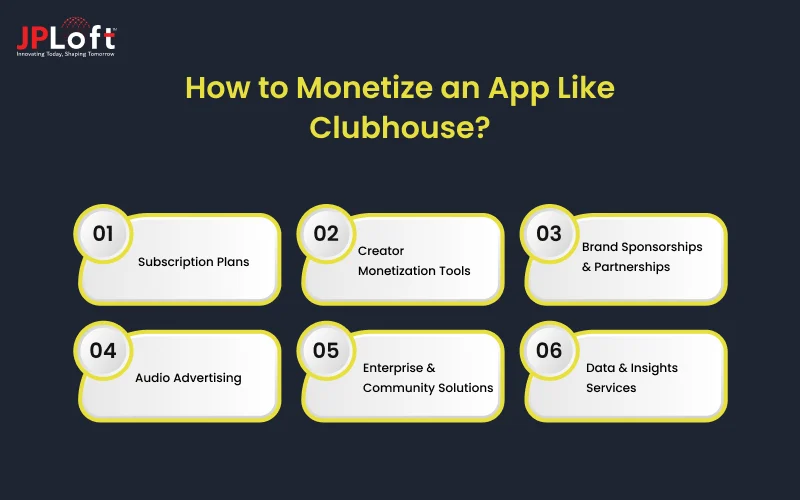
Here are the proven monetization models, including those you can use to create revenue streams for your Clubhouse-like app.
1. Subscription Plans
Offer premium memberships for exclusive rooms, advanced analytics, creator tools, and priority access to events. This creates predictable recurring revenue while strengthening user loyalty and long-term platform sustainability.
2. Creator Monetization Tools
Enable tipping, paid rooms, gated communities, and ticketed events so creators earn directly. Platform commissions generate scalable revenue while motivating creators to grow their audiences organically.
3. Brand Sponsorships & Partnerships
Allow brands to sponsor rooms, host audio events, and collaborate with influencers. This creates native advertising opportunities that feel authentic and non-intrusive to users.
4. Audio Advertising
Integrate short, contextual audio ads in public rooms and sessions. These placements maintain user experience while generating consistent revenue from high-engagement audio consumption patterns.
5. Enterprise & Community Solutions
Offer private audio communities, enterprise communication tools, and branded platforms for organizations, startups, and creators. This opens high-value B2B revenue channels beyond consumer monetization.
6. Data & Insights Services
Provide anonymized analytics, audience insights, and engagement intelligence to creators and brands. These insights support decision-making while creating additional platform-level revenue streams.
Partner with JPLoft and Create an App Like Clubhouse
Building a successful audio-first social platform isn’t just about code; it’s about strategy, scalability, and long-term growth vision.
Partnering with a trusted social media app development company like JPLoft ensures your product is designed for performance, security, engagement, and real-world market success from day one.
If you're exploring how to develop a social media app like Clubhouse, JPLoft brings the technical expertise, product thinking, and innovation mindset required to turn complex ideas into scalable platforms.
From architecture planning to real-time audio systems and growth-ready infrastructure, our team helps you create a clone app like Clubhouse that’s not just functional but future-proof.
Whether your goal is to build a social media clone like Clubhouse for startups, communities, creators, or enterprises, JPLoft delivers reliable engineering, modern technology, and business-focused execution that transforms vision into a high-impact digital product.
Conclusion
Developing a Clubhouse-style social audio app presents immense opportunities for engagement, community building, and monetization.
By carefully planning features, UX/UI design, real-time infrastructure, and AI-driven personalization, you can create a social media app like Clubhouse that stands out in a crowded market.
Understanding costs, scalability, and monetization strategies ensures your platform is both sustainable and growth-ready.
Whether building from scratch or designing a clone app like Clubhouse, following a structured, step-by-step approach reduces risks and accelerates success.
With the right technology, strategic planning, and expert execution, you can confidently build a social media clone like Clubhouse that delights users, empowers creators, and creates long-term value in the evolving audio-first social networking space.
FAQs
Key features include live audio rooms, user profiles, interest-based clubs, moderation tools, notifications, AI-powered recommendations, and monetization options like subscriptions or paid rooms. These features ensure engagement, safety, and scalability.
The cost typically ranges from $35,000 to $200,000+, depending on app complexity, real-time audio infrastructure, design, scalability, and monetization features. Advanced platforms with AI moderation or enterprise-grade tools fall at the higher end.
Real-time audio platforms use cloud-native infrastructure, WebRTC for audio streaming, microservices for scalability, AI for personalization and moderation, and secure databases for user data management.
Revenue streams include subscriptions, creator monetization (tips, paid rooms), brand sponsorships, in-app advertising, enterprise solutions, and analytics services for insights.
Depending on features, platform complexity, and testing, development can take 4–9 months for an MVP and 9–12 months for a fully-featured, scalable platform with advanced tools and monetization options.

Conor has 10+ years of experience in software development, application engineering, solution design, and UX/UI. He has worked across digital products in restaurant technology, food and grocery delivery, healthcare, media, streaming, and social platforms, bringing both technical and user-experience perspectives to product development. His experience working with large organizations and growth-focused digital products helps businesses translate complex requirements into practical, user-focused solutions.




Share this blog