


Key Takeaways:
If you want to develop a music app like Anghami, you need a clear process, from market research and UI/UX design to development, launch, and ongoing improvements.
Feature-rich experiences boost user engagement, with essentials like high-quality streaming, playlists, offline listening, lyrics, and social sharing.
A scalable tech stack is essential, using cloud infrastructure, secure streaming protocols, AI engines, and modern frameworks.
AI-driven personalization drives retention, enabling smart recommendations, mood-based playlists, and voice search.
Cost and monetization planning matter, with development costs ranging from $15,000–$80,000 and revenue from subscriptions, ads, and partnerships.
JPLoft empowers businesses to build Anghami-like apps, offering end-to-end development, scalability, and long-term support.
Have you ever considered to create a music app like Anghami? If yes, this blog is for you.
In the MENA regions, Anghami is one of the highly considered and evolving into a multi-media streaming and entertainment ecosystem in the MENA region.
As it continues to dominate the region, more and more investors are asking the question, “How to develop a music app like Anghami?”
Simply put, for that, you need to have the right strategy, technology, and execution plan to create a fast, reliable, and engaging music streaming platform.
So, in this guide, we’ll break down the key steps and insights you need to successfully build a music streaming app like Anghami.
What is the Anghami App?
Anghami is a popular music streaming and entertainment app that lets users access millions of songs, podcasts, and exclusive audio content anytime, anywhere.
The app is widely popular as a Spotify of the Middle East, and has grown into a powerful multimedia platform.
It combines music discovery, social sharing, personalized playlists, and offline listening into one seamless experience.
The app uses advanced algorithms and AI-powered recommendations to suggest songs based on user preferences, listening history, and trends.
Users can search for tracks, create playlists, follow artists, and even download music for offline playback, all through an intuitive and user-friendly interface.
For entrepreneurs looking to create a successful music streaming app, Anghami is a name that serves as a perfect example of how smart personalization, smooth streaming, and engaging social features can create a loyal user base and drive long-term growth.
Benefits of Building an App Like Anghami
Every founder evaluates whether investing in an app clone is actually worth it.
.webp)
That’s where understanding the real market potential becomes important. With hundreds of music apps already competing for users, the big question remains: why will users choose?
1. Tap Into Growing Demand
When people look for apps like SoundCloud, Anghami, and Spotify, they look for new features. Be it music in their own language, or handpicked playlists, or anything else.
User want today expect a personalized listening experience that feels more connected to their taste and culture.
2. Revenue Streams Are Open
A music streaming app is no longer limited to paid memberships. In current times, a music app has the potential to make money through different sources, such as collaborating with artists, labels, and even AI-driven recommendations. This makes the business model more scalable and attractive for investors.
3. Music Apps Have High User Retention
Users stay longer on platforms that understand their listening habits. By integrating AI-powered recommendations, mood-based playlists, offline listening, podcasts, and social sharing features, an app like Anghami can create a highly personalized music journey.
This is how creating a music streaming app like Anghami can open different doors to monetization.
Key Features to Have in A Music App Like Anghami
Anghami has amazing features, without any doubt. But to win the race, you need to have standout functionalities that draw people.
These features directly impact user experience, engagement, and retention. Let’s get to know the top music app feature that you must consider:
|
Feature |
Description |
|
User Registration & Profiles |
Allows users to sign up via email, phone, or social media and create personalized profiles. |
|
Music Streaming |
Enables high-quality audio streaming with minimal buffering and adaptive bitrate technology. |
|
Personalized Recommendations |
Uses AI and machine learning to suggest songs, artists, and playlists based on listening behavior. |
|
Playlist Creation & Management |
Let's users create, edit, and share playlists with friends or the public. |
|
Offline Listening |
Allows premium users to download songs and listen without an internet connection. |
|
Lyrics Display |
Shows real-time lyrics synced with the song for a more immersive listening experience. |
|
Search & Filters |
Helps users quickly find songs, albums, artists, or genres using advanced search filters. |
|
Social Sharing & Following |
Enables users to follow artists, share tracks, and connect with friends on the platform. |
|
Subscription & Payment System |
Supports premium plans, in-app purchases, and multiple payment gateways. |
|
Push Notifications |
Sends alerts for new releases, personalized recommendations, and playlist updates. |
To successfully build an audio streaming app like Anghami, you should prioritize user-centric features that improve discovery, personalization, and seamless streaming.
With the right combination of technology and functionality, you can create a powerful app that users can’t stop coming back to.
Step-by-Step Process to Develop a Music Streaming App Like Anghami
Wondering how to build a music app like Anghami? This is where you get to the real work.
The process includes multiple stages, from market research to deployment, and continuous improvement.
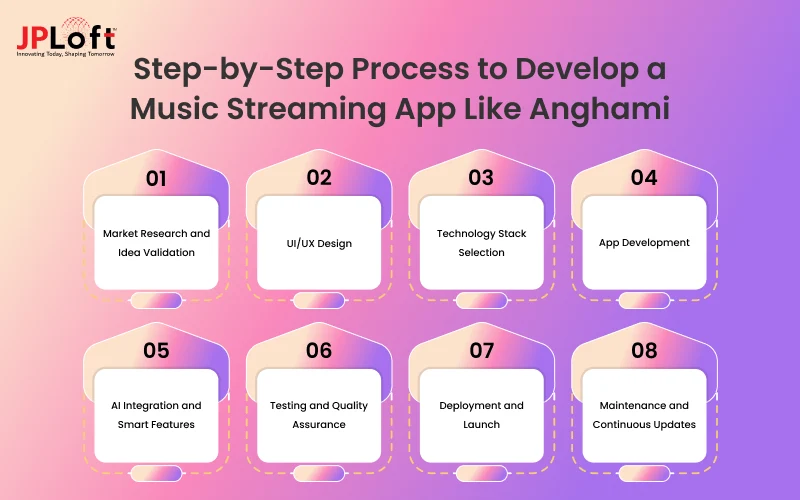
Understanding each step will help you build a secure and user-friendly music app.
For a glimpse, these are the steps:
-
Market Research and Idea Validation
-
Planning and Feature Finalization
-
UI/UX Design
-
Technology Stack Selection
-
App Development
-
AI Integration and Smart Features
-
Testing and Quality Assurance
-
Deployment and Launch
-
Maintenance and Updates
Now, let’s explore the complete process to develop a music app like Anghami in detail.
Step 1: Market Research and Idea Validation
The first step to build a music app like Anghami is understanding the market and your target audience.
In this step, you have to study market and industry trends, conduct thorough research on user demographics, and understand what competitors are providing and where the difference lies.
It is an extremely important step as it leads the whole development journey. You validate your music app idea, such as niche genres, regional content,t or AI-powered discovery features.
Key activities in this step include:
-
Identifying your target audience
-
Studying competitor features and pricing models
-
Defining your unique value proposition
Step 2: UI/UX Design
See, the only difference between a successful music app and a failed product is how it is designed.
In layman’s terms, design plays an important role in user retention. To design a music streaming app, you need to focus on simplicity, accessibility, and intuitive navigation.
A great UI/UX ensures users can easily search for songs, create playlists,s and discover new music.
The design should be appealing to users, and it should be easy for them to find any button or any feature the app has to offer.
Important design elements include:
-
Clean dashboard layout
-
Easy navigation menus
-
Personalized home screen
-
Dark mode and accessibility features
Step 3: Technology Stack Selection
It is important to choose the right mobile app tech stack to create a music streaming app like Anghami that is scalable and high-performing.
Your tech stack will include:
-
Frontend: React Native, Flutter, Swift, Kotlin
-
Backend: Node.js, Python, Ruby on Rails
-
Database: MongoDB, PostgreSQL
-
Cloud & Storage: AWS, Google Cloud, Azure
-
Streaming Protocols: HLS, DASH
This step also includes implementing music app security, such as DRM protection, encrypted streaming, and secure payment gateways to prevent piracy and data breaches.
Step 4: App Development
This is the core stage of Anghami like app development, where developers start coding the frontend and backend modules.
The development process is usually divided into:
-
Frontend development (mobile and web apps)
-
Backend development (servers, APIs, databases)
-
Admin panel development (content and user management)
At this stage, you develop a music streaming app like Anghami by integrating features such as playlists, search, recommendations, and social sharing.
Step 5: AI Integration and Smart Features
Modern music platforms rely heavily on AI-driven features to enhance user engagement. Adding AI features of music streaming apps can significantly improve retention and user satisfaction.
Popular AI-driven functionalities include:
-
Personalized playlists
-
Smart recommendations
-
Voice-based search
-
Mood-based music suggestions
These features make your app smarter and more competitive in the streaming market.
Step 6: Testing and Quality Assurance
Before launch, your app must undergo rigorous mobile app testing to ensure it is bug-free and performs smoothly under heavy traffic.
Testing includes:
-
Functional testing
-
Performance testing
-
Security testing
-
Usability testing
-
Compatibility testing across devices
Testing ensures your music streaming app like Anghami delivers a seamless experience without crashes or buffering issues.
Step 7: Deployment and Launch
Once app testing is complete, the next step is to launch your app on major platforms like Google Play and the Apple App Store. This phase also involves configuring servers, cloud infrastructure, and a CDN to ensure fast and reliable global content delivery.
Key activities in this stage include:
-
Submit an iOS app to the App Store by following Apple’s review guidelines.
-
Publish an app to the Google Play Store with optimized listings and metadata.
-
Set up cloud hosting, databases, and CDN for smooth streaming.
-
Add analytics tools to track user behavior and downloads.
-
Run marketing campaigns and ads to attract early users.
Step 8: Maintenance and Continuous Updates
Launching the app is not the end. Continuous updates, app maintenance services, bug fixes, and feature enhancements are essential to keep users engaged.
Regular updates also help you create a clone like Anghami that evolves with market trends and user expectations.
Maintenance includes:
-
Performance optimization
-
Feature upgrades
-
Security patches
-
User feedback implementation
You should know that knowing how to create a music app like Anghami requires you to fulfill all the processes properly.
Tech Stack for Developing a Music App Like Anghami
You should use the right tech stack when you develop a music app like Anghami.
There are several benefits it has that includes performance, scalability, and user experience.
A robust music streaming app tech stack ensures seamless streaming, fast loading times, and secure data handling.
So, be it a cloud-based music solution like Anghami, selecting modern and scalable technologies is essential for long-term success.
Below is a commonly used tech stack:
|
Category |
Technologies & Tools |
Purpose |
|
Frontend (Mobile) |
Swift (iOS), Kotlin (Android), Flutter, React Native |
Build responsive and high-performance mobile apps |
|
Frontend (Web) |
React.js, Angular, Vue.js |
Develop interactive web-based music streaming platforms |
|
Backend |
Node.js, Python (Django/Flask), Ruby on Rails |
Handle server-side logic, APIs, and user requests |
|
Database |
MongoDB, PostgreSQL, MySQL, Firebase |
Store user data, playlists, and content metadata |
|
Cloud Services |
AWS, Google Cloud, Microsoft Azure |
Host servers, storage, and scalable infrastructure |
|
Streaming Protocols |
HLS, MPEG-DASH |
Enable adaptive bitrate streaming for smooth playback |
|
AI & Recommendation Engine |
TensorFlow, PyTorch, Apache Spark |
Power personalized recommendations and smart playlists |
|
Payment Gateway |
Stripe, PayPal, Apple Pay, Google Pay |
Manage subscriptions and in-app purchases |
|
DevOps & CI/CD |
Docker, Kubernetes, Jenkins |
Automate deployment and ensure system reliability |
|
Security |
DRM, SSL Encryption, OAuth |
Protect music content and user data |
A well-planned tech stack helps you make a music app like Anghami that is scalable, secure, and capable of handling millions of users simultaneously.
By leveraging cloud infrastructure, AI-driven recommendations, and modern development frameworks, you can build a future-ready music streaming platform that competes with top industry players.
Cost to Develop a Music App Like Anghami
The cost to build a music streaming platform like Anghami typically ranges between $15,000 and $80,000+, depending on the scope and complexity of the app.
The overall music streaming app development cost is influenced by several factors, including feature set, platform selection (iOS, Android, or both), UI/UX design quality, and third-party integrations.
So, if you are developing a basic MVP or a fully scalable app, the budget can be different:
|
Development Component |
Estimated Cost Range |
|
UI/UX Design |
$3,000 – $8,000 |
|
Frontend & Backend Development |
$6,000 – $30,000 |
|
Music Streaming & APIs |
$3,000 – $12,000 |
|
Cloud Infrastructure & CDN |
$2,000 – $10,000 |
|
Testing & Deployment |
$1,000 – $5,000 |
|
Maintenance & Updates |
$2,000 – $15,000 |
While the initial investment may vary, choosing the right mobile app development company in USA helps control the cost without compromising quality.
A scalable architecture and future-ready features ensure long-term value, performance, and growth for your music streaming app.
Monetization Models for Apps Like Anghami
Building a music streaming platform is not just about features, it’s also about choosing the right revenue model. If you want to monetize a music streaming app, you need multiple income streams to maximize profitability and user retention.
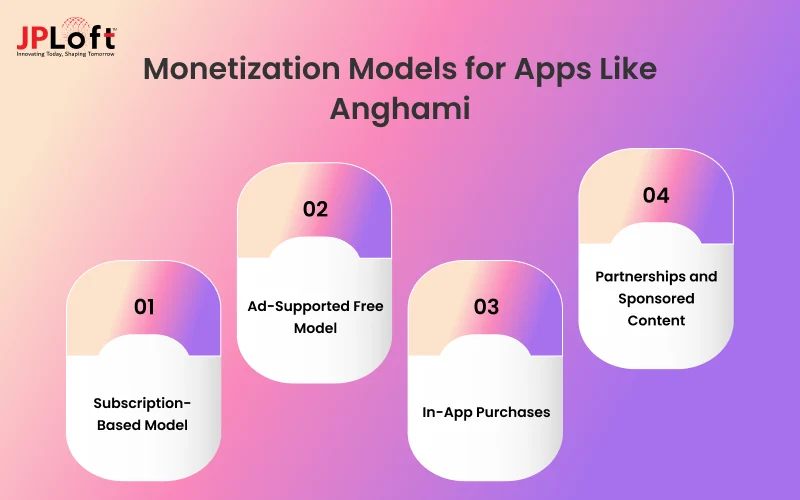
Here are the most effective monetization models:
A. Subscription-Based Model
In this model, users pay a monthly or yearly fee to enjoy ad-free streaming, offline downloads, and premium features.
This monetization strategy is used by platforms like Anghami and Spotify.
B. Ad-Supported Free Model
Free users listen to music with ads in between tracks. This model attracts a large user base and generates revenue through audio ads, display ads, and sponsored content.
C. In-App Purchases
Users can buy add-ons like premium playlists, exclusive content, or artist subscriptions. This model works well for users who prefer flexibility instead of full subscriptions.
D. Partnerships and Sponsored Content
Brands and artists can collaborate with the platform to promote music, playlists, or events. Sponsored playlists and branded content are powerful ways to generate additional revenue.
Challenges in Developing a Music Streaming App Like Anghami
Launching your Anghami clone app is complex and comes with several technical and business hurdles.
Here are the key music app development challenges you should be aware of:
-
Content Licensing & Copyright Issues: Acquiring music licenses from labels and artists is expensive and legally complex.
-
High Infrastructure Costs: Streaming requires powerful servers, cloud storage, and CDNs to handle millions of users simultaneously.
-
Scalability Issues: As users grow, performance optimization becomes critical to avoid buffering and crashes.
-
Security Risks: Protecting content from piracy and ensuring platform security with DRM and encryption is essential.
-
Competition with Global Giants: Competing with Spotify, Apple Music, and YouTube Music requires strong differentiation.
-
User Retention Challenges: Keeping users engaged with AI-driven recommendations and personalization is a constant effort.
Overall, while these challenges can seem complex, they are manageable with the right strategy, technology, and development expertise. Businesses that plan carefully and invest in scalable architecture can successfully overcome these hurdles.
With a user-first approach, it’s entirely possible to build a competitive and future-ready music streaming platform like Anghami.
Future Trends to Create a Music Streaming App Like Anghami
The music streaming industry is evolving rapidly, and staying ahead of trends is crucial if you want to build a clone Anghami that stands out.
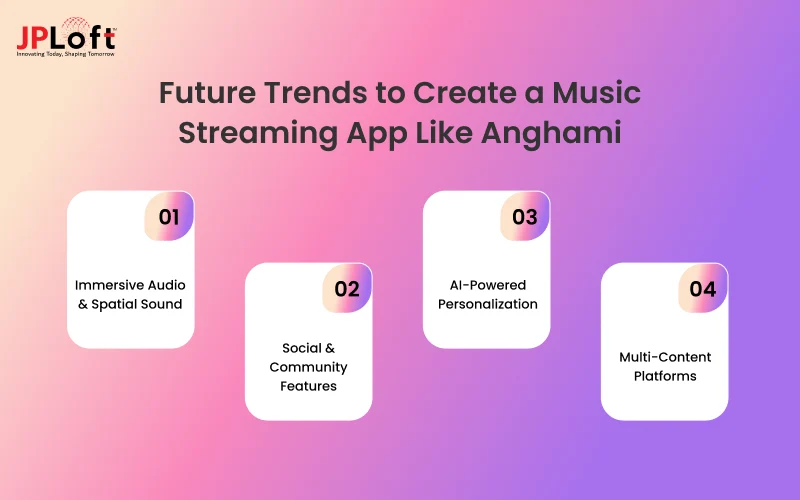
Here are the latest music streaming app trends shaping the future:
[1] Immersive Audio & Spatial Sound
High-quality audio experiences such as Dolby Atmos and spatial sound are becoming a key differentiator for premium users.
These technologies offer richer, more immersive sound, making users feel closer to live performances and studio-quality music.
As user expectations rise, immersive audio will become a standard feature in modern music streaming apps.
[2] Social & Community Features
Future music streaming apps will focus more on building communities rather than just streaming music.
Features like social listening, live sessions, artist-fan interactions, and shared playlists help increase engagement and foster loyalty among users.
[3] AI-Powered Personalization
Artificial intelligence will continue to play a major role in shaping music discovery.
From smart playlists and mood-based recommendations to voice-assisted search, AI helps deliver a highly personalized listening experience.
Advanced algorithms can analyze user behavior, listening patterns, and preferences to suggest music users truly enjoy, significantly improving engagement and long-term retention.
[4] Multi-Content Platforms
Music apps are evolving into complete entertainment ecosystems.
Along with music, platforms now offer podcasts, videos, live concerts, and exclusive content, similar to Anghami’s OSN+ integration. This multi-content approach keeps users engaged within a single app.
By embracing these trends, you can future-proof your platform and build a next-generation music streaming app that competes effectively on a global scale.
How JPLoft Can Help You Develop a Music App Like Anghami?
Looking to turn your music streaming idea into a powerful, revenue-generating platform? JPLoft offers music streaming app development services that help startups and enterprises turn innovative ideas into high-performing digital products.
As a top company, we have delivered many successful music apps in the market. We have 98% client retention rate and have a track record of 1100+ successful apps.
From intuitive UI/UX design and robust backend architecture to AI-powered recommendations and cloud-based streaming solutions, the team ensures every aspect of development aligns with your business goals.
Final Wrap-Up
Building a music streaming app like Anghami requires careful planning, the right technology stack, and a deep understanding of user expectations.
From licensing and infrastructure to personalization and scalability, every decision plays a crucial role in performance and growth. With a clear strategy and the right development approach, businesses can develop a music app like Anghami that is scalable, secure, and user-focused.
Partnering with an experienced development team further ensures the platform delivers long-term value, strong engagement, and sustained success in today’s evolving digital music landscape.
FAQs
To develop an app like Anghami, start with market research, secure music licenses, design a user-friendly interface, and build a scalable backend with cloud-based streaming and AI recommendations.
The cost typically ranges between $15,000 and $80,000+, depending on features, platform choice, design complexity, and scalability requirements.
On average, development can take 2 to 4 months for an MVP, while a feature-rich app may take longer based on customization and integrations.
Core features include user registration, music streaming, playlists, search, offline mode, AI-based recommendations, and secure payment integration.
Key trends include AI-powered personalization, immersive audio formats, social listening features, and multi-content platforms offering music, podcasts, and live events.

Conor has more than 10 years of experience in software development, app creation, solution engineering, and UX/UI design. With an impressive track record of high retention and growth working with Fortune 500 companies, he brings the technical depth and strategic perspective needed to help businesses build impactful, user-focused digital solutions.


Share this blog