


Key Takeaways:
Music streaming apps require strong scalability, security, and performance planning for long-term business growth.
Personalized recommendations and smooth user experiences play a major role in improving user retention.
Licensing compliance and copyright management remain critical challenges for modern music streaming platforms.
AI-powered features are transforming music apps, but businesses must implement them responsibly and strategically.
Continuous updates and maintenance are essential for staying competitive in the evolving streaming industry.
Partnering with JPLoft can simplify complex music app development challenges effectively.
Building a music app may look simple, but the actual process involves many complex steps and technical decisions. From managing user expectations to handling licensing rules, businesses often face several music app development challenges during the journey.
Users now expect smooth streaming, smart recommendations, offline access, and fast app performance across every device. Even a small issue like buffering or poor navigation can quickly push users toward competing platforms.
At the same time, businesses must manage content security, platform scalability, music rights, and changing user preferences. These factors can directly affect user retention and long-term app success.
Creating a successful music platform requires the right strategy, experienced developers, and a deep understanding of user behavior. Without proper planning, development costs and technical issues can grow quickly.
In this blog, we will explore the most common development challenges of music apps and practical ways businesses can overcome them.
Market Overview: Music Streaming Industry in 2026
The music streaming industry continues to grow rapidly in 2026, driven by rising smartphone usage, AI-powered recommendations, and increasing demand for personalized audio experiences. Businesses entering this market now face significant opportunities, but competition is also intensifying.
-
The global music streaming market size is expected to reach $108.39 billion in 2030, at a CAGR of 14.9%.
-
Paid streaming services remained the biggest growth driver, contributing more than 52% of total industry revenue.
-
Similarly, the paid music streaming subscriptions crossed 837 million users globally in 2026, highlighting how streaming platforms continue to replace traditional music consumption methods.
-
Spotify remains the market leader in 2026 with around 290 million paid subscribers and more than 751 million monthly active users globally.
-
AI is also reshaping the music streaming landscape. Deezer reported that nearly 44% of newly uploaded tracks in 2026 were AI-generated.
-
Another major trend involves smarter recommendation systems. Industry research suggests that algorithm-based playlists now influence nearly 60% of global music streams.
As user expectations continue rising, businesses must focus on streaming quality, content licensing, app scalability, and user retention strategies. Companies planning to enter this market need strong development planning to compete successfully in 2026 and beyond.
.webp)
Key Music App Development Challenges To Look At
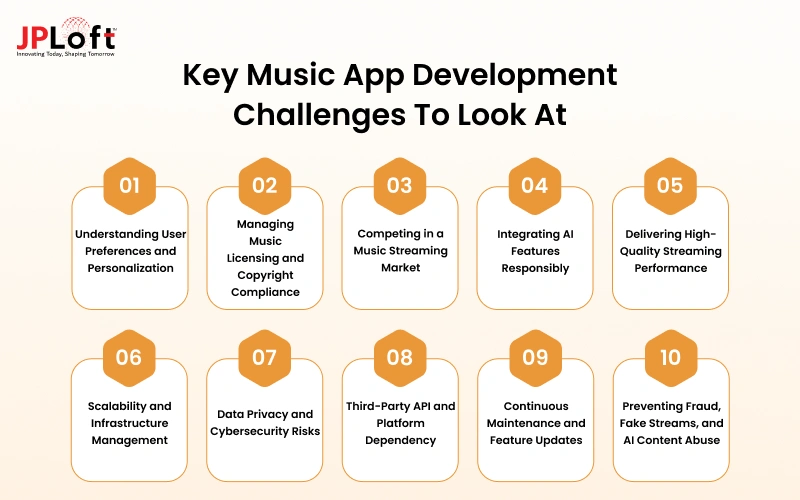
Let's discuss some of the major music app challenges that every business faces while they choose to build a music streaming app.
Challenge 1: Understanding User Preferences and Personalization
Modern users expect that the best music apps understand their listening habits and recommend relevant content instantly. Generic recommendations no longer keep users engaged for long periods.
Businesses must analyze user behavior, listening history, skipped tracks, search patterns, and playlist activity accurately. However, building smart recommendation systems requires advanced algorithms, real-time data processing, and continuous optimization.
Poor personalization can reduce user engagement and increase uninstall rates quickly. User expectations also continue changing with trends, moods, and regional preferences.
Delivering personalized experiences across multiple devices while maintaining speed and accuracy remains one of the biggest music streaming app development challenges for businesses in 2026.
Solutions:
-
Use AI-powered recommendation engines
-
Track real-time user listening behavior
-
Build personalized playlists and suggestions
-
Analyze user engagement regularly
-
Offer region-based music recommendations
-
Continuously improve recommendation algorithms
Challenge 2: Managing Music Licensing and Copyright Compliance
Music licensing remains one of the most complicated areas in music app development. Businesses must secure legal rights from artists, record labels, publishers, and distributors before streaming copyrighted content.
Licensing rules also vary across countries and regions, making music app compliance more difficult for global platforms. Unauthorized streaming or improper licensing can lead to lawsuits, penalties, and app removal risks.
The rise of AI-generated music has added new copyright concerns in 2026. Managing royalty payments, content ownership, and distribution permissions requires proper legal planning.
Without strong licensing management, businesses may face financial and operational problems after launching the platform.
Solutions:
-
Partner with licensed music distributors
-
Work with legal compliance experts
-
Maintain clear royalty tracking systems
-
Secure region-specific streaming rights
-
Regularly review copyright policies
-
Use content identification systems
Challenge 3: Competing in a Music Streaming Market
The music streaming industry has become highly competitive, with platforms like Spotify, Apple Music, and YouTube Music dominating global markets.
New businesses often struggle to attract and retain users because customers already have established platform preferences. Simply offering music streaming is no longer enough to stand out.
Businesses must provide unique features, better user experiences, exclusive content, or niche-focused services. Marketing costs and user acquisition expenses have also increased significantly in recent years.
Without a strong differentiation strategy, many startups fail to gain long-term traction. Building brand loyalty in such a crowded market remains one of the major app development challenges.
Solutions:
-
Focus on a niche target audience
-
Offer unique features or exclusive content
-
Build strong onboarding experiences
-
Invest in referral and loyalty programs
-
Use influencer and social media marketing
-
Improve user retention strategies continuously
Challenge 4: Integrating AI Features Responsibly
AI features in music apps are transforming the industry through smart recommendations, voice assistants, and AI-generated music creation tools. However, integrating these technologies creates several challenges while developing a music app for businesses.
Poor AI implementation may generate inaccurate recommendations or repetitive user experiences. AI-generated content also raises concerns related to originality, copyright ownership, and content authenticity.
Users increasingly expect transparency regarding how AI systems operate inside applications. Businesses must balance automation with human-centered experiences while avoiding biased recommendations and misleading AI-generated content.
Properly managing AI systems while maintaining trust, quality, and ethical standards has become an important development challenge in 2026.
Solutions:
-
Use transparent AI recommendation systems
-
Monitor AI-generated content quality
-
Combine AI with human moderation
-
Avoid biased recommendation algorithms
-
Clearly disclose AI-powered features
-
Regularly test AI performance accuracy
Challenge 5: Delivering High-Quality Streaming Performance
Users expect smooth and uninterrupted streaming experiences across smartphones, tablets, desktops, and smart devices. Even minor buffering delays or audio quality issues can negatively impact user satisfaction.
Music streaming apps must handle high traffic volumes, fast content delivery, and stable playback under varying internet conditions. Features like offline downloads, live streaming, and high-definition audio increase technical complexity further.
Businesses must optimize server response times, reduce latency, and maintain reliable streaming performance globally. Poor performance directly affects user retention in music apps
Ensuring consistent playback quality across devices and networks remains a critical challenge for modern music streaming platforms.
Solutions:
-
Use reliable cloud infrastructure services
-
Optimize audio compression technologies
-
Implement adaptive bitrate streaming
-
Reduce server response times
-
Support offline listening functionality
-
Conduct regular performance testing
Challenge 6: Scalability and Infrastructure Management
As music streaming apps grow, they must handle increasing numbers of users, music uploads, playlists, and real-time streaming requests. Poor infrastructure planning can lead to crashes, slow loading speeds, and server downtime during peak traffic periods.
Businesses also need large-scale storage systems to manage millions of audio files efficiently. Expanding globally increases infrastructure complexity because streaming performance must remain stable across different regions.
Managing scalable databases, cloud servers, content delivery networks, and backend systems requires significant technical expertise.
Without a scalable architecture, businesses may struggle to support long-term growth and maintain a seamless user experience.
Solutions:
-
Build scalable cloud-based infrastructure
-
Use content delivery networks (CDNs)
-
Optimize database performance regularly
-
Implement load-balancing systems
-
Monitor server performance continuously
-
Plan infrastructure upgrades early
Challenge 7: Data Privacy and Cybersecurity Risks
Music streaming apps collect large amounts of personal data, including listening habits, payment details, location data, and user preferences. This makes music platforms attractive targets for hackers and cybercriminals.
Data breaches can damage brand reputation and reduce customer trust significantly. Businesses must also comply with global privacy regulations like GDPR and other regional data protection laws
Weak security systems may expose sensitive information or allow unauthorized access to accounts. As cyber threats continue evolving, protecting user information has become more difficult.
Maintaining strong cybersecurity standards while delivering personalized experiences remains a major challenge for music app businesses.
Solutions:
-
Use end-to-end data encryption
-
Implement secure payment gateways
-
Enable multi-factor authentication
-
Follow global privacy regulations
-
Conduct regular security audits
-
Monitor suspicious user activities
Challenge 8: Third-Party API and Platform Dependency
Many music streaming apps depend on third-party APIs for music libraries, payment systems, social sharing, and recommendation features. However, relying heavily on external platforms creates long-term risks for businesses.
API providers may change pricing models, restrict access, or modify usage policies unexpectedly. These changes can disrupt app functionality and increase the cost to build a music app.
Recent restrictions introduced by major streaming platforms have already impacted many third-party developers globally. Businesses must carefully manage external dependencies while maintaining service reliability.
Building a stable app ecosystem without excessive reliance on external providers remains an important technical and strategic challenge in music app development.
Solutions:
-
Reduce dependency on single API providers
-
Create backup integration systems
-
Monitor API policy changes regularly
-
Build custom internal features gradually
-
Choose reliable third-party vendors
-
Maintain flexible system architecture
Challenge 9: Continuous Maintenance and Feature Updates
Launching a music app is only the beginning of the development journey. User expectations continue to change rapidly, requiring businesses to release regular updates and improvements.
Apps must remain compatible with new operating systems, devices, and streaming technologies. Businesses also need to fix bugs, improve security, optimize speed, and add modern features continuously.
Delayed updates can reduce user satisfaction and increase uninstall rates. Maintaining stable app performance while introducing new functionalities requires ongoing technical support and investment.
Without proper music app maintenance, businesses may struggle to keep users engaged and competitive within the evolving music streaming industry.
Solutions:
-
Hire dedicated developers to release updates regularly
-
Monitor user feedback actively
-
Fix bugs and performance issues quickly
-
Improve features based on user behavior
-
Maintain long-term technical support teams
-
Test app compatibility across devices
Challenge 10: Preventing Fraud, Fake Streams, and AI Content Abuse
Streaming fraud and AI-generated content abuse have become serious concerns for music platforms in 2026.
Fraudulent activities such as fake streams, bot-generated plays, and unauthorized AI-generated songs can affect platform credibility and royalty distribution systems. Some users attempt to manipulate streaming numbers for financial gain or artificial popularity.
AI-generated music uploads are also increasing rapidly, creating content moderation challenges for businesses. Without proper detection systems, platforms may face legal issues, revenue losses, and trust-related problems.
Managing content authenticity while protecting artists and maintaining fair streaming practices has become a critical challenge for modern music streaming applications.
Solutions:
-
Use AI in music apps to detect fraud systems
-
Monitor suspicious streaming activities
-
Verify artist and content authenticity
-
Implement strict content moderation policies
-
Track abnormal streaming behavior
-
Remove fraudulent accounts quickly
How Can JPLoft Help Overcome Music App Development Challenges?
Building a successful music streaming platform requires the right technology, industry expertise, and long-term development support. JPLoft helps businesses overcome complex music streaming app development challenges by delivering scalable, secure, and feature-rich solutions tailored to modern market demands.
From licensing support and AI-powered recommendations to high-quality streaming performance, our experienced developers focus on creating smooth and engaging user experiences. We also help businesses manage scalability, security, API integrations, and continuous app maintenance efficiently.
As a trusted company for custom music streaming app development, JPLoft builds solutions designed for long-term growth and strong market performance. Our team understands changing user expectations and develops platforms that support better retention, faster performance, and seamless functionality across devices.
Whether you are launching a startup or upgrading an existing platform, JPLoft provides end-to-end development services that help your music app stay competitive in the evolving streaming industry.
Conclusion
The music streaming industry is growing rapidly, but building a successful platform is becoming increasingly challenging. Modern users expect personalized recommendations, smooth streaming, strong security, and seamless experiences across every device.
If your app fails to meet these expectations, users may quickly switch to competing music platforms. That is why businesses must focus on long-term scalability, licensing compliance, and user engagement from the beginning.
Features alone cannot guarantee success in today’s competitive music streaming market. Businesses also need strong performance, reliable infrastructure, and continuous platform improvements to retain users successfully.
The good news is that these challenges can create strong growth opportunities with the right development strategy. Companies that invest in modern technologies and smart planning can build scalable and future-ready music applications.
In 2026, innovation, performance, and user experience will continue shaping the success of music streaming platforms worldwide.
FAQs
Key challenges in music streaming app development include licensing, scalability, user experience, security, personalization, cross-platform compatibility, offline functionality, third-party integrations, and standing out in a competitive market.
Every music streaming app should include important features like an extensive music library, user accounts, powerful search functions, set creation, mobile listening, and personalized suggestions. These features ensure a smooth and interesting user experience.
The price of developing a music streaming app changes based on factors like features, difficulty, platform, and development team rates. On average, the cost can range anywhere from $20,000 to $150,000+.
To stand out, focus on unique features that cater to specific user needs, such as high-quality audio, live streaming events, social sharing options, or AI-driven personalized choices. Providing exclusive material and having a smooth, user-friendly experience can also give your app a competitive edge.
Common marketing tactics include membership models, in-app ads, partnerships with artists or brands, and exclusive content. To attract a larger audience, you can also offer a mix of paid and free tiers.

Conor has 10+ years of experience in software development, application engineering, solution design, and UX/UI. He has worked across digital products in restaurant technology, food and grocery delivery, healthcare, media, streaming, and social platforms, bringing both technical and user-experience perspectives to product development. His experience working with large organizations and growth-focused digital products helps businesses translate complex requirements into practical, user-focused solutions.


Share this blog