


Key Takeaways:
Building a music streaming app requires a clear process: audience research, business model selection, licensing agreements, feature development, UI/UX design, infrastructure setup, security testing, and a scalable, well-planned launch strategy.
Development costs typically range from $20,000 to $150,000+, driven mainly by feature complexity, platform choice, and advanced AI capabilities.
Future growth will be shaped by AI personalization, voice navigation, social listening, and fairer, artist-centric monetization models.
Licensing complexity, infrastructure scaling, competition, and data security remain the biggest challenges businesses must plan for early.
Core features like offline listening, cross-device sync, and smart search are non-negotiable for retaining users from day one.
What if your users could discover their next favorite song without searching for it? That is the power of a well-designed music streaming app.
Today’s listeners expect more than a large music library. They want personalized recommendations, smart playlists, seamless playback, offline access, and experiences that fit their mood and routine.
AI is also changing how users discover and interact with audio, making personalization a key part of modern streaming platforms.
For businesses, this creates new opportunities to reach niche audiences, build subscription-based services, and offer unique audio experiences.
However, developing a successful platform requires more than attractive screens. Licensing, streaming infrastructure, security, technology, monetization, and scalability all matter.
In this guide, we will explain how to build a music streaming app, key features, costs, strategies, and more needed to turn your idea into a scalable music platform.
Music Streaming Market Overview
Music streaming has grown from a convenient way to listen to songs into a major digital entertainment market. The global music app market is projected to grow from $62.5 billion in 2026 to $158.1 billion by 2033, representing a 14.2% CAGR.
The opportunity is also expanding across regions. The Middle East and Africa are expected to record the fastest growth, with a 17.9% CAGR from 2025 to 2030.
Competition remains strong, especially in established markets. In the US, Spotify holds 36% of the music streaming market, followed by Apple Music at 30.7% and Amazon Music at 23.8%.
At the same time, AI-powered recommendations, spatial audio, voice features, and faster 5G networks are changing how users discover and consume music.
For businesses, these music app market stats show opportunities to build focused platforms that serve specific audiences, regions, or listening needs.
Different Types of Music Streaming Apps
Before you build a music streaming app, you need to decide what type fits your business goals and target audience. Each type serves a different audience and comes with its own features and revenue model.
Here is a breakdown of the main types of music streaming apps businesses build today.
|
App Type |
What It Offers |
Best For |
Monetization Model |
|
On-Demand Streaming Apps |
Unlimited library, playlists, offline mode |
Mainstream, broad audiences |
Subscriptions, ad-supported tier |
|
Music Discovery Apps |
AI recommendations, mood-based playlists |
New music discovery focus |
Subscriptions, affiliate links |
|
Audio Recording & Production Apps |
Multi-track recording, mixing tools |
Musicians, podcasters, creators |
One-time purchase, premium tiers |
|
Podcast & Audio Content Apps |
Episode subscriptions, chapter navigation |
Spoken-word, long-form audio |
Ads, premium ad-free tier |
|
Social Music Sharing Apps |
Collaborative playlists, activity feeds |
Community-driven listening |
Subscriptions, brand partnerships |
|
Live Music & Concert Streaming Apps |
Live broadcasts, ticketed access |
Live-to-digital entertainment |
Ticket sales, merchandise |
|
Niche & Genre-Specific Apps |
Curated libraries, regional focus |
Underserved audience segments |
Subscriptions, direct artist deals |
Essential Features for a Music Streaming App
Every app needs a core set of music app features that keep users engaged from the first session onward.
Without these essentials in place, even a beautifully designed app struggles to hold user attention.
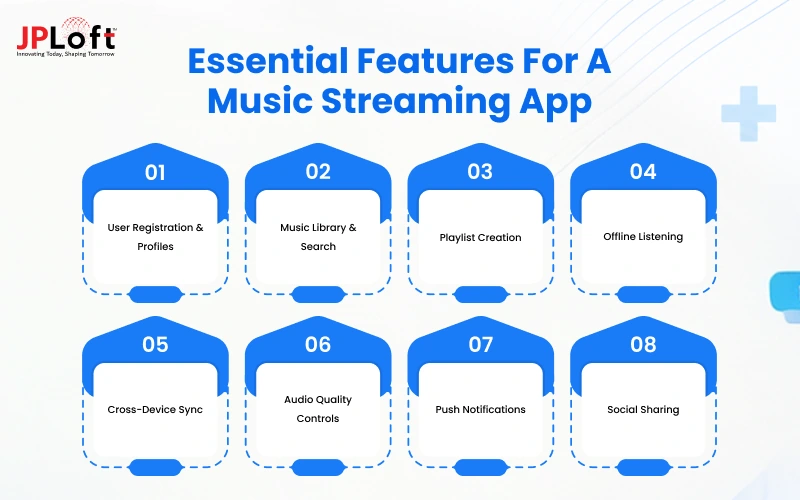
Here's what should be present when you choose to make a music app.
1. User Registration & Profiles
Lets users create accounts and save preferences, playlists, and listening history across devices, so their experience stays consistent every time they log in.
2. Music Library & Search
Fast, accurate search across songs, artists, albums, and genres helps users find what they want without friction, which directly impacts session length.
3. Playlist Creation
Users expect to build and organize custom playlists for different moods, activities, or occasions, making this one of the most-used features on any platform.
4. Offline Listening
Downloads for uninterrupted playback without an active internet connection are essential for users who listen while traveling, commuting, or in low-connectivity areas.
5. Cross-Device Sync
Keeps playback position, playlists, and preferences consistent whether a user switches from mobile to desktop to smart speaker.
6. Audio Quality Controls
Lets users choose streaming quality based on data usage or personal preference, balancing sound fidelity against bandwidth constraints.
7. Push Notifications
Alerts for new releases, playlist updates, and personalized recommendations keep users returning to the app between sessions.
8. Social Sharing
Lets users share tracks, playlists, or listening activity with friends, turning the app into a discovery channel through word of mouth.
These features work together to create a smooth, dependable listening experience.
Once these basics are locked in, businesses planning to develop a music streaming app typically move on to advanced, differentiating features that set their platform apart from generic on-demand apps.
Advanced Features to Include in a Music App
Once the essentials are in place, advanced features are what separate a forgettable app from one users stay loyal to. These additions boost engagement, personalization, and differentiation in a crowded market.
Businesses that want to build a music app capable of competing usually phase these mobile app features in after validating their core product with real users.
|
Feature |
What It Does |
|
AI-Powered Recommendations |
Suggests songs, artists, and playlists based on listening history and behavior patterns |
|
Mood & Activity-Based Playlists |
Curates music for specific moods, workouts, focus sessions, or times of day |
|
Song Recognition |
Identifies playing tracks in real time, similar to Shazam-style functionality |
|
Lyrics Sync |
Displays real-time lyrics alongside playback for a richer listening experience |
|
Voice Search & Control |
Lets users search, play, and control playback using voice commands |
|
Collaborative Playlists |
Allows multiple users to add, edit, and share a single playlist together |
|
Concert & Event Tracking |
Notifies users of upcoming concerts or events from artists they follow |
|
Music Therapy & Wellness Modes |
Curated audio experiences designed for relaxation, sleep, or stress relief |
How to Create a Music Streaming App From Scratch?
With licensing and copyright requirements covered, the next stage is understanding how to develop a music streaming app step by step, from initial planning through to launch and ongoing maintenance.
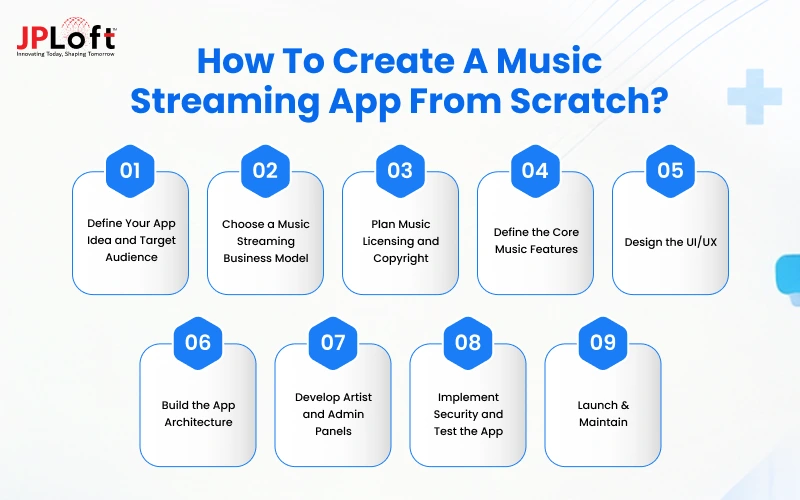
Step 1: Define Your App Idea and Target Audience
Every successful music app starts with clarity on your audience. This foundational step shapes every decision that follows, from feature priorities to long-term monetization strategy.
-
Identify your target listeners: Understanding your target listeners means researching their age, location, listening habits, and genre preferences. This data shapes feature priorities, content curation, and how you position your app against competitors.
-
Analyze leading music streaming apps: Studying platforms like Spotify, Apple Music, and niche market research reveals what already works well and where clear gaps exist. Review their features, pricing models, and user reviews carefully for opportunities.
-
Identify user needs and market gaps: Beyond studying competitors, talk directly to potential users about frustrations with existing apps. Underserved niches, missing features, or poor experiences often reveal the clearest opportunities for your new platform.
Step 2: Choose a Music Streaming Business Model
Once your audience is clear, the next decision is choosing how you'll monetize. This choice shapes how businesses typically build a Music Streaming App for sustainable, long-term revenue growth.
-
Select subscription or freemium plans: Subscription models offer predictable recurring revenue, while freemium plans attract users faster with a free ad-supported tier. Many successful platforms combine both to capture different listener segments.
-
Consider advertising-based monetization: Ad-supported listening works well for free-tier users, generating revenue through audio, banner, or video ads. This model works best alongside a premium tier to encourage eventual upgrades.
-
Explore additional revenue opportunities: Beyond subscriptions and ads, consider artist promotions, merchandise integration, concert ticket sales, or brand partnerships. These additional streams diversify revenue and reduce dependence on subscriptions alone.
Step 3: Plan Music Licensing and Copyright
With licensing covered earlier, this step focuses on turning that knowledge into action, securing agreements before development begins to avoid costly legal issues later.
-
Identify the required music rights: Determine whether you need Sound Recording Licenses, Musical Composition Licenses, or the entire music app compliance, depending on your content model. This determines which rights holders and organizations you'll work with.
-
Establish agreements with artists and labels: Direct agreements with labels and independent artists give you more content control but require more negotiation. Licensing aggregators can speed this process up significantly for newer platforms.
-
Plan royalty and copyright management: Set up systems to track plays, calculate royalties accurately, and pay rights holders on schedule. Poor royalty management damages artist relationships and can trigger platform takedowns.
Step 4: Define the Core Music Features
Every solid music app development guide emphasizes getting core features right before adding anything advanced, since these fundamentals directly determine user retention and daily engagement.
-
Build music streaming and playback: Reliable, low-latency streaming and playback form the foundation of any music app. Buffering issues or playback failures are among the fastest ways to lose frustrated users.
-
Add search, playlists, and favorites: Fast search, custom playlist creation, and favoriting tracks let users organize their listening experience. These features are used constantly and directly impact daily session length.
-
Implement downloads and cross-device syncing: Offline downloads and cross-device syncing keep the experience consistent whether users are traveling, switching devices, or losing connectivity, which strongly improves satisfaction and retention.
Step 5: Design the UI/UX
Strong music app design keeps users engaged and reduces drop-off during onboarding. This step translates your feature list into an intuitive, enjoyable listening experience.
-
Create user flows and wireframes: Map out how users move through registration, discovery, playback, and playlist creation before writing any code. Wireframes catch usability issues early, saving development time and cost.
-
Design intuitive music discovery screens: Discovery screens should make finding new music feel effortless, using clear visual hierarchy, smart categorization, and prominent recommendation sections that highlight personalized content immediately.
-
Build and test interactive prototypes: Interactive prototypes let you test navigation and user flows with real users before development begins, catching confusing layouts or missing features early in the process.
Step 6: Build the App Architecture
The technical foundation matters as much as design when developing an audio streaming app, since architecture decisions here directly affect performance, scalability, and cost as your user base grows.
-
Design the backend and API architecture: A well-structured backend and API layer handle user data, content delivery, and third-party integrations efficiently. Poor architecture decisions here become expensive and difficult to fix later.
-
Set up cloud storage and CDN delivery: Cloud storage holds your music library, while a content delivery network ensures fast streaming worldwide with minimal buffering, regardless of a listener's location.
-
Plan scalable audio streaming infrastructure: Infrastructure should handle growth from thousands to millions of concurrent listeners without performance drops, so plan for scalability early rather than rebuilding under pressure.
Step 7: Develop Artist and Admin Panels
A complete guide to music application development always includes backend tools, since artists and administrators need dedicated panels to manage content, users, and platform performance effectively.
-
Create artist profiles and upload tools: Artist profiles with easy upload tools let musicians manage their own catalogs, track performance, and update content directly, reducing your team's manual workload significantly.
-
Build content and catalog management: Admin tools for organizing, tagging, and moderating your music catalog keep the platform organized as your library grows, preventing content chaos as scale increases.
-
Add analytics, user, and royalty management: Dashboards tracking user behavior, engagement metrics, and royalty calculations give your team the data needed to make informed business and content decisions.
Step 8: Implement Security and Test the App
Mobile app security and testing are non-negotiable before launch, since businesses that create a music streaming app without rigorous testing often face costly bugs and user trust issues post-launch.
-
Secure accounts and user data: Implement encryption, secure authentication, and data protection measures to safeguard user accounts and personal information, meeting privacy regulations across the regions your app serves.
-
Integrate subscriptions and payment gateways: Reliable payment gateway integration ensures smooth subscription billing, renewals, and refunds, which directly affects user trust and reduces churn caused by failed transactions.
-
Perform functional and usability testing: Rigorous testing across devices, network conditions, and user scenarios catches bugs before launch, preventing poor first impressions that are difficult to recover from later.
Step 9: Launch & Maintain
Launch is not the finish line. Businesses that successfully develop a music app treat the post-launch phase as an ongoing cycle of monitoring, updates, and improvement.
-
Prepare App Store and Google Play listings: Optimize your app store listing with clear screenshots, descriptions, and keywords to improve discoverability and conversion rates among people browsing for new platforms.
-
Monitor performance and user behavior: Track engagement metrics, crash reports, and user feedback closely after launch to identify issues quickly and understand how real users interact with your platform.
-
Release updates and improve features: Regular updates addressing bugs, adding requested features, and refining performance keep users engaged and signal that the platform is actively maintained.
How Much Does It Cost to Build a Music Streaming App?
Building a music streaming app typically costs between $20,000 and $150,000+. However, the final cost to build a music streaming app depends on feature complexity, platform choice, and development approach.
Let’s break down the development cost on the basis of app complexity.
|
Complexity Level |
What's Included |
Estimated Cost |
|
Basic App |
Core streaming, playback, search, user profiles, basic playlists |
$20,000 - $45,000 |
|
Mid-Level App |
Basic features + offline downloads, cross-device sync, social sharing, admin panel |
$45,000 - $90,000 |
|
Advanced App |
Mid-level features + AI recommendations, voice search, song recognition, live streaming |
$90,000 - $150,000+ |
What Influences the Final Cost
-
Platform choice — Building for iOS, Android, or both simultaneously affects timeline and budget
-
Feature complexity — AI-driven personalization and live streaming cost more than standard playback
-
Team location — Development rates vary significantly across regions and agency models
-
Licensing approach — Aggregators are faster and cheaper than direct label negotiations
Businesses aiming to make a music streaming app that scales should budget for post-launch costs from the start, not just initial development, since ongoing maintenance and licensing fees continue well after launch.
Challenges in Developing a Music App & Their Solutions
Even with the right features and licensing in place, businesses face several recurring music streaming app development challenges.
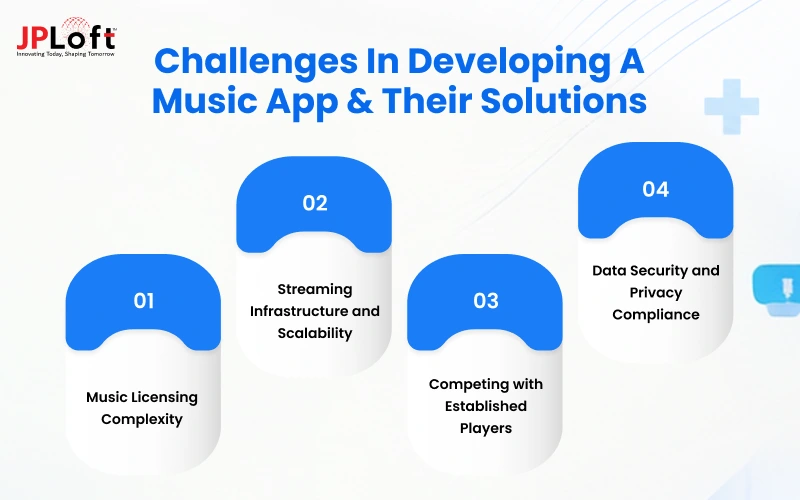
Understanding these challenges upfront helps avoid costly delays and post-launch issues.
Challenge 1: Music Licensing Complexity
Securing rights from multiple labels, artists, and Performance Rights Organizations is time-consuming and legally complex.
Different regions have different licensing requirements, and negotiating directly with major labels often takes months, delaying launch timelines significantly for new platforms entering the market.
Solution: Use licensing aggregators like Epidemic Sound or 7digital to speed up rights clearance.
Challenge 2: Streaming Infrastructure and Scalability
Delivering low-latency playback to thousands or millions of concurrent users requires a strong cloud infrastructure.
Businesses that develop a music streaming app without planning for scale often face buffering, crashes, and downtime as user numbers grow, damaging retention right when stability matters most.
Solution: Build on a scalable cloud infrastructure with CDN delivery from day one.
Challenge 3: Competing with Established Players
Spotify, Apple Music, and Amazon Music dominate mainstream listener attention and marketing budgets.
New entrants struggle to gain visibility and divert users away from platforms they've already invested playlists, preferences, and years of listening history into, making user acquisition genuinely difficult.
Solution: Focus on an underserved niche audience rather than competing head-on.
Challenge 4: Data Security and Privacy Compliance
Music apps handle sensitive user data, including payment information, listening habits, and location.
Meeting privacy regulations like GDPR across multiple regions while protecting against breaches requires ongoing investment, and non-compliance risks significant fines alongside lasting damage to user trust.
Solution: Implement encryption, secure authentication, and region-specific compliance reviews early.
Future Trends in Music Streaming Apps
Current features only tell half the story. Businesses following a solid music app development guide should also plan ahead.
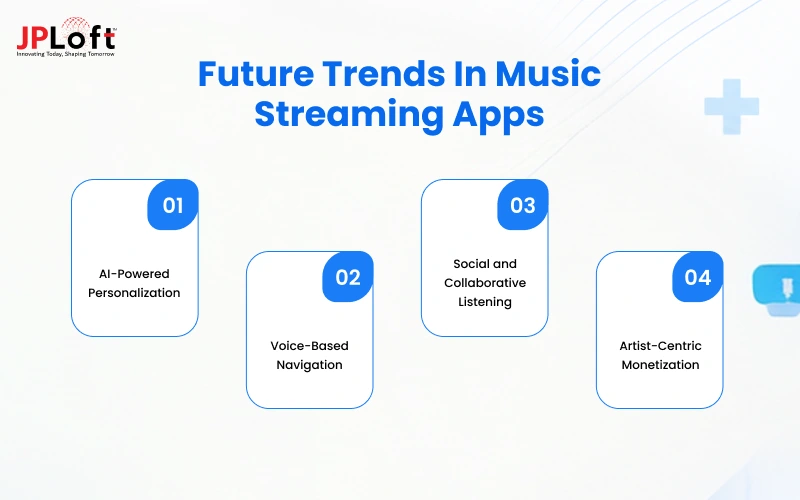
So, below are the top music app trends to consider when looking out for scalable business growth.
Trend 1: AI-Powered Personalization
AI is moving past basic recommendations. Platforms now use real-time context to shape listening.
Mood, time of day, and past behavior all factor in now. The goal is a playlist that feels personal, not generic.
Trend 2: Voice-Based Navigation
Voice control is becoming standard, not optional. Users want hands-free search and playback everywhere.
Smart speakers, cars, and mobile assistants all drive this shift. Convenience is now a competitive feature, not a bonus.
Trend 3: Social and Collaborative Listening
Listening is becoming social again. Shared playlists and activity feeds are gaining real traction.
Friends can see what others are playing in real time. This turns solo listening into a shared, community experience.
Trend 4: Artist-Centric Monetization
Platforms are rewarding artists more directly now. Fan-funded subscriptions and direct tipping are growing fast.
Musicians want fairer payout models than traditional streaming offers. Platforms that meet this demand stand out.
Why Choose JPLoft To Build A Music App?
JPLoft is a trusted music streaming app development company helping businesses turn ideas into scalable, revenue-ready streaming platforms. From licensing guidance to AI-driven personalization, our team handles every layer of development with precision.
We've built audio and streaming solutions across genres, regions, and business models, giving us practical insight into what actually drives user retention and engagement.
Our developers work with modern tech stacks, robust cloud infrastructure, and secure payment integrations to ensure your platform performs reliably at scale.
Beyond development, we support licensing strategy, monetization planning, and post-launch maintenance, so your app stays competitive long after launch.
Whether you're building a niche platform or a full-scale competitor to major players, JPLoft brings the technical expertise and industry experience to bring your vision to life, on time and within budget.
Conclusion
Building a successful music streaming app takes more than an attractive interface. From understanding market opportunity and choosing the right business model to securing proper licensing and building scalable infrastructure, every stage plays a role in long-term success.
Essential features keep users engaged, while advanced additions like AI personalization and social listening create real differentiation in a crowded market.
Costs vary based on complexity, but planning for licensing, security, and post-launch maintenance from the start prevents costly surprises later.
As trends like voice navigation and artist-centric monetization reshape the industry, businesses that plan ahead will be better positioned to compete.
With the right technology partner, turning your music app idea into a scalable, revenue-generating platform is well within reach.
FAQs
To create a music app, you need to define your audience, choose a business model, secure licensing, build core and advanced features, then design, develop, test, and launch on scalable infrastructure.
The development cost of a music app typically ranges from $20,000 to $150,000+, depending on feature complexity, platform choice, and whether you include AI-driven advanced features.
The future trends, including AI-powered personalization, voice-based navigation, social and collaborative listening, and artist-centric monetization models, are shaping music apps in 2026 and beyond.
Licensing complexity, scaling streaming infrastructure, competing with established players, and maintaining data security are the most common development challenges.
User profiles, search, playlists, offline listening, cross-device sync, audio quality controls, push notifications, and social sharing are all essential features that must be included in a music streaming app.

Conor has 10+ years of experience in software development, application engineering, solution design, and UX/UI. He has worked across digital products in restaurant technology, food and grocery delivery, healthcare, media, streaming, and social platforms, bringing both technical and user-experience perspectives to product development. His experience working with large organizations and growth-focused digital products helps businesses translate complex requirements into practical, user-focused solutions.


Share this blog