



Key Takeaways:
Build real user value with real-time fuel price tracking, route-based comparisons, and rewards that help drivers save money on every refill.
Apps like GasBuddy solve daily fuel cost uncertainty using crowd-sourced data, location intelligence, and timely alerts.
Learning how to develop an app like GasBuddy starts with market research, MVP planning, and choosing scalable features users actually return for.
Strong monetization comes from subscriptions, in-app ads, data insights, and loyalty partnerships without hurting user experience.
The future favors AI-driven price prediction, EV integration, and broader automotive services that increase retention and long-term revenue.
Partnering with JPLoft helps businesses build secure, scalable GasBuddy-like apps faster, with proven expertise in location-based platforms and fuel-tech monetization.
Every day, millions of drivers face a costly inefficiency, such as finding affordable fuel without wasting time and money.
Hence, it creates an opportunity for you and many of the investors to contribute to the fuel delivery industry.
When it comes to the industry, you need to search for diversified and competitive fuel delivery apps. GasBuddy is one of them that tops the list.
Now, the question arises, “How to build an app like GasBuddy?”
Well, you can create an app like GasBuddy through a process that begins with market study, selecting the right features, designing the app, building the tech stack, testing, and deployment.
It seems easy, right? Well, it is this simple with the right selection of the team. In this guide, you will learn about the complete process to build an app like GasBuddy, feature selection, monetization model, and much more.
Let’s discuss it all in this blog.
An Overview of GasBuddy: Find & Pay for Gas
If you are wondering how to build an app like GasBuddy, then its prime important to learn a bit about GasBuddy.
GasBuddy is a popular mobile app that helps users find the cheapest gas prices near them in real time. The flash deals make it simple to save when you fill it up. Here, on the find gas screen, find a station with the teal fresh deal banner.
The users can compare fuel prices across nearby gas stations, get notified about price drops, and even earn rewards by reporting accurate gas prices. Here, the users can earn points for purchasing items, playing games, or shopping online, which are redeemable for discounts.
This app has even saved millions of drivers significant money on fuel expenses, making it an essential tool for everyday commuters and road travelers. It also contributes effectively to the overall market size.
Before you switch to hire fuel delivery app developers for your app, let's learn a brief on market stats:
-
The global mobile fuel delivery market size is likely to be valued at USD 6.2 billion in 2026, and is projected to reach USD 10.1 billion by 2033, growing at a CAGR of 7.3% during 2026-2033.
-
GasBuddy has reportedly about 12 million monthly active users interacting with fuel price data and station information.
-
When it comes to fuel delivery, North America held the major market of more than 40% of the global revenue with the market size of USD 100.48 million in 2024 and will grow at a CAGR of 16.4% from 2024 to 2031.
-
However, the Asia Pacific held the market share of around 23% of the global revenue with the market size of USD 57.78 million in 2024, which can grow to a CAGR of 20.2% from 2024 to 2031.
Now, proceeding with the above stats, let's evaluate the complete reasons to make an app like GasBuddy in the following section.
Reasons to Make an App Like GasBuddy
Before you learn about “how to develop an app like GasBuddy”, you should evaluate “why.”
There are different reasons that you can consider for building an app like GasBuddy, such as massive daily demand driven by fuel price volatility, different money-making paths, and many more.
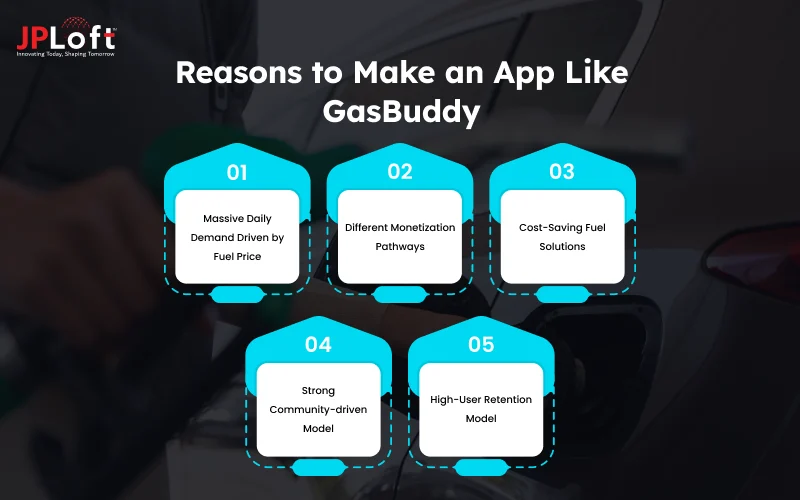
Let’s evaluate the complete list of reasons below:
► Massive Daily Demand Driven by Fuel Price
You must be aware that the fuel prices change daily, and users actively search for cheaper options before every refill. An app like this becomes part of a daily routine, not an occasional download.
► Different Monetization Pathways
When you create an app like GasBuddy, it will offer you multiple pathways. The key monetization models can be identified as targeted advertising, subscription models, data licensing, and retail media networks.
► Cost-Saving Fuel Solutions
Apps like GasBuddy offers cost-saving fuel platform that combines crowdsourced, real-time pricing data with a dedicated payment card and rewards program. This further helps the users to save up to 33-40 cents per gallon.
► Strong Community-driven Model
These apps are a strong community-driven model that encourages user participation through price reporting and station reviews. It fosters a sense of belonging through dedicated in-app spaces that encourage user-generated content and shared value.
► High-User Retention Model
Apps like GasBuddy have a high user retention potential through loyalty programs, rewards, and gamification features. This app does help the employees by fostering a positive, flexible work culture and offering competitive and comprehensive benefits.
Now, after pursuing the reasons, let's examine the key features to include in an app like GasBuddy in the following section.
Key Features to Include in an App Like GasBuddy
Fuel delivery app features such as location detection, fuel ordering, real-time tracking, order history, push notifications, and in-app support.
Let’s evaluate the complete list of features to include while building a clone like GasBuddy, in the table presented below:
|
Feature |
Description |
|
Real-Time Fuel Price Tracking |
Shows live fuel prices for nearby stations based on user updates and verified data sources. |
|
Location-Based Search |
Automatically detects user location and displays the closest gas stations with prices. |
|
Crowd-Sourced Price Updates |
Allows users to submit and update fuel prices, keeping data fresh and accurate. |
|
Price History & Trends |
Displays historical price changes to help users decide the best time to refuel. |
|
Fuel Type Filters |
Lets users filter prices by fuel type such as petrol, diesel, premium, or electric charging. |
|
Route-Based Price Comparison |
Shows the cheapest gas stations along a planned driving route. |
|
Station Details |
Provides station amenities like restrooms, car wash, air pumps, and payment options. |
|
Loyalty & Rewards Programs |
Integrates reward points, fuel discounts, and cashback programs for repeat usage. |
|
Push Notifications & Alerts |
Sends alerts for nearby price drops, deals, or favorite station updates. |
|
In-App Payments |
Enables users to pay for fuel directly through the app for faster checkout. |
|
Reviews & Ratings |
Allows users to rate stations and share feedback on service quality and accuracy. |
|
Analytics & Admin Dashboard |
Helps admins monitor usage, pricing accuracy, fraud detection, and engagement metrics. |
Proceeding with the features in the table, let's understand the complete process to make an app like GasBuddy.
How to Build an App Like GasBuddy?
You can make an app like GasBuddy after going through the steps, beginning from market research, selecting the right set of features, building the core architecture, and then launching the app in this diversified market.
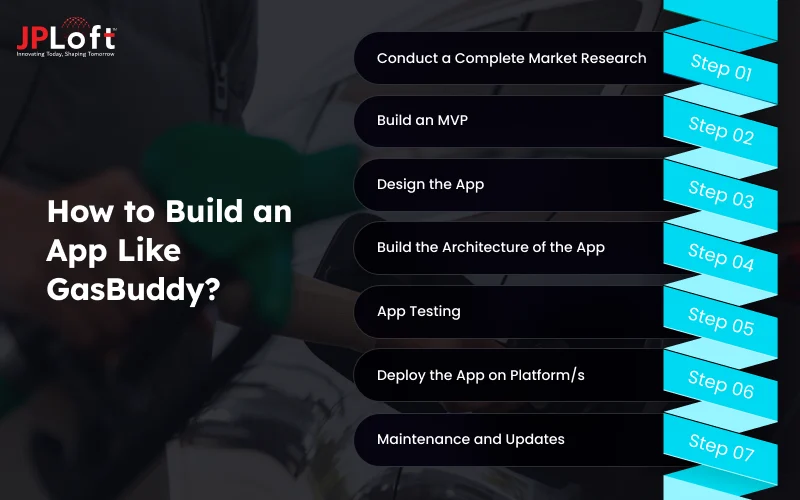
Let’s discuss the complete list of steps in this section:
Step 1: Conduct a Complete Market Research
This is the prime and most important step where you should learn about the market, discover the complete size of the fuel delivery app market, and then explore the dynamic interest of the users.
In this step, you should understand your audience well, study how people use the existing apps, and identify the competitors' strategy to gain users’ interest.
For the market research, you should conduct surveys or pilot studies to validate your app’s concept before investing heavily in development.
Step 2: Build an MVP
You can hire dedicated app developers and begin with a minimal viable product (MVP). This is a significant step to hold the interest of the target users.
For creating an MVP, you should select the key features or the basic features to include in such an app. Decide what the different types of features that you can include here are, and then you need to examine other features that you can include further in the app’s advancement.
This is a prime step that will be effective in saving your overall cost to build an app like GasBuddy and provide you with a complete pathway to proceed further.
Step 3: Design the App
In this step, you should proceed with the fuel delivery app design. When you talk about the first interaction of your app, then UI/UX tops the list.
Effective design streamlines complicated data such as map integration, live price updates, and user-generated reporting into a seamless experience that boosts engagement, trust, and even user retention.
Apart from this, you can proceed with the mobile app wireframe and the mobile app prototypes that will help you to sketch up the blueprint of your app.
Step 4: Build the Architecture of the App
Now, it's time to create the complete architecture of your app. For the fuel delivery app tech stack, it's crucial to follow cross-platform frameworks, including Flutter or React Native.
For an app like GasBuddy, the tech stack that can be included here is for the frontend; you can use frameworks like React Native, languages like JavaScript, and a web dashboard like React.js.
While for backend, you can use a framework like Node.js, an API architecture like RESTful API, and real-time communication like socket.io. This is the step where you create extensive functionalities.
Step 5: App Testing
Under this step, you should conduct a complete fuel delivery app testing. Testing comprises a comprehensive evaluation of functionality, performance, usability, and compatibility to ensure the app works.
It is one of the crucial stages where you need to ensure functionality, performance, and user satisfaction across diverse devices. It comprises functional testing, compatibility, usability, and network simulation.
Here, the key components of testing include functional testing, performance testing, compatibility testing, security testing, and many other tests as per the requirements of the app.
Step 6: Deploy the App on Platform/s
This is the last step, where you need to deploy the app on different platforms. You can submit an app on the Play Store, or you can publish an app on the App Store, as per the goal of the app.
You should check out the guidelines for both platforms. If you prefer to launch your app on one of them, then you should consider the targeted users accordingly.
Now, it's time for you to launch the app like GasBuddy on your designated platform. It does include compliance, setting up analytics for tracking, and further creating a suitable marketing strategy for your app.
Step 7: Maintenance and Updates
In this step, the work is after the deployment of your app, like GasBuddy. Fuel delivery app maintenance is a structured cycle of identifying needs, planning, executing, and validating changes or systems to ensure optimal performance, security, and relevance.
Connecting with a relevant mobile app maintenance service provider can be an important step to take if you feel confused regarding updates and maintenance.
Under this step, you should execute regular bug fixes, OS compatibility patches, performance optimizations, and backend server monitoring.
Well, within this process of Gadbuddy like app development, one of the prime steps that you need to evaluate in detail is the tech stack.
Hence, we have created a detailed version ofthe technology stack for an app like GasBuddy, in the following section.
Tech Stack to Include in an App Like GasBuddy
Mobile app tech stack can be considered as a combination of programming languages, frameworks, databases, and tools that are used together for designing, developing, and maintaining a software app.
Let's discover the complete list of given tech stacks to evaluate and understand diversified technologies.
|
Layer |
Technology Stack |
|
Mobile App Development |
Swift (iOS), Kotlin (Android), or Flutter / React Native for cross-platform |
|
Frontend Web Panel |
React.js or Next.js for admin and analytics dashboards |
|
Backend Development |
Node.js or Laravel for scalable API-driven architecture |
|
Database |
PostgreSQL or MySQL for structured data, MongoDB for flexible listings |
|
Real-Time Data Handling |
Firebase Realtime Database or WebSockets |
|
Maps & Location Services |
Google Maps API, Mapbox, Geolocation APIs |
|
Cloud Infrastructure |
AWS, Google Cloud, or Microsoft Azure |
|
Push Notifications |
Firebase Cloud Messaging (FCM), Apple Push Notification Service (APNs) |
|
Authentication & Security |
OAuth 2.0, JWT, Multi-Factor Authentication |
|
Payments Integration |
Stripe, PayPal, Apple Pay, Google Pay |
|
Analytics & Tracking |
Google Analytics, Firebase Analytics, Mixpanel |
|
Admin & Monitoring Tools |
Grafana, Kibana, CloudWatch |
With this technology set, let's evaluate the cost to create an app like GasBuddy in the following section.
How Much Does it Cost to Make an App Like GasBuddy?
The overall cost to build an app like GasBuddy falls between $25,000 to $100,000+.
This variation depends on multiple factors, such as the complexity of the app, the design of the app, the technology stack of the app, maintenance of the app, security of the app, and many other parameters.
Let’s discuss all of them in the following table:
|
Cost Factor |
Estimated Cost Range |
|
App Complexity (Basic to Advanced) |
$8,000 – $30,000 |
|
UI/UX Design & Prototyping |
$5,000 – $15,000 |
|
Frontend App Development |
$10,000 – $30,000 |
|
Backend Development & APIs |
$12,000 – $35,000 |
|
Real-Time Data & Map Integration |
$5,000 – $15,000 |
|
Admin Panel & Analytics |
$4,000 – $12,000 |
|
Testing & Quality Assurance |
$3,000 – $10,000 |
|
Security & Compliance Setup |
$2,000 – $8,000 |
|
Third-Party Integrations |
$3,000 – $10,000 |
|
Ongoing Maintenance & Scaling |
$5,000+ annually |
With this cost to develop a fuel delivery app, another crucial segment that follows is monetization, because including money-making models is of prime importance as you proceed with the development.
Let’s evaluate the complete list of monetization models in the following section.
Key Monetization Models to Include in an App Like GasBuddy
Different fuel delivery money-making models include subscription plans, in-app advertising, affiliate and partnership commissions, data monetization, loyalty, and reward programs.
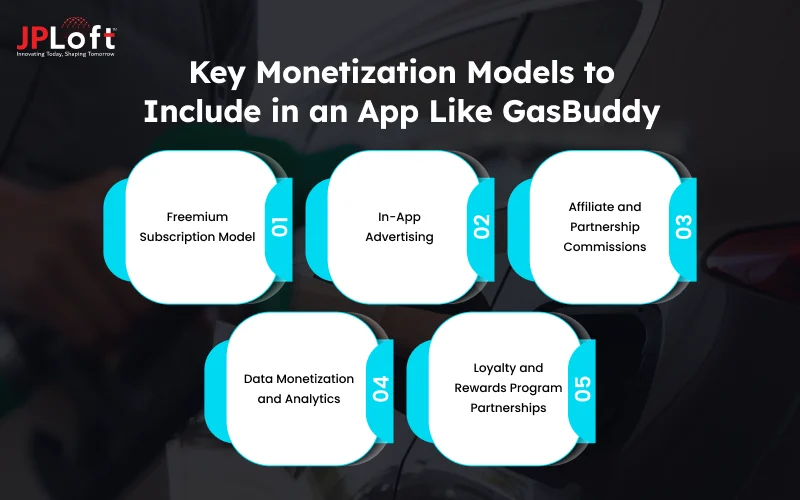
Let’s discuss all the models in this list:
1. Freemium Subscription Model
Offer a basic version of the app for free with core features like real-time gas price tracking and station locator, while charging users a monthly or annual subscription fee for premium features.
Premium features can include advanced price prediction, ad-free experience, priority notifications, fuel consumption analytics, and exclusive discounts at partner stations.
This model attracts a large user base initially while converting engaged users into paying subscribers, generating consistent and predictable recurring revenue for the business.
2. In-App Advertising
Display targeted advertisements within the app to generate revenue from the large user base without charging them directly.
Partner with gas stations, automotive brands, insurance companies, and local businesses to display relevant ads based on user location, driving habits, and fuel preferences.
Implement different ad formats such as banner ads, interstitial ads, sponsored listings, and native ads to maximize visibility and click-through rates while maintaining a seamless and non-intrusive user experience.
3. Affiliate and Partnership Commissions
Establish partnerships with gas stations, fuel companies, and automotive service providers, and earn commissions when you make a clone like GasBuddy.
When a user clicks on a sponsored gas station listing and fuels up there, your app earns a percentage of the transaction or a fixed referral fee.
This model benefits all parties involved: gas stations gain visibility and customers, users discover the best deals, and your app generates revenue without directly handling transactions.
4. Data Monetization and Analytics
Leverage the valuable data collected through user behavior, fuel consumption patterns, location history, and market trends to sell insights to fuel companies, automotive manufacturers, and research firms.
Provide detailed analytics reports on regional fuel pricing trends, consumer preferences, and market movements that businesses can use for strategic decision-making.
This model generates significant revenue as fuel industry stakeholders are willing to pay premium prices for accurate, real-time market intelligence and consumer behavior data.
5. Loyalty and Rewards Program Partnerships
Partner with gas stations and fuel companies to offer exclusive rewards, cashback, and discount programs to app users.
Gas stations pay your platform a fee to feature their rewards and promotions prominently within the app, attracting more customers to their locations.
Users benefit from earning points, cashback, or discounts on fuel purchases, increasing their engagement and retention, while gas station partners enjoy higher foot traffic and customer loyalty through your platform.
Now, as we have evaluated diversified money-making models, let's evaluate the complete future of an app like GasBuddy in the following section.
What is the Future of an App Like GasBuddy?
There is a bright future for an app like GasBuddy. The transformation in the mobility industry is due to people being more focused on convenience.
Let’s discuss the future of the app like GasBuddy in this section:
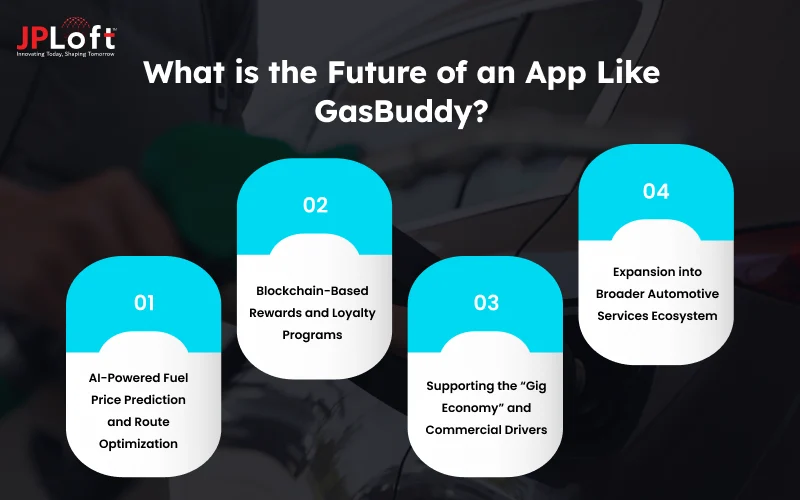
1. AI-Powered Fuel Price Prediction and Route Optimization
The future of fuel-finding apps lies in integrating artificial intelligence and machine learning to predict fuel price trends, recommend optimal refueling times, and suggest the most cost-effective routes.
Hence, adding AI in fuel delivery apps can be identified as an important trend and a future for an app like GasBuddy, which can enhance your app’s sustainability in the competitive market.
2. Blockchain-Based Rewards and Loyalty Programs
You can use the blockchain-based rewards and loyalty programs, and can further use decentralized ledgers for securely tokenizing rewards, enabling real-time digital assets.
Unlike traditional systems with delays, blockchain enables instantaneous tracking and redemption of rewards, which further leads to enhancing the overall user experience. Blockchain in fuel delivery apps enhances security and prevents malicious acts.
3. Supporting the “Gig Economy” and Commercial Drivers
An app like GasBuddy does support the gig economy by helping rideshare drivers, delivery couriers, and independent contractors minimize their overall fuel costs.
Through real-time price tracking and rewards programs, you can improve the overall profit margins. When a person builds an app like GasBuddy, they can further support this economy by adding gig-worker-specific features, such as bulk fuel discount partnerships.
4. Expansion into Broader Automotive Services Ecosystem
The fuel delivery apps are evolving into a comprehensive, on-demand automotive service platform by leveraging GPS, IoT, and user-friendly interfaces to expand beyond refueling into maintenance and EV charging.
You can integrate services such as maintenance, insurance, car buying, and much more.
With the above future trends of fuel delivery apps, it is clear that fuel delivery apps like GasBuddy has bright future, and are a good option for proceeding with investment.
Connect with JPLoft and Create an App Like GasBuddy
Building an app like GasBuddy requires a strategic combination of cutting-edge technology, intuitive design, and a deep understanding of the fuel industry to deliver a seamless user experience that attracts and retains millions of users.
The right development partner plays a crucial role in transforming your vision into a fully functional, market-ready application that stands out in the competitive fuel technology space.
As a leading Fuel Delivery App Development Company, JPLoft brings extensive experience in developing innovative location-based applications with real-time tracking, advanced analytics, and robust monetization features.
Our skilled team of developers, designers, and strategists works closely with you throughout the entire development process, from initial concept and UI/UX design to deployment and post-launch support.
With JPLoft as your trusted partner, turning your GasBuddy-like app idea into a successful, revenue-generating product becomes a seamless reality.
Conclusion
To build an app like GasBuddy, you need to follow a determined series of steps. Success requires comprehensive market research, strategic feature selection, robust technology implementation, and innovative monetization models that balance user value with revenue generation.
From real-time price tracking and crowd-sourced data to AI-powered predictions and blockchain-based rewards, the fuel-finding app landscape continues evolving with emerging technologies.
By following the structured development process outlined in this guide, beginning from MVP creation and intuitive design to rigorous testing and strategic deployment, you can build a competitive, user-centric application.
Furthermore, you can follow a determined series of monetization strategies, such as a freemium subscription model, data monetization models, and in-app advertising. Along with this, partnering with the reputed company can help you to prioritize user experience.
FAQs
Start with comprehensive market research and competitor analysis, then build an MVP with essential features like real-time price tracking and location-based search. Design an intuitive UI/UX, select the right tech stack, then deploy on App Store and Play Store, and implement ongoing maintenance and feature updates.
Apps like GasBuddy generate revenue through multiple streams, including freemium subscriptions for premium features, in-app advertising from gas stations, and data monetization.
Building a complete app like GasBuddy typically takes 4-8 months, depending on complexity and features. This includes market research and planning, UI/UX design, MVP development, deployment preparation, and post-launch iterations based on user feedback.
Essential features include real-time fuel price tracking with crowd-sourced updates, location-based station search with GPS integration, price history, and trend analysis. Apart from this, you can include features such as route-based price comparison and a comprehensive admin analytics dashboard.
The optimal tech stack includes Flutter or React Native for cross-platform mobile development, Node.js or Laravel for scalable backend architecture, and PostgreSQL or MySQL for structured databases.
Development costs range from $25,000 to $100,000+, depending on app complexity, design sophistication, feature set, technology stack, platform choice (iOS, Android, or both), and ongoing maintenance requirements. Basic MVPs start around $25,000-40,000, while feature-rich enterprise solutions exceed $80,000-100,000, including all development phases.

Savannah Bustos is a technology professional with experience across financial platforms, mobility solutions, and on-demand digital products. Her areas of expertise include FinTech, digital banking, eWallets, lending, BNPL, stock trading, fuel delivery, and taxi-booking platforms. She combines a strong understanding of business requirements with practical technology insight, helping companies evaluate challenges, define product needs, and make informed decisions about scalable digital solutions.


Share this blog