


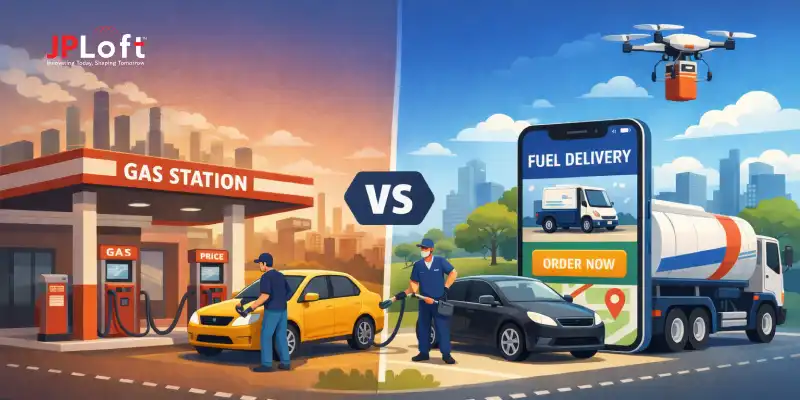
Key Takeaways
Fuel delivery apps redefine convenience by bringing refueling to homes, offices, and fleets, saving time and reducing operational downtime for users and businesses.
Fuel delivery apps are not replacing gas stations outright, but they are capturing specific segments where scheduled, on-demand fueling delivers higher value.
From a business impact perspective, fuel delivery apps unlock new revenue streams for fuel providers through subscription models, B2B contracts, and fleet partnerships.
The future points to coexistence, with gas stations dominating highways and rural areas, while currently, fuel delivery apps expand in cities, enterprises, and logistics hubs.
JPLoft enables this shift by building scalable fuel delivery apps, combining real-time tracking and performance-driven design for long-term growth.
Are fuel delivery apps overtaking the gas stations?
This question is reshaping the entire fuel industry landscape. Imagine never waiting in long queues at gas stations or detours during busy schedules. Here, fuel is delivered directly to your doorstep instead.
The convenience-driven economy has already transformed sectors like food delivery and ride-sharing, and now it's targeting fuel distribution.
With technological advancements, changing consumer preferences, and environmental considerations accelerating this shift, the traditional gas station model faces unprecedented disruption.
As we approach 2030, understanding whether mobile fuel delivery can completely replace gas stations requires examining market trends, technological capabilities, regulatory frameworks, and consumer behavior patterns that will define the future of fueling.
Hence, let’s discuss it all in this guide.
What is a Fuel Delivery App?
A fuel delivery app is a convenient way to order fuel online. It brings the petrol and diesel straight to your home, office, or even to the worksite. This app connects users with licensed fuel suppliers to ensure safe and secure fuel delivery.
The working function of the app all begins when the user selects the type of fuel they want, pays digitally securely, and then receives the fuel at their address. That is all, like any food delivery or e-commerce platform, trending today.
Yes, a fuel delivery business model is running on the on-demand delivery apps. The fuel delivery apps use features such as real-time GPS tracking, secure digital payments, scheduling, and instant notifications for customers.
But, is there a global market for fuel delivery apps? Is driving the user experience towards convenience, rather than standing in a queue?
Let's examine this in the following section.
The Rise of Fuel Delivery Apps
People no longer plan their day around fuel stops. Fuel delivery apps are quietly changing that habit.
Earlier, when aeroplanes or aircraft needed fuel, the fuel delivery options did not start as a consumer convenience brand; rather, they started as a logistics option.
Other than the aviation industry, construction sites, and heavy vehicles were accustomed to getting fuel through delivery.
The real shift was observed when smartphones and the GPS tracking system in fuel delivery apps came into existence.
This is the era of mid- 2010s, when startups and investors saw an opportunity in this sector. Then they began to apply an on-demand service models for the fuel transportation and distribution.
And that’s when it all started.
The rise of fuel delivery apps started for the consumers, and the apps were launched in urban markets with dense vehicle ownership and high time sensitivity.
Here, the core idea was simple: instead of the drivers visiting fuel stations, the certified tankers would come to the parked vehicles to deliver fuel.
With technologies like AI in fuel delivery apps, the segment has become more scalable to fulfill the dynamic demands of the users.
Apart from this, there are several technologies helping the fuel delivery apps to scale. Such as
-
Machine learning acts as an advanced tool with AI to gather the changes in user behavior and their ordering patterns.
-
Whereas IoT is revolutionizing the fuel delivery apps by providing real-time data for route optimization, predictive maintenance, and better fuel management.
-
Blockchain in fuel delivery apps helps to provide secure, transparent, and automated operations via smart contracts.
-
Cloud infrastructure helps the fuel delivery apps store data on the cloud platforms. It provides scalable, real-time data to the users related to tracking of vehicles and other details.
Well, in the current era, people are driving towards convenience, that resulted in the fuel delivery app market boom. Let’s check out the following stats related to the global and region-specific fuel delivery app market statistics.
-
The global fuel delivery market is projected to grow significantly from USD 5.84 billion in 2025 to USD 11.93 billion by 2035.
-
North America held the major market of more than 40% of the global revenue, with a market size of USD 100.48 million in 2024, which will grow at a compound rate of 16.4% CAGR from 2024 to 2031.
-
Other than this, the Asia Pacific held a market share of around 23% of the global revenue market size of USD 57.87 million in 2024, which will grow at a CAGR of 20.2% from 2024 to 2031.
-
The Middle East and Africa held the major markets, accounting for around 17.9% of the global revenue.
With this growing market, building a fuel delivery app can help you to contribute a large share and to grasp the audience's attention faster.
When it comes to the market demands, you should know what service you are replacing. Hence, it is essential to learn about the traditional gas stations.
Understanding the Traditional Fuel Services
The traditional fuel services or gas stations are basically the full-service stations that go beyond just pumping fuel, offering attendants to provide gas, fluid checks. It creates a one-stop for basic vehicle care, on the go.
Here, the key characteristics and drawbacks of traditional fuel services are off-site travel, waiting times, manual tracking, higher operational costs, and even security risks.
Traditional fuel services involve the extraction, refining, and distribution of petroleum-based fuels through large networks to the gas stations for consumer purchase.
Basically, this is the concept of traveling to the station. This is all about pumping gasoline or diesel into their vehicles using dispensers.
Do you know that U.S along accounts for well over 150,000 retail fuel stations?
Amazing, right? Well, China similarly has roughly 120,000 stations.
Now, let's check the following section for the difference between these two segments, below.
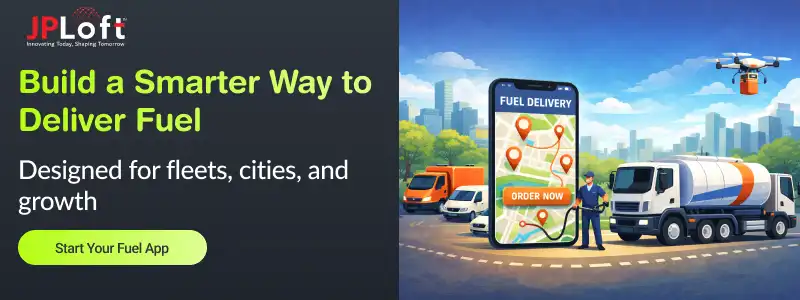
Fuel Delivery Apps Vs Traditional Gas Stations
A fuel delivery app is the future, while gas stations still exist. Confused about which to invest?
Whether you start an online fuel delivery business or stick to the gas stations, let's discover the differences below.
|
Basis of Difference |
Fuel Delivery Apps |
Traditional Gas Stations |
|
Access Model |
Fuel is delivered directly to the vehicle at a chosen location |
Drivers must physically visit the station |
|
Convenience |
High convenience, refueling happens at home, office, or fleet yard |
Convenience depends on proximity and traffic |
|
Time Efficiency |
Saves time by eliminating travel and waiting |
Time spent driving, queuing, and refueling |
|
Operating Hours |
Often available 24/7 based on service coverage |
Limited by station operating hours |
|
Target Users |
Fleets, businesses, construction sites, and urban consumers |
General public and passing traffic |
|
Infrastructure Requirement |
Mobile fuel trucks and digital platforms |
Fixed real estate, pumps, storage tanks |
|
Scalability |
Scales by expanding service zones and fleet size |
Scales through new station construction |
|
Cost Structure |
Higher per-delivery cost but lower indirect costs for users |
Lower per-liter cost but higher indirect time costs |
|
Technology Dependency |
App-based ordering, GPS tracking, digital payments |
Minimal technology required for customers |
|
Safety & Compliance |
Regulated mobile fueling with strict delivery protocols |
Long-established safety and compliance systems |
|
Fuel Management |
Centralized tracking, analytics, and reporting |
Manual tracking or basic POS systems |
|
Use-Case Fit |
Ideal for scheduled, bulk, or off-hour refueling |
Best for spontaneous or long-distance travel |
|
Customer Experience |
Service-oriented and personalized |
Transaction-oriented and standardized |
|
Environmental Impact |
Can reduce vehicle trips if routes are optimized |
Higher cumulative emissions from individual trips |
Are Fuel Delivery Apps Overtaking Gas Stations?
No, fuel delivery apps are not overtaking gas stations; however, they are carving out parallel lines.
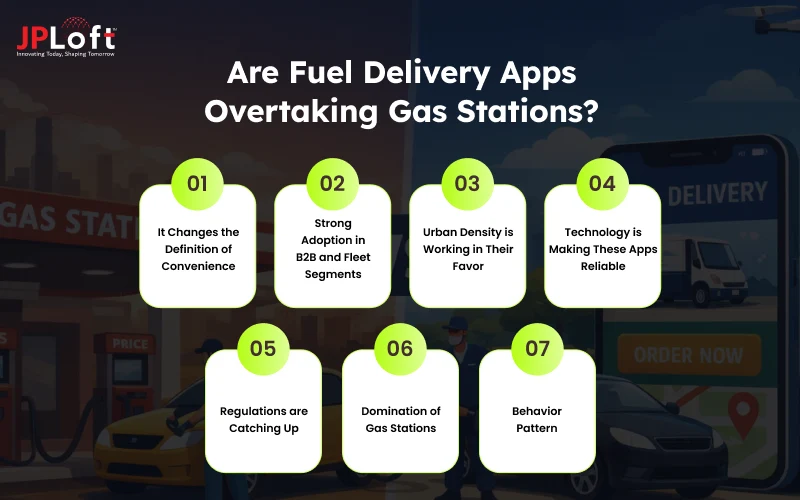
To understand this well, let's evaluate the following points.
1. It Changes the Definition of Convenience
Leading fuel delivery apps have changed the definition of convenience; they have removed the need to travel, wait in line, or plan refueling stops. These apps have fundamentally shifted convenience by bringing fuel to the user.
Other than this, these apps can be observed as a scaling parameter for the fuel station services. Here, the drivers don’t need to visit the fuel stations. They can even connect with the fuel stations and check if they are delivering fuel.
2. Strong Adoption in B2B and Fleet Segments
The fuel delivery apps see strong B2B and fleet adoption due to efficiency gains, cost savings, and streamlined management. It eliminates the time wasted at gas stations and enables overnight fueling.
The fuel stations act as a connecting various B2B businesses when it comes to sending fuels. Hence, investing in the fuel delivery app start-up ideas can help these businesses to scale across the fuel industry.
3. Urban Density is Working in Their Favor
In crowded cities, refueling trips add traffic at the fuel stations. Fuel delivery apps have become an opportunity for users to order fuel at their addresses, even while working or enjoying a family dinner at a restaurant.
These apps have provided an opportunity for the fuel stations and related entrepreneurs to invest in these features and create a mobile app that scales their business.
4. Technology is Making These Apps Reliable
The technologies are making fuel delivery apps reliable and trustworthy. Here, the use and implementation of recent technologies range from advanced encryption and AI-driven threat detection to cloud infrastructure. With an advanced fuel delivery app tech stack, you can improve its performance.
Many of the fuel stations are using technologies such as AI, IoT, and machine learning to scale the mobile apps and to enhance the customer acquisition rate. Here, the use of advanced technologies can help you to scale your business and reach potential users.
5. Regulations are Catching Up
Many regions now have clear safety and regulatory compliance in fuel delivery. The legitimacy has helped the fuel delivery apps to scale beyond the pilot programs.
Additionally, you must be aware that fuel is a hazardous material that requires strict compliance with local and federal rules of licensing.
It is important to learn about the regulations and to successfully ensure safety, avoid hefty fines, and prevent shutdowns of the fuel delivery apps. It is important to protect the environment by following the regulations and rules.
6. Domination of Gas Stations
In the current era, we can observe that fuel delivery apps are scaling well and can be considered the future of fuel delivery; however, gas stations have their domination around the industry.
The gas stations have established a dominant position in retail by transforming from mere fuel providers to comprehensive, high-convenience, and high-margin retail destinations.
7. Behavior Pattern
You should evaluate the complete behavior pattern of the users when it comes to the fuel delivery apps. It is one of the significant parameters, as ultimately, you have to reach the consumers.
However, when it comes to the fuel or gas stations, consumers have the old tendencies to wait in line, in the cities where high uncertainty avoidance (UAI) culture is followed, the change in the behavior patterns of the users is negligible.
Well, considering these parameters, it can be well said that the fuel delivery apps are not taking over the gas stations; they are becoming a passive income source.
It is a wonderful opportunity for the investors, businesses, and entrepreneurs who are already in the fuel and gas station industry to scale further.
Now, let's examine different factors that might impact your decision on selecting fuel delivery apps or gas stations for further investment.
Let’s Build Your Fuel Delivery App the Right Way with JPLoft
The on-demand fuel delivery industry is transforming how consumers and businesses access fuel services.
A well-designed fuel delivery app streamlines operations, enhances customer convenience, and opens new revenue streams. Whether targeting individual vehicle owners or commercial fleets, the right mobile solution can set your business apart in this competitive market.
Modern fuel delivery applications require robust features like real-time tracking, secure payment gateways, route optimization, and comprehensive admin dashboards to ensure seamless service delivery.
JPLoft stands out as a premier fuel delivery app development company dedicated to turning your vision into reality. Our expert team delivers custom, scalable solutions tailored to your specific business needs.
From intuitive UI/UX design to advanced backend development, JPLoft ensures your fuel delivery platform performs flawlessly across all devices, helping you dominate the on-demand fuel delivery market.
Conclusion
The potential for fuel delivery apps to overtake traditional gas stations by 2030 remains a complex equation.
While these innovative platforms offer undeniable convenience, cost-effectiveness, and time-saving benefits that appeal to modern consumers, completely replacing gas stations seems unlikely within this timeframe.
The reality will likely be a hybrid ecosystem where both models coexist, serving different market segments. Traditional gas stations will need to evolve, integrating digital solutions and additional services, while fuel delivery apps continue expanding their infrastructure and overcoming regulatory challenges.
Urban areas may see faster adoption, whereas rural regions will maintain reliance on conventional stations. The winner won't be determined by technology alone but by adaptability, consumer trust, and sustainable business practices that benefit both providers and end-users.
FAQs
Complete overtaking by 2030 is unlikely, but fuel delivery apps will capture significant market share, especially in urban areas. While they offer superior convenience, traditional gas stations provide immediate access, multiple services, and established infrastructure. A realistic scenario involves coexistence, with delivery apps serving 15-30% of markets.
Fuel delivery apps are on-demand platforms bringing gasoline or diesel directly to your location. Users order through the app, select fuel type and quantity, then professional drivers arrive in certified tanker vehicles to refuel your parked vehicle. Payment and tracking happen digitally for a convenient, contactless experience.
Fuel delivery apps save time by eliminating station visits and waiting in queues. They offer flexible scheduling, competitive pricing, and doorstep convenience. Additional benefits include contactless service, digital receipts, loyalty rewards, and, for businesses, centralized fuel management and reduced fleet downtime.
Yes, reputable services use certified equipment, trained personnel, and meet strict safety regulations. Delivery vehicles have spill-prevention technology, fire suppression systems, and proper insurance. They comply with EPA standards and local hazardous material laws. Always verify that providers maintain proper licensing and certifications.
Major barriers include high infrastructure costs, varying regional regulations, and safety concerns. Gas stations offer immediate refueling without scheduling and provide additional services like convenience stores and car washes. Rural coverage remains economically challenging for delivery services, limiting widespread adoption.

Savannah Bustos is a technology professional with experience across financial platforms, mobility solutions, and on-demand digital products. Her areas of expertise include FinTech, digital banking, eWallets, lending, BNPL, stock trading, fuel delivery, and taxi-booking platforms. She combines a strong understanding of business requirements with practical technology insight, helping companies evaluate challenges, define product needs, and make informed decisions about scalable digital solutions.


Share this blog