


Key Takeaways:
Stock trading apps like eToro have transformed investing by combining real-time trading with social and copy trading features.
eToro’s scale proves strong market demand, with 40 million+ registered users, millions of funded accounts, and billions in assets under administration.
Building an app like eToro includes product planning, trading engine setup, compliance, security, API integrations, and post-launch scalability.
Core features of the eToro-like trading app include copy trading, social feeds, multi-asset support, real-time analytics, and risk management tools.
The cost to build an eToro-like app ranges from $25,000 to $300,000+, depending on MVP, mid-level platform, or enterprise-grade app development.
Security, compliance, and scalability are critical challenges, and addressing them early reduces long-term risks and development costs.
eToro-like apps generate revenue through multiple streams, including spreads, commissions, subscriptions, copy trading fees, and value-added services.
Choosing an experienced development partner like JPLoft matters, as fintech expertise directly impacts app performance, compliance readiness, and time to market.
Stock trading apps have simplified the trading process for all. These apps allow users to invest their money in the stock market in real time. Furthermore, for the entrepreneurs, these apps have uncovered a new way of making money.
Such an increased demand has also contributed to the launch of several popular stock trading apps, including eToro. These apps are not just simplifying trading but are offering proprietary features like copying the portfolio of successful traders, providing automated suggestions, and more.
eToro, as of 2025, has more than 10 million downloads and 40 million+ active users, reflecting a strong market potential of the app. Such has also contributed to the increasing interest in building a trading app like eToro.
If you are planning to develop an app like Toro, then the development process includes defining the product vision, choosing the right business model, ensuring a user-friendly UI, integrating third-party APIs, planning for the launch, and finally launching the product.
In this blog, we will discuss more about how to build a stock trading app like eToro, the features to have in your app, the associated costs, challenges, and more.
What is eToro?
eToro is a multi-asset trading platform that enables users to invest in stocks, ETFs, cryptocurrencies, commodities, and CFDs through a single digital ecosystem.
Launched in 2007, it stands out for introducing social trading and copy trading, allowing users to learn from and automatically replicate the strategies of experienced investors.
This model reflects current industry trends such as community-led investing, simplified user experiences, and growing participation from first-time and mobile-first traders.
With 40 million+ registered users globally and 3.63 million funded users, eToro has become a reference point for planning to build a stock trading app. Furthermore, a modern trading app design that combines accessibility, transparency, and engagement.
How Does eToro Work?
If you are planning to create an app like eToro, then you need to be aware of how the platform works. Here is a brief overview of how eToro works:
► Account Setup & Verification
Users register on the platform, complete KYC verification, and add funds using supported payment methods to start trading securely.
► Multi-Asset Trading Access
The app provides a unified dashboard to trade stocks, ETFs, crypto assets, commodities, and CFDs without switching platforms.
► Self-Directed Trading
Users can manually place trades using real-time market data, price charts, asset insights, and performance indicators.
► Copy Trading Functionality
Investors can explore top traders, review their historical returns and risk scores, and automatically copy their trades in real time with a chosen investment amount.
► Social & Community Features
Trader profiles include public feeds where users share updates, discuss market movements, and follow other investors.
► Risk Management & Monitoring
Tools like stop-loss limits, portfolio breakdowns, and real-time notifications help users track performance and manage exposure.
This integrated workflow can be used as a blueprint for scalable, engagement-driven eToro clone app development.
eToro Platform and Trading Market Stats
Let’s take a look at key industry and platform statistics that can justify the reason and need to invest in developing a stock trading app like eToro:
-
eToro has 40 million+ registered users and 3.79M funded accounts globally. Also, more than $18.8B Assets Under Administration (AUA) and 46.3M total trades (capital markets/ECC). (Source)
-
eToro’s November 2025 crypto activity stood at 5.0M crypto trades; $264 invested amount per crypto trade.
-
The app has 10M+ downloads, a 3.8 rating, and 1.52L reviews on the Google Play Store.
-
The social trading platform market is $2.62B in 2025 and is projected to reach $3.51B by 2029 (7.6% CAGR).
-
The online trading platform market has been recorded at $10.82B in 2025, which is further forecasted to reach $16.71B by 2032.
Such market stats reflect how the global trading market is transforming, and apps like eToro are making the most out of it.
Benefits of Investing in eToro Like App Development
Investing in an eToro clone app development can help entrepreneurs meet the rising demand for intuitive, community-driven trading platforms.
As retail investing continues to grow, building an app like eToro offers a practical balance between accessibility, engagement, and long-term scalability.
1. Wider User Adoption Across Experience Levels
Traditional trading apps often focus on a narrow user segment, but eToro-like platforms are designed for inclusivity.
The social and copy trading features even allow beginners to participate without deep market expertise, while advanced users retain full control through manual trading and analytics tools.
This dual approach significantly broadens the target audience and speeds up platform adoption.
2. Higher User Engagement and Retention
Community feeds, public trader profiles, performance insights, and ongoing discussions keep users active beyond basic trading actions.
Users return not just to trade but to learn, follow strategies, and observe market behavior. This continuous interaction improves retention rates and increases overall user lifetime value.
It is one of the key reasons that they decide to create a trading app like eToro, a profitable option.
3. Diversified and Sustainable Revenue Models
eToro-like trading platforms support diversified monetization options, including spreads, trading commissions, copy trading fees, premium subscriptions, and value-added features such as advanced analytics.
This diversified revenue structure reduces reliance on a single income stream and improves financial stability during market fluctuations.
4. Scalable Business Growth Opportunities
Platforms like eToro are built to scale efficiently, which means they focus on following the stock trading app trends, adding new features, and transforming the platform as per the scenario.
Hence, businesses planning to make a trading app like eToro can add new asset classes, expand feature sets, or integrate technologies like AI-driven insights without rebuilding the core system.
How to Build an App like eToro?
Being aware of the step-by-step process of how to develop a trading app like eToro can help you better plan for your next trading app.
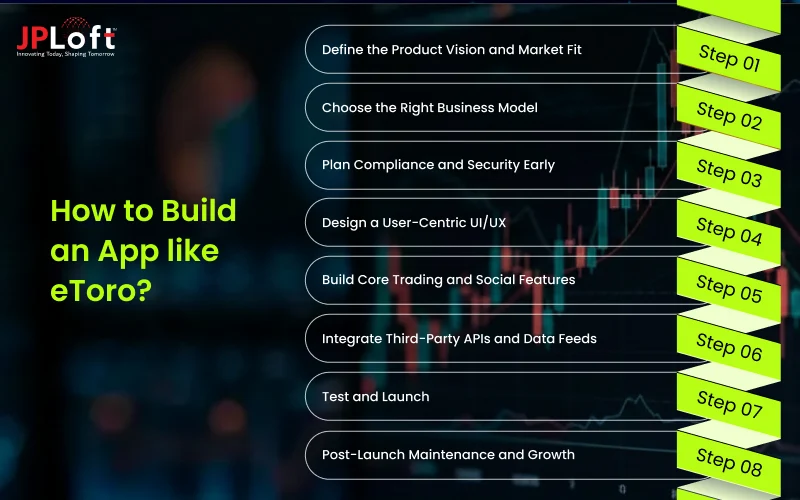
Here is the step-by-step process to consider:
Step 1: Define the Product Vision and Market Fit
Start the development process by identifying your core user segments, such as beginners, active traders, or copy traders. Each group influences feature complexity, trading frequency, and overall system load.
► Asset Classes and Trading Scope
Define which instruments the app will support, including stocks, ETFs, crypto, or CFDs. Such asset selection impacts data sources, order execution logic, and compliance requirements.
► MVP Scope and Core Data Models
Lock the core MVP feature set early and entities like users, wallets, orders, and positions to ensure long-term scalability.
Step 2: Choose the Right Business Model
The next step is to plan for the right business model, including the monetization approach and revenue tracking, so that the app's scalability can be better planned.
► Monetization Strategy Definition
Decide how the platform will generate revenue through spreads, subscriptions, copy trading fees, or premium features. This shapes backend logic from day one.
► Revenue Tracking and Metrics Planning
Plan analytics to track trade volume, revenue contribution, and feature usage for continuous optimization.
Step 3: Plan Compliance and Security Early
Along with planning to create a trading app like eToro, it is important to plan for the app's compliance and mobile app security at the early stages.
► KYC and AML Workflow Integration
Embed identity verification and transaction monitoring across onboarding, trading, and withdrawals rather than treating them as one-time steps.
► Security Architecture Design
Implement encryption, secure authentication, and role-based access controls to protect sensitive financial and user data.
► Audit Logs and Compliance Readiness
Maintain detailed system logs and reporting mechanisms to support regulatory audits and transparency.
Step 4: Design a User-Centric UI/UX
Once the business goals, model, and security aspects have been planned, the next step is to plan for mobile app design.
► User Flow and Information Architecture
Design app wireframes that can indicate clear navigation for onboarding, trading, copy trading, and portfolio tracking to minimize friction.
► Real-Time UI Performance Optimization
Plan for a stock trading app design that ensures charts, prices, and portfolio data update smoothly during high market activity.
Step 5: Build Core Trading and Social Features
The next step is to plan for the core trading and social trading features important to get users’ attention and plan for app scalability. Such a stage includes:
► Trading Engine and Order Management
Develop a low-latency engine to handle order placement, execution, and balance updates reliably.
► Copy Trading Logic and Risk Controls
Implement proportional trade replication with built-in risk limits and exposure controls.
► Social Feed and Engagement Layer
Separate social features from trading services to ensure engagement never impacts execution speed.
Step 6: Integrate Third-Party APIs and Data Feeds
The stock trading apps can perform effortlessly with the help of third-party APIs and data feeds. However, too many unnecessary integrations can lead to an impact on app performance. Hence, thorough planning is essential.
► Market Data and Pricing Feeds
Integrate real-time and historical market data providers for accurate price discovery and charting.
► Payments and Wallet Infrastructure
Support secure deposits, withdrawals, and internal wallet management with proper reconciliation.
Step 7: Test and Launch,
Once the app has been developed and APIs have been integrated, the next step is mobile app testing to launch it for final usage.
► Functional, Load, and Security Testing
Test the platform under peak trading conditions to validate performance and system resilience.
► Monitoring and Performance Analytics
During the resting phase, the developers should track latency, execution success, and system health using real-time monitoring tools.
► Scalable Deployment Strategy
Focus on cloud-based, modular infrastructure to support growth in users, assets, and features. Furthermore, a well-planned strategy needs to be adopted to publish the app on the Play Store or submit the app to the App Store.
Step 8: Post-Launch Maintenance and Growth
Launching the app is not the final step in any deployment process. But post-launch, it is important to plan for maintenance and growth.
► App Maintenance
Post app launch, it is important to evaluate how the app performs in real scenarios and consider the user feedback. Based on this, app maintenance services need to be hired to ensure its performance.
► App Growth and Scalability
Further, depending on the app performance, industry competition, and growth, further feature additions can be planned to ensure your app's competitiveness and growth.
Features to Have in eToro like App
For entrepreneurs with a vision to build a trading app like eToro, a better understanding of the features to be included is a must.
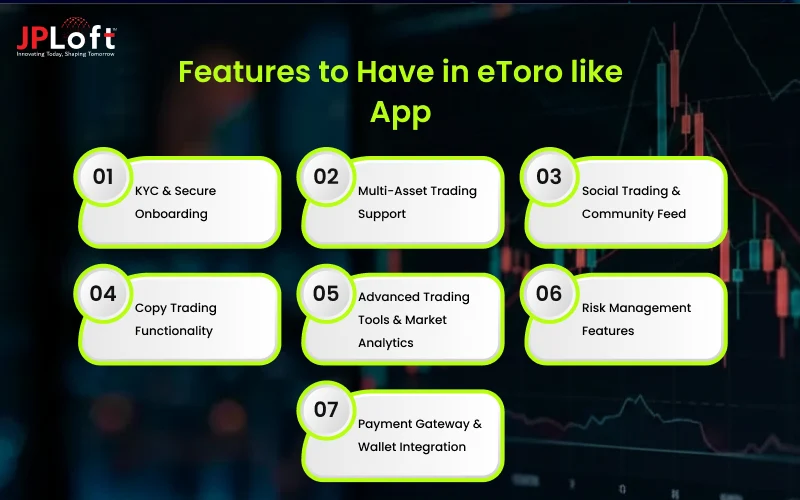
Below are the core features of a stock trading app that define a competitive eToro-like trading app and directly influence user adoption and retention.
A] KYC & Secure Onboarding
A smooth onboarding process with built-in KYC and identity verification is essential if developing a trading app like eToro.
This ensures regulatory compliance while building early trust. Fast verification, guided steps for background verification, and secure authentication set the tone for the overall user experience.
B] Multi-Asset Trading Support
A key feature to include in the eToro-like trading app is the ability to support multiple asset classes, such as stocks, ETFs, cryptocurrencies, commodities, and CFDs, from a single dashboard.
Providing a unified trading experience reduces friction and encourages users to diversify their portfolios using a common platform.
C] Social Trading & Community Feed
The feature planning for any app should be aimed towards modern-day users. Hence, it should incorporate the latest mobile app trends.
Social trading is one of the trending features when planning to develop an app like eToro.
D] Copy Trading Functionality
The copy trading feature of the stock trading app allows users to replicate the trades of experienced investors automatically.
To introduce such a functionality, key elements to include are trader rankings, historical performance, risk scores, and customizable copy limits.
E] Advanced Trading Tools & Market Analytics
A key reason that is contributing to the popularity of the stock trading apps is the advanced tools and analytical data.
Hence, including real-time charts, technical indicators, price alerts, and market news integration is critical for informed decision-making.
F] Risk Management Features
Stock trading tools like stop-loss, take-profit settings, and risk scoring help users control exposure.
Such visible risk indicators also improve transparency and promote responsible trading behavior, making it one of the core features to incorporate when planning to build a trading app like eToro.
G] Payment Gateway & Wallet Integration
Secure fund deposits, withdrawals, and e-wallet integration are essential. Supporting multiple payment methods improves accessibility and reduces drop-offs during transactions.
How Much Does it Cost to Develop a eToro like App?
The cost to develop a stock trading app like eToro typically ranges from $25,000 to $300,000+, based on the scope and feature depth of the platform.
A basic MVP trading app, costing around $25,000 to $60,000, includes essential features such as user registration, KYC, basic buy-sell functionality, and portfolio tracking, making it ideal for validating the product idea.
A mid-level trading app development cost generally falls between $60,000 and $150,000 and adds real-time market data, advanced charts, notifications, social trading components, and an enhanced user experience.
For businesses targeting long-term scalability, an advanced or enterprise-level trading app like eToro can cost $150,000 to $300,000+, covering copy trading, multi-asset support, high-end security, regulatory readiness, robust admin controls, and a scalable architecture capable of handling large user volumes.
|
Development Phase |
Scope Covered |
Estimated Cost |
|
Planning & Product Strategy |
Market research, feature planning, and architecture |
$5,000 – $15,000 |
|
UI/UX Design |
Wireframes, user journeys, and visual design |
$5,000–$25,000 |
|
Frontend Development |
Mobile/web interfaces, dashboards |
$10,000–$60,000 |
|
Backend Development |
Trading engine, databases, APIs |
$15,000–$80,000 |
|
Integrations & Security |
KYC, payments, market data, encryption |
$10,000–$50,000 |
|
Testing & Deployment |
QA, performance testing, app launch |
$5,000–$20,000 |
|
Total Estimated Cost |
Basic to Enterprise-Level App |
$25,000–$300,000+ |
Factors Affecting eToro Like App Development Cost
The eToro-like trading app development cost varies based on several factors. Understanding these variables helps businesses plan budgets realistically and avoid unexpected overruns during development.
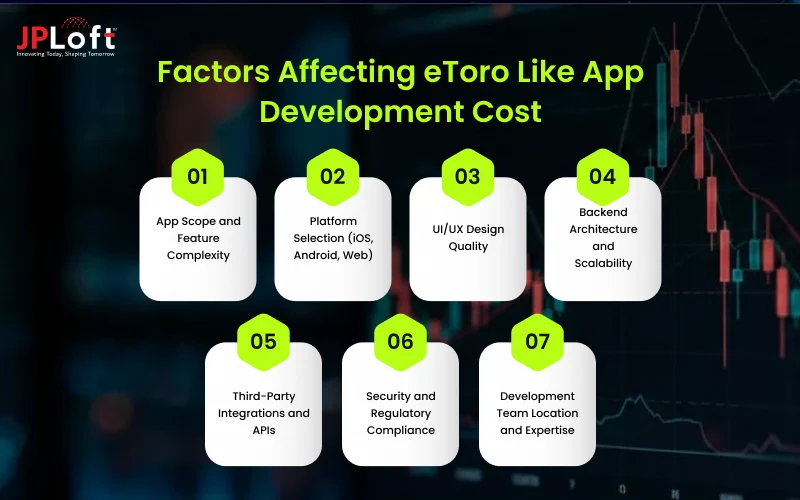
1. App Scope and Feature Complexity
A basic app with core trading, user profiles, and portfolio tracking requires less time and effort compared to advanced platforms with social trading, copy trading, multi-asset support, and real-time analytics.
The more interactive and data-intensive the features are, the higher the mobile app development cost.
2. Platform Selection (iOS, Android, Web)
Choosing whether to build a single-platform app, a cross-platform solution, or a full ecosystem including web, iOS, and Android significantly impacts cost. Accordingly, you can look for cross-platform, Android, or iOS app developers for hire.
Multi-platform development increases testing, maintenance, and optimization efforts, but it also expands market reach and user accessibility.
3. UI/UX Design Quality
Hiring UI/UX design services for custom designing, including advanced dashboards, interactive charts, and smooth user flows, requires specialized designers and additional iterations, increasing overall costs but improving user retention.
4. Backend Architecture and Scalability
A trading app relies heavily on its backend for real-time data processing, order execution, user management, and performance stability.
Building a scalable architecture that can handle high traffic, concurrent trades, and future feature expansion requires more development time and infrastructure investment.
5. Third-Party Integrations and APIs
Integrations such as market data providers, payment gateways, KYC/AML services, and analytics tools add both development and recurring costs.
Real-time financial data APIs, in particular, can be expensive when deciding to control the eToro like app development cost, but are essential for accuracy and user trust.
6. Security and Regulatory Compliance
Security is non-negotiable in trading app development. Implementing encryption, secure authentication, fraud detection, and compliance-ready features increases development effort.
Regulatory requirements vary by region and often require additional audits, documentation, and system controls.
7. Development Team Location and Expertise
Another factor impacting the cost is whether you hire an in-house team, freelancers, or an experienced mobile app development company in Denver.
Teams with strong fintech and trading domain expertise may charge more, but they reduce risks, rework, and long-term maintenance costs.
Challenges in Developing A Trading App Like eToro
For businesses focusing on “how to create a trading app like eToro,” understanding associated challenges is important.
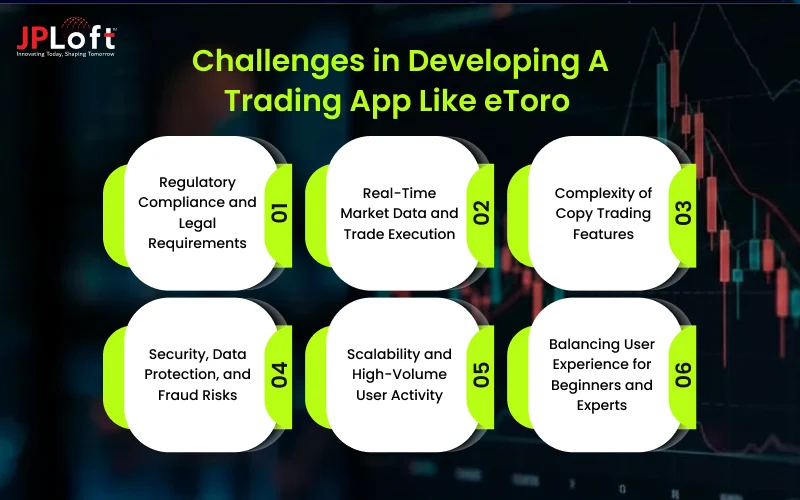
Below are the key challenges of developing a stock trading app like eToro:
Challenge 1: Regulatory Compliance and Legal Requirements
Trading apps must meet strict KYC, AML, and data protection standards, which vary across nations and directly impact how the platform operates. Missing compliance elements can delay app launches and can even lead to penalties.
Solution: Embed compliance into the product architecture from day one and work with fintech-legal specialists to ensure regulatory readiness.
Challenge 2: Real-Time Market Data and Trade Execution
An eToro-like stock trading app relies on real-time price feeds and instant order execution, where even small delays can affect user trust and trading accuracy. However, managing data at this scale is technically complex.
Solution: Use enterprise-grade market data APIs, low-latency infrastructure, and optimized backend systems for consistent performance.
Challenge 3: Complexity of Copy Trading Features
Copy trading is a core feature, but difficult to implement because trades must be replicated accurately while managing risk and portfolio differences. Poor execution can lead to user losses and dissatisfaction.
Solution: Hire dedicated developers and plan to build a dedicated copy trading engine with risk limits, trader scoring, and controlled execution logic.
Challenge 4: Security, Data Protection, and Fraud Risks
Stock trading apps handle sensitive financial and personal data, making them prime targets for cyberattacks and fraud. Security failures can permanently damage credibility.
Solution: Implement strong encryption, secure authentication, regular security audits, and real-time fraud detection mechanisms to overcome stock trading app security threats.
Challenge 5: Scalability and High-Volume User Activity
As user numbers grow, trading apps must handle concurrent trades, data streaming, and analytics without system crashes or downtime.
Solution: Design a cloud-based, scalable architecture that supports high traffic and future feature expansion.
Challenge 6: Balancing User Experience for Beginners and Experts
An eToro-like app must feel simple for new investors while still offering advanced tools for experienced traders. But maintaining this balance is challenging.
Solution: Offer adaptive UI/UX with beginner-friendly views and advanced modes that users can enable as they gain experience.
How Do eToro-like Apps Make Money?
The approach to eToro clone app development offers a diversified approach to making money for entrepreneurs.
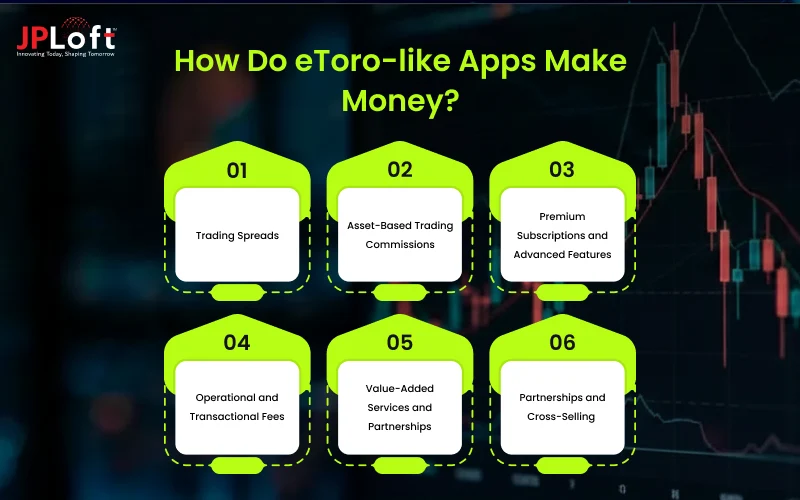
But understanding how trading apps make money in detail is important so that they can be implemented during the development phase.
1. Trading Spreads
Most eToro-style trading apps earn through spreads, which is the small difference between the buy and sell price of an asset.
Every executed trade contributes to platform revenue, making this model effective even when commission-free trading is offered to users.
2. Asset-Based Trading Commissions
While stock trades may be commission-free, eToro-like platforms often apply commissions on specific assets such as cryptocurrencies, CFDs, or leveraged trades.
These fees scale naturally with trading volume and active users. Hence, it becomes a significant part of the revenue generation for eToro like app.
3. Premium Subscriptions and Advanced Features
Trading apps can earn through subscription features that unlock advanced analytics, reduced spreads, enhanced portfolio insights, or priority support.
This subscription-based model adds predictable recurring revenue and appeals to serious investors. Furthermore, subscriptions can provide access to copy trading and more.
4. Operational and Transactional Fees
Revenue for a stock trading app can also be generated through withdrawal fees, currency conversion charges, and inactivity fees.
These operational and transactional fees contribute steadily to the app's overall revenue as the user base grows.
5. Value-Added Services and Partnerships
Offering value-added services can also be a considerable mobile app monetization strategy for stock trading apps.
Advanced eToro-like trading apps monetize further through educational tools, AI-driven insights, and portfolio management add-ons.
6. Partnerships and Cross-Selling
If you are planning to build a trading app like eToro, then a considerable option to expand revenue opportunities is by partnering with other financial institutions and cross-selling.
Such can include offering credit cards, loan offers, or any other financial product from an institution. These can help earn commission from the partner institutions.
How JPLoft Can Help You Develop an App like eToro?
The stock trading space is booming, and entrepreneurs are stepping into the sector with new and creative ideas. Following this, several development partners exist nowadays that claim to be the right choice for your project.
But among these, you need to search for a partner with relevant experience and expertise in stock trading app development. JPLoft stands out as a leading stock trading app development company offering real-time assistance and successful eToro like app development.
At JPLoft, we understand that building an app like eToro is not just about replicating features. It is about creating a secure, scalable, and engaging trading ecosystem that users can trust from day one. With strong experience in fintech and trading platforms, our team approaches every project with a balance of technical depth and real-world market understanding.
The developers at JPLoft help you shape the product from the ground up. Whether you are starting with a focused MVP or planning a full-scale trading platform, we align development with your growth roadmap.
JPLoft also supports seamless third-party integrations, including payment gateways, KYC providers, and market data APIs. Post-launch, we continue to assist with optimization, feature expansion, and ongoing maintenance to keep your platform competitive in a fast-moving trading environment.
Conclusion
Building an app like eToro is a strategic investment that goes far beyond replicating trading features. It requires an in-depth understanding of market behavior, user psychology, compliance standards, and scalable technology architecture.
From defining the right product vision to implementing secure trading engines, social features, and monetization models, every stage plays a critical role in long-term success.
As trading continues to evolve toward social, mobile-first, and data-driven experiences, platforms that balance usability with performance will stand out. A well-planned eToro-like app can attract diverse user segments, encourage long-term engagement, and open multiple revenue streams when built with the right technical foundation.
By approaching development with clarity, compliance readiness, and scalability in mind, businesses can create a future-ready trading platform that meets modern investor expectations and adapts seamlessly to changing market trends.
FAQs
To build an app like eToro, you need a structured approach that covers product planning, trading engine development, real-time market data integration, copy trading logic, security, and compliance. The process typically starts with defining asset coverage and user flows, followed by backend trading infrastructure, social features, third-party API integrations, and scalable cloud deployment.
The cost to build an eToro-like trading app usually ranges from $25,000 to $300,000+. A basic MVP with core trading features sits at the lower end, while advanced platforms with copy trading, social feeds, multi-asset support, and enterprise-grade security fall into the higher range.
Key challenges include managing real-time market data, implementing accurate copy trading, ensuring regulatory compliance, maintaining high security, and scaling the platform for heavy user and trade volumes. Each challenge requires careful technical planning and robust infrastructure.
eToro-like apps generate revenue through trading spreads, asset-based commissions, copy trading fees, premium subscriptions, and operational charges such as withdrawals or currency conversions. This multi-stream model supports stable and scalable monetization.
Core features include user onboarding with KYC, multi-asset trading, real-time charts, copy trading, social feeds, portfolio tracking, risk management tools, notifications, and secure wallet integration. These features define the social trading experience popularized by eToro.

Savannah Bustos is a technology professional with experience across financial platforms, mobility solutions, and on-demand digital products. Her areas of expertise include FinTech, digital banking, eWallets, lending, BNPL, stock trading, fuel delivery, and taxi-booking platforms. She combines a strong understanding of business requirements with practical technology insight, helping companies evaluate challenges, define product needs, and make informed decisions about scalable digital solutions.



Share this blog