



Key Takeaways:
Robinhood’s success is driven by commission-free trading, mobile-first design, and real-time market access, making it a benchmark for modern stock trading apps.
A Robinhood-style trading app development includes planning, UX design, real-time trading systems, API integrations, testing, and continuous optimization.
The Robinhood-like App Development cost generally ranges from $25,000 to $150,000+, depending on several factors.
The factors impacting the cost include feature scope, platform choice, compliance requirements, integrations, and development team location.
Key challenges include regulatory complexity, low-latency trading, data accuracy, security risks, scalability during market spikes, and dependency on third-party APIs.
Emerging trends such as AI-driven personalization, automation, cloud-native architecture, and integrated financial ecosystems can help new platforms stand out beyond Robinhood.
Apps like Robinhood generate revenue through models like PFOF, subscriptions, interest on idle cash, margin lending, stock lending, and crypto spreads.
Partnering with a stock trading app development company like JPLoft helps reduce risk, control costs, and build a secure, scalable, and future-ready trading platform.
Stock trading is becoming increasingly common due to increasing financial literacy as well as increased access to financial and investment tools.
Among these, a popular stock investment tool is Robinhood, which holds 30-35% of the US stock trading app market. The platform started its operations in 2013, which gradually grew to become the leading and most favorable platform among the audience.
Such a rapid growth of the platform has further attracted the interest of entrepreneurs, and hence, they are looking for “how to develop an app like Robinhood?”
The development process of the app, like Robinhood, starts from
In this blog, we will help you understand the process to build a stock market app like Robinhood, the associated cost, factors involved, and other aspects for a successful build and deployment.
What is Robinhood?
Robinhood is a commission-free stock trading app designed to make investing simple and accessible for everyday users. Launched as a mobile-first platform, it allows users to trade stocks, ETFs, options, and cryptocurrencies without paying traditional brokerage fees.
This approach helped Robinhood onboard over 25+ million registered users and manage tens of billions of dollars in assets, making it one of the most recognized retail trading platforms in the market.
A key reason behind its growth is how well it matches modern investor behavior. Today’s users expect instant access, clean interfaces, real-time market data, and low entry barriers. The popularity of the app is leading to attracting investors' attention towards developing an app like Robinhood.
Robinhood meets these expectations by removing minimum balance requirements and offering a smooth, app-driven investment experience. This model has strongly influenced how new stock trading apps are built today.
► How Does Robinhood Work?
Before we proceed to discuss “how to build an app like Robinhood?” let’s understand how the platform works.
-
User Registration and KYC: Users create an account and complete identity verification using standard KYC and compliance checks.
-
Bank Account Linking and Funding: A bank account is securely connected, allowing users to add funds. Many platforms enable instant deposits to speed up first trades.
-
Asset Discovery and Market Data: Users explore stocks, ETFs, and crypto using search tools, watchlists, and real-time price updates.
-
Trade Execution: Users place buy or sell orders directly from the app. Orders are routed to market makers for execution.
-
Portfolio Monitoring: The app provides performance tracking, price alerts, and basic insights to help users monitor their investments.

Robinhood Market Stats
If you are concerned about whether to develop a stock trading app like Robinhood, then you should go through the key market statistics. Such can help better understand the market growth pattern and get clarity.
-
Robinhood has about 27.4 million funded customers and approximately $279 billion in assets under custody as of 2025.
-
The platform is growing at a 112% year-over-year, with strong net deposit growth.
-
Average Revenue Per User (ARPU) increased 82% year-over-year to about $191 in 2025.
-
The total global stock market capitalization reached an all-time high of ~$147.6 trillion by October 2025.
-
The stock trading and investing applications market is expected to grow to about $129.4 billion by 2029, at a ~19.4% CAGR from 2025 onward.
Benefits Of Investing In Robinhood-Like App Development
Investing in an app like Robinhood allows entrepreneurs to tap into the growing demand for simple, mobile-first investing platforms.
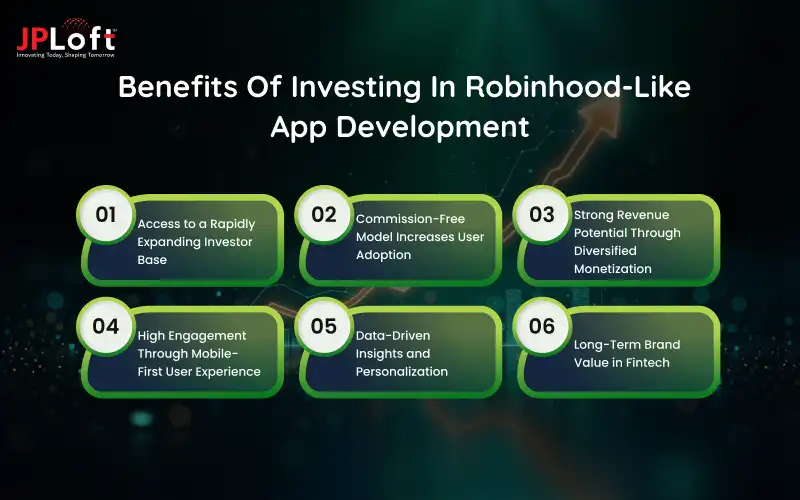
As retail participation rises, users increasingly prefer low-cost, easy-to-use apps that offer real-time market access without complexity. Such a rising demand is influencing entrepreneurs to build a stock trading app as per the latest competitive trends.
1. Access to a Rapidly Expanding Investor Base
Retail investing continues to rise as more users enter the market through mobile stock trading apps. Hence, understanding how to develop an app like Robinhood can help you have a platform that appeals strongly to first-time investors and younger users.
Further, such an early adaptation and getting audience attention can help you scale effortlessly despite the competition.
2. Commission-Free Model Increases User Adoption
Zero-commission trading removes one of the biggest entry barriers for users. When investors are not charged per trade or required to maintain minimum balances, adoption and engagement improve, leading to higher activity and long-term retention.
Planning to build a stock trading app like Robinhood follows the same commission-free approach, which can help improve user adoption.
3. Strong Revenue Potential Through Diversified Monetization
Robinhood-like apps rely on diverse monetization models, rather than focusing solely on trading fees. Such includes subscription plans, margin trading, interest on idle funds, payment for order flow, and premium features, which together create a balanced and scalable monetization model.
Hence, planning to make an app like Robinhood can help entrepreneurs explore better and more fruitful revenue opportunities.
4. High Engagement Through Mobile-First User Experience
Robinhood like app development follows a lean design, fast execution, and real-time alerts, which encourage users to interact with the app more frequently.
Stock trading app features, such as interactive charts and instant notifications, increase session time and keep users engaged during market hours.
5. Data-Driven Insights and Personalization
If you are building a modern-day stock trading app like Robinhood, then you can plan for an app infrastructure that allows tracking user behavior and trading data.
Based on these data, the entrepreneurs can plan for personalization across the app. Smarter recommendations, tailored alerts, and improved onboarding flows build trust and support long-term user engagement.
6. Long-Term Brand Value in Fintech
Launching a stock trading app platform positions a business as an innovative fintech brand. Over time, this credibility helps attract partnerships, expand financial offerings, and strengthen market presence in the competitive trading app space.
How to Develop an App like Robinhood?
A Robinhood-style platform must support real-time trading, secure transactions, and a seamless user experience while remaining flexible for future expansion.
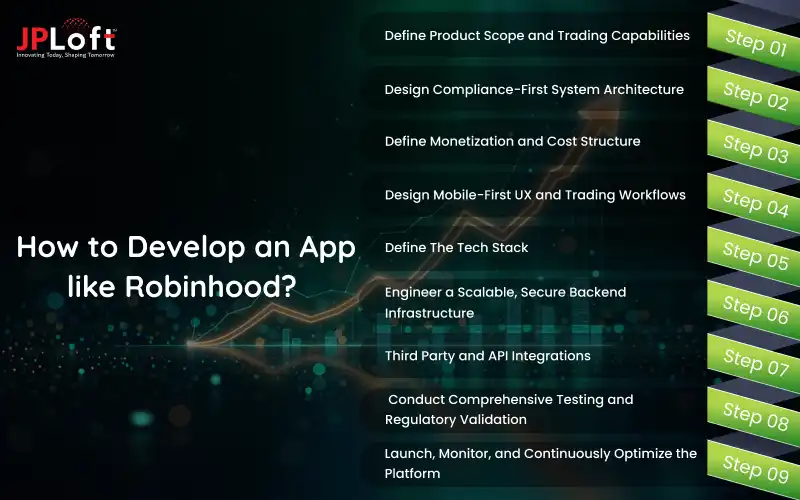
Below is a step-by-step technical approach to developing a stock trading app like Robinhood:
Step 1. Define Product Scope and Trading Capabilities
The first step, if you plan to create a stock trading app like Robinhood, is defining the technical scope of the product. This stage determines what markets, instruments, and user types the platform will support at launch.
- Define Supported Trading Instruments
Decide whether the app will support equities, ETFs, options, cryptocurrencies, or fractional shares. Each instrument requires different backend workflows, data feeds, and compliance logic.
- Outline User Segmentation and Permissions
Before proceeding with the app design, define account types, trading limits, and user access levels to ensure the platform aligns with risk management and regulatory expectations.
Step 2. Design Compliance-First System Architecture
Any attempt to build a stock trading app like Robinhood must begin with a compliance-driven architecture. Regulations directly influence data flow, system design, and user verification logic.
- Plan For KYC, AML, and Risk Controls
Before proceeding with designing the app, it is important to identify key app compliances, including KYC, AML, and risk control. Such can help plan for an app design that aligns with both the market and compliance expectations.
- Plan Secure Data Handling and Audit Trails
Ensure trade history, user data, and financial records are logged securely and remain audit-ready at all times.
Step 3. Define Monetization and Cost Structure
When businesses explore the cost to make a mobile app like Robinhood, app monetization planning plays a central role in development decisions.
- Choose a Commission-Free or Hybrid Revenue Model
Decide whether revenue will come from subscriptions, margin lending, premium analytics, or order routing partnerships.
- Align Monetization With Feature Access
Such monetization approaches need to be planned and blended with the regular app features and should enhance the experience without restricting core trading functionality.
Step 4. Design Mobile-First UX and Trading Workflows
The next step is to plan for the design of the mobile app. Such an app design can be planned with the help of a UI/UX design services provider that can prioritize the user experience when aiming to make an app like Robinhood, so that the app can appeal to modern investors.
- Design Intuitive Navigation and Dashboards
Start with app wireframes, which can help create clear portfolio views, balance summaries, and asset discovery flows that reduce cognitive load.
- Optimize Trade Placement and Confirmation Flows
Work on app prototypes that can help developers ensure that users can place, review, and confirm trades quickly with transparent pricing and order status visibility.
Step 5. Define The Tech Stack
When businesses plan to create a stock trading app like Robinhood, the developers need to plan for the app tech stack. A solid stack is important for processing real-time data, handling order execution, and maintaining transactional accuracy across the platform.
- Build Real-Time Market Data Processing Systems
Integrate low-latency market data feeds that deliver live prices, historical charts, and intraday movements. The system must handle frequent data updates without lag, even during high market volatility.
- Implement Robust Order Management and Execution Logic
Design order workflows that support market, limit, and stop orders. Every trade must pass through validation, execution routing, and confirmation stages to ensure accuracy and regulatory compliance.
Step 6. Engineer a Scalable, Secure Backend Infrastructure
A scalable backend is essential to build an app like Robinhood that can support growing user traffic and trading volume without performance issues.
- Adopt Cloud-Native and Microservices Architecture
Use microservices to separate user management, trading operations, payments, and analytics. This approach improves scalability, fault isolation, and long-term maintainability. Such can further be done by partnering with an experienced cloud development service provider.
- Implement Advanced Security and Risk Controls
Apply encryption for data at rest and in transit, role-based access control, and continuous security monitoring to protect financial transactions and user data.
Step 7. Third Party and API Integrations
To ensure the success of a clone app like Robinhood, seamless integration with third-party services is required to enable trading, funding, and compliance workflows.
- Connect Brokerage, Clearing, and Settlement Providers
Integrate APIs that handle trade execution, clearing, and settlement to ensure trades are processed accurately and on time.
- Enable Secure Banking and Payment Operations
Support instant deposits, withdrawals, and fund transfers through secure banking integrations while maintaining transaction transparency.
Step 8. Conduct Comprehensive Testing and Regulatory Validation
Before launching a stock trading app like Robinhood, extensive mobile app testing ensures the platform performs reliably under real-world trading conditions.
- Perform Load, Stress, and Performance Testing
Simulate peak trading periods, high user concurrency, and rapid market fluctuations to evaluate system stability and response times.
- Validate Compliance, Accuracy, and Data Integrity
Test KYC workflows, trade calculations, portfolio balances, and reporting accuracy to ensure regulatory readiness and user trust.
Step 9. Launch, Monitor, and Continuously Optimize the Platform
Once the app has been tested, the next step is to launch the app and submit the app to the App Store and publish the app on the Play Store. But the responsibility doesn’t end here. The developers need to monitor and optimize the platform continuously.
- Monitor Application Performance and Trading Activity
Track system health, transaction latency, error rates, and user behavior to quickly identify and resolve issues.
- Roll Out Feature Enhancements and Infrastructure Upgrades
Continuously improve the platform by adding advanced analytics, automation tools, and performance optimizations based on market trends and user feedback.
Features to Have in a Robinhood-like App
When planning “How to Build an app like Robinhood?”, it is also important to look for key features to include in your app to ensure its competitiveness and acceptability in the market.
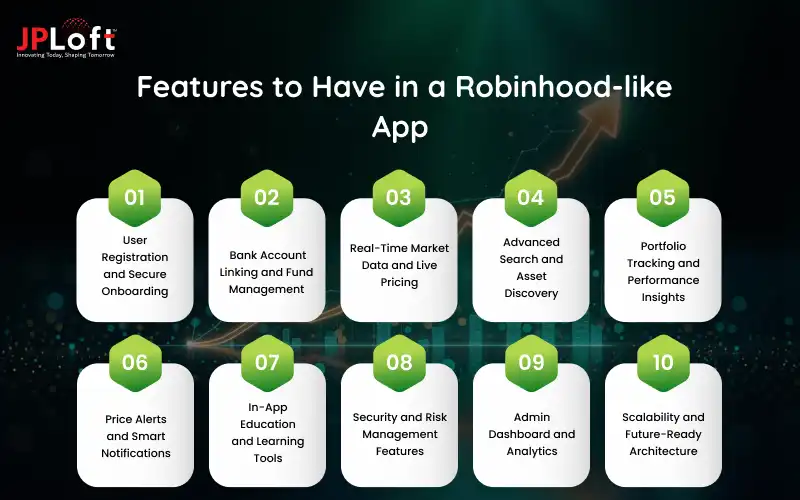
1. User Registration and Secure Onboarding
The key trading app feature is that it should support quick sign-up while meeting regulatory standards. This feature includes account creation, identity verification, and secure authentication.
Robinhood app features like Automated KYC and AML workflows help validate users without adding friction, while multi-factor authentication improves account security from day one.
2. Bank Account Linking and Fund Management
To build an app like Robinhood and to ensure its success, seamless fund handling is a must. Users should be able to link bank accounts and manage funds without delays. This feature enables deposits, withdrawals, instant transfers, and balance tracking.
Transparency on funds availability, pending transactions, and settlement timelines builds trust and improves trading confidence.
3. Real-Time Market Data and Live Pricing
Live market access is the backbone of any Robinhood-like app development strategy. Users expect up-to-date information at all times. This feature provides real-time stock prices, historical charts, intraday movements, and market trends.
Low-latency data delivery is essential to support informed trading decisions, especially during volatile market conditions.
4. Advanced Search and Asset Discovery
A strong discovery experience helps users explore investment opportunities efficiently. This feature allows users to search stocks, ETFs, and other assets using filters such as price, market cap, performance, or popularity.
Hence, having features like watchlists and trending assets further improve engagement and repeat usage.
5. Portfolio Tracking and Performance Insights
Users expect clear visibility into how their investments are performing. This feature, integrated when planning to build the stock trading app, displays holdings, gains and losses, allocation breakdowns, and performance charts.
Simple insights help beginners understand their portfolio, while detailed metrics support more experienced traders.
6. Price Alerts and Smart Notifications
Timely updates play a key role in user engagement for a stock trading app like Robinhood. This feature enables customizable alerts for price changes, earnings announcements, and trade executions.
Along with the price alerts, it is important to integrate push notifications to keep users informed and hence engaged even when they are not active on the app.
7. In-App Education and Learning Tools
Another feature to include is in-app education tools. Educational features help reduce user churn and trading anxiety.
This feature includes basic investing guides, tooltips, risk explanations, and market terminology support. In-app education builds confidence and promotes responsible investing behavior.
8. Security and Risk Management Features
A non-negotiable feature to consider when planning to create a stock trading app like Robinhood is app security.
A strong app security includes encryption, session monitoring, biometric login, fraud detection, and activity alerts. Such strong controls protect user data and financial transactions while supporting compliance requirements.
9. Admin Dashboard and Analytics
Behind the success of every clone app like Robinhood is a powerful admin system. Every stock trading app needs to have an admin panel along with the user panel.
Such a dashboard and analytics enable platform operators to monitor users, transactions, system health, compliance logs, and performance analytics. It supports operational control and informed decision-making.
10. Scalability and Future-Ready Architecture
If you are focusing on “how to develop a stock trading app like Robinhood?” then you must be aiming for long-term performance. A feature often overlooked is scalability itself.
Planning for scalability ensures that the app can handle growing user volumes, new asset classes, and feature expansion without performance degradation. Such feature planning ensures the long-term success of the app.
How Much Does it Cost to Develop a Robinhood-like App?
Every entrepreneur, when evaluating a market opportunity, has a common concern regarding the investment or the cost to build a stock trading app.
Hence, along with focusing on the development process, it is also required to plan for the associated development costs.
The average cost to make a mobile app like Robinhood ranges anywhere from $25,000 to $150,000 or more, depending on the project vision and the planned app features.
These mobile app development costs can vary depending on whether you plan to create an app exactly like Robinhood or plan to make relevant adjustments to suit your target audience.
|
App Type |
Estimated Cost |
Estimated Timeline |
|
MVP Trading App (Core Trading Features) |
$25,000 – $45,000 |
3–4 months |
|
Mid-Scale Trading App (Advanced Features) |
$50,000 – $90,000 |
4–6 months |
|
Full-Scale Stock Market App Like Robinhood |
$100,000 – $150,000+ |
6–9+ months |
The cost bifurcation as per the development phases is as follows:
|
Development Component |
Estimated Cost Range |
Estimated Timeline |
|
Product Discovery & Technical Planning |
$3,000 – $8,000 |
2–3 weeks |
|
UI/UX Design (Mobile-First Trading Experience) |
$4,000 – $12,000 |
3–5 weeks |
|
Frontend App Development (iOS / Android / Cross-Platform) |
$8,000 – $25,000 |
6–10 weeks |
|
Backend Development & APIs |
$10,000 – $30,000 |
8–14 weeks |
|
Trading Engine & Order Management System |
$12,000 – $35,000 |
8–12 weeks |
|
Market Data & Brokerage API Integrations |
$6,000 – $20,000 |
4–8 weeks |
|
KYC, AML & Compliance Implementation |
$5,000 – $15,000 |
3–6 weeks |
|
Payment Gateway & Banking Integrations |
$4,000 – $12,000 |
3–5 weeks |
|
Security, Encryption & Fraud Prevention |
$5,000 – $15,000 |
3–6 weeks |
|
Testing, QA & Performance Optimization |
$4,000 – $10,000 |
3–5 weeks |
|
Cloud Infrastructure & DevOps Setup |
$3,000 – $8,000 |
2–4 weeks |
|
Maintenance, Updates & Scalability Enhancements |
$6,000 – $20,000+ |
Ongoing |
Factors Affecting Robinhood-Like App Development Cost
The Robinhood-like app development cost is shaped by several factors, and understanding these factors helps businesses plan accurately.
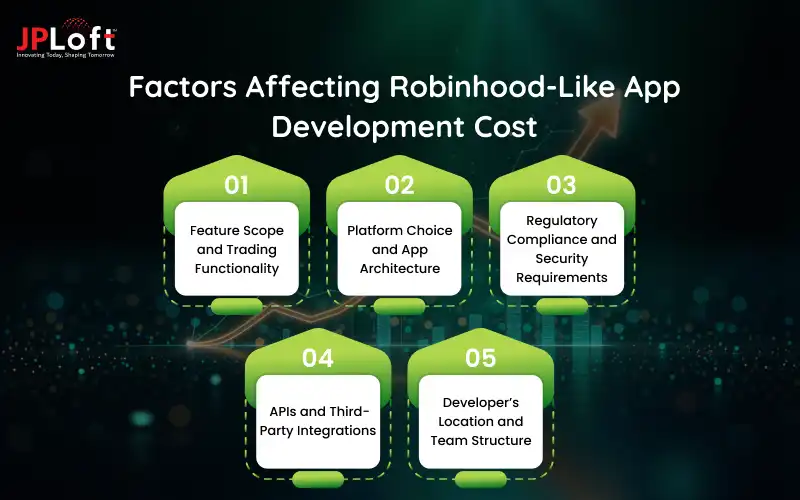
These factors include:
1. Feature Scope and Trading Functionality
The complexity of features plays a major role in determining cost. Basic stock trading functionality requires less effort, while advanced features such as options trading, fractional shares, real-time analytics, and multiple asset classes increase development time and cost to make a mobile app like Robinhood.
2. Platform Choice and App Architecture
The decision to build for iOS, Android, or cross-platform directly impacts development cost. Native apps offer better performance but require separate development efforts, while cross-platform frameworks reduce cost but may need optimization for real-time trading.
3. Regulatory Compliance and Security Requirements
Compliance and security are non-negotiable for any stock trading app like Robinhood. Implementing KYC, AML, data encryption, fraud detection, and audit-ready systems adds both development and ongoing maintenance costs.
4. APIs and Third-Party Integrations
Real-time market data, brokerage APIs, payment gateways, and identity verification services often come with integration complexity, influencing the overall Robinhood-like App Development cost. These integrations also come with recurring costs, which impact the budget.
5. Developer’s Location and Team Structure
Development costs vary based on the geographic location and experience level of the development team. A mobile app development company in Australia may charge more than a company from the Asian market. Hence, such factors need to be considered.
Challenges in Developing Robinhood-like App Development
Building a Robinhood-like stock trading platform can offer several benefits to entrepreneurs. But there are several stock trading app development challenges that you need to be aware of.
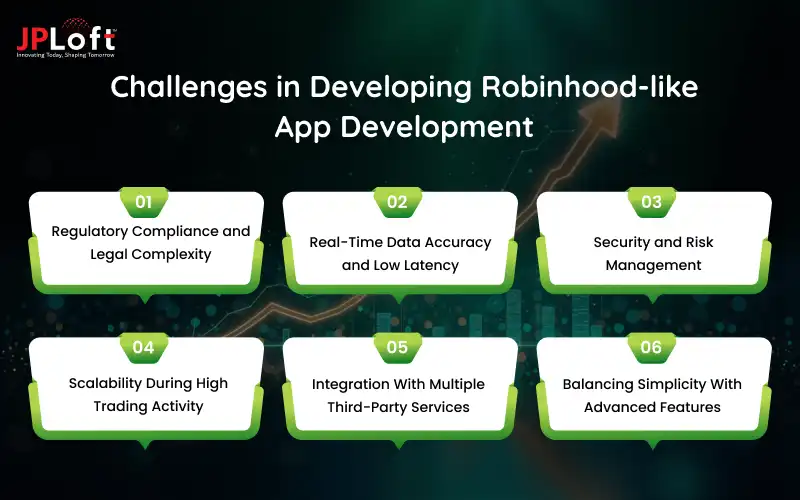
Businesses planning to develop a stock trading app like Robinhood must be prepared to address these issues early to avoid delays, cost overruns, and trust gaps.
Challenge 1: Regulatory Compliance and Legal Complexity
One of the biggest challenges is meeting strict financial regulations. Trading apps must follow KYC, AML, data privacy, and other app compliance requirements. Regulations evolve frequently, making ongoing compliance management both time-consuming and costly.
Solution: Build compliance into the architecture from day one by automating KYC and AML workflows and designing audit-ready data systems that can adapt quickly to regulatory updates without major rework.
Challenge 2: Real-Time Data Accuracy and Low Latency
A stock market app like Robinhood depends on real-time market data and instant trade execution. Ensuring low latency, accurate pricing, and consistent data across devices is technically demanding, especially during peak market volatility.
Solution: Use low-latency market data providers, event-driven architecture, and real-time data synchronization to ensure accurate pricing and fast trade execution, even during high market volatility.
Challenge 3: Security and Risk Management
Trading apps handle sensitive financial and personal data, making them attractive targets for fraud and cyberattacks. Implementing strong mobile app security features, encryption, fraud detection, secure authentication, and continuous monitoring adds complexity and requires specialized expertise.
Solution: Implement a security-first approach with encryption, multi-factor authentication, fraud detection systems, and continuous monitoring to protect user data and financial transactions at scale.
Challenge 4: Scalability During High Trading Activity
Market events can cause sudden spikes in traffic and trading volume. Designing infrastructure that scales instantly without downtime is a major engineering challenge when you build an app like Robinhood.
Solution: Design cloud-native infrastructure with auto-scaling, load balancing, and redundancy to handle traffic spikes and trading surges without performance degradation or downtime. Also, partner with an experienced app maintenance services provider to ensure performance consistency.
Challenge 5: Integration With Multiple Third-Party Services
Brokerage APIs, market data providers, banking systems, and identity verification services must work together seamlessly. Any failure or latency from third-party integrations can disrupt the entire trading experience.
Solution: Use modular API integration layers and fallback mechanisms to isolate failures and maintain platform stability when external services experience delays or outages.
Challenge 6: Balancing Simplicity With Advanced Features
Robinhood’s success lies in its simple interface, but users also expect powerful tools. Maintaining a beginner-friendly UX while offering advanced trading capabilities is a constant design and product challenge.
Solution: Adopt a layered UX strategy that keeps core trading simple for beginners, while allowing advanced tools and analytics to be accessed progressively as users gain experience.
Trends to Leverage to Stand Out
Robinhood has secured its positioning as a trusted name in the stock trading app space. Hence, to ensure the success of a clone app like Robinhood, it is important to look for key stock market app trends and plan to integrate them into the development process.
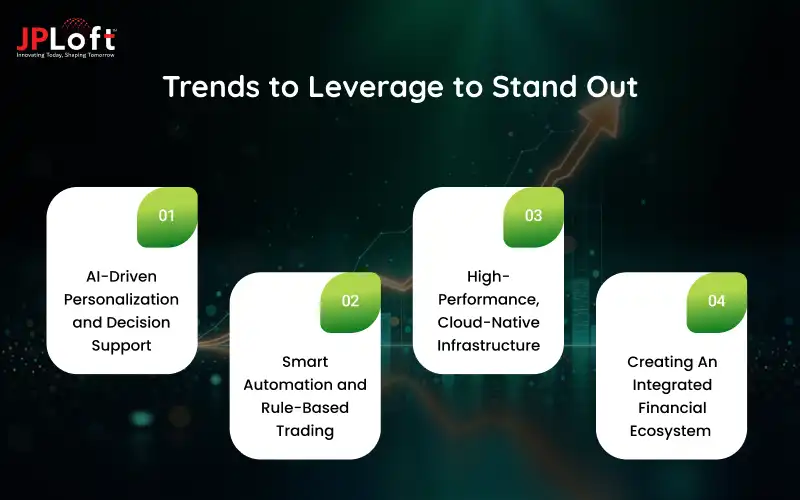
1. AI-Driven Personalization and Decision Support
Advanced trading apps are increasingly using AI to personalize the user experience. Instead of generic market data, partner with AI development companies that can help build AI models.
Such can help analyze user behavior, investment patterns, and market movements to deliver customized insights, timely alerts, and smarter portfolio suggestions. This helps users make confident decisions while keeping the app engaging.
2. Smart Automation and Rule-Based Trading
Automation is becoming a key differentiator in modern trading platforms. Features such as rule-based order execution, recurring investments, and automated rebalancing allow users to follow strategies without constant monitoring.
These capabilities add sophistication while maintaining simplicity for less experienced investors. Such automation can reduce manual intervention and boost Robinhood clone app performance.
3. High-Performance, Cloud-Native Infrastructure
A key stock trading app development challenge is ensuring real-time updates and steady performance in peak hours. Hence, a key trend to be followed is cloud-native and event-driven architectures.
This approach improves scalability, reduces latency, and ensures consistent performance during peak market activity, making the platform more reliable.
4. Creating An Integrated Financial Ecosystem
The platforms that are moving beyond trading will lead the financial ecosystem. Hence, integrating features such as digital wallets, savings tools, and financial planning modules can help turn the app into a complete financial ecosystem.
Such trends can allow businesses to create a next-generation trading platform that feels smarter, safer, and more capable than traditional Robinhood-style apps.
How do Apps like Robinhood Make Money?
Robinhood is popular as a stock trading app due to its zero-commission model. But following such a model doesn’t mean it is not earning revenue, but it relies on alternative stock market app monetization ways to make money.

Here are some of the key ways through which apps like Robinhood make money.
1. Payment for Order Flow (PFOF)
Robinhood sends user buy and sell orders to market makers, who pay the platform for order execution, allowing commission-free trades while generating consistent backend revenue.
2. Subscription Approaches
The platform offers a paid subscription that unlocks margin trading, higher instant deposit limits, advanced market insights, and priority access to premium financial tools.
3. Interest on Uninvested Cash
Another way through which businesses can plan to monetize their trading app, like Robinhood, is through interest on uninvested cash. Uninvested cash held in user accounts is placed in low-risk financial instruments, enabling Robinhood to earn interest on balances that would otherwise remain idle.
4. Margin Lending
If you are building a clone app like Robinhood, you can earn through margin lending. Users who borrow money to trade on margin are charged interest on the borrowed amount, creating an ongoing revenue stream tied to active and high-volume traders.
5. Stock Lending
Robinhood also lends user-owned stocks to institutional investors for short-selling, earning lending fees while maintaining ownership rights for the original investors.
6. Crypto Trading Spreads
Robinhood not only deals in stock assets. But has a diversified portfolio including stocks and crypto assets. Hence, Robinhood also earns revenue from the difference between buying and selling prices on cryptocurrency trades executed within the app.

How JPLoft Can Help You Develop an App like Robinhood?
Building an app like Robinhood requires a deep understanding of financial markets, user behavior, and regulatory expectations. The platform must handle real-time data, secure transactions, and high trading volumes while remaining simple enough for everyday investors.
This is where working with an experienced stock trading app development company like JPLoft becomes essential for long-term success.
JPLoft supports businesses throughout the entire development journey, starting with product planning and feature selection that align with clear business and monetization goals. The development process focuses on security-first architecture, performance stability, and compliance-ready systems to protect user data and financial transactions.
Equal attention is given to user experience, ensuring the app feels intuitive for beginners while offering advanced tools for active traders.
Beyond core trading features, JPLoft enables seamless integrations with market data providers, payment systems, and third-party APIs needed for smooth operations. After launch, continuous support, performance optimization, and feature upgrades help the app scale confidently.
With this end-to-end approach, JPLoft helps transform a trading app idea into a reliable, future-ready investment platform.
Conclusion
So now you know how to make an app like Robinhood. It can be concluded that building an app like Robinhood requires a careful balance of innovation, security, and user trust. Beyond trading features, the platform must deliver speed, reliability, and a seamless experience that encourages long-term engagement.
Further, choosing the right development approach helps ensure the app can manage real-time market data, protect sensitive information, and scale as user demand grows. With clear planning and the right technical foundation, businesses can avoid costly rework and launch with confidence.
A future-ready trading app evolves with market trends, meets regulatory expectations, and continues to deliver value to users while supporting sustainable business growth.
FAQs
Building a Robinhood-like app involves market research, feature planning, secure architecture design, real-time data integration, regulatory compliance, testing, and ongoing maintenance.
The cost varies based on app complexity, security standards, APIs, compliance requirements, and platforms. A basic trading app costs less, while advanced features raise development expenses.
A stock trading app typically takes 4 to 9 months to develop, depending on features, real-time integrations, compliance checks, and testing requirements.
Essential features include user onboarding, real-time market data, order execution, portfolio tracking, watchlists, alerts, and strong security measures.

Savannah is a passionate tech enthusiast with a sharp understanding of client needs across diverse digital domains. With expertise spanning financial platforms, on-demand solutions, and emerging technologies, she brings a unique blend of analytical insight and interpersonal skills, helping businesses decode complexities and make informed decisions in today's rapidly evolving digital world.



Share this blog