


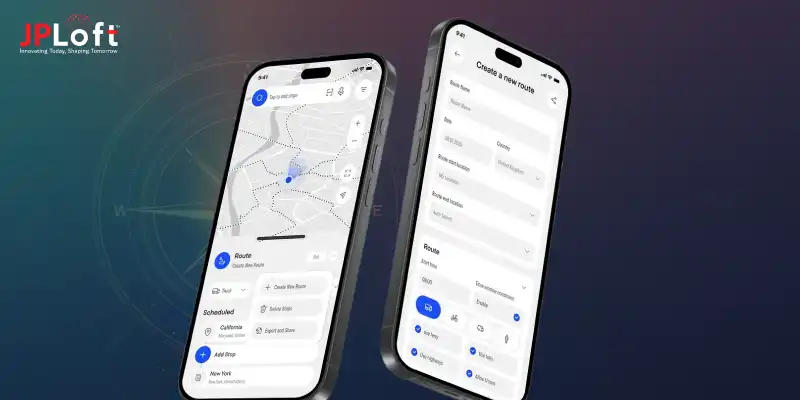
Key Takeaways:
Building a route planner app requires understanding user needs, accurate mapping, and smart algorithms for efficient routing.
A structured development approach covering planning, design, testing, and deployment ensures scalability, performance, and long-term usability.
Features like live traffic updates, multi-stop routing, offline maps, and analytics enhance user experience and operational efficiency.
A route planner app cost and timeline depend on feature complexity, integrations, and platforms, making early planning essential for budgeting.
With technical expertise and a strategic approach, JPLoft builds reliable, scalable, and future-ready route planner apps that deliver real value.
In an era where efficiency defines competitive advantage, route planner apps are reshaping how businesses and individuals navigate the world.
From cutting fuel costs and improving delivery timelines to boosting customer satisfaction, these apps are now mission‑critical tools for logistics, travel, delivery, and field services.
This guide explains how to build a route planner app that’s fast, accurate, and scalable by blending real‑time data, intelligent algorithms, and user‑centric design.
Rather than just showing directions, the best route planner apps dynamically optimize routes based on traffic, constraints, and multiple destinations, helping users make smarter decisions on the go.
Whether you’re building a solution for enterprise logistics or consumer navigation, this guide will walk you through key concepts, development steps, must‑have features, costs, monetization models, and real‑world challenges.
What is a Route Planner App?
A route planner app is a digital tool that helps in finding the most efficient path from one location to another. These apps are mostly used in logistics, delivery services, travel and personal navigation.
They combine real-time data, mapping systems, and user preferences to optimize routes, saving time, reducing costs, and improving overall efficiency.
Modern route planner apps provide more than navigation. Considering traffic conditions, road closures, multiple stops, and even fuel consumption, they can create intelligent and adaptive routing solutions.
Therefore, businesses and individual users alike rely on these apps to streamline operations and enhance decision-making while travelling or managing deliveries.
How Does a Route Planner App Work?
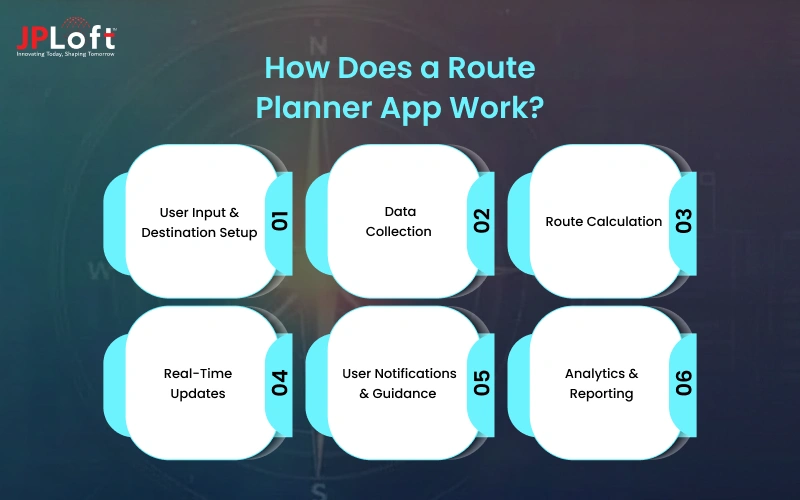
Here is a simplified breakdown of how a route planner app functions:
1. User Input & Destination Setup
Users insert their start location and destination(s). Also, the app allows customization regarding their preferred routes, stops, and travel modes.
2. Data Collection
The app collects all the important data from GPS, traffic sensors, mapping databases, and weather sources to understand current conditions and constraints.
3. Route Calculation
The app uses algorithms like Dijkstra or A* to calculate the fastest or most efficient route considering distance, traffic, and time.
4. Real-Time Updates
The app keeps monitoring traffic and environmental conditions in order to adjust routes dynamically if delays or obstacles are detected.
5. User Notifications & Guidance
The app provides step-by-step navigation, estimated arrival times, alerts for delays and suggested alternative routes to improve efficiency.
6. Analytics & Reporting
Many apps offer insights and reports on travel efficiency, mileage, fuel usage, and performance metrics for businesses or regular users.
Key Market Statistics of a Route Planner App
The route planner and navigation app market is growing rapidly, driven by widespread mobile adoption, real-time data technologies, and rising demand for efficient travel and logistics solutions. Here are the current market statistics related to route planner apps.
-
Strong Market Growth: The global route optimization and planning software market is projected to grow from USD 7.6 billion in 2025 to USD 22.5 billion by 2035, registering a CAGR of over 11%.
-
Delivery Route Planner Expansion: Delivery-focused route planner apps are forecasted to grow from USD 2.9 billion in 2025 to USD 6.5 billion by 2035, fueled by eCommerce and last-mile logistics.
-
Travel Planner App Potential: The travel planner app market is estimated to reach USD 9.3+ billion by 2032, supported by mobile-first and personalized travel experiences.
These statistics clearly highlight the growth opportunities for businesses and developers in route planning app development. This applies to both standalone navigation solutions and broader travel or logistics platforms.
Why You Should Invest in a Route Planner App?
Investing in a route planner app can transform your business by improving efficiency, cutting costs, and enhancing customer satisfaction.
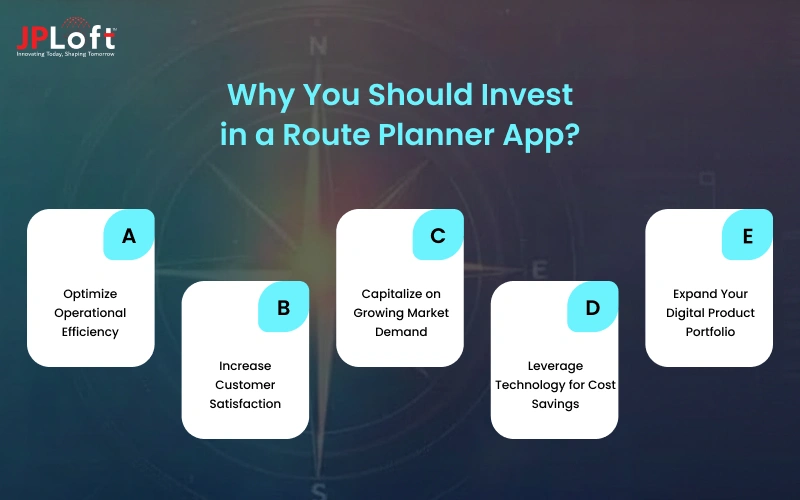
Here are the top reasons why now is the perfect time for route planning mobile app development:
Reason 1: Optimize Operational Efficiency
Route planner apps allow businesses to plan multiple routes effectively, minimizing fuel usage and reducing travel time. Companies that develop a route planner app can gain a competitive edge by streamlining logistics and enhancing delivery operations.
Reason 2: Increase Customer Satisfaction
Customers appreciate timely deliveries and accurate travel information. Therefore, businesses that build a route planner app with real-time tracking, estimated arrival times, and adaptive routing create a reliable user experience, fostering loyalty and retention.
Reason 3: Capitalize on Growing Market Demand
The demand for route optimization solutions is on the rise, both for businesses and consumers. By choosing to create a route planner app, you can tap into a market projected to grow significantly in the next decade.
Forward-thinking companies are exploring the top travel app ideas, including AI-assisted navigation and multi-stop routing, to differentiate their offerings.
Reason 4: Leverage Technology for Cost Savings
Modern route planner apps integrate AI, real-time traffic data, and predictive analytics. Businesses that make a route planner app can identify inefficiencies, reduce operational costs, and make data-driven decisions for long-term sustainability.
Reason 5: Expand Your Digital Product Portfolio
Adding a route planner app to your suite allows for new revenue streams and service offerings. Entrepreneurs considering the best mobile app ideas often find route planner apps appealing because they serve multiple sectors, such as travel, logistics, and e-commerce, with high scalability potential.
With route planning mobile app development, you’re positioning your business for innovation, efficiency, and growth in a market that is increasingly reliant on smart, digital solutions.
Step-by-Step Process to Develop a Route Planner App
Building a route planner solution requires a structured approach that balances user needs, technology, and scalability.
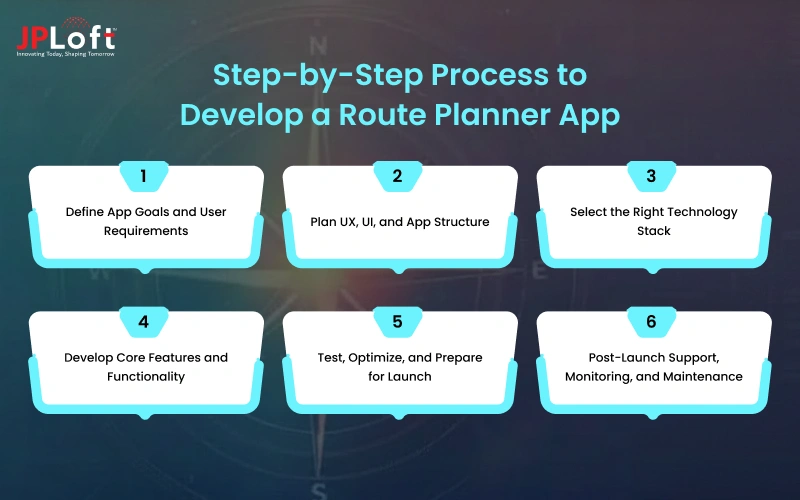
This step-by-step breakdown explains how to develop a route planner app that delivers performance, accuracy, and long-term value.
Step 1: Define App Goals and User Requirements
Before you build a route planner app, it’s essential to define who the app is for and what problems it will solve. Clear goals help align design, features, and development priorities.
►Identify the Target Audience
Understand whether your app serves travelers, logistics companies, delivery partners, or field service teams. Each audience has different routing expectations and usage patterns.
►Define Core Use Cases
Outline how users will interact with the app, single-route navigation, multi-stop planning, or real-time route optimization. This clarity helps when you create a route planner app that feels intuitive.
►Analyze Competitor Solutions
Review existing navigation and routing platforms to identify gaps. Studying similar platforms also provides insight into how to create a travel app that stands out in a competitive market.
Step 2: Plan UX, UI, and App Structure
User experience plays a critical role in adoption, especially for navigation-based applications. A well-planned interface ensures clarity, speed, and ease of use.
►Design User-Centric Interfaces
Focus on simple navigation, minimal inputs, and clear visual cues. Applying strong mobile app design principles ensures users can plan routes quickly without confusion.
►Create Wireframes for Core Screens
Wireframes define the structure of screens like route input, map view, and navigation mode. Proper mobile app wireframing helps validate layouts before development begins.
►Validate Flow with Early Prototypes
Interactive prototypes allow you to test usability and logic early. This step reduces risk and accelerates development by refining ideas through mobile app prototyping.
Step 3: Select the Right Technology Stack
Choosing the right technology foundation is critical for performance, scalability, and long-term maintenance. This decision directly impacts how well your app handles real-time data.
►Choose Backend and Frontend Technologies
Select frameworks and platforms that support real-time processing and map rendering. Evaluating top programming frameworks for app development helps ensure speed and reliability.
►Integrate Mapping and Navigation APIs
APIs like Google Maps or Mapbox provide routing, traffic, and location data. These integrations are central to effective route planner app development.
►Finalize the Infrastructure
From databases to cloud hosting, a scalable travel app tech stack ensures the app can handle growing users, routes, and data loads without performance issues.
Step 4: Develop Core Features and Functionality
This is where your app starts coming to life. Development focuses on turning designs and plans into a working product.
►Implement Route Calculation Logic
Use proven algorithms to determine the most efficient routes based on distance, traffic, and constraints. This forms the backbone of route planning app development.
►Enable Real-Time Updates
Live traffic updates, rerouting, and ETA adjustments improve reliability. These features are essential when you develop a route planner app for real-world usage.
►Ensure Cross-Platform Compatibility
Whether Android, iOS, or web, consistency matters. Many businesses aim to develop a mobile route planner app that performs seamlessly across devices.
Step 5: Test, Optimize, and Prepare for Launch
Testing ensures your app performs reliably under real-world conditions. Skipping this step can lead to poor user experience and app failures.
►Conduct Functional and Usability Testing
Test route accuracy, UI responsiveness, and feature flows thoroughly. Structured testing, similar to a travel app testing process, ensures realistic validation.
►Perform Performance and Load Testing
Evaluate how the app handles multiple users and heavy data loads. Applying best practices from mobile app testing helps uncover performance bottlenecks early.
►Optimize for Accuracy and Speed
Fine-tune algorithms, reduce load times, and fix inconsistencies. Proper optimization ensures your app is ready for public release and long-term scalability.
Step 6: Post-Launch Support, Monitoring, and Maintenance
Launching the app is not the final step; continuous support is essential to ensure long-term performance, accuracy, and user satisfaction. Route planner apps must evolve with changing user needs, data sources, and platform updates.
►Monitor App Performance and User Behavior
Track app stability, route accuracy, and usage patterns through analytics and monitoring tools. Ongoing insights help identify issues early and guide future improvements.
►Manage Updates and Third-Party Integrations
Regular OS updates, API changes, and map data updates require timely action. Structured mobile app maintenance services ensure compatibility, security, and uninterrupted functionality.
►Plan Feature Enhancements and Scalability
Post-launch feedback often highlights new feature demands. Continuous optimization and feature rollouts help your route planner app stay competitive and scalable over time.
With the development roadmap defined, the next step is identifying the must-have capabilities that ensure performance, usability, and scalability. Let’s explore the essential features every route planner app should include.
Essential Features of a Route Planner App
To succeed in today’s competitive navigation and mobility market, a route planner app must offer more than basic directions. The right combination of top travel app features ensures accuracy, usability, and long-term user engagement.
When businesses focus on the right route planner app features, they create solutions that serve both individual users and enterprise needs effectively.
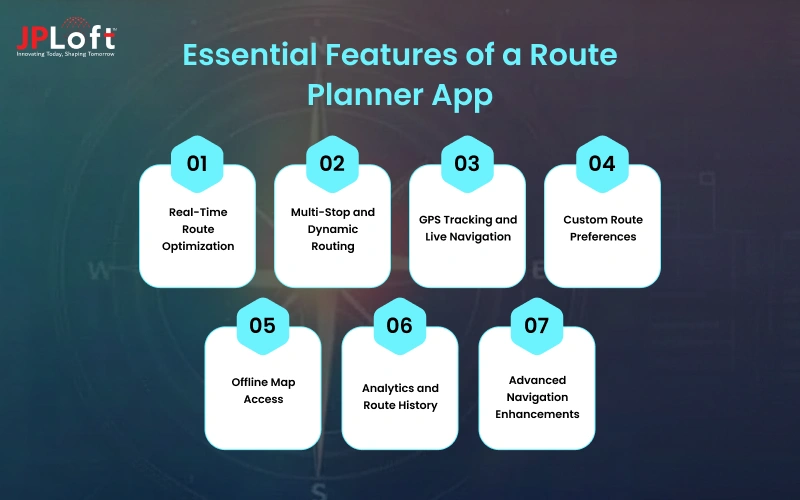
Here are the key features that must be part of your route planner app.
1) Real-Time Route Optimization
At the core of any route planner app is the ability to calculate the most efficient routes in real time. This feature considers traffic conditions, road closures, distance, and travel time to provide accurate navigation. Businesses that develop a route planner app with real-time optimization help users save time, reduce fuel consumption, and avoid unnecessary delays.
2) Multi-Stop and Dynamic Routing
Multi-stop routing allows users to plan journeys with multiple destinations in a single trip. This feature is particularly valuable for delivery services, logistics companies, and field operations. Many successful platforms include this dynamic rerouting feature that adjusts paths instantly when conditions change.
3) GPS Tracking and Live Navigation
Accurate GPS tracking enables turn-by-turn navigation and live route updates. It ensures users always know where they are and what lies ahead. When you build a route planner app with reliable GPS functionality, it significantly improves trust and usability, especially for time-sensitive travel.
4) Custom Route Preferences
Users should be able to customize routes based on preferences such as avoiding toll roads, highways, or congested areas. This level of personalization makes the app more user-centric. Such customization aligns well with broader mobile app features that focus on flexibility and user control.
5) Offline Map Access
Offline navigation allows users to access maps and routes without an active internet connection. This feature is especially useful in remote areas or during international travel. Adding offline access improves reliability and ensures uninterrupted navigation experiences.
6) Analytics and Route History
Route history and analytics provide insights into past trips, travel time, and distance covered. For businesses, this data helps optimize operations and monitor performance. For users, it adds value by tracking efficiency and travel patterns.
7) Advanced Navigation Enhancements
To stand out, modern apps are increasingly adopting immersive technologies. Integrating AR in travel apps enables users to visualize routes through camera-based overlays, making navigation more intuitive, especially in unfamiliar locations or crowded urban environments.
Cost & Timeline to Build a Route Planner App
The cost to develop a route planner app varies from $20k to $120k+, depending on multiple factors, including feature complexity, supported platforms, UI/UX design depth, and integrations such as maps, real-time traffic data, and analytics tools.
For businesses assessing the overall mobile app development cost for navigation-based solutions, budgets typically vary based on scalability and long-term performance requirements.
In practical terms, a basic route planner app with standard GPS navigation and limited features usually falls in the $20k–$40k range.
Mid-level apps with real-time traffic updates, multi-stop routing, and performance optimization often range between $40k–$80k, while advanced solutions featuring AI-powered routing, predictive analytics, and enterprise-grade integrations can exceed $120k+.
The development timeline also varies with complexity and testing depth. When evaluating how long does it take to build a mobile app, most route planner apps require 3–5 months for core functionality, while feature-rich and highly scalable solutions may take 6–9 months or more to ensure accuracy, stability, and reliable real-time performance.
Estimated Cost & Timeline Breakdown
|
App Complexity |
Estimated Cost |
Timeline |
|
Basic MVP |
$20k – $40k |
2–3 months |
|
Mid-Level App |
$40k – $80k |
4–6 months |
|
Advanced App |
$80k – $120k+ |
6–9+ months |
How Do Route Planner Apps Make Money?
Route planner apps can generate revenue through multiple monetization models, depending on the target audience and business goals. Whether the app serves individual users, enterprises, or logistics providers, a well-planned revenue strategy ensures long-term sustainability and scalability.
One of the most common approaches is offering free basic navigation while charging for advanced capabilities.
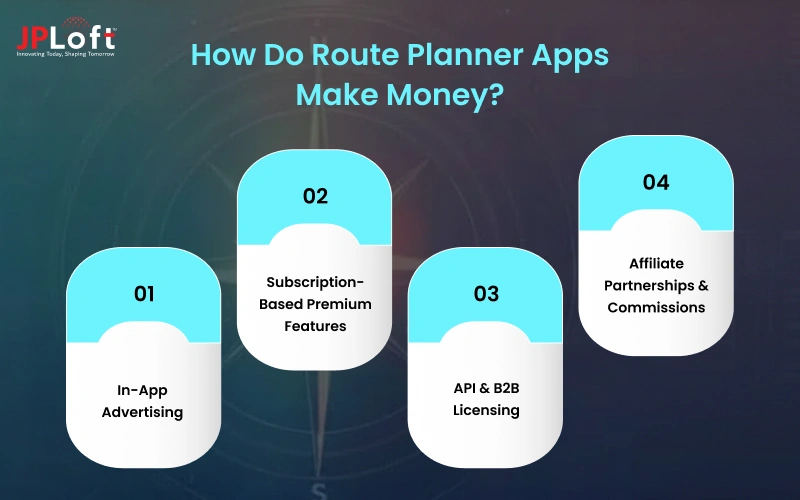
Businesses that make a route planner app often combine multiple travel app monetization strategies to maximize revenue without compromising user experience.
Model 1: In-App Advertising
Advertising is a popular monetization method for consumer-facing route planner apps. Brands can promote nearby locations, services, or travel-related offers based on user routes and preferences. This model works best when the app has a large and active user base.
Model 2: Subscription-Based Premium Features
Subscriptions allow users to unlock advanced functionalities such as multi-stop optimization, offline access, detailed analytics, or real-time traffic alerts. Many successful platforms rely on recurring revenue through monthly or yearly plans, creating predictable income while continuously delivering added value to users.
Model 3: API & B2B Licensing
Route planner apps can also monetize by licensing their routing technology or APIs to businesses. Logistics companies, delivery platforms, and enterprises pay for access to reliable routing systems, making this a strong revenue stream for scalable solutions.
Model 4: Affiliate Partnerships & Commissions
Partnering with fuel stations, hotels, travel services, or local businesses enables apps to earn commissions on referrals and bookings. This revenue stream aligns naturally with common mobile app monetization models, where value-driven partnerships drive passive income.
Challenges in Developing a Route Planner App
Building a route planner app involves more than integrating maps and GPS. From data accuracy to scalability and security, developers face multiple travel app development challenges that must be addressed early to ensure long-term success.
Understanding these challenges helps teams develop a route planner app that performs reliably in real-world conditions.
Challenge 1: Ensuring Accurate and Real-Time Route Data
One of the biggest challenges is maintaining route accuracy in dynamic environments. Traffic congestion, road closures, weather changes, and unexpected delays can all impact routing quality, especially for apps operating across multiple regions with varying infrastructure and data reliability.
Solution: Integrate reliable mapping APIs and real-time data sources, and use adaptive algorithms that recalculate routes instantly. Regular data updates and fallback routing logic help maintain accuracy even during sudden changes.
Challenge 2: Handling Scalability and Performance
As the user base grows, route calculations, live tracking, and real-time data processing place increasing pressure on the system. High request volumes, frequent location updates, and concurrent users can impact response times, especially during peak usage periods or large-scale operations.
Solution: Implement a cloud-based infrastructure with auto-scaling and load balancing to handle fluctuating demand. Optimized databases, efficient caching, and asynchronous processing help maintain fast performance and ensure the app remains stable as usage scales.
Challenge 3: Protecting User Data and Location Privacy
Route planner apps handle highly sensitive data, including real-time location information, travel patterns, and usage history. Any security lapse can lead to data breaches, regulatory issues, and loss of user trust, especially when operating across regions with strict privacy requirements.
Solution: Apply strong mobile app security measures such as end-to-end encryption, secure authentication mechanisms, and role-based access control. Regular security audits, secure data storage practices, and compliance with data protection regulations help safeguard user data and maintain long-term trust.
Challenge 4: Managing Cross-Platform Compatibility
Delivering a consistent experience across multiple devices, operating systems, and screen sizes can be challenging, particularly when supporting both iOS and Android platforms with varying hardware capabilities and OS versions.
Solution: Use cross-platform development frameworks where suitable and follow platform-specific guidelines where needed. Thorough device testing and standardized UI components help ensure consistent performance and a seamless user experience across platforms.
Challenge 5: Continuous Testing and Maintenance
After launch, route planner apps must adapt to frequent OS updates, third-party API changes, bug reports, and evolving user expectations. Without proactive monitoring, these issues can impact navigation accuracy, performance stability, and overall user experience over time.
Solution: Implement continuous testing and monitoring pipelines to detect issues early and respond quickly. Plan for regular maintenance cycles, performance optimizations, and timely updates to ensure the app remains compatible, secure, and reliable as platforms and user needs evolve.
How Does JPLoft Help You Build a Route Planner App?
Building a reliable and scalable route planner app requires deep technical expertise, industry understanding, and a structured development approach. At JPLoft, we specialize in crafting intelligent, data-driven routing solutions tailored to your business goals and user expectations.
As a trusted travel app development company, JPLoft helps you transform your idea into a high-performing route planner app by combining strategic planning, user-focused design, and robust engineering. From defining requirements and designing intuitive interfaces to implementing real-time routing, APIs, and scalable cloud infrastructure, our team manages the entire development lifecycle.
We focus on building apps that deliver accuracy, speed, and seamless user experiences across platforms. Our approach emphasizes performance optimization, data security, and long-term scalability, ensuring your app can handle growing user demands and evolving technologies.
Whether you’re launching a new product or enhancing an existing platform, JPLoft ensures your route planner app is built to industry standards, optimized for growth, and ready for real-world usage, helping you gain a competitive edge in today’s location-driven digital ecosystem.
Conclusion
Route planner apps have evolved from simple navigation tools into intelligent, data-driven platforms that support travel, logistics, delivery, and mobility-focused businesses. With growing reliance on real-time location data, AI-powered optimization, and seamless user experiences, building a robust route planner app is no longer optional, it’s a strategic advantage.
From understanding how route planner apps work to selecting the right features, technology stack, and development approach, every decision directly impacts performance, scalability, and user satisfaction. A well-designed app not only improves navigation accuracy but also enhances operational efficiency and long-term business growth.
By following a structured, step-by-step development process and aligning it with user needs and market trends, businesses can create future-ready route planner apps that remain competitive in an increasingly location-centric digital ecosystem.
FAQs
A route planner app is a digital solution that helps users find the most efficient paths between multiple locations. It works by collecting real-time data from GPS, traffic sensors, and mapping APIs, calculating optimized routes using algorithms, and providing live navigation with updates for delays, road closures, and alternate paths.
Building a route planner app involves several key steps: defining goals and target users, designing UX/UI and wireframes, selecting the right tech stack, implementing core features like real-time routing and GPS tracking, and performing thorough testing. Following a structured development process ensures your app is accurate, scalable, and user-friendly.
Core features include real-time route optimization, multi-stop navigation, GPS tracking, offline map access, custom route preferences, analytics, and advanced navigation enhancements like AR integration. These features ensure efficiency, usability, and engagement for both personal and business users.
The cost varies based on app complexity, platforms, features, and integrations. Basic apps typically range from $20k to $40k, mid-level apps from $40k to $80k, and advanced apps can exceed $120k. Timelines usually span 2–3 months for MVPs and 6–9+ months for fully-featured solutions.
Route planner apps monetize through several strategies: in-app advertising, subscription-based premium features, B2B licensing of routing APIs, and affiliate partnerships. Combining multiple monetization models can increase revenue while maintaining a great user experience.

Kris Jacobs brings 20+ years of experience solving complex digital product challenges through strategic thinking and user-centric design. With deep exposure to on-demand services, entertainment, travel, and interactive platforms, she collaborates across teams to shape scalable, engaging solutions that align business goals with intuitive user experiences across evolving digital landscapes.



Share this blog