



Key Takeaways:
To build a travel app, define a business model, find target users, select features, design UI, choose technology, integrate travel APIs, build, test, launch, and maintain.
Travel apps connect users with travel services while managing searches, bookings, payments, availability, and personalized experiences.
Businesses can build flight, hotel, rental, itinerary, tour, guide, or comprehensive travel marketplace applications.
Travel apps monetize through commissions, service fees, subscriptions, advertisements, affiliate partnerships, sponsored listings, and premium travel services.
The cost to create a travel app ranges from $15,000 to $200,000+, depending on platforms, features, integrations, complexity, and infrastructure.
AI, agentic booking, personalization, digital identity, conversational search, and real-time data are reshaping travel apps.
JPLoft builds scalable travel platforms with customized booking workflows, integrations, secure payments, personalization, and ongoing technical support.
77% of travelers are likely to book multiple parts of a trip on the same platform. Additionally, 76% are likely to return to the same platform to book additional services.
This highlights the importance of building travel apps that support the complete customer journey, from discovery to booking and trip management.
But how do you develop a travel app that works reliably beyond basic bookings?
It requires the right combination of booking systems, real-time availability, secure payments, maps, travel APIs, personalization, and third-party integrations. Businesses must also consider development costs, technology choices, scalability, and monetization before starting.
This travel app development guide covers essential features, app types, technology stack, architecture, costs, challenges, and emerging trends. It also explores how businesses can build a scalable travel platform aligned with their goals and customer expectations.
What Is a Travel App & Working?
A travel app assists users in planning, booking, and managing different parts of a trip through one platform. Depending on the business model, it can support flight and hotel bookings, vacation rentals, transportation, tours, activities, itinerary planning, travel guides, and trip management.
Developing travel software typically connects with travel APIs and third-party service providers to access real-time inventory, prices, schedules, and availability. Users can search for services, compare options, make bookings, and complete payments within the app.
How Do Travel Apps Work?
The following is the workflow of travel apps:
-
Search: Users explore destinations, flights, hotels, or activities using search filters.
-
Compare: The app displays prices, availability, ratings, and travel options.
-
Book: Users select services, enter traveler details, and confirm reservations.
-
Pay: Secure payment gateways process transactions and generate booking confirmations.
-
Manage: Travelers access tickets, itineraries, reservations, and payment details.
-
Navigate: Maps provide directions, nearby attractions, and location-based information.
-
Stay Updated: Notifications share booking confirmations, schedule changes, reminders, and travel alerts.
-
Personalize: The app recommends destinations, accommodations, and activities based on user preferences.
Types of Travel Apps You Can Build
The travel app industry is estimated to reach USD 1.43 trillion by 2034. Choosing the type of travel platform development depends on your target users, business model, and services you want to offer.
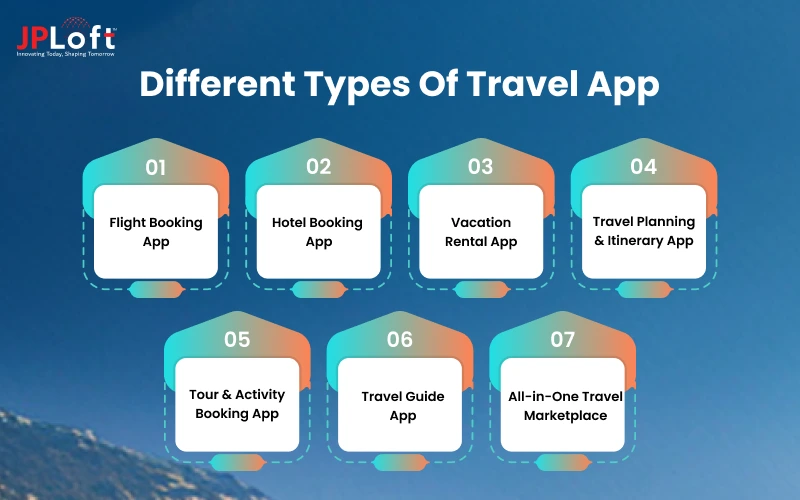
Businesses can choose from several app models, ranging from focused booking platforms to comprehensive travel marketplaces.
Type 1: Flight Booking App
Creating flight booking apps lets travelers search flights, compare fares, check schedules, select seats, and complete bookings. This type of travel booking app development can integrate airline APIs to provide real-time availability, pricing, flight status, and booking confirmation through a single platform.
Example: Expedia
Type 2: Hotel Booking App
Hotel booking apps help users discover accommodations, compare room prices, check availability, view amenities, read reviews, and make reservations. Making a hotel booking app lets businesses connect to hotel inventory APIs to keep property information, pricing, and availability updated.
Example: Booking.com
Type 3: Vacation Rental App
Developing an app like Airbnb for vacation rentals connects travelers with property owners offering apartments, homes, villas, and other short-term rentals. Users can browse listings, check availability, communicate with hosts, reserve properties, and make secure payments through the app.
Example: Airbnb
Type 4: Travel Planning & Itinerary App
Travel planning apps help users organize flights, hotels, activities, reservations, routes, and daily schedules. Building an AI itinerary app can combine booking information with maps, calendars, notifications, and personalized recommendations to create a centralized digital travel itinerary.
Example: TripIt
Type 5: Tour & Activity Booking App
Tours and excursion bookings are estimated to grow at a CAGR of about 9.7% from 2026 to 2033. These apps help travelers discover and book guided tours, attractions, experiences, events, and local activities. Real-time availability, digital tickets, reviews, and secure payments can simplify the activity booking process.
Example: Viator
Type 6: Travel Guide App
Travel guide apps provide destination information, attractions, restaurants, local recommendations, maps, travel tips, and reviews. Developing a tour guide app focuses on destination discovery and can also offer offline content for travelers without reliable internet access.
Example: TripAdvisor
Type 7: All-in-One Travel Marketplace
All-in-one travel apps bring flights, hotels, transportation, activities, payments, and itinerary management together. They require multiple travel APIs and third-party integrations to deliver synchronized availability, pricing, booking, and trip management across services.
Example: Expedia
How to Develop a Travel App: Step-by-Step Process
The process of building a travel platform must account for real-time travel data, third-party services, location, and scalability.
It involves planning the business model, conducting research, planning features, designing, integrating APIs, building backend systems, testing, launching, and performing regular maintenance.
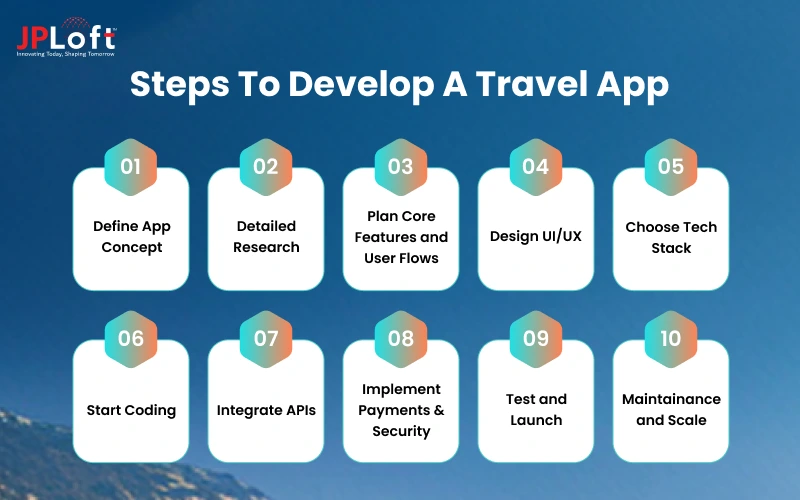
Now let's look at how to develop a travel app step by step that is easily scalable:
Step 1. Define Your Travel App Concept
Start developing your travel app idea by deciding the purpose and who will use it. You can build a flight booking app, hotel platform, vacation rental marketplace, itinerary planner, tour booking app, or all-in-one travel platform.
Before development begins, establish the following:
-
Target audience: Identify whether your platform serves individual travelers, families, business travelers, travel agencies, or service providers.
-
Business model: Decide whether you will earn through commissions, subscriptions, service fees, or partnerships.
-
Service area: Determine whether the app will serve a specific city, country, or international market.
-
Primary objectives: Define whether your priority is increasing bookings, simplifying travel planning, connecting providers, or improving customer retention.
A clearly defined concept helps your development team establish realistic requirements and avoid unnecessary features.
Step 2. Research the Market and Competitors
Conduct market research and analyze the best travel apps in the market to identify their core features and potential gaps. Pay attention to common problems such as confusing booking processes, hidden charges, outdated availability, limited payment options, and poor customer support.
Consider these research activities:
-
Conduct customer interviews and surveys.
-
Analyze competitor features and customer reviews.
-
Evaluate travel industry pricing and commission structures.
-
Identify underserved customer segments.
-
Research travel API providers and partnership opportunities.
Use these findings to establish your app's value proposition. Your goal should be to solve a specific traveler problem rather than simply replicate existing applications.
Step 3. Plan Core Features and User Flows
Create a feature roadmap based on your app concept and user requirements. Common features include registration, search, filters, real-time availability, booking, payments, maps, reviews, notifications, booking history, and customer support.
Common travel app features include:
-
User registration and profile management
-
Destination search and filters
-
Real-time pricing and availability
-
Booking and reservation management
-
Secure payment processing
-
Maps and location services
-
Reviews and ratings
-
Push notifications
-
Booking history and digital tickets
-
Customer support
Map important user flows from discovery to booking confirmation. Prioritize essential features for the MVP and reserve advanced functionality for future releases.
Step 4. Design the UI/UX
Begin with app wireframes that define the application's structure. Then create interactive app prototypes to evaluate navigation, booking flows, and overall usability before development begins.
Important screens may include:
-
Home and destination discovery
-
Search results and filters
-
Flight, hotel, or activity details
-
Booking and checkout
-
Payment confirmation
-
Itinerary and trip management
-
Customer support
Use clear navigation and pricing information throughout the experience. If your platform supports multiple providers, travel app design should have separate workflows for customers, administrators, hotels, tour operators, or other service partners.
Step 5. Choose the Technology Stack
Select technologies according to your application's complexity, platform requirements, integrations, scalability needs, and development budget. The technology stack should support reliable performance, secure data handling, and future feature expansion.
A typical travel app technology stack includes:
-
Frontend: Flutter, React Native, Swift, Kotlin
-
Backend: Node.js, Python, Java, .NET
-
Database: PostgreSQL, MySQL, MongoDB
-
Cloud Infrastructure: AWS, Microsoft Azure, Google Cloud
-
Maps: Google Maps Platform, Mapbox
-
Payments: Stripe, PayPal, Braintree
-
Notifications: Firebase Cloud Messaging, APNs
Choose technologies based on project requirements rather than popularity alone. Also consider maintenance, developer expertise, integration compatibility, and long-term operating costs.
Step 6. Develop the App and Backend
Build the customer-facing application alongside the backend infrastructure. The frontend manages user interactions, while the backend handles business logic, bookings, payments, and travel data.
Focus on developing the following components:
-
Customer App: Build features for destination search, service comparison, booking, payments, itinerary management, and notifications.
-
Backend Services: Develop systems to manage user accounts, searches, bookings, availability, payments, and travel data.
-
Admin Panel: Create a dashboard for managing customers, bookings, service providers, content, promotions, and analytics.
-
Vendor Dashboard: For marketplace apps, allow hotels, property owners, and tour operators to manage listings, pricing, availability, and reservations.
-
Database Management: Store and organize customer profiles, booking records, transaction details, and provider information securely.
-
API Integration: Connect backend services with travel providers, payment gateways, maps, and other third-party systems.
Use a modular architecture to simplify maintenance, support future integrations, and scale the platform as business requirements grow.
Step 7. Integrate Travel APIs and Third-Party Services
The process of making a travel app depends on external systems for flights, hotels, activities, transportation, maps, payments, and other services. Select APIs according to your business model and required inventory.
Your integrations should support essential operations such as:
-
Searching available travel services
-
Retrieving current prices and inventory
-
Creating and confirming reservations
-
Processing cancellations and refunds
-
Receiving booking updates
-
Synchronizing customer and provider information
Real-time availability is particularly important because travel inventory and prices can change frequently. Also, plan for external API failures. Use appropriate error handling, retry mechanisms, monitoring, and fallback processes to prevent temporary provider issues from disrupting the entire application.
Step 8. Implement Payments, Security, and Personalization
Integrate suitable payment gateways and connect payment processing with booking confirmations, cancellations, refunds, and invoices. Your application should clearly communicate transaction status and prevent duplicate payment attempts.
Security measures should include:
-
Secure authentication and authorization
-
Encryption for sensitive information
-
Protected API communication
-
Role-based access controls
-
Secure payment gateway integration
-
Regular security testing
Businesses must also consider applicable privacy, payment, and data protection requirements in their target markets. You can also add personalized recommendations, AI itinerary planning, location-based suggestions, and targeted notifications to make the travel experience more relevant to individual users.
Step 9. Test and Launch the Travel App
Perform travel app testing across devices, operating systems, screen sizes, and network conditions. Validate critical workflows such as search, availability updates, booking, payment, cancellation, refunds, and location services.
Important testing activities include:
-
Functional testing: Verify that features work according to requirements.
-
Integration testing: Check communication between travel APIs, payment gateways, and backend services.
-
Performance testing: Evaluate response times and application behavior under increased traffic.
-
Security testing: Identify vulnerabilities and verify data protection measures.
-
Usability testing: Confirm that users can complete bookings without unnecessary confusion.
Resolve critical issues before release and conduct a final review of app content, pricing information, privacy policies, and booking conditions.
Step 10. Maintain and Scale the App
Development continues after submitting the iOS app to the App Store. Monitor performance, API reliability, booking failures, security issues, and user feedback. Regularly update integrations when travel providers change their systems or requirements.
Post-launch activities should include:
-
Monitoring application performance and uptime
-
Updating third-party API integrations
-
Fixing bugs and security vulnerabilities
-
Improving booking and payment workflows
-
Reviewing user feedback and analytics
-
Introducing new features based on demand
As the user base grows, businesses may need to scale cloud infrastructure, databases, APIs, and backend services.
Must-Have Travel App Features
The right features depend on the travel app model, target audience, and services being offered. Most commercial travel apps need a combination of booking, discovery, payments, location, communication, and management features.
Here is a table of travel app features businesses must include in their platform:
|
Feature |
Description |
|
User Registration & Profiles |
Let users create accounts, manage personal details, save preferences, and access booking history. |
|
Search & Advanced Filters |
Allow users to search flights, hotels, activities, or destinations using dates, location, price, ratings, and other filters. |
|
Real-Time Availability |
Display current inventory, prices, schedules, and booking status by connecting with relevant travel APIs. |
|
Booking Management |
Enable users to create, modify, cancel, and review bookings from one place. |
|
Secure Payments |
Support secure online payments through cards, digital wallets, and other relevant payment methods. |
|
Personalized Recommendations |
Suggest destinations, accommodations, activities, or travel plans based on user preferences and trip history. |
|
Reviews & Ratings |
Allow travelers to review hotels, activities, destinations, or other services and help businesses build credibility. |
|
Push Notifications |
Send booking confirmations, payment updates, reminders, schedule changes, offers, and other important travel alerts. |
|
In-App Customer Support |
Provide chat, FAQs, support tickets, or chatbot assistance for booking and travel-related queries. |
|
Multi-Language & Multi-Currency Support |
Make the app accessible to users across different countries and simplify international travel transactions. |
|
Trip & Itinerary Management |
Let users organize flights, hotels, activities, reservations, and schedules into a single travel itinerary. |
|
Admin Dashboard |
Give businesses control over users, bookings, payments, content, providers, promotions, and analytics. |
Essential Travel APIs & Integrations
Developing a travel app depends on APIs and third-party integrations to access live travel information and content for users through external services. Unlike standalone apps, travel platforms often need to exchange data with airlines, hotels, payment providers, mapping services, and their travel business.
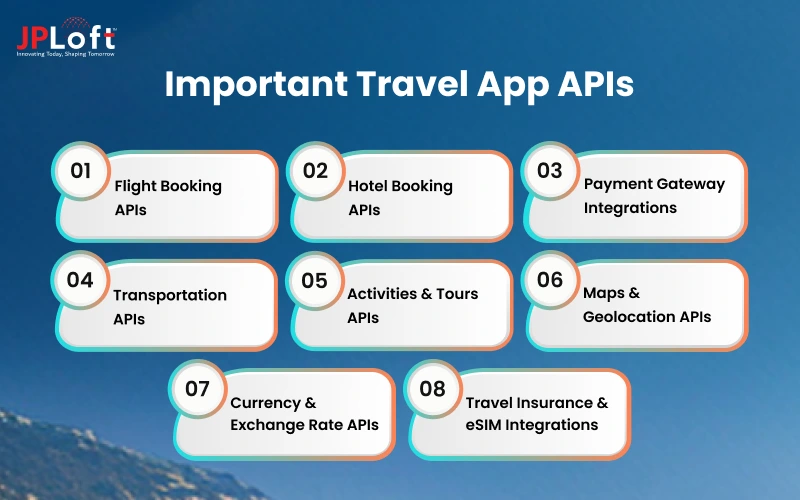
1. Flight Booking APIs
Flight APIs provide access to airline schedules, fares, routes, seat availability, and booking information. They allow users to search and compare flights without requiring the business to maintain airline inventory directly.
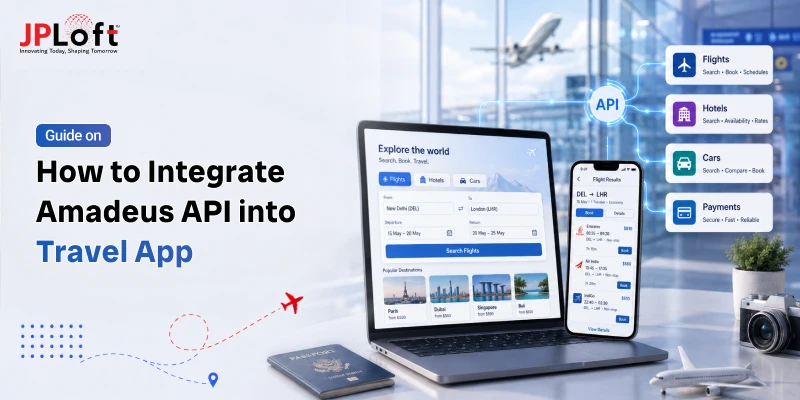
Example: Amadeus Self-Service APIs can support flight search, pricing, order creation, and flight order management.
2. Hotel Booking APIs
Hotel APIs connect the app with accommodation providers and aggregators. They can provide property details, room types, pricing, amenities, availability, images, and booking functionality.
Example: Booking.com Connectivity APIs support property availability, rates, reservations, content, and other accommodation data. Another option is integrating the Amadeus API for hotels, which supports hotel search, availability, pricing, and booking.
3. Payment Gateway Integrations
Payment integrations allow travelers to securely pay for bookings and services. Depending on the target market, businesses may support credit cards, debit cards, digital wallets, and local payment methods.
Example: Stripe can be integrated to process online payments and connect payment transactions with the app's booking workflow.
4. Transportation APIs
Transportation APIs can connect travel apps with car rentals, taxis, trains, buses, or other mobility services. This enables businesses to offer transportation alongside flights, hotels, and activities.
Example: Amadeus Cars and Transfers APIs can help travel businesses integrate transportation services into their platforms.
5. Activities & Tours APIs
These integrations provide access to tours, attractions, events, and local experiences. Users can discover activities, check availability, compare options, and make reservations directly through the app.
Example: Viator Partner API provides product details, pricing, availability, reviews, and booking functionality for tours and experiences.
6. Maps & Geolocation APIs
Maps and location APIs help users find hotels, attractions, airports, restaurants, and other nearby places. They can also support creating a route planner app, distance calculations, geocoding, and location-based recommendations.
Example: Google Maps Platform can be integrated to add maps, location search, geocoding, and navigation-related functionality to a travel app.
7. Currency & Exchange Rate APIs
For international travel apps, currency APIs can provide current exchange rates and support multi-currency price displays. This makes pricing easier to understand for users traveling across different countries.
Example: Integrate Open Exchange Rates to retrieve currency exchange-rate data and support multi-currency price displays.
8. Travel Insurance & eSIM Integrations
Businesses can integrate insurance providers and eSIM platforms to offer additional travel services during the booking journey. These integrations can also create additional revenue opportunities through commissions and service fees.
Example: A travel marketplace can integrate an eSIM provider API so users can purchase a destination-specific data plan alongside their flight or hotel booking. Similarly, an insurance provider API can add travel coverage as an optional booking add-on.
Choosing the right integrations early can improve booking accuracy, reduce manual operations, and create a smoother user experience.
Travel App Tech Stack & Architecture
A travel app tech stack should be able to handle real-time data, high booking volumes, location services, secure transactions, and multiple external integrations. The architecture should also allow businesses to add new travel services without rebuilding the entire platform.
Recommended Travel App, Tech Stack
Here is a table of the most popular tech stacks to begin how to build a travel app:
|
Layer |
Recommended Technologies |
Purpose |
|
Frontend |
Flutter, React Native, Swift, Kotlin |
Build responsive mobile experiences |
|
Backend |
Node.js, Python, Java, .NET |
Manage business logic, bookings, users, and APIs |
|
Database |
PostgreSQL, MySQL, MongoDB |
Store users, bookings, listings, payments, and travel data |
|
APIs |
REST APIs, GraphQL |
Connect the app with backend services and third-party platforms |
|
Maps & Location |
Google Maps Platform, Mapbox |
Maps, routes, geolocation, and nearby services |
|
Payments |
Stripe, PayPal, Braintree |
Secure payments, refunds, and transaction management |
|
Cloud |
AWS, Microsoft Azure, Google Cloud |
Hosting, storage, scalability, and infrastructure |
|
Notifications |
Firebase Cloud Messaging, Apple Push Notification Service |
Booking updates, reminders, and alerts |
|
Analytics |
Google Analytics, Firebase Analytics, Mixpanel |
Track user behavior, bookings, and engagement |
|
Security |
OAuth 2.0, JWT, SSL/TLS, encryption |
Protect accounts, payments, and sensitive travel data |
Travel App Architecture
A typical layered architecture is the core of how to create a travel app from scratch. It connects the user interface with backend services and external travel providers.
-
User Interface: Users search destinations, compare options, make bookings, manage trips, and complete payments through the mobile or web app.
-
API Layer: APIs transfer requests between the frontend and backend. They handle authentication, search requests, booking actions, payments, and user data.
-
Backend Services: The backend manages users, inventory, bookings, pricing, notifications, loyalty programs, and business rules.
-
Database: The database stores customer profiles, booking records, payment status, preferences, reviews, and other operational data.
-
Travel APIs: External APIs provide flight schedules, hotel inventory, transportation options, activities, pricing, and availability.
-
Payment Gateway: The payment layer processes transactions securely and communicates payment status back to the booking system.
-
Maps & Location Services: Mapping services support destination discovery, route planning, nearby attractions, distance calculations, and location-based recommendations.
-
Admin Panel: Business teams can manage users, bookings, listings, pricing, promotions, vendors, content, and analytics.
How Much Does Travel App Development Cost?
The cost to build a travel app typically ranges from USD 15,000 to USD 200,000+, depending on the app’s features, platform choice, API integrations, design complexity, and development team type.
A basic travel app with limited booking functionality requires significantly less investment than a multi-service travel marketplace with real-time inventory and advanced personalization.
Here is a cost table to create a travel app of different types:
|
Travel App Type |
Estimated Development Cost |
Key Features Included |
|
Basic Travel Guide App |
$15,000 – $35,000+ |
Destination guides, attraction listings, search, maps, location services, travel tips, reviews, push notifications, offline content. |
|
Travel Planning & Itinerary App |
$25,000 – $60,000+ |
Trip planning, itinerary builder, booking imports, calendar integration, maps, travel reminders, reservation management, offline access |
|
Hotel Booking App |
$30,000 – $80,000+ |
Hotel search, filters, room listings, real-time availability, room selection, reviews, booking management, payments, cancellation |
|
Flight Booking App |
$40,000 – $100,000+ |
Flight search, fare comparison, filters, real-time schedules, seat selection, passenger management, ticket booking, payments, cancellation, and refunds |
|
Tour & Activity Booking App |
$35,000 – $90,000+ |
Activity discovery, location-based search, availability calendar, booking, digital tickets, reviews, payments, vendor management, notifications |
|
Vacation Rental App |
$40,000 – $110,000+ |
Property listings, search and filters, availability calendars, booking, host profiles, guest-host chat, reviews, payments, identity verification |
|
All-in-One Travel App |
$100,000 – $200,000+ |
Flight and hotel booking, vacation rentals, activities, transportation, itinerary management, maps, payments, personalized recommendations, loyalty programs, notifications, multi-vendor management |
For businesses testing a travel concept, an MVP can start around USD 15,000 to USD 50,000 with essential features. Choosing to build a travel app with scalable infrastructure can be a better choice for companies already having a huge audience to serve.
How Do Travel Apps Make Money?
Travel apps can generate revenue through bookings, subscriptions, partnerships, advertising, service fees, and additional travel services.
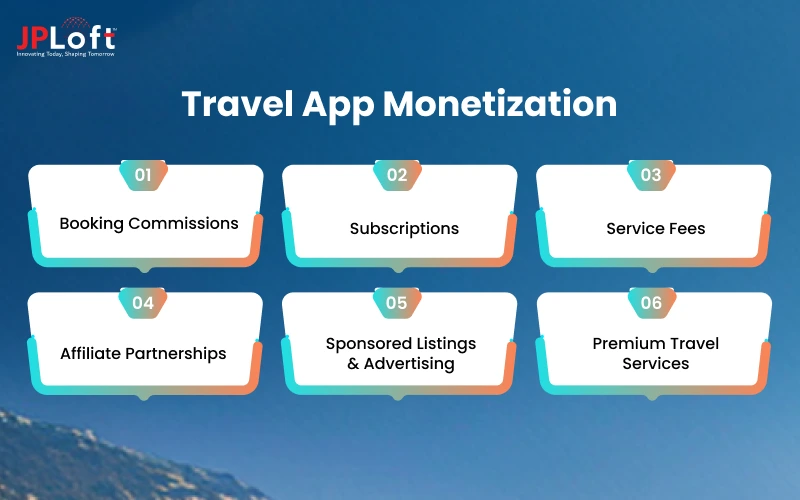
The right monetization model depends on the app type, target audience, and services offered.
1. Booking Commissions
Booking commissions are one of the most common travel app monetization strategies. The travel app earns a percentage or predetermined fee whenever a user completes a booking through the app.
This model works particularly well for hotel booking, flight booking, vacation rental, tour, and activity platforms.
2. Subscriptions
Travel apps can offer subscription plans that provide additional benefits. Subscription revenue can provide a recurring income stream beyond individual bookings.
These may include exclusive deals, lower booking fees, premium customer support, airport lounge access, or advanced trip-planning features.
3. Service Fees
Businesses can develop a travel app and add a service or convenience fee to eligible transactions. The fee can apply to bookings, itinerary services, cancellation assistance, or other value-added services.
The app should clearly communicate applicable charges during checkout to maintain pricing transparency.
4. Affiliate Partnerships
Travel apps can promote third-party services through affiliate partnerships. When users purchase flights, hotels, insurance, car rentals, or other services through tracked referrals, the app receives a commission.
This approach can be particularly useful for travel guides and content-focused apps that do not manage their own booking inventory.
5. Sponsored Listings & Advertising
Hotels, tour operators, restaurants, and other travel businesses can pay to promote their services within the app. Sponsored properties can appear in relevant search results or destination pages.
Advertising can generate additional revenue once an app has a substantial and engaged user base.
6. Premium Travel Services
Businesses can introduce paid services such as AI-powered itinerary planning, concierge assistance, personalized recommendations, offline destination guides, travel insurance, airport transfers, and eSIM purchases.
These services allow travel apps to generate additional revenue from users who want more convenience during their trips.
Common Travel App Development Challenges & Solutions
After knowing how to create a travel app, managing the system can create technical and operational challenges during development.
Each component introduces various travel app development challenges that can affect booking accuracy, app performance, security, and user experience.
Challenge 1: Real-Time Data Synchronization
Travel prices, availability, schedules, and booking inventory change frequently, making outdated information a major risk. Even small delays in synchronization can lead to incorrect listings, failed bookings, or customer dissatisfaction.
Solution: Integrate reliable travel APIs with real-time synchronization, availability validation, caching, and automated error-handling mechanisms.
Challenge 2: Complex Third-Party Integrations
Travel apps often connect flights, hotels, payments, maps, activities, and transportation through multiple third-party APIs. Differences in API structures, response times, and service availability can make integrations difficult to manage.
Solution: Build a centralized integration layer with standardized data formats, API monitoring, fallback mechanisms, and robust error handling.
Challenge 3: Secure Payment Processing
Travel apps process payments, refunds, cancellations, and international transactions, increasing travel app security and compliance requirements. Any weakness in the payment flow can expose financial information and create transaction failures.
Solution: Use trusted payment gateways with encryption, tokenization, secure authentication, fraud controls, and appropriate payment-security practices.
Challenge 4: Complex Booking Management
Travel bookings involve multiple steps, including availability checks, traveler details, payments, confirmations, cancellations, and refunds. A failure at any stage can create inconsistent booking records or require manual intervention.
Solution: Create structured booking workflows with transaction states, validation, automated notifications, and recovery mechanisms for failed transactions.
Challenge 5: Scalability During Peak Demand
Travel apps can experience sudden traffic increases during holidays, seasonal periods, and promotional campaigns. Without scalable infrastructure, high traffic can cause slow loading, service interruptions, or failed booking requests, leading to travel app failure.
Solution: Use scalable cloud infrastructure, load balancing, caching, database optimization, and performance monitoring to handle demand efficiently.
Challenge 6: Data Privacy and Security
Travel apps handle personal details, booking records, payment-related information, and location data that require strong protection. Unauthorized access or poor data management can create security risks and damage user trust.
Solution: Implement encryption, secure authentication, role-based access, regular security testing, and appropriate data protection and retention practices.
Latest Travel App Development Trends
The process of building a travel platform is moving beyond basic search and booking features. In 2026, businesses are focusing on AI-powered planning, personalized experiences, agentic booking, and real-time data as travel app development trends.
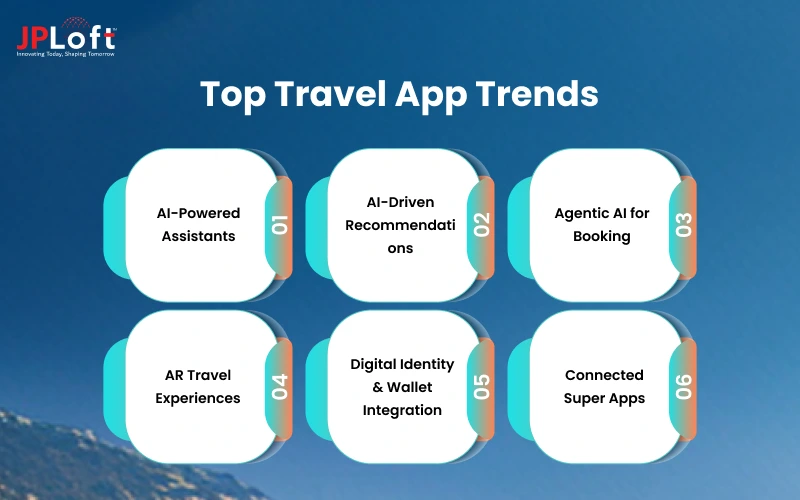
Below, we have listed the latest trends from an expert’s travel app development guide that businesses can integrate into their platform:
1. AI-Powered Travel Assistants
AI assistants help travelers search destinations, build itineraries, compare options, answer questions, and manage bookings. They create more convenient experiences by reducing manual searching and simplifying trip planning.
2. AI-Driven Recommendations
AI in hospitality analyzes preferences, budgets, destinations, and previous interactions to suggest relevant travel products. Businesses can use these recommendations to promote suitable hotels, activities, destinations, and additional services.
3. Agentic AI for Travel Booking
Agentic AI can understand travel preferences, search available options, compare results, and perform booking tasks with user authorization. This can create more automated travel planning and purchasing experiences.
4. AR and Immersive Travel Experiences
Augmented reality used to develop a travel app can provide interactive destination information, navigation, attraction details, and location-based experiences through smartphone cameras. Businesses can use AR in travel apps to make destination exploration more informative and engaging.
5. Digital Identity & Wallet Integration
Digital identity and wallet integrations can combine payment details, identity credentials, loyalty information, and travel preferences. This reduces repetitive data entry and can create faster, more convenient booking experiences.
6. Connected Travel Super Apps
Building travel super apps combines flights, hotels, activities, transportation, payments, loyalty programs, insurance, and in-trip services. This creates a centralized platform where users can manage multiple parts of their journey.
Why Choose JPLoft for Travel App Development?
A successful travel app needs a technology foundation that can manage real-time inventory, secure transactions, and changing customer expectations while supporting business growth.
JPLoft, a renowned travel app development company, is here to help travel businesses turn complex booking and travel workflows into scalable digital products. Our travel app development services cover discovery, UI/UX design, development, API integration, testing, deployment, and post-launch support.
We build custom travel apps with booking systems, real-time availability, secure payments, maps, travel APIs, personalization, and third-party integrations based on specific business requirements. Our team can also develop admin and vendor panels to manage bookings, inventory, customers, pricing, and analytics.
Whether you need a flight booking platform, hotel app, itinerary planner, vacation rental marketplace, or all-in-one travel solution, we design the architecture around your business model and growth plans.
Conclusion
Knowing how to create a travel platform requires more than creating booking screens and adding travel listings. Businesses need a scalable platform that connects booking systems, real-time availability, maps, payments, travel APIs, and third-party services into reliable experiences.
Development costs can range from USD 15,000 for a basic solution to USD 200,000+ for a feature-rich travel marketplace. Emerging technologies such as AI assistants, personalization, conversational search, and real-time recommendations are also changing how travelers discover and book services.
By choosing the right development approach from the travel app development guide, you get app that supports current customer needs while providing the flexibility to scale and adapt.
A strong architecture also makes it easier to introduce new services, integrations, and monetization opportunities as your business grows.
FAQs
Building a travel app involves defining your business model, researching users, and selecting essential features. Next, design interfaces, choose technologies, integrate travel APIs, develop booking systems, and implement secure payments. Test thoroughly, launch, and continuously improve performance, security, and user experience.
Businesses can build flight booking, hotel booking, vacation rental, itinerary planning, travel guides, tour bookings, or all-in-one travel apps. The right model depends on the target audience, available travel services, revenue strategy, required integrations, and overall business objectives.
Travel app development generally costs between $15,000 and $200,000+. The final budget depends on app type, features, platforms, UI/UX complexity, travel API integrations, payment systems, backend architecture, security requirements, development team location, and ongoing infrastructure or maintenance needs.
A travel app typically requires mobile technologies such as Flutter, React Native, Swift, or Kotlin, alongside backend technologies like Node.js, Python, Java, or .NET. Databases, cloud platforms, travel APIs, payment gateways, maps, analytics, and security technologies complete the technology stack.
Current travel app trends include AI-powered assistants, agentic booking, hyper-personalization, real-time travel information, visual discovery, smarter payments, augmented reality, and API-first architectures that support flexible third-party service integrations.

Kris Jacobs brings 20+ years of experience in digital product strategy, user-focused design, and solving complex product challenges. She has worked across on-demand services, travel, entertainment, sports, insurance, education, and service marketplaces, including handyman, dog-walking, courier, event-management, and equine platforms. Her focus is on shaping practical, scalable digital experiences that align user needs with business goals and long-term product growth.



Share this blog