


Key Takeaways:
AI helps shift app maintenance from reactive bug fixing to proactive monitoring, issue detection, and preventive action.
AI can support bug detection, automated testing, performance monitoring, log analysis, root-cause analysis, and security monitoring.
AI-powered predictive maintenance identifies patterns and warning signs that may indicate potential application failures.
Machine learning, generative AI, AIOps, RAG, AI agents, and predictive analytics support different stages of the maintenance lifecycle.
AI can help businesses reduce maintenance costs, minimize downtime, improve developer productivity, and maintain application performance.
AI in mobile app maintenance can support crash detection, performance monitoring, testing, and proactive issue resolution across mobile applications.
Successful AI adoption requires quality data, secure integrations, human oversight, and a gradual implementation strategy.
AI is transforming app maintenance by helping teams detect issues earlier, automate repetitive tasks, predict potential failures, and improve application reliability.
As applications become more complex and rely on APIs, cloud infrastructure, third-party services, and changing user demands, development teams need smarter ways to monitor performance and prevent failures.
AI in application maintenance enables a proactive approach by analyzing application data, detecting anomalies, automating testing, identifying performance issues, and supporting faster troubleshooting.
AI can also predict potential failures before they disrupt users, making AI-powered predictive maintenance increasingly valuable for modern applications.
From intelligent monitoring and automated testing to AI-assisted root-cause analysis and security detection, these capabilities can improve reliability while reducing repetitive maintenance work.
This guide explores how AI is transforming app maintenance, its technologies, benefits, challenges, and implementation strategies.
What is AI-Powered App Maintenance?
AI-powered app maintenance combines intelligent monitoring, automation, predictive analysis, and developer assistance to manage applications throughout their lifecycle.
Instead of relying mainly on manual checks and user-reported issues, teams can use AI to analyze application logs, performance metrics, system events, and other operational data continuously.
This approach to maintaining a mobile app supports activities such as anomaly detection, automated testing, performance monitoring, issue analysis, and predictive failure detection.
Its key advantage is the shift from reactive to proactive maintenance, helping teams identify risks earlier, prioritize critical issues, investigate potential causes, and take preventive action while maintaining human oversight.
How is AI Transforming App Maintenance?
AI is transforming app maintenance by helping teams automate routine tasks, identify issues earlier, analyze application behavior, and support faster resolution. Its impact can be seen across testing, performance monitoring, security, troubleshooting, and application updates.
1. AI-Powered Bug Detection and Resolution
AI can analyze crash reports, error logs, code changes, and user activity to identify unusual behavior and potential bugs.
It can group related errors, identify recurring patterns, and highlight issues that require attention, helping developers spend less time sorting through large volumes of data.
2. AI-Assisted App Testing
AI-powered app maintenance tools can generate test scenarios, analyze test results, identify regression risks, and prioritize high-impact test cases.
By adapting testing based on application changes, AI can help teams improve test coverage and reduce repetitive manual testing during frequent releases.
3. Performance Monitoring and Optimization
Another role that AI plays in app maintenance is automating continuous application metrics such as response times, API performance, crashes, resource consumption, and system activity.
It can identify abnormal patterns and highlight potential performance bottlenecks, allowing developers to investigate and optimize issues before they significantly affect users.
4. AI-Powered Root-Cause Analysis
Identifying the underlying cause of an application problem can take considerable developer time. AI can correlate logs, recent deployments, system metrics, and error patterns to identify possible root causes.
Developers can then use these insights to investigate problems and determine appropriate fixes more efficiently.
5. Security and Anomaly Detection
AI can monitor application activity to identify unusual access patterns, suspicious behavior, and can conduct security audit in maintenance process.
Continuous analysis can help maintenance teams detect potential risks earlier and support faster investigation of security-related incidents.
6. AI-Assisted Updates and Dependency Management
Intelligent systems can help teams identify outdated libraries, dependencies, and platform requirements that may affect application stability or compatibility.
It can assess potential risks, support update testing, and highlight dependencies that require developer attention, making ongoing application upgrades more manageable.
How Does AI-Powered Predictive Maintenance Work?
AI-powered predictive maintenance uses application data, machine learning, and continuous monitoring to identify warning signs before they develop into major failures.
The process connects data collection, anomaly detection, failure prediction, risk prioritization, and preventive action into a continuous maintenance workflow.
Let’s have a look at the step-by-step process of how AI-powered predictive maintenance works.
Step 1: Collect Application Data
The process begins by gathering data from application logs, crash reports, APIs, databases, servers, and performance monitoring tools.
User activity and system events can also provide useful signals. This combined data gives AI models the information needed to understand application health and identify changes over time.
Step 2: Establish Performance Baselines
AI models analyze historical application data to understand normal performance patterns. Metrics such as API response times, crash frequency, memory usage, error rates, and resource consumption help establish these baselines.
Having a clear baseline allows the system to distinguish expected behavior from potentially problematic changes.
Step 3: Detect Anomalies
The AI system continuously compares new application activity against established performance patterns. Significant changes, such as increasing crashes, unusual API latency, repeated errors, or unexpected resource consumption, can be flagged as anomalies.
Maintenance teams can then investigate these warning signs before they develop into larger problems.
Step 4: Predict Potential Failures
After detecting unusual patterns, AI analyzes historical incidents and related application data to estimate potential failures.
This is where AI in predictive maintenance becomes valuable. For example, increasing response times combined with rising error rates may indicate a developing issue that could affect application reliability.
Step 5: Identify and Prioritize Risks
AI can correlate application logs, performance metrics, recent code changes, dependencies, and infrastructure events to identify possible causes.
It can then help prioritize issues based on severity, likelihood, affected users, and business impact. Developers can use these insights to focus on the risks that require attention first.
Step 6: Apply Preventive Measures
Once a potential issue is identified, maintenance teams can take appropriate action before it causes significant disruption.
Depending on the problem, this may include optimizing code, updating dependencies, improving database queries, adjusting configurations, or scaling infrastructure. AI can support these decisions while developers maintain control over critical changes.
Step 7: Monitor and Improve Continuously
After preventive changes are implemented, AI continues monitoring application performance to assess their impact. New data can confirm whether the issue has been resolved and reveal additional warning signs.
This continuous user feedback loop in app maintenance helps businesses make AI-powered predictive maintenance an ongoing part of application management rather than a one-time activity.
AI Technologies Used in App Maintenance
Several AI technologies support different stages of the app maintenance lifecycle, from detecting anomalies and predicting failures to analyzing technical issues and assisting developers.
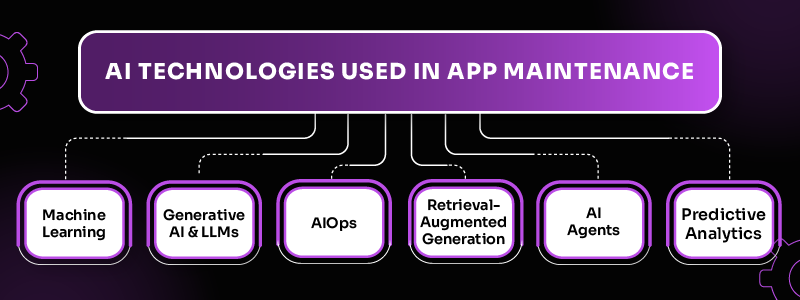
Understanding how these technologies work helps businesses select the right capabilities for their application maintenance needs.
[A] Machine Learning
Machine learning models analyze historical and real-time application data to identify patterns, detect anomalies, and predict potential failures.
They can evaluate metrics such as crash rates, API latency, resource consumption, and error frequency, making machine learning a core technology behind predictive maintenance.
[B] Generative AI and LLMs
Generative AI and large language models can assist developers with code analysis, documentation, test-case generation, debugging, and error interpretation.
They can also summarize complex logs and explain technical issues in natural language, helping maintenance teams investigate problems more efficiently.
[C] AIOps
AIOps combines AI with application, infrastructure, and observability data to analyze large volumes of operational information.
It can correlate events across servers, APIs, databases, and cloud environments, helping teams detect incidents, identify unusual activity, and understand the broader impact of application issues.
[D] Retrieval-Augmented Generation
Retrieval-Augmented Generation (RAG) connects AI models with relevant organizational and technical information, such as documentation, system specifications, troubleshooting guides, and previous incident records.
Planning to build RAG-powered software allows maintenance teams to receive more context-aware assistance when investigating application issues.
[E] AI Agents
AI agents can support multi-step maintenance workflows by monitoring application events, investigating issues, analyzing relevant data, and recommending appropriate actions.
With suitable controls and human approval, agents can help automate repetitive maintenance processes while keeping developers involved in critical decisions.
[F] Predictive Analytics
Predictive app maintenance uses historical application and operational data to estimate future performance and maintenance risks.
It can help teams identify trends such as increasing error rates, declining performance, or growing resource consumption and take preventive measures before these issues significantly affect users.
Benefits of AI in App Maintenance
Modern application maintenance requires teams to identify issues quickly, minimize downtime, and manage growing technical complexity.
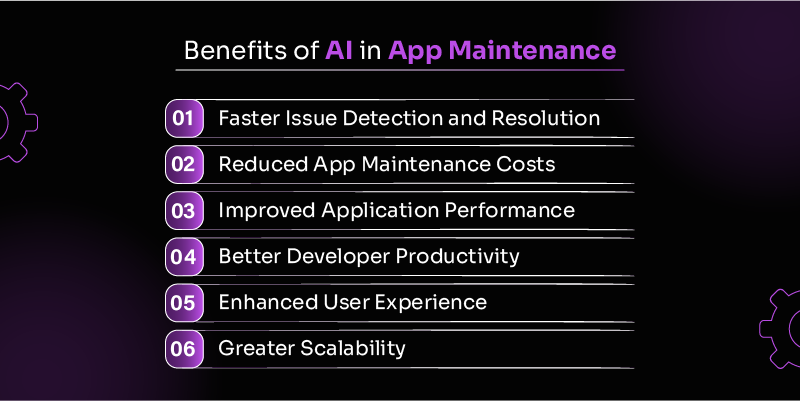
Intelligent automation in app maintenance can reduce repetitive tasks, detect potential problems earlier, and support faster resolution, helping businesses maintain reliable, high-performing applications.
1. Faster Issue Detection and Resolution
AI continuously analyzes application data to identify errors, anomalies, and performance changes.
By highlighting important issues and providing relevant diagnostic insights, it helps developers investigate problems faster and reduce the time applications spend in an unstable state.
2. Reduced App Maintenance Costs
Automation can reduce the amount of manual effort required for testing, monitoring, log analysis, and routine maintenance activities.
By identifying issues earlier and helping teams prioritize high-impact problems, AI can also reduce the mobile app maintenance costs associated with prolonged downtime and emergency fixes.
3. Improved Application Performance
AI in mobile app maintenance can help teams monitor performance metrics and identify patterns that indicate potential bottlenecks.
Maintenance teams can use these insights to optimize APIs, databases, application code, and infrastructure, helping maintain consistent performance as application usage grows.
4. Better Developer Productivity
AI can handle repetitive maintenance tasks and help developers analyze large volumes of technical information.
Instead of spending excessive time reviewing logs or investigating routine issues, developers can focus more on complex problems, application improvements, and strategic development work.
5. Enhanced User Experience
Reliable performance, fewer crashes, faster response times, and quicker issue resolution directly contribute to a better user experience.
By continuously monitoring application behavior, AI helps maintenance teams identify problems that could negatively affect users and address them proactively.
6. Greater Scalability
As applications gain users, features, integrations, and data, maintenance requirements also increase.
AI can process large volumes of application and operational data more efficiently, helping maintenance teams manage growing workloads without relying entirely on proportional increases in manual effort.
Challenges of Implementing AI in App Maintenance
Despite its advantages, integrating AI into app maintenance can present challenges related to data quality, system compatibility, security, cost, and accuracy.
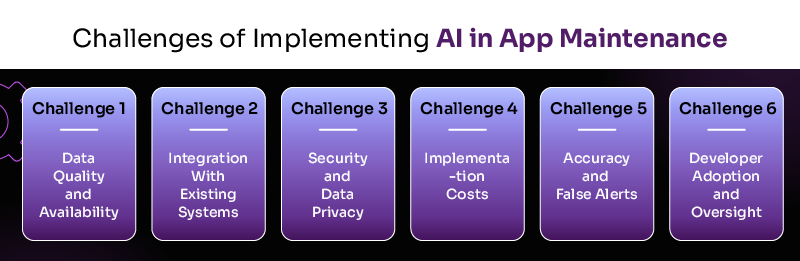
Understanding these challenges and applying practical solutions can help businesses adopt AI effectively and eliminate mistakes in the mobile app maintenance process.
Challenge 1: Data Quality and Availability
AI models require reliable application data to identify patterns and generate accurate insights. Incomplete logs, inconsistent monitoring, or limited historical data can affect prediction accuracy and make maintenance recommendations less reliable.
Solution: Establish structured data collection and centralized monitoring. Regularly validate data quality and ensure important application events, errors, and performance metrics are captured consistently.
Challenge 2: Integration With Existing Systems
Connecting AI tools with applications, databases, monitoring platforms, CI/CD pipelines, and cloud infrastructure can be challenging, especially when maintaining legacy systems with outdated architectures.
Solution: Use APIs and modular integrations to introduce AI capabilities gradually. Test each integration within existing maintenance workflows before expanding AI across additional maintenance activities.
Challenge 3: Security and Data Privacy
AI maintenance systems may process application logs, user information, and business-critical data. Sharing such information with external AI platforms can introduce security and privacy risks.
Solution: Implement encryption, access controls, data minimization, and secure API practices. Define clear policies governing the data AI systems can access, process, and retain.
Challenge 4: Implementation Costs
AI-powered maintenance requires investment in automation tools, infrastructure, integration, development, and employee training. These investments can be difficult to justify for smaller applications.
Solution: Start with high-value use cases such as automated testing, anomaly detection, or log analysis. Measure results before expanding AI across additional maintenance activities.
Challenge 5: Accuracy and False Alerts
AI can generate incorrect predictions or unnecessary alerts. Too many false positives can create alert fatigue and make it harder for developers to identify genuine issues.
Solution: Continuously evaluate AI performance, refine detection thresholds, and use real application data for improvement. Maintain human review for critical maintenance decisions.
Challenge 6: Developer Adoption and Oversight
AI supports developers but does not replace engineering expertise. Teams must validate recommendations, investigate complex issues, and approve changes that could affect application stability.
Solution: Treat AI as a developer-support tool and establish clear approval workflows. Train teams to evaluate AI-generated recommendations before implementing them.
How JPLoft Delivers AI App Maintenance Services
Ongoing app maintenance requires more than fixing bugs after they appear. You need continuous monitoring, proactive issue detection, and reliable technical support as your application evolves.
At JPLoft, we combine AI capabilities with experienced development practices to help you maintain your application throughout its lifecycle.
Our app maintenance services support AI-assisted monitoring, predictive analysis, automated testing, performance optimization, dependency management, security monitoring, and application upgrades. We use AI to identify crashes, unusual behavior, performance issues, and potential maintenance risks before they become larger problems.
We also use AI-assisted testing for regression checks and quality validation during application updates. Our developers review AI-generated insights before implementing critical changes, ensuring appropriate human oversight throughout the maintenance process.
With intelligent automation and technical expertise, we help you maintain reliable, secure, and high-performing applications as your business requirements grow.
Conclusion
AI is making app maintenance more proactive by helping development teams detect issues, analyze application behavior, automate testing, and identify potential failures earlier.
From predictive monitoring to intelligent troubleshooting, these capabilities can reduce manual effort while supporting better application reliability and performance.
However, successful AI adoption requires reliable data, secure integrations, appropriate human oversight, and a clear implementation strategy.
Businesses that combine AI with experienced development teams can build a maintenance process that responds faster to issues and adapts as applications grow.
With the right approach, AI in application maintenance can move app support beyond reactive bug fixing toward continuous monitoring, intelligent optimization, and proactive maintenance.
FAQs
AI improves app maintenance by analyzing application logs, performance metrics, errors, and system activity. It can detect anomalies, identify recurring issues, support root-cause analysis, automate testing, and help developers address potential problems before they affect users.
AI-powered predictive maintenance uses historical and real-time application data to identify patterns that may indicate future failures. By detecting warning signs such as increasing error rates, crashes, latency, or resource consumption, teams can take preventive action before major incidents occur.
AI can help reduce maintenance costs by automating repetitive tasks, improving testing efficiency, detecting issues earlier, and minimizing downtime. However, the overall savings depend on the application's complexity, existing maintenance processes, AI tools, and implementation scope.
Common challenges include poor-quality data, integration with existing systems, security and privacy concerns, implementation costs, false alerts, and developer adoption. Businesses should introduce AI gradually and maintain human oversight for critical maintenance decisions.
No. AI can automate repetitive maintenance activities and provide recommendations, but developers remain essential for validating AI-generated insights, handling complex technical issues, approving critical changes, and maintaining application security and reliability.

Rahul Sukhwal is the CEO and Founder of JPLoft, a visionary technologist with 18+ years at the forefront of emerging tech innovation and software engineering. He channels deep software engineering and AI expertise into building smarter, scalable solutions that shape how forward-thinking businesses worldwide harness the true power of AI.



Share this blog