


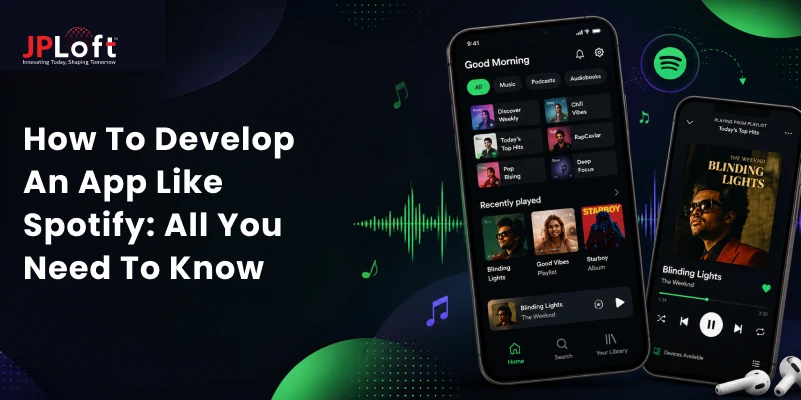
Key Takeaways:
To develop an app like Spotify, follow a clear roadmap like research, features, UI/UX, tech stack, development, AI integration, testing, and scaling.
The cost to develop an app like Spotify ranges from $30,000 to $120,000+, depending on features, AI, and scalability.
Features like AI recommendations, personalized playlists, offline mode, and seamless music streaming drive strong engagement and daily usage.
A scalable tech stack and cloud infrastructure ensure smooth performance, secure payments, and support for millions of users.
Music licensing, DRM, and data security are critical to avoid legal issues and protect content.
JPLoft delivers end-to-end Spotify-like app development, combining AI, secure streaming, scalable architecture, and long-term support.
Spotify now has more than 761 million active users, and the global music streaming market is set to cross $42 billion by 2026, growing toward nearly $77 billion by 2030.
Numbers like these explain why so many founders and investors want to know how to develop an app like Spotify.
Building a music streaming platform means more than adding a play button. It calls for AI-driven recommendations, licensed content, secure payments, and infrastructure that can handle millions of streams without lag or downtime.
This complete guide to Spotify app development walks you through the real process, from early planning to final launch.
You will learn the must-have features, the right tech stack, realistic costs, and the common challenges involved, so you get a clear roadmap for building a platform that users actually stick with and keep coming back to every single day.
Why Should Businesses Build an App Like Spotify?
Developing a platform like Spotify today means tapping into a fast-growing market with real, lasting, worldwide demand from daily listeners.
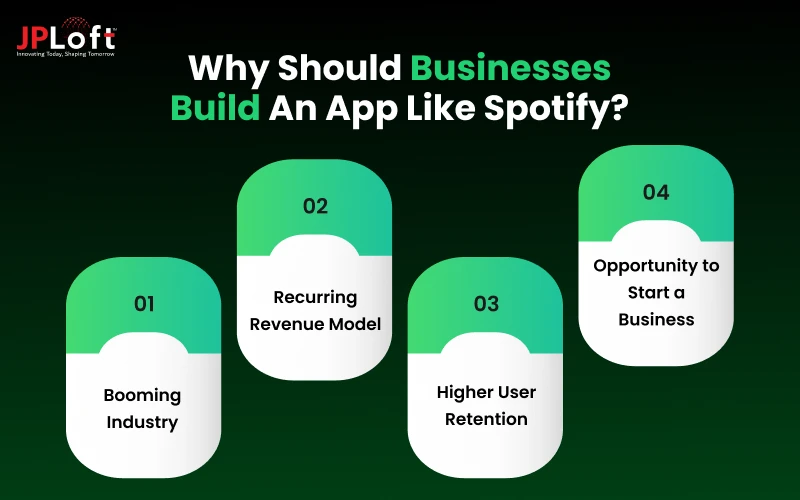
1. Booming Industry
Paid music streaming subscriptions have crossed 800 million worldwide, and the subscription segment is projected to grow nearly 13 percent every year through 2033.
This steady climb shows no sign of slowing down. Businesses that act now can capture early demand before the market gets even more competitive.
2. Recurring Revenue Model
A freemium structure lets you earn from free and paying users alike. Ads cover the free tier, while premium subscriptions bring steady, predictable monthly income.
This dual model reduces reliance on one income source. As your user base grows, subscription revenue compounds, giving your business cash flow to reinvest.
3. Higher User Retention
Music apps see daily use, unlike most other app categories. People stream during workouts and commutes, so once you build a music streaming app like Spotify, engagement stays high.
Smart recommendations and personalized playlists keep listeners coming back often. The more relevant content feels, the longer users stay active and loyal.
4. Opportunity to Start a Business
A music app offers strong branding potential and space to build lasting partnerships with artists, labels, and independent creators right from launch day.
This makes it a solid entry into the digital entertainment industry, with room to expand into podcasts, live audio, or regional content later.
Key Features To Include in an App Like Spotify
When users open a music app, they want more than a play button. They expect personalization and offline access too, so knowing these top music app features matters before you develop an app like Spotify.
|
Feature |
Description |
Why It Matters |
|
User Registration & Profiles |
Simple sign-up via email, phone, or social login with personalized user profiles |
Enables personalization and user data tracking |
|
AI-Based Music Recommendations |
Smart algorithms suggest songs based on listening history |
Increases engagement and user retention |
|
Advanced Search & Filters |
Search by artist, album, genre, mood, or playlist |
Helps users quickly find desired content |
|
Offline Mode |
Download songs for listening without the internet |
Improves convenience and accessibility |
|
High-Quality Audio Streaming |
Multiple streaming quality options (Low, High, Lossless) |
Delivers a better listening experience |
|
Social Sharing |
Share songs or playlists with friends |
Boosts organic growth and user interaction |
|
In-App Player Controls |
Play, pause, skip, repeat, shuffle options |
Core functionality for seamless playback |
|
Push Notifications |
Alerts for new releases, playlists, or recommendations |
Keeps users engaged and informed |
|
Subscription & Payment Integration |
Secure payment gateway for premium plans |
Enables monetization and recurring revenue |
|
Admin Dashboard |
Manage users, content, analytics, and subscriptions |
Ensures smooth backend operations |
When you carefully implement these features, you don’t just build an app like Spotify, but a daily habit for millions of users.
Step-by-Step Process of How to Create an App Like Spotify
Wondering how to make an app like Spotify that keeps users engaged for years? The process is not random. It follows proven stages, similar to building a music streaming app from scratch.
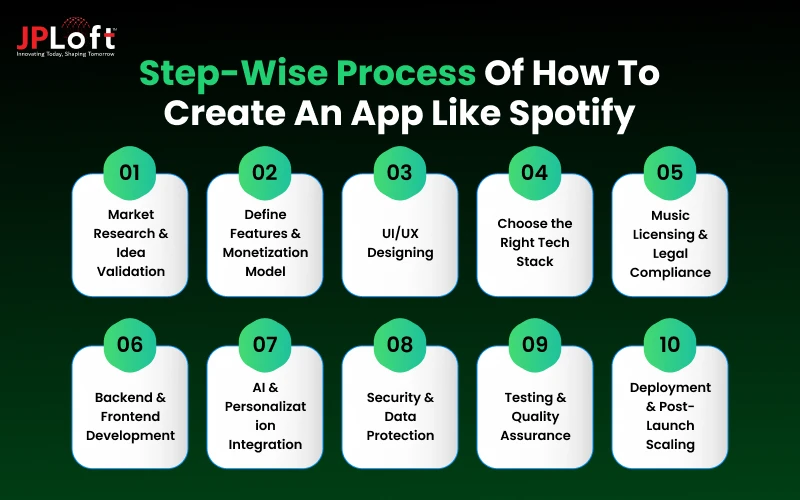
Let’s have a look at the steps.
-
Market Research & Idea Validation
-
Define Features & Monetization Model
-
UI/UX Design
-
Choose the Right Tech Stack
-
Music Licensing & Legal Compliance
-
Backend & Frontend Development
-
AI & Personalization Integration
-
Security & Data Protection
-
Testing & Quality Assurance
-
Deployment & Post-Launch Scaling
Now, let’s break down the complete process to develop a music streaming app like Spotify in detail.
Step 1: Market Research & Idea Validation
Every strong platform starts with clarity on who you are building for and why now, before a single line of code gets written.
-
Identify your target audience and niche
-
Study best music streaming apps and their reviews
-
Note gaps competitors have not solved yet
A clear point of difference lowers risk and helps you build something people actually want to use every single day, not just once.
Step 2: Define Features & Monetization Model
The next step in learning how to build an app like Spotify is deciding exactly what your platform will offer to its earliest users.
-
Choose between a lean MVP or full launch
-
Pick a freemium or paid-only revenue model
-
Add AI features for music streaming apps from the start
This early groundwork shapes every decision that follows, so define it clearly before you move into design work.
Step 3: UI/UX Design
A great user experience keeps people coming back daily, so early design choices matter far more than most first-time founders tend to really expect them to.
-
Focus on intuitive, clutter-free navigation
-
Add personalized dashboards and fast loading times
-
Support quick search and easy playlist creation
Music apps get used every single day, so skilled UI/UX design services help balance style with real, practical usability for listeners overall.
Step 4: Choose the Right Technology Stack
Your mobile app tech stack decides how well the platform performs once you actually create a music streaming app like Spotify for real, active users.
-
Use Flutter or React Native for cross-platform builds
-
Handle backend logic with Node.js or Python
-
Add CDNs for fast global audio delivery
Cloud storage keeps everything scalable, so performance stays smooth even as your user base grows well past the first year.
Step 5: Music Licensing & Legal Compliance
Securing music licenses is one of the most important steps in the entire development process, and it truly cannot be skipped or delayed.
-
Get agreements from labels and publishers
-
Confirm music streaming app compliance with copyright and streaming laws
-
Work with a licensing agency to simplify things
Handling licensing correctly from the beginning builds credibility and protects your platform from serious legal risk further down the road.
Step 6: Backend & Frontend Development
This is where you actually develop a music app like Spotify from the ground up, turning early plans into real, fully working software your team can properly test out.
-
Build user authentication and playlist management
-
Set up subscriptions and streaming infrastructure
-
Design responsive frontend and playback controls
A scalable backend architecture supports millions of concurrent streams while the frontend keeps users engaged with a smooth, polished feel.
Step 7: AI & Personalization Integration
Personalization sits at the core of every modern music streaming platform, shaping exactly how long users stay engaged with your steadily growing content library over time.
-
Analyze listening habits and skipped tracks
-
Track favorite genres and time-of-day patterns
-
Predict user interests before they even search
If your goal is to create an AI app that truly understands preferences, a sharper recommendation engine becomes your platform's strongest competitive edge.
Step 8: Security & Data Protection
Strong music app security protects user data and payment details from breaches once you make a music streaming app like Spotify ready for public, everyday use across the board.
-
Add encryption and secure APIs
-
Implement Digital Rights Management protection
-
Run regular audits and vulnerability testing
Protecting user trust matters just as much as any feature on your platform, since a breach can undo years of goodwill.
Step 9: Testing & Quality Assurance
Before launch, thorough mobile app testing helps find and fix issues early. This prevents negative reviews, refund requests, and poor user experiences after launch.
-
Test streaming speed and crash rates
-
Check device compatibility and payment flow
-
Run beta tests with real listeners
Continuous quality checks, even after release, help maintain stability and performance, since skipping this stage often leads to poor retention.
Step 10: Deployment & Post-Launch Scaling
Once testing wraps up, submit the iOS app to the App Store and publish the app to the Play Store, following each platform's guidelines.
-
Run App Store Optimization for visibility
-
Partner with influencers and referral programs
-
Monitor feedback and roll out updates
Launching is not the end goal. Ongoing updates keep the platform growing after release.
So, if you want to make an app like Spotify for a niche audience or build a global brand, following this structured roadmap will turn your idea into a scalable digital product.
Tech Stack for Developing an App Like Spotify
Right technology is one of the most critical decisions when you plan to make a music streaming app like Spotify. Your app’s performance, scalability, security, and user experience heavily depend on the technology stack you choose.
A powerful and scalable music streaming app tech stack ensures seamless audio delivery, real-time data processing, AI-driven personalization, and smooth cross-platform performance.
Below is a recommended tech stack structure for building a robust music streaming platform:
|
Layer |
Technology Options |
Purpose |
|
Frontend (iOS/Android) |
Swift / Kotlin |
Native iOS / Android app development |
|
Backend |
Node.js / Python (Django) |
Handle user requests, streaming logic, APIs |
|
Database |
PostgreSQL / MongoDB |
Store user data, playlists, subscriptions |
|
Cloud Services |
AWS / Google Cloud / Azure |
Scalable hosting & storage |
|
Streaming Protocols |
HLS (HTTP Live Streaming) |
Smooth and adaptive audio streaming |
|
Content Delivery Network (CDN) |
CloudFront / Cloudflare |
Fast global audio delivery |
|
AI & Personalization |
TensorFlow / PyTorch |
AI features for music streaming apps & recommendations |
|
Authentication |
OAuth 2.0 / Firebase Auth |
Secure user login & access management |
|
Payment Integration |
Stripe / Razorpay / PayPal |
Subscription & in-app payment processing |
When you carefully choose technologies aligned with your business goals, you not only create a music streaming app like Spotify but also build a scalable digital product ready for long-term growth.
How Much Does it Cost to Develop an App Like Spotify?
The music streaming app development cost depends on multiple factors such as feature complexity, platform choice, UI/UX design, AI integration, licensing requirements, and backend scalability.
On average, the overall development cost for an app like Spotify ranges from $30,000 to $120,000+.
A basic MVP with essential music streaming features will fall on the lower end.
On the other hand, an advanced platform with AI-powered recommendations, high-quality streaming, and multi-device support will require a higher investment.
Here is a quick overview of the cost to make an app like Spotify:
|
Development Stage |
Key Inclusions |
Estimated Cost |
Timeline |
|
Basic MVP |
User registration, basic search, playlist creation, audio streaming, simple UI, admin panel |
$30,000 – $50,000 |
3–5 months |
|
Mid-Level Streaming App |
Advanced UI/UX, offline mode, subscription plans, payment gateway, push notifications, cloud hosting |
$50,000 – $80,000 |
5–7 months |
|
Advanced Streaming Platform |
AI-powered recommendations, personalized playlists, high-quality streaming, social sharing, analytics dashboard |
$80,000 – $120,000+ |
7–10+ months |
Challenges in Developing a Music Streaming App Like Spotify
What makes it difficult to develop a music streaming app like Spotify even with the right idea and budget? The answer lies in the technical, legal, and operational complexities involved in building and scaling such a platform.
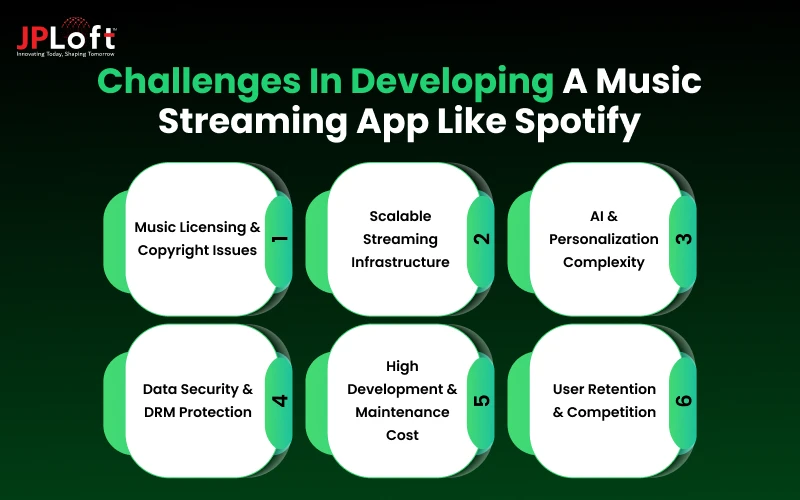
Here are some major music app development challenges you must prepare for:
Challenge 1: Music Licensing & Copyright Issues
Securing agreements with record labels and publishers is complex and expensive. Without proper licensing, you would face several difficulties related to publishing original or latest content.
Solution: Partner with music aggregators, licensing agencies, or independent distributors to streamline agreements and reduce negotiation complexity.
Challenge 2: Scalable Streaming Infrastructure
Handling thousands or millions of concurrent streams requires powerful cloud architecture and CDN integration. Poor infrastructure leads to buffering and user drop-offs.
Solution: Use scalable cloud platforms like AWS or Google Cloud with auto-scaling and global CDN support to ensure smooth, uninterrupted streaming.
Challenge 3: AI & Personalization Complexity
Implementing advanced recommendation engines while integrating AI features for music streaming apps demands strong data science expertise.
Solution: Start with basic recommendation algorithms in the MVP stage and gradually enhance them using machine learning models and user behavior analytics.
Challenge 4: Data Security & DRM Protection
Protecting copyrighted content and user data through strong app security mechanisms is critical to avoid piracy and breaches.
Solution: Hire dedicated developers to implement end-to-end encryption, secure APIs, multi-factor authentication, and robust DRM systems.
Challenge 5: High Development & Maintenance Cost
The cost of developing a music streaming app increases with feature complexity, licensing, and scalability requirements.
Solution: Begin with a feature-focused MVP, prioritize essential functionalities, and scale gradually to manage budget effectively.
Challenge 6: User Retention & Competition
Competing with established platforms while trying to make a music streaming service like Spotify requires unique positioning and strong branding.
Solution: Focus on niche targeting, exclusive content, personalized experiences, and strong marketing strategies to build an app like Spotify with a loyal user base.
Overcoming these challenges requires careful planning, the right tech stack, and experienced development support.
Future Trends to Create an App Like Spotify
The music industry moves fast, and staying competitive means watching where it heads next.
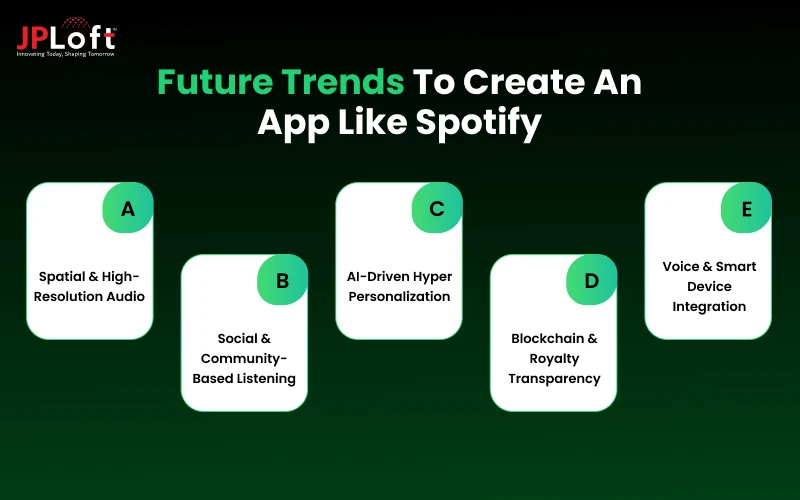
If you are exploring how to make an app like Spotify, keep an eye on these music streaming app trends shaping the years ahead.
1. Spatial & High-Resolution Audio
Lossless streaming, Dolby Atmos, and immersive 3D audio are becoming standard expectations, not optional extras, across nearly every major music streaming platform today.
2. Social & Community-Based Listening
Live listening rooms, collaborative playlists, and direct artist-fan interaction are reshaping how people connect around music, not just consume it alone.
3. AI-Driven Hyper-Personalization
AI increasingly predicts user moods and preferences before they even ask. Partnering with AI app development services helps you build smarter, more personalized listening experiences.
4. Blockchain & Royalty Transparency
Blockchain integration can simplify royalty payments and bring more transparency between artists, labels, and the platforms that host their music.
5. Voice & Smart Device Integration
Integration with smart speakers, wearables, and in-car systems is changing how people discover and control music throughout their day.
Adapting to these trends ensures you don’t just develop a music streaming app like Spotify, but build a future-ready platform.
Monetization Models for Apps Like Spotify
Before launching your platform, one question matters most: how will you generate revenue? Choosing the right strategy is essential if you want to monetize a music streaming app and build long-term sustainability.
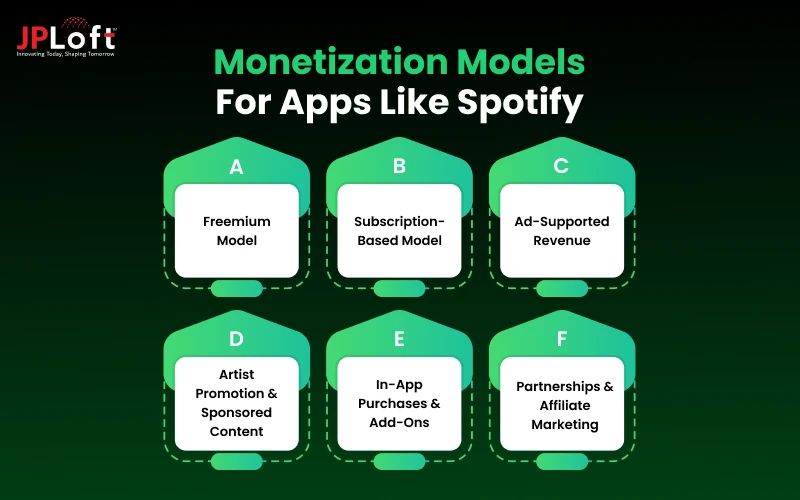
A well-planned approach balances steady income with a smooth, enjoyable user experience.
1. Freemium Model
Spotify uses a freemium model to attract users with free, ad-supported music access. Premium users get benefits such as ad-free listening, offline downloads, and enhanced playback features. Businesses can follow this approach to build a large user base first and convert engaged listeners into paid subscribers over time.
2. Subscription-Based Model
A major portion of Spotify’s revenue is generated through premium subscriptions. Users can choose plans based on their needs, including Individual, Duo, Family, and Student options in supported markets. Businesses can adopt a similar tiered subscription strategy to offer different pricing and benefits for different customer segments.
3. Ad-Supported Revenue
Spotify monetizes its free users through audio, video, and display advertising. It also uses personalized advertising to help brands reach relevant listeners. Businesses can apply a similar model by offering free streaming with carefully placed ads while keeping the listening experience convenient enough to encourage continued usage.
4. Artist Promotion & Sponsored Content
The app provides promotional opportunities that help artists and music creators reach relevant audiences. Features such as sponsored recommendations and promotional placements can connect artists with listeners based on their interests. Businesses can introduce similar paid promotional options to create another revenue stream while helping artists improve music discovery.
5. In-App Purchases & Add-Ons
The ecosystem of Spotify extends beyond basic music playback through features and experiences that can support additional revenue opportunities. Businesses can build on this idea by offering exclusive content, premium features, merchandise, event tickets, or other music-related add-ons within their platform.
6. Partnerships & Affiliate Marketing
Spotify also works with brands and partners through collaborations, bundled offers, and platform integrations. Businesses can use a similar strategy by partnering with headphone brands, event platforms, artists, telecom providers, or other relevant services. These partnerships can create additional revenue while expanding the app's reach.
Why Choose JPLoft to Develop an App Like Spotify?
If you're planning to build a powerful music streaming platform, partnering with the right music streaming app development company makes all the difference. JPLoft specializes in building scalable, feature-rich, and AI-powered music applications tailored to your business goals.
From UI/UX design and backend architecture to AI integration, security implementation, and cloud scalability, the team ensures end-to-end development support.
With expertise in creating high-performance streaming infrastructures and personalized recommendation systems, JPLoft helps businesses turn innovative ideas into competitive digital products.
Whether you want to launch an MVP or a fully advanced streaming ecosystem, JPLoft delivers customized solutions designed for growth, engagement, and long-term success in the evolving music streaming market.
Final Words
Building a truly successful music streaming platform takes more than just a good idea. It calls for careful planning, the right tech stack, proper licensing, and a monetization model that actually holds up well over time.
From market research to post-launch scaling, every stage covered in this guide plays a real role in long-term success.
Once you understand how to develop an app like Spotify, from features and design to security and AI personalization, you are far better prepared to build something users genuinely trust and return to daily.
The market keeps growing fast, and the opportunity is real. With the right team, clear positioning, and a platform built for scale, you can turn a strong idea into a streaming business ready to compete and grow for years to come.
FAQs
To make an app like Spotify, define features, secure licenses, choose the right tech stack, build scalable infrastructure, and integrate AI-powered personalization before launch.
The cost typically ranges from $30,000 to $120,000+, depending on features, tech stack, AI integration, and licensing requirements.
On average, developing a basic MVP takes 3–6 months, while a feature-rich music streaming app may require 6–10+ months, depending on complexity.
Common technologies include Flutter or React Native for the frontend, Node.js or Python for the backend, and cloud platforms like AWS for scalable hosting.
They generate revenue through subscription plans, ads, sponsored content, in-app purchases, and partnerships.

Conor has 10+ years of experience in software development, application engineering, solution design, and UX/UI. He has worked across digital products in restaurant technology, food and grocery delivery, healthcare, media, streaming, and social platforms, bringing both technical and user-experience perspectives to product development. His experience working with large organizations and growth-focused digital products helps businesses translate complex requirements into practical, user-focused solutions.


Share this blog