



Key Takeaways:
Start With a Problem, Not a Feature: The strongest AI apps are built around a specific pain point, not technology for its own sake.
Bad Data Means a Bad App Nearly 95% of AI projects fail because of messy, unstructured data. Clean data is not optional; it is the foundation.
Pick the Right AI Technology ML, NLP, Computer Vision, Generative AI — each solves something different. Match the technology to your use case, not the hype.
Launch Is Just the Beginning The best AI apps improve with every interaction. Build feedback loops and retraining cycles from Day 1.
Your USP wins the market: Features get copied. Solving one problem better than anyone else does not.
The numbers are hard to ignore: by 2030, the global AI application market is projected to skyrocket to $42.7 billion.
But viewing this figure as just another financial milestone means missing the seismic shift happening beneath the surface.
We aren't just witnessing growth; we are witnessing a total restructuring of how business operates.
Even at the highest levels of tech, the impact is undeniable.
OpenAI CEO Sam Altman recently said that even the CEO role isn't immune, suggesting that AI could eventually perform the job better than "certainly me."
This isn't just about automation; it's about a fundamental change in user expectations.
In 2026, customers no longer view AI as a "cool feature" or a side-add-on; they expect it to be the very foundation upon which a service is built.
For investors and visionaries looking to lead the AI race, the goal isn't just to "use" AI, but to integrate it into their business DNA.
To lead this race, businesses are moving beyond generic tools. They are seeking specialized expertise to weave intelligence into their operational DNA.
JPLoft serves as a strategic AI development company that helps enterprises transition into this "AI-first" era.
By focusing on custom LLM integration, autonomous agents, and scalable AI architecture, JPLoft ensures that businesses aren't just participating in the trend; they are defining it.
Before you connect, first let’s get to know how to build an AI app in 2026:
Overview of Artificial Intelligence Development
AI application development is the process of building software that doesn't just follow static rules but learns and evolves through data.
In 2026, this has shifted from simply "plugging in an API" to creating intent-based systems.
Traditional apps depend on manual input for almost every action. Users must tell the system exactly what to do each time.
An AI-driven platform works differently. It uses machine learning models and Natural Language Processing (NLP) to understand context, predict user behavior, and automate complex decisions without constant user instructions.
At its core, the process involves training or fine-tuning models to handle specific industry logic, whether that’s calculating risk in Fintech or personalizing health tracking.
By integrating autonomous agents and real-time data processing, developers create tools that move beyond basic automation toward true cognitive assistance.
For a modern AI app development, the goal is "invisible technology": building a sophisticated backend that solves high-level problems while providing a seamless, human-centric experience for the end user.
For a better in-depth AI-powered application, you need to know the working as well. In 2026, the working of an AI app is defined by a sophisticated, four-layer architecture:
1. The Ingestion & Data Layer (The "Memory")
Everything starts with data. However, modern apps no longer just "store" data; they "vectorize" it.
-
Data Ingestion: The app pulls raw info from various sources (user logs, PDFs, live APIs, or IoT sensors).
-
Vector Databases: Instead of a standard table, data is converted into numerical "embeddings" and stored in a Vector DB. This allows the AI to find information based on meaning rather than just keywords.
2. The Intelligence & Model Layer (The "Brain")
This is where the actual "thinking" happens. The app doesn't just use one giant model; it often uses a hybrid approach:
-
The Foundation Model: Large models (like GPT-4.5 or Gemini 2.0) provide general reasoning.
-
RAG (Retrieval-Augmented Generation): When a user asks a question, the app "retrieves" the most relevant snippets from its private Vector DB and feeds them to the model. This ensures the answer is factual and up-to-date.
-
Fine-Tuning: For specialized industries (like Fintech or Health), the model is further trained on niche datasets to understand specific jargon and regulations.
3. The Orchestration & Agentic Layer (The "Logic")
This is the newest and most critical part of the 2026 tech stack. It’s what makes the app "intent-based."
-
Task Planning: An "Orchestrator" (like LangChain or a custom agent) breaks down a complex user request into smaller steps.
-
Tool Use: If you ask an app to "book a flight," the agent realizes it needs to call a specific API, check your calendar, and then process a payment.
-
Guardrails: This sub-layer checks the AI's output for safety, bias, or "hallucinations" before it ever reaches the user.
4. The Application & Feedback Layer (The "Interface")
Finally, the result is delivered through a clean, human-centric UI.
-
Real-Time Inference: The backend ensures the AI's complex reasoning happens in milliseconds.
-
The Feedback Loop: This is the secret sauce. Every time you "thumbs up" an answer or correct a mistake, the app sends that data back to the training pipeline, making the system smarter for your next session.
This is the working of AI-powered mobile apps, which you should know about. The next logical question is whether you should develop an AI-powered mobile app.
Should You Invest in AI App Development?
The short answer is, “absolutely yes.”
The $42.7 billion market valuation by 2030 isn’t just a sign of growth; it’s a sign of a closing window.
In 2026, the question is no longer, “Does my business need AI?” but “how to create an AI app” that suits the market need and takes the business forward.
While most consultants will give you reasons like “efficiency’ and “automation’’, we are here with deeper and disruptive reasons to pull the trigger now:
1. The "Zero-Marginal-Cost" Creative Engine
Most businesses see AI as a way to cut costs, but the real ROI lies in infinite personalization.
In a traditional app, every new feature or personalized user journey requires a developer's time, whereas in a truly AI-based app development framework, the AI generates personalized UI/UX and content on the fly for each specific user.
You aren’t paying for “features” anymore; you are paying for a system that builds a unique experience for every person who opens it, at zero additional cost per user.
2. Data Decay vs. The "App that Learns"
Traditional software is "depreciating hardware": it gets older, slower, and less relevant the day after it’s launched.
AI-powered apps are the first assets that appreciate with use. Because of the feedback loops mentioned earlier, every interaction makes your app smarter.
If you delay investment, your competitors are already building a "data moat" that becomes mathematically impossible to bridge three years from now.
You aren't just buying software; you’re buying a compounding asset.
3. Transition from "Search" to "Result"
People often avoid discussing how AI is killing the “navigation’’ model of apps.
In 2026, users hate browsing menus.
If your investment focuses on an AI-powered app development strategy that prioritizes “outcome as a service’’, you bypass the UI fatigue that kills most startups.
The goal is an app where the user doesn’t ‘’use’’ the software; they simply state a goal, and the software provides the finished result.
Investing now means owning the interface that replaces the need for any other interface.
These are pretty strong reasons for you to make up your mind and invest in AI app development solutions.
Now, get to know the features that are a must for your app.

What Are the Must-Have Features in a Modern AI Application?
To successfully develop an AI app in 2026, you must move beyond basic automation.
Modern app features are no longer about static responses; they are about creating a system that understands intent and operates with high degrees of autonomy.
Below are the critical features that define a market-ready AI application:
1. Retrieval-Augmented Generation (RAG)
RAG is the "grounding" mechanism for AI.
Instead of relying solely on general knowledge, it allows your app to pull from a private, real-time database to provide factual, company-specific answers.
This eliminates "hallucinations" and ensures that when you develop an AI app, it remains an authoritative source of truth.
2. Autonomous Agentic Workflows
The most advanced features today are agentic. This means the AI doesn't just "suggest" a solution; it executes it.
For example, a travel AI doesn't just show flights; it independently navigates APIs to check your calendar, compare prices, and finalize bookings based on your predefined preferences.
3. Predictive Behavioral Analytics
Modern AI apps use machine learning to anticipate what a user wants before they ask.
By analyzing historical patterns, the app can suggest actions, such as a Fintech app suggesting a specific investment move because it predicts a drop in your monthly expenses.
4. Multimodal Input Processing
Users expect to interact with apps via text, voice, images, and even video.
A robust feature set includes the ability to "see" and "hear", allowing a user to upload a photo of a broken appliance and have the AI instantly identify the part and draft a repair guide.
5. Edge AI & On-Device Processing
To enhance privacy and speed, many developers now choose to create an AI app that processes data locally on the device.
This "Edge AI" ensures that sensitive biometric or personal data never leaves the user's phone, significantly boosting trust and reducing latency.
6. Hyper-Personalization Engines
This feature moves beyond "User Name" tags. The AI dynamically reshapes the entire UI/UX based on the user's skill level and frequency of use.
If the system detects a first-time user, it simplifies the dashboard; for power users, it reveals advanced analytical tools.
7. Self-Healing & Continuous Feedback Loops
A defining trait of AI-driven software is that it improves with use. Every interaction is fed back into the model (anonymously) to refine accuracy.
If a user corrects an AI’s mistake, the system "learns" from that error, ensuring the same mistake isn't repeated for the next user.
8. Biometric & AI-Powered Security
Beyond standard passwords, modern apps use behavioral biometrics, analyzing how a user holds their phone or their typing cadence to detect unauthorized access.
This adds a layer of "invisible security" that is nearly impossible for hackers to replicate.
Having explored the transformative features that define modern intelligence, it’s time to look behind the curtain.
Understanding "what" an app can do is only half the battle; the real competitive advantage lies in the execution.
AI App Development Process: Step-by-Step Guide
Now, here comes the important question: How to build an AI app?
The process for building a successful and feature-rich AI app includes defining the use case, preparing data, training AI models, and integrating intelligence into the application.
For a better understanding, we will get into the steps:
Step 1: Define the Idea and Use Case
Every successful AI-powered application development journey starts with one critical question: what exact problem are we solving?
Identify the pain point your AI app will address. Is it slow customer support? Poor sales forecasting? Manual data entry eating up your team's time? The more specific the problem, the more powerful your solution.
Next, define your target users. Are you building for business owners managing operations, enterprise teams handling large datasets, or end consumers needing a smarter experience? Clarity here drives every decision that follows.
Finally, lock in your core objective. What does success look like in 90 days? Define it in measurable terms — reduced response time, increased conversion rate, hours saved per week. Your idea is only as strong as the outcome it is tied to.
Step 2: Conduct Market and Competitor Research
Before you write a single line of code, do thorough market research for your app. AI-powered application development without market research is like building in the dark.
Analyze similar AI apps already in the market. What are they doing well? Where are users complaining? What features are missing that your target audience desperately needs? Read reviews, study competitor positioning, and map out their weaknesses.
These gaps are your opportunity. The goal is not to copy what exists — it is to identify the white space where your AI app can deliver superior value.
A well-researched entry point saves months of misdirected development and positions you for immediate traction on launch.
Step 3: Choose the Type of AI Technology
Not all AI is the same. Choosing the right technology is one of the most consequential decisions in your AI-powered application development process.
-
Machine Learning is ideal for prediction, pattern recognition, and automation based on historical data.
-
Natural Language Processing (NLP) powers chatbots, voice assistants, sentiment analysis, and anything involving human language.
-
Computer Vision enables your app to analyze images and video — useful in healthcare, retail, and security.
-
Generative AI creates original content, code, designs, or responses — the engine behind tools transforming creative and knowledge industries today.
Choose based on your use case, not hype. The right AI technology aligned to your problem is what separates high-impact apps from expensive experiments.
Step 4: Collect and Prepare Data
Data is the fuel that powers every AI app. Without quality data, even the most sophisticated AI model will fail to deliver reliable results.
Start by gathering relevant datasets that directly reflect the problem your app solves. This could mean internal business data, publicly available datasets, third-party data sources, or data collected directly from users.
The more representative and diverse your dataset, the stronger your model will perform in real-world scenarios.
Once gathered, clean and structure the data rigorously. Remove duplicates, handle missing values, normalize formats, and label data correctly for training.
This step is unglamorous but absolutely critical — poor data preparation is the single biggest reason AI apps underperform after launch.
Step 5: Select the Tech Stack and Tools
Your app tech stack is the foundation on which everything else is built. Choosing the wrong tools early creates expensive technical debt that slows down your entire AI application development process.
For AI frameworks, leading options include TensorFlow, PyTorch, and Scikit-learn, depending on your model type and team expertise. For development tools, platforms like Hugging Face, OpenAI API, and Google Vertex AI accelerate build time significantly.
On the infrastructure side, decide your backend language and framework, your frontend technology for the user interface, and your cloud provider AWS, Google Cloud, and Azure each offer specialized AI and ML services. Choose a stack that balances performance, scalability, and the current skill set of your development team.
Step 6: Design the App Architecture and UI/UX
Great AI capability inside a confusing interface will kill adoption. UI/UX design is not an afterthought in AI-powered application development — it is a competitive advantage.
Plan your system architecture first. Map out how data flows through your app, how the AI model connects with the backend, and how the frontend delivers results to users in real time.
A clean architecture reduces bugs, improves performance, and makes future scaling dramatically easier.
Then design your user interface with your target users at the center. Business owners and enterprise teams need clarity, speed, and trust.
Every screen, button, and output must feel intuitive. Invest in UX research, build wireframes, test with real users early, and iterate before development begins.
Step 7: Develop and Train the AI Model
This is where your AI app comes to life.
Using the technology you selected and the data you prepared, build and train your AI model to recognize patterns, make decisions, and generate outputs that solve your defined problem.
Select the right algorithms based on your use case — classification, regression, clustering, or generative models.
Feed your cleaned datasets into the training pipeline and run iterative training cycles, evaluating performance at each stage using accuracy metrics, precision, recall, and loss functions.
Training is not a one-time event. Expect multiple iterations before your model reaches acceptable performance benchmarks. Document every experiment, track model versions, and always validate against a test dataset your model has never seen before.
Step 8: Integrate AI Into the Application
A trained model sitting in isolation creates zero business value. Integration is what transforms your AI model into a real, functioning AI-powered application.
Connect your trained model to the app via APIs or direct embedding, depending on your architecture. Implement the AI-driven features your users will interact with — smart recommendations, automated responses, predictive analytics, or real-time decision outputs.
Test every integration point rigorously. Ensure latency is acceptable, outputs are accurate under varied inputs, and the system handles edge cases gracefully. The AI must feel seamless and invisible to the end user — they should experience the result, not the complexity behind it.
Step 9: Test, Deploy, and Improve the App
Launching your AI app is not the finish line — it is the starting line of continuous improvement.
Perform comprehensive app testing before go-live: functional testing, performance testing under load, security audits, and real-user acceptance testing. Identify failure points and fix them before they reach production.
Deploy using a phased rollout strategy — start with a limited user group, gather feedback, and expand. Monitor the AI model performance in production closely. Real-world data will always surface behaviors your training data did not anticipate.
Most importantly, build a feedback loop. User behavior and feedback are your most valuable datasets for improving the model. Schedule regular retraining cycles, release incremental updates, and treat your AI app as a living product that grows smarter with every interaction.
Now that you’ve mastered the blueprint on how to create an AI app, let’s step out of this and understand the real-world use cases across the industries.
Real World Use Cases of Artificial Intelligence
To truly understand how to develop an artificial intelligence app, look at what AI is already doing in the real world.
AI is not a future technology,
From the phone in your pocket to the logistics of global shipping, AI has moved from "experimental" to "essential."
Here is how different industries are using AI to turn raw data into massive competitive advantages:
1. Automotive
The automotive sector has evolved from simple mechanical engineering into a software-led industry. By integrating AI in Automotive, manufacturers are creating vehicles that "see" and "think" in real-time.
-
Use Cases: Self-driving algorithms, predictive engine maintenance, and voice-activated in-car assistants.
-
Impact: Enhanced passenger safety through collision avoidance and a massive reduction in vehicle downtime via smart diagnostics.
2. Banking
Modern banking is no longer just about storing money; it’s about managing data securely. AI in Banking allows institutions to monitor millions of transactions simultaneously to identify patterns that humans might miss.
-
Use Cases: High-frequency trading, biometric security, and automated credit scoring for loans.
-
Impact: Near-instant loan approvals and a significant drop in manual processing costs for global banks.
3. E-commerce
Customer expectations in e-commerce have never been higher. Shoppers want instant answers, perfect recommendations, and seamless experiences across every device. AI in e-commerce makes all of that possible at scale.
-
Use Cases: Personalized product recommendations, dynamic pricing, AI-powered chatbots, demand forecasting, and visual search.
-
Impact: AI-driven personalization increases average order value by up to 35%, reduces cart abandonment, and turns one-time buyers into loyal, repeat customers.
4. Education
Education is becoming a personalized journey rather than a rigid curriculum. AI in Education enables platforms to adapt the difficulty of lessons based on a student's real-time performance.
-
Use Cases: Smart tutoring systems, automated grading, and personalized learning paths for neurodivergent students.
-
Impact: Improved learning outcomes and a more inclusive environment for students with different learning speeds.
5. Healthcare
Healthcare is where AI is quite literally saving lives. The volume of patient data generated daily far exceeds what any human team can process and act on in time. AI in healthcare bridges that gap instantly.
-
Use Cases: Early disease detection, medical imaging analysis, drug discovery acceleration, patient risk prediction, virtual health assistants.
-
Impact: AI diagnostic tools have demonstrated accuracy rivaling senior specialists, while reducing diagnosis time from days to minutes in critical, time-sensitive conditions.
6. Insurance
The insurance industry runs on risk, and nothing assesses risk more accurately than AI. AI in insurance is replacing outdated actuarial models with dynamic, real-time intelligence that prices policies and processes claims with precision.
-
Use Cases: Automated claims processing, fraud detection, risk assessment, personalized policy pricing, customer behavior analysis.
-
Impact: Insurers using AI reduce claims processing time by up to 80%, cut fraudulent payouts significantly, and deliver faster, more accurate service that builds lasting customer trust.
7. Logistics
Logistics is a high-stakes game of precision; one delayed shipment can disrupt an entire supply chain. AI in logistics brings intelligence to every node of that chain, from warehouse to last-mile delivery.
-
Use Cases: Route optimization, warehouse automation, inventory forecasting, real-time shipment tracking, demand-driven restocking.
-
Impact: AI-powered logistics operations report fuel savings of up to 15%, dramatically faster delivery times, and supply chains resilient enough to adapt to disruptions in real time.
8. Transportation
Modern transportation networks move millions of people daily across complex, unpredictable systems.
AI in transportation is turning that complexity into efficiency — making every journey faster, safer, and more reliable.
-
Use Cases: Smart traffic management, predictive fleet maintenance, ride-sharing optimization, and autonomous public transit systems.
-
Impact: Cities deploying AI traffic systems have seen congestion reduce by up to 25%, while transportation companies cut operational costs significantly through predictive maintenance and intelligent scheduling.
9. Retail
Retail success today is built on knowing your customer better than they know themselves.
AI in retail gives businesses that edge, turning mountains of purchase and behavior data into precise, profitable action.
-
Use Cases: Inventory management, in-store customer analytics, personalized promotions, AI-powered visual merchandising, theft prevention.
-
Impact: Retailers leveraging AI report higher inventory accuracy, reduced overstock waste, and increased sales conversion — all while delivering shopping experiences that feel personal, seamless, and effortless to every customer.
10. Manufacturing
Manufacturing demands speed, precision, and zero tolerance for defects at scale.
AI in manufacturing is delivering all three, transforming traditional factory floors into smart, self-optimizing production environments.
-
Use Cases: Predictive equipment maintenance, automated quality inspection, production line optimization, energy consumption management, and defect detection using computer vision.
-
Impact: Manufacturers using AI-driven systems report up to 50% reduction in unplanned downtime, significantly lower defect rates, and leaner operations that produce more output with fewer resources and less waste.
If you are planning to build an AI app for your industry, this is the right time to know how you can separate your AI app from competitors.
What Should Be the Unique Selling Proposition of Your AI App?
Many founders focus heavily on features when planning an AI product. But features alone rarely make an app stand out.
The real difference comes from the value your AI delivers that others cannot easily replicate.
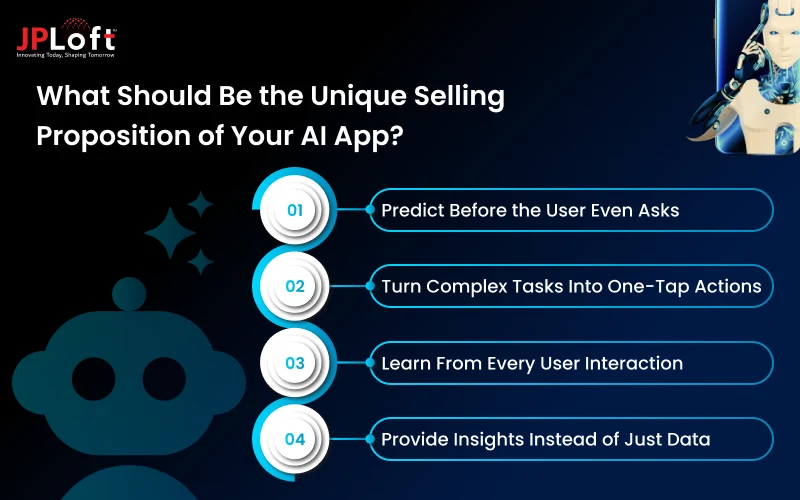
Below are a few USP ideas that can truly differentiate an AI app in the market.
#1: Predict Before the User Even Asks
The best AI apps do not just respond. They anticipate needs.
Example: Spotify predicts songs you might like before you search. Google Maps predicts traffic before you start driving.
Why this works:
-
Reduces user effort
-
Creates a feeling of intelligence
-
Keeps users coming back because the app feels helpful
#2: Turn Complex Tasks Into One-Tap Actions
AI becomes powerful when it simplifies something complicated.
Example: Notion AI can summarize long documents instantly. Grammarly rewrites sentences with a single click.
Why this works:
-
Saves time immediately
-
Makes the product addictive
-
Turns AI into a daily productivity tool
#3: Learn From Every User Interaction
Apps that continuously improve become difficult to replace.
Example: Netflix recommendations improve as users watch more content. The system keeps learning preferences.
Why this works:
-
The product becomes smarter over time
-
Personalization increases user retention
-
Competitors cannot easily copy user-specific data
#4: Provide Insights Instead of Just Data
Most apps show information. Great AI apps explain what the information means.
Example: AI finance apps analyze spending patterns and suggest better budgeting decisions.
Why this works:
-
Users value guidance more than raw data
-
Builds trust in the product
-
Positions the app as an intelligent assistant
A strong USP is not about adding more AI features. It is about solving one meaningful problem in a smarter way than anyone else. When that happens, the AI becomes the reason users choose your product.
With the USP for your AI app being, let’s get to know about the cost. This will help you plan better and move forward with the right strategy alongside an experienced AI-powered mobile app development company.
How Much Does it Cost to Develop an Artificial Intelligence App?
Overall, the cost to create a successful & feature-rich AI app can go from $30,000 to $350,000+.
There are several factors that affect the overall complexity of the AI model, including the technology stack selected, the size of the development team, and the scale at which you intend to deploy.
Understanding the cost breakdown before you begin is not just smart financial planning; it is the difference between a project that stays on budget and one that stalls halfway through.
Here is a quick breakdown of the AI app development cost:
|
App Type |
Complexity |
Estimated Cost |
Timeline |
|
Basic AI App |
Single AI feature, limited data |
$30,000 – $35,000 |
1 – 3 months |
|
Mid-Level AI App |
Multiple features, custom model |
$35,000 – $80,000 |
3 – 6 months |
|
Advanced AI App |
Deep learning, large datasets |
$80,000 – $200,000 |
6 – 12 months |
|
Enterprise AI App |
Full custom system at scale |
$200,000 – $350,000+ |
12 – 18+ months |
|
AI Mobile App |
iOS/Android AI integration |
$30,000 – $120,000 |
4 – 9 months |
Now that we’ve covered the cost, let’s take a look at the challenges you may face and how to solve them.
What Are Challenges While Developing an Artificial Intelligent App?
Nearly 95% of projects struggle because of messy, outdated, or poorly contextualized data.
This is only a percentage of issues AI deployment faces. The businesses that succeed are not the ones that avoid these challenges; they are the ones that see them coming and make sure to solve them as soon as possible.
This section highlights all those major challenges that you should know about:
Challenge 1: Data Quality and Availability
Bad data is a silent killer. Your AI model is only as smart as the data it learns from; feed it garbage, and it delivers garbage.
Most businesses discover too late that their internal data is incomplete, inconsistent, or completely unstructured.
Solution: Invest in data cleaning and governance before development begins. Build a structured data pipeline early and treat data quality as a non-negotiable foundation — not an afterthought.
Challenge 2: Choosing the Wrong AI Model
Not every problem needs deep learning. Picking an overly complex model for a simple use case wastes time, money, and computing resources. Or, choosing an underpowered model for a complex problem produces unreliable results that erode user trust fast.
Solution: Match the model to the problem, not to the hype. Start simple, validate results, and scale complexity only when the use case genuinely demands it.
Challenge 3: Integration With Existing Systems
Building the AI model is one challenge. Getting it to work seamlessly inside your existing tech infrastructure is another one entirely. Legacy systems, incompatible APIs, and siloed data architectures create friction that stalls even the most promising deployments.
Solution: Conduct a full infrastructure audit before integration begins. Design APIs with flexibility in mind and prioritize modular architecture so your AI layer connects cleanly without breaking existing workflows.
Challenge 4: High Development Costs
AI app development is expensive — and costs have a way of growing faster than budgets can keep up.
Unplanned retraining cycles, infrastructure scaling, and unexpected technical debt can push a project well beyond its original estimate without warning.
Solution: Define a realistic app development cost with a built-in contingency of at least 20%. Prioritize an MVP approach — build the core AI feature first, validate it, then expand. Spend where it creates value, cut where it does not.
Challenge 5: Lack of Skilled Talent
AI expertise is one of the most in-demand and hardest-to-find skill sets in the market today.
Many businesses underestimate how specialized the knowledge required to build, train, and maintain an AI system truly is — and pay the price in delays and poor outputs.
Solution: Partner with experienced AI development specialists or hire selectively for critical roles. Upskill existing team members where possible and build a team structure that balances technical depth with product thinking.
Challenge 6: Bias in AI Models
AI learns from historical data, and if that data carries bias, your model will too.
Biased outputs do not just produce inaccurate results: they create legal, ethical, and reputational risks that can seriously damage your business and erode user trust at scale.
Solution: Audit training datasets for representation gaps before and during model development. Test outputs across diverse user scenarios regularly and build bias detection checkpoints into every stage of your development and retraining cycle.
Challenge 7: Messy and Uncontextualized Data
One of the biggest roadblocks businesses hit when they decide to make an AI app is discovering that their data is far messier than expected.
Raw data without proper context means your model cannot understand patterns, cannot make accurate predictions, and ultimately cannot deliver the results your business needs to justify the investment.
Solution: Before training begins, contextualize every dataset — label it, structure it, and make sure it accurately reflects real-world scenarios your app will encounter.
Clean data is not optional. It is the entire foundation your AI stands on. So, these are some challenges that we briefly explained. Now that this is clear, let’s see the new technologies that are shaping various AI trends
Emerging Technologies Driving the Next Wave of AI App Development
The AI landscape is not standing still: it is evolving at a pace that makes last year's cutting-edge look ordinary today.
New technologies are not just improving how we build an AI app; they are completely rewriting what is possible.
If you want to stay ahead, you need to know what is coming before it arrives.
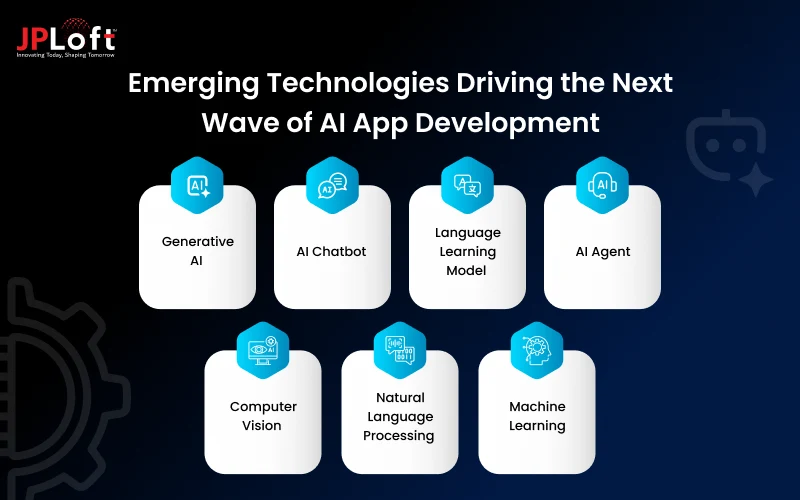
Here is a look at the technologies currently shaping the future of AI app development:
1. Generative AI
Generative AI is redefining what AI-powered applications can create from written content and images to code and synthetic data.
Businesses investing in generative AI development services are launching smarter products faster, automating creative workflows, and delivering personalized user experiences that were simply not possible even two years ago.
2. AI Chatbot
Old chatbots were very basic and could only reply with fixed answers.
Modern chatbots understand context and remember conversations. They can resolve complex queries without human intervention.
This means businesses can provide 24/7 customer support.
It also enables faster lead qualification and significantly reduces operational costs, all running automatically in the background with AI chatbot development services.
3. Language Learning Model
Large Language Models are the engine powering the most intelligent applications being built today.
Leveraging LLM development services allows apps to understand, generate, and reason with human language at a deeper level.
This makes intelligent search faster and more effective.
It also improves automated document processing and conversational AI, making responses more accurate.
4. AI Agent
AI agents are the biggest element in emerging AI. The number of Active AI agents in companies worldwide was expected to grow to over 2.2 billion in 2030.
In 2025, there were 28.6 million active AI agents. With the help of an experienced AI agent development company, businesses are creating systems that plan, decide, and execute different tasks independently.
5. Computer Vision
The computer vision market is expanding. The market is expected to reach 112.10 billion by 2035.
Investors look forward to computer vision development service giving applications the ability to see and interpret the visual world.
Businesses are now automating processes that once required constant human observation and review.
6. Natural Language Processing
The NLP market is entering a major growth phase, forecasted to surge to $68.1 billion by 2028.
NLP is bridging the gap between human communication and machine understanding.
Powering sentiment analysis, intelligent document processing, and multilingual voice interfaces, businesses are leveraging NLP development services.
7. Machine Learning
Machine learning is the foundation for intelligent application development.
Using systems powered by machine learning allows applications to learn from data and continuously improve over time.
As the system processes more information, it becomes better at making accurate predictions.
This gives businesses a powerful, self-improving tool that becomes more valuable over time with the support of ML development services.
How JPLoft Can Help You Launch a Market-Leading AI App?
Launching an AI product requires more than just an idea. It needs the right strategy, technology, and execution.
As a trusted AI app development company, JPLoft helps startups and businesses turn innovative ideas into scalable AI-powered applications. These apps are built to solve real user problems and create measurable business value.
Our team begins by understanding your business goals. Then we design intelligent solutions using machine learning, natural language processing, and advanced data analytics.
What sets JPLoft apart is not just technical expertise — it is the ability to translate complex AI capabilities into products that real users love, and businesses can scale confidently.
If you are ready to stop planning and start building, JPLoft is the partner that gets you there faster, smarter, and built to lead.
Conclusion
Artificial intelligence is no longer a futuristic concept reserved for large tech corporations.
It has become a practical tool that businesses of every size can use to build smarter products, automate operations, and deliver highly personalized user experiences.
Companies that understand how to build an AI app today are positioning themselves ahead of a major digital transformation that will define the next decade of innovation.
From defining the right use case and preparing high-quality data to selecting the right technology stack and training intelligent models, successful AI development requires careful planning and the right technical expertise.
Businesses that approach AI strategically can unlock powerful advantages such as predictive insights, automation, and continuous product improvement.
If your goal is to create an AI app that stands out in a competitive market, partnering with experienced developers can make the entire journey smoother.
With the right development strategy and scalable architecture, AI-powered applications can evolve into long-term digital assets that grow smarter with every user interaction.
FAQs
To create an Artificial Intelligence app, define the problem, gather quality data, choose the right AI technology, train the model, integrate it into the app, and continuously improve.
The development timeline depends on the complexity of the application. A basic AI-powered app can take around 2–3 months, while advanced applications with custom models, large datasets, and multiple AI features may require 6–12 months or more.
AI applications are widely used across industries such as healthcare, fintech, e-commerce, logistics, education, retail, and manufacturing. These industries benefit from automation, predictive analytics, personalized user experiences, and improved operational efficiency.
AI apps typically use technologies such as machine learning, natural language processing (NLP), computer vision, deep learning, and generative AI models. Frameworks like TensorFlow, PyTorch, and APIs from platforms such as OpenAI or Google AI are commonly used during development.
The amount of data required depends on the type of AI model and the problem it solves. Simple machine learning models can work with smaller datasets, while deep learning models usually require large volumes of structured and labeled data for accurate results.
Businesses investing in AI today gain a strong competitive advantage. AI apps can automate tasks, analyze large datasets, predict user behavior, and deliver personalized experiences. These capabilities help companies improve efficiency, reduce operational costs, and scale their digital products faster.

Rahul Sukhwal is the CEO and Founder of JPLoft, a visionary technologist with 18+ years at the forefront of emerging tech innovation and software engineering. He channels deep software engineering and AI expertise into building smarter, scalable solutions that shape how forward-thinking businesses worldwide harness the true power of AI.



Share this blog