



Key Takeaways:
Horse racing app centralizes race data, profiles, and live results, providing fans and professionals with an interactive and reliable platform.
Essential features include live updates, horse/jockey profiles, analytics, and push notifications that drive engagement and security.
Tools and technologies used are frontend, backend, database, APIs, cloud services, and security tools to build a high-performing app.
The price to develop a horse racing app ranges from USD 20,000 to USD 180,000+, depending on features, complexity, and security.
Future trends are AI insights, AR, blockchain, IoT, personalization, live streaming, and advanced security, shaping future apps.
Horse racing has always been a sport driven by speed, strategy, and passion. Today, technology plays a big role in how fans, trainers, owners, and investors connect with the racing world. This shift has created strong demand for smart and reliable digital solutions.
Knowing how to develop a horse racing app in 2026 enables businesses to integrate live races, real-time data, and user-friendly features into a single, powerful platform.
Successful horse racing app development requires the choice of the right features, extensive research, scalable technology, expert development, strong security, and compliance with industry rules.
From tracking race schedules and horse profiles to managing odds, stats, and secure payments, a well-built horse racing app adds value for every user.
In this blog, we will explain everything you need to know about developing a horse racing app. Covering everything from core features and tech stack choices to cost, challenges, and best practices for long-term success.
What is a Horse Racing App?
A horse racing app is a mobile-based application designed to deliver digital services related to horse racing events. It helps users access race information, track horses, follow jockeys, and stay updated with upcoming races in real time.
These apps are widely used by racing fans, investor brands, racing clubs, and industry professionals who want quick and reliable access to race data. A typical horse racing app displays race schedules, live results, horse profiles, past performance records, odds, and race statistics.
For businesses, the guide to horse racing app development improves user engagement and simplifies operations.
Investors planning to launch an equine app often look toward horse racing apps due to their strong market potential.
Trainers and owners use them to monitor performance and insights.
Types of Horse Racing Apps
There are several types of horse racing app development, each catering to different aspects of the horse racing society:
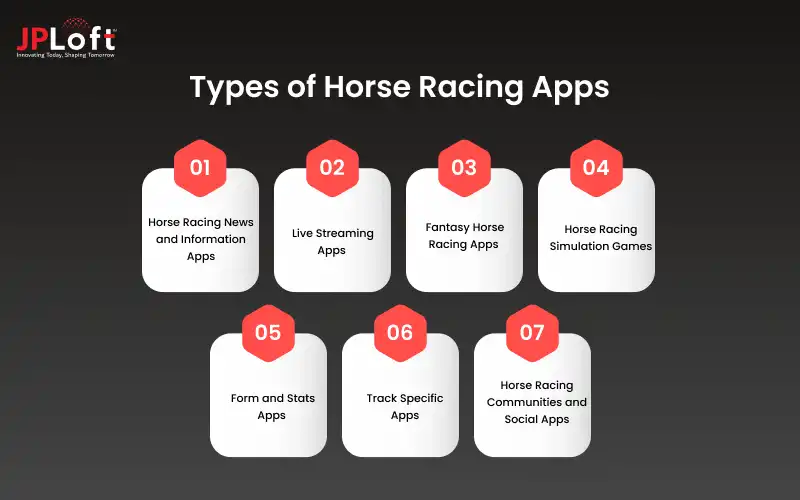
Type 1: Horse Racing News and Information Apps
These apps keep users updated on the latest horse racing news, including results, upcoming events, jockey and trainer statistics, and more. They are ideal for fans who want to stay informed but not necessarily place bets.
Type 2: Live Streaming Apps
These apps provide live coverage of races from tracks worldwide. Users can watch races as they happen, often with commentary and in-depth race analysis.
Type 3: Fantasy Horse Racing Apps
These apps allow users to participate in fantasy leagues based on horse racing. Users can pick horses, create teams, and win points based on their performance in actual races.
Type 4: Horse Racing Simulation Games
These apps simulate the experience of owning and racing horses. Users can breed horses, train them, and race them, sometimes against other players. These are more for entertainment and skill development.
Type 5: Form and Stats Apps
These apps are focused on providing in-depth statistics, form guides, and analytics for races, horses, jockeys, and trainers. Ideal for professionals who want to research and perform better.
Type 6: Track Specific Apps
Some horse racing tracks have their own apps, offering live streams, race schedules, and special track information.
Type 7: Horse Racing Communities and Social Apps
These apps focus on bringing fans together to talk about races, share tips, or even participate in fantasy leagues. They're more about building a community around horse racing.
Recent Horse Racing App Market Statistics
Below, we have provided recent market statistics of the horse racing industry before you create a horse racing app:
-
As estimated by SensorTower, leading horse racing games have seen significant downloads and active user growth. Rival Stars Horse Racing on Android had weekly downloads peaking at about 3.2K in early June 2025, with active users increasing from 17.3K to 22.8K.
-
According to DataIntelo, North America remains the dominant region for horse racing software, supported by established betting infrastructure and high adoption rates of digital platforms.
-
DataIntelo also stated that Europe, particularly the UK and France, also shows substantial growth opportunities, while the Middle East and Africa are emerging markets with potential for expansion.
Understanding what a horse racing app is, along with market statistics and popular types, sets the stage for exploring the key features that make these apps engaging, reliable, and valuable for users.

Key Features of Horse Racing App
Features can make or break your app’s success.
This is why choosing the right equine app features is important. When planned well, equine app features can define how users interact with your platform and how efficiently it performs.
Here are some key features of a horse racing app:
|
Category |
Feature |
Description |
|
User Management |
User Registration & Login |
Allows users to sign up and log in using email, phone number, or social accounts. This feature helps businesses manage user profiles and provide personalized experiences. |
|
User Profiles |
Enables users to create profiles with preferences, favorite horses, jockeys, and race types. This improves engagement and helps deliver relevant updates. |
|
|
Race Information |
Race Schedule |
Displays upcoming, ongoing, and past races with dates, locations, and timings. Users can plan and stay informed without searching multiple platforms. |
|
Live Race Updates |
Provides real-time race status, positions, and results. This feature keeps users engaged during live events and increases app usage time. |
|
|
Horse & Jockey Data |
Horse Profiles |
Shows detailed horse information such as age, breed, past performance, and win history. This helps users make informed decisions and track favorites. |
|
Jockey Profiles |
Displays jockey experience, performance stats, and recent results. It adds transparency and improves trust in the platform. |
|
|
Engagement Tools |
Push Notifications |
Sends alerts for race start times, results, odds changes, and promotions. This helps retain users and increase return visits. |
|
Live Streaming |
Allows users to watch races directly within the app. Live streaming improves user experience and boosts engagement levels. |
|
|
Analytics & Insights |
Performance Analytics |
Provides race trends, horse statistics, and historical data. Businesses can use insights to enhance services and user targeting. |
|
Admin Panel |
Content Management |
Let's admins manage races, results, banners, and notifications from a single dashboard. This simplifies daily operations. |
|
User & Transaction Monitoring |
Helps track user activity, bets, and payments. This feature supports compliance and reduces fraud risks. |
|
|
Security & Compliance |
Data Protection |
Ensures user data privacy through encryption and secure storage. It supports compliance with industry and regional regulations. |
These features together help businesses build a horse racing app that is smooth, engaging, and reliable, meeting both user needs and market demand. Once you know the key features that make a horse racing app engaging and functional, the next step is to explore the steps of how to build a horse racing app to bring these features to life.
Step-By-Step Process To Develop a Horse Racing App
Developing a successful horse racing app requires a clear roadmap to ensure smooth execution, high performance, and user satisfaction. From planning and design to development, testing, and post-launch support, each step plays a crucial role.
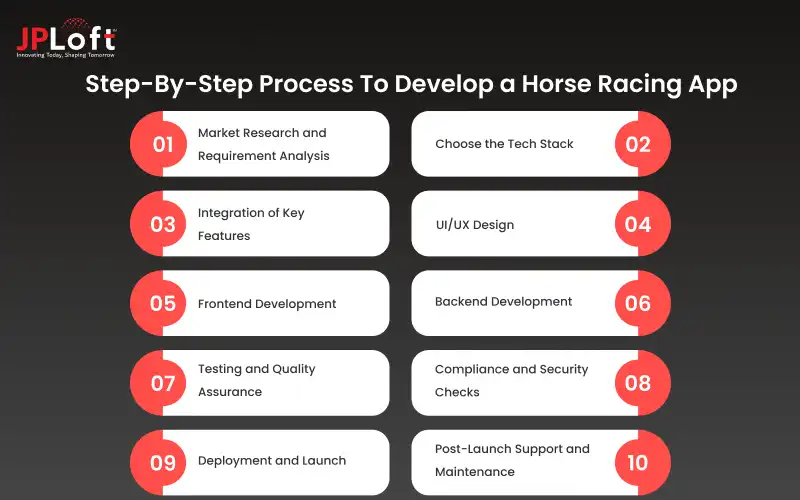
Here are detailed steps on how to develop a horse racing app:
Step 1. Market Research and Requirement Analysis
Start to develop a horse racing app by studying the industry, target users, and existing apps in the market. Identify whether your app is focused on race tracking, betting, analytics, or fan engagement. Define core and advanced features, user roles, revenue model, and compliance needs. Clear documentation at this stage reduces rework later and helps align stakeholders, timelines, and technical expectations clearly.
Step 2. Choose the Tech Stack
Selecting the right tools impacts performance, scalability, and cost. Decide whether to build a cross-platform or native app based on budget and reach. Choose backend technologies that support real-time data and high traffic. Finalize databases, cloud services, APIs, and security tools to ensure smooth integration, flexibility, and long term business growth.
Step 3. Integration of Key Features
This step connects core app functionalities. Live race data APIs are integrated to display accurate results and odds. Payment gateways support secure transactions. Analytics tools track user behavior and engagement. Notification systems deliver timely alerts, promotional messages, and important system updates reliably.
Step 4. UI/UX Design
Design focuses on usability and engagement. Create mobile app wireframes for every screen, including race listings, profiles, betting flows, and dashboards. The interface should be clean, fast, and easy to navigate. App prototypes help visualize the app and collect early feedback, reducing design and usability issues during development and future feature expansion.
Step 5. Frontend Development
While you develop an equine app, the frontend turns designs into functional screens. Implement smooth navigation, fast-loading pages, and responsive layouts. Real-time updates, live feeds, and interactive elements are integrated. The goal is to ensure consistent performance, accessibility, and usability across devices and operating system versions.
Step 6. Backend Development
In the development process, the backend handles logic, data flow, and scalability. Horse racing app developers build APIs to manage users, races, horses, odds, payments, and notifications. Real-time data processing is set up for live race updates. An admin panel is also developed to manage content, users, reports, and system configurations efficiently.
Step 7. Testing and Quality Assurance
Mobile app testing ensures reliability and performance. Functional testing checks each feature. Performance testing ensures the app handles peak traffic. Security testing protects user data and payments. Bugs and issues are fixed before launch to avoid negative user experiences and unexpected production failures.
Step 8. Compliance and Security Checks
Horse racing app development in UK or in any country must meet local legal and regulatory standards. Implement strong authentication, encryption, and fraud detection as app security. Ensure compliance with regional betting laws, data privacy rules, and payment regulations. This step reduces legal risks, penalties, and operational disruptions, and builds long-term user trust.
Step 9. Deployment and Launch
Next in the horse racing app development guide, prepare the app for release by optimizing performance and store listings. Submit the app to app stores with required documentation and compliance details. Plan onboarding, promotions, and user support for a smooth launch and positive first impression.
Step 10. Post-Launch Support and Maintenance
After launch, continuous monitoring is essential. Track performance, user feedback, and analytics. Fix bugs, release updates, add features, and scale infrastructure as usage grows. Regular maintenance ensures long term stability, security, performance optimization, and user satisfaction.
This process of how to create a horse racing app ensures a stable, scalable, and user-friendly horse racing app that aligns with business goals and provides a seamless experience for racing fans and professionals. Now it’s important to understand the cost involved, which varies based on features, platform, and complexity.
Cost To Develop A Horse Racing App
The cost to develop a horse racing app ranges between USD 20,000 to USD 180,000+, varying with the choice of features, platform, complexity, and region of the development team. Knowing the equine app development cost helps businesses plan budgets with clarity.
Below is a detailed breakdown table of the cost of horse racing software development:
|
Development Type |
Features Included |
Estimated Cost |
|
Basic (MVP) |
User login, race listings, basic UI, notifications |
$20,000 – $50,000 |
|
Mid-Level App |
Live race updates, profiles, payments, better UI/UX |
$50,000 – $100,000 |
|
Advanced / Enterprise App |
AI insights, real-time analytics, betting features, scalability |
$100,000 – $180,000+ |
These estimated cost to develop a horse racing app help you choose the right budget level based on the goals and your targeted audience.
Estimated Total Development Cost Based on App Complexity
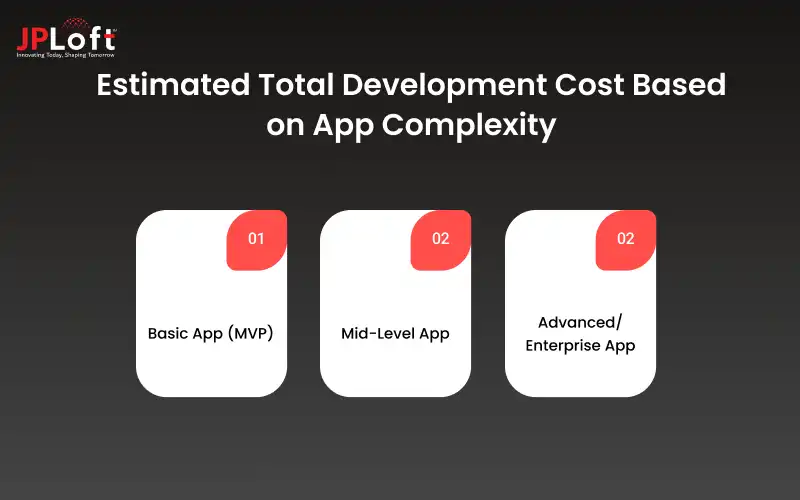
1. Basic App (MVP)
This tier works for startups or MVPs (Minimum Viable Products) with fundamental features.
Estimated Cost (in USD): $20,000 – $40,000
Features: Core features, simple UI, basic race info, login, and limited stats functionality.
2. Mid-Level App
This is ideal for growing businesses needing more engagement and a better experience.
Estimated Cost (in USD): $40,000 – $95,000
Features: Adds real-time updates, secure payments, an admin panel, and analytics.
3. Advanced/Enterprise App
This tier suits large platforms aiming for full feature sets and high scalability.
Estimated Cost (in USD): $95,000 – $180,000+
Features: Includes live streaming, advanced stats features, high security, and custom UI.
Choosing the right feature set and building approach helps control the mobile app development cost while ensuring the quality of the horse racing app development.
A well-planned budget supports scalability, compliance, and sustainable growth in the horse racing market. In the next section, we will explore the tools and technologies that make building a feature-rich, scalable app possible.

Technologies Used To Develop a Horse Racing App
To start with how to create a horse racing app requires the right mix of tools and technologies to ensure speed, accuracy, and security. From frontend frameworks to backend systems and cloud platforms, each technology plays a key role in delivering a smooth experience.
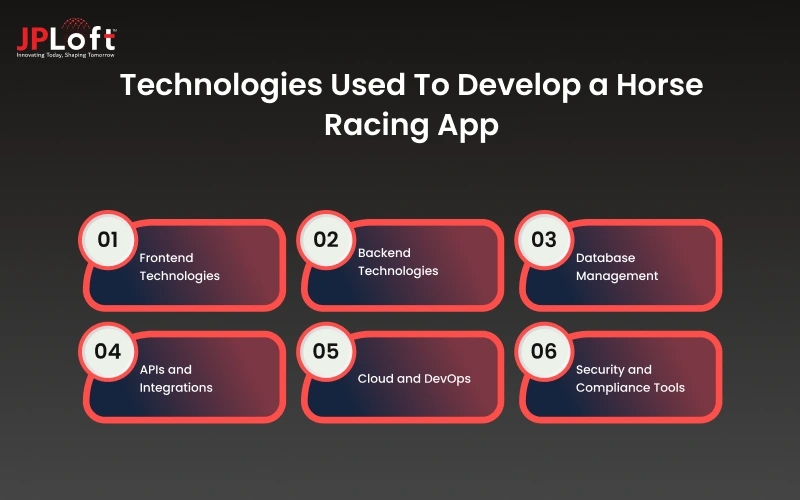
Below is an overview of the popular app tech stack used to create a horse racing app:
1. Frontend Technologies
Frontend tools focus on app design and user experience.
-
React Native or Flutter are widely used for cross-platform development. They help build Android and iOS apps using a single codebase, which reduces cost and time.
-
Swift (iOS) and Kotlin (Android) are used for native app development when high performance and platform-specific features are required.
2. Backend Technologies
The backend of horse racing app development manages data, logic, and app performance.
-
Node.js is popular for handling real-time updates like live race results and odds.
-
Python with frameworks like Django or Flask supports heavy data operations and analytics.
-
Java is often used for scalable and secure enterprise-level systems.
3. Database Management
Databases store user data, race records, and transaction details.
-
MySQL and PostgreSQL are used for structured data and strong reliability.
-
MongoDB works well for flexible data, such as live race updates and logs.
-
Redis helps cache real-time data to improve speed and performance.
4. APIs and Integrations
Integration of third-party tools to avoid building every functionality from scratch.
-
Third-party race data APIs provide live scores, odds, and horse statistics.
-
Payment gateway APIs support secure deposits and withdrawals.
-
Push notification services like Firebase Cloud Messaging deliver real-time alerts.
5. Cloud and DevOps
Consisting of a large amount of data from users, horses, and analytics, needing smooth regulation.
-
AWS, Google Cloud, or Microsoft Azure support hosting, scaling, and data storage.
-
Docker and Kubernetes help manage deployments and ensure system stability.
-
CI/CD tools automate testing and updates.
6. Security and Compliance Tools
To build a horse racing app consisting of user data and racing analytics, security and compliance play a huge role in securing them.
-
SSL encryption, OAuth, and JWT protect user data and sessions.
-
Fraud detection tools help monitor suspicious activities.
Tools Used to Develop a Horse Racing App
These tools are platforms, software, and utilities that developers use during design, development, testing, deployment, and maintenance.
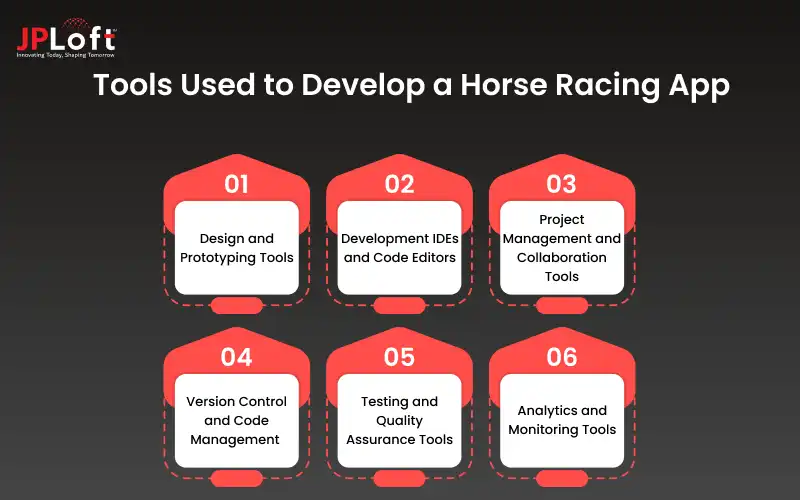
1. Design and Prototyping Tools
Used to design UI, UX flows, and user journeys.
-
Figma
-
Adobe XD
-
Sketch
-
InVision
2. Development IDEs and Code Editors
Used for writing and managing code.
-
Android Studio
-
Xcode
-
Visual Studio Code
-
IntelliJ IDEA
3. Project Management and Collaboration Tools
Used to manage tasks, timelines, and communication.
-
Jira
-
Trello
-
Asana
-
Slack
-
Notion
4. Version Control and Code Management
Used for source code tracking and collaboration.
-
Git
-
GitHub
-
GitLab
-
Bitbucket
5. Testing and Quality Assurance Tools
Used to ensure performance, security, and stability.
-
Appium
-
Selenium
-
Firebase Test Lab
-
TestFlight (iOS testing)
-
BrowserStack
6. Analytics and Monitoring Tools
Used to track user behavior and app performance.
-
Google Analytics
-
Firebase Analytics
-
Mixpanel
-
Crashlytics
Using the right combination of these tools ensures a secure, scalable, and high-performing horse racing app that meets business and user expectations. While the right tools and technologies form the backbone, horse racing app developers must also address common challenges to ensure the app is secure, scalable, and user-friendly.
Challenges and Solutions For Successful Horse Racing App Development
You will have to handle technical, security, and compliance challenges in equine app development while ensuring smooth performance, real-time accuracy, and strong user engagement.
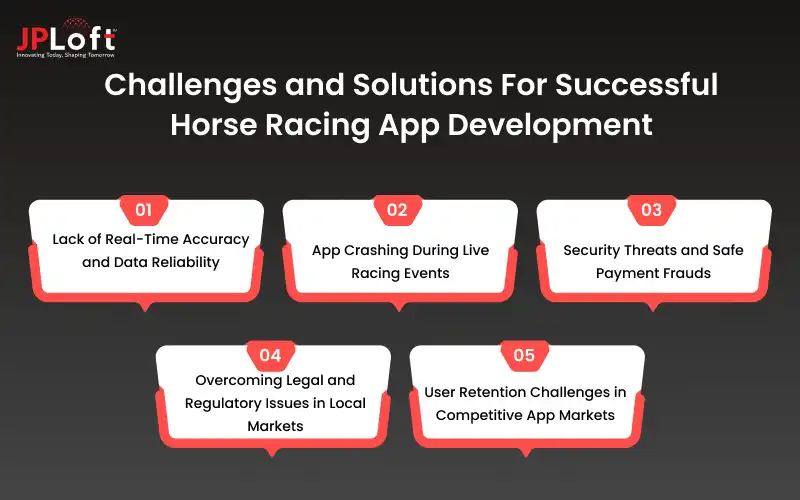
Below are the most common horse racing app development challenges:
Challenge 1: Lack of Real-Time Accuracy and Data Reliability
Horse racing apps rely on live race results, odds, and statistics. Any delay or incorrect data can affect user trust, leading to user complaints, lower engagement, and potential revenue loss.
Solution: Integrate reliable third-party race data providers and use real-time APIs with caching tools like Redis. Regular monitoring and fallback data sources help maintain accuracy and uptime.
Challenge 2: App Crashing During Live Racing Events
User activity spikes sharply during popular races, which can lead to app crashes or slow performance, especially when thousands of users access live updates simultaneously.
Solution: Use cloud-based infrastructure with auto-scaling for live horse racing app development. Load balancing and performance testing before major events ensure the app handles traffic smoothly.
Challenge 3: Security Threats and Safe Payment Frauds
One of the huge challenges in equine or horse racing apps is security.
Apps that support payments face risks such as fraud, data breaches, and unauthorized access, which can damage brand reputation and lead to financial penalties.
Solution: Implement strong encryption, secure authentication, and fraud detection systems. Regular security audits and compliance checks reduce risks and build user confidence.
Challenge 4: Overcoming Legal and Regulatory Issues in Local Markets
Many users uninstall apps that feel complex or fail to deliver value after initial use, especially when features are difficult to understand or poorly optimized.
Solution: Focus on simple navigation, personalized alerts, and features like favorite horses or race reminders. Regular updates and performance improvements keep users engaged.
Challenge 5: User Retention Challenges in Competitive App Markets
When you build a horse racing app, it must follow different laws across regions, which can be complex and time-consuming, particularly for platforms operating in multiple markets.
Solution: Design the app with flexible compliance settings. Work with legal experts and allow region-based feature control to meet local regulations.
Future Trends in Horse Racing App Development
To create a horse racing app with future trends shows that it is moving toward smarter, more interactive, secure, and personalized digital experiences that benefit fans, professionals, and businesses.
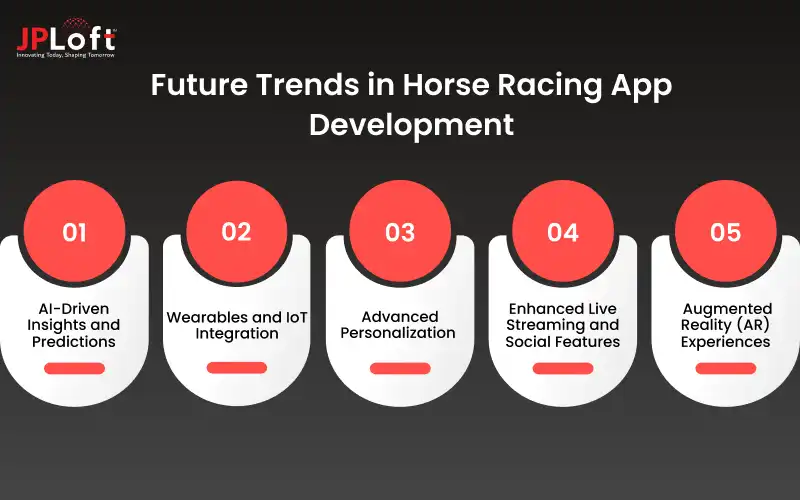
Below, we have listed the upcoming trends to develop a horse racing app:
1. AI-Driven Insights and Predictions
Artificial intelligence will play a bigger role in horse racing apps. AI development services can integrate AI to help you analyze race history, weather, and jockey performance to generate smarter predictions and personalized suggestions. It will also adapt over time, learning user behavior and market trends for more accurate guidance.
2. Wearables and IoT Integration
Wearable sensors on horses and jockeys will collect performance data like heart rate and speed. Apps that integrate this IoT data can offer deeper insights, performance trends, and personalized analytics for trainers and racing fans. These integrations also offer predictive data for injury prevention and training optimizations.
3. Advanced Personalization
The guide to horse racing app development promotes apps to use machine learning to tailor content, odds alerts, race suggestions, and promotions for each user. Personalized feeds increase retention and time spent in the app. This also helps businesses deliver more relevant recommendations and increase long-term user satisfaction and loyalty.
4. Enhanced Live Streaming and Social Features
Live horse racing app development will combine high-quality streaming with social features like in-app chats, comment feeds, and shared highlights. Social engagement helps build communities and increases user loyalty. Users will be able to share experiences, create groups, and discuss races, boosting platform activity further.
5. Augmented Reality (AR) Experiences
AR features will let fans explore virtual racetracks, view horse stats in real time, and interact with 3D content during live races. This immersive experience allows users of the horse racing app to feel part of the action, increasing excitement and engagement significantly.

Why Partner With JPLoft For Horse Racing App Development?
When building a high-performing horse racing app, choosing the right partner makes all the difference.
JPLoft is a trusted Horse racing app development company with 1100+ projects delivered and a 98% client retention rate, known for scalable, secure, and feature-rich solutions.
From market research and UI/UX design to development, testing, and post-launch support, we ensure a seamless process.
Our apps include live race updates, horse and jockey profiles, secure payments, and analytics.
By integrating AI-driven insights and real-time notifications, we create engaging user experiences that help your platform stand out and grow.
Conclusion
Knowledge of how to build a horse racing app offers businesses an opportunity to tap into a growing digital market while providing fans, trainers, and bettors with a seamless and engaging experience. From real-time race updates and detailed horse and jockey profiles to secure betting systems and live streaming, a well-designed app brings every aspect of horse racing into a single, interactive platform.
Success, however, depends on careful planning, the right technology stack, strong security, and adherence to legal regulations. By addressing challenges like real-time data accuracy, high traffic loads, and user engagement, businesses can build apps that are reliable, scalable, and user-friendly.
Looking ahead, trends such as AI-driven insights, AR experiences, blockchain integration, and personalized features will further shape the horse racing software development landscape. Investing in these strategies ensures long-term growth, better user retention, and a competitive edge in the digital horse racing market.
FAQs
To develop a horse racing app, start with market research, define features, choose a tech stack, design UI/UX, build the frontend and backend, integrate live data and payment systems, test thoroughly, ensure security and compliance, then deploy and maintain the app.
Core features include user registration, race schedules, live updates, horse and jockey profiles, odds display, secure payment integration, push notifications, live streaming, admin dashboards, and performance analytics to enhance engagement, usability, and business operations.
Frontend technologies like React Native, Flutter, Swift, or Kotlin, backend frameworks such as Node.js or Django, databases like MySQL or MongoDB, and APIs for live data, payments, and notifications are commonly used.
The cost ranges from USD 20,000 to USD 180,000, depending on features, platforms, design complexity, live streaming, betting integration, security, and post-launch maintenance. Advanced apps with real-time data and live streaming are at the higher end.
Challenges include real-time data accuracy, high traffic management, secure payments, legal compliance, user engagement, live streaming, and scalability. Each challenge can be addressed with advanced technology, cloud infrastructure, and strategic planning.
Future trends include AI-driven insights, AR experiences, blockchain-based transparency, IoT integration, personalized content, voice and chatbot interactions, enhanced live streaming, and cross-platform optimized apps for better engagement, security, and user experience.

Kris Jacobs brings 20+ years of experience in digital product strategy, user-focused design, and solving complex product challenges. She has worked across on-demand services, travel, entertainment, sports, insurance, education, and service marketplaces, including handyman, dog-walking, courier, event-management, and equine platforms. Her focus is on shaping practical, scalable digital experiences that align user needs with business goals and long-term product growth.





Share this blog