



Key Takeaways:
A well-designed equine app reduces manual work, improves decision-making, and helps equine businesses deliver better services with reliability.
Investing in an equine app streamlines operations, improves communication, enhances user satisfaction, and makes better decisions.
The key challenges in equine app development are managing large amounts of data, real-time updates, integrations, offline use, and reliability.
Following best practices such as modular design, simple UI, strong security, offline support, and real-world testing ensures long-term app success.
Building a strong equine app sounds simple, but the actual process brings many equine app development challenges for technical teams and business owners. Horses need detailed care, and users expect apps that support daily tasks without confusion. This makes the development journey different from that of regular apps.
Equine apps handle real-time data, medical records, stable operations, bookings, and communication between owners, trainers, and vets. At the same time, businesses must focus on accuracy, reliability, and safety. Understanding the key equine app development challenges to meet these needs in one platform requires careful planning.
In this blog, we will explain the common challenges while building an equine app that companies face during equine app development and why solving them efficiently helps create a trusted and user-friendly platform. The goal is to build a dependable app that saves time and supports better horse care.
Equine App Concept and Its Related Market Stats
An equine app is designed to simplify everyday activities for horse owners, trainers, riders, vets, and stable managers. The goal of creating an app for equines is to keep all important information organized in a simple, friendly, and highly secure way.
The app works like a digital assistant for stable operations. Users can store health reports and schedule veterinary visits, track vaccinations, and manage feeding plans. Trainers can record training notes, create progress charts, and share updates with owners. Stable managers can monitor occupancy, track payments, and communicate with customers.
Each action becomes faster and more transparent with the help of equine app development. Anyone can share notes, upload images, and record activities in real time. Improving horse care and reducing repeated conversations. A well-built equine app brings everything into one place, making it easier for businesses to deliver better services and for horse owners to make informed decisions.
Equine App and Related Market Statistics
Below are the most recent equine apps and recent market statistics:
-
The digital horse management app market is valued at approximately USD 500 million in 2025, with a projected CAGR of 15% through 2033, according to Market Report Analytics.
-
Major equine app platforms, based on Market Report Analytics, are EquineM, BarnManager, and Hippovibe, collectively holding around 60% of the market share.
-
As estimated by 360 Research Reports, North America leads in user adoption, accounting for 38% of the global horse software market. The U.S. alone contributes 81% of regional adoption.
-
In research by SensorTower, the top horse management apps like Rival Stars Horse Racing have seen steady growth in active users of 33.9K weekly in the U.S. during the first quarter of 2025.
Understanding the equine app concept and the market potential sets a strong foundation for planning your digital solution. Before starting with the challenges in equine app development, let’s see why investing in these apps can create long-term value for your business.
Why Invest in an Equine App?
Although there are a few development challenges of equine apps, investing in an equine app can be a smart move for several reasons. Key reasons include increased interest in the equestrian industry and reliance on technology.
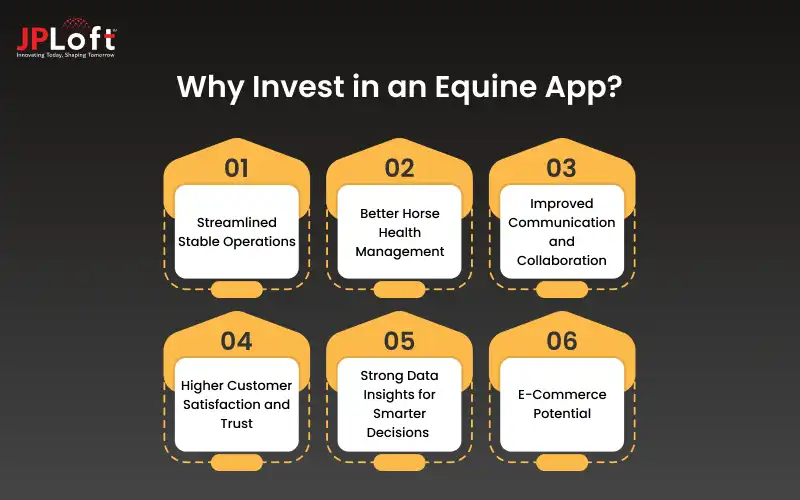
Here are some compelling reasons why you might consider investing, overlooking the challenges while developing an equine app:
1. Streamlined Stable Operations
Equine apps help businesses manage daily tasks like feeding, scheduling, and horse care without confusion. Everything stays organized in one place, reducing manual work. This improves accuracy and saves time for stable managers, trainers, and owners while supporting smooth coordination across the entire stable.
2. Better Horse Health Management
The app keeps health records updated, tracks vaccinations, monitors treatments, and sends reminders for upcoming care. This avoids missed checkups and improves long-term planning. Users get quick access to important medical information, helping them make faster decisions and maintain consistency.
3. Improved Communication and Collaboration
Every user connected to the horse can share updates, notes, images, and tasks in real time, removing repeated calls and manual follow-ups.
Partnering with the best mobile app development company in Dallas to create one place for every trainer, vet, stable staff member, and owner to stay aligned. This leads to better care quality and clear visibility across daily activities.
4. Higher Customer Satisfaction and Trust
Clients appreciate transparency, organized information, and timely updates about their horses. An equine app builds trust by showing progress, tracking services, and managing billing clearly. This strengthens relationships with customers and increases the chances of repeat business for equine service providers.
5. Strong Data Insights for Smarter Decisions
The app gathers data on performance, feeding, training, and health trends. Businesses can study this information to plan better routines, adjust services, and improve overall efficiency.
These insights support informed decisions and long-term growth for stables and equine service companies. The app also provides high safety for the user and stable data, along with accuracy.
6. E-Commerce Potential
The equine industry is a massive product market ranging from riding gear to supplements and horse care equipment. An equine app could offer e-commerce integration, allowing users to browse, purchase, and receive recommendations for products tailored to their horses' needs. Affiliate marketing, partnerships with vendors, or in-app purchases could provide a steady revenue stream.
Now, let's take a look at the key equine app development challenges to help you plan better and prepare with the best solution.

What are the Challenges While Creating an Equine App?
Challenges while creating an equine app are more complex than building a regular business or lifestyle app. It brings several technical and operational difficulties that development teams must handle carefully.
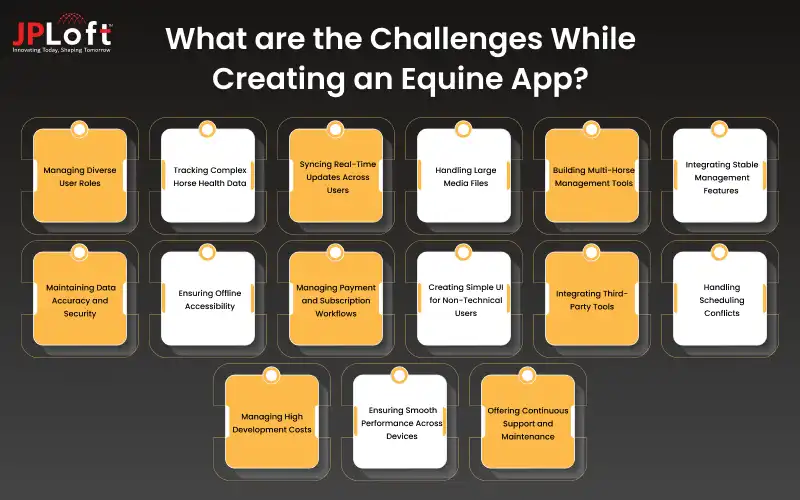
Below are the 15 top equine app development challenges, along with solutions that help businesses plan better:
Challenge 1: Managing Diverse User Roles
Equine apps serve many users, including owners, trainers, vets, riders, and stable managers. Each group expects different tools and workflows. Meeting all needs without making app complicated increases the equine app development challenges. If the structure is unclear, users may struggle to find features and lose interest in daily use.
Solution:
Create separate dashboards for each user type. Keep only the features relevant to their role. Use guided navigation, clean labels, and simple icons. This improves clarity and reduces learning time for every user group.
Challenge 2: Tracking Complex Horse Health Data
Horse health tracking requires detailed information such as vitals, treatments, regular vet visits, vaccination cycles, and injury notes. These records must stay accurate and easy to read. Handling medical history and reminders across multiple horses becomes difficult if the database is not planned correctly from the start.
Solution:
Design structured health modules with predefined categories. Add automated reminders and templates for vets. Use a secure database with clear tagging to ensure every record stays organized and easy to access.
Challenge 3: Syncing Real-Time Updates Across Users
Stable operations involve constant activity, such as horse training notes, feeding updates, status changes, and care instructions. If the equine app does not sync in real time, users may receive outdated information, causing equine app development challenges. This results in confusion, missed tasks, and poor coordination across large stables or remote teams.
Solution:
Use cloud-based architecture with WebSocket or Firebase for live updates. Add offline-sync capabilities to store data even without network access. This ensures smooth communication across all user devices.
Challenge 4: Handling Large Media Files
Users often upload photos, equine training videos, injury images, and performance clips. Large files slow down the equine app, cause storage overloads, and increase hosting costs. Without proper optimization, the app becomes slow and drains mobile data, leading to a poor user experience.
Solution:
Hire iOS developers with experience to enable automatic media compression, cloud storage integration, and optimized video formats. Use CDN hosting for faster delivery and storage management. This keeps the app lightweight and responsive.
Challenge 5: Building Multi-Horse Management Tools
Many users own or manage more than one horse and stable. Each horse requires separate health records, feeding plans, training logs, and documents. If the equine app does not support smooth switching between profiles, users may find it hard to organize information or risk mixing up records.
Solution:
Create a simple horse profile selector, color-coded sections, and grouped data categories. Allow quick switching and provide profile-level notifications to avoid confusion.
Challenge 6: Integrating Stable Management Features
Stables handle tasks like stall assignments, feed inventory, staff schedules, client billing, and boarding plans. Combining all these into one app requires careful planning. If equine app features do not connect well, the app may feel cluttered and difficult for managers to adapt.
Solution:
Break features into modular sections with shared data flow. Add task automation, custom reminders, and simple dashboards to make management easier for staff and stable owners.
Challenge 7: Maintaining Data Accuracy and Security
Horse health, medical reports, and ownership documents are sensitive and require high app security. Any data breach or incorrect record can cause major problems for equine businesses and clients. Development teams face security challenge in equine app and have to ensure records remain accurate across multiple devices for every user.
Solution:
Implement role-based permissions, audit logs, encrypted storage, and regular backups. Use secure authentication and multi-factor login for added protection.
Challenge 8: Ensuring Offline Accessibility
Many stables operate in rural or remote areas with weak network coverage. Equestrian app users need to record health notes, feeding details, or training progress, even without the internet. Without offline support, the app becomes unreliable and limits usage during outdoor or field activities.
Solution:
Build an offline-first equestrian app architecture using local storage and background sync. Let users record updates offline and auto-sync when the network becomes available.
Challenge 9: Managing Payment and Subscription Workflows
Equine services involve many payments, such as boarding fees, vet charges, training sessions, or premium app features. Building secure billing workflows creates huge challenges while developing equine apps. Users expect error-free transactions, clear invoices, and multiple payment methods, and small failures impact customer trust.
Solution:
Make an equine app with integrated secure payment gateways, automated invoices, and transparent billing history. Ensure PCI compliance and use tokenized payments to protect user data.
Challenge 10: Creating Simple UI for Non-Technical Users
Many equine professionals are not tech-savvy. A complex interface may prevent them from using important features and create challenges while building an equine app. If the app feels difficult, users may skip tasks or switch back to manual records.
Solution:
Use minimal screens, large buttons, clean layouts, and easy forms in the equine app. Add tutorial pop-ups and quick-start guides for smooth onboarding.
Challenge 11: Integrating Third-Party Tools
Equine businesses rely on external tools like wearable trackers, RFID chips, accounting tools, GPS systems, and veterinary software. Integrating these services requires strong APIs and stable connections. Without proper integration, users may need multiple apps to complete everyday tasks.
Solution:
Use the best mobile app tech stack to create an API-friendly framework and prioritize integrations based on user demand. Use standardized protocols for smoother syncing and data accuracy in the equestrian app.
Challenge 12: Handling Scheduling Conflicts
Horse care involves many appointments, including vet visits, farrier schedules, training sessions, and stable tasks. These often overlap across several horses. Building a scheduling system for the equine app that avoids conflicts, supports reminders, and manages team coordination is difficult.
Solution:
Use smart scheduling logic with conflict detection in your equine app. Add color-coded calendars, push notifications, and shared access for team members to stay aligned.
Challenge 13: Managing High Development Costs
Equine apps require many advanced features, health logs, media uploads, offline mode, scheduling, payment systems, and stable management. These increase the time and equine app development cost. Without proper planning, budgets can exceed expectations and delay launch timelines.
Solution:
Build your equestrian app in small phases. Start with an MVP and add advanced features later. Use reusable components and scalable architecture to reduce long-term costs.
Challenge 14: Ensuring Smooth Performance Across Devices
Users access the equine app on different devices, screen sizes, and operating systems. Poor optimization leads to slow loading, broken layouts, or frequent crashes. Performance issues reduce trust and impact long-term adoption.
Solution:
Use responsive mobile app design, device-level testing, caching, and optimized APIs. Run regular performance audits and update the equine app based on real user behavior.
Challenge 15: Offering Continuous Support and Maintenance
Equine operations change over time. New regulations, updated care routines, and evolving user needs require regular app updates. Without consistent maintenance, the app becomes outdated, buggy, and less useful for daily operations.
Solution:
Set up ongoing maintenance plans with regular updates, bug fixes, feature enhancements, and user feedback reviews. Keep the equine app aligned with real-world stable needs.
Together, these key challenges in developing an equine app shape the development journey of an equine app. Since these apps support many user roles with different expectations, these apps need solid solutions. With these development challenges in the equine app, the next step is to follow proven best practices that make the development process smoother and the final app more reliable.
Best Practices to Develop a Successful Equine App
Building a reliable equine app requires clear planning, clean design, and a strong focus on user needs.
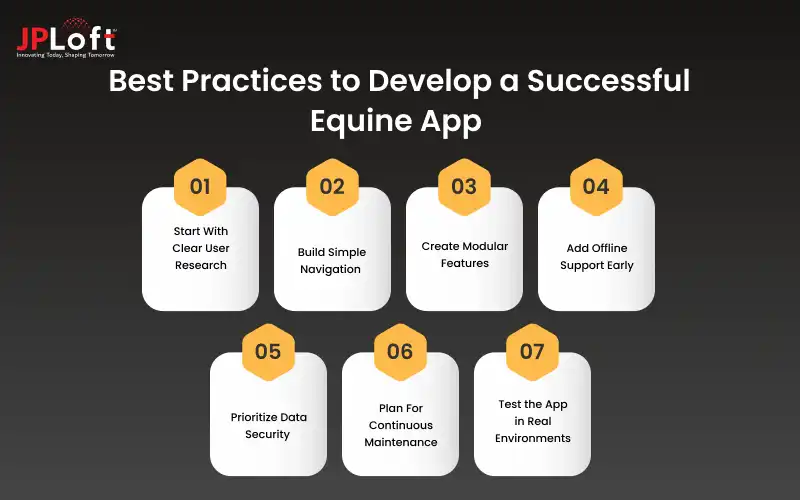
These best practices help companies create platforms that are easy to use, scalable, and reduce challenges while developing an equine app:
1. Start With Clear User Research
Equine apps serve owners, trainers, vets, riders, and stable managers. Each group needs different tools.
Begin the project with interviews and surveys to define features that matter most.
This ensures developers build an app that feels relevant and useful from day one.
2. Build Simple Navigation
Many users prefer straightforward layouts. Avoid designing challenges while building an equine app, like complicated menus or hidden actions.
Keep icons readable and screens clean. A simple flow improves daily adoption and helps non-technical users complete tasks with ease.
3. Create Modular Features
Equine operations cover health tracking, scheduling, training logs, payments, and stable tasks.
Hire mobile app developers to break these into separate modules so teams can update or extend each area without interrupting the entire system. Modular design also reduces long-term maintenance costs.
4. Add Offline Support Early
Stables often have weak network coverage. Offline mode should be part of the first development phase, not an add-on.
Let users record notes, upload images, and update schedules without the internet. Sync automatically when the network returns.
5. Prioritize Data Security
Equine apps store medical histories, ownership papers, invoices, and personal details. Use encrypted storage, secure login, permissions, and audit trails.
This builds trust and protects sensitive information across all user groups.
6. Plan For Continuous Maintenance
As the equine businesses grow, user expectations change. Set up regular updates based on user feedback, bug fixes, and features.
Update these improvements by the best mobile app maintenance service provider. This builds trust and protects sensitive information across all user groups.
7. Test the App in Real Environments
Before launch, conduct mobile app testing inside stables, training grounds, and outdoor areas.
This shows real usage patterns, identifies performance issues, and helps refine features for actual equine routines.

Why Choose JPLoft For Equine App Development?
Are you looking to launch a successful equine app? Then, you are at the right place.
With so many options in the market, you might be wondering who can be a great company to work with.
JPLoft is a trusted name delivering expert equine app development solutions tailored to riders, trainers, stables, and equine businesses worldwide.
With 15+ years of experience, we are often mentioned in the list of successful app developers for equine apps, trusted by businesses looking to build reliable and future-ready platforms.
Conclusion
An equine app supports tasks that must run smoothly, from health tracking to scheduling, payments, and stable management. When built with the right structure, they avoid development challenges of equine apps, operate faster, improve communication, and help users make better decisions for every horse.
The development journey comes with many equine app development challenges, but each of these also has a clear solution when teams follow best practices. Simple navigation, real-time updates, offline support, modular features, and secure data systems create a dependable app that grows with your business.
With the right approach to resolve top equine app development challenges, equine apps become powerful tools that reduce manual work and bring more clarity to daily routines. As the industry expands, investing in a well-planned app helps businesses stay competitive, deliver better services, and build long-term trust with their users.
FAQs
The equine industry is grappling with rising horsekeeping costs (50.3% of owners), limited land and vet access, welfare issues like neglect and high "wastage" rates, plus growing labor shortages. Together, these pressures are driving owners and businesses to adopt digital tools for smarter horse care.
The best way to avoid development challenges in equine apps is to use clear user research, modular features, simple navigation, offline support, strong data structures, real-time syncing, and secure storage. Testing in real stable environments and planning continuous maintenance also ensures long-term stability and performance.
You have to manage complex data, multiple user roles, real-time updates, offline access, large media files, scheduling conflicts, and security needs. These challenges require strong planning, structured modules, and reliable technologies to ensure smooth performance.
Custom apps match the exact needs of equine businesses. They offer personalized workflows, better user experience, stronger integrations, and long-term scalability. This helps companies stay competitive, deliver reliable services, and build trust with their clients.
Developers use clean layouts, large buttons, simple forms, and guided steps. Strong UI planning reduces confusion and helps trainers, owners, and staff complete tasks quickly without needing technical knowledge.

Kris Jacobs brings 20+ years of experience solving complex digital product challenges through strategic thinking and user-centric design. With deep exposure to on-demand services, entertainment, travel, and interactive platforms, she collaborates across teams to shape scalable, engaging solutions that align business goals with intuitive user experiences across evolving digital landscapes.





Share this blog