


Key Takeaways:
Develop an app like Walmart by combining in-depth market research, scalable architecture, secure development, testing, and continuous maintenance.
Development costs typically range from $20,000 to $70,000, based on features, platforms, and scalability.
Essential features include smart search, secure checkout, real-time inventory, order tracking, and AI recommendations.
Revenue comes from commissions, subscriptions, in-app ads, affiliate sales, and personalized offers.
AI personalization, AR shopping, voice commerce, omnichannel experiences, and smart analytics will shape the future of retail apps.
JPLoft delivers scalable, secure, and high-performance Walmart-style retail apps built for long-term success.
The global eCommerce market is expanding at an unprecedented pace, and mobile shopping apps are now at the heart of how people discover, compare, and buy products online.
This naturally leads many entrepreneurs and business owners to wonder, how to develop an app like Walmart that can effortlessly manage massive product catalogs, support real-time order tracking, and still deliver high performance?
The journey begins with understanding the user, validating the market, and building a strong technical foundation. Creating such a platform requires more than just coding, it calls for thoughtful market research, intuitive design, scalable architecture, and modern development strategies.
If you aim to build a retail shopping app like Walmart, this blog will walk you through the complete development roadmap, covering essential features, technology choices, and cost considerations to help you build a competitive and future-ready retail app.
What is the Walmart Retail App?
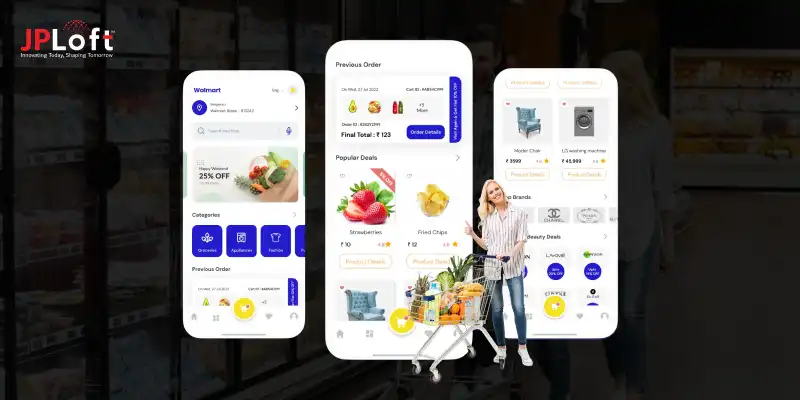
The Walmart retail app is more than just an online shopping platform, it’s a complete digital shopping companion built to simplify everyday purchases. From groceries and electronics to fashion and home essentials, users can browse millions of products, compare prices, and place orders within minutes.
What makes the Walmart app especially powerful is how smoothly everything works behind the scenes. When a user searches for a product, the app fetches real-time inventory, shows nearby store availability, and suggests delivery or pickup options.
Secure payment processing and live order tracking keep the entire journey transparent and stress-free.
For entrepreneurs looking to create a mobile app at enterprise scale, the Walmart retail app is a strong example of how intuitive design and seamless integrations come together to deliver a fast, reliable, and personalized shopping experience.
Why Should You Build an App Like Walmart ?
Today’s retail landscape is rapidly shifting toward mobile-first experiences, and customers expect speed, convenience, and personalization at every touchpoint. Apps like Walmart have proven how powerful a well-designed retail app can be in driving user engagement and long-term business growth.
This is why many businesses now look toward Walmart’s app model as a benchmark for success.
-
Proven and Scalable Retail Framework
When you develop a retail app like Walmart, you adopt a model that successfully manages huge product catalogs, heavy traffic, and high transaction volumes without performance issues.
-
Meeting the demand for mobile commerce
If you create an e-commerce app like Walmart, you align your business with the growing preference for in-app shopping, offering users faster access, smoother navigation, and better checkout experiences.
-
AI-driven personalization and efficiency
The role of AI in mobile app development is vital in Walmart-like apps, enabling smart recommendations, predictive analytics, inventory optimization, and enhanced customer engagement.
-
Clear development roadmap
Understanding how to build an app like Walmart helps businesses plan features, integrations, and scalability with clarity and confidence.
-
Room for innovation and new ideas
Walmart-style platforms inspire fresh mobile app ideas, such as hyperlocal delivery, subscription-based shopping, and AI-powered assistants.
Building a Walmart-like app is not just about copying features, it’s about adopting a future-ready retail strategy. With the right planning and technology, such an app can become a powerful growth engine.
For businesses aiming to stay competitive in modern retail, this approach offers both stability and endless expansion opportunities.
Key Features of an Retail App Like Walmart
When planning a large-scale shopping platform, features are one of the most important steps to create a shopping app like Walmart. They directly shape how users browse products, place orders, and return to your app again and again.
The right feature set doesn’t just improve usability, it builds trust, boosts conversions, and supports long-term scalability.
Whether you are choosing between a web app vs mobile app, these features remain the foundation of a smooth and high-performing retail experience.
|
Feature |
Description |
|
User Registration & Profiles |
Allows users to sign up via email, phone, or social login and manage personal details, addresses, and order history. |
|
Product Search & Smart Filters |
Enables fast product discovery using categories, filters, sorting, and AI-powered search suggestions. |
|
Product Details & Reviews |
Displays pricing, images, descriptions, ratings, and customer reviews to support informed buying decisions. |
|
Cart & Secure Checkout |
Provides a smooth checkout flow with multiple payment options and saved carts for convenience. |
|
Real-Time Inventory Management |
Shows livestock availability across warehouses and nearby stores to avoid order cancellations. |
|
Order Tracking & Notifications |
Keeps users informed with real-time updates on order status, delivery, and pickup progress. |
|
Multiple Delivery & Pickup Options |
Supports home delivery, curbside pickup, and in-store collection for added flexibility. |
|
AI-Powered Recommendations |
Suggests relevant products based on user behavior, search history, and preferences. |
|
Customer Support & Help Center |
Offers in-app chat, FAQs, and support tickets to resolve issues quickly. |
|
Admin Dashboard & Analytics |
Enables retailers to manage products, pricing, users, orders, and performance metrics efficiently. |
These features work together to deliver the speed, convenience, and reliability users expect from a Walmart-like platform. When thoughtfully implemented, they create a seamless shopping journey across devices.
Whether you start with a web app or prioritize a mobile experience, focusing on these core features sets the stage for scalable growth and long-term customer loyalty.
How to Develop an App Like Walmart – Step-by-Step Process
Many business owners exploring large-scale retail platforms often wonder how to develop an app like Walmart that delivers speed, scalability, and a seamless shopping experience for millions of users.
The truth is, if you want to build a clone like Walmart, it is not about rushing into development, it’s about following a structured, well-planned roadmap that aligns technology with real customer needs.
Before diving deep, here’s a quick look at the complete journey involved in the complete process to develop a retail app like Walmart:
-
Market research & business planning
-
Feature planning & architecture design
-
Mobile App Wireframing & Prototyping
-
Frontend and backend development
-
Mobile App Security Implementation
-
App Performance Testing
-
Smooth Deployment
-
Ongoing Maintenance
Now, let’s walk through each step in detail.
Step 1: Market Research & Business Strategy Planning
The foundation of any successful retail platform starts with understanding the market. Before you develop an app like Walmart, you need clarity on your target audience, competitors, pricing models, and unique value proposition.
At this stage, businesses analyze customer shopping behavior, study Walmart’s app flow, and identify gaps they can improve upon. This step also defines monetization strategies, logistics models, and regional expansion plans.
Without strong research, even the best-looking app can fail to gain traction. This planning phase ensures you don’t just make an app like Walmart, but build one that fits your specific business goals and market demand.
Step 2: Feature Mapping & Technical Architecture
This stage focuses on defining core and advanced features, product search, filters, checkout, order tracking, inventory sync, and admin dashboards. At the same time, teams plan the mobile app tech stack, deciding on frameworks, databases, APIs, and integrations.
For scalability, most enterprises opt for a cloud-based retail solution like Walmart, which supports high traffic, real-time updates, and flexible expansion. This architectural planning ensures the app performs smoothly during peak sales and seasonal spikes.
Whether you want to make an app like Walmart this step defines how robust and future-ready your platform will be.
Step 3: Mobile App Wireframing & Prototyping
Once the strategy is set, the next step is visual planning. Using mobile app wireframing, designers outline basic layouts, navigation structures, and user journeys. This helps stakeholders visualize how users will browse products, add items to the cart, and complete purchases.
After wireframes, mobile app prototyping brings those screens to life through clickable mockups. Prototypes help validate usability early, saving time and cost during development.
This step is especially important when you aim to build a retail shopping app like Walmart, where user experience directly impacts conversions.
Step 4: Frontend & Backend Development
This is where actual coding begins. Developers start implementing UI designs, business logic, databases, payment gateways, and third-party integrations. At this stage, companies often hire iOS developers and Android specialists to ensure platform-specific performance and native responsiveness.
During Walmart like app development, the frontend focuses on speed and usability, while the backend manages inventory, user data, order processing, and analytics.
Strong backend architecture is critical if you plan to create an app like Walmart that handles thousands of concurrent users.
Step 5: Mobile App Security Implementation
Mobile app security is the backbone of any retail shopping app like Walmart. Since your app will handle sensitive information such as user credentials, payment details, and order histories, it’s crucial to implement strong security measures from the ground up.
Start by using end-to-end encryption for data transmission and secure APIs for backend communication. Incorporate multi-factor authentication to protect user accounts and comply with regulatory standards such as PCI DSS for online payments.
Regular security audits and penetration testing also help identify vulnerabilities before they can be exploited. A secure app not only protects your users but also builds trust, which is essential for long-term success.
Step 6: App Performance Testing
Once the security framework is in place, thorough mobile app testing ensures your app runs smoothly across all devices and platforms. Conduct functional testing to verify that all features work as intended, and performance testing to monitor load times, speed, and responsiveness.
Usability testing helps identify any navigation issues or user experience gaps. Don’t forget compatibility testing for both iOS and Android, ensuring your retail app delivers a consistent experience across devices.
By combining automated and manual testing, you can catch potential bugs, crashes, and glitches before launch. Proper testing guarantees a seamless, crash-free, and highly reliable experience for users.
Step 7: Smooth Deployment
To successfully submit an iOS app to App Store and publish an app to Google Play Store, proper deployment planning is essential. After thorough testing, it’s time to release your retail shopping app like Walmart to production environments.
But launching is just the beginning. A well-executed deployment ensures your app reaches the right audience without glitches, supports high traffic volumes, and integrates seamlessly with backend systems.
For businesses aiming to build a retail shopping app like Walmart, deployment also involves configuring cloud-based solutions, server scaling, and analytics tools to monitor user engagement from day one.
Step 8: Ongoing Maintenance
Post-launch, continuous maintenance is key to long-term success. This includes bug fixes, security updates, OS compatibility adjustments, and feature enhancements. A reliable mobile app maintenance service ensures your app evolves with customer expectations, market trends, and technological advancements.
For those looking to develop a clone like Walmart or scale globally, maintenance also involves infrastructure upgrades, performance monitoring, and analytics-driven improvements.
By prioritizing maintenance, your app stays competitive, secure, and delivers a shopping experience that keeps users coming back.
To develop an app like Walmart successfully, you need more than inspiration, you need execution backed by strategy, technology, and continuous improvement.
Whether your vision is to replicate the model or innovate beyond it, following this step-by-step process ensures clarity, scalability, and long-term growth.
Tech Stack for Developing an App Like Walmart
Choosing the right technology stack is one of the most crucial steps when you aim to create an e-commerce app like Walmart. The tech stack determines your app’s performance, scalability, security, and overall user experience.
From frontend design to backend architecture, payment integration, and cloud solutions, each component plays a vital role in building a robust and reliable retail shopping app.
Here’s a breakdown of the essential technologies used in Walmart like app development:
|
Layer |
Technology / Tool |
Purpose |
|
Frontend (Mobile App) |
React Native, Flutter |
Build responsive, cross-platform mobile apps |
|
Backend |
Node.js, Java, Python |
Handle server-side logic, APIs, and database communication |
|
Database |
MySQL, MongoDB, PostgreSQL |
Store user data, product catalogs, and transaction history |
|
Cloud & Hosting |
AWS, Google Cloud, Azure |
Ensure scalability, high availability, and cloud-based retail solutions |
|
Payment Gateway |
Stripe, PayPal, Braintree |
Secure payment processing for multiple platforms |
|
Analytics & Tracking |
Google Analytics, Firebase, Mixpanel |
Monitor user behavior and app performance |
|
Security Tools |
OAuth 2.0, SSL, JWT |
Ensure data encryption, secure login, and user privacy |
|
Admin Panel / CMS |
Laravel, Django, WordPress |
Manage products, orders, inventory, and user management |
Selecting the right tech stack not only ensures your app performs seamlessly but also helps you build a custom app like Walmart that is scalable and future-ready.
By partnering with a reliable mobile app development company in UK, you can leverage expert guidance to choose the best technologies for your project.
How Much Does It Cost to Develop an E- Commerce App Like Walmart?
Many entrepreneurs often ask, “What will be the mobile app development cost if I want to make a clone like Walmart?” The cost depends on features, platform, design complexity, tech stack, and development team experience.
On average, building a Walmart-like retail app can range between $20,000 – $70,000, depending on whether you opt for basic functionality or a full-featured, scalable solution.
Understanding the cost distribution helps businesses plan budgets effectively and make an app like Walmart.
|
Development Stage |
Estimated Cost (USD) |
Description |
|
UI/UX Design |
$3,000 – $8,000 |
Wireframing, prototyping, and user interface design |
|
Frontend Development |
$5,000 – $15,000 |
Building the app’s mobile interface for iOS & Android |
|
Backend Development |
$7,000 – $20,000 |
Server-side logic, APIs, databases, cloud integration |
|
Testing & QA |
$2,000 – $7,000 |
Functional, performance, and security testing |
|
Deployment & Launch |
$1,000 – $5,000 |
Publishing on App Store & Google Play, server setup |
|
Maintenance & Updates |
$2,000 – $5,000 |
Bug fixes, feature upgrades, and OS compatibility |
While the initial investment may vary, focusing on quality, scalability, and user experience ensures your retail app like Walmart delivers a seamless shopping experience.
Proper budgeting and planning allow you to maximize ROI while building a competitive and future-ready retail app.
Monetization Models for an App Like Walmart
Monetization is a key aspect of building a successful retail app. Understanding how to generate revenue effectively ensures your Walmart-like app remains profitable while offering a seamless shopping experience.
Here are the top mobile app monetization strategies:
1. Commission-Based Model
Charge sellers a commission on each transaction processed through your app. This is ideal if your platform hosts multiple vendors or allows third-party sellers to list products.
2. Subscription Model
Offer premium memberships with exclusive deals, early access to sales, or free delivery. Users pay a recurring fee, ensuring predictable and steady revenue.
3. In-App Advertising
Integrate ads from third-party platforms or partner brands. Targeted advertising can increase revenue without compromising user experience if implemented carefully.
4. Freemium Model
Provide basic app functionality for free while offering advanced features or personalized shopping experiences for a fee.
5. Affiliate Marketing
Promote products from other brands within your app and earn a commission for every sale made through your referral links.
6. Data-Driven Offers
Leverage analytics to deliver personalized deals, cross-selling, and upselling opportunities, boosting average order value and customer retention.
By carefully choosing and combining these monetization models, businesses can generate consistent revenue while keeping users engaged and satisfied.
Challenges in Developing a Retail App Like Walmart
Many entrepreneurs ask, “What are the key challenges when I try to create a retail app like Walmart while complying with regulations?” Developing a large-scale retail app comes with several hurdles:
► Complex Architecture: Handling millions of users, product catalogs, and transactions requires scalable and efficient backend systems.
► US Compliance in Mobile App Development: Adhering to data privacy laws like CCPA, PCI DSS for payments, and other regional regulations is crucial to avoid legal issues.
► Payment Integration & Security: Securely processing payments across multiple gateways while ensuring user trust is a major challenge.
► Cross-Platform Compatibility: Ensuring consistent performance across iOS, Android, and web apps demands careful planning, development, and testing.
► User Experience & Performance: Maintaining fast load times, seamless navigation, and glitch-free checkout while scaling up can be difficult.
► Maintenance & Upgrades: Post-launch updates, bug fixes, and feature enhancements are continuous responsibilities that require dedicated resources.
Despite these challenges, proper planning, experienced developers, and robust infrastructure can help you create a clone like Walmart that is secure, scalable, and user-friendly.
Future Trends to Create an App Like Walmart
To stay competitive, it’s crucial to anticipate the future of retail apps and adopt trends that enhance user experience.
Here are the emerging directions for businesses aiming to build a super app like Walmart:
A] Augmented Reality (AR) Shopping
AR allows users to visualize products in real-world environments before making a purchase.
This immersive experience enhances customer confidence, reduces return rates, and bridges the gap between online and in-store shopping.
B] AI-Powered Personalization
Artificial intelligence is transforming how retail apps interact with users. From personalized product recommendations and dynamic pricing to demand forecasting and predictive inventory management, AI drives smarter decision-making.
By leveraging a reliable AI app development service, businesses can deliver highly tailored shopping experiences that increase engagement and improve conversions.
C] Voice Commerce & AI Chatbots
Voice-enabled search and AI-powered chatbots simplify product discovery and customer support.
These tools provide instant assistance, faster queries, and hands-free shopping experiences, especially useful for busy users.
D] Omnichannel Integration
Seamless integration across mobile apps, websites, physical stores, and social commerce platforms ensures a unified shopping journey.
This approach improves customer retention and brand consistency across all touchpoints.
E] Sustainable & Ethical Commerce Features
Modern consumers value transparency and sustainability.
Retail apps can highlight eco-friendly products, display ethical sourcing details, and support responsible shopping decisions.
F] Advanced Analytics & IoT Integration
Combining real-time analytics with IoT devices helps optimize inventory tracking, supply chain management, and delivery operations. It helps in improving efficiency and reducing operational costs.
By adopting these future-focused trends, businesses can create retail apps that not only compete with Walmart but also deliver a smarter, more engaging, and customer-centric shopping experience built for long-term success.

JPLoft: Your Technology Partner for Walmart-Style Retail Apps
Choosing the right development partner plays a crucial role in the success of any large-scale retail application. JPLoft is a trusted mobile app development company in USA with proven expertise in building scalable, high-performance retail applications.
With a deep understanding of complex eCommerce ecosystems, we help businesses design, develop, and launch feature-rich Walmart-like apps that deliver seamless shopping experiences.
From market research and UI/UX design to backend development, cloud integration, and post-launch support, we follow a structured and transparent development approach.
The team focuses on performance, security, and scalability, ensuring your app can handle large product catalogs, high user traffic, and real-time operations without compromise.
Whether you’re launching a new retail platform or upgrading an existing one, JPLoft combines technical excellence with business-focused strategies to deliver solutions that drive growth, user engagement, and long-term success in the competitive retail market.
Final Wrap-Up
Building a large-scale retail platform requires more than just an idea, it demands strategic planning, the right technology, and a future-ready approach.
This guide has covered everything you need to develop an app like Walmart, from features and development steps to cost, challenges, and future trends.
With the right roadmap and execution, businesses can create a powerful retail ecosystem that delivers seamless shopping experiences, scales effortlessly, and stays competitive in today’s fast-evolving digital commerce landscape.
FAQs
To develop an app like Walmart, you need market research, user-centric UI/UX design, scalable backend architecture, secure payment integration, testing, and continuous maintenance.
Core features include product search, smart filters, secure checkout, real-time inventory, order tracking, AI-powered recommendations, and customer support.
The development cost typically ranges between $20,000 and $70,000, depending on features, platforms, tech stack, and development complexity.
Revenue models include commissions, subscriptions, in-app advertising, affiliate marketing, and personalized data-driven promotions.
AI personalization, AR shopping, voice commerce, omnichannel integration, and super app ecosystems are key future trends.

Priyanka Sukhwal is the Managing Director and Business Head of JPLoft, a results-driven leader with 10+ years of experience steering technology ventures and business growth. Her strategic acumen and deep understanding of digital markets and on-demand solutions have consistently translated into innovations that help businesses scale, evolve, and lead in competitive landscapes.




Share this blog