


Key Takeaway
Steps to build a karaoke app require clear planning, right tech stack, UI design, development, testing, launch, and maintenance.
Core features like song libraries, lyric sync, voice recording, and social sharing are essential for user engagement and retention.
The karaoke app development cost typically ranges between USD 15,000 and USD 100,000+, depending on features and complexity.
Monetization strategies such as subscriptions, in-app purchases, ads, and virtual gifting help generate consistent revenue streams.
Future trends like AI voice enhancement, AR/VR experiences, and live streaming will shape the next generation of karaoke apps.
Partnering with JPLoft ensures full karaoke app development support, helping you launch a scalable, feature-rich platform.
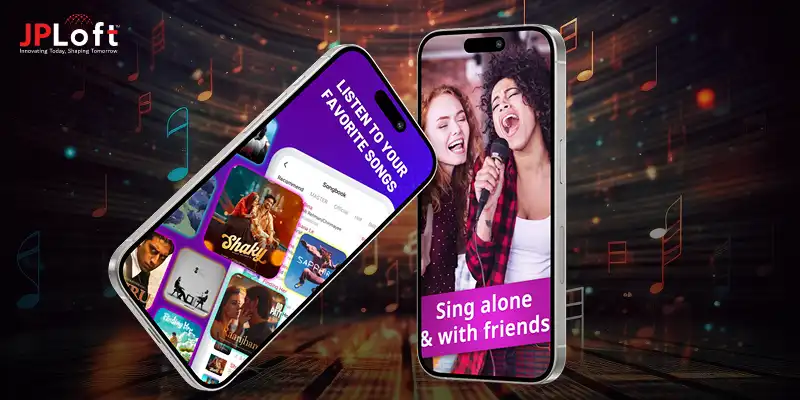
Music brings people together, and karaoke takes that experience to a whole new level. Turning music lovers into their idol singers and performers. Today, karaoke apps are more than just entertainment tools. They are social platforms where users can sing, record, share, and even build a fan base.
With the growing demand for interactive and engaging mobile experiences, building a karaoke app has become a promising opportunity. But creating a successful karaoke app goes beyond adding songs and recording features.
Building a karaoke app requires smart planning, the right technology, and a deep understanding of user expectations. From real-time audio processing to social sharing and monetization, every feature plays a key role in the app’s success.
In this blog, you will learn how to build a karaoke app step by step, including essential features, development process, and tips to stand out in a competitive market.
What is a Karaoke App and How Does It Work?
A karaoke app is an application that allows users to sing along with their favorite songs using instrumental tracks and on-screen lyrics. It transforms a simple singing experience into an interactive activity.
Offering audio recording app features, real-time audio processing, and social sharing. These apps are designed for both casual users who enjoy singing for fun and aspiring artists who want to showcase their talent.
Karaoke app development allows users to browse a library of songs, select a track, and sing along while reading synchronized lyrics displayed on the screen. Building a music streaming app with advanced features also includes pitch correction, voice enhancement, and duet options, making the experience more engaging and personalized.
How Does a Karaoke App Work?
The process of how karaoke apps work is through a combination of audio processing, cloud storage, and user interface design.
-
Song Selection: Users choose a song from the app’s database, which includes licensed instrumental tracks and synced lyrics.
-
Real-Time Playback: The app plays the music while displaying lyrics in sync, guiding users as they sing.
-
Voice Recording: The user’s voice is recorded through the device’s microphone during the performance.
-
Audio Processing: The app enhances the recording using filters like echo, reverb, and pitch correction.
-
Saving & Sharing: Users can save their performances and share them on social platforms or within the app community.
Why Invest in Karaoke App Development?
If you create a karaoke app, it offers a strong investment opportunity due to its growing market size, high user engagement, and multiple revenue streams. With increasing demand for social, interactive, and AI-powered entertainment, businesses are building future-ready digital apps.
1. Rapidly Growing Market Size
The global karaoke app market was valued at over USD 7.5 billion in 2025 and is expected to reach nearly USD 19.8 billion by 2035, growing at a CAGR of around 10%. This steady growth shows strong potential for long-term investment to develop a karaoke app.
2. Massive Mobile First User Base
Around 80% of users use mobile devices to access karaoke apps, making it a mobile-dominated market.
Additionally, more than 59% of downloads come from smartphones, highlighting strong demand for on-the-go entertainment.
3. Rising Popularity Among Gen Z and Millennials
Karaoke apps are especially popular among younger audiences. Over 65% of users of an average karaoke app are under 35 years old. This ensures a long-term, tech-savvy user base with high engagement potential.
4. High User Engagement and Retention
Karaoke apps drive consistent engagement, with an average daily usage of over 61% of users, engaging in singing activities. A karaoke app with live streaming features, duets, and gamification significantly improves user retention in music apps.
Core Features of a Karaoke App
A successful karaoke app depends on features that keep users engaged and entertained. The right set of music app features can transform a basic app into a highly interactive and revenue-driven platform.
Here is the list of more important features of karaoke app development:
|
Feature |
Description |
Benefit |
|
Song Library |
A collection of licensed songs with instrumental tracks and synced lyrics. |
Attracts users by offering variety and keeps them engaged longer. |
|
Search & Filters |
Allows users to find songs by genre, artist, language, or popularity. |
Improves user experience and increases app usability. |
|
Lyrics Synchronization |
Displays real-time lyrics in sync with the music. |
Ensures smooth singing experience, boosting user satisfaction. |
|
Voice Recording |
Records user performances using the device microphone. |
Enables content creation, increasing user interaction. |
|
Audio Effects |
Adds filters like echo, reverb, and pitch correction. |
Enhances performance quality, making users more likely to share content. |
|
Video Recording |
Records video along with audio during performances. |
Supports short-form content creation, increasing engagement. |
|
Duet & Collaboration |
Allows users to sing with friends or other users remotely. |
Builds community and encourages repeat usage. |
|
Social Sharing |
Let users share performances on social media or within the app. |
Drives organic growth and user acquisition. |
|
User Profiles |
Provides personalized profiles with saved recordings and followers. |
Encourages long-term engagement and user retention. |
|
Like, Comment, Follow |
Social interaction features within the app. |
Creates a community-driven platform that boosts engagement. |
|
Leaderboard & Rewards |
Ranks users based on performance and engagement. |
Gamifies the experience and motivates users to stay active. |
|
Offline Mode |
Allows users to download songs and sing without the internet. |
Expands usability and improves user convenience. |
|
In-App Purchases |
Offers premium songs, features, or subscriptions. |
Generates revenue and supports the monetization strategy. |
|
Cloud Storage |
Saves recordings securely on the cloud. |
Ensures data safety and seamless access across devices. |
Step-by-Step Process to Build a Karaoke App
Working on how to create a karaoke app requires a structured approach that blends user experience, technology, and business strategy. By following a structured development process, your app delivers a great user experience and business growth.
Below are the steps to develop a karaoke app that is easily scalable and highly engaging:
Step 1: Define Your App Concept and Conduct Market Research
Start by identifying your app’s purpose, target audience, and unique value. Decide whether your karaoke app features will focus on entertainment, social interaction, or professional singing. Analyze top karaoke apps to understand their strengths, weaknesses, and user feedback.
This research helps you refine your idea to build music streaming karaoke app and validate demand. It also positions uniquely in a competitive market while reducing the chances of failure of the music app.
Step 2: Design UI/UX for Engagement
Create an intuitive and visually appealing music streaming app design that enhances user experience. Ensure smooth navigation for browsing songs, reading lyrics, and recording performances.
Focus on simplicity, responsiveness, and accessibility. A strong UI/UX design reduces user friction, increases engagement, and encourages users to spend more time on your app while improving overall satisfaction.
Step 3: Select the Right Tech Stack
Choose the right music streaming app tech stack that matches your app’s needs. Use frameworks like Flutter or React Native for cross-platform development. For the backend, consider Node.js or Python, and integrate cloud services for storage.
The best tech stack for karaoke app ensures smooth functionality, faster development, and the ability to scale as your user base grows steadily.
Step 4: Acquire Music Licensing and Legal Requirements
Secure proper licenses to use songs and their instrumental versions legally. Partner with music labels, distributors, or licensing agencies to avoid copyright issues.
Ensure full compliance with music copyright laws, data protection regulations, and regional policies. Legal compliance protects your app from penalties, builds user trust, and ensures smooth operations across different markets.
Step 5: Develop Core Features
Begin with essential features of karaoke app development like song selection, synchronized lyrics, voice recording, and audio effects. Ensure real-time processing and smooth playback.
Enhance your app by adding advanced features like AI voice tuning, duet mode, live streaming, and leaderboards. These karaoke app features improve engagement and differentiate your app from competitors.
Step 6: Test the App Thoroughly
Perform rigorous testing to ensure your app functions smoothly across devices and platforms. Check audio quality, synchronization, and user flows.
Use manual and automated testing methods to identify bugs. Thorough testing improves performance, reduces crashes, and ensures a reliable experience, which is essential for gaining user trust and positive reviews.
Step 7: Launch and Market Your
Publish your app on the App Store and Google Play Store. Use marketing strategies such as social media promotion, influencer collaborations, and app store optimization.
The right strategy to get your music app approved on App Store helps you reach your target audience quickly. It helps generate downloads and build initial momentum for your karaoke app in a competitive marketplace.
Step 8: Monitor Performance and Scale
After launch, track key performance metrics, including user engagement, retention, and revenue. Collect feedback to identify improvement areas. Regular music app maintenance, updates, and feature enhancements keep users interested.
As your user base grows, scale your infrastructure to maintain performance. Continuous monitoring ensures music app security and long-term success and helps your karaoke app stay competitive.
Cost to Build a Karaoke App
The cost to develop a karaoke app typically ranges between USD 15,000 to USD 100,000+. The cost depends on the complexity of the app, features, and development approach. A basic app with essential features costs less compared to a feature-rich, scalable platform.
Below is the breakdown for karaoke app development cost for better budget planning:
|
Development Stage |
Estimated Cost (in USD) |
Description |
|
Planning & Research |
$1,000 – $5,000 |
Market research, competitor analysis, and feature planning. |
|
UI/UX Design |
$2,000 – $8,000 |
Wireframes, user flows, and interactive interface design. |
|
Frontend Development |
$3,000 – $20,000 |
Building user-facing features for iOS and Android platforms. |
|
Backend Development |
$3,000 – $18,000 |
Server, database, APIs, and cloud integration. |
|
Audio Processing Integration |
$2,000 – $10,000 |
Real-time recording, syncing lyrics, and adding audio effects. |
|
Music Licensing |
$2,000 – $15,000+ |
Legal rights to use songs and instrumental tracks vary widely. |
|
Testing & QA |
$1,000 – $7,000 |
Bug fixing, performance testing, and quality assurance. |
|
Deployment & Launch |
$500 – $3,000 |
App store setup, deployment, and initial launch support. |
Build an MVP for a music app to reduce the initial cost to develop a karaoke app, then gradually add advanced features based on user feedback and market demand.
Estimated Development Cost based on App Complexity
1. Basic App/MVP:
-
Features: Song library, lyrics sync, voice recording, and basic UI.
-
Development Time: 2 to 3 months
-
Estimated Cost in USD: $15,000 – $30,000
2. Mid-Level App:
-
Features: Audio effects, social sharing, user profiles, and better UI/UX.
-
Development Time: 3 to 5 months
-
Estimated Cost in USD: $30,000 – $70,000
3. Advanced App:
-
Features: Karaoke app with live streaming features, AI voice enhancement, duet mode, cloud scalability, and monetization.
-
Development Time: 5 to 7 months+
-
Estimated Cost in USD: $80,000 – $100,000+
Monetization Strategies for Karaoke Apps
Turning your music app idea for karaoke into a profitable business requires a mix of smart monetization models that balance user experience and revenue generation. A successful karaoke app often combines multiple monetization strategies rather than relying on one.
Below are the most effective karaoke app monetization strategies:
[A] Freemium Model
The freemium model offers basic features for free while charging users for advanced functionalities. Premium features like exclusive songs, HD recording, or advanced audio effects are unlocked through payment.
Revenue Source: Particular feature purchase or one-time purchases for premium upgrades.
[B] Subscription Plans
If you make a karaoke app with a recurring revenue model where users pay monthly or yearly fees for full access. Users subscribe to enjoy an ad-free experience, unlimited songs, and exclusive features like duet mode or AI voice enhancement.
Revenue Source: Monthly or annual subscription fees.
[C] Advertisements
Another common music app monetization model is to display ads to users and earn revenue based on impressions or clicks. You can integrate banner ads, interstitial ads, or rewarded video ads where users watch ads to unlock songs or features.
Revenue Source: Ad networks pay per impression, click, or completed view.
[D] Virtual Gifting and Live Streaming
Social-driven karaoke app monetization strategies where users earn through audience interaction. During live performances, viewers can send virtual gifts that can be converted into real money or rewards for performers.
Revenue Source: Commission on virtual gift purchases.
[E] Paid Song Licensing or Premium Content
Charges users for access to exclusive or high-demand content. Offer trending songs, regional music, or new releases as paid content that users can unlock individually or through premium packs.
Revenue Source: Pay-per-song or bundled content purchases.
[F] Brand Partnerships and Sponsorships
Collaborate with brands to promote their products after you create a karaoke app. Run sponsored singing contests, branded challenges, or feature partner content inside the app.
Revenue Source: Sponsorship deals and brand collaborations.
Challenges in Karaoke App Development and How to Solve Them
Working on how to develop a karaoke app is exciting and very popular. But it comes with several technical and business challenges. Addressing these early can save the music app development time, cost, and user frustration.
Below are the key challenges to build a karaoke app and a practical solution to resolve them:
[1] Music Licensing and Copyright Issues
Challenges: Securing legal rights for songs across regions is complex, expensive, and time-consuming. Especially when dealing with multiple copyright holders and licensing agreements globally.
Solution: Partner with licensing agencies or music distributors to streamline rights management and ensure music streaming app compliance across different regions efficiently.
[2] Real-Time Audio Synchronization
Challenges: Maintaining perfect sync between music, lyrics, and user voice recording is technically challenging. Different devices, networks, and latency conditions generally exhibit this phenomenon.
Solution: Use advanced audio processing APIs and optimize buffering techniques during the karaoke app development process. It ensures smooth, real-time synchronization with minimal latency issues.
[3] High-Quality Audio Processing
Challenges: Delivering clear sound with effects like pitch correction and reverb requires strong processing power, which can impact app performance on low-end devices.
Solution: Integrate lightweight audio processing libraries and offload heavy processing tasks to cloud servers to maintain performance across devices.
[4] Monetization Balance
Challenges: Excessive ads or paywalls can frustrate users, while limited monetization may impact revenue generation and the sustainability of the karaoke app business model.
Solution: Adopt a balanced freemium approach with optional ads and valuable premium features of karaoke app development to maintain user satisfaction and steady revenue streams.
[5] Scalability Issues
Challenges: Handling large user traffic, real-time recordings, and media storage can strain servers, leading to slow performance, crashes, or downtime during peak usage.
Solution: Use scalable cloud infrastructure with auto-scaling capabilities to handle traffic spikes and maintain consistent app performance during high usage periods.
[6] Data Storage and Management
Challenges: Managing large volumes of audio and video recordings requires significant storage capacity, efficient retrieval systems, and secure data handling practices for users.
Solution: Implement cloud storage solutions with compression techniques and efficient database structures to optimize storage and retrieval processe
Future Trends in Karaoke App Development
The future of karaoke apps is driven by AI, social interaction, and immersive technology. Businesses that adopt these music streaming app trends early will gain a strong competitive advantage in this rapidly growing market.
Below is the list of the most popular future trends in karaoke app development:
1. AR/VR-Based Immersive Karaoke
AR/VR is creating immersive singing environments with virtual stages, lighting effects, and audience simulations. Partnering with an experienced AR/VR app development company will redefine home entertainment by offering concert-like experiences.
2. AI-Powered Voice Enhancement and Personalization
AI features in music streaming app like karaoke enable real-time pitch correction, voice modulation, and personalized song recommendations. Future apps will offer highly personalized singing experiences based on voice type, mood, and music preferences.
3. Live Streaming and Social Karaoke Experiences
Live streaming is becoming a core feature, allowing users to perform in front of global audiences. Future platforms will focus more on real-time engagement, creator and fan interaction, type of karaoke app monetization strategies.
4. Real-Time Duet and Global Collaboration
Collaborative singing is gaining traction, with users increasingly preferring duet and group performances.
Future apps will enable seamless global collaborations with minimal latency and enhanced sync.
5. AI-Based Song Generation and Vocal Removal
You can make a karaoke app leveraging AI tools to convert any song into a karaoke track by removing vocals automatically. New solutions can generate AI custom music and backing tracks instantly, opening new creative possibilities.
6. Multilingual and Regional Content Expansion
With growing global adoption, apps are expanding into regional and multilingual content. Future apps will include real-time lyrics translation and pronunciation support for global audiences.
From Idea to Launch: Build Your Karaoke App with JPLoft
Turning your karaoke app idea into a successful product requires the right strategy, technology, and development partner. With JPLoft, you get end-to-end support to transform your vision into a feature-rich and scalable application.
From initial concept validation to final deployment, our team ensures every stage is handled with precision and clarity. JPLoft, an expert music app development company, focuses on building user-friendly interfaces, seamless audio experiences, and engaging social features that keep users coming back.
We also ensure smooth integration of cloud storage, real-time processing, and secure payment systems.
Whether you need a basic MVP or a fully advanced karaoke platform with AI effects, live streaming, and monetization capabilities, we tailor soUSD 19.8 billion by 2035lutions to match your business goals. Our developers use modern technologies to deliver high-performance apps across iOS and Android platforms.
Partner with JPLoft to accelerate your development journey and launch a karaoke app that stands out in a competitive market while driving long-term user engagement and revenue growth.
Conclusion
Learning how to build a karaoke app is a strategic opportunity to become a part of the growing demand for interactive and social entertainment platforms. From defining your concept to selecting the right technology stack for advanced features and monetization, every step is important for success.
A well-designed karaoke app goes beyond basic singing features by offering engaging experiences through AI, social integration, and seamless performance. However, success depends on balancing user experience with scalability, performance, and legal compliance.
Starting with a focused MVP and gradually expanding based on user feedback can help reduce risks and optimize investment. As karaoke app with live streaming features, AI voice enhancement, and other technologies grow, businesses that innovate and adapt quickly will stand out in the market.
With the right approach, your karaoke app can evolve into a powerful platform that attracts users, drives engagement, and generates sustainable revenue.
FAQs
Start by defining your target audience and features. Conduct market research, design UI/UX, choose the right tech stack, and secure music licenses. Develop core features, test thoroughly, and launch with a strong marketing strategy for growth.
A karaoke app includes a song library, lyrics synchronization, voice recording, and audio effects. It also offers social sharing, user profiles, duet options, and leaderboards. These features enhance user engagement and create an interactive singing experience.
The cost to develop a karaoke app ranges between USD 15,000 and USD 100,000+. It depends on features, design complexity, platform choice, and development team location. Advanced features like AI voice effects and live streaming increase the overall cost.
Revenue can be generated through subscriptions, in-app purchases, and advertisements. You can also offer premium songs, virtual gifting, and brand partnerships. Combining multiple monetization strategies helps maximize revenue while maintaining a smooth user experience.
Karaoke apps have a growing market, high user engagement, and strong monetization potential. Increasing demand for social and interactive entertainment makes them a profitable investment. With the right features, businesses can build scalable platforms and attract long-term users.

Conor has 10+ years of experience in software development, application engineering, solution design, and UX/UI. He has worked across digital products in restaurant technology, food and grocery delivery, healthcare, media, streaming, and social platforms, bringing both technical and user-experience perspectives to product development. His experience working with large organizations and growth-focused digital products helps businesses translate complex requirements into practical, user-focused solutions.


Share this blog