


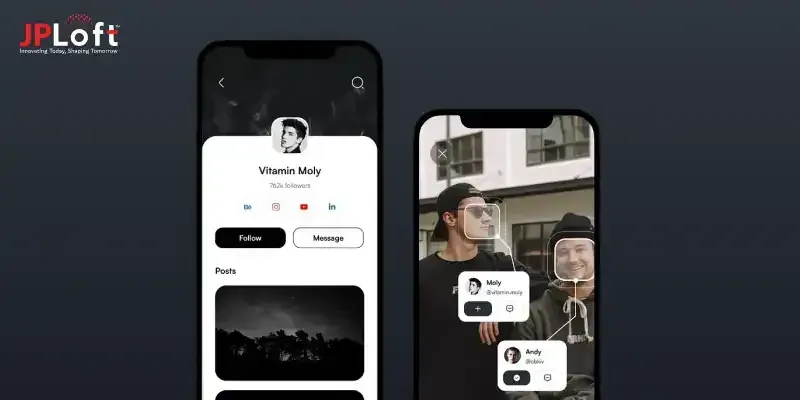
Key Takeaways
Immersive technology transforms social platforms into interactive and engaging ecosystems that go beyond traditional content.
Platforms like Snapchat, Instagram, TikTok, and Meta Horizon Worlds demonstrate how AR/VR drives creativity, interaction, and stronger community engagement.
Successful immersive apps require a structured approach combining UX design, backend architecture, and specialized AR/VR development expertise.
Scalable infrastructure, AR/VR engines, AI, and cloud-native architecture form the backbone of high-performing immersive social platforms.
Addressing technical, UX, and privacy challenges with careful planning, testing, and user-focused design ensures long-term adoption and success.
Partnering with experienced teams like JPLoft helps bring immersive ideas to life with innovative features, reliable execution, and future-ready social platforms.
Social platforms are evolving beyond likes, shares, and scrolling feeds into fully immersive digital experiences.
From virtual hangouts to interactive filters and digital avatars, AR/VR in social media apps is redefining how people connect, communicate, and express themselves online.
This shift isn’t just about innovation; it’s about creating deeper emotional engagement and more meaningful digital interactions.
As immersive experiences become mainstream, immersive technology in social media is transforming user expectations, pushing platforms to offer more presence, realism, and personalization.
This blog explores how AR and VR are shaping social platforms, their real-world impact, and what it takes to build the next generation of immersive social media experiences.
What is AR/VR Integration in Social Platforms?
AR/VR integration in social platforms refers to embedding immersive digital experiences directly into everyday social interactions.
Instead of static feeds and flat content, users can engage with interactive filters, 3D environments, virtual spaces, and real-time augmented layers that blend the digital and physical worlds.
This shift allows people to communicate, share, and connect in more expressive and emotionally engaging ways than traditional social formats.
Modern platforms are no longer just communication tools; they’re becoming experiential ecosystems.
Many of the best social media apps, such as Instagram, TikTok, and Snapchat, now use intelligent systems to personalize immersive experiences. These systems adapt content in real time, and create context-aware interactions that feel natural rather than forced.
As augmented reality social media apps and VR-powered features evolve, social platforms are transforming into shared digital spaces where presence matters as much as content.
This evolution is also supported by AI in social media, which helps personalize experiences, improve interaction quality, and make immersive features more accessible to everyday users.
Together, AR, VR, and AI are shaping a new generation of social platforms that focus on engagement, presence, and meaningful digital connection, not just content consumption.
Use Case of AR/VR in Social Media Apps
AR and VR are no longer experimental features; they are becoming core engagement drivers that reshape how users interact, create, and connect on social platforms.
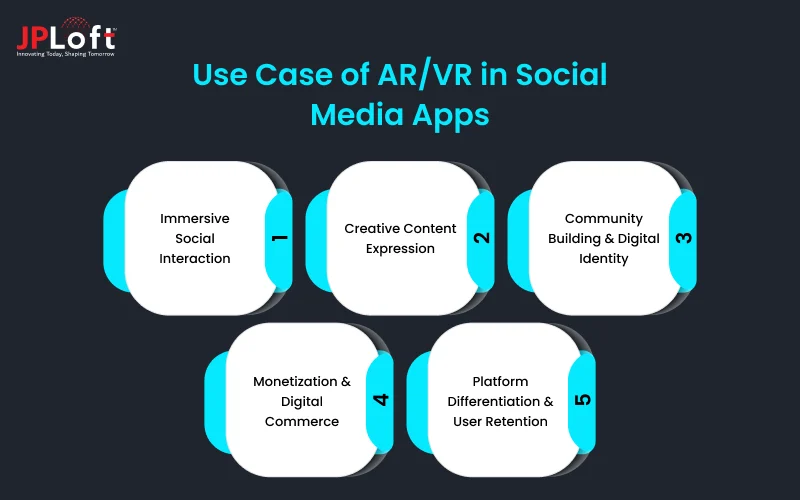
Below are the most impactful real-world use cases where immersive experiences are transforming digital social ecosystems.
1. Immersive Social Interaction
AR and VR enable real-time shared experiences like virtual meetups, digital hangouts, and interactive environments where users feel present together, not just connected.
This transformation creates a social media app with AR VR that feels more human, more personal, and more emotionally engaging than traditional chat-based or feed-based platforms.
2. Creative Content Expression
Immersive tools empower users to create 3D content, interactive filters, avatars, and spatial stories that go beyond static photos and videos.
These experiences expand creative freedom while driving the benefits of AR VR in social media by making self-expression more engaging, personalized, and identity-driven in digital communities.
3. Community Building & Digital Identity
AR/VR helps form communities around shared virtual spaces, experiences, and interests instead of just content.
From virtual fan zones to digital events, these ecosystems also inspire new social media app ideas that focus on belonging, interaction, and immersive participation rather than passive scrolling.
4. Monetization & Digital Commerce
Immersive environments create new revenue streams through virtual goods, experiences, branded spaces, and interactive advertising.
This evolution reshapes the way social media apps make money by shifting monetization from traditional ads toward experiential commerce and digital ownership models within immersive social ecosystems.
5. Platform Differentiation & User Retention
Unique immersive experiences help platforms stand out in competitive markets while increasing user loyalty.
By integrating intelligent design with immersive functionality, platforms can enhance features of AR VR social media apps alongside core social media app features, creating experiences users don’t want to leave.

Real-World Examples of AR/VR in Social Media
Global platforms are already using immersive technology to reshape how users connect, create, and socialize.
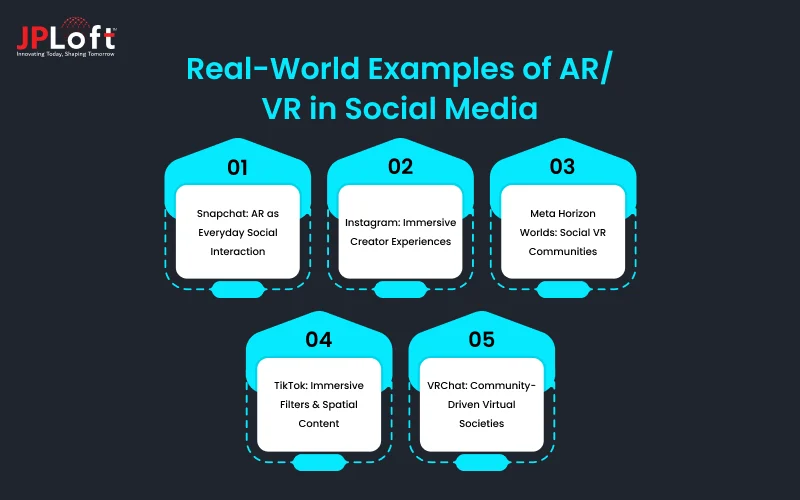
These real-world implementations show how AR and VR are no longer experimental concepts; they’re actively redefining social engagement, content creation, and community interaction across mainstream platforms.
1. Snapchat: AR as Everyday Social Interaction
Snapchat transformed casual communication through AR lenses, filters, and spatial effects that users interact with daily. This sets the benchmark for apps like Snapchat in immersive social engagement.
Snapchat’s immersive camera experience reflects the real-world adoption of AR and VR social media trends, where immersive content becomes part of normal social behavior rather than a novelty feature.
2. Instagram: Immersive Creator Experiences
Instagram’s AR effects, interactive stories, and immersive content formats allow creators to build deeper emotional connections with audiences. This creates a strong foundation for brands looking to develop an app like Instagram.
These experiences demonstrate how virtual reality in social media is influencing engagement design, even in platforms traditionally focused on visual content and short-form interactions.
3. Meta Horizon Worlds: Social VR Communities
Meta’s Horizon Worlds enables users to meet, socialize, and build communities inside shared virtual spaces.
This platform shows how immersive environments can create persistent social ecosystems, reflecting evolving social media app development trends that prioritize presence, interaction, and shared digital experiences.
4. TikTok: Immersive Filters & Spatial Content
TikTok integrates AR-powered effects, motion tracking, and spatial filters into content creation, making immersive storytelling accessible to everyday users. This makes it especially valuable for businesses aiming to develop an app like TikTok.
This approach shows how immersive tech can scale across mass platforms without requiring specialized devices or complex onboarding.
5. VRChat: Community-Driven Virtual Societies
VRChat demonstrates how fully immersive social platforms can create digital societies, economies, and identities.
At the same time, platforms that fail to balance UX, accessibility, and scalability reveal why social media apps fail when immersive innovation lacks a strong product strategy.
How to Build an AR/VR Social Media App?
A successful approach to how to build AR VR social media app solutions requires structured planning, strong technical foundations, and sustainable business thinking.
This process ensures the platform is not only innovative but also usable, scalable, and commercially viable.
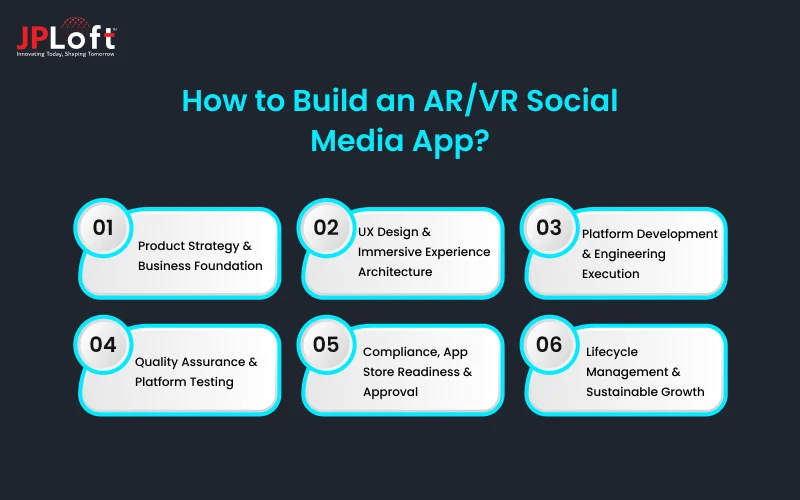
Here is the step-by-step following which you can build an AR/VR social media app efficiently.
Step #1: Product Strategy & Business Foundation
The creation of a successful immersive platform begins with clarity of vision, audience definition, and long-term growth planning.
A strong foundation connects user needs with business goals and platform purpose. This phase defines positioning, market relevance, and value creation while shaping the future roadmap.
It also sets the structural direction for how to build AR VR social media app solutions that scale sustainably.
For founders, aligning vision with execution strategy is essential when learning how to start a social media business.
It ensures immersive innovation is supported by real commercial viability, market differentiation, and long-term platform sustainability across evolving digital ecosystems.
Step #2: UX Design & Immersive Experience Architecture
Experience design determines whether immersive platforms feel intuitive or overwhelming.
Spatial interfaces, interaction flows, and usability must work naturally across devices and environments.
This stage translates user intent into immersive journeys that feel human, accessible, and emotionally engaging. Applying principles from how to design a social media app ensures intuitive navigation, clear interaction logic, and inclusive design systems.
Effective immersive UX design removes friction, builds trust, and supports long-term engagement.
A well-structured experience layer transforms complex AR/VR systems into simple, enjoyable interactions that users understand instantly, driving adoption, retention, and emotional connection.
Step #3: Platform Development & Engineering Execution
Strong engineering architecture ensures stability, performance, and scalability across immersive systems. Development includes backend infrastructure, real-time processing, spatial rendering, and system integrations.
Structured workflows inspired by how to create a social media app principles help teams manage complexity while maintaining reliability.
To execute advanced immersive systems effectively, many organizations hire mobile app developers with specialized AR/VR expertise and platform engineering experience.
The right technical talent ensures seamless integration, secure data handling, scalable architecture, and long-term maintainability, allowing immersive platforms to evolve without sacrificing performance, reliability, or user trust.
Step #4: Quality Assurance & Platform Testing
Immersive platforms demand rigorous testing frameworks to ensure stability across devices, environments, and interaction models.
Performance testing, compatibility validation, and UX testing are essential for maintaining quality standards.
Applying proven social media app testing guidelines helps validate immersive interactions, reduce friction, and prevent performance failures.
Continuous testing ensures real-time experiences remain smooth, responsive, and accessible across different hardware ecosystems.
This stage protects platform reputation, user trust, and product credibility while ensuring immersive features deliver consistent experiences across networks, devices, and real-world usage conditions.
Step #5: Compliance, App Store Readiness & Approval
Regulatory compliance and platform approval are critical steps in immersive platform deployment. Privacy policies, data security standards, and platform regulations must align with AR/VR-specific requirements.
Following how to get your social media app approved on the iOS store ensures adherence to Apple’s guidelines for immersive content, device permissions, and user data handling. Structured compliance planning prevents launch delays, rejections, and regulatory risks.
This phase transforms a finished product into a legally compliant, platform-ready application prepared for global distribution, trust building, and long-term market expansion.
Step #6: Lifecycle Management & Sustainable Growth
Long-term success depends on structured lifecycle management, not just product launch. Continuous optimization, performance monitoring, and feature evolution are essential for platform longevity.
Using frameworks aligned with proven social media app maintenance practices ensures scalability, stability, and system health.
Strategic planning around the cost to develop AR VR social media app solutions also supports financial sustainability and infrastructure growth.
Lifecycle management transforms immersive platforms into evolving ecosystems that adapt to user behavior, technology shifts, and market demands while maintaining consistent performance, trust, and innovation over time.
Technology Stack Behind AR/VR Social Media Apps
A powerful technology foundation determines how immersive, scalable, and sustainable an AR/VR platform becomes.
A well-structured social media app tech stack enables real-time interaction, immersive rendering, data security, and long-term performance stability.
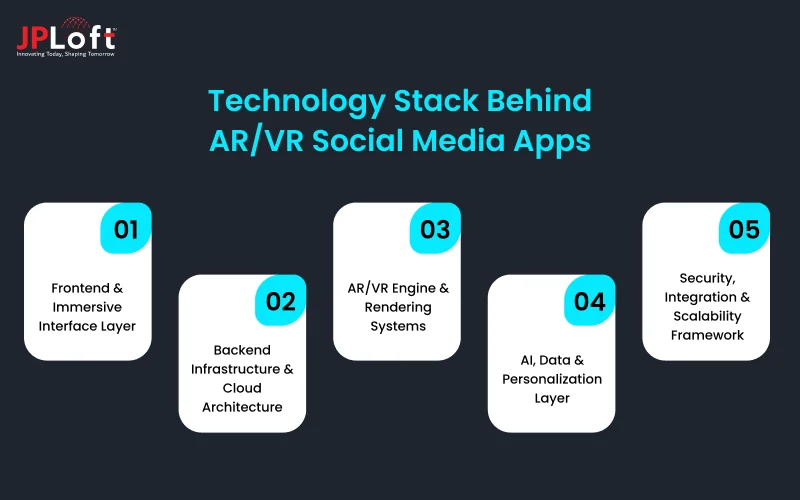
This foundation is what transforms innovation into reliable, real-world digital experiences.
1. Frontend & Immersive Interface Layer
This layer handles user interaction, visual rendering, and real-time immersive engagement. It focuses on 3D interfaces, spatial design, and responsive UI systems for user experiences.
It supports high-performance rendering pipelines and interactive environments for augmented reality social media apps that require visual consistency, smooth animations, and seamless immersive navigation across devices.
2. Backend Infrastructure & Cloud Architecture
Backend systems manage data processing, real-time communication, user management, and content delivery. Cloud-native infrastructure ensures scalability, low latency, and high availability for immersive platforms.
This layer supports data synchronization, session management, and secure transactions, enabling immersive platforms to handle large-scale user engagement without performance degradation.
3. AR/VR Engine & Rendering Systems
Rendering engines manage spatial mapping, object recognition, motion tracking, and immersive visualization.
These systems form the technical core supported by the AR VR app development company, enabling real-time environment interaction and immersive digital experiences.
High-performance rendering ensures realistic visuals, responsive interactions, and stable immersive environments across hardware ecosystems.
4. AI, Data & Personalization Layer
AI-powered systems manage content recommendations, behavior analysis, and experience personalization. This layer supports immersive technology in social media by adapting environments to user behavior, preferences, and engagement patterns.
Intelligent data processing enhances user experience quality while improving platform relevance, retention, and long-term engagement performance.
5. Security, Integration & Scalability Framework
This layer ensures platform stability, data protection, and system interoperability. APIs, encryption frameworks, and integration services enable seamless platform expansion and ecosystem connectivity.
Many businesses partner with a top-rated mobile app development company to design secure, scalable architectures that support long-term growth, compliance, and performance optimization.
Key Challenges in Implementing AR/VR in Social Media and Their Smart Solutions
Integrating immersive technologies into social platforms is powerful, but complex. From infrastructure to user trust, multiple barriers can impact adoption and scalability.
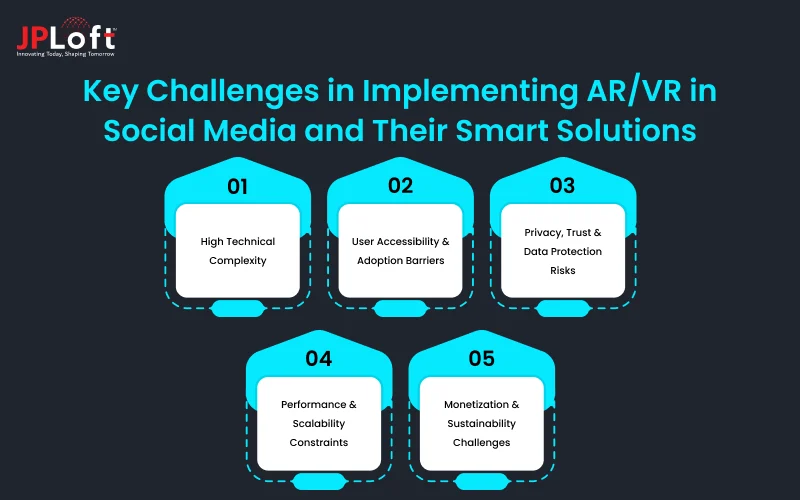
Understanding these social media app development challenges early allows platforms to build sustainable, secure, and user-centric immersive ecosystems that unlock the long-term role of AR and VR in social media.
1. High Technical Complexity
AR/VR systems require advanced rendering, real-time processing, spatial mapping, and device optimization.
This complexity increases development time, technical risk, and system instability, making it difficult for platforms to deliver consistent immersive experiences across multiple devices and operating environments.
Solution:
Adopt modular architecture, scalable infrastructure, and cloud-native systems.
Structured engineering frameworks and specialized immersive development pipelines help simplify complexity, ensure stability, and enable platforms to evolve features incrementally without disrupting performance or user experience.
2. User Accessibility & Adoption Barriers
Many users find immersive platforms overwhelming due to complex interfaces, learning curves, and hardware dependency.
This limits adoption and reduces engagement, especially among non-technical users unfamiliar with immersive interaction models and spatial navigation systems.
Solution:
Design intuitive UX flows, progressive onboarding, and device-agnostic experiences.
Simplified interfaces, accessibility-first design, and cross-device compatibility make immersive platforms approachable, inclusive, and easier for mainstream users to adopt and sustain engagement.
3. Privacy, Trust & Data Protection Risks
Immersive platforms collect sensitive data such as biometrics, spatial mapping, and behavioral patterns.
Without proper safeguards, this creates trust issues and regulatory risks that threaten platform credibility and long-term adoption.
Solution:
Implement strong social media app security frameworks, encryption systems, data governance policies, and compliance standards.
Transparent privacy practices build user trust while ensuring regulatory alignment and long-term platform sustainability.
4. Performance & Scalability Constraints
AR/VR platforms demand high processing power, low latency, and stable real-time interactions.
Performance bottlenecks can lead to lag, crashes, and degraded user experiences that reduce retention and platform reliability.
Solution:
Use cloud scaling, edge computing, and optimized rendering pipelines.
Scalable infrastructure ensures smooth performance under high user loads while maintaining immersive quality across devices and network environments.
5. Monetization & Sustainability Challenges
Immersive platforms struggle to balance innovation with sustainable revenue.
Poor monetization design can lead to financial instability, low ROI, and limited long-term growth potential despite strong user engagement.
Solution:
Align monetization with user experience through digital goods, subscriptions, immersive commerce, and value-based services.
This approach reinforces the benefits of AR VR in social media while supporting sustainable business growth.
Best Practices to Follow When Implementing AR/VR in Social Media Apps
Successful immersive platforms are built on more than innovation; they rely on strategic execution, user-centric design, and long-term sustainability planning.
Implementing AR/VR in social media apps effectively requires balancing technology, experience, performance, and business models.
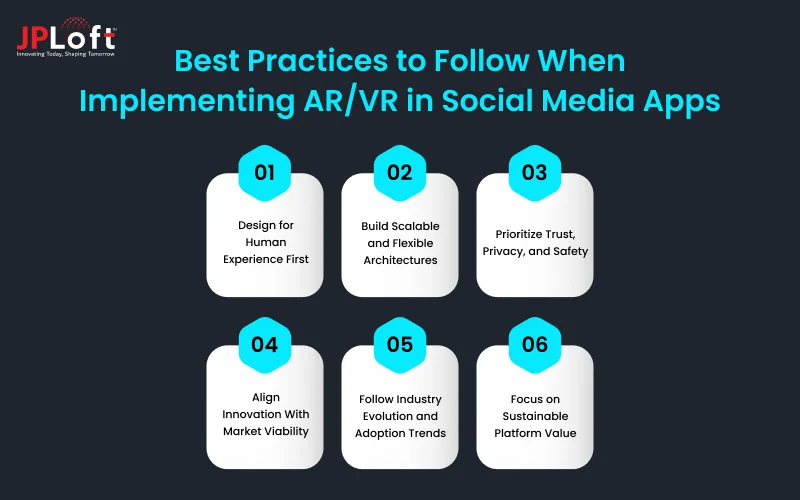
These best practices help platforms scale responsibly while preparing for the future of AR VR in social media.
1. Design for Human Experience First
Immersive platforms should prioritize comfort, simplicity, and emotional connection over technical complexity.
Human-centered design ensures immersive experiences feel natural, intuitive, and accessible, enabling broader adoption while supporting long-term engagement across diverse user groups.
2. Build Scalable and Flexible Architectures
Scalable infrastructure ensures platforms grow without performance breakdowns.
Modular systems, cloud-native frameworks, and adaptive engineering allow immersive ecosystems to evolve with user demand, device innovation, and platform expansion requirements.
3. Prioritize Trust, Privacy, and Safety
User trust drives adoption in immersive ecosystems.
Strong governance, transparent data policies, and ethical design frameworks protect users while strengthening platform credibility and long-term community sustainability.
4. Align Innovation With Market Viability
Immersive innovation must support sustainable business models.
Understanding social media app development cost structures helps align investment strategy with platform growth, ensuring innovation remains financially viable without compromising long-term scalability.
5. Follow Industry Evolution and Adoption Trends
Tracking AR and VR social media trends allows platforms to adapt to changing user behavior, emerging technologies, and market expectations.
This ensures relevance, competitiveness, and long-term strategic alignment.
6. Focus on Sustainable Platform Value
Long-term success depends on creating real user value through meaningful engagement, strong communities, and practical functionality.
This approach reinforces the benefits of AR VR in social media while building ecosystems that users trust and remain loyal to.
Why Partner with JPLoft for Integrating AR/VR in Social Media Apps?
Integrating AR/VR in social media apps can transform user experiences, making platforms more engaging, interactive, and immersive. JPLoft helps brands turn this potential into reality.
Our expertise in integrating AR/VR in social media apps enables brands to create platforms that combine innovation with usability, ensuring long-term growth and adoption.
As a trusted social media app development company, we bring together strategy, design, immersive engineering, and scalable architecture to deliver future-ready social platforms.
From concept to launch and beyond, JPLoft helps businesses transform immersive ideas into powerful, high-impact social experiences that users trust, adopt, and grow with.
Final Thoughts
AR and VR are transforming social media from passive content platforms into immersive, interactive ecosystems.
The role of AR and VR in social media is no longer just experimental; it’s shaping engagement, retention, and monetization strategies for forward-thinking platforms.
By strategically integrating immersive technology, brands can deliver unique experiences that foster community, creativity, and meaningful interaction.
Businesses looking to stay competitive must embrace this evolution thoughtfully, balancing technical innovation with user-centric design, scalability, and long-term sustainability.
As the future of AR and VR in social media unfolds, platforms that prioritize immersive experiences will define the next generation of social engagement and digital connection.
FAQs
AR and VR in social media enhance user engagement by creating immersive experiences that go beyond traditional content. They allow users to interact in 3D spaces, use interactive filters, and participate in virtual events, making social platforms more interactive, engaging, and emotionally connected.
Immersive technology improves user experience by making interactions more dynamic and visually engaging. From AR filters to VR meetups, users enjoy personalized, interactive experiences that encourage creativity, deeper community connections, and longer platform engagement.
Snapchat’s AR lenses, Instagram’s interactive effects, TikTok’s motion-tracking filters, Meta Horizon Worlds’ VR meetups, and VRChat’s digital communities are prime examples. These platforms use immersive tech to increase engagement, create unique social interactions, and build interactive virtual communities.
Challenges include high technical complexity, device compatibility issues, performance optimization, user adoption barriers, privacy concerns, and high development costs. Overcoming these requires strong UX design, scalable architecture, data security practices, and specialized AR/VR development expertise.
AR and VR are shaping the next generation of social interaction by merging digital and physical experiences. Platforms that integrate immersive technology enable more expressive communication, interactive content, and shared virtual experiences, defining the future of user engagement and social connection online.

Conor has 10+ years of experience in software development, application engineering, solution design, and UX/UI. He has worked across digital products in restaurant technology, food and grocery delivery, healthcare, media, streaming, and social platforms, bringing both technical and user-experience perspectives to product development. His experience working with large organizations and growth-focused digital products helps businesses translate complex requirements into practical, user-focused solutions.




Share this blog