


Key Takeaways
Customer acquisition is essential to build awareness, drive early growth, generate revenue, and establish a strong competitive position.
Fuel delivery business growth strategies rely on technology integration, data insights, and seamless user experiences.
Technology plays a key role in improving customer acquisition by enabling automation, analytics, personalization, and seamless operations.
Customer acquisition costs range between USD 650 to USD 1,200, requiring startups to balance spending with long-term value.
Fuel delivery startups face challenges like low awareness, trust issues, high costs, and high competition, but these can be easily overcome.
Partnering with JPLoft helps startups scale faster by providing advanced technology, seamless user experience, and scalable solutions.
Fuel delivery startups are changing how people access one of life’s daily essentials. Instead of waiting in long lines at gas stations, customers now expect fuel to come directly to their doorstep. This shift in behavior creates a huge opportunity, but it also brings strong competition.
To grow in this space, startups must focus on smart and effective customer acquisition strategies for fuel delivery startups. Attracting users is about offering convenience, building trust, raising awareness, and delivering a smooth experience from the first interaction.
Startups need to combine digital marketing, local outreach, and strong value propositions to stand out in the market. A clear strategy helps turn first-time users into loyal customers.
In this blog, we will explore methods for how to acquire customers for fuel delivery startup while building a strong and scalable business foundation.
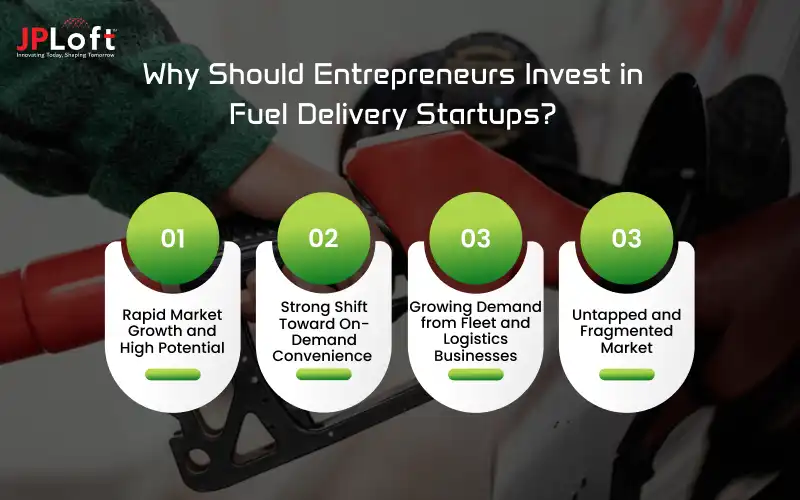
Why Should Entrepreneurs Invest in Fuel Delivery Startups?
Fuel delivery startup app ideas stand at the intersection of energy, logistics, and on-demand technology. With strong market growth, recurring demand, and scalable models, they offer a compelling opportunity for entrepreneurs looking to build a future-ready business.
Knowing the latest fuel delivery market statistics and the reasons behind them can help you understand better why to invest:
1. Rapid Market Growth and High Potential
The global on-demand fuel delivery market is projected to grow from USD 0.45 billion in 2026 to USD 1.76 billion by 2035, at an impressive 15.97% CAGR. This growth indicates that the industry remains in its early stages, providing startups with an opportunity to enter before market saturation.
2. Strong Shift Toward On-Demand Convenience
Modern consumers prefer services that save time and effort. Around 60% of fuel delivery demand is from app-based ordering, highlighting a major shift toward digital platforms. This behavior mirrors the success of food and grocery delivery apps, making fuel delivery a natural next step.
3. Growing Demand from Fleet and Logistics Businesses
The rise in logistics and e-commerce is a major growth driver for this market. This creates a stable B2B revenue stream, which is often more predictable than individual consumers.
4. Untapped and Fragmented Market
The market is still moderately fragmented, with top players holding only 50–60% share, leaving room for new entrants. Thus, it provides an opportunity for growth through the right hyperlocal marketing for fuel delivery startups.
Why Customer Acquisition Is Critical for Fuel Delivery Startups?
A customer acquisition plan for fuel delivery business is the foundation of growth, revenue, and long-term success for fuel delivery startups. The faster a startup builds its customer base, the stronger its position becomes in this evolving market.
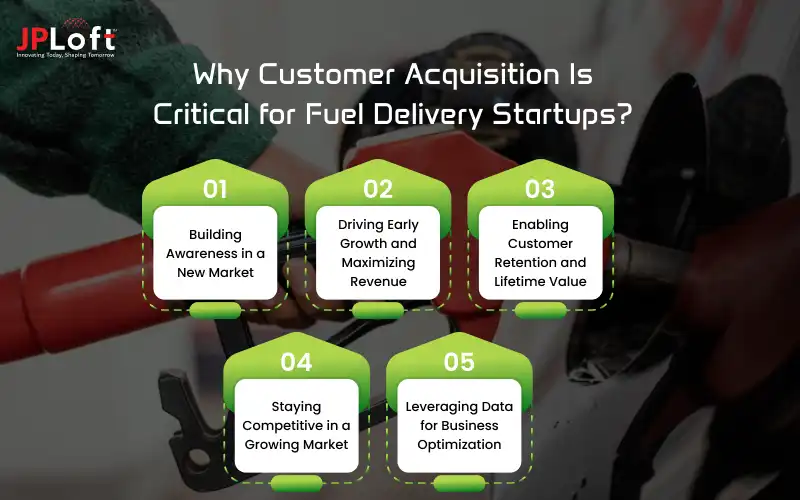
Below are the core reasons why customer acquisition with a proper fuel delivery app marketing strategy is important:
[A] Building Awareness in a New Market
Fuel delivery is still a new concept for many users. Unlike traditional fuel stations, customers may not even know such services exist. Strong customer acquisition helps startups:
-
Create awareness
-
Educate users
-
Introduce the value of doorstep fuel delivery
Without such support, even the best service can go unnoticed.
[B] Driving Early Growth and Maximizing Revenue
Startups need quick traction to survive and grow. Customer acquisition helps build an initial user base, which is essential for:
-
Validating the business model
-
Attracting investors
-
Revenue consistency
-
Profit margins
A larger customer base helps optimize delivery routes and reduce operational costs per order, improving overall unit economics.
[C] Enabling Customer Retention and Lifetime Value
A customer acquisition plan for fuel delivery business is the first step toward retention. Once users try the service and have a smooth experience, they are more likely to reorder.
-
Repeat customers increase lifetime value (LTV)
-
Lower reliance on paid marketing over time
-
Stronger brand loyalty
Without acquisition, there is no base to retain or grow.
[D] Staying Competitive in a Growing Market
As the industry grows, more players are entering the space. Startups that invest early in fuel delivery business growth strategies can:
-
Capture market share faster
-
Build a recognizable brand
-
Create barriers for new competitors
Delaying acquisition efforts can result in lost opportunities and higher future costs.
[E] Leveraging Data for Business Optimization
When working with a fuel delivery app, the business can track user data and use it to further upgrade its strategies. Every acquired customer provides valuable data, such as:
-
Buying patterns
-
Preferred delivery times
-
Location-based demand
This data helps startups refine their services, improve targeting, and make smarter business decisions.
Proven Customer Acquisition Strategies for Fuel Delivery Startups
The success of customer acquisition strategies for fuel delivery startups relies heavily on the effective combination of technology, data, and user experience. A development-focused approach ensures scalable growth and long-term success.
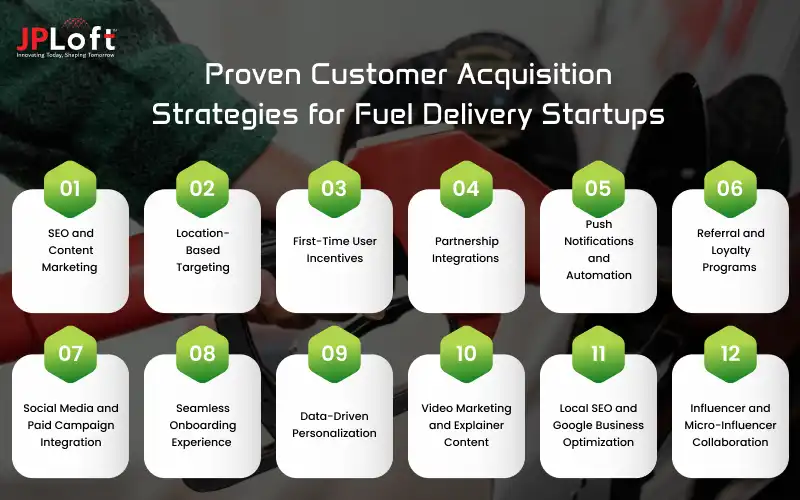
The following are the fuel delivery business growth strategies you can implement for customer acquisition:
1. SEO and Content Marketing
Build SEO-optimized landing pages and blogs targeting relevant fuel delivery queries. Ensure fast-loading, mobile-friendly websites with proper indexing. Use analytics tools to track traffic and performance.
High-quality content improves search rankings, attracts organic users, and establishes authority. Reducing dependency on paid ads while supporting long-term customer acquisition and brand visibility.
2. Location-Based Targeting
Leverage GPS and geofencing technologies to target users in high-demand locations. Build backend systems that support real-time location tracking and trigger personalized offers.
This approach ensures efforts for hyperlocal marketing for fuel delivery startups reach relevant users, improve conversion rates, and reduce expenses by focusing only on serviceable areas with strong demand potential.
3. First-Time User Incentives
Offer discounts, cashback, or free delivery to encourage first-time usage and reduce hesitation. Develop a flexible promo engine to manage codes, eligibility, and redemption seamlessly.
Track campaign performance through analytics tools to identify effective incentives. Optimize spending and improve conversion rates while ensuring a smooth onboarding and checkout experience.
4. Partnership Integrations
Form strategic partnerships with fleet operators, logistics companies, and service platforms to access existing user bases. Build robust APIs for seamless integration, enabling businesses to schedule deliveries within their systems.
This approach is one of the best ways to get customers for fuel delivery app, accelerating B2B acquisition, supporting bulk orders, and creating long-term contracts that ensure stable revenue and growth.
5. Push Notifications and Automation
Use push notifications to send reminders, offers, and updates that drive engagement and conversions. Implement marketing automation tools to segment users based on behavior and preferences.
Personalized messaging improves relevance, increases retention, and reactivates inactive users. All while reducing manual effort, ensuring consistent communication, and better overall acquisition efficiency.
6. Referral and Loyalty Programs
Develop referral systems that reward users for inviting others, leveraging trust-based acquisition. Create loyalty programs offering points, discounts, or exclusive benefits for repeat usage.
Track performance through integrated dashboards to measure success, encourage engagement, and increase lifetime value. This fuel delivery app marketing strategy helps acquire new customers at a lower cost compared to traditional channels.
7. Social Media and Paid Campaign Integration
Run targeted paid campaigns on social platforms to reach specific audiences based on demographics, behavior, and location. Integrate tracking SDKs to measure conversions and optimize performance.
Use retargeting strategies to re-engage interested users, ensuring efficient budget utilization and scalable acquisition through data-driven campaign management and continuous optimization.
8. Seamless Onboarding Experience
Design a simple and intuitive onboarding process with minimal steps, social logins, and clear instructions. Reduce friction during registration and checkout to improve conversions.
Focus on performance and user experience to ensure quick order placement. Helping users understand the service easily and increasing the likelihood of successful first-time transactions.
9. Data-Driven Personalization
Another fuel delivery startup marketing strategies are leveraging analytics and AI tools to understand user behavior, preferences, and purchase patterns. Deliver personalized offers, recommendations, and reminders based on insights.
This improves engagement, enhances user experience, and increases conversion rates. Making acquisition strategies more effective while also supporting long-term retention and lifetime value.
10. Video Marketing and Explainer Content
Video marketing simplifies complex fuel delivery concepts through engaging visuals. Create short explainer videos showcasing ordering steps, safety measures, and benefits.
Integrate videos across apps and websites with optimized loading. Track engagement metrics like watch time, clicks, and conversions to refine content strategy and improve acquisition performance across multiple digital platforms effectively.
11. Local SEO and Google Business Optimization
Local SEO helps fuel delivery startups capture nearby demand efficiently. Optimize Google Business profiles with accurate details, service areas, and customer reviews. Implement structured data and location pages on websites.
Encourage user feedback to boost rankings. This improves visibility in local searches, drives organic traffic, and increases high-intent customer acquisition consistently.
12. Influencer and Micro-Influencer Collaboration
Fuel delivery service marketing ideas, like influencer collaborations, help startups reach targeted audiences quickly. Partner with local micro-influencers to showcase real service usage and build credibility.
Develop tracking systems using unique referral codes or links to measure campaign success. Analyze engagement and conversions to optimize partnerships, ensuring better reach, trust, and customer acquisition through authentic recommendations.
How to Identify Your Ideal Customer Acquisition Strategies?
Let's briefly know how you can identify your ideal fuel delivery app marketing strategy for the particular business model:
- Define Your Target Audience: Analyze user demographics, behavior, and fuel consumption patterns. Build detailed personas, helping development teams in fuel app delivery design and campaigns.
- Evaluate Data and User Insights: Use in-app analytics, heatmaps, and CRM tools to study user journeys. Identify high-conversion channels and optimize strategies based on real-time data.
- Test Multiple Channels: Implement A/B testing frameworks to experiment with channels like ads, SEO, and referrals. Measure results through integrated dashboards to identify the most cost-effective methods.
- Align with Product Capabilities: Ensure acquisition strategies match your app’s features and infrastructure.
- Monitor, Optimize, and Scale: Continuously track KPIs like CAC, conversion rate, and retention. Use automation and analytics tools to refine strategies, scale successful channels, and improve overall acquisition efficiency over time.
Role of Technology in Customer Acquisition for Fuel Delivery App
Technology is the backbone of how to promote fuel delivery startup for customer acquisition. From app experience to data-driven marketing, the right fuel delivery app tech stack ensures better reach, higher conversions, and long-term customer growth.
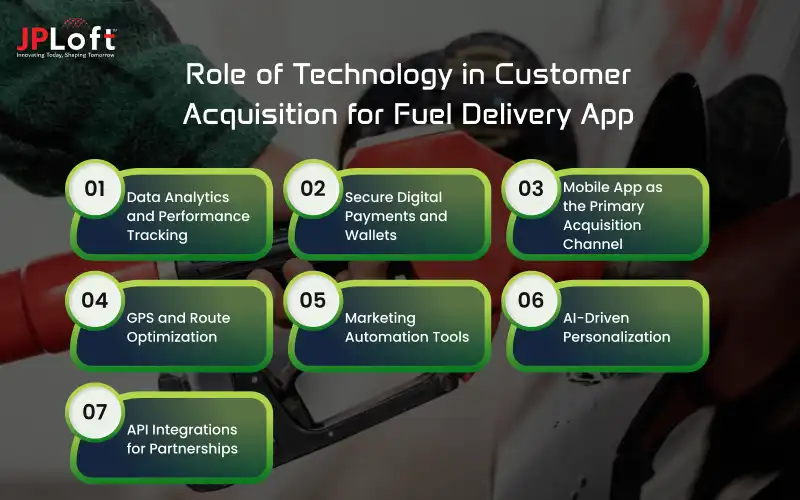
The integration of technology as a fuel delivery service marketing ideas for customer acquisition is crucial, as:
► Data Analytics and Performance Tracking
Analytics tools track user acquisition channels, conversion rates, and campaign performance. These insights help optimize strategies, reduce acquisition costs, and improve decision-making for scalable growth.
► Secure Digital Payments and Wallets
Secure payment systems build user trust during transactions. Multiple payment options like wallets, cards, and UPI reduce friction, encouraging more users to complete orders and adopt the service.
► Mobile App as the Primary Acquisition Channel
A well-built mobile app acts as the core acquisition engine. It simplifies discovery, onboarding, and ordering. Fuel delivery app features like quick registration, real-time tracking, and secure payments help convert first-time users efficiently.
► GPS and Route Optimization
GPS integration ensures accurate location tracking and efficient delivery routes. Faster service builds trust and satisfaction, which supports word-of-mouth acquisition and strengthens the brand’s reliability among new users.
► Marketing Automation Tools
Automation tools streamline campaigns across push notifications, SMS, and email. They reduce manual effort while improving targeting accuracy, helping startups reach potential users and re-engage inactive customers effectively.
► AI-Driven Personalization
AI personalization is one of the best ways to get customers for fuel delivery app. AI in fuel delivery apps analyzes user behavior, order history, and preferences. It enables personalized offers, reminders, and recommendations, helping startups attract and convert users through relevant and timely engagement.
► API Integrations for Partnerships
APIs enable integration with fleet systems, vehicle apps, and enterprise platforms. This supports bulk user acquisition through partnerships, allowing startups to tap into existing customer bases quickly.
Cost of Customer Acquisition for Fuel Delivery Startups
The cost of a customer acquisition plan for fuel delivery business is the total expense spent on acquiring one new customer. It includes marketing, sales, and technology costs divided by the number of users acquired within a specific period. For fuel delivery startups, the cost generally ranges between USD 650 to USD 1,200 per customer, based on a report by Bain & Company.
Below are the key cost components of customer acquisition strategies for fuel delivery startups:
|
Components |
Cost range (of total cost) |
Description |
|
Digital Marketing and Paid Ads |
30%-40% |
Expenses on Google Ads, social media campaigns, and app install ads form the largest share. High competition in urban areas increases the cost per acquisition significantly. |
|
Technology Development |
15-20% |
Includes updates, backend systems management, analytics tools, and automation features that support user acquisition, tracking, and conversion optimization. |
|
Discounts and Incentives |
20-25% |
First-time user offers, promo codes, and referral rewards increase conversions but add to acquisition costs, especially during early growth stages. |
|
Sales and Partnerships |
10-15% |
Costs related to onboarding B2B clients, fleet partnerships, and business development efforts contribute to acquiring high-value customers. |
|
Operations and Onboarding |
10-15% |
Logistics setup, customer support, and onboarding assistance ensure a smooth first experience, which is essential for successful acquisition. |
Top Challenges in Acquiring Customers for Fuel Delivery Startups
There are various challenges in the process of how to acquire customers for fuel delivery startup. These challenges range from building trust to managing costs. Businesses have to face multiple hurdles.
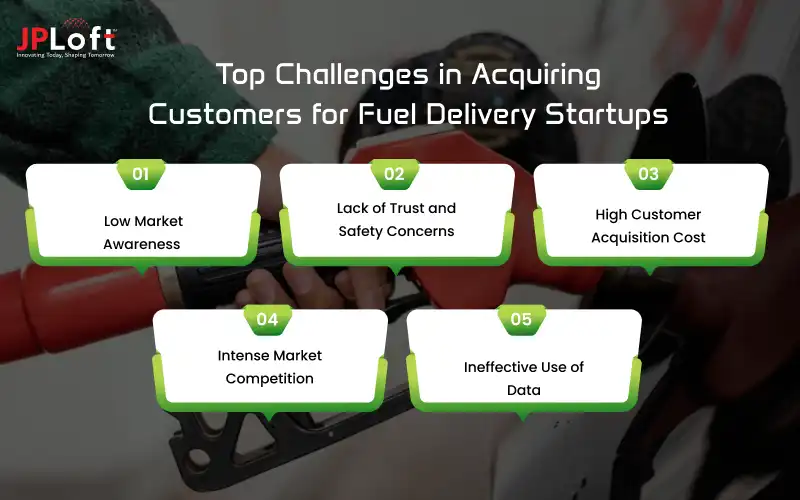
Knowing about the challenges of how to get customers for fuel delivery business and applying the right solutions can help startups attract users faster and achieve sustainable growth:
Challenge 1: Low Market Awareness
Fuel delivery is still a new concept in many regions. Customers are unaware of the service, its benefits, or how it works, which slows down adoption and initial user acquisition efforts.
Solution: Use educational campaigns, explainer videos, and localized marketing to build awareness and clearly communicate convenience, safety, and value propositions.
Challenge 2: Lack of Trust and Safety Concerns
Customers hesitate to adopt fuel delivery due to safety concerns, fear of fuel quality issues, and doubts about handling flammable materials. This fear directly impacts conversion rates and customer trust.
Solution: Highlight certifications, safety protocols, and real-time tracking features. Display trust badges and offer transparent service details to build confidence.
Challenge 3: High Customer Acquisition Cost
Acquiring customers requires heavy investment in ads, discounts, and promotions. High competition and the need to educate users further increase acquisition costs, making it difficult for startups to scale profitably.
Solution: Focus on organic channels, referral programs, and retention strategies to reduce dependency on paid marketing and improve cost efficiency.
Challenge 4: Intense Market Competition
As the market grows, more startups and established players enter the space. This increases competition for customer attention, making it harder to stand out and acquire users effectively.
Solution: Differentiate through unique features, better pricing models, and superior user experience to create a strong competitive advantage and attract customers.
Challenge 5: Ineffective Use of Data
Many startups fail to leverage user data effectively. Without proper analytics, they cannot identify high-performing channels, optimize campaigns, or understand customer behavior, leading to inefficient acquisition strategies.
Solution: Implement analytics tools and dashboards to track performance. Use insights to refine campaigns, improve targeting, and make data-driven decisions.
Scale Your Fuel Delivery Business Faster With JPLoft
Customer acquisition requires more than just an idea. It needs the right technology, strategy, and execution. JPLoft helps you build a strong foundation with scalable and secure solutions designed for long-term growth.
From user-friendly apps to advanced backend systems, every element is developed by JPLoft, a leading fuel delivery app development company. Every feature is developed to support seamless operations and faster customer acquisition.
These capabilities improve user experience and help convert more customers while reducing operational challenges. We also ensure your platform is ready to scale as your business expands into new locations and markets.
With deep industry understanding and a development-driven approach, JPLoft supports you at every stage, from idea validation to deployment and beyond. Whether you are targeting individual users or fleet businesses, we help you launch faster and grow smarter.
Partner with JPLoft to turn your fuel delivery concept into a powerful, revenue-generating platform that stands out in a competitive market.
Conclusion
Fuel-delivery startups are entering a high-potential market where convenience, technology, and customer experience drive the growth. However, success depends heavily on how effectively businesses acquire and retain customers.
From understanding the target audience to leveraging data-driven strategies, every step plays a role in how to get customers for fuel delivery business. The right mix of mobile app capabilities, location targeting, partnerships, and personalization significantly improves acquisition outcomes.
At the same time, managing challenges like high costs, low awareness, and trust barriers requires a strategic and technology-focused approach. Entrepreneurs who invest in scalable solutions and continuously optimize their strategies will be better positioned to grow sustainably.
In a competitive and evolving market, focusing on customer needs and delivering consistent value is the key to long-term success in the fuel delivery business.
FAQs
Fuel delivery startups use strategies like app store optimization, location-based targeting, referral programs, first-time user discounts, SEO, and paid ads. They also leverage partnerships and data-driven personalization to attract, convert, and retain customers efficiently.
Fuel delivery startups offer strong growth potential due to rising demand for convenience and on-demand services. With recurring usage, scalable technology, and increasing urbanization, they provide steady revenue opportunities and long-term business sustainability for entrepreneurs and investors.
Customer acquisition drives initial growth, builds market presence, and generates revenue. It helps create a loyal user base, supports retention, and enables scalability. Without strong acquisition, startups cannot achieve sustainable growth or compete effectively.
Reduce customer acquisition cost by focusing on organic channels like SEO and referrals, improving retention, and using data-driven targeting. Optimize campaigns, automate marketing, and enhance user experience to increase conversions and lower overall acquisition expenses.
Technology enables seamless onboarding, personalized marketing, and efficient operations. Tools like mobile apps, analytics, AI, and automation improve targeting, engagement, and conversions, helping startups acquire customers faster and scale effectively.

Savannah Bustos is a technology professional with experience across financial platforms, mobility solutions, and on-demand digital products. Her areas of expertise include FinTech, digital banking, eWallets, lending, BNPL, stock trading, fuel delivery, and taxi-booking platforms. She combines a strong understanding of business requirements with practical technology insight, helping companies evaluate challenges, define product needs, and make informed decisions about scalable digital solutions.


Share this blog