


Key Takeaways
Fuel delivery apps fail mainly due to poor planning, high operational costs, and weak logistics management.
High operational expenses can quickly reduce profit margins if not properly controlled.
Continuous marketing and customer retention strategies are necessary for sustainable growth.
Long-term success requires scalable technology, strong backend systems, and ongoing improvements.
Partnering with JPLoft helps businesses build scalable and revenue-focused fuel delivery solutions.
The fuel delivery industry is growing fast as more customers prefer doorstep services for convenience.
In fact, the global mobile fuel delivery market is expected to grow from $5.84 billion in 2025 to $11.93 billion by 2035.
Hence, this shows strong demand for such services. Despite this growth, many startups struggle to survive.
Generally, on-demand delivery apps have a very high drop-off rate, with studies showing that users stop using them soon after installation.
Before businesses invest in building a fuel delivery app, it is crucial to understand why fuel delivery apps fail.
There are several reasons for the failure of such a business idea, such as poor market research, weak supply chain, app performance, and more.
In this blog, we will explain those reasons in simple terms to help businesses make better decisions.
Understanding Fuel Delivery Apps and Their Market
Fuel delivery apps are digital platforms that allow customers to order fuel through a mobile app and get it delivered to their location. Instead of visiting a fuel station, users can schedule delivery at home, office, or construction sites.
The best fuel delivery apps usually connect customers, delivery vehicles, and fuel suppliers through one system. Businesses with vehicle fleets, generators, or heavy equipment also prefer doorstep fuel services to save time and improve operations.
However, this market is highly regulated and operationally complex. Hence, it requires proper licenses, safety standards, trained staff, and strong logistics management.
Overview of the Market
Here are some key fuel delivery market statistics that will give you more details.
-
The mobile fuel delivery market projection of $11.93 billion by 2035 is estimated at a CAGR of 7.4%.
-
Accordingly, diesel accounts for a large share of this market, with reports estimating around 62 % revenue share due to its high commercial use.
-
North America is the dominant region with about 42 % market share, driven by fleet digitization and app adoption.
-
The Asia Pacific region is expected to witness the highest growth rate from 2026 to 2033, driven by expanding logistics networks and ongoing infrastructure development.
Moreover, understanding how this market works is the first step to know reasons for gasoline delivery apps failure and how businesses can avoid common mistakes.
10+ Core Reasons Why Fuel Delivery Apps Fail
You can build a fuel delivery app, but running it successfully is complex. Many businesses enter this market with high expectations, yet fail to manage operations.
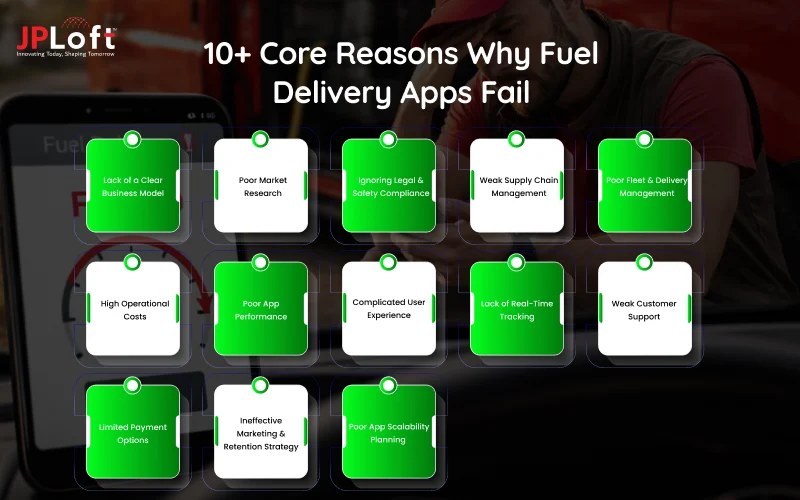
Below are the most common reasons why fuel delivery apps fail and what investors should carefully plan before investing in them.
1. Lack of a Clear Business Model
Many fuel delivery startups enter the market without clearly defining how they will generate steady profit. They often underestimate delivery expenses, insurance, safety compliance, and the cost to develop a fuel delivery app.
In addition, many businesses focus only on individual customers and ignore business diversification opportunities. Fuel delivery can serve not just households, but also transport companies, logistics fleets, construction sites, ports, warehouses, and industrial businesses.
How to avoid this failure: Define revenue streams, calculate expenses carefully, and build a realistic financial roadmap before starting development.
2. Poor Market Research
Some businesses launch their fuel delivery app without properly studying demand, competitors, or customer expectations. They assume convenience alone will attract users.
However, without understanding fuel delivery app trends and regional behavior, marketing efforts become ineffective. This is one of the main reasons for fuel delivery app failure in competitive markets.
How to avoid this failure: Conduct detailed market research and validate real customer demand before investing heavily.
3. Ignoring Legal & Safety Compliance
Fuel delivery involves strict transport and storage regulations. Operating without proper permits or safety approvals can result in penalties or forced shutdowns. Non-compliance also increases the risk of accidents, which damages brand image and customer trust.
The reason for fuel delivery app startup failure is that they underestimate regulatory compliance in fuel delivery apps. However, legal challenges create uncertainty and prevent long-term business stability and expansion.
How to avoid this failure: Secure all required licenses and follow national and local safety regulations from the beginning.
4. Weak Supply Chain Management
A stable fuel supply is essential for consistent service. If suppliers delay shipments or fail to meet demand, deliveries become unreliable. Customers lose confidence when orders are postponed frequently.
Poor coordination between suppliers and operations leads to service interruptions and negatively affects overall performance. This operational gap is another reason for the failure of fuel delivery apps during scaling.
How to avoid this failure: Partner with dependable suppliers and maintain alternative sourcing plans to ensure continuity.
5. Poor Fleet & Delivery Management
Fuel delivery depends heavily on timely transportation. Inefficient routing and a lack of driver monitoring increase delivery time and fuel wastage. Without proper tracking systems, delays become common.
Late deliveries reduce customer satisfaction and generate negative feedback, which impacts brand reputation and repeat business. Operational inefficiency is a key factor for a fuel delivery app startup failure to maintain service quality.
How to avoid this failure: Use route optimization tools and monitor fleet performance consistently.
6. High Operational Costs
Running a fuel delivery service requires vehicles, safety equipment, trained staff, insurance, and maintenance. Many startups underestimate these recurring costs. When expenses rise faster than revenue, profitability declines.
Poor financial control eventually creates losses that the business cannot sustain. Financial miscalculation is often the reason for petrol delivery app failure within the first few years.
How to avoid this failure: Plan expenses carefully, control overhead costs, and expand operations gradually.
7. Poor App Performance
Customers expect smooth and fast digital experiences. If the app crashes, loads slowly, or fails during payment, users quickly lose trust. Technical glitches reduce confidence in the service.
Negative user experiences directly impact ratings and retention rates. Weak technical infrastructure is one of the major reasons for fuel delivery app failure in the long term.
How to avoid this failure: Invest in reliable development, fuel delivery app testing, and maintain regular performance updates.
8. Complicated User Experience
If users find the booking process confusing or the pricing unclear, they hesitate to complete orders. However, too many steps and unclear instructions reduce convenience.
A complicated interface discourages repeat usage and lowers conversion rates significantly over time. Poor UX design is a silent reason for petrol delivery app failure despite strong initial marketing.
How to avoid this failure: The fuel delivery app design should have a simple interface with clear pricing and minimal booking steps.
9. Lack of Real-Time Tracking
Modern customers expect transparency in delivery services. Without live tracking or timely updates, they feel uncertain about order status. This uncertainty leads to frequent support calls and dissatisfaction.
Lack of visibility weakens trust and reduces loyalty. Moreover, limited transparency is another factor contributing to on-demand fuel delivery failure for retaining customers.
How to avoid this failure: Integrate GPS tracking and provide real-time notifications for every order.
10. Weak Customer Support
In order to resolve service disruptions or delays, the action must be quick. However, if support teams respond slowly or fail to solve issues, customers become frustrated.
Poor service handling damages brand reputation and discourages repeat purchases. Inefficient support systems are often overlooked until fuel delivery apps fail to maintain customer trust.
How to avoid this failure: Provide fast support channels and clear complaint resolution processes.
11. Limited Payment Options
Today, almost all customers prefer flexible and secure payment methods. However, restricting them to limited options reduces convenience and order completion rates.
Payment friction often results in abandoned bookings. Moreover, offering fewer digital payment choices directly impacts revenue growth, which is another reason for gas delivery apps failure in competitive regions.
How to avoid this failure: Support multiple secure digital payment methods for better customer convenience.
12. Ineffective Marketing & Retention Strategy
Many fuel delivery apps struggle because they focus only on launch marketing. Without consistent promotion and retention efforts, growth slows quickly. Ignoring loyalty programs and engagement strategies increases customer churn.
Weak long-term marketing is a common reason for on-demand fuel delivery failure after initial traction. Thus, sustainable success requires ongoing marketing and relationship building.
How to avoid this failure: Develop long-term marketing campaigns and implement customer retention programs.
13. Poor App Scalability Planning
Many fuel delivery startups build their app only for current demand without planning for future growth. In the early stage, the system may work smoothly with limited users and delivery vehicles.
However, as orders increase, the app may slow down, crash, or fail to handle real-time tracking and payment processing efficiently. This leads to delayed deliveries, poor user experience, and negative reviews.
How to avoid this failure: Design a scalable architecture from the beginning, use reliable cloud infrastructure, and plan for high traffic handling to support future growth.
Case Studies: Fuel Delivery Startups That Struggled or Shut Down
Not every fuel delivery startup achieves long-term success. While the market shows growth potential, several companies have struggled or shut down due to operational, financial, or strategic fuel delivery app challenges.
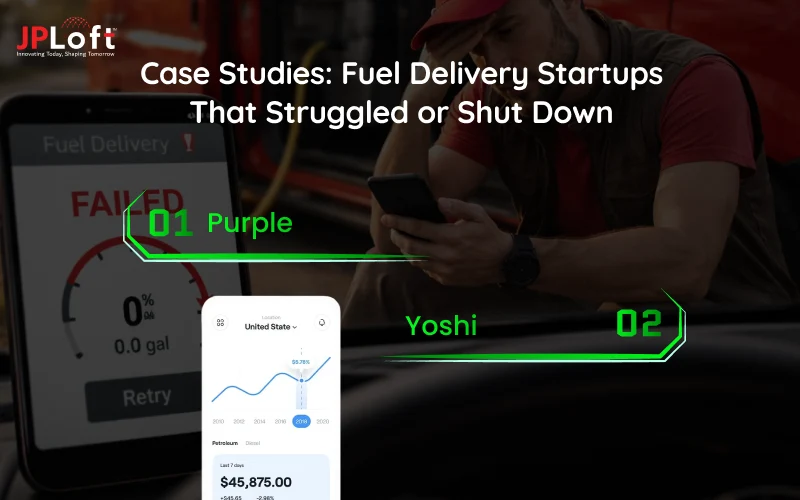
Studying these real-world examples helps businesses understand the reasons for the failure of fuel delivery apps.
[1] Purple
Purple was a mobile fuel delivery startup that aimed to provide on-demand fuel services directly to customers’ locations. Launched in May 2015, the company focused on logistics to simplify fuel access for individuals and businesses.
► What Went Wrong
Purple entered the fuel delivery market with strong ambition but struggled to maintain operational balance. The company faced challenges in managing delivery logistics, maintaining consistent demand, and handling regulatory compliance.
High operational complexity, combined with limited customer retention, made growth unstable. As scaling increased, cost control became difficult, which directly affected sustainability.
► Unit Economics Breakdown
For Purple, delivery vehicle costs, driver salaries, insurance, and safety compliance likely consumed a large portion of revenue.
If customer acquisition costs were high and repeat orders were low, the per-order profit would shrink. Without strong recurring demand, covering fixed operational costs becomes challenging.
► Investor Perspective
Investors generally look for scalable and predictable revenue models. If operational risks, regulatory exposure, and burn rate appear high, funding confidence reduces. In such models, sustainability becomes a concern when profitability timelines are unclear.
► Lessons Learned
Fuel delivery startups must control operational costs, improve retention, validate demand early, and build scalable systems before expanding aggressively.
[2] Yoshi
Yoshi was a U.S.-based mobile fuel delivery startup launched in 2015 that offered on-demand gas delivery, car washes, and maintenance services at customers’ locations. The company aimed to combine convenience with a subscription-based model for recurring revenue.
► What Went Wrong
Yoshi expanded aggressively into multiple cities, which increased operational complexity. Managing logistics, local regulations, and consistent demand across regions became challenging.
The broader market shift toward electric vehicles and changing consumer behavior also impacted long-term fuel demand expectations. Later, the company’s fuel delivery division was acquired by EZFill Holdings in January 2025.
► Unit Economics Breakdown
Fuel delivery operates on thin margins. Vehicle operations, driver wages, insurance, and city-wise expansion costs raised expenses.
If subscription growth slowed or customer acquisition costs remained high, maintaining positive margins per customer became difficult.
► Investor Perspective
Investors likely evaluated scalability risks, high burn rate, and market uncertainty. When long-term fuel demand became less predictable, confidence in sustained growth reduced.
► Lessons Learned
Startups should scale gradually, validate recurring demand, control expansion costs, and diversify services carefully to maintain sustainable growth.
What New Fuel Delivery Startups Must Do Differently?
Today, launching a fuel delivery startup requires more than just a good idea. As we see, multiple fuel delivery apps fail soon after launch. It becomes important to stay cautious in the early stages only.
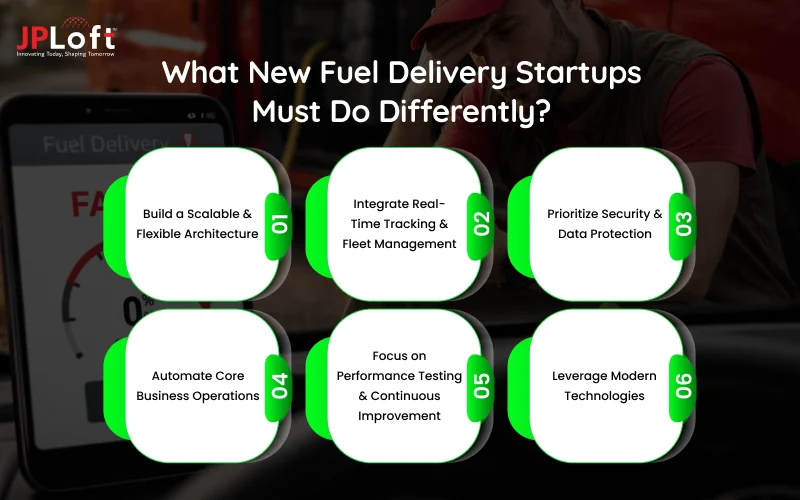
Below are key technical areas new fuel delivery businesses must consider to create a reliable and profitable platform.
A. Build a Scalable & Flexible Architecture
New fuel delivery startups must focus on building a scalable backend system from the beginning. As orders increase, the system should handle high traffic, multiple vehicles, and data without slowing down.
Moreover, a flexible architecture allows easy upgrades in the fuel delivery app features. Without strong technical planning, scaling becomes costly and complex later.
B. Integrate Real-Time Tracking & Fleet Management
Fuel delivery depends on accurate logistics management. Startups should integrate GPS tracking, route optimization, and automated order allocation into the platform. Thus, real-time tracking improves transparency and customer trust.
A connected fleet management system also reduces delivery delays and fuel wastage. However, technical integration between the app and logistics system is essential for smooth operations.
C. Prioritize Security & Data Protection
Fuel delivery apps manage payment, customer details, worker details, and location data. However, a weaker security system can lead to data breaches and financial loss.
Startups must implement encrypted transactions, secure authentication, and protected databases. Strong security not only protects users but also builds long-term credibility.
D. Automate Core Business Operations
Manual processes increase errors and slow down operations. Startups should automate order assignment, billing, invoicing, reporting, and notifications. Automation improves efficiency and reduces operational costs.
A technically strong system ensures that orders move smoothly from booking to delivery without manual involvement. Thus, helping businesses manage growth effectively.
E. Focus on Performance Testing & Continuous Improvement
Launching the app is only the beginning. Startups must conduct proper testing before release and monitor performance regularly. Load testing, bug fixing, and system updates ensure stability.
Continuous technical improvements keep the platform reliable as user demand grows. Businesses that invest in ongoing development are more likely to build sustainable fuel delivery solutions.
F. Leverage Modern Technologies
New fuel delivery startups should actively adopt modern technologies to improve efficiency and transparency. AI in fuel delivery apps can help in demand forecasting and route optimisation, while IoT sensors can monitor fuel levels in storage tanks and track vehicle performance.
Moreover, cloud-based fuel app architecture allows startups to scale operations smoothly. By leveraging AI, Blockchain, IoT, and cloud infrastructure, fuel delivery businesses can reduce operational risks, improve accuracy, and build a more reliable app.
How can JPLoft provide a Profitable Fuel Delivery App?
Building a profitable fuel delivery app requires more than basic development. JPLoft is an experienced fuel delivery app development company that focuses on creating complete, scalable, and revenue-driven fuel delivery solutions.
Our development process begins with understanding your target market, pricing strategy, and operational model. This ensures that the fuel delivery app is built with the right features, including real-time tracking, fleet monitoring, and more.
A strong backend architecture supports high user traffic and smooth performance as your business grows. Security, compliance support, and data protection are also prioritized to help businesses operate safely and legally.
Moreover, we design a simple and easy user interface to increase customer satisfaction and repeat orders.
With proper planning, advanced technology, and continuous support, JPLoft helps businesses reduce fuel delivery business risks and build a profitable fuel delivery app for long-term growth.
Conclusion
The fuel delivery industry offers strong growth opportunities, but success depends on careful planning and strong execution. Many businesses fail not because the idea is weak, but because they ignore key areas like compliance, logistics, technology, and customer experience.
Understanding why fuel delivery apps fail helps you avoid costly mistakes and build a stable foundation from the beginning. A successful fuel delivery app requires a clear business model, reliable supply chain, efficient fleet management, secure payment systems, and scalable technology.
It also demands continuous improvement and strong customer support to maintain trust and loyalty. For businesses planning to enter this market, focusing on the right development strategy is critical.
With proper technical planning and expert guidance, you can reduce fuel delivery app risks, control operational costs, and create a platform that delivers long-term value and sustainable profitability.
FAQs
Yes, fuel delivery apps can be profitable when supported by a clear pricing strategy, efficient fleet management, and controlled operational costs. Profitability depends on strong demand, repeat customers, optimized routes, and a well-planned revenue model such as delivery fees, subscriptions, or bulk fuel contracts.
Fuel delivery apps fail due to poor planning, weak logistics, legal non-compliance, high operational costs, and unstable technology. Many businesses ignore market research and scalability, which leads to financial pressure and customer dissatisfaction over time.
Mobile fuel delivery is legal in many regions, but it is strictly regulated. Businesses must obtain proper licenses, follow fuel transport and storage regulations, and comply with safety standards before operating legally.
Fuel delivery apps do not directly replace gas stations but offer convenience for homes, offices, and fleet businesses. Their advantage lies in doorstep service, time savings, and scheduled deliveries rather than walk-in fuel sales.
Electric vehicles are growing, but fuel-powered vehicles still dominate many markets. Fuel delivery businesses can remain relevant for years, especially in commercial fleets, heavy equipment, and regions where EV adoption is slow.

Savannah is a passionate tech enthusiast with a sharp understanding of client needs across diverse digital domains. With expertise spanning financial platforms, on-demand solutions, and emerging technologies, she brings a unique blend of analytical insight and interpersonal skills, helping businesses decode complexities and make informed decisions in today's rapidly evolving digital world.



Share this blog