


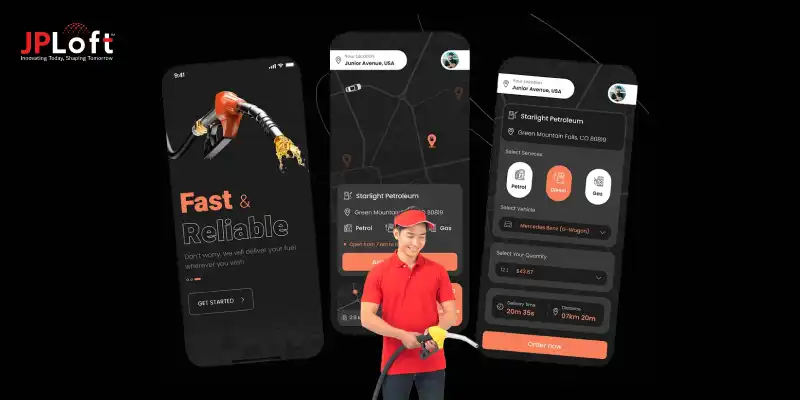
Key Takeaways
On demand fuel delivery app works through automated order management, GPS tracking, and intelligent dispatch systems to ensure a reliable doorstep fuel supply.
Revenue generation depends on diversified monetization models such as delivery fees, subscriptions, enterprise contracts, and priority delivery services.
Regulatory compliance is a critical operational pillar, requiring certified vehicles, licensed operators, and strict safety standards.
Core architecture includes four integrated components: customer app, delivery partner app, admin dashboard, and centralized backend infrastructure.
Future growth in fuel delivery apps will be driven by AI optimization, IoT-based monitoring, sustainable logistics practices, and personalized enterprise solutions.
Fuel delivery is changing fast. Today, people want everything at their doorstep, including fuel for their cars, bikes, and generators. This is where on-demand fuel delivery apps come in.
These apps allow users to order fuel through their smartphones and get it delivered to their location in a safe and easy way.
Instead of visiting a fuel station and waiting in line, customers can choose the fuel type, enter their address, select a time slot, and make payment directly in the app.
Behind the scenes, a complete system manages orders, assigns delivery vehicles, tracks drivers, and ensures safety standards are followed.
For businesses, this model creates a new opportunity in the energy and logistics sector.
Understanding how fuel delivery apps work is important for companies planning to build an on-demand fuel delivery platform. So, let’s discuss this in detail.
Overview of On-Demand Fuel Delivery App
An on-demand fuel delivery app is a digital platform that allows users to order fuel whenever they need it and receive it at their chosen location. The fuel delivery app working is like other on-demand services where customers place a request through a mobile app, and a service provider fulfills it in real time.
The app connects three main users: customers, delivery partners, and the business owner. Customers can select the fuel type, enter vehicle or equipment details, choose quantity, and schedule delivery.
Delivery partners receive the request through their app, navigate to the location, and complete the delivery using approved fuel containers and safety measures. The admin panel helps the business monitor orders, manage payments, track vehicles, and ensure smooth operations.
For businesses planning to build a fuel delivery app, creating a new revenue stream by combining technology with fuel distribution is important. It offers better control, real-time tracking, digital payments, and improved customer experience.
Core Components of On-Demand Fuel Delivery Apps
An on demand fuel delivery app works through a well-connected system where multiple components operate together. Each part plays an important role in managing orders, tracking deliveries, handling payments, and ensuring smooth business operations. These integrated modules collectively define the essential fuel delivery app features to ensure efficiency, safety, and scalability.
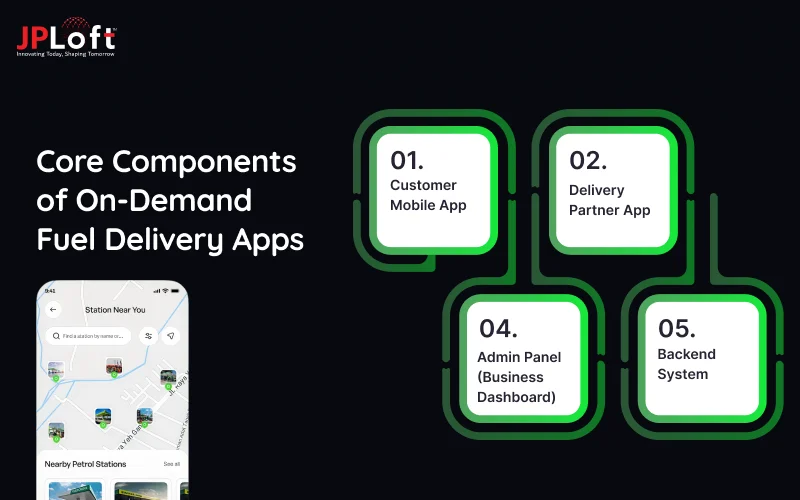
Now, we will have a clear look at the core components of such a platform.
1. Customer Mobile App
The customer mobile app serves as the primary interface that allows users to conveniently order fuel, track deliveries, and manage payments from their smartphones.
Key components of a customer mobile app are:
-
User Registration & Login: Customers can easily sign up using their mobile number or email. A secure login system protects user data and ensures safe access to the app.
-
Fuel Type & Quantity Selection: Users can choose the required fuel type and enter the exact quantity they need. This makes the ordering process simple and clear.
-
Live Location Tracking: The app allows customers to track the delivery vehicle in real time. This improves transparency and builds trust.
-
Payment Options: Multiple payment methods can be integrated for smooth transactions, such as cards, digital wallets, and online banking.
-
Order History & Invoices: Customers can view past orders, download invoices, and manage their fuel usage records directly within the app.
2. Delivery Partner App
The delivery partner app enables drivers to efficiently manage assigned orders, navigate routes, update delivery status, and monitor their earnings in real time.
Key components of a delivery partner mobile app are:
-
Order Notifications:Delivery partners receive instant alerts when a new order is assigned to them.
-
Route Navigation with GPS: Built-in GPS navigation helps drivers reach the customer’s location quickly and safely.
-
Delivery Status Updates: Drivers can update order status, such as accepted, on the way, and delivered.
-
Digital Proof of Delivery: The app records delivery confirmation through digital signatures or OTP verification.
-
Earnings & Payout Tracking: Delivery partners can track completed orders and monitor their earnings inside the app.
3. Admin Panel (Business Dashboard)
The admin panel acts as the central control system that allows businesses to manage operations, monitor fleet performance, oversee customers, and track revenue. For full functionality, you can choose to hire dedicated developers from a trusted company.
Key components of an admin panel are:
-
Order Management: The admin can view, approve, assign, or cancel orders from a single dashboard.
-
Fleet Management: Businesses can monitor delivery vehicles, fuel capacity, and driver activity in real time.
-
Customer Management: Admin can manage user accounts, handle support requests, and maintain customer records.
-
Payment & Revenue Tracking: The system tracks payments, delivery charges, and total revenue for better financial control.
-
Reports & AnalyticsDetailed reports help businesses analyze order trends, performance, and growth opportunities.
4. Backend System
The backend system powers the entire fuel delivery platform by processing data and automating order assignments. Since the backend handles real-time operations and compliance logic, it plays a major role in determining the cost to build a fuel delivery app.
Here are the key components of the backend system:
-
Real-Time Data Processing: The backend handles live order updates, tracking information, and payment confirmations.
-
Order Assignment Logic: The system automatically assigns orders to the nearest available delivery vehicle for faster service.
-
Secure Database Management: All customer, order, and transaction data is stored securely to ensure privacy and safety.
-
System Integration with Payment Gateways: The backend connects with trusted payment systems to process transactions smoothly and securely.

How Fuel Delivery Apps Work: Step-Wise Process
On demand fuel delivery app works with a simple process: bring fuel directly to the customer’s location without the need to visit a gas station. Behind that simplicity is a simple workflow involving mobile apps, admin dashboards, GPS tracking, digital payments, and regulatory compliance in fuel delivery systems.
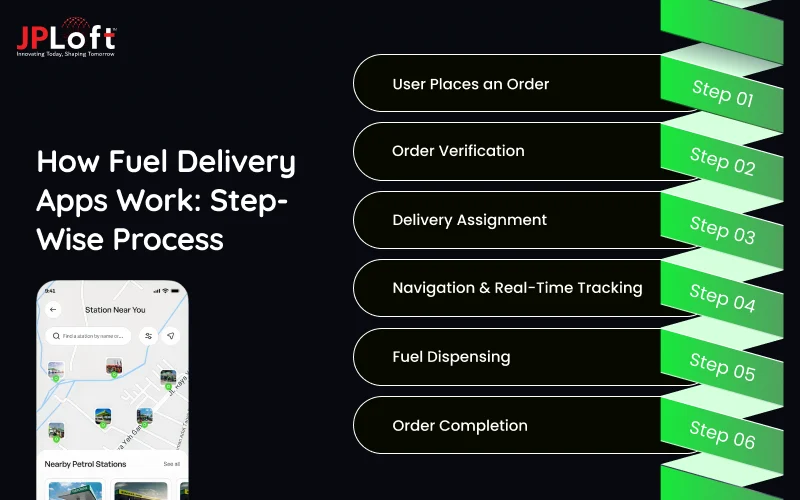
Here is how fuel delivery apps work, step by step.
Step 1: User Places an Order
Everything begins inside the mobile app.
The customer logs in to the fuel delivery app using their personal credentials. Most apps support multiple login methods such as email, phone number with OTP verification, or social sign-in.
Once logged in, the user lands on a dashboard showing fuel types, pricing per liter or gallon, and current availability.
Next, the customer selects:
-
Fuel type (Gasoline, Diesel, Premium variants, etc.)
-
Quantity required
-
Delivery location
The location can either be automatically detected through GPS or entered manually. Some apps allow users to save multiple addresses, such as home, office, warehouse, or fleet parking area.
After adding the delivery location, the app displays:
-
Estimated delivery time
-
Final price breakdown
-
Taxes and service charges
-
Safety compliance notes
Once the user reviews the details, they proceed to payment. Most fuel delivery apps support:
-
Credit/debit cards
-
UPI or digital wallets
-
Net banking
-
Corporate credit accounts
-
Subscription billing (for fleet operators)
After payment confirmation, the order is successfully placed. The user receives a digital receipt and order confirmation notification.
What this really means is the entire fuel ordering process takes less than two minutes from login to checkout.
Step 2: Order Verification
Once the order is placed, the system automatically moves to the fuel delivery app backend process verification.
This step ensures that every request is valid, compliant, and serviceable.
Here’s what happens behind the scenes:
1. Service Availability Check
The system checks whether the customer’s location falls within the service coverage area. Fuel delivery apps typically operate within predefined city zones or approved industrial areas.
2. Inventory Confirmation
The system verifies fuel availability in the nearest delivery vehicle or hub.
3. Compliance Validation
Since fuel is classified as a hazardous material, regulatory compliance is critical. The platform ensures:
-
The delivery vehicle is certified
-
The dispensing unit meets safety standards
-
The operator has valid documentation
4. Delivery Time Confirmation
The algorithm estimates delivery time based on:
-
Traffic conditions
-
Distance
-
Current vehicle availability
-
Weather conditions
Once validated, the order is approved and forwarded to the admin dashboard.
The customer receives:
-
Order confirmation notification
-
Estimated time of arrival
-
Assigned vehicle details
If service is unavailable, the user is informed instantly and refunded automatically.
This automated verification reduces delays and eliminates manual intervention.
Step 3: Delivery Assignment
Now comes the logistics intelligence.
The system identifies the nearest available fuel delivery vehicle using GPS tracking and real-time fleet management software.
Assignment is based on:
-
Distance from customer location
-
Fuel availability in the vehicle tank
-
Driver availability
-
Delivery load capacity
-
Route optimization factors
Once selected, the driver receives complete order details via their driver app, including:
-
Customer name
-
Contact details
-
Delivery address
-
Fuel type and quantity
-
Special instructions
The driver confirms acceptance of the order. If declined, the system reassigns it automatically to another nearby vehicle.
At this stage, both admin and customer can see:
-
Driver name
-
Vehicle ID
-
Estimated arrival time
This transparent assignment model improves accountability and efficiency.
Step 4: Navigation & Real-Time Tracking
After accepting the order, the driver begins navigation.
The driver app integrates with GPS and route optimization software. Instead of manually choosing a path, the system suggests the fastest and safest route.
Route optimization considers:
-
Live traffic conditions
-
Road closures
-
Restricted zones for hazardous vehicles
-
Delivery priority queue
Meanwhile, the customer can track the vehicle in real time.
The tracking screen typically shows:
-
Live map view
-
Estimated arrival time
-
Driver contact option
-
Order status updates
Push notifications keep the customer informed at every milestone:
-
Driver en route
-
Driver arriving soon
-
The driver has reached the location
This transparency eliminates uncertainty and builds trust.
Fleet managers also monitor deliveries from the admin dashboard. They can:
-
Track all vehicles live
-
Monitor fuel levels
-
Check delivery timelines
-
Analyze route efficiency
Real-time tracking is one of the most important features in modern fuel delivery apps. Supported by strong API integration for fuel delivery apps, it ensures accountability, improves safety, and enhances customer confidence.
Step 5: Fuel Dispensing
This is the operational core of the service.
Once the driver reaches the location, the app updates the status to Arrived.
Before dispensing fuel, the driver performs a few safety checks:
-
Verifies customer identity
-
Confirms fuel type and quantity
-
Checks dispensing equipment integrity
-
Ensures no ignition sources nearby
Fuel delivery vehicles are equipped with certified mobile dispensing units that meet regulatory standards. These units include:
-
Calibrated meters
-
Anti-static hoses
-
Emergency shut-off valves
-
Spill containment systems
The driver connects the dispensing nozzle to the vehicle’s fuel tank and begins refueling.
During dispensing:
-
The calibrated meter records the exact quantity
-
The system logs the transaction digitally
-
Safety protocols are maintained throughout
In many advanced apps, the meter is digitally integrated with the backend system. That means the quantity dispensed is automatically recorded in real time.
Once refueling is complete:
-
The driver disconnects the equipment
-
Seals the tank if required
-
Updates the app status
This step ensures accurate measurement, regulatory compliance, and safe delivery.
Step 6: Order Completion
After successful fuel dispensing, the system moves to order closure.
Here’s how the fuel delivery app working completes:
1. Digital Confirmation
The driver confirms completion in the app. The customer receives a notification stating the order has been successfully delivered.
2. Invoice Generation
A digital invoice is generated instantly. It includes:
-
Fuel type
-
Quantity delivered
-
Price per unit
-
Taxes
-
Total amount
-
Transaction ID
-
Delivery timestamp
The invoice is sent via:
-
In-app notification
-
Email
-
SMS
3. Payment Confirmation
If prepaid, the system confirms successful transaction settlement.
If payment-on-delivery is enabled, the driver collects payment digitally through POS or QR code.
4. Feedback & Rating
The customer is prompted to rate the service and provide feedback.
This feedback loop helps improve:
-
Driver performance
-
Delivery timing
-
App usability
-
Customer satisfaction
Once feedback is submitted, the order is officially closed in the system.
Hence, understanding how on demand fuel delivery apps operate helps businesses handle functioning easily and become profitable.
Monetization Models for Fuel Delivery Apps
Selecting the fuel delivery app monetization model is crucial for ensuring long-term profitability and operational sustainability in a business.
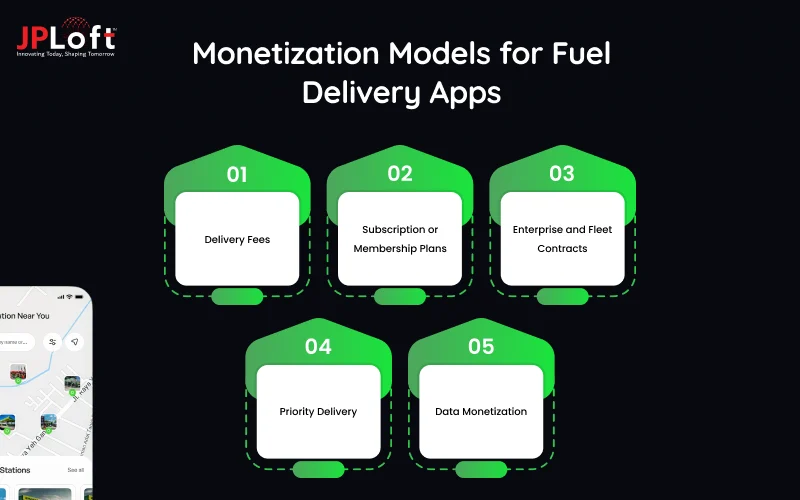
Below are key models explained in detail:
► Delivery Fees
Charging delivery fees is one of the most common and straightforward revenue models for fuel delivery apps. Customers pay a fixed, distance-based, or dynamic fee for doorstep fuel delivery services.
The pricing may vary depending on fuel quantity, delivery location, peak hours, or urgency of the request. Transparent pricing structures build trust and reduce disputes.
► Subscription or Membership Plans
Subscription or membership plans provide a consistent and predictable revenue stream for fuel delivery platforms. Customers can subscribe on a monthly or annual basis to receive exclusive benefits.
However, the benefits include free delivery, discounted service charges, priority booking, or reward points. This model increases customer retention and encourages frequent app usage.
► Enterprise and Fleet Contracts
Enterprise and fleet contracts offer significant revenue opportunities through long-term business partnerships. Companies managing fleets, delivery vehicles, taxis, or logistics operations require a consistent and reliable fuel supply.
By offering customized pricing, bulk fuel delivery, scheduled refueling, and consolidated billing systems, businesses can secure steady contracts. However, the integration of fleet management systems with fuel delivery apps further enhances transparency by providing real-time data.
► Priority Delivery
Priority delivery allows customers to pay an additional fee for faster or time-specific fuel delivery services. This monetization strategy is especially useful during emergencies or urgent operational needs.
Customers who require immediate refueling are often willing to pay extra for convenience and speed. Offering guaranteed time slots or express delivery options increases revenue per order.
► Data Monetization
Fuel delivery apps collect valuable data related to fuel consumption patterns, customer behavior, geographic demand trends, and peak usage times. This data can provide actionable insights for fuel suppliers, fleet operators, and logistics firms.
Businesses can generate additional revenue by offering analytical reports, trend insights, or strategic partnerships based on this information. However, it is essential to ensure compliance with data privacy regulations and maintain customer trust.
Challenges in On-Demand Fuel Delivery Apps & Their Solutions
On-demand fuel delivery apps operate in a highly regulated environment. Understanding the step by step fuel delivery app working process followed by the mobile app development company in USA helps businesses identify operational gaps and address these issues effectively.
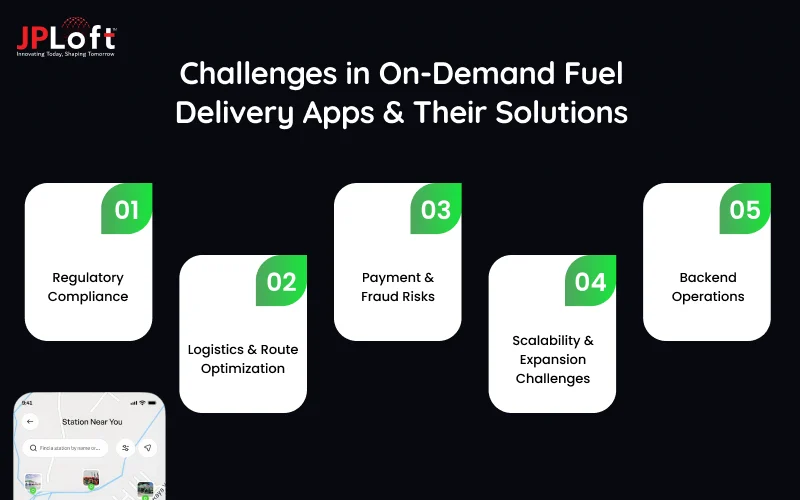
Below are some key challenges in fuel delivery apps explained clearly.
[A] Regulatory Compliance
Challenge: Fuel is a highly regulated commodity. Businesses must comply with government regulations on fuel storage, transportation, safety standards, and environmental policies.
Solution: Partner with legal experts, maintain licenses, conduct audits, and implement strict safety protocols with proper digital compliance documentation systems.
[B] Logistics & Route Optimization
Challenge: Efficient delivery depends on proper route planning and fuel demand forecasting. Traffic congestion, location accessibility, and last-mile challenges can delay deliveries.
Solution: Use GPS tracking, AI route optimization, real-time traffic data, and automated dispatch systems to improve delivery efficiency and reduce delays.
[C] Payment & Fraud Risks
Challenge: Handling online payments, refunds, and transaction security is another challenge. Fraudulent bookings, failed transactions, or chargebacks can impact revenue.
Solution: Integrate secure payment gateways, enable encryption, implement fraud-detection tools, and enable real-time transaction monitoring with automated refund controls.
To strengthen fuel delivery app security, integrate secure payment gateways, enable end-to-end encryption, implement fraud-detection tools, and enable real-time transaction monitoring.
[D] Scalability & Expansion Challenges
Challenge: Scaling a fuel delivery app from one city to multiple regions is complex. Each location may have different fuel regulations, licensing requirements, and safety standards.
Solution: Adopt scalable cloud infrastructure, modular architecture, standardized processes, and regional partnerships to support controlled growth across multiple cities.
[E] Backend Operations
Challenge: The fuel delivery app backend process is to manage orders, payments, inventory, route allocation, and customer data. Poor backend coordination can cause incorrect fuel quantity updates, deployed dispatch, or billing errors.
Solution: Hire mobile app developers to implement integrated backend systems, including ERP, IoT tracking, and automation to ensure accurate inventory, dispatch, and billing management.
Future Trends in On-Demand Fuel Delivery Apps
The fuel delivery industry is growing fast with changing customer expectations. Businesses must stay updated with emerging fuel delivery app trends to remain competitive and improve operational efficiency.
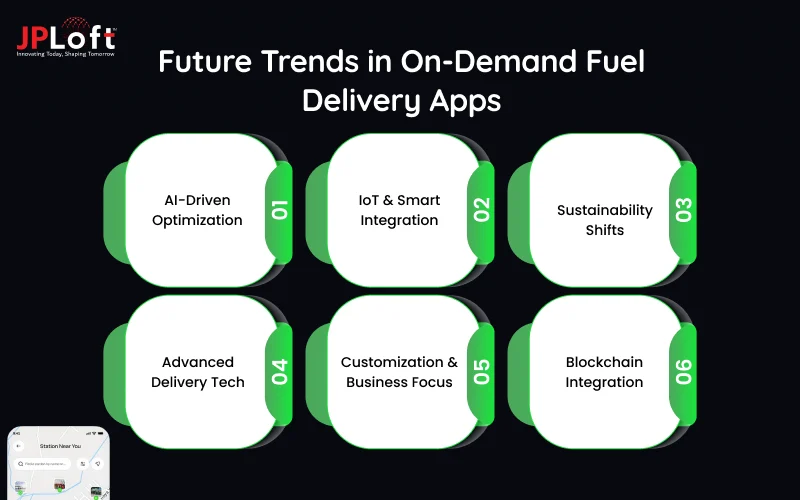
Let us discuss this in detail.
1. AI-Driven Optimization
AI is transforming fuel delivery operations through smart forecasting, route optimization, and predictive maintenance.
AI algorithms analyze customer behavior, traffic patterns, and fuel consumption trends to improve delivery accuracy.
2. IoT & Smart Integration
IoT in fuel delivery app development plays a crucial role in enhancing operational transparency and automation. It helps monitor fuel levels, vehicle movement, and storage conditions.
Smart tank monitoring systems automatically trigger refill requests when fuel levels drop. However, this improves transparency and reduces manual errors.
3. Sustainability Shifts
Environmental awareness is increasing, and fuel delivery companies are adopting eco-friendly practices.
This includes optimized routes to reduce emissions, electric vehicles, and improved handling systems.
4. Advanced Delivery Tech
Advanced technologies such as drone monitoring, automated dispatch systems, and smart fleet management platforms are improving delivery precision.
Real-time tracking dashboards provide better visibility for both operators and customers.
5. Customization & Business Focus
Future fuel delivery apps will offer more personalized services based on customer needs.
Businesses can provide tailored pricing, flexible scheduling, subscription plans, and dedicated enterprise dashboards.
6. Blockchain Integration
Blockchain in fuel delivery apps is emerging as a powerful tool for improving transparency and security in operations.
This helps businesses track fuel supply from source to delivery, improving accountability and operational transparency.
Why Choose JPLoft for On-Demand Fuel Delivery Apps?
Choosing the right fuel delivery app development company is critical when building a scalable on-demand platform. JPLoft combines deep industry expertise with the latest technologies to deliver high-performance solutions that drive growth and customer satisfaction.
Our team specializes in developing fuel delivery apps using modern frontend frameworks like React, Vue.js, and Flutter. They ensure fast, responsive, and intuitive user interfaces across both web and mobile devices.
For the fuel delivery app backend process, we use powerful technologies such as Node.js, Python, and Golang to build scalable, secure, and efficient API-driven architectures. To support real-time features like live tracking and route optimization, we integrate WebSockets, GraphQL, and Firebase services.
Moreover, for data management and analytics, we use PostgreSQL, MongoDB, and Redis, enabling reliable performance and high throughput. Thus, with a focus on security, automation, and user-centric design, JPLoft delivers future-ready apps for your business goals.
Conclusion
Building a successful on-demand fuel delivery app requires more than just launching a platform. It is important to understand how dispatching, safety compliance, real-time tracking, and smooth digital operations work together within a well-structured fuel delivery app process flow.
A strong system ensures timely deliveries, secure transactions, and proper regulatory adherence. Without the right structure, managing operations across multiple regions can become complex and risky.
JPLoft creates enterprise-level fuel delivery app solutions designed for B2B companies and fleet-based businesses.
The platforms we build support multi-location operations, real-time monitoring, and secure admin control panels that help businesses manage fuel supply efficiently and safely.
If you are planning to start or expand your fuel delivery business, expert guidance at the early stage can make a big difference.
With the right technology foundation, your fuel delivery platform can grow confidently and meet both business and regulatory requirements.
FAQs
An on demand fuel delivery app works efficiently by using real-time order management, GPS tracking, automated order assignment, and secure payment systems. The backend system assigns the nearest delivery vehicle, optimizes routes, processes payments instantly, and updates order status for a smooth delivery.
Fuel delivery apps generate revenue through delivery fees, subscription plans, enterprise and fleet contracts, priority delivery charges, and data insights. These models help businesses create a steady income while offering convenience and value-added services to customers.
Major challenges include regulatory compliance, route optimization, payment security risks, backend coordination, and scaling across multiple cities. Businesses must ensure safety standards, efficient logistics, secure transactions, and strong backend systems to manage operations smoothly.
Fuel delivery apps consist of four main components: a customer app for placing orders, a delivery partner app for managing deliveries, an admin dashboard for business control, and a backend system that handles real-time data, payments, and order assignment.
Future trends include AI-driven route optimization, IoT-based fuel monitoring, sustainable practices, advanced fleet technology, and personalized business solutions. These innovations help improve efficiency, safety, and customer experience in fuel delivery operations.

Savannah is a passionate tech enthusiast with a sharp understanding of client needs across diverse digital domains. With expertise spanning financial platforms, on-demand solutions, and emerging technologies, she brings a unique blend of analytical insight and interpersonal skills, helping businesses decode complexities and make informed decisions in today's rapidly evolving digital world.


Share this blog