


Key Takeaways
The courier delivery app development cost typically ranges from $8,000 to $90,000+, based on project scope and complexity.
Features, integrations, platform choice, and app architecture are the biggest drivers of total development cost.
Starting with an MVP helps businesses validate demand while reducing initial investment and launch risk.
Hidden post-launch expenses like hosting, maintenance, and API fees should always be included in budget planning.
Partnering with JPLoft experts ensures cost-effective development, scalable architecture, and faster project execution.
Fast delivery is no longer a bonus. It is now what customers expect from every business.
From local courier startups to large logistics brands, many companies now invest in courier delivery apps to manage orders, track drivers, and improve delivery speed. These apps help businesses reduce manual work and offer better customer service.
But one important question comes first. How much does courier delivery app development cost in 2026?
Generally, the app’s features, design, platform, and development team all affect the final budget. A simple courier app may cost far less than a large-scale delivery platform with advanced tools.
If you want to build a courier app, this guide will help you estimate costs with confidence. You will learn what impacts pricing, how features change the budget, and what businesses should plan before starting development.
Why Businesses are Investing in Courier Delivery Apps?
The global delivery as a service market is growing rapidly and is expected to reach $1,172.67 billion by 2032. More businesses now use digital platforms to manage shipping, courier, and last-mile delivery services.
Rising eCommerce demand and customer expectations continue to drive this growth. As the market expands, many startups and enterprises are exploring the logistics app development cost to enter this space. This trend shows strong long-term potential for courier app investments.
Average Courier Delivery App Development Cost in 2026
The average parcel delivery app development cost in 2026 usually ranges between $8,000 and $90,000+. The final budget depends on your app’s complexity, feature set, number of user panels, and integration needs.
A basic MVP with core delivery features costs far less than an enterprise-grade courier platform with automation, analytics, and advanced route optimization. Most businesses build a courier app MVP and scale features later to control budget wisely.
Let’s break down the final cost based on the app types:
|
App Type |
Estimated Cost |
Best For |
Typical Features |
|
Basic / MVP |
$8,000 – $20,000 |
Startups and small businesses |
User login, booking, tracking, notifications |
|
Mid-Level App |
$20,000 – $50,000 |
Growing courier businesses |
Live tracking, payments, driver panel, analytics |
|
Advanced App |
$50,000 – $90,000+ |
Large logistics brands |
AI dispatch, route optimization, multi-admin panel, ERP/CRM integrations |
Choosing the right app level depends on your business stage, delivery volume, and long-term growth plan.
Feature-Wise Cost Breakdown of Courier Delivery Apps
The total cost to build courier delivery app solutions depends heavily on the app features you include. Each function adds to design, development, testing, and integration efforts.
Basic features keep costs lower and help businesses launch faster. Advanced tools increase the budget but improve automation, scalability, and customer experience.
Below is a feature-wise breakdown to help you understand where your development budget goes.
|
App Feature |
Estimated Cost |
Why It Matters |
|
User Registration & Login |
$500 – $1,500 |
Enables secure account access |
|
Order Booking & Scheduling |
$1,000 – $3,000 |
Let users place delivery requests |
|
Real-Time Tracking |
$500 – $6,000 |
Helps users track the courier's location live |
|
Push Notifications |
$800 – $2,000 |
Sends order and delivery updates |
|
Payment Gateway Integration |
$1,500 – $4,000 |
Supports secure online payments |
|
Driver Panel |
$2,000 – $5,000 |
Helps drivers manage deliveries |
|
Admin Dashboard |
$3,000 – $8,000 |
Centralizes operations and analytics |
|
Route Optimization |
$1,000 – $6,000 |
Improves delivery efficiency |
|
In-App Chat/Support |
$1,500 – $4,000 |
Enhances communication |
|
Analytics & Reports |
$2,000 – $5,000 |
Tracks business performance |
|
Multi-Language |
$2,000 – $6,000 |
Supports global expansion |
Factors Affecting Courier Delivery App Development Cost
Several factors influence the final logistics software development cost. Each project requirement affects the budget differently based on complexity, scale, and technical needs.
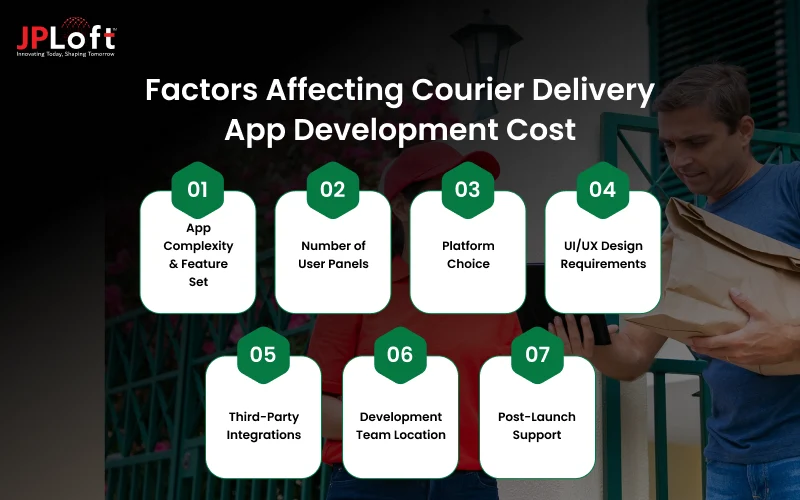
Understanding these app development cost drivers helps businesses estimate investment more accurately and plan development with fewer surprises.
1. App Complexity & Feature Set
The more advanced your app becomes, the higher the development budget will be. Basic apps need fewer resources, while advanced features require more coding, testing, and backend support.
Cost Impact: $5,000 to $30,000+
2. Number of User Panels
Courier apps often include separate panels for users, drivers, admins, and vendors. Each panel requires its own workflows, screens, and backend logic to function properly.
Cost Impact: $3,000 to $15,000+
3. Platform Choice
Building for one platform costs less than launching on both Android and iOS. Multi-platform development increases design, coding, and testing efforts.
Cost Impact: $4,000 to $20,000+
4. UI/UX Design Requirements
Custom app design work improves branding and user experience, but adds more design and frontend development effort. Interactive visuals also increase implementation time.
Cost Impact: $2,000 to $10,000+
5. Third-Party Integrations
Adding maps, payment systems, SMS alerts, or CRM tools increases development work. Some integrations also include monthly or usage-based charges.
Cost Impact: $2,000 to $12,000+
6. Development Team Location
Developer pricing changes based on region and agency expertise. Teams in premium markets usually charge more for similar project scopes.
Cost Impact: Can vary by 30%–60% overall
7. Post-Launch Support
Post-launch support includes updates, bug fixes, hosting, and security monitoring. Such app maintenance cost is important for long-term app performance.
Cost Impact: 15%–20% of development cost annually
Hidden Costs to Consider Beyond Development
Building your courier app is only the beginning of the investment journey. After launch, several ongoing and hidden costs can affect your total project budget over time.
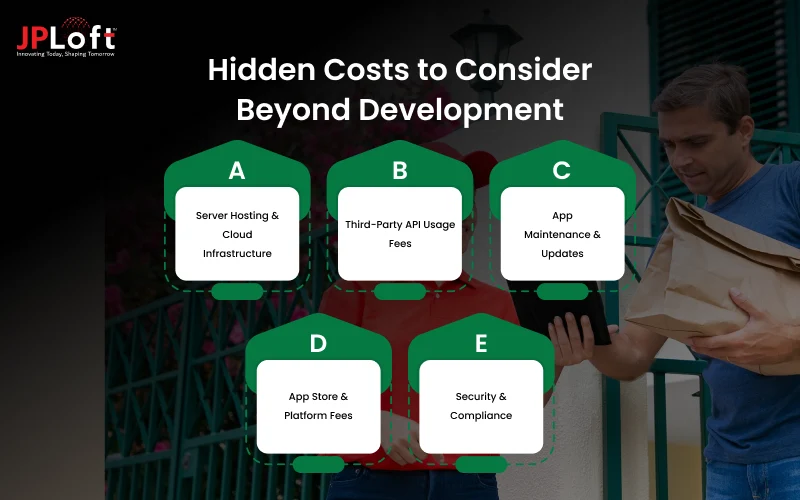
Businesses can take the help of a custom mobile app development company USA to plan for these expenses early. Hence, they can manage their finances and avoid unexpected operational challenges later.
[A] Server Hosting & Cloud Infrastructure
Courier apps need cloud servers to store user data, process orders, and manage live tracking. Hosting supports the backend systems that keep the app running smoothly every day.
As your business grows, traffic and storage needs also increase. This raises your monthly infrastructure expenses over time.
Cost Impact: $100 to $1,000+ per month
[B]Third-Party API Usage Fees
Most courier apps use third-party services for maps, SMS alerts, payment processing, and push notifications. These services improve app functionality but often charge recurring fees.
The cost to develop a courier delivery app may depend on usage volume, API calls, or subscription plans. Higher delivery volumes usually lead to higher monthly charges.
Cost Impact: $200 to $2,000+ per month
[C] App Maintenance & Updates
After launch, your app needs regular updates to fix bugs and improve performance. Maintenance services also ensure compatibility with new operating system versions.
Without proper support, user experience may decline over time. Ongoing maintenance helps keep the platform stable and secure.
Cost Impact: 15%–20% of development cost annually
[D] App Store & Platform Fees
Publishing apps on app stores may include registration or renewal charges. Payment gateways also deduct fees from every completed transaction.
Though smaller than development costs, these charges add up over time. Businesses should include them in financial planning.
Cost Impact: $100 to $500+ annually / transaction fees
[E] Security & Compliance
Courier apps handling customer and payment data need strong security systems. Businesses may need encryption, audits, and compliance checks to protect user information.
App security costs grow as the platform scales and handles more sensitive data. Strong protection reduces long-term business risk.
Cost Impact: $500 to $5,000+ annually
How Long Does It Take to Build a Courier Delivery App?
The time needed to build a courier delivery app depends on project scope, features, and complexity. A basic MVP usually takes around 2 to 3 months, while a mid-level courier platform may require 3 to 5 months for full development.
Advanced enterprise-grade courier apps with custom integrations and automation features can take 5 to 8+ months to complete. Proper planning, clear requirements, and an experienced development team can help reduce delays and improve the app development timeline.
Cost to Build MVP vs Full-Scale Courier App
Businesses often start with an MVP to test the market before making a larger investment. An MVP includes only the core features needed to launch quickly and validate demand.
A full-scale courier platform includes advanced tools, deeper integrations, and better scalability for long-term growth. Choosing between the two depends on your budget, business stage, and expansion goals.
|
Factor |
MVP Courier App |
Full-Scale Courier App |
|
Estimated Cost |
$8,000 – $20,000 |
$50,000 – $90,000+ |
|
Development Timeline |
2 – 3 Months |
5 – 8+ Months |
|
Core Purpose |
Validate the idea quickly |
Launch scalable production-ready platform |
|
Feature Scope |
Essential features only |
Advanced and enterprise-grade features |
|
User Panels |
Basic customer/admin/driver panels |
Multi-role panels with advanced permissions |
|
Integrations |
Limited third-party integrations |
Full API and enterprise integrations |
|
Scalability |
Moderate |
High |
|
Maintenance Need |
Lower initially |
Higher due to complexity |
|
Best For |
Startups and early-stage businesses |
Enterprises and scaling logistics companies |
Starting with an MVP is often the smarter choice for startups that want to reduce risk and test product-market fit before scaling.
How to Reduce the Cost to Create a Courier App?
Reducing courier mobile app development pricing does not mean compromising on app quality. It means making smarter product and technical decisions during planning and execution.
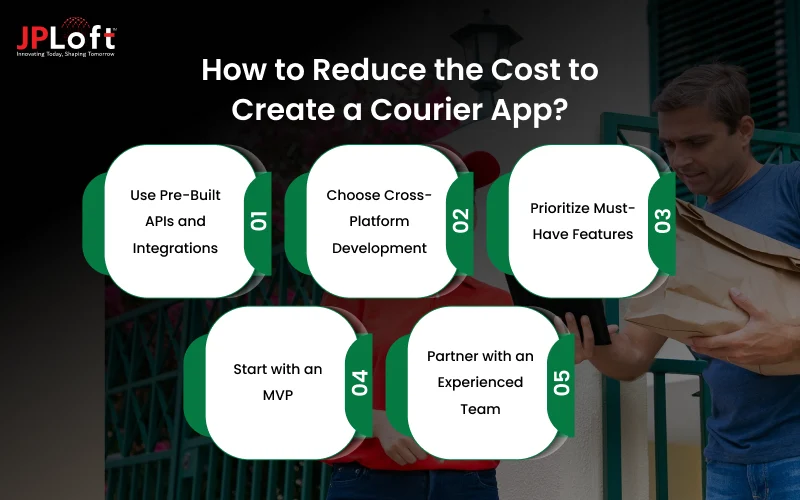
Businesses that follow a strategic development approach can lower expenses while still building a scalable and reliable courier platform.
[1] Use Pre-Built APIs and Integrations
Instead of building every function from scratch, businesses can use existing APIs for maps, payments, notifications, and messaging. This reduces custom development work.
Pre-built integrations also lower testing time and speed up deployment. They are often more cost-effective than custom-built modules.
Potential Cost Savings: 10%–25%
[2] Choose Cross-Platform Development
Building one codebase for both Android and iOS reduces separate development efforts. This approach lowers design, coding, and testing costs compared to native app builds.
It also speeds up launch timelines and simplifies future maintenance. Cross-platform frameworks are ideal for many startup-stage courier apps.
Potential Cost Savings: 20%–40%
[3] Prioritize Must-Have Features
Adding too many features in the first version increases the cost to make a courier delivery app. Businesses should focus on core functions that directly support app usability and operations.
Keeping the first release lean helps reduce complexity and improve time to market. Extra features can be introduced later based on feedback.
Potential Cost Savings: 15%–35%
[4] Start with an MVP
Launching with an MVP helps businesses reduce on demand app development cost by focusing only on essential features needed. This reduces development time and avoids spending on features users may not need initially.
Once the product is validated, additional features can be added in future updates. This phased approach lowers initial investment and reduces launch risk.
Potential Cost Savings: 30%–50%
[5] Partner with an Experienced Team
An experienced app development company can help avoid costly mistakes, delays, and rework. Skilled teams improve planning, execution, and code quality from the start.
While expert agencies may charge more initially, they often reduce long-term costs through efficient delivery and better architecture.
Potential Cost Savings: 15%–30% Long-Term
These strategies help businesses control on demand courier app development cost while ensuring long-term product scalability and performance.

Why Choose JPLoft for Cost-Effective Courier Delivery Apps?
Choosing the right development partner plays a major role in your app’s success and long-term ROI. At JPLoft, we deliver reliable and scalable courier delivery app development services tailored to your business goals and budget.
Our team combines industry expertise with strategic planning to build courier apps that balance performance, user experience, and cost efficiency. We help businesses launch faster by prioritizing essential features and choosing the right tech stack from day one.
Whether you need an MVP or a full-scale logistics platform, JPLoft offers flexible development models for every stage of growth. Our experts focus on transparent pricing, efficient execution, and future-ready architecture to maximize your investment.
From live tracking and route optimization to admin dashboards and custom integrations, we build complete courier solutions designed for scalability. With JPLoft, you gain a trusted technology partner committed to turning your courier app idea into a profitable digital product.
Conclusion
The courier industry is becoming more digital, faster, and more competitive every year. Businesses that invest in the right technology today can build stronger delivery operations for the future.
Understanding the courier app development cost is not just about setting a budget. It is about making smart decisions that align with your business goals, growth plans, and customer expectations.
From MVP launches to enterprise-grade logistics platforms, every feature and development choice impacts your final investment. That is why careful planning matters before starting the project.
A well-built courier app can streamline operations, improve delivery speed, boost customer trust, and create long-term value for your business. The real advantage comes from building a solution that balances cost, performance, and scalability.
With the right strategy and expert development partner, your courier app can become a powerful engine for business growth in 2026 and beyond.
FAQs
The average cost ranges from $8,000 to $90,000+, depending on features, complexity, platform, and development team.
Major cost factors include app complexity, number of user panels, platform choice, integrations, UI/UX design, and maintenance needs.
A courier delivery app usually takes 2 to 8+ months, depending on feature scope and development complexity.
Yes, launching with an MVP helps businesses reduce initial investment, validate demand, and scale gradually.
Post-launch costs may include hosting, maintenance, API fees, security updates, and app store charges.
Businesses can lower the cost to build a courier delivery app by starting with an MVP, using cross-platform development, and prioritizing essential features.

Kris Jacobs brings 20+ years of experience in digital product strategy, user-focused design, and solving complex product challenges. She has worked across on-demand services, travel, entertainment, sports, insurance, education, and service marketplaces, including handyman, dog-walking, courier, event-management, and equine platforms. Her focus is on shaping practical, scalable digital experiences that align user needs with business goals and long-term product growth.




Share this blog