


Key Takeaways
The cost to build an IoT app ranges from $20,000 to $300,000+ based on features, complexity, and connected devices.
Development timelines vary from 2 to 10+ months depending on app scope and scalability requirements.
Starting with an MVP is the most cost-effective way to test and launch an IoT app idea.
Factors like integrations, backend systems, and security significantly increase overall development costs.
Building an MVP first helps reduce risk and allows gradual scaling based on real user feedback.
Businesses across the world are investing in smart solutions to improve operations, reduce costs, and deliver better user experiences today. The demand for connected apps is growing fast.
However, this makes understanding the IoT app development cost more important than ever.
In 2026, the cost of an IoT app can vary widely based on features, complexity, and the number of connected devices involved.
A simple app may cost much less, while advanced systems with real-time data and automation can require a larger budget. Many business owners struggle to estimate the right budget because hidden factors often increase the final cost during development stages.
Without clear planning, companies may overspend or delay their product launch timelines.
This guide will help you understand pricing, key cost factors, and smart ways to plan your IoT app investment with confidence.
What is the Cost to Create an IoT App?
Understanding the Internet of Things app development cost helps business owners plan budgets clearly and avoid unexpected expenses during product development stages. On average, the custom IoT app development cost usually ranges from $20,000 to $300,000+.
The effective cost depends on several important factors like complexity, number of users, and integration requirements.
IoT apps connect devices, collect data, and help businesses make faster decisions in real time. However, building such systems requires careful planning, because even small mistakes in the early stages can increase costs later.
Let’s understand the effective development cost of a mobile app with the table below:
|
App Level |
Estimated Cost |
Timeline |
Best For |
|
Basic App |
$20,000 – $50,000 |
2–3 months |
Startups, MVPs |
|
Mid-Level App |
$50,000 – $150,000 |
3–6 months |
Growing businesses |
|
Enterprise App |
$150,000 – $300,000+ |
6–10+ months |
Large-scale solutions |
Key Factors that Influence the Cost to Develop an IoT App
Before starting development, it is important to understand how different factors affect your overall budget and planning decisions.
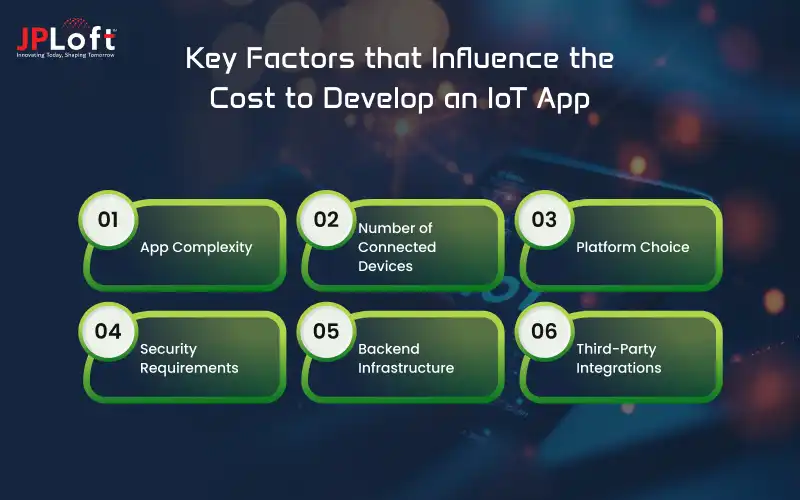
Each factor can increase or reduce your final app cost depending on your business needs and product scope.
|
Factor |
Cost Impact |
Why It Affects Cost |
|
App Complexity |
$10,000 – $100,000+ |
More features require more time and effort |
|
Connected Devices |
$5,000 – $80,000+ |
More devices increase integration and testing work |
|
Platform |
$10,000 – $70,000 |
Multiple platforms need separate development |
|
Backend Infrastructure |
$15,000 – $120,000+ |
Handles data processing and scaling |
|
Third-Party Integrations |
$5,000 – $50,000 |
External services require setup and support |
|
Security Requirements |
$10,000 – $90,000+ |
Strong protection adds complexity |
Let us now discuss these key factors in detail.
1. App Complexity
App complexity plays a major role in determining development cost because more features require extra coding, testing, and planning efforts. A simple app includes basic controls, while advanced solutions offer automation, analytics, and real-time processing.
2. Number of Connected Devices
The number of devices connected to your system directly affects development effort and testing requirements. Each device needs a proper communication setup, data handling, and performance checks.
3. Platform Choice
Platform selection significantly impacts costs because IoT ecosystems often require interfaces across mobile apps, web dashboards, and device control panels. Developing separate platforms increases both engineering effort and the cost to hire dedicated developers.
4. Security Requirements
App security is critical in IoT because sensitive data flows between devices, servers, and users constantly. Businesses must consider IoT security costs while planning development, since features require additional effort but help protect data and build long-term trust.
5. Backend Infrastructure
A strong backend is essential for handling data, managing users, and ensuring smooth app performance at scale. IoT apps rely heavily on cloud infrastructure IoT systems to process and store large volumes of data.
6. Third-Party Integrations
Many apps rely on external services like payment systems, analytics tools, and cloud platforms to improve functionality. The overall cost increases when multiple integrations are required, as each service needs setup, testing, and ongoing maintenance.
Cost Breakdown by App Development Stages
Businesses can effectively plan a budget if they know how costs are distributed across each stage to develop an IoT app. Each phase plays a critical role in building a stable and scalable IoT solution.
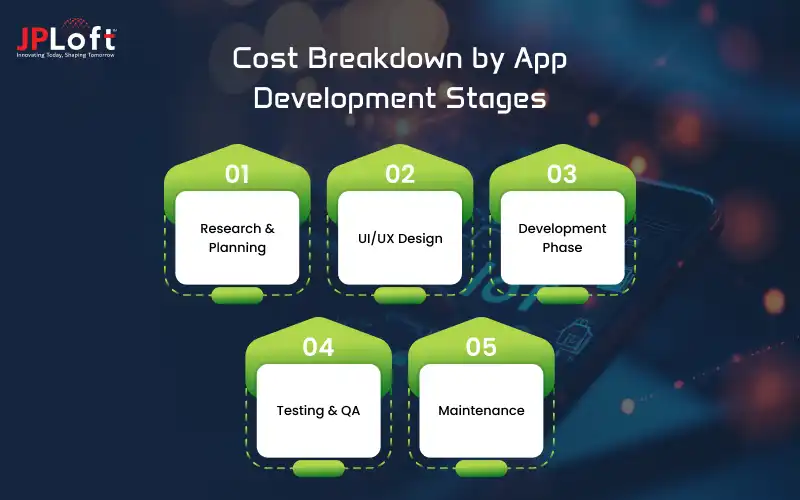
[A] Research & Planning
This stage focuses on understanding business goals, user needs, and technical requirements before development begins. Teams define features, timelines, and overall structure to ensure smooth execution from the start.
Proper market research and planning help reduce risks and prevent costly changes later in development. It also gives businesses a clear roadmap, which improves decision-making and keeps the project aligned with long-term goals.
Cost Contribution - 10% – 15%
[B] UI/UX Design
Designers create layouts, wireframes, and visual elements that shape how users interact with the application. A simple and clear design improves usability and helps users complete tasks easily.
Good UI/UX design services also build trust and keep users engaged for a longer time. Investing in user-friendly interfaces can improve customer satisfaction and support business growth over time.
Cost Contribution - 10% – 20%
[C] Development Phase
This is the core stage where developers build the app, including user interfaces and backend systems. Most of the budget is spent here due to coding, integrations, and system setup.
The IoT app cost is highest during this phase because of real-time data handling, device communication, and scalability requirements. Strong development ensures long-term performance and reliability.
Cost Contribution - 40% – 55%
[D] Testing & QA
App testing ensures that the platform works properly without bugs or performance issues. Teams check functionality, speed, and compatibility across devices before launch.
A well-tested product reduces the chances of failure and improves user experience. It also helps businesses avoid extra costs to make an IoT app that may arise from fixing issues after deployment.
Cost Contribution - 10% – 15%
[E] Maintenance
Maintenance includes regular updates, bug fixes, and performance improvements after the app is launched. It is an ongoing process that keeps the system stable and up to date.
Businesses must plan for long-term support to handle new features, security updates, and user feedback. Continuous app maintenance helps the app stay competitive and useful in the market.
Cost Contribution - 15% – 25% (annual)
Cost to Create an IoT App based on Industry
The IoT app development pricing can vary based on the industry you choose, because each use case has different requirements, features, and complexity levels.
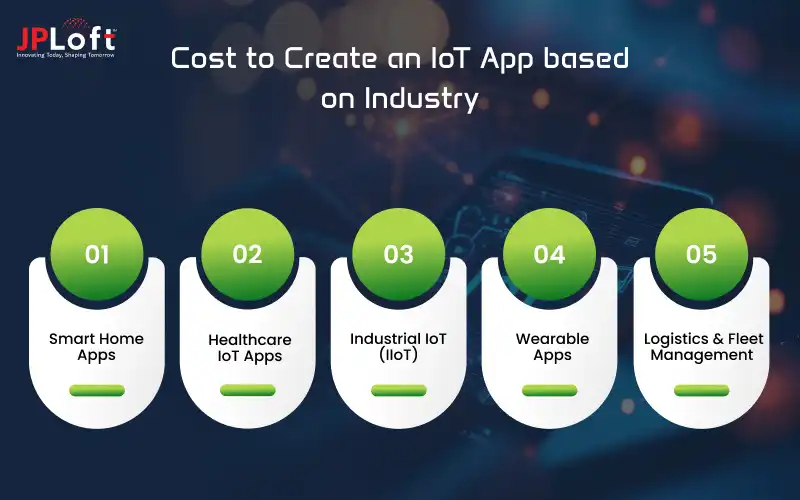
Some apps need simple device control, while others require real-time monitoring, automation, and high-level security.
► Smart Home Apps
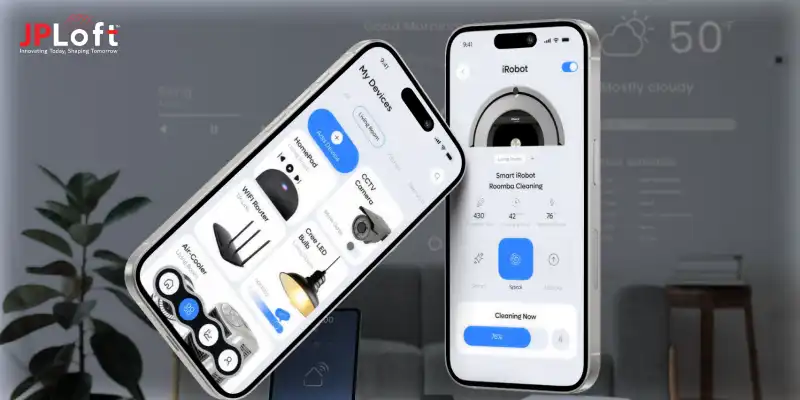
Smart home apps focus on controlling devices like lights, cameras, and appliances from a single dashboard. These apps are easier to build compared to complex systems and require moderate integrations.
Estimated Cost: $30,000 – $120,000+
► Healthcare IoT Apps
Healthcare apps handle sensitive data and require strong security, real-time monitoring, and compliance with regulations. These apps often connect with medical devices and provide critical insights.
Estimated Cost: $80,000 – $250,000+
► Industrial IoT (IIoT)
Industrial IoT apps are used in manufacturing and operations to monitor machines, improve efficiency, and reduce downtime. These apps require advanced analytics and large-scale data processing.
Estimated Cost: $100,000 – $300,000+
► Wearable Apps
Wearable apps connect with devices like fitness trackers and smartwatches to collect user data. These apps focus on user experience, real-time tracking, and device synchronization.
Estimated Cost: $40,000 – $150,000+
► Logistics & Fleet Management
These apps help businesses track vehicles, manage routes, and monitor deliveries in real time. They require GPS tracking, data processing, and system integration.
Estimated Cost: $60,000 – $200,000+
Hidden Costs of Developing an IoT Application
Many businesses focus only on initial development, but hidden expenses can increase the overall budget over time. Understanding the IoT development cost early helps you plan better and avoid surprises during scaling and long-term usage.
|
Cost Factor |
Estimated Cost Range |
Why It Matters |
|
Cloud Infrastructure |
$500 – $5,000+/month |
IoT apps rely on cloud servers to process and manage real-time data from connected devices efficiently. |
|
Connected Devices Cost |
$10 – $200 per device |
Hardware devices like sensors and gateways add upfront and scaling costs based on quantity and quality. |
|
API & Integrations |
$5,000 – $30,000 |
Third-party services require setup, testing, and ongoing updates to ensure smooth communication between systems. |
|
Maintenance & Updates |
15% – 25% of total cost/year |
Regular updates, bug fixes, and performance improvements are needed to keep the app running smoothly. |
|
Data Storage |
$200 – $3,000+/month |
IoT apps generate large volumes of data, which requires secure and scalable storage solutions. |
How to Reduce the Cost to Develop an IoT App?
Reducing the cost to make an IoT app is not about cutting important features, but making smarter decisions during planning and execution.
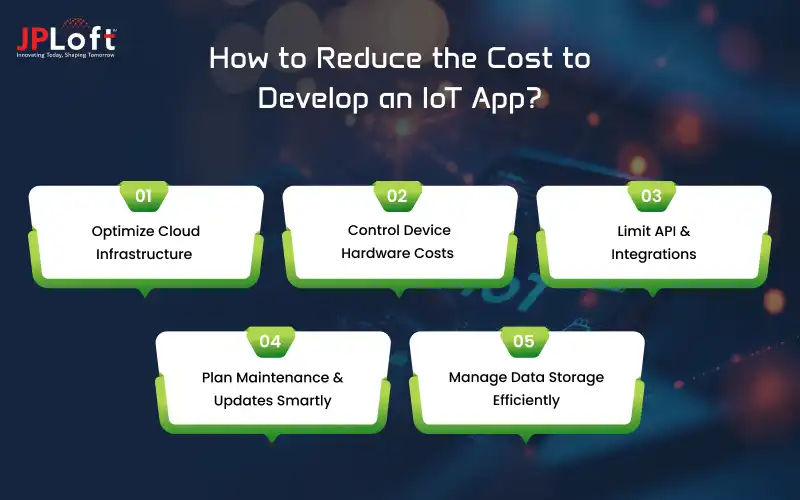
Businesses can take the help of a professional app development company in UK to save a significant portion of their total investment while still building a scalable product.
1. Optimize Cloud Infrastructure
Choose only the services you need instead of paying for full-scale setups from the beginning. Start small and scale gradually as your users grow. This approach reduces cloud infrastructure IoT expenses and prevents unnecessary spending on unused server resources and storage.
-
Save 20% – 40%
2. Control Device Hardware Costs
Select cost-effective devices that meet your core requirements without adding extra features. Start with a limited number of devices to test your product. This strategy helps reduce the cost of connected devices and avoids heavy upfront investment during early development stages.
-
Save 15% – 35%
3. Limit API & Integrations
Use only essential third-party services during the initial phase of development. Too many integrations increase complexity and cost. By adding features step by step, businesses can control device integration cost and keep the system simple and easier to manage.
-
Save 10% – 30%
4. Plan Maintenance & Updates Smartly
Instead of frequent updates, focus on planned releases based on user needs and business priorities. Fix critical issues first and delay non-essential updates. This approach helps reduce ongoing maintenance expenses and ensures better use of development resources over time.
-
Save 10% – 25%
5. Manage Data Storage Efficiently
Store only useful and relevant data while removing outdated information regularly. Optimizing storage reduces long-term costs and improves system performance. Efficient data handling is important when dealing with real-time data processing IoT systems that generate large volumes of information.
-
Save 15% – 35%
By following these strategies, businesses can significantly reduce overall development costs while still delivering a reliable and high-performing IoT application.
How JPLoft Can Help Businesses in the IoT App Journey?
Turning an IoT idea into a real product needs the right partner who understands both technology and business goals clearly. JPLoft, an experienced IoT app development company, helps businesses build scalable applications with a clear and result-driven approach from day one.
The team works closely with you to define features, choose the right tech stack, and create a strong development plan. This helps avoid delays, reduces risks, and ensures your product meets market expectations without unnecessary complexity.
JPLoft also focuses on optimizing the IoT app development cost by using efficient development methods and prioritizing features that deliver real business value. This approach helps you launch faster while staying within your budget.
From design to deployment and ongoing support, JPLoft ensures smooth execution at every stage. Thus, helping your business grow with a reliable and future-ready IoT solution.
Final Words
The IoT application development cost typically ranges between $20,000 and $300,000+, depending on your product vision, features, and scalability goals. Businesses that understand these cost drivers early can avoid overspending and build solutions that deliver long-term value instead of short-term results.
From selecting the right industry use case to planning each development stage and managing hidden expenses, every decision directly impacts your final budget and product success. A structured approach helps you balance performance, security, and user experience without adding unnecessary complexity or cost.
Focusing on smart cost strategies like phased development, controlled integrations, and efficient infrastructure can improve your overall return on investment. Instead of building everything at once, successful businesses launch MVPs first and scale based on real user feedback.
However, choosing the right development partner ensures faster delivery, better quality, and optimized costs while building a future-ready IoT solution.
FAQs
The IoT app development cost 2026 usually ranges from $20,000 to $300,000+, depending on features, complexity, and connected devices. Simple apps cost less, while advanced solutions with real-time data and automation require higher investment and longer development time.
Developing an IoT app typically takes 2 to 10+ months based on the app’s complexity and features. Basic apps can be built quickly, while enterprise-level solutions with integrations and scalability require more time for development and testing.
The cheapest way is to start with an MVP, use cross-platform development, and include only essential features. This approach reduces initial costs and allows you to test your idea before investing in advanced functionality.
Factors like app complexity, number of connected devices, backend infrastructure, third-party integrations, and security requirements increase the overall cost. More advanced features and scalability needs require higher development effort and budget.
Yes, building an MVP is the best way to start. It includes only core features, reduces development cost, and helps validate your idea quickly before scaling into a full-featured IoT application.

Rahul Sukhwal is the CEO and Founder of JPLoft, a visionary technologist with 18+ years at the forefront of emerging tech innovation and software engineering. He channels deep software engineering and AI expertise into building smarter, scalable solutions that shape how forward-thinking businesses worldwide harness the true power of AI.


Share this blog