


Key Takeaway:
Begin by defining a clear business model, then select the right features and follow a structured courier app development guide to ensure a successful launch.
Developing a courier delivery app typically ranges from $8,000 to $90,000+, depending on features and scalability requirements.
Must-have features include user registration, real-time tracking, secure payments, notifications, route optimization, and an admin dashboard.
App complexity, features, design, platform choice, and the development team significantly influence the overall development cost.
Partner with JPLoft to build a scalable, high-performance courier app backed by expert developers and proven industry experience.
The demand for on-demand delivery solutions is growing rapidly, making courier apps a crucial part of modern logistics.
Recent market insights reveal that the global courier, express, and parcel market was valued at $956.19 billion in 2025 and is expected to reach $2,976.01 billion by 2033.
Businesses are increasingly investing in digital solutions to stay competitive and efficient. This is where a well-planned courier delivery app development guide becomes essential.
It helps you understand market trends, user expectations, and the right technologies needed to build a scalable platform.
So, in this blog, you will explore a complete roadmap to build a successful courier app, including features, cost, tech stack, and development steps.
What is the Courier Delivery App?
A courier delivery app is a digital platform that connects users, businesses, and delivery agents to enable fast and efficient parcel delivery.
It allows customers to schedule pickups, track shipments in real time, and make secure payments, all from their smartphones.
For businesses looking to build an on-demand courier delivery app, it is a powerful solution for streamlining operations, reducing manual effort, and improving customer satisfaction.
With features like live tracking, route optimization, and instant notifications, these apps ensure seamless communication and quicker deliveries in the convenience-driven market.
Courier Industry Market Growth: Facts & Figures
The courier industry is experiencing rapid growth, driven by e-commerce expansion and rising demand for faster deliveries.
Here are some key market statistics that highlight its strong momentum:
-
The global courier and delivery services market is expected to grow at a CAGR of 5.8% between 2024 and 2034.
-
East Asia is projected to generate revenue of around US$153.87 billion by 2034.
-
Meanwhile, South Korea’s market is expected to grow at a steady CAGR of 5.8% over the same period.
These statistics clearly show that the courier industry is evolving rapidly, offering immense opportunities for businesses to invest in innovative delivery solutions.
How Do Courier Delivery Apps Work?
Courier delivery apps streamline the entire logistics process, making deliveries faster, more efficient, and user-friendly. Understanding their workflow is essential when planning how to develop a courier delivery app.
-
User Registration: Customers and agents sign up and manage profiles.
-
Order Placement: Users enter pickup, delivery details, and schedule shipments.
-
Agent Allocation: The system assigns the nearest delivery partner.
-
Live Tracking: Real-time GPS tracking with instant updates.
-
Secure Payments: Multiple payment options for convenience.
-
Route Optimization: Efficient routes for faster delivery.
-
Delivery Confirmation: Final status update with user feedback.
If you aim to make an on-demand courier delivery app, focusing on these essential steps will help you create an app that is reliable, scalable, and high-performing.
Why Should You Invest in a Courier Delivery App?
Investing in a courier delivery app is a strategic move to stay competitive in today’s fast-paced, on-demand economy.
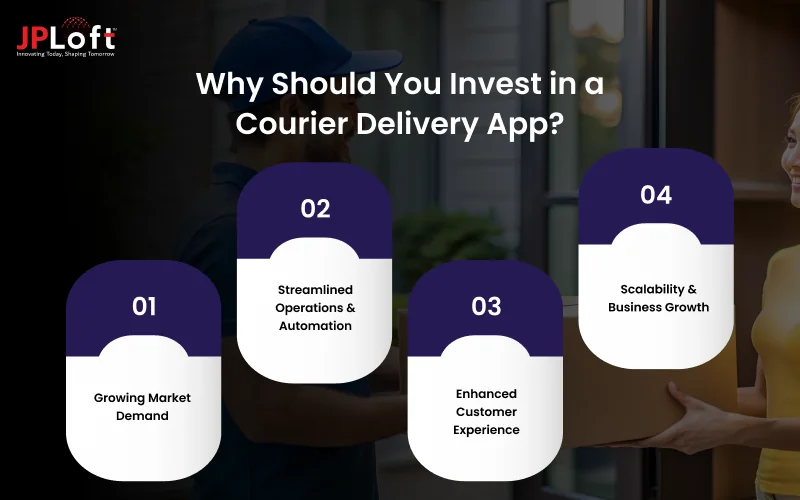
Here’s why it makes business sense:
1. Growing Market Demand
With the rise of eCommerce and instant delivery expectations, businesses need efficient logistics solutions. A solid courier delivery app development guide helps you tap into this growing market.
2. Streamlined Operations & Automation
Courier apps automate order management, dispatching, and tracking, reducing manual work. Understanding the courier delivery app development process improves efficiency and lowers costs.
3. Enhanced Customer Experience
Real-time tracking, notifications, and secure payments boost user satisfaction. While learning how to build a courier delivery app, focusing on user experience gives you a competitive edge.
4. Scalability & Business Growth
Courier apps enable easy scalability for startups and enterprises. Partnering with a trusted courier delivery app development company like JPLoft ensures long-term growth.
Investing in a courier app helps you build a future-ready business focused on speed, efficiency, and customer satisfaction.
Major Types of Courier Delivery Apps
Understanding the different types of courier delivery apps is essential when following a complete guide to courier delivery app development.
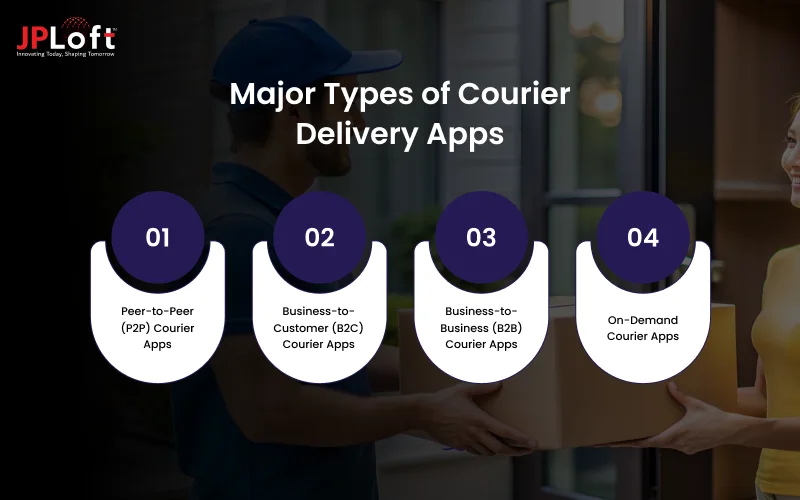
Each type serves a unique business model and target audience, helping you decide the right approach based on your goals.
Type 1: Peer-to-Peer (P2P) Courier Apps
These apps connect individuals who want to send packages with nearby travelers or drivers. This model offers a cost-effective and flexible delivery solution, especially for short-distance or urgent shipments.
Type 2: Business-to-Customer (B2C) Courier Apps
Designed for businesses to deliver products directly to customers, this is one of the most common models. Many companies develop an on-demand courier delivery app using this approach to streamline eCommerce logistics.
Type 3: Business-to-Business (B2B) Courier Apps
These apps focus on bulk deliveries between businesses, such as wholesalers and retailers. They require advanced features like route optimization and inventory integration. This ensures efficient and timely large-scale deliveries.
Type 4: On-Demand Courier Apps
These apps offer instant or same-day delivery services, allowing users to send packages anytime. Businesses aiming for app development should prioritize speed, real-time tracking, and seamless user experience.
Choosing the right type depends on your business model, target audience, and long-term goals, making it a crucial step in building a successful courier delivery solution.
Key Features Every Courier App Should Include
While understanding how to develop a courier delivery app, defining the right mobile app features set is critical. A successful courier app is not just about moving packages, it’s about delivering speed, transparency, and reliability through technology.
Below are the essential and advanced features:
|
Feature |
Description |
Why It Matters |
|
User Registration & Profiles |
Simple sign-up/login via email, phone, or social media |
Makes onboarding quick and personalized |
|
Real-Time Tracking |
Live GPS tracking of packages and delivery agents |
Builds trust and keeps users informed |
|
Order Booking System |
Easy interface to schedule pickups and deliveries |
Enhances convenience and user satisfaction |
|
Multiple Payment Options |
Supports cards, UPI, wallets, and COD |
Offers flexibility and increases conversions |
|
Push Notifications |
Alerts for order status, delays, and confirmations |
Keeps users engaged and updated |
|
Route Optimization |
AI-based route planning for faster deliveries |
Reduces delivery time and fuel costs |
|
In-App Chat/Support |
Communication between users and delivery agents |
Improves transparency and resolves issues quickly |
|
Admin Dashboard |
Centralized panel to manage orders, users, and analytics |
Enables smooth business operations |
|
AI-Based Delivery Time Estimation |
Predicts accurate delivery times using historical and real-time data |
Enhances user trust and planning |
|
Multi-Language Support |
Offers app interface in multiple languages |
Expands reach to diverse user bases |
A well-designed solution that combines these capabilities will make it easier to build a courier delivery app that meets modern logistics demands and drives long-term success.
How to Develop a Courier Delivery App in 2026?
Building a successful courier platform requires a strategic approach, the right technology, and a clear understanding of user needs.
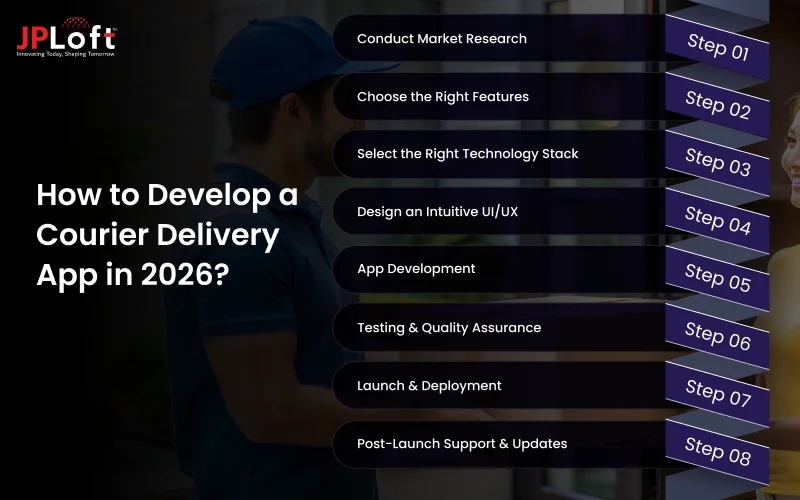
This courier app development guide will walk you through the essential steps to help in creating a delivery app that is scalable, efficient, and user-friendly.
Step 1: Conduct Market Research
Analyze competitors, user expectations, and trends. Market research helps you understand what features and services are essential if you want to build a courier delivery app that stands out.
-
Study competitor apps and their features
-
Identify target audience needs and pain points
-
Analyze current market trends and demand
Step 2: Choose the Right Features
Include must-have features like user registration, real-time tracking, push notifications, payment integration, route optimization, and admin dashboards. A feature-rich app is key to any courier and parcel delivery app development guide.
-
Define core and advanced features
-
Prioritize user-centric functionalities
-
Plan admin and delivery panel features
Step 3: Select the Right Technology Stack
Choose the right mobile app tech stack that ensures scalability and performance, such as robust backend frameworks, cloud integration, and GPS tracking systems. This is crucial when planning how to make a courier delivery app that handles real-time operations efficiently.
-
Select frontend and backend technologies
-
Integrate APIs for maps and payments
-
Ensure scalability with cloud solutions
Step 4: Design an Intuitive UI/UX
Focus on creating a simple, engaging, and user-friendly interface for customers, delivery agents, and admins. Leveraging professional UI/UX design services ensures a seamless and visually appealing experience. A well-crafted design enhances user experience and improves retention.
-
Create wireframes and prototypes
-
Focus on simple navigation and usability
-
Ensure consistent and appealing design
Step 5: App Development
Start the actual development process by building the frontend, backend, and integrating all essential features and APIs. This is the core phase where you create an on-demand courier delivery app that is fully functional and ready for real-world use.
-
Develop user, admin, and delivery panels
-
Integrate APIs for payments, maps, and notifications
-
Follow agile development for faster delivery
Step 6: Testing & Quality Assurance
Thorough mobile app testing for bugs, performance issues, and security vulnerabilities. This ensures a smooth and reliable user experience. It also helps identify and fix potential issues early, ensuring your app performs flawlessly after launch.
-
Perform functional and performance testing
-
Fix bugs and security issues
-
Ensure smooth app performance
Step 7: Launch & Deployment
Deploy your app on platforms like iOS and Android. Make sure your app is optimized for performance and ready to handle real users. Carefully plan your release strategy to successfully launch an app on the App Store and publish the app to Google Play Store and reach your target audience effectively.
-
Prepare app store listings and assets
-
Optimize app performance before launch
-
Plan marketing and launch strategy
Step 8: Post-Launch Support & Updates
After launch, continuously monitor performance, gather user feedback, offer app maintenance services, and release updates. Ongoing improvements are essential to build an on-demand courier delivery app that stays competitive.
-
Monitor app performance and analytics
-
Collect and implement user feedback
-
Release regular updates and improvements
By following this structured courier app development guide, businesses can confidently move from idea to execution and build a powerful courier solution that meets modern delivery demands.
How Much Does It Cost to Build a Courier and Parcel Delivery App?
The cost to develop a courier and parcel delivery app typically ranges between $8,000 to $90,000+, depending on various factors like features, complexity, and development approach. Here’s a quick breakdown:
-
Basic App ($8,000 – $20,000): Includes core features like user registration, order placement, and simple tracking.
-
Mid-Level App ($20,000 – $50,000): Adds real-time tracking, payment integration, notifications, and better UI/UX.
-
Advanced App ($50,000 – $90,000+): Includes AI-based features, route optimization, analytics dashboard, and high scalability.
The final mobile app development cost may vary based on your business requirements, platform (iOS/Android), and the development team you choose.
Final Wrap-Up
Building a courier app today is a smart investment for businesses aiming to stay competitive in the on-demand economy. From understanding market trends to selecting the right features and technology, every step plays a crucial role in success.
This courier delivery app development guide has outlined the key aspects you need to consider, including app types, development steps, features, and cost estimation.
By following a structured approach, businesses can create scalable, user-friendly, and efficient courier solutions. Partnering with an experienced development company further ensures smooth execution and long-term growth.
With the right strategy and execution, a courier delivery app can significantly enhance operations, improve customer satisfaction, and drive business success in today’s fast-paced digital landscape.
FAQs
Define your business model, choose key features, select the right tech stack, develop, test, and launch the app with regular updates.
Essential features include user registration, real-time tracking, payment integration, push notifications, route optimization, and an admin dashboard.
Common types include peer-to-peer (P2P), business-to-customer (B2C), business-to-business (B2B), on-demand, and aggregator courier apps, each serving different business needs.
The cost to build a courier delivery app typically ranges from $8,000 to $90,000+, depending on features, app complexity, design, platform, and development team expertise.
The development time usually ranges from 2 to 6+ months, depending on app complexity, features, and development approach.

Kris Jacobs brings 20+ years of experience solving complex digital product challenges through strategic thinking and user-centric design. With deep exposure to on-demand services, entertainment, travel, and interactive platforms, she collaborates across teams to shape scalable, engaging solutions that align business goals with intuitive user experiences across evolving digital landscapes.


Share this blog