


Key Takeaways
The cost to build an app like Fuelio ranges from $15,000 to $80,000+, depending on features, tech stack, and scalability, making MVP-first development the smartest approach.
A structured process, from market research to UI/UX design, tech stack selection, and agile development, ensures your app is scalable, user-friendly, and ready for real-world usage.
Core features like fuel tracking, mileage calculation, expense insights, GPS fuel finder, and reminders are essential to turn your app into a daily-use utility.
Handling issues like user habit drop-off, offline functionality, accurate fuel data, and multi-vehicle management is key to creating a reliable and trusted app.
Fuel apps generate revenue through freemium models, subscriptions, ads, and partnerships, ensuring steady income without compromising user experience.
Simple UI, fast logging, and data-driven insights are what make users stick, making UX a critical factor in the success of any Fuelio-like app.
Fuelio has changed the way drivers track fuel and manage their vehicle expenses.
What once felt like a manual chore is now a smart, data-driven habit powered by intuitive apps.
That’s exactly why how to develop an app like Fuelio is becoming a key focus for entrepreneurs looking to build practical, high-demand solutions in 2026.
After all, the app turned a boring habit, tracking fuel, into something people actually look forward to checking.
And there's a massive market still waiting to be tapped.
This guide breaks down everything. Features, tech stack, costs, monetization, all of it, without the fluff.
Let's build a fuel tracking app like Fuelio, something people actually use:
What is Fuelio and How Does It Work?
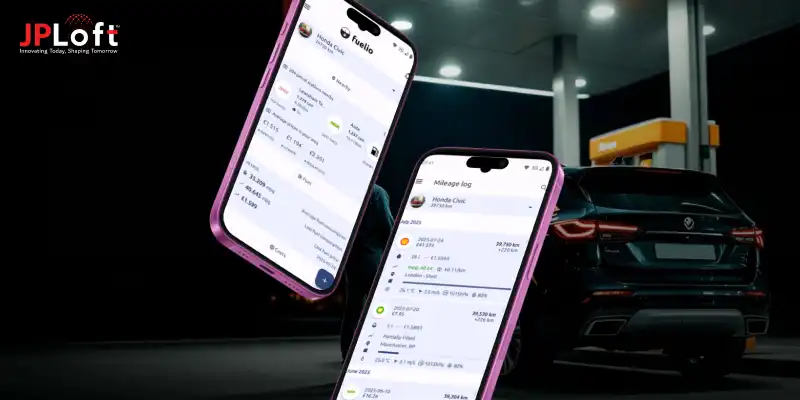
Fuelio is a mobile-based fuel tracking app that gives drivers a complete picture of their vehicle's running costs.
At its core, Fuelio works like a smart logbook; users manually or automatically log each fuel fill-up, including the date, mileage, fuel type, liters filled, and price paid.
Every time you fill up, you log it. Liters added, price paid, current mileage, all done in under 30 seconds.
Then the magic happens.
The app starts calculating fuel consumption, cost per kilometer, & monthly spending trends. It turns users' boring receipts into a dashboard that actually tells you something useful.
But a fuel tracking app like Fuelio doesn't stop at fuel.
Servicing costs, tire replacements, insurance renewals, and more are all offered in the app, making it a fuel vehicle expense manager, not just a mileage counter.
There's also a built-in fuel station finder. It uses GPS to show you nearby stations and their prices, so you're never paying more than you have to.
What makes it work so well?
There is no learning curve, no unnecessary step; all you have to do is open the app, log fuel consumption, and close it. Over time, it builds a history that helps you spot problems before they become expensive ones.
That's Fuelio. Simple on the surface. genuinely powerful underneath. This is why, when many businesses focus on creating a fuel delivery app, they take Fuelio as an inspiration.
Why Build an App Like Fuelio in 2026?
The timing couldn't be better.
Rising vehicle ownership, global fuel price volatility, and a growing culture of personal finance tracking have created the perfect storm for fuel management apps to thrive.
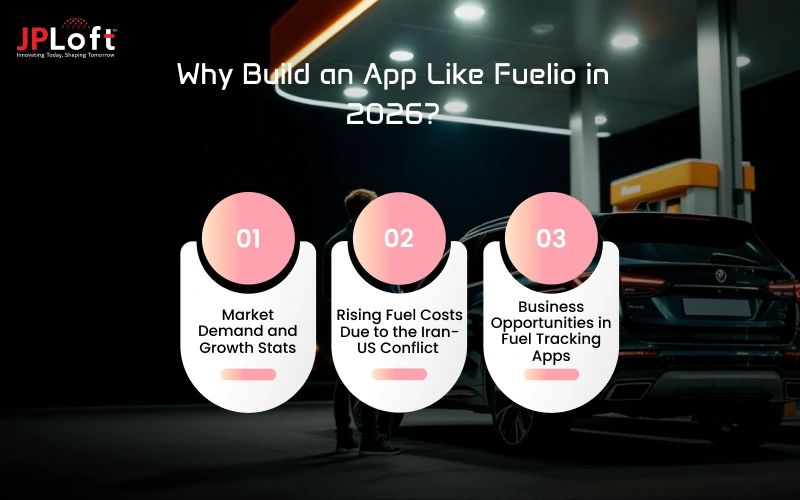
If you're considering building a fuel tracking app like Fuelio, here's exactly why 2026 is the year to do it:
1. Market Demand and Growth Stats
The numbers don't lie.
The global vehicle telematics market is on track to cross $170.43 billion by 2030.
Fuel management apps have seen consistent download growth, especially in Asia, Latin America, and Eastern Europe, where fuel costs hit harder.
There are 1.4 billion registered vehicles in the world. And most of those drivers have zero visibility into what their car actually costs them each month.
That's not a niche. That's a massive underserved market, and it's growing every year.
2. Rising Fuel Costs Due to the Iran-US Conflict
Fuel prices were already climbing. Then the US-Israel war on Iran hit in March 2026, and everything spiked overnight.
Global oil prices surged by over 25%. The Strait of Hormuz, carrying a fifth of the world's oil, was choked shut.
Drivers panicked. Then they got smart. They started comparing stations, tracking consumption, and logging every fill-up.
That habit? That's your user base, already formed, already motivated.
3. Business Opportunities in Fuel Tracking Apps
Having a fuel app like Fuelio can open new doors of monetization.
With your own app, you can charge a monthly fee for premium analytics and multi-vehicle support and earn money.
Besides, partner with fuel brands and auto service providers for affiliate income. Build a B2B tier for small fleet operators and logistics businesses.
Layer in contextual ads from insurance and car care brands, and suddenly you have four revenue streams from one app.
Most successful fuel apps hit consistent recurring revenue within 12 to 18 months of launch. These models are tried and tested; all you need is the right execution.
Key Features to Have in an App Like Fuelio
To build an app like Fuelio, you need the right features that attract users.
This is why your feature list decides everything: how fast you launch, how much you spend, and whether users actually stick around after day three.
Here are the needed fuel delivery app features that belong to your app:
|
Feature |
Description |
|
User Profile |
Sign up, manage personal & vehicle details |
|
Fuel Tracking |
Log fuel entries with price, quantity & mileage |
|
Mileage Calculator |
Track fuel efficiency automatically |
|
Expense Tracking |
Monitor fuel & maintenance costs |
|
Dashboard |
View usage, spending & insights in one place |
|
Reminders |
Alerts for refueling & servicing |
|
GPS & Fuel Finder |
Locate nearby fuel stations |
|
Cloud Sync |
Backup & access data across devices |
|
AI Insights |
Smart predictions & spending analysis |
|
Multi-Vehicle Support |
Manage multiple vehicles easily |
What this really means is you’re not just building a fuel tracker. You’re building a smart system that understands user behavior and helps them make better decisions every day.
Key Development Steps to Build an App Like Fuelio
If you want to understand how to develop an app like Fuelio, it all comes down to following the right steps in the right order without skipping the ones that actually matter.
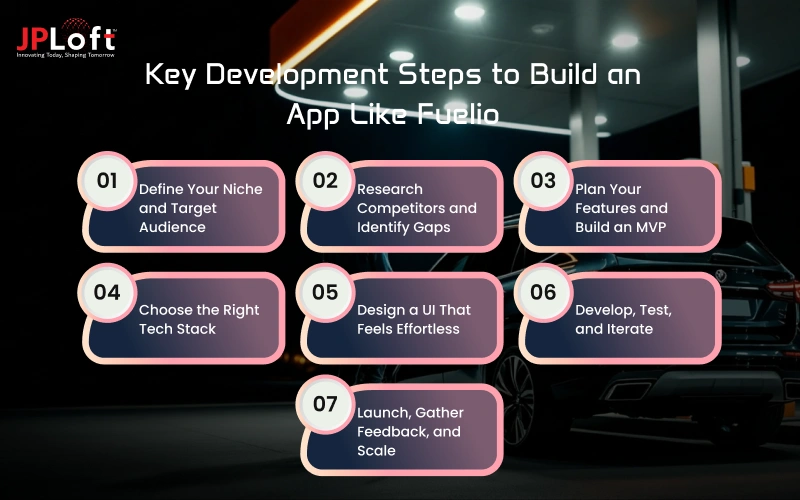
Here's the exact roadmap:
Step 1: Define Your Niche and Target Audience
Before a single line of code gets written, stop and ask one question: Who exactly is this app for?
Everyday commuters tracking personal fuel costs? Or small fleet owners managing 10 vehicles? Know your audience to build what they actually want.
The Fuelio app development process always starts here, with clarity, not code. Your audience shapes everything. Features, UI, pricing, even the way push notifications are worded.
Get this wrong, and you'll build a technically solid app that nobody actually wants.
Step 2: Research Competitors and Identify Gaps
Fuelio is good. It isn't perfect.
Do a thorough market research for your audience. Study your competitors to develop a better app.
Especially, study the top performer fuel apps reviews, especially the one-star ones. That's where frustrated users tell you exactly what's missing.
When you create an app like Fuelio, your goal isn't to copy what exists. It's to spot the gaps nobody has filled yet, and build straight into them.
Maybe it’s a better UI, maybe it’s smarter alerts, maybe it’s regional fuel price accuracy. Once you find the gap, own it.
Step 3: Plan Your Features and Build an MVP
You don't launch with everything. You launch with enough to be genuinely useful, and nothing more.
List every feature you want. Then cut it in half. That's your MVP.
To make an app like Fuelio, your MVP should cover fuel logging, consumption tracking, basic expense management, and a GPS fuel station finder. That's the core loop. Everything else comes later.
This approach saves money, cuts your launch timeline, and most importantly, gets real user feedback before you over-invest in features nobody asked for.
Step 4: Choose the Right Tech Stack
Picking the right fuel app tech stack decision affects your speed, your cost, and your app's long-term scalability.
For most teams looking to develop an app like Fuelio, React Native or Flutter are the smart choices for the frontend, one codebase, both iOS and Android covered.
For the backend, Node.js or Python with a PostgreSQL or Firebase database handles fuel data, user accounts, and real-time sync without breaking a sweat.
For GPS and maps, use Google Maps API or Mapbox. For fuel price data feeds, integrate third-party APIs like GasBuddy or local government fuel price databases, depending on your target market.
Pick for scalability. Not just for today.
Step 5: Design a UI That Feels Effortless
Fuel tracking only works if logging a fill-up takes under 30 seconds. The moment it feels like a chore, users stop. And once they stop, they don't come back.
When you make an app like Fuelio, you need to focus on fuel app designing services, including speed and ease, so users can log fuel in seconds.
Big input fields, minimal steps, and smart defaults that remember their last fuel type and station.
Your dashboard should surface the three numbers users care about most: consumption, spend this month, and cost per km, without them having to dig for it.
Clean, fast, obvious – That’s the standard.
Step 6: Develop, Test, and Iterate
This is where the actual Fuelio app development process happens, and where most teams either get it right or quietly fall apart.
Build in sprints, two weeks at a time. Each sprint delivers something testable and real.
Test your app thoroughly, not just for bugs for usability. Put the app in front of people who have never seen it and watch where they get confused. Those moments are gold.
Iterate fast. The version you launch with will look nothing like the version you planned. That's not failure, that's how good apps are built.
Step 7: Launch, Gather Feedback, and Scale
Launch day isn't the finish line. It's the starting gun.
Push your app live on the App Store and Google Play. Drive your first users through communities, car forums, Reddit threads, Facebook driving groups, and regional auto blogs.
Then listen harder than you've ever listened.
What are users loving? What's frustrating them? What feature are they requesting over and over?
The teams that successfully create an app like Fuelio treat their first 500 users like co-founders. Their feedback shapes the roadmap. Their retention tells you what’s actually working.
One of the important things to never avoid is app maintenance services. Scale what sticks, cut what doesn’t, and keep shining.
How Much Does it Cost to Build an App Like Fuelio?
The cost to make an app like Fuelio can go from $15,000- $80,000+.
From basic mileage tracking to advanced analytics and real-time insights, every feature adds value and impacts the budget.
The fuel app development cost isn’t just a number; it’s a reflection of how powerful and user-friendly you want your app to be.
A well-built fuel tracking app doesn’t just log expenses; it helps users save money, optimize usage, and make smarter driving decisions, making the investment truly worth it.
|
App Version |
Features Included |
Development Timeline |
Estimated Cost |
|
Basic MVP |
Fuel logs, mileage tracking, basic reports, simple UI |
1–2 Months |
$15,000 – $25,000 |
|
Standard App |
Advanced analytics, reminders, cloud sync, multi-device support |
2–4 Months |
$20,000 – $40,000 |
|
Advanced App |
GPS tracking, expense insights, smart alerts, and detailed reports |
4–6 Months |
$40,000 – $60,000 |
|
Fully Scalable App |
AI insights, third-party integrations, real-time sync, premium features |
6–8 Months |
$60,000 – $80,000+ |
Note: The final cost may vary based on design complexity, integrations, and the development team you choose.
Challenges and Solutions When Building a Fuel Tracking App Like Fuelio
No app worth building comes without its hard parts.
When you build a fuel tracking app like Fuelio, you'll hit walls. Technical ones, design ones, business ones.
The developers who succeed aren't the ones who avoid these challenges; they're the ones who saw them coming.
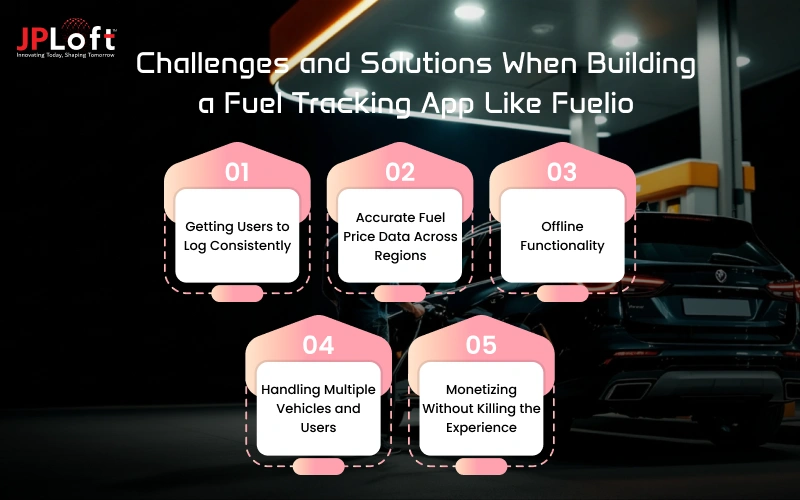
Here's what to expect. And exactly how to handle it.
Challenge 1: Getting Users to Log Consistently
The biggest killer of fuel tracking apps isn't bad code. It's a habit drop-off.
Users log their first two fill-ups excitedly. Then life happens. They forget. The data gaps. The app becomes useless.
Solution: Make logging feel automatic. Smart reminders triggered by location — so when a user pulls into a fuel station, the app nudges them instantly. Pre-fill last known fuel type, last station, and last price range. The less they have to type, the more they actually do it.
Challenge 2: Accurate Fuel Price Data Across Regions
Fuel prices change daily. Sometimes hourly. Showing outdated prices doesn't just frustrate users; it destroys trust.
Solution: Anyone looking to develop a fuel tracking app like Fuelio needs reliable data pipelines from day one.
Integrate third-party APIs, GasBuddy for the US, and government-published feeds for South Asian markets. Layer in crowdsourced price reporting from your own users. Fresh data, always.
Challenge 3: Offline Functionality
Drivers are often in areas with zero connectivity, rural highways, underground parking, and remote roads. If your app needs the internet to log a fill-up, it's already failed half your users.
Solution: Build offline-first from day one. Every entry gets stored locally and syncs automatically the moment connectivity returns. The user never notices. The app never misses a data point.
Challenge 4: Handling Multiple Vehicles and Users
One user, three cars, one family account- this sounds simple until you’re building it.
Data bleeds between vehicles. Reports become meaningless. Hence, the UX collapses under the weight of edge cases nobody planned for.
Solution: Anyone trying to make a fuel tracking app like Fuelio needs to design a clean multi-vehicle architecture early, not as an afterthought.
Each vehicle gets its own isolated data profile. Switching between them should take one tap. Fleet mode needs its own permission layer entirely.
Challenge 5: Monetizing Without Killing the Experience
Slap too many ads in, and users leave. Make everything paid, and nobody downloads. Get the balance wrong, and you've built a product with no revenue and no retention.
Solution: Lead with a genuinely useful free tier, core logging, basic stats, and one vehicle. Then make the premium tier irresistible.
Users who get real value from the free version convert naturally. If you want to build an app like Fuelio that actually makes money, don't rush the monetization. Earn it first.
How Fuelio-Like Apps Make Money?
Understanding Fuel app monetization models is essential to turning your app into a profitable product.
Fuel tracking and fuel-related apps generate revenue by offering useful features that enhance convenience, insights, and user experience without overwhelming users.
Some common ways to make money include:
-
Freemium Model: Basic features are free, while advanced analytics and reports are paid
-
In-App Ads: Display relevant ads to generate passive income
-
Subscription Plans: Monthly or yearly plans for premium features
-
Affiliate Partnerships: Earn commissions by partnering with fuel stations or service providers
-
Data Insights (Anonymized): Offer analytics to businesses for market insights
The right mix of these strategies ensures steady revenue while keeping users engaged.

How JPLoft Can Help You Develop an App Like Fuelio?
A great fuel tracking app isn’t built with code alone; it’s built around user habits.
At JPLoft, a fuel tracking app development company, we turn your idea into a practical, easy-to-use app like Fuelio that users keep coming back to.
From idea validation to post-launch scaling, our team ensures every stage of development is aligned with performance, usability, and long-term growth.
We have delivered several fuel apps and fuel tracking apps, such as 2U Fuel, Juiced Fuel, and Stay Fueled.
What You Get with JPLoft:
-
End-to-End Development: From concept to launch, we handle everything, including UI/UX, backend, APIs, and deployment.
-
Custom Feature Development: We build tailored features like fuel analytics, GPS tracking, expense insights, and smart alerts.
-
Scalable Tech Architecture: Apps built to handle growth, real-time data, and multi-device sync without performance issues
-
User-Centric Design: Clean, intuitive interfaces designed for fast logging and effortless navigation
-
Third-Party Integrations: Seamless integration with maps, fuel price APIs, payment gateways, and cloud services
-
Post-Launch Support: Continuous updates, maintenance, and feature enhancements based on user feedback
Why Choose JPLoft?
-
15+ years of experience in app development
-
1100+ successful projects delivered
-
Expertise in building data-driven and utility-based apps
-
Agile development process with faster time-to-market
-
Marketing and Branding of Dating Apps as Well
We don’t just build apps, we build products that users come back to every day.
Conclusion
Creating a fuel tracking app today isn’t just about technology; it’s about building a tool that becomes part of users’ everyday routine.
From smart fuel logs to real-time insights and cost optimization, the demand is only growing.
If you’re exploring how to create an app like Fuelio, the key lies in focusing on user behavior, simplicity, and scalable features.
Start with a strong MVP, listen to your users, and evolve based on real feedback.
With the right strategy and execution, your app can stand out in a market that’s still far from saturated and full of long-term potential.
FAQs
It usually takes 2 to 6 months, depending on features, complexity, and development approach.
The cost ranges between $15,000 to $80,000+ based on features and scalability requirements.
Fuel logs, mileage tracking, expense tracking, GPS integration, and analytics are must-have features.
Yes, using cross-platform technologies like Flutter or React Native can help you target both platforms efficiently.
They generate revenue through subscriptions, in-app ads, affiliate partnerships, and premium features.

Savannah Bustos is a technology professional with experience across financial platforms, mobility solutions, and on-demand digital products. Her areas of expertise include FinTech, digital banking, eWallets, lending, BNPL, stock trading, fuel delivery, and taxi-booking platforms. She combines a strong understanding of business requirements with practical technology insight, helping companies evaluate challenges, define product needs, and make informed decisions about scalable digital solutions.


Share this blog