



Key Takeaways
IoT app development costs range from $20,000 to $300,000+ based on features and complexity.
Development time usually takes 3 to 9 months, depending on integrations and system requirements.
Security, connectivity, and scalability are the main challenges to make an IoT app.
A clear strategy and the right tech stack are essential for building a successful IoT application.
Core features like tracking, control, analytics, and security drive IoT app performance and value.
Partnering with JPLoft ensures scalable, secure, and future-ready IoT business solutions.
Businesses today want smarter ways to work, save time, and improve daily operations without adding extra effort or cost. Many companies now use digital tools to manage tasks, track data, and serve customers more efficiently.
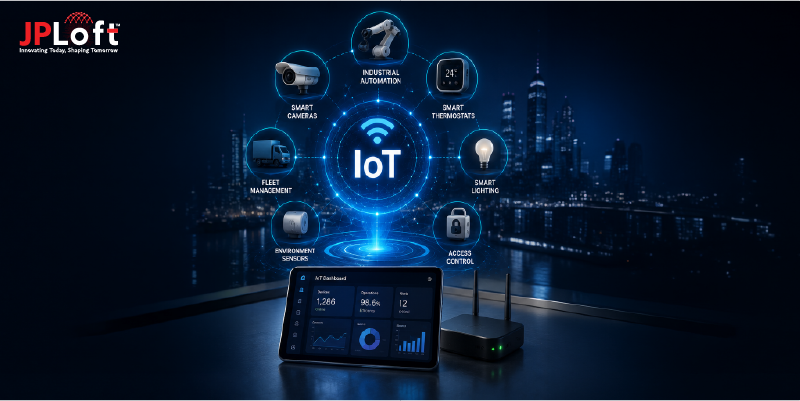
As technology grows, connected devices are becoming a big part of modern business systems across many industries worldwide. This shift has created a strong demand for IoT applications to connect devices and manage data in real time.
From smart homes to logistics tracking, IoT apps are changing how companies manage work and deliver services. So, if you want to create an IoT app, you must first understand how IoT apps work and which tools you need.
A clear idea of IoT application architecture helps you build a strong and scalable solution for long-term growth. This IoT app development guide will explain the complete process along with features, effective cost, and more.
What is IoT Application Development?
The IoT app development guide involves creating apps that connect smart devices and enable them to share data over the internet in real time. These apps help businesses control devices, track activity, and make faster decisions without manual work.
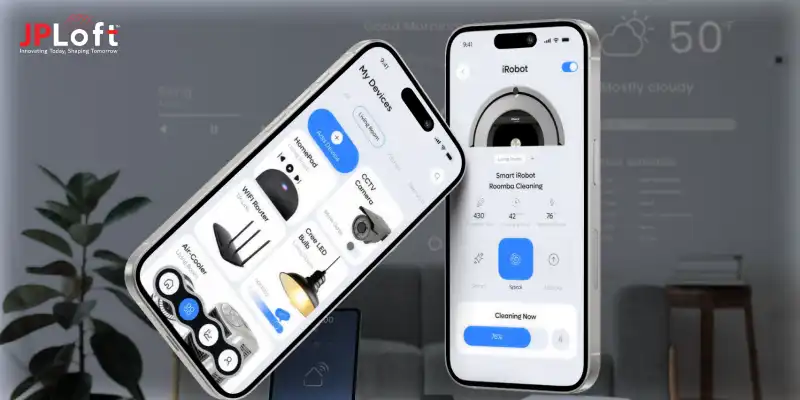
For example, a smart home app lets users control lights, fans, and security cameras from their phone. In the same way, companies use IoT mobile apps to monitor machines, track delivery vehicles, and improve daily operations easily.
How IoT Apps Work?
IoT apps follow a simple flow where devices collect data, send it to the cloud, and display it in a user-friendly app.
-
Devices collect data from the real world, like temperature, location, or movement, using sensors installed in machines or objects.
-
The collected data moves from devices to the cloud using networks like Wi-Fi, Bluetooth, or mobile data connections.
-
The cloud stores and processes data, making it useful for analysis, automation, and decision-making in real time.
-
The app simply shows data, letting users monitor devices, control actions, and get alerts instantly.
Types of IoT Apps & Their Use Cases
IoT apps are used in many industries to improve daily work, reduce manual effort, and make faster decisions using real-time data. Businesses use IoT applications to solve different problems based on their needs and industry goals.
Let’s understand better with the help of the table below:
|
Type |
Use Cases |
|
Smart Homes & Offices |
Control lights, fans, and security systems using mobile apps. Helps save energy and improve safety in daily use. |
|
Healthcare |
Track patient health using wearable devices and send real-time data to doctors for quick action and better care. |
|
Industrial |
Monitor machines, predict failures, and improve production efficiency using sensors and real-time alerts in factories. |
|
Logistics |
Track vehicles and shipments in real time, helping businesses manage delivery routes and reduce delays. |
|
Social Networking |
Connect smart devices with apps to share activity, location, and real-time updates with other users easily. |
|
Ecommerce |
Manage smart inventory, track products, and improve customer experience using connected devices and automation tools. |
|
Delivery |
Track orders, monitor delivery status, and improve route planning using IoT-enabled systems for faster service. |

Key Features of IoT Apps to Consider
IoT apps include several important mobile app features that help businesses manage connected devices. They also handle large amounts of data and improve overall performance with better control, faster actions, and smarter decision-making.
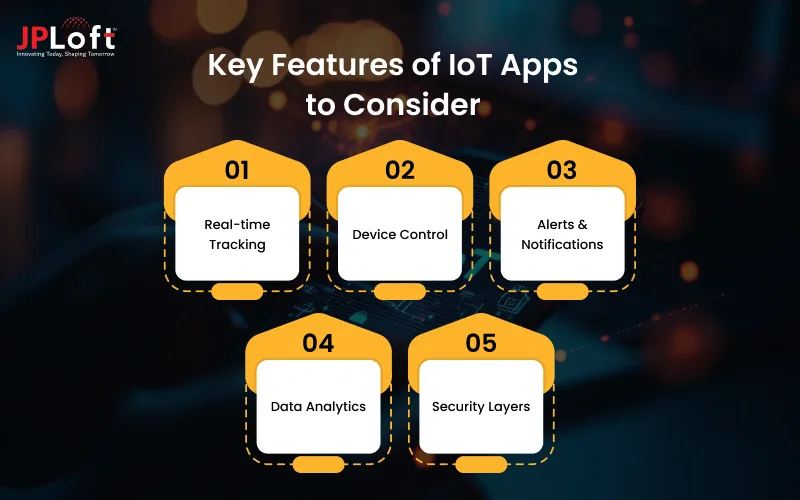
Here are some features discussed:
1. Real-time Tracking
Real-time tracking allows continuous monitoring of devices, assets, or systems without delays. It ensures that users always have access to the latest information.
This feature improves visibility across operations and helps businesses react quickly to changes, ensuring better control and improved efficiency in daily processes.
2. Device Control
Device control enables users to manage and operate connected devices directly through a centralized application interface.
It reduces manual work and allows remote access, giving businesses the ability to control multiple systems easily from a single platform.
3. Alerts & Notifications
Alerts and notifications keep users informed about important updates, system changes, or unusual activities in real time.
This feature helps businesses stay proactive by allowing quick responses to issues, reducing risks, and maintaining smooth operations.
4. Data Analytics
Data analytics processes collect data and turn it into meaningful insights that support better business decisions.
It helps identify patterns, improve performance, and optimize resources, allowing businesses to plan and grow more effectively.
5. Security Layers
App security layers protect data, devices, and communication channels from threats and unauthorized access.
This feature ensures safe data transfer, maintains system integrity, and builds trust by keeping sensitive business information secure.
Step-by-Step IoT App Development Process For Businesses
Building an IoT app requires a clear and structured approach to connect devices, manage data, and deliver smooth user experiences. Each step plays an important role in ensuring your app works efficiently and meets business goals.
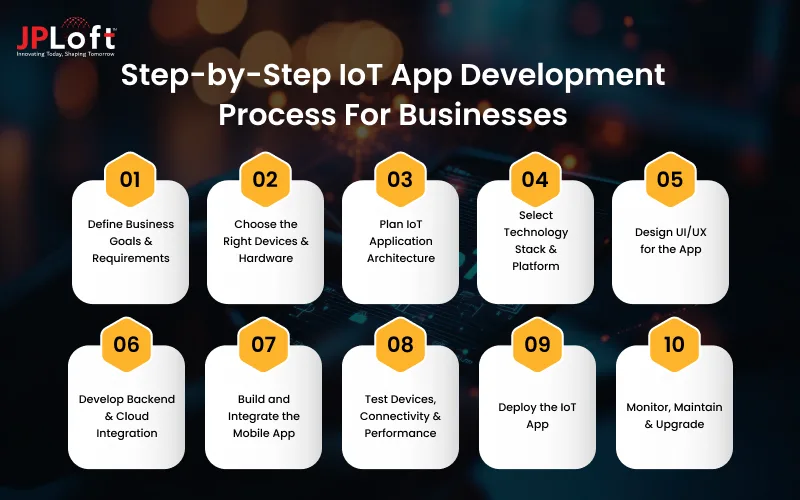
By following a step-wise process to build a mobile app with IoT technology, businesses can build scalable solutions that perform well in real-world conditions.
Step 1: Define Business Goals & Requirements
Start by identifying the main problem your IoT app will solve and the value it will provide to users. Define clear goals, features, and expected results for better planning.
Understanding user needs and business objectives helps avoid confusion during development. It also ensures your app delivers real value and supports long-term growth effectively.
Step 2: Choose the Right Devices & Hardware
Select devices and hardware based on your app’s purpose and required functionality. These include sensors, gateways, and other smart devices that collect and transmit data.
Choosing suitable hardware improves performance, reliability, and compatibility. It also reduces future issues related to maintenance, ensuring your IoT system works smoothly and efficiently.
Step 3: Plan IoT Application Architecture
Plan a clear IoT application architecture to define how devices, cloud, and apps will connect and share data. This includes system design, data flow, and integration methods.
A well-structured architecture improves scalability and performance. It also ensures smooth communication between components, allowing your app to handle growth and increase data efficiency.
Step 4: Select Technology Stack & Platform
Choose the right app technology stack, including programming languages, frameworks, and cloud platforms that match your app’s needs. This decision affects development speed and performance.
A strong tech stack supports scalability, security, and easy integration. It also helps your app adapt to future changes, making it more flexible and reliable for business growth.
Step 5: Design UI/UX for the App
Design a simple and user-friendly interface that allows users to interact with devices easily and understand data without confusion. Focus on clean layout and smooth navigation.
Good UI/UX improves user experience and engagement. It also helps users manage devices efficiently, making your IoT app more effective and easier to use for different users.
Step 6: Develop Backend & Cloud Integration
Build a strong backend system to handle data processing, storage, and communication between devices and the application. Integrate cloud services for real-time access and scalability.
This step ensures smooth data flow and system performance. It also helps manage large data volumes, allowing businesses to operate efficiently without delays or technical issues.
Step 7: Build and Integrate the Mobile App
Further, you can hire AI developers to develop the mobile app that connects users with devices and displays data in a simple and clear format. Ensure proper integration with backend systems and hardware components.
This step focuses on functionality and responsiveness. A well-integrated app ensures seamless communication, allowing users to control devices and access information without delays or errors.
Step 8: Test Devices, Connectivity & Performance
Test all components to ensure devices, cloud, and app work together without issues. Check connectivity, data flow, performance, and security features carefully.
Testing helps identify and fix problems before launch. It improves reliability and ensures the app performs well under different conditions, providing a smooth and stable user experience.
Step 9: Deploy the IoT App
Deploy the IoT app on selected platforms and connect it with cloud services and devices for real-world use. Ensure everything is set up correctly before launch.
A smooth deployment ensures users can access the app without issues. It marks the transition from development to actual usage, helping businesses start gaining value from the solution.
Step 10: Monitor, Maintain & Upgrade
After deployment, monitor app performance, device activity, and user behavior regularly. Fix issues, update features, and improve security when needed.
Ongoing maintenance ensures long-term performance and reliability. Regular upgrades help your app stay updated with new technologies and changing business needs, supporting continuous improvement and growth.
Custom IoT App Development Cost Breakdown in 2026
The cost to develop an IoT app in 2026 usually ranges between $20,000 and $300,000 or more, depending on features, complexity, and system requirements.
Basic apps with limited features cost less, while advanced apps with real-time data, cloud integration, and strong security need higher investment.
Factors like hardware selection, IoT application architecture, development team, and maintenance also impact the final app development cost. Businesses planning to build an IoT app should focus on long-term value instead of just initial cost to ensure better performance, scalability, and return on investment.
|
App Level |
Cost Range |
Description |
|
Basic IoT App |
$20,000 – $50,000 |
Includes simple features, basic connectivity, and limited device integration suitable for small-scale projects. |
|
Mid-Level IoT App |
$50,000 – $150,000 |
Offers advanced features, better UI/UX, cloud integration, and support for multiple devices and real-time data. |
|
Advanced IoT App |
$150,000 – $300,000+ |
Includes complex architecture, high security, AI integration, scalability, and enterprise-level performance. |
Challenges to Create an IoT App & Its Solutions
Building an IoT app comes with several challenges that can affect performance, security, and overall user experience if not handled properly. Understanding these app development challenges early helps businesses plan better and avoid costly mistakes during development and deployment.
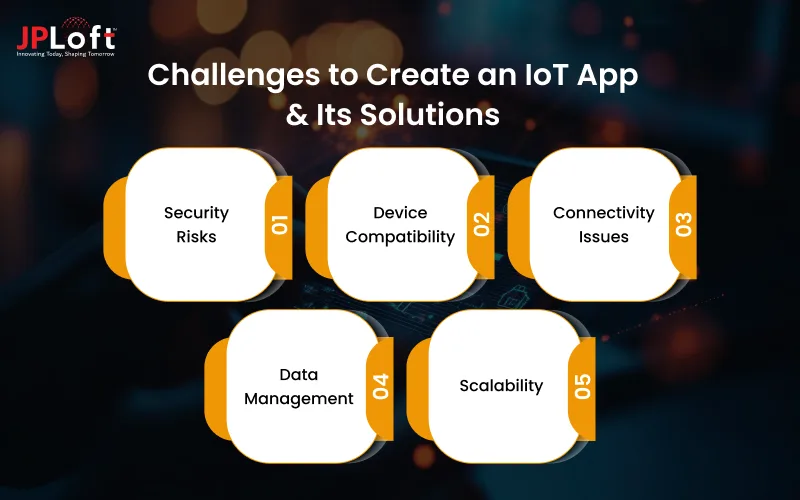
Challenge 1: Security Risks
IoT apps handle large amounts of sensitive data shared between devices, the cloud, and users. Weak security systems can lead to data breaches and unauthorized access.
As more devices connect, the risk increases and becomes harder to manage. Poor security can also damage user trust and business reputation over time.
Solutions:
-
Use data encryption for secure communication
-
Apply strong user authentication methods
-
Regularly update systems to fix vulnerabilities
Challenge 2: Device Compatibility
IoT systems include many devices with different hardware, software, and communication standards. This makes it difficult to ensure smooth integration across all devices.
Inconsistent performance can affect user experience and system reliability. Managing compatibility becomes more complex as the number of devices increases.
Solutions:
-
Use standard communication protocols
-
Test across multiple devices during development
-
Build a flexible and adaptable system architecture
Challenge 3: Connectivity Issues
IoT apps depend on stable internet connections for smooth data transfer between devices and systems. Poor connectivity can cause delays, data loss, or interruptions in communication.
This directly affects app performance and user experience. Reliable connectivity is important for real-time operations and consistent system behavior.
Solutions:
-
Optimize apps for low network conditions
-
Use reliable connectivity technologies
-
Enable offline data storage and syncing
Challenge 4: Data Management
IoT apps generate large volumes of data from multiple devices and systems continuously. Managing this data can become complex without proper tools and planning.
Poor data handling may slow down performance and affect accuracy. It also creates challenges in storing, processing, and analyzing useful information.
Solutions:
-
Use cloud-based data management systems
-
Filter and process only useful data
-
Implement efficient data storage techniques
Challenge 5: Scalability
As the number of connected devices grows, the system must handle more data and traffic efficiently. Without proper planning, performance may slow down or fail under increased load.
Scaling becomes difficult if the system is not designed for growth. This can limit future expansion and business opportunities.
Solutions:
-
Use a scalable cloud infrastructure
-
Design a flexible system architecture
-
Plan for future growth from the beginning
Tech Stack to Choose to Make an IoT Application
The IoT app tech stack includes the tools and technologies used to build, connect, and manage devices, data, and applications. Choosing the right stack is important for performance, security, and long-term scalability.
|
Layer |
Tools/Technologies |
Purpose |
|
Devices & Hardware |
Sensors, Microcontrollers, Raspberry Pi, Arduino |
Collect real-world data and send it to connected systems |
|
Connectivity |
Wi-Fi, Bluetooth, Zigbee, Cellular |
Enable communication between devices and cloud platforms |
|
Data Protocols |
MQTT, HTTP, CoAP |
Manage how data is transmitted between devices and servers |
|
Backend Development |
Node.js, Python, Java |
Handle server logic, data processing, and integrations |
|
Cloud Platforms |
AWS IoT, Microsoft Azure IoT, Google Cloud IoT |
Store, process, and manage large-scale IoT data |
|
Database |
MongoDB, PostgreSQL, Firebase |
Store structured and unstructured data efficiently |
|
Mobile App Development |
Flutter, React Native, Swift, Kotlin |
Build user-friendly mobile apps for device control |
|
Web App Development |
React.js, Angular, Vue.js |
Create dashboards for monitoring and managing IoT systems |
|
Security Tools |
SSL/TLS, OAuth, Encryption Tools |
Protect data and ensure secure communication |
|
Analytics & Monitoring |
Power BI, Google Analytics, IoT Dashboards |
Analyze data and track system performance |
Why Choose JPLoft to Develop IoT Apps?
JPLoft stands out as an experienced IoT app development company that delivers scalable and secure business solutions. Their team uses modern technologies and follows a structured approach to build high-performing IoT systems that support long-term growth.
They use advanced tools like AI, machine learning, and predictive analytics to turn data into useful insights and improve decision-making. Their expertise in cloud platforms such as AWS IoT, Microsoft Azure IoT, and Google Cloud ensures smooth connectivity and scalable performance.
JPLoft also leverages edge computing for faster processing and reduced delays, along with secure protocols like MQTT for reliable communication. Their development process includes real-time data processing, strong encryption, and device authentication to ensure complete system security.
With support for modern frameworks like Flutter, React Native, and Node.js, they build user-friendly apps with seamless integration. Their focus on innovation, security, and performance makes them a strong choice for the enterprise IoT app development process.
Conclusion
IoT apps are changing how businesses work by connecting devices, improving efficiency, and helping teams make faster decisions using real-time data. From smart homes to industrial systems, IoT application development is becoming an important part of modern business growth.
If you plan to build an IoT app, it is important to follow a clear process, choose the right technology, and focus on long-term scalability. Understanding the development steps, cost, and challenges helps you avoid risks and build a reliable solution.
As competition grows in 2026, businesses that invest in an IoT mobile app will gain a strong advantage in their industry. A well-planned approach to IoT app development guide not only improve operations but also enhances customer experience and overall performance.
Partnering with an experienced team can help you create an IoT app that is secure, scalable, and ready for future growth.
FAQs
The cost to develop an IoT app usually ranges from $20,000 to $300,000+, depending upon the complexity of the app, including features, tech stack, and more.
It usually takes 3 to 9 months to make an IoT app. The timeline depends on features, complexity, and integrations involved.
Common challenges include security risks, device compatibility, connectivity issues, data management, and scalability. These can affect performance if not handled properly.
Start with clear goals, choose the right tech stack, and focus on scalability and security. A proper IoT app development process ensures better results.
Key features include real-time tracking, device control, alerts, data analytics, and security layers for better performance and control.

Rahul Sukhwal is the CEO and Founder of JPLoft, with 18+ years of experience in software engineering, emerging technologies, and digital product development. His expertise spans artificial intelligence, including AI agents, generative AI, LLMs, chatbots, computer vision, and machine learning, as well as blockchain, IoT, AR/VR, mobile, web, and enterprise software. He focuses on applying these technologies to real business challenges across industries such as healthcare, education, mobility, finance, real estate, and on-demand services.



Share this blog