


Key Takeaways
The Taskrabbit business model operates as a two-sided marketplace connecting users with independent taskers through a digital system.
Mandatory in-app payments ensure secure transactions and consistent revenue collection.
In-app chat keeps communication centralized, improving trust and dispute resolution.
The Taskrabbit revenue model is transaction-based, earning primarily through commissions and service fees on completed tasks.
Building a similar app requires focus on matching logic, payments, and trust systems.
On-demand service platforms are reshaping how service businesses operate and scale. Instead of maintaining full-time staff for short-term or variable work, companies are adopting marketplace models that connect customers with skilled service providers in real time.
The global handyman service market is projected to reach $1.19 billion by 2032, highlighting strong and growing business potential.
Taskrabbit represents a scalable example of this model in action. It operates as a structured marketplace that efficiently connects service demand with independent taskers.
For business owners, startups, and enterprises planning to build a similar platform, studying what is Taskrabbit and how does it work is crucial. In this blog, we will discuss the entire functioning of the platform for better decision-making.
Overview of Taskrabbit
Taskrabbit is a platform that connects people who need help with tasks to taskers who can perform them. Instead of hiring full-time staff, customers can use the app to find taskers quickly and easily.
Taskrabbit focuses on everyday services such as furniture assembly, home repairs, moving help, cleaning, and other small jobs. From a business perspective, the Taskrabbit business model is a two-sided online handyman marketplace.
The business was launched in 2008 in Boston, and later its app was launched in 2011. Since then, the app has over 1M downloads on the Play Store with an average of 4.7 rating on the App Store.
This immense popularity encourages businesses to invest in such sectors. Moreover, the flexible business approach is also a reason to create a handyman app.
Taskrabbit Business Model: How Does it Work?
Taskrabbit works as a digital platform that manages the complete task-booking process between customers and Taskers. The handyman app business model is designed to reduce effort for both sides while keeping control within the app.
To understand the Taskrabbit working properly, we are dividing it into two sections. This structure closely aligns with best practices that balance user experience and backend control.
► How Does Taskrabbit Work For Users & Taskers?
This section explains how users and taskers interact with the application.
1. User & Tasker Onboarding
Taskrabbit starts by onboarding two different groups:
-
Users who need services
-
Taskers who provide services
Both create accounts through the app or website. Users add basic details, while Taskers build profiles that include skills, location, pricing, and availability. This onboarding flow depends heavily on the underlying handyman app tech stack.
Taskers also go through verification steps to improve trust. This structure helps ensure that only genuine participants enter the platform. However, this improves service quality and reduces future issues.
2. Task Creation & Service Browsing
Once registered, users can create a task by selecting a service category and adding details such as task size, location, and preferred date. Clear task categories help users describe their needs easily.
At the same time, Taskers can browse available tasks that match their skills. This organized task flow is supported by backend logic and API integration for handyman apps.
3. Tasker Discovery & Selection
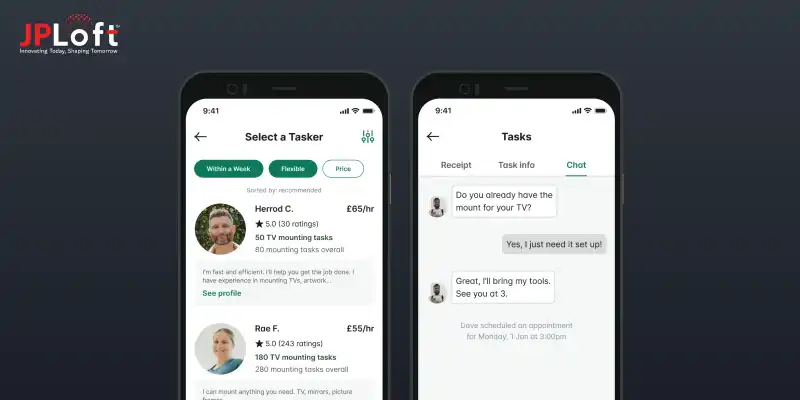
After a task is posted, users are shown a list of available Taskers. Each profile includes pricing, ratings, completed tasks, and availability. This visibility allows users to compare options before making a choice.
For Taskers, a strong profile increases booking chances. This transparent system builds confidence on both sides and increases the likelihood of successful task completion.
4. Booking, Scheduling & In-App Chat
Once a Tasker is selected, the task is booked through the platform. However, the scheduling is handled inside the app, reducing back-and-forth communication.
The in-app chat feature allows both sides to discuss details, ask questions, and share updates. You can also add voice integration in handyman apps to improve accessibility and reduce friction during communication.
5. Task Completion, Payment & Reviews
After the task is completed, payment is processed through the platform. Users are not allowed to pay outside the system. Both users and Taskers can then leave reviews and ratings.
This feedback system helps maintain service quality, rewards reliable Taskers, and guides future users when making decisions.
► How Does Taskrabbit Work at the Backend?
Behind the simple user experience, Taskrabbit runs on a complex system that manages operations, revenue, and trust at scale. So, you must design a handyman app that handles backend seamlessly. Here, we discuss its backend working in depth.
1. Marketplace Architecture & Role of the Platform
Taskrabbit operates as a two-sided marketplace. The platform does not perform tasks itself but controls how tasks are created, matched, completed, and paid for.
It sets rules, manages data, and ensures smooth interaction between both sides. This Taskrabbit business model allows it to grow without managing a direct workforce while still maintaining control over service standards.
2. Matching Logic & Data-Driven Decisions
Matching is one of the most important backend processes. The platform uses task details such as location, skill type, pricing range, and availability to suggest suitable Taskers.
Better matching reduces cancellations and improves completion rates. Over time, the platform learns from booking history, user behavior, and reviews to improve future matches and overall performance.
3. Payment Processing & Revenue Flow
All payments are handled within the platform. When a task is booked, the payment process is controlled by Taskrabbit. Service fees and platform charges are applied automatically before payouts are made to Taskers.
This system protects both parties and ensures that the platform earns revenue from every completed task. Centralized payments also reduce disputes and late payments.
4. Scheduling & Workflow Management
Taskrabbit manages scheduling through availability tracking and calendar integration. Taskers set their working hours, and users can only book within those time slots.
This reduces double bookings and last-minute cancellations. From a platform view, proper scheduling improves task flow, increases completed jobs, and supports better planning across cities and service categories.
5. Trust, Safety & Quality Control Systems
Trust is maintained through profile verification, ratings, reviews, and behavior tracking. Taskrabbit monitors task outcomes and feedback to identify poor performance.
Repeated issues can lead to limited visibility or removal from the platform. These controls are validated through processes similar to a handyman app testing guide. However, ensuring the marketplace maintains service quality at scale.
6. Support, Issue Resolution & Platform Oversight
Even with automation, issues can occur. Taskrabbit provides customer support to handle cancellations, payment problems, or service disputes. The platform tracks task communication and history to resolve issues fairly.
This support layer protects users and supports Taskers. Moreover, it also prevents damage to the reputation of the platform while maintaining an overall operational balance.
7. Scalability & Expansion Strategy
Taskrabbit is built to expand in cities, regions, and globally. Moreover, the Taskrabbit business model is in such a form that it adjusts pricing, availability, and service demand based on local conditions.
Backend systems support regional onboarding, location-based matching, and local compliance needs. These capabilities align with proven ways to scale your handyman app without rebuilding the system for every new market.
Taskrabbit’s success depends on keeping the front-end experience simple while managing complex systems at the backend.
Once you understand Taskrabbit’s business model, now is the time to discuss the key features associated with the app.
Key Features That Drive User Engagement & Revenue
A well-designed app includes features that keep users engaged while supporting steady revenue generation.
Below are some key handyman app features integrated into the Taskrabbit app that drive engagement and business growth.
1. In-App Messaging
This feature helps users and taskers to communicate directly within the application.
This reduces confusion, improves task clarity, and increases completion rates. The in-app conversations help the platform maintain control, trust, and service quality.
2. Payment Options
Multiple payment options make transactions smooth and convenient for users.
The mandatory in-app payment system reduces late payments while allowing the platform to charge service fees easily. Moreover, it ensures steady revenue collection for the business.
3. User Registration
An easy user registration process helps onboard both customers and taskers securely.
Verified profiles improve trust and reduce fake accounts. However, registration data also helps track user behavior and improve services through insights.
4. Task Posting & Browsing
Clear task details improve matching accuracy, reduce disputes, and increase booking success.
Moreover, increased posted tasks mean high platform activity and revenue opportunities.
5. Tasker Matching
Smart tasker matching connects users with suitable taskers based on skills, location, availability, and pricing.
Better matches improve task success rates and user satisfaction. However, accurate matching leads to repeat usage and stronger marketplace performance.
6. Rating & Review
Ratings and reviews help maintain service quality by allowing users to share feedback after task completion.
This system builds trust, rewards reliable service providers, and filters poor performance. Strong review systems increase platform credibility and support long-term user retention.
7. Calendar Integration
Calendar integration helps taskers manage availability and avoid scheduling conflicts.
Accurate scheduling reduces cancellations and delays, improving overall task completion rates. For businesses, this feature increases operational efficiency.
8. Marketplace
The marketplace structure brings users and taskers together in one organized platform. It supports discovery, pricing control, and service comparison.
A strong marketplace increases network activity, creates repeat transactions, and enables the platform to scale revenue.
9. Geolocation
Geolocation helps match tasks with nearby service providers, reducing travel time and improving service speed.
Location-based matching increases task acceptance rates and user satisfaction. For the business, this feature improves efficiency while supporting expansion strategies.
Considering these features and top handyman app trends helps investors build a platform with great revenue streams.
Taskrabbit vs Other Gig Economy Platforms
Taskrabbit works in the broader gig economy but follows a more structured and service-focused approach compared to others.
While top handyman apps like Handy and Yelp also connect users with service providers, Taskrabbit does it differently.
Taskrabbit manages service delivery, platform control, and revenue generation. However, this different Taskrabbit business model makes it easier to scale and monetize.
A. Taskrabbit vs Uber/Lyft
Ride-hailing platforms like Uber and Lyft are built around instant transportation needs. Their services are time-sensitive, high-frequency, and limited to a single category.
Taskrabbit works differently by supporting schedules, task-based services that require skill matching and planning. However, this allows it to offer a wide range of services and generate higher revenue per booking.
B. Taskrabbit vs Yelp
Platforms like Yelp primarily help users find local service providers through business listings and reviews. However, it does not manage booking, payments, or task completion.
Taskrabbit goes beyond discovery by controlling the full service journey. This gives the platform better visibility into service quality and allows it to earn revenue directly from completed tasks.
C. Taskrabbit vs Handy
Home service marketplaces such as Handy operate in a similar space. They often focus on a limited set of services like cleaning or maintenance.
Taskrabbit has a larger marketplace structure that supports many service types under one platform. This flexibility helps increase repeat usage and allows it serve both users and taskers.
D. Business Takeaway
Taskrabbit’s business model stands out by combining service discovery, execution, and payment into one system. It has a transaction-based revenue model, a wider service range, and stronger platform control.
However, this makes it a more complete and scalable gig economy model. For businesses, this approach offers useful insights into building a platform that supports growth, quality control, and long-term value.
Taskrabbit Revenue Model Breakdown
The Taskrabbit revenue model is transaction-based, where income is generated when the task is completed. Instead of relying on ads or fixed subscriptions, the platform earns by managing the service flow.
Let’s discuss in detail:
1. Surge Pricing
Taskrabbit generates revenue through peak or surge pricing.
When demand for certain services is particularly high, the platform may increase prices for those tasks.
Customers who are willing to pay more during busy periods help the platform balance supply and demand.
2. Advertising & Promotions
Another way how the Taskrabbit app earns money is through advertising and promotions.
Taskers who want more visibility in search results or appear above others can pay additional fees.
These charges not only help Taskers get more bookings but also create an extra revenue source for the platform.
3. Trust & Support Fees
Taskrabbit revenue model also involves a trust and support fee for each booking.
These fees are typically calculated as a percentage of the task cost, which is charged to customers.
The fees ensure that both customers and taskers can rely on secure interactions, quality checks, and help from the platform when needed.
4. Commission Fees
The commission fee is the primary way Taskrabbit generates revenue on every completed task.
Whenever a customer books a service, Taskrabbit collects a percentage of the total amount paid to the service provider.
This commission forms the main income stream and helps cover operational costs.
In summary, these are some ways how the Taskrabbit app earns money. Now, you must choose a trusted mobile app development company that will help you build an app like Taskrabbit.
Legal Considerations & Compliance for Apps Like Taskrabbit
Building an on-demand platform like Taskrabbit requires careful attention to legal and compliance needs.
Businesses must consider building such platforms, but they need to look after some handyman app development challenges. Let us discuss some points that will help us understand easily.
► Gig Worker Classification
Apps like Taskrabbit must clearly classify service providers as independent contractors, not employees.
This requires proper contracts, clear role definitions, and platform rules that avoid direct control over work.
Correct classification helps prevent legal disputes, penalties, and compliance issues related to labor laws.
► Data Privacy Laws
On-demand apps collect personal, location, and payment data from users and taskers.
Platforms must comply with data privacy laws like GDPR and local regulations.
This includes secure data storage, user consent, transparent privacy policies, and protection against data breaches to build trust and avoid fines.
► Payments & Taxation
Handling in-app payments requires compliance with payment gateway rules, tax reporting, and financial regulations.
Platforms must manage service fees, commissions, and invoices properly. Clear payment flows help reduce disputes, ensure accurate tax calculations, and meet local taxation requirements.
► Regional Requirements
Legal rules vary by country, state, and city. Apps must follow local service laws, permits, pricing regulations, and consumer protection rules.
Adapting the platform to regional requirements helps ensure smooth expansion and avoids legal barriers when entering new markets.
► Liability & Insurance
Platforms must define liability clearly for task-related damages or accidents. Terms and conditions should outline the responsibilities of users and taskers.
Many apps also require taskers to carry basic insurance, reducing risk for the platform and improving trust among users.
However, going through these points will help you know why a handyman startup fails at scale. Thus, you can easily prevent yourself from making such mistakes.
How can JPLoft Help you Develop an App Like Taskrabbit?
The Taskrabbit’s business model is the reason for the rise of business globally.
However, building an app like Taskrabbit requires more than just an app interface. It needs a strong system that manages users, taskers, bookings, and payments, all in one.
JPLoft helps businesses design and develop such platforms with a clear focus on real business needs. We are a handyman app development company and work closely with clients to understand their service model and revenue goals.
The team helps plan the full app flow, including user onboarding, task posting, smart matching, and much more.
From a technical side, JPLoft focuses on scalable architecture, data security, and performance.
With experience in building marketplace-based applications, JPLoft supports businesses from idea validation to launch and future upgrades. Moreover, helping turn complex service concepts into reliable digital platforms.
Conclusion
Taskrabbit shows how an on-demand service platform can succeed by combining a simple user experience with a well-managed system behind the scenes. Its business model is built around connecting service demand with skilled providers while keeping control over matching, payments, quality, and trust.
By managing the full service journey, Taskrabbit can generate steady revenue through service fees, commissions, and business partnerships rather than relying on ads or fixed subscriptions.
For businesses and startups, studying Taskrabbit’s business model, feature set, and revenue structure offers clear insight into what it takes to build a scalable marketplace.
Overall, Taskrabbit serves as a practical example of how technology can organize service-based work efficiently. Hence, making it a useful reference point for companies planning to build similar on-demand platforms with long-term business value.
FAQs
The cost to develop an app like Taskrabbit usually ranges from $20,000 to $100,000, depending on the app's complexity and features integrated.
Taskrabbit app make money by taking a small fee from each task. They charge Taskers a percentage of their earning. However, some apps also make money from cancellation fees and business deals.
An app like Taskrabbit must have:
User sign-up
Tasker profile creation
Task posting and booking
Rating & reviews
In-app chat
Safe online payments
Customer support
These features help users trust the app and use it often.
Taskrabbit uses a two-sided marketplace model. It connects people who need help with people who want to work. However, Taskrabbit does not hire workers; it earns money by helping both sides meet and complete tasks.
To build a gig app like Taskrabbit, you need to:
Study the market and user needs
Choose the right features
Design an easy-to-use app
Add secure payment options
Launch and improve the app over time
Working with an app development company can make this process easier.

Kris Jacobs brings 20+ years of experience solving complex digital product challenges through strategic thinking and user-centric design. With deep exposure to on-demand services, entertainment, travel, and interactive platforms, she collaborates across teams to shape scalable, engaging solutions that align business goals with intuitive user experiences across evolving digital landscapes.



Share this blog