


Key Takeaways:
AI improves music recommendations by analysing listening behaviour and continuously learning user preferences for personalised suggestions.
Original songs, beats, and lyrics can be created using advanced generative technology across various music genres.
Successful implementation depends on balancing user privacy, copyright compliance, and innovative experiences.
Partnering with JPLoft ensures expert implementation, scalability, security, and a seamless user experience.
AI-powered music apps stay competitive by evolving recommendations, adding smart features, and adapting to user feedback.
You sing a song for three seconds, and your phone finds it in less time than it takes to blink. That is not magic. That is AI in music apps working quietly in the background.
A few years ago, music apps just played songs. Now they learn your taste, predict your mood, and even help create new tracks.
This shift did not happen overnight. It came from years of small updates that added up to something big.
Today, AI in music industry trends is moving faster than ever. Apps are adding smarter recommendations, voice search, and tools that let anyone create music without training. Streaming giants and startups alike are racing to keep up.
This guide breaks down the role of AI in music apps in 2026 and a lot more.
Overview of AI in Music Apps
Artificial Intelligence in music apps simply means using the technology to make music platforms smarter. It helps apps understand what you like, predict what you want to hear next, and even create new sounds.
Think of it as a helpful assistant working behind the scenes. It studies your listening habits, then uses that data to shape playlists, suggest songs, and improve search results.
The growth here is hard to ignore. The global market for AI in the music industry is expected to grow from $1.7 billion in 2026 to $4 billion in 2031, at a CAGR of 18.7%.
However, the global generative AI in music market is growing exponentially and is expected to grow from $570 million in 2026 to $1.34 billion by 2030.
Moreover, Artificial intelligence in music apps is no longer limited to big players like Spotify or Apple Music. Independent developers and startups are building AI-first products from scratch, often focused on a single feature done exceptionally well.
How AI is Revolutionizing Music Apps?
AI in music apps is not just a passing trend. It is shaping the future that many in the industry have been waiting for.
Understanding the benefits of artificial intelligence helps you grasp where the market is heading and what decisions to make around it.
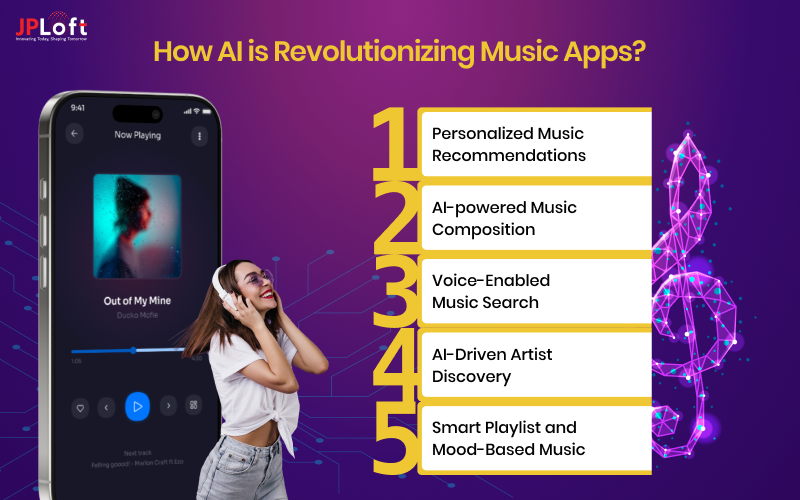
1. Personalized Music Recommendations
AI has changed how users discover new music, creating experiences that go far beyond a basic playlist.
People once searched for new songs manually. Today, AI-powered music apps study past interactions, search history, and favorite artists to offer tailored recommendations that save time and feel personal.
Personalized recommendations remain one of the biggest drivers of AI across industries, and music is no different. This growing demand is also why more businesses want to create an AI app or add AI features to their own app.
2. AI-Powered Music Composition
Human artists have always led the way in music. Now, AI is stepping in as a creative partner.
Some apps use AI to help artists build tracks from scratch, generating beats, lyrics, and even full compositions. AIVA is one strong example, letting users generate music in over 250 styles.
Anyone following the latest music app trends will notice this space growing fast. The future of music production is shifting, and AI is driving that shift forward.
3. Voice-Enabled Music Search
Apps like Spotify and SoundCloud are changing how people interact with music every day.
Instead of typing or scrolling, users can now find a song with a simple voice command. This convenience is a direct result of AI in music streaming apps working behind the scenes.
Voice search is no longer a nice-to-have feature. It is becoming essential for platforms that want to stay competitive in a hands-free world.
4. AI-Driven Artist Discovery
AI does more than serve listeners. It also drives innovation in how new artists get discovered.
By identifying emerging talent and matching it to the right audience, AI improves music discovery across apps. This gives platforms a real opportunity to support new artists while keeping their content library fresh.
Many common music app challenges around discoverability are solved this way, helping platforms stay relevant to users over time.
5. Smart Playlists and Mood-Based Music
AI takes personalization further by curating playlists based on mood, time of day, or current activity.
By detecting genre and emotional tone, AI serves the right songs at the right moment. Mood-based playlists tend to be highly shareable, which helps apps grow through word of mouth.
This kind of personalization does come at a cost. Building it well can raise the cost to develop a music app, but most platforms see it as a worthwhile investment.
The benefits of AI in music applications are hard to overlook. To truly compete in this space, though, it helps to understand the technology working behind the scenes.
The Shift Toward AI-Generated Music: Labeling and Disclosure
As AI-generated songs become more common, the music industry is pushing for more transparency. Listeners want to know when a track was made by a human, an AI, or both.
Groups like the RIAA and IFPI are now urging major platforms to label AI-generated content clearly. Spotify and Apple Music have started testing systems that flag AI involvement in a track.
This shift matters for the AI in music industry as a whole. Trust between artists, platforms, and listeners depends on knowing where the music actually comes from.
For music apps, this means labeling features may soon become a standard requirement, not just an option.
Text-to-Song Generation Goes Mainstream
Typing a few words to get a full song was once a novelty. In 2026, it is becoming a real feature inside music apps.
► Suno and Udio Lead the Way
Tools like Suno and Udio let anyone type a prompt and get a complete song with vocals, instruments, and structure. No musical training is needed to use them.
► Google's Lyria 3 Enters the Space
Google added text-to-music generation through Lyria 3, bringing this capability into a more mainstream, widely trusted platform. This move signals that big tech now sees the feature as ready for everyday users.
► What This Means for Music Apps
More apps are expected to add similar text-to-song tools in the coming months. This gives users a new way to create, not just consume, music inside the same platform.
Key AI Technologies Used in Music Apps
Behind every smart feature in a music app, there is a specific technology doing the heavy lifting. Understanding these helps make sense of how AI in music apps works.
A. Machine Learning
Machine learning is the foundation of most AI features in music apps. It studies listening patterns over time and gets better at predicting what a user wants to hear next.
This is what powers recommendation engines, smart playlists, and personalized home screens across nearly every major platform today.
B. Natural Language Processing
Natural language processing, or NLP, helps apps understand human language. It is the technology behind voice search and text-to-song prompts.
When a user speaks a command or types a request, NLP breaks down the meaning and turns it into an action the app can perform.
C. Generative Models
Generative models, including transformers and diffusion models, are what actually create new music. These models learn patterns from massive amounts of existing music, then use that knowledge to generate original tracks.
This is the technology running behind tools like Suno, Udio, and AIVA. However, businesses partner with a trusted Gen AI development company to create AI-powered music streaming apps that can now produce full songs from a simple prompt.
D. Audio Signal Processing / Neural Audio Synthesis
Audio signal processing allows an app to actually "hear" and analyze sound. It separates vocals from instrumentals, removes noise, and improves audio quality.
Neural audio synthesis takes this further, generating realistic, natural-sounding audio instead of something that sounds robotic or artificial.
E. Adaptive & Emotion-Aware Analytics
This is one of the newer additions shaping AI in mobile music apps. Instead of relying only on past listening history, adaptive analytics use real-time signals like time of day, activity, or mood to adjust music on the fly.
Some apps are even exploring biometric data, such as movement or heart rate, to make music feel more in sync with how a user actually feels in the moment.
Together, these technologies form the technical base of modern music apps. Choosing the right combination often depends on the platform's goals, which is closely tied to the right music streaming app tech stack.
How to Develop An AI-Powered Music App?
AI app development is at an all-time high, and leveraging AI is no longer optional. It has become essential for any music platform that wants to stay competitive.
If you want to build a music app with AI integration, this guide covers exactly what you need to know.
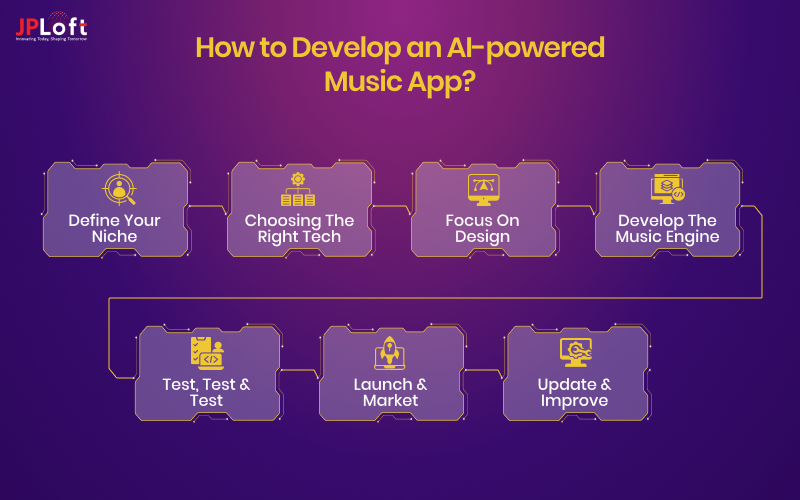
Step 1: Define Your Niche
Before writing a single line of code, decide what makes your app different.
Will it focus on music discovery, or will it help users create music using AI? Some apps are becoming a hub for producers, offering tools to generate AI-assisted beats.
Whatever direction you choose, make sure it stands out. AI is reshaping the music and machine learning space, giving you a real chance to change how people engage with music.
Step 2: Choose the Right Technology
One of the best parts of building in this space is the range of app tech stack options available.
You could use natural language processing to enable voice control, so a user can simply say "play this track" and the app responds. Or you could use deep learning to analyze listening habits and build playlists that evolve.
Think of AI in music app development as the core of how your app improves, not just a one-time feature. This is where artificial intelligence and music truly come together.
Step 3: Focus on Design
An app is not just about technology. User experience matters just as much. Start with a solid prototype and app wireframe to keep the design smooth and aligned with what users actually need.
Expert UI/UX design services become even more important once AI is involved, since users should be able to reach any feature without friction.
Make sure your app also integrates smoothly with other platforms. This kind of user-centered design helps you get an app that keeps users engaged over time.
Step 4: Develop the Music Streaming Engine
Now it is time to build the core of your app.
AI can improve streaming quality in real ways, from reducing buffering to optimizing audio delivery based on user preferences. Predictive algorithms also help ensure users keep discovering fresh tracks.
With the right AI tools, your app could even let users generate custom tracks or remixes, turning any listener into a next-gen DJ.
Step 5: Test, Test & Test
Testing your app thoroughly is one of the most important steps before launch.
Check that every AI feature works as expected, the interface stays intuitive and bug-free, and the app performs well across devices.
Most importantly, gather user feedback early so you can fix issues before they reach a wider audience.
Step 6: Launch & Market
Once everything is ready, it is time to launch. A great app still needs great marketing to succeed.
Highlight how your app uses AI to deliver personalized experiences. Show how machine learning predicts user taste, and how AI-based music apps like yours help people discover new genres.
When you are ready, submit your app on the App Store or publish it on the Play Store to reach a global audience.
Step 7: Update & Improve
AI keeps evolving, and your app should too.
Keep listening to user feedback, and update your app regularly with new AI-driven features and smarter recommendations. Staying current with music app maintenance keeps users engaged and excited about what comes next.
With the development process covered, let's look at the challenges that come with building an AI music app.
Challenges of Implementing AI in Music Apps & Its Solutions
While AI in music applications opens up a world of possibilities, building one is not without hurdles. From handling sensitive data to balancing automation with genuine creativity, developers face real obstacles along the way.
Whether you are creating a new AI music app or improving an existing one, here are some top challenges in music apps you are likely to face, along with how to address them.
Challenge 1: Data Privacy Concerns
AI is used in music apps by collecting personal data, including listening habits, search history, and preferences. Without this data, personalization simply does not work. But collecting it also raises real privacy concerns among users.
Solution: Stay compliant with privacy laws like GDPR and CCPA, and be transparent about what data is collected and why. Clear privacy controls go a long way in building the kind of trust needed for AI-based music apps to succeed.
Challenge 2: Copyright and Licensing Issues
Whether AI is generating original tracks or powering recommendations, it must operate within copyright law. This gets complicated fast, especially as AI-generated music blurs the line around ownership and originality.
Solution: Work with legal experts early in development, not after launch. Set clear licensing terms for any AI-generated content, and stay updated on evolving regulations around AI and music rights.
Challenge 3: Balancing Human Creativity with AI
The AI in music industry offers powerful capabilities, but AI still lacks the emotional depth and nuance that human composers bring to their work. Over-relying on automation can make music feel generic.
Solution: Hire AI developers to position AI as a creative assistant, not a replacement. Let it handle repetitive or data-heavy tasks, while leaving core creative decisions to human artists and producers.
Challenge 4: Algorithmic Bias and Filter Bubbles
AI recommendation systems can unintentionally favor popular tracks or familiar genres, trapping users in a narrow listening loop instead of encouraging real discovery.
Solution: Build in intentional diversity, such as surfacing new artists or genres outside a user's usual pattern. Regularly audit recommendation models to check they are not reinforcing the same narrow results over time.
Challenge 5: High Development and Integration Costs
Building AI features like recommendation engines, generative tools, or adaptive analytics requires specialized talent and infrastructure, which can significantly raise the cost to develop a mobile app.
Solution: Start with core AI features that offer the most value, then expand gradually. Using pre-built AI models or APIs early on can also help manage costs without slowing down development.
Overcoming these challenges takes planning, but it is what separates a successful AI-powered music streaming app from one that struggles to gain user trust.
Why Partner with JPLoft for AI Music Apps?
Building an AI-powered music app takes more than just good ideas. It takes the right technical expertise, a clear product strategy, and a team that understands where the music industry is headed.
At JPLoft, our music app development services are built around exactly that. We combine deep experience in AI, machine learning, and a clean development process to help you create a platform that stands out in a crowded market.
From personalized recommendation engines to voice search, generative music tools, and adaptive analytics, our team knows how to bring advanced AI features into a smooth, user-friendly app.
Whether you are building a new AI music app from scratch or adding AI capabilities to an existing platform, JPLoft has the experience to guide you through every stage of development.
Conclusion
AI in music apps has moved far beyond simple recommendations. It now shapes how songs are discovered, created, and even labeled, changing the entire listening experience along the way.
From personalized playlists and voice search to text-to-song tools and adaptive analytics, this guide covered how AI-powered music streaming apps are transforming the industry in 2026.
We also looked at real challenges, including privacy, licensing, and cost, and how developers can solve them along the way.
One thing is clear. The role of AI in music industry is not slowing down, and platforms that adapt early will have a real advantage.
Whether you are building your first AI-based music app or upgrading an existing one, understanding these trends is the first step toward long-term success in a fast-changing market.
FAQs
AI employs machine learning algorithms to scan your listening history and tastes, making music suggestions from the information.
The AI becomes more intelligent over time, adjusting the suggestions to better fit your tastes.
Yes, AI can create music. There are apps such as AIVA that employ AI to create original music, generating beats, lyrics, and even complete tracks in different genres.
This has made AI a useful asset for artists and music producers alike.
The biggest challenges are data privacy issues, copyright and licensing problems, and balancing human creativity with AI capabilities.
Making sure that user information is secure and that the app is in line with copyright regulations is vital to creating a successful AI music app.
A development company has the expertise required to implement AI properly into your music app.
They assist with technical issues, user interface design, security, and scalability to make your app competitive in a crowded market.
By continuously improving the AI capabilities in your app, including enhancing music suggestions, investigating new ways of discovering artists, and providing innovative features like mood-based playlists or voice searches.
Keeping up with the latest developments in AI and user feedback is essential to remain competitive.

Rahul Sukhwal is the CEO and Founder of JPLoft, a visionary technologist with 18+ years at the forefront of emerging tech innovation and software engineering. He channels deep software engineering and AI expertise into building smarter, scalable solutions that shape how forward-thinking businesses worldwide harness the true power of AI.


Share this blog